

Review
Review: Icicles No. 8
The most widely stocked glass series in Swedish stores — 17.8 cm and 90 days’ warranty.
29 July 2026
Review · Glass dildo · Curved G-spot wand
Dream Toys double-ended glass wand reviewed against the manufacturer’s own specifications and price data from four Swedish stores. Borosilicate glass as the only material, 17 centimeters in length, 3.3 centimeters largest diameter, IPX7 and zero electronics — but also two contradictory diameters in the manufacturer’s own records, no published warranty period and no net weight.
A curved, double-ended G-spot wand made of borosilicate glass with not a single electronic component. The material is the category’s most durable: non-porous, tough against all lubricants, suitable for temperature play, and without a best-before date. The shape gives two different pressure patterns in the same product. What you pay for is brittleness: a completely omitted warranty period, and manufacturer documentation that states two different diameters and two different recommended prices for the same article number.
Glamour Glass Curved Wand is a double-ended wand in borosilicate glass from Dream Toys. It has no battery, no motor, no buttons, and nothing to charge. The entire product consists of a single material, and the only moving part is your own hand. That makes it one of the few products in the category where the specification can actually be seen at a glance on a screen height — and where every line that’s missing is therefore clearly visible.
The specification looks like this: 17 centimeters total length, 3.3 centimeters largest diameter, borosilicate glass as the only material, an IPX7 ingress protection rating according to the manufacturer’s product page and expressly no battery operation. The manufacturer’s article number is 21835 and the suggested retail price is stated as 36.99 euro on the product page. In Sweden, the item is sold by four stores at prices between 199 and 399 SEK, and three of them had it in stock at the price check on July 29, 2026.
This review is exclusively about the smaller of the two models in the series, the one with EAN 8720365100703. Dream Toys also sells a larger variant, Glamour Glass Curved Big Wand, which has the article number 21836 and EAN 8720365100710. The two have almost the same name, they look the same in pictures, and are regularly mixed up in Swedish stores. Check the number before you pay—the difference between them is four centimeters in length and half a centimeter in diameter, which is a significant difference for a product of this type.
The Dreamtoys brand is owned by the Dutch wholesaler Tonga BV, and it is Tonga that publishes the product data. It’s worth knowing because it means there are three parallel official documents for the same item: the brand’s consumer page, the wholesaler’s B2B product page, and a sales flyer in PDF format. The three don’t quite say the same thing, and those differences are listed further down.
Borosilicate glass is also called hard glass. The manufacturer describes it as glass made from silicon dioxide combined with boron trioxide, a composition that makes the material significantly more resistant to sudden temperature changes than regular glass. Dream Toys also points out that borosilicate glass is both stronger and lighter than ordinary lime-soda glass, and that’s precisely why practically all modern lab glassware equipment and a large part of medical device equipment are made from it.
This isn’t a marketing phrase but a material-technical description that can be verified. Adding boron lowers the glass’s coefficient of thermal expansion, and it’s that property that makes the material able to handle temperature differences without cracking. For a product that is explicitly marketed for temperature play, it’s the single most important property in the entire specification—ordinary glass placed in the freezer and then brought against body-warm skin is exposed to exactly the kind of stress that borosilicate is designed to handle.
The second property that comes with the material is that it is non-porous. The manufacturer formulates it as: that the glass is “very strong, non-porous, hygienic and safe for the body”. A non-porous surface can be cleaned, because there are no microscopic cavities where residue can get trapped. It is the single most important property of a material that is meant to lie against mucous membrane, and that is why the material declaration weighs more than almost all other lines in a specification.
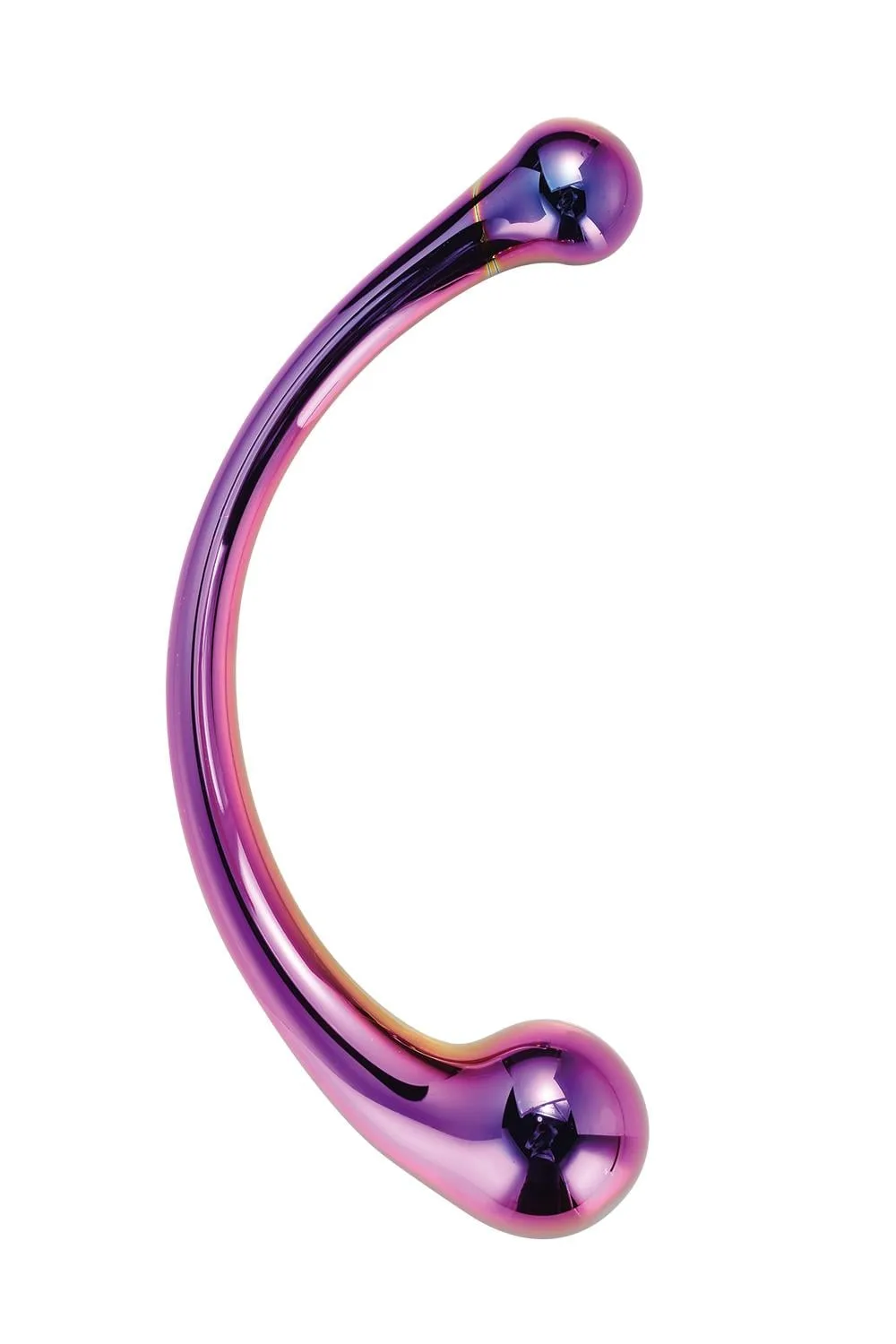
The manufacturer lists five properties for the model: glass rod, double-ended, good for G-spot stimulation and variation in pressure, suitable for temperature play, and made from body-safe and hygienic borosilicate glass. That description is brief, but it says something concrete about the construction, and it is confirmed by the manufacturer’s own product images: the rod is a single bend, roughly a half circle, with a ball-shaped end in each direction.
The point of having two ends is that they have different sizes. Joyland, the retailer, is the store that describes it most clearly and states that the ball-shaped tips are different sizes in order to provide variation. In practice, that means that one and the same product provides two different pressure patterns without you having to buy two things: the larger end spreads the pressure over a wider area, the smaller one concentrates it. Swapping the product and switching the end is free, unlike switching the stimulation tip on an air pressure product.
The bend has a different function than the shape of a straight dildo. A curved rod with the center of gravity at the ends allows you to apply pressure to the front vaginal wall by angling the handle instead of pushing the product forward. What can be established is that the entire category of curved G-spot rods — from Dream Toys’ own series to njoy’s Pure Wand in steel — is built on the same geometric idea, and that the material rather than the bend determines weight, temperature behavior, and price.
Adult also states that the rod is suitable for both vaginal and anal penetration. That information is not found with the manufacturer, which neither states nor advises against anal use for this item. That is a store claim and should be read as a store claim — but it is relevant, because a product with two ball-shaped ends and no base requires no overthinking when used anally. More about that further down.
The material question is the only characteristic of an intimate product that can’t be compensated for with experience or care, and it determines whether the product is still hygienic after ten years. The manufacturer lists a single material for the Glamour Glass Curved Wand: borosilicate glass. No silicone, no ABS plastic, no coating, no metal inlay. So there is no seam anywhere on the product, and it is a real difference from almost all vibrating alternatives, where the boundary between a silicone housing and a plastic handle is the place where residue collects first.
A non-porous material doesn’t let liquids seep into the surface. That means the product can be cleaned completely instead of only being cleaned on the surface, and that it doesn’t build up a biofilm over time the way soft, porous materials do. The consequence is that the material has no best-before date. Silicone ages slowly, TPE ages quickly, but glass is chemically stable and looks the same after ten years as it does after ten days—provided it isn’t dropped on the floor.
The color deserves its own note here, because it’s one of the few pieces of information where the manufacturer makes a technical commitment instead of an estimate. Tonga explicitly states that the colors are not an external layer on the glass but embedded in the material, and that’s why they can’t be worn off. It’s a significant difference compared with lacquered or metallized products, where a surface layer can peel and where peeling is both a hygiene problem and a material problem. The color specification in the manufacturer’s records is Multicolor; Joyland describes it instead as shimmering purple and Intima as holographic.
An adult also adds the information that the wand is hand-blown. That claim isn’t found in any of the manufacturer’s three documents—neither on the consumer page, in the B2B register, nor in the sales brochure—and should therefore be read as a store claim. The manufacturer lists only the material and the country of origin, China.
Phthalates are a group of plasticizers used to make plastic—especially softened PVC—flexible. The Kemikalieinspektionen describes them as substances that can affect the hormone system and make reproduction more difficult, and several of them are therefore restricted or prohibited within the EU in a large number of products. This product category is repeatedly subject to supervision because it often contains soft plastic against the skin.
Glass requires no plasticizers at all. The material’s properties come from its chemical composition and not from additives, and that’s why the question of phthalate content is, in practice, not applicable to a product that consists of glass only. Still, the manufacturer labels the manual’s front page with the symbol “PHTHALATE FREE,” which is correct but actually self-evident for the material.
What makes the material specification valuable, then, is not that phthalates are excluded, but that the specification is unambiguous. “Borosilicate glass” is a material designation that means the same thing regardless of the manufacturer, unlike labels such as “TPE” or “jelly rubber” that say nothing at all about which plasticizers are included. Here, however, it’s possible to note a discrepancy in the retail channel: Joyland and Intima list the material only as “Glass,” while the manufacturer, Blush Me and Vuxen, list borosilicate glass. The manufacturer’s specification applies—but someone who only reads Intima’s or Joyland’s specification table gets less information than someone who reads the manufacturer’s.
The manufacturer lists the length as 17 centimeters. That figure is consistent in all three official documents and is also confirmed by three of the four stores. The diameter, however, is not consistent. Dream Toys’ consumer page and the manufacturer’s sales brochure both state 3.3 centimeters, while Tongа’s own B2B register lists 3.5 centimeters for the same item number. Two millimeters may sound marginal, but on a product whose entire function is built around the circumference, those two millimeters are noticeable—and, above all, it’s a sign that the manufacturer’s own registers are not fully synchronized. This review is based on 3.3 centimeters, because it’s the figure that appears on both the consumer page and the sales brochure, and that all stores except Intima reproduce.
The weight information requires clarification. The manufacturer does not publish a net weight for the product. What is stated, both in the B2B register and in the sales brochure, is the gross weight of 0.174 kilograms—i.e., 174 grams for the product including packaging. How much the glass rod itself weighs can’t be read from any of the manufacturer’s documents, and none of the four Swedish stores publishes any weight at all. Assume that the rod alone weighs less than 174 grams, but treat that figure as a shipping weight until the manufacturer specifies it.
According to the manufacturer, the packaging measures 25.5 × 9.5 × 5.7 centimeters. The fact that the cardboard carton is 8.5 centimeters longer than the product is because the rod lies diagonally in an elongated window carton—this is shown in the manufacturer’s own packaging image. Tonga also states that the item is packed 12 units per inner carton and 24 per outer carton, that the HS number is 70139900, and that the country of origin is China. None of that information affects use, but it’s the kind of data that makes it possible to verify that two stores are actually selling the same item.
What the manufacturer, however, does not publish is insertable length. On a bent shaft, it is a more relevant measurement than overall length, because the bend means that part of the length is used to go around the angle. None of the four shops publishes any such measurement either. This is the most noticeable gap in this specification.
The instructions are short enough to be reproduced almost in their entirety. The manufacturer writes that the dildo should be inserted carefully, that lubricant is recommended for smooth penetration, that the product is compatible with all types of lubricants, and that it can be cooled or heated with water for extra sensation. That’s the whole instruction set. There are no positions to step through, no app, no button sequence, and no reset procedure.
What makes a bent shaft different to use than a straight one is that you control the pressure with your wrist instead of with your arm. The bend works like a lever: a small change in angle in your hand produces a relatively large change in pressure at the tip. What can be established is that it’s precisely this mechanics that means the shape is used by essentially all manufacturers of dedicated G-spot products, from Dream Toys’ own line to njoy’s steel shafts.
All of them. The manufacturer explicitly states that the dildo is compatible with all types of lubricants, and Joyland specifies in its specification table “water- or silicone-based.” That’s a genuine advantage over silicone products, where silicone-based lubricant breaks down the surface over time and makes it porous. Glass is not affected by silicone oil, and that means you can use a silicone-based lubricant that lasts significantly longer without needing to top up.
So the practical advice is the opposite of what applies to the rest of the category: here, silicone-based lubricant is often the better choice, because glass is a smooth surface that doesn’t absorb anything, and where a water-based product dries in faster than it does against silicone. Oil-based products also work on the material, but they’re incompatible with latex condoms and harder to rinse off—and if you’re going to share the product with someone else anyway, putting a condom over the glass is a reasonable hygiene step.
Temperature play is the feature the manufacturer highlights most clearly. The instructions are to store the shaft in the refrigerator or put it in warm water before use, and that it can be cooled or warmed with water. Two things are worth noting in that wording. The first is that the manufacturer writes refrigerator, not freezer, in its own product text. The second is that the heating method stated is water—not a microwave, not an oven, and not a direct heat source.
The reason is physical. Borosilicate glass can handle temperature changes far better than ordinary glass, but “better” is not “unlimited.” A water bath provides an even temperature throughout the entire material, while a microwave oven heats unevenly and an oven can create locally hotter spots. Uneven heating creates stresses in the material, and stresses in glass are exactly what lead to cracks. The water bath also has the practical advantage that you can feel the temperature directly before you insert what you’re going to put in.
A concrete piece of advice that applies regardless of material: always check the temperature against the inside of your wrist before using the product. Glass conducts heat significantly better than silicone, which is the whole point of temperature play—but it also means that a tempered glass item feels warmer or colder than a silicone item at exactly the same temperature. The manufacturer publishes no temperature limits in degrees—neither an upper nor a lower one.
For this article, the manufacturer neither recommends nor discourages anal use. The retailer Vuxen states that the shaft is suitable for both vaginal and anal penetration, and Intima describes it as suitable for both the G-spot and the P-spot. Both are shop claims.
What can be established about the construction is that the product has no base and no flanged end. It has two ball-shaped ends and a continuous bend. With anal use, a wide base is what prevents a product from going too far in, and therefore a bent shaft without a base requires that you keep your grip on the other end at all times. It’s a design feature, not an opinion—and the same applies to njoys Pure Wand and to essentially all double-ended shafts in this kind of shape.
Here is the real trade-off with the material, and it’s worth stating plainly. Borosilicate glass is hard, chemically stable, and resistant to temperature changes. However, it is brittle. A hard material that doesn’t deform absorbs no energy when struck, which means that a fall onto tile, the edge of a bathtub, or a stone floor can make the product unusable right away. There is no middle ground: glass either works completely or not at all.
The manufacturer publishes no strength specifications—no drop height, no impact strength, and no information about wall thickness. This is consistent across the entire product category and not specific to this particular model, but it means that the only practical risk management is behavior: avoid hard surfaces, avoid placing the product on the edge of a bathtub, and visually check the surface before every use. A glass product with a chip or a visible crack must be discarded immediately and not repaired or sanded.
Thermal shock occurs when part of an object changes temperature faster than another part. The surface contracts or expands while the core remains, and the difference creates tensile stress in the material. If the stress exceeds the material’s strength, it cracks. Borosilicate glass’s low thermal expansion is exactly what allows the material to withstand much larger temperature jumps than ordinary glass before that limit is reached—and that is why the manufacturer can market temperature leaping as a feature rather than as a risk.
Dream Toys does not publish exactly where the limit is. Practically, this means you should avoid the largest possible jump: a rod taken directly from the freezer into boiling water, or vice versa. Go gradually, use a water bath in both directions, and let the product reach room temperature between the two extremes. In its product text, the manufacturer mentions that boiling water can be used for cleaning but that it is not needed—that’s the only place where a specific temperature is mentioned at all.
The manufacturer’s instructions are unequivocal: clean the product with a toy cleaner after each use, spray on the cleaner, and wipe it off with a clean, lint-free cloth, then store the product in a storage pouch when it is completely dry. The manual also adds that the product should be cleaned both before and after use. In its own product text, Tonga also states that the glass can be cleaned with soapy water and that boiling water works but is not necessary.
No storage pouch is included in the delivery. The manufacturer’s sales brochure and B2B register list no delivery contents beyond the product, and none of the four Swedish stores states that a pouch is included—despite the fact that the manufacturer’s own care instructions assume that you have one. It’s a small thing in kronor, but a real gap between the instructions and the contents, especially for a product made of brittle material where storage is the single most important protective measure.
A practical addition that follows from the material: store the rod separately from other objects, not in a drawer together with metal or other glass products. It’s not the dirt that’s the risk, but the contact between two hard surfaces. A soft pouch or its own compartment is enough.
The manufacturer’s specification table states the enclosure class IPX7 with the addition “bathtub friendly.” The rating comes from the international standard IEC 60529, which defines enclosure classes for electrical equipment. The number 7 in the second position means that the product is tested for submersion in water to a depth of one meter for 30 minutes.
What can be established is that an IP rating for a solid glass wand without electrical components is, in practice, a formality. The IP code describes how well an enclosure protects what’s inside, and here there’s nothing inside to protect. The information should therefore be read as the manufacturer’s way of saying that the product can be used in a bathtub and rinsed with water without any restriction—which is true—but it should not be read as meaning that the product has undergone the same type of testing as a vibrator with the same rating. The same information is given for the sister model Curved Big Wand.
The manufacturer’s sales sheet states under the heading Battery that the value is “no battery”. This means that the lines for battery capacity, runtime, charging time, charging connector, and sound level do not exist for this product, and that they will not exist either. It’s an argument in itself worth weighing: there is no cell that degrades after two hundred charging cycles, no proprietary magnetic charging cable to misplace, and no electronics that stop responding.
On a rechargeable product, in practice it’s the battery that determines the lifespan. There is no such upper limit here. The only factor that determines how long the product lasts is whether it’s dropped or not. For anyone who’s tired of charging things, it’s a stronger argument than it sounds—and that’s also the explanation for why glass products continue to be sold in a category where everything else becomes more technology-intensive.
The sound level needs no measurement: the product emits no sound because it has no motor. It’s the only product category where a missing decibel figure isn’t a gap in the specifications, but a logical consequence of the design.
We do not have price data from shops in your market yet.
The manufacturer states 3.3 centimeters on the product side and in the sales brochure, but 3.5 centimeters in its own wholesaler register. Same item number, two different measurements.
Three comparisons are relevant: against the larger sister model in the same series, against the most widespread glass line in Swedish stores, and against the steel wand that is the category’s reference. All of the information below comes from the respective manufacturer’s own specifications, and all Swedish prices come from the stores’ product feeds or product pages on July 29, 2026.
The larger sister model has item number 21836 and EAN 8720365100710. The manufacturer states 21 centimeters in length and 3.8 centimeters in diameter for it, compared with 17 and 3.3 for the smaller one. The material is the same borosilicate glass, the IPX rating is the same IPX7, and the product text is, in practice, identical—the only difference in the manufacturer’s own description is the word “big”.
The difference also shows in the gross weight: 0,241 kilogram for the large one versus 0,174 for the small one, i.e. 67 grams more including packaging. The recommended price differs by 3 euro according to the sales sheets, 29,99 versus 26,99 euro. In a Swedish shop, the gap is bigger: Vuxen lists the large model at 439 SEK and the small at 249, while Blush Me lists the large at 299 SEK versus 199 for the small.
The conclusion is simple and it shouldn’t be overcomplicated. If you’re used to products in this size class and want more length to work with, Big Wand is the same product on a larger scale. If you’re unsure, or if you’re buying your first glass wand, the smaller model is the more reasonable choice — and it’s also the cheapest in both shops that sell both.
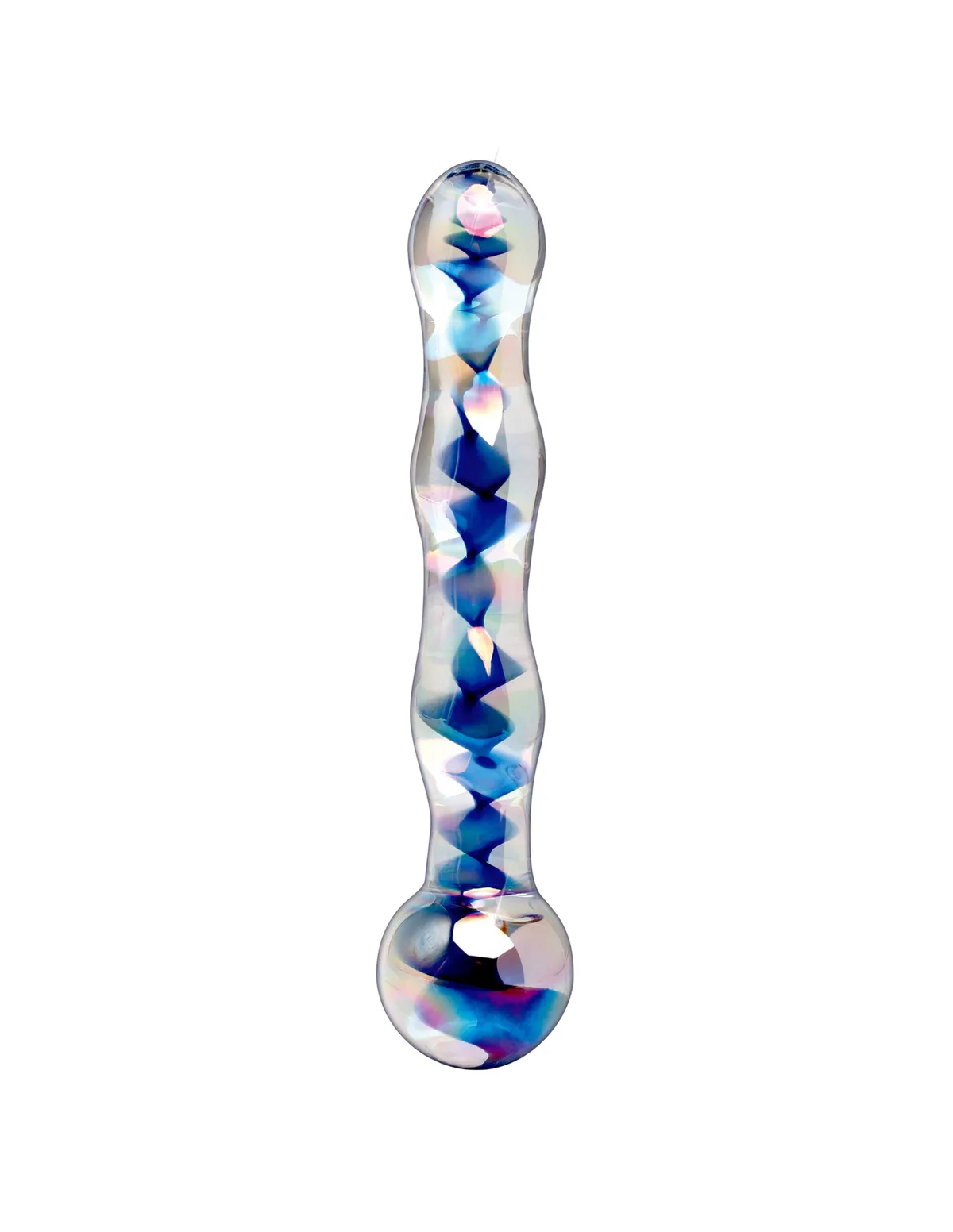
Icicles No. 8 from Pipedream is the most widely sold glass range in Swedish shops and therefore the most natural comparison. Pipedream states a total length of 17,8 centimeters and a width of 3,8 centimeters, i.e. just under a centimeter longer and half a centimeter thicker than Curved Wand. The material is given there only as "Glass" — not as borosilicate — and is described as hand-blown, hypoallergenic, non-porous, and body-safe.
The decisive difference doesn’t lie in the dimensions but in what the manufacturers publish. Pipedream states a consumer warranty of 90 days for non-vibrating products. Dream Toys publishes no warranty period at all, neither on the brand’s consumer site, in the wholesaler’s product register, nor in the manual. Pipedream’s warranty, on the other hand, is short, requires the product to be registered in advance, and requires proof of purchase from an authorized retailer — which for a Swedish consumer makes it difficult to use in practice. In both cases, what actually applies is the Swedish three-year right to complain.
In terms of shape, the two different products are despite the same length class. Icicles No. 8 is a straighter wand with a spiral pattern; Curved Wand is a half-circle with two balls. If you want texture, you choose Icicles; if you want angles and two printed images, you choose Curved Wand.
njoy Pure Wand is the product that defined the format of the bent double-ended G-spot wand. The manufacturer states a length of 8 tum, i.e. 200 millimeters, with ends of 38 and 25 millimeters in diameter respectively, made from high-quality stainless steel and with a weight of 1,51 pund — 680 gram. njoy’s list price is 150 US-dollar, and Vuxen lists it for 1 196 SEK versus the regular 1 395.
The differences are noticeable. Pure Wand is three centimeters longer and has a thicker larger end, but the most noticeable difference is the weight: 680 grams versus a glass rod whose gross weight including packaging is 174 grams. The weight is part of njoy’s construction idea—the mass makes the product sit steadily on its own—but it also means it requires more from the wrist, and that a dropped sample is more dangerous for the floor than for the product.
Both steel and borosilicate glass are non-porous, can handle all lubricants, and work for temperature use. Steel conducts heat even better than glass and keeps the temperature longer, but steel weighs more and costs in this case four to six times as much in a Swedish store. What can be established is that Curved Wand provides the same basic function—curved shape, two end sizes, non-porous material, temperature use—for between one fifth and one sixth of the price, and that what you give up is mass, published manufacturer data, and the brand’s reputation.
Four Swedish stores sell the item under EAN 8720365100703. The cheapest is Blush Me at 199 SEK, and the most expensive is Intima at 399 SEK. It’s a difference of 200 SEK, or precisely a 100 percent spread, for the exact same item number, the same color, and the same packaging—one of the larger relative price spreads we see in this price range.
The stock situation, however, changes the picture completely. Blush Me, the cheapest store, had the product sold out during the price check on July 29, 2026. The cheapest among those that actually had the item in stock was Joyland at 229 SEK, followed by Vuxen at 249 and Intima at 399. That means the actual spread among available samples is 170 SEK, not 200, and that the difference between the two cheapest available stores is 20 SEK. In that price range, the difference is easily wiped out by shipping costs.
When you compare the prices with the manufacturer’s recommended price, the picture becomes clearer—and here the second contradiction in the manufacturer’s materials comes up. Dream Toys’ consumer page and Tongas B2B register both list an MSRP of 36.99 euros, while the manufacturer’s own sales flyer for the same item number lists 26.99 euros. The sales flyer also states the wholesaler’s list price as 14.84 euros. It isn’t shown which of the two MSRP figures is the current one, but both are above all four Swedish store prices when converted to roughly the same order of magnitude—which is unusual and suggests the model is being heavily price-pressured in Swedish retail.
The prices in the table above are updated when the stores update their product flow, but always check the final price at checkout. Shipping costs are added by all four stores below a certain order value, and for a product that costs between 199 and 399 SEK, it’s rather the shipping cost than the item price that determines which store is cheapest overall.
A discrepancy is big enough to earn its own headline. Intima states the length as 16 centimeters between the ends and the diameter as at least 1 and at most 3 centimeters, while the manufacturer states 17 centimeters and 3.3 centimeters. Intima also lists the material only as “Glass.” Blush Me, Joyland, and Vuxen, on the other hand, provide the manufacturer’s measurements correctly: 17 centimeters and 3.3 centimeters, respectively.
When a store specification and a manufacturer specification diverge, it’s the manufacturer’s that applies. Intima is also the most expensive of the four stores, at 399 SEK versus Joyland’s 229, which makes the discrepancy twice as worth knowing about. Practically speaking, it means you should not use Intima’s measurement details when comparing this wand to other products — it makes the product one centimeter shorter and three millimeters narrower than it is according to both the brand’s and the wholesaler’s own records.
It’s for you if you want a pore-free material that you can clean completely and that doesn’t age. It’s for you if you want to be able to use any lubricant at all, including silicone-based, without the material being damaged. It’s for you if you’re interested in temperature play, because borosilicate glass is one of the very few materials in the category where it works meaningfully. And it’s for you if you want a curved G-spot shape without paying a steel price — 229 SEK versus 1,196 for the njoy Pure Wand from the same type of store.
It’s not for you if you want vibration. There is no motor, no battery, and no option to add either. It’s not for you if you want a soft, yielding material — glass is hard by definition, and Vuxen explicitly lists elasticity as “not bendable” and stiffness as “hard.” It’s not for you if you store your products loose in a drawer or on a bathroom shelf, because fragility requires organized storage and because no storage pouch is included.
It also isn’t for you if you require a complete specification before buying. The manufacturer does not publish net weight, insertable length, body material thickness, or warranty period, and it publishes two different values for both diameter and the recommended price. It’s not dramatic for a product made of a single material and lacking moving parts, but it is a clear difference from what, for example, Lelo or Womanizer present for their models — and that’s one of the reasons the rating below isn’t higher.
Here’s the verdict, briefly. Dream Toys does not publish any manufacturer warranty for Glamour Glass Curved Wand. Neither the brand’s consumer page, the wholesaler Tongas product register, the sales leaflet, nor the 11-language manual states any warranty period, any warranty terms, or any procedure for handling warranty claims. By way of comparison, Pipedream states 90 days for its non-vibrating products—short, but at least published.
What always applies, on the other hand, are your statutory rights, and they are stronger than most manufacturer warranties. Under the konsumentköplagen (Swedish Consumer Sales Act), you have a three-year right to make a complaint for defects in the goods, regardless of what the manufacturer promises or fails to promise. A defect that shows up within two years from the purchase is also presumed to have existed at the time of delivery unless the seller proves otherwise. For distance purchases, you also have a right of withdrawal for fourteen days under the lagen om distansavtal och avtal utanför affärslokaler (Act on Distance Contracts and Contracts Outside Business Premises).
Be aware that, in practice, the right of withdrawal is limited for hygiene items that have been taken out of a sealed package—Konsumentverket describes the exception and how it is applied. The right to make a complaint for defects, however, always applies. An important point for this particular product: a glass wand that has broken because it was dropped is not an original defect, whereas a wand that is already cracked in the package is. Therefore, check the surface carefully right when the package is opened. If you have questions about what applies in your case, Konsumentverket provides guidance via Hallå konsument (Ask the Consumer).
Dream Toys Glamour Glass Curved Wand is ranked på plats 5 av 13 in glass dildo best i test, where the entire category is compared against each other using five shared criteria. Guiden vinns av Gildo Glass Dildo No. 5.
Every numerical piece of information in the text can be traced to one of the sources below. The links were checked manually on the specified date.
This page is machine-translated from Swedish. Read the Swedish original