

Review
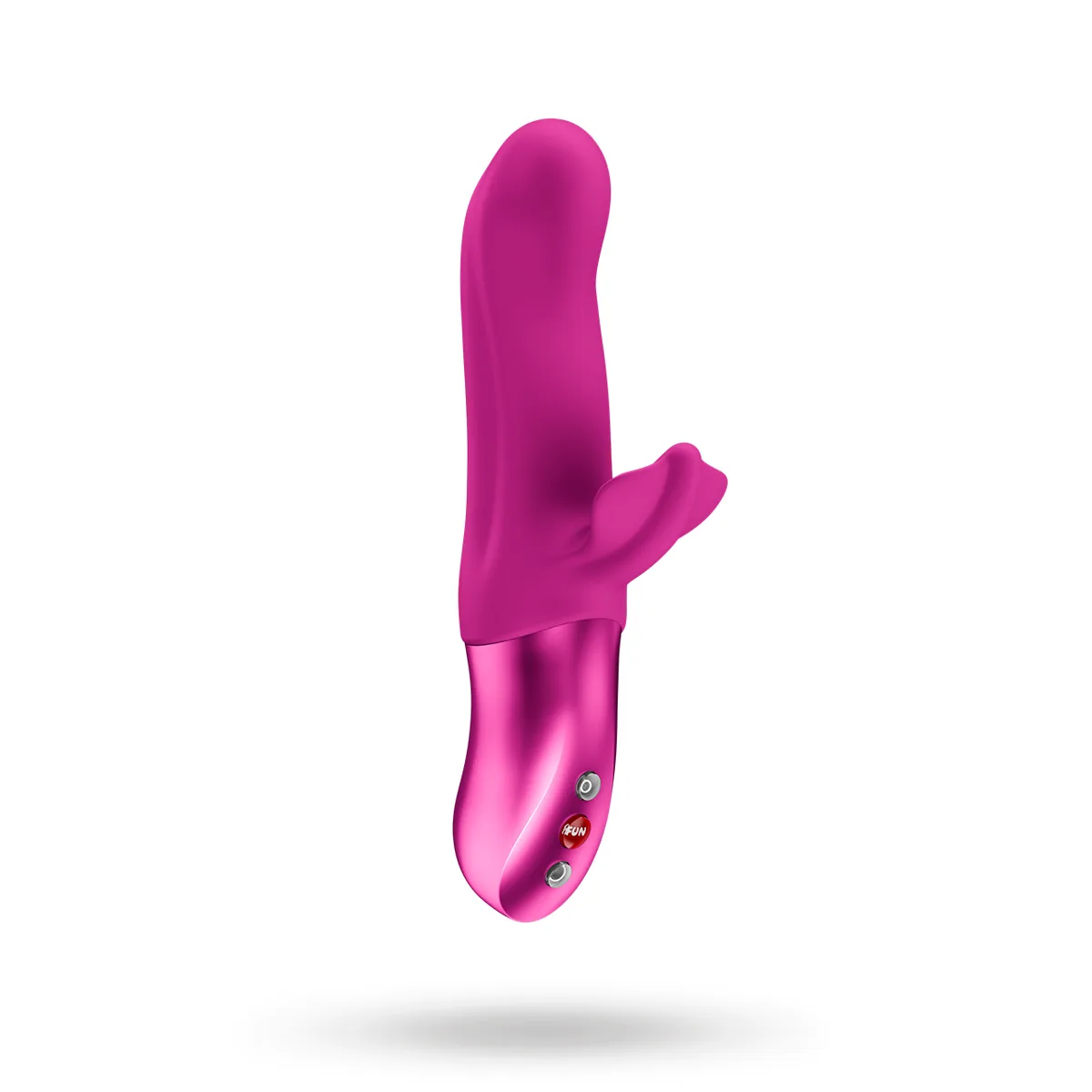
Review: Fun Factory Bi Stronic Fusion
The predecessor in the Bi Stronic family — from 599 SEK.
29 July 2026
 Best budget
Review · Rabbit vibrator · Pulsator with impact function
Fun Factory’s impact rabbit vibrator reviewed against the manufacturer’s own specifications, quick guide, and price data from five Swedish stores. Eight impact programs times six vibration programs, two separately controlled motors, a 900 mAh lithium-ion battery, IPX7 according to IEC 60529 and USB-C—but only about 30 minutes of run time, and a package that promises a warranty you don’t get when you shop in Sweden.
The cheapest way into pulsatort technology with a rabbit arm. Eight impact programs and six vibration programs are driven by two motors that are controlled independently, which gives 48 combinations and three products in one: an impact G-point vibrator, a rabbit, and both at the same time. IPX7 and standard USB-C instead of a magnetic cable are two concrete advantages. What you trade off is run time—the manufacturer states about 30 minutes on a three-hour charge—the weight of 336 grams, and a package that promises a 25-year warranty while the manufacturer’s FAQ gives 24 months for in-store purchases.
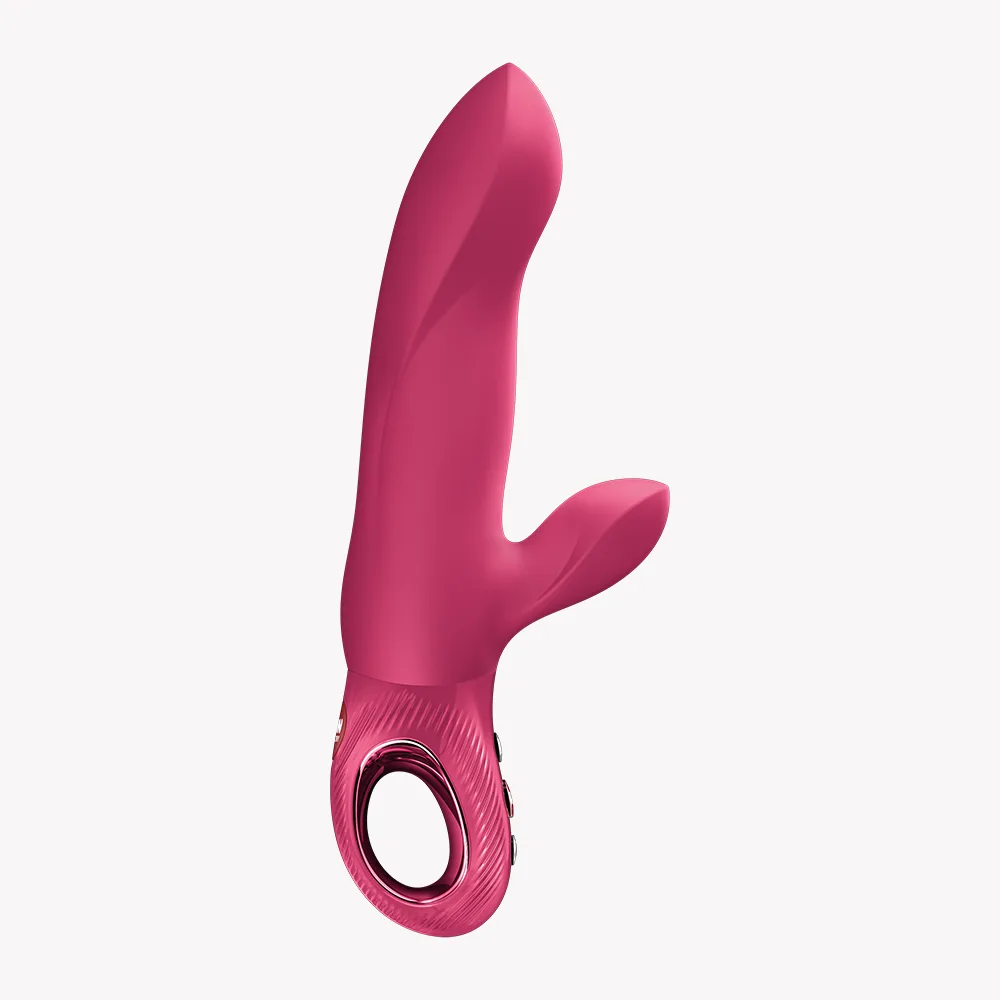
Fun Factory Bi Stronic Arc is a rabbit vibrator that not only vibrates. It thrusts. The shaft moves back and forth under its own power, while a separate arm rests against the clitoris and vibrates. The manufacturer calls the product category a pulsator and describes the function as the product thrusting completely by itself — you don’t need to move it. It’s this feature that sets Bi Stronic Arc apart from practically all rabbit models in the same price range, and it’s also the reason the specification needs to be read differently than for a regular vibrator.
The specification looks like this: eight thrusting programs and six vibration programs, two motors that are controlled independently, length 223 millimeters, largest width Ø 79 millimeters, weight 336 grams, silicone material in combination with ABS plastic and polycarbonate, enclosure rating IPX7, lithium-ion battery at 3.7 volts and 900 milliampere-hours, charging time about three hours and operating time about 30 minutes. Charging is via USB-C, but the charging cable is not included in the package. In Sweden, the item is sold by five stores at prices between 499 and 899 SEK, and four of them had it in stock at the price check.
This review is about the variant with EAN 4255821803552, which Swedish stores consistently sell as the color Raspberry. The manufacturer’s own item number for Raspberry is FF001018RB01. Here is a deviation worth knowing about: in the manufacturer’s own product data, the same barcode, 4255821803552, is used for both Raspberry and the black variant FF001018BK01. This is an obvious mislabeling by the manufacturer — two articles cannot share a GTIN — but it means you should check the color selection at checkout and not rely on the EAN number alone if you want a specific color.
A standard vibrator has a motor that makes the whole house shake. A pulsator, instead, has a motor that moves a lot back and forth along the product’s longitudinal axis, so that part of the shaft moves relative to the handle. So the movement is not a vibration but a displacement, and it is repeated in a rhythm controlled by the program you’ve selected. Fun Factory lists eight such thrusting programs on the Bi Stronic Arc.
The difference is fundamental, and you can see it right in the specification. A vibration motor converts electricity into high-frequency movement with very small amplitude — a few tenths of a millimeter. A thrusting mechanism converts electricity into low-frequency movement with a large amplitude. The latter costs significantly more energy, and that’s the whole explanation for one of this product’s most striking figures: the battery is 900 milliampere-hours, meaning it’s larger than in most clitoral stimulators, but the manufacturer still states only about 30 minutes of runtime. We’ll return to that figure under the battery section.
Bi Stronic Arc combines both principles. The manufacturer lists two motors: one that drives the thrusting movement in the shaft and one that drives the vibration in the clitoral arm. The Swedish product text from the stores specifies that the motors can be controlled separately, which the manufacturer’s own packaging confirms with the icon "8 THRUSTING & 6 VIBRATION MODES" and "2 STRONG MOTORS". What can be established purely mathematically is that eight thrusting programs times six vibration programs give 48 combinations where both motors run at the same time. If you also include the modes where only one of the motors is running, you end up with 62 possible states. That’s more than on any other model in this price range that we have reviewed.
For a long time, Fun Factory sold just one model in this family, the Bi Stronic Fusion. During 2026, there are five parallel Bi Stronic models in the manufacturer’s range, and they get mixed up in stores because the names are short and the pictures look similar. The differences are almost exclusively about shape and size — the technical platform is the same.
What can be concluded from this table is that the differences are small: from the shortest to the longest model, there are 14 millimeters, and from the lightest to the heaviest, 31 grams. None of them is an upgrade of any other. If you choose between them, you choose the shape, not performance — and since the prices in Swedish shops are within a few hundred SEK of each other, it’s the design and availability of stock that determine it.
The material issue is the only feature of an intimate product that can’t be compensated for with experience or care, and it determines whether the product is still hygienic after five years. Fun Factory lists three materials for Bi Stronic Arc: silicone, ABS plastic, and polycarbonate. The same three materials are also listed in the manufacturer’s quick guide, where they are listed as "ABS, PC, silicone".
The manufacturer’s product page describes the product as made of body-friendly, durable silicone, and the manufacturer’s FAQ specifies how the materials are distributed across the range: the toys are made of 100 percent medical-grade silicone, while the battery housing and control part are made of body-friendly thermoplastic. Applied to Bi Stronic Arc, that means the curved shaft and clitoral arm — i.e., everything that touches the body — is silicone, while the LOOP handle with its three buttons and the ribbed structure is hard plastic. ABS and polycarbonate are exactly those kinds of thermoplastics.
That’s a reasonable construction and not a stingy one. A pulsator needs a rigid housing to anchor the impact mechanism in, and that force can’t be absorbed by soft silicone. But that also means that Bi Stronic Arc isn’t an all-silicone product in the sense that, for example, Womanizer Next is, and that the seam between the silicone and the plastic part is a surface that needs to be cleaned with a bit of thought. The manufacturer’s FAQ describes the silicone as non-porous, hypoallergenic, vegan, and halal.
A non-porous surface can be cleaned, because there are no microscopic cavities where residue can get trapped. It is the single most important property of a material that is meant to sit against mucous membranes. Polycarbonate and ABS are also non-porous, so the entire product is, in practice, cleanable — it’s the transition between the materials, not the materials themselves, that requires attention.
Phthalates are a group of plasticizers used to make plastic, especially flexible PVC, pliable. The Swedish Chemical Inspectorate (Kemikalieinspektionen) describes them as substances that can affect the endocrine system and make reproduction more difficult, and several of them are therefore restricted or prohibited within the EU in a large number of products. This particular product category is recurring subject to supervision because it contains flexible plastic against skin and mucous membranes.
Fun Factory states in its FAQ that all products are free from plasticizers, BPA, and phthalates. It’s a clear-cut declaration, unlike labels such as "TPE" or "jelly rubber" which say nothing at all about which plasticizers are included. Silicone doesn’t require phthalate plasticizers to become soft — the softness comes from the polymer’s own structure — and therefore specifying silicone as the material in itself is a better piece of information than almost any other item in a product specification.
What’s missing is a materials declaration that is specific to Bi Stronic Arc itself. The manufacturer’s product page lists three material names in one line, and the FAQ describes the range as a whole. Fun Factory does not publish any breakdown by component, so it isn’t possible to determine from the manufacturer’s documentation exactly how many grams of silicone versus plastic the product consists of, or where the boundary between them is in millimeters.
The manufacturer’s specification table states the size as 223 millimeters and Ø 79 millimeters, as well as the weight as 336 grams. The same weight is given in the manufacturer’s structured product data, listed per variant. The width figure Ø 79 millimeters refers to the product’s widest width including the clitoral arm — this is shown by the fact that the sibling models are listed with separate dimensions for length, width, and height, where the width is 71 to 85 millimeters, i.e. in the same size range.
There is a discrepancy between the manufacturer and the retailer that is worth reporting. The retailer Mshop states the length as 22.30 cm, the width as 4.80 cm, the height as 22.30 cm, and the diameter as 4.80 cm, as well as the weight as 0.45 kg. The length matches the manufacturer’s 223 millimeters. The width does not: 48 millimeters versus the manufacturer’s 79. The height information of 22.30 cm is also identical to the length, which is a clear sign that the field has not been filled in but copied. The most reasonable explanation is that Mshop’s 4.80 cm is intended to be the shaft’s diameter rather than the product’s total width — but the shop itself writes in its running text about an overall length of about 22 cm and a maximum diameter around 5 cm — however, that is an interpretation, not a published specification.
In turn, the retailer Vuxen states the total length as 21.5 cm, i.e. 8 millimeters shorter than the manufacturer. In the event of a direct conflict between the manufacturer and the shop, use the manufacturer’s figures: count on 223 millimeters. The weight information also differs. The manufacturer states 336 grams, while Mshop states 450 grams. The difference of 114 grams reasonably corresponds to the packaging, since Mshop in the same table states the packaging dimensions as 23.00 × 9.50 × 5.50 cm — but the shop does not specify what the weight refers to, so it remains a guess.
No matter which information you base the conclusion on, the conclusion is the same: this is a large and heavy product. 336 grams is almost twice as much as the Lelo Ina Wave 2, which weighs 176 grams, and 223 millimeters is 23 millimeters longer. The weight is not an error but a consequence of the design — an impact mechanism needs a counterweight to work against; otherwise, the entire product moves instead of just the shaft.
A detail in the manufacturer’s own documentation deserves a note, because Fun Factory has historically been marketed as a German brand with its own production. The quick guide for the Bi Stronic Arc lists the manufacturer as FUN FACTORY Germany GmbH, Am Lenkwerk 3, 33609 Bielefeld. The product page shows, under the heading "Hersteller/Verantwortliche Person", Triple A Import GmbH at the same address, and in the manufacturer’s structured product data Triple A (Shenzhen) Co. Ltd appears in the supplier field.
What can be established, then, is that this generation of Bi Stronic is documented by a group that has both a German import division and a production unit in Shenzhen. It says nothing about the quality itself—contract manufacturing in China is more the rule than the exception in the whole category—but it’s relevant for anyone buying the brand under the belief that the product is still made in Bremen. It also explains another thing: the older Fun Factory items in Swedish store assortments carry EAN numbers that start with 4032498 and cost around 1,700 SEK, while the entire new generation carries numbers that start with 4255821 and costs a third of that. There are two different product lines—not the same item being put on sale.
The interface consists of three buttons on the LOOP handle. The manufacturer’s quick guide shows exactly what they do. The top button steps through the six vibration programs, one press at a time, and turns off the vibration if you hold it in for one to two seconds. The bottom button does the same for the eight impact programs. Between them sits the FUN button, which turns both motors on and off at the same time with a press-and-hold of one to two seconds.
It’s an unusually straightforward interface for a product with this many modes. You don’t need to go through a menu or an app, and there’s no combination button to learn. What can be established, however, is that the stepping is one-way: the arrows in the quick guide go from 1 to 6 respectively 1 to 8 and then around again. So if you’ve clicked one step too far, you have to cycle all the way around—on the impact side that means up to seven extra presses.
The fact that the impact motor and the vibration motor each have their own button is the most important usage feature of the entire product, and it’s easy to miss in the product text. The result is that you can run the impact movement on its own, the vibration on its own, or any combination of the two—and that you can change one without the other jumping along. The packaging icon "2 STRONG MOTORS" and the Swedish store text stating that the motors can be controlled separately point in the same direction.
In practice, that means the product works like three different things: a pure G-spot vibrator with the clitoral arm turned off, a pure rabbit vibrator with the impact motor turned off, and a combination. It’s unusual for a product in the 499 to 899 SEK price range to be all three. The counterargument is just as simple: two motors in the same housing mean more mass, more noise, and more power consumption than one—and all three are shown in the specification.
The handle is shaped like a ring — the manufacturer calls it the LOOP handle and states that it has a ridged structure for extra grip. The ring shape has two purposes. The first is that you get a stable grip as well, even with lubricant on your hands, which is the most common reason why a product of this length slips out of your hand. The second is that the ring provides a clear stop that allows the product to stay in place against the body without having to be held, which is the prerequisite for what the manufacturer calls handsfree.
Both the packaging icon "HANDS-FREE FUN" and the manufacturer’s description "stops completely on its own" are based on the same thing: because the motion comes from within the product, no one has to drive it. That’s the real difference compared with a rabbit with only vibration, where you always have to hold it and move it. What can be established is that it assumes the product is seated firmly — a bumping mechanism that has to work with too little resistance moves itself instead of bumping, and that’s a physical consequence of the fact that it’s the same force acting in both directions.
Eight times six is more combinations than anyone needs, and it’s worth saying plainly. The pattern in this product category is that you end up with three or four settings and then you stop there. The value of a large number of programs isn’t that you use all of them, but that the likelihood increases that one of them will fit — and that logic is stronger for a pulsator than for a standard vibrator, because the bumping rhythm is a significantly more personal parameter than vibration intensity.
What the eight bump programs and the six vibration programs concretely do is not published by Fun Factory. The quick guide counts them, but doesn’t describe them, and the product page does the same. So there is no manufacturer source on whether the bump programs differ in speed, stroke length, or rhythm, and not on how long the stroke length is in millimeters either. This is the most noticeable gap in this specificaion, because stroke length is the single most important characteristic of a pulsator.
The question of sound is more important for a pulsator than for a vibrator, because a mechanism that moves mass back and forth produces a low-frequency sound that travels through walls better than a high-frequency buzzing. The answer has to be honest: Fun Factory publishes no measured decibel value for the Bi Stronic Arc, either on the product page, in the quick guide, or on the packaging. None of the manufacturer’s icons on the packaging also mentions silence, which is notable because "whisper quiet" would otherwise be a standard argument in the category.
What can be concluded is that the absence of a silence pledge in the manufacturer’s own materials is information in itself. When a manufacturer has a silent product, they say so. Here, Fun Factory does the opposite: the packaging highlights two powerful motors. This shouldn’t be read as meaning the product is loud—only that silence isn’t what it’s sold on.
A practical piece of advice that applies regardless of the model: place the product on a soft surface between uses, and avoid letting it work against a hard surface. A tabletop or a bedhead panel acts as a resonating box and noticeably amplifies especially low-frequency sound. Information about the decibel levels for this model that appears on other websites is not supported by the manufacturer.
Fun Factory Bi Stronic Arc is rated IPX7. The rating comes from the international standard IEC 60529, which defines enclosure classes for electrical equipment. The number 7 in the second position means the product is tested for immersion in water to a depth of one meter for 30 minutes. The information is stated both on the manufacturer’s product page, in the quick guide, and as an icon on the packaging, and the cleaning section in the quick guide shows the product immersed in water.
The difference from a splash-proof product is greater than the wording suggests. Splash protection covers water droplets and, in the best case, water jets, but not immersion. Such a product can handle a damp cloth and possibly a shower, but not a bathtub.
There is, however, an important caveat that is specific to this model. The manufacturer’s own close-up of the charging connection shows that the USB-C socket sits in the handle behind a rubber plug that must be pressed into place—in contrast to solutions with magnetic charging, where the casing is completely sealed. For a product with a removable plug, IPX7 applies only when the plug is in place, and the plug is also the part that wears out and loses its tightness first. So never rinse off the product without first checking that the plug is pressed in properly, and wipe the socket before charging. Next to the socket, the CE marking is also visible, embossed directly into the plastic.
The manufacturer’s FAQ is direct on cleaning: all Fun Factory products can be washed with warm water and mild soap, and for more thorough cleaning the manufacturer recommends a cleaning agent intended for silicone products. The quick guide shows the same thing with a picture. Pay extra attention to the seam between the silicone and the plastic handle—that’s the only place on the product where two materials meet.
On the question of lubricants, the manufacturer has a clear and unusually strict answer. A silicone-based lubricant should never be used on silicone products, because it cannot be removed completely and makes the product unhygienic over time. In addition, Fun Factory expressly warns against oils and creams — sun oil and sun cream, lip balm and lip cerate, essential oils, coconut oil, and food oils of all kinds — on the grounds that they can cause irreversible damage to the control part and to the entire product, and that you risk losing your warranty right. This is a significantly stricter wording than most manufacturers use, and it is worth taking seriously precisely because the control part here is a plastic component in a housing that is otherwise silicone.
The quick guide also states the storage temperature, between −5 and +60 degrees Celsius, and shows a crossed-out sun, meaning the product should not be stored in direct sunlight. With the upper limit at 60 degrees, boiling and the dishwasher are ruled out despite IPX7. The quick guide also advises against use if the product is abnormally warm, mechanically damaged or deformed, or has discolored — three specific signs that a lithium-ion battery or a casing has been damaged.
This is where the most eye-catching figure in the entire specification is found, and it is not shown on the product page but in the manufacturer’s quick guide. Fun Factory specifies a lithium-ion battery of 3.7 volts and 900 milliampere-hours, a charging voltage of 5 volts, a maximum charging current of 500 milliamperes, a charging time of about three hours, and a runtime of about 30 minutes.
Via USB-C, and that’s a genuine advantage. The manufacturer states that the entire range now uses USB-C, which means that any standard USB-C cable works. That’s a real difference compared with premium competitors that use magnetic, product-specific charging cables, where a lost cable means placing an order from the manufacturer.
The downside is that the charging cable is not included in the package. The quick guide’s charging section states it in its own words — "USB-C charging cable not included" — and the Swedish store text repeats it. So if you don’t have a USB-C cable at home, that’s an extra thing to get, even if it’s a cheap and replaceable one. The manufacturer also does not state that any power adapter is included.
The quick guide also shows that the product indicates charging status with a light that distinguishes between charging in progress and a fully charged battery, and that a full charge takes about three hours. It does not say what happens if the product is used while it is charging.
About 30 minutes of runtime is short. It’s half of what Satisfyer states for its Pro 2 Next Generation, and a quarter of the two hours Lelo states for the Ina Wave 2—despite the fact that Lelo’s 520 milliampere-hour battery is only a little more than half the size of the 900 milliampere-hours Fun Factory lists here. The relationship is therefore not that the battery is small, but that power consumption is high.
The calculation example is enlightening. 900 milliampere-hours at 3.7 volts corresponds to roughly 3.3 watt-hours of stored energy. To last 30 minutes, the product draws an average of around 6.7 watts. Lelo’s 520 milliampere-hours at 3.7 volts corresponds to about 1.9 watt-hours, and spread over two hours that becomes just under 1 watt. Bi Stronic Arc therefore draws on the order of seven times more power. That’s exactly what you’d expect from a mechanism that moves mass instead of shaking it, and in that sense it’s not a shortcoming in the design, but the price you pay for the function.
Practically speaking, it still means two things that should influence the buying decision. The first is that the product has to be charged after almost every use, and that charging takes six times as long as the runtime. The second is that a battery that runs out in half an hour goes through charging cycles quickly. The manufacturer does not state whether the battery is replaceable, and the design with a sealed, IPX7-rated housing makes it unlikely. With use a couple of times a week, it’s the battery—not the silicone—that sets the limit for lifespan.
A final note about what isn’t published. Fun Factory states neither stroke length in millimeters, nor impact frequency in strokes per minute, nor vibration frequency in hertz. Lelo publishes the frequency 60 hertz for Ina Wave 2 and an automatic shut-off after 20 minutes. The corresponding information for Bi Stronic Arc can’t be found with the manufacturer, and the figures that circulate on reseller pages lack a source.
We do not have price data from shops in your market yet.
The package promises a 25-year warranty. The manufacturer’s own FAQ states 24 months when the product is not purchased directly from Fun Factory.
Three comparisons are relevant: versus the two closest sibling models in the same family, and versus the premium alternative that is closest in terms of function but furthest away in price. All specifications below come from each respective manufacturer’s own information, and all prices come from the stores’ product feeds on July 29, 2026.
Bi Stronic Curve costs from 674 SEK, versus Bi Stronic Arc from 499 SEK. The manufacturer’s quick guide for Curve contains exactly the same technical data as Arc: lithium-ion battery 3.7 volts and 900 milliampere-hours, 5 volts charging voltage, 500 milliampere maximum charging current, about three hours of charging time, about 30 minutes of runtime, IPX7, and six vibration patterns plus eight impact patterns. So it’s the same technical platform, down to the last digit.
The difference is the geometry. Curve measures 213 × 75 × 50 millimeters and weighs 352 grams; Arc is 223 millimeters long with a maximum width of 79 millimeters and weighs 336 grams. So Curve is 10 millimeters shorter and 16 grams heavier. The conclusion is simple: the one who chooses between the two chooses based on shape and price, not on performance, and Arc is, at the time of writing, the cheaper of the two. If the shape of Curve is the one that suits you, then the 175 SEK is money well spent—but they don’t buy any function.
Bi Stronic Immerse costs from 599 SEK and measures 224 × 75 × 33 millimeters with a weight of 350 grams. So it is practically just as long as Arc—just one millimeter apart—but noticeably flatter: 33 millimeters in height versus Curve’s 50. It weighs 14 grams more than Arc.
What’s worth noting in this comparison is that the differences within the family consistently come down to tens of millimeters and tens of grams, never in function. Fun Factory doesn’t publish any deviating program or battery details for Immerse, Crave, or Embrace. Bi Stronic Crave is the shortest at 210 millimeters but the widest at Ø 85 millimeters and the lightest at 321 grams, while Bi Stronic Embrace is the narrowest at 71 millimeters and weighs 328 grams. Five models, one platform. If you only want a pulsator with a rabbit arm and you don’t have an opinion about the shape, then you should buy the one that’s cheapest and in stock—and that is Bi Stronic Arc for 499 SEK.
Lelo Ina Wave 2 is seen in stores from 1,125 SEK, and the cheapest store that had it in stock charged 1,195 SEK. So it’s at least 696 SEK more than Bi Stronic Arc. Both are rabbit models with movement in the shaft in addition to vibration, but they solve the same problem in different ways: Lelo uses a wave movement in a fixed insert part, Fun Factory a jolt-like shifting movement of the entire shaft.
The specifications differ on almost every line. Lelo states 200 × 65 × 45 millimeters, an insertable length of 110 millimeters, a diameter of 37.09 millimeters, and a weight of 176 grams—half of Bi Stronic Arc. The battery is 520 milliampere-hours and 3.7 volts, with a charging time of two hours at 5.0 volts and 500 milliamperes, an operating time of up to two hours, and a standby time of up to 90 days. Lelo lists twelve modes, a frequency of 60 hertz, a five-button interface, and automatic shutoff after 20 minutes. The material is stated to be body-friendly silicone and ABS plastic—so the same basic breakdown as with Fun Factory. In the package you get a USB charging cable, a satin pouch, a warranty card, and a detailed manual.
What Lelo wins on is the reported data: four times longer runtime, half the weight, published frequency, published insertable length, and a charging cable in the box. The warranty is two years plus a ten-year quality warranty. What Fun Factory wins on is the price, the thrust movement’s amplitude, and the number of combinations—Lelo’s twelve modes versus 48 combinations of two separately controlled motors. If you choose based on specification density and endurance, Lelo wins. If you choose based on features per dollar, Bi Stronic Arc wins, and with a wide margin.
Five Swedish stores sell the item with EAN 4255821803552. The cheapest is SexleksakerOutlet at 499 SEK, and the most expensive is Mshop at 899 SEK. That’s a difference of 400 SEK, or 80 percent, for exactly the same item number, the same color, and the same packaging.
The inventory situation is unusually good for this category. Four of the five stores had the product in stock at the price check: SexleksakerOutlet at 499 SEK, Vuxen at 674 SEK, Blush Me at 799 SEK, and Mshop at 899 SEK. The only one that lacked stock was Sexonic at 680 SEK. That means the cheapest store is actually the cheapest available, which isn’t always the case.
The price spread isn’t because any store sells a different variant—all five list the item under EAN 4255821803552, either directly or via their own item number that’s linked to it. Sexonic also states its price in euro and shows 61,55 euro on the product page, which explains why that store’s price lands on an odd SEK amount in the feed. Two of the stores, SexleksakerOutlet and Vuxen, also had an “ordinariepris” in the feed that was higher than the price they actually charged—799 and 899 SEK, respectively—which is worth knowing if the price looks like it has gone up when you visit the page.
The prices in the table above are updated when the stores’ product feeds are updated, but always check the final price at checkout. Shipping costs are added by several stores under a certain order value, and at this price level most stores are below the threshold for free shipping—which can offset part of the difference you save by choosing the cheapest option.
It’s for you if you want to try a pulsator without paying a premium price. The combination of two separately controlled motors, eight thrust programs, six vibration programs, IPX7, and USB-C for 499 SEK has no equivalent in the comparison. It’s for you if you want to be able to use the product hands-free, you who prefer a G-spot angled tip, and you who want to be able to use the same charging cable as for your phone instead of a product-specific magnetic charging cable.
It doesn’t fit you if you want a long runtime. About 30 minutes on a charge that takes three hours makes it the weakest line in the entire specification, and it’s difficult to get around because it’s a result of the technology. It doesn’t fit you if you want a small and lightweight product — 223 millimeters and 336 grams are about twice as much product as an average rabbit vibrator. It doesn’t fit you if you require a published sound level, a published stroke length, or a published frequency, because Fun Factory doesn’t state either of those. And it doesn’t fit you if you want a charging cable in the box, because none is included.
One more thing belongs in the decision. A pulsator is a product with moving parts, and moving parts wear out. That makes the warranty question more important here than on a product without mechanics — and, as the next section shows, that issue is more complicated than the packaging makes it sound.
The packaging for Bi Stronic Arc has an icon with the text "25-YEAR GUARANTEE". It’s one of the longest warranty commitments that appears in this category, and in practice it’s the strongest single argument on the entire carton. If you read the manufacturer’s FAQ, the picture is different.
Fun Factory has two parallel answers to the question of how long warranty they offer. One says that, with proof of purchase presented, they offer 24 months of warranty on all Fun Factory products. The other says that they offer 25 years of warranty on products bought directly from Fun Factory, meaning via funfactory.com or at the earlier company-owned stores. Both answers appear on the same page.
The consequence for a Swedish buyer is unambiguous: if you buy Bi Stronic Arc from any of the five stores in the table above, it’s the two-year warranty that applies, not the 25 years stated on the packaging. The manufacturer also expressly states that complaints about products that were not bought directly from Fun Factory must be directed to the seller, and that they don’t handle them themselves — at most, they offer help in getting in touch with the store. For an icon on the packaging to promise 25 years without stating the condition is, to put it mildly, unfortunate.
Read also the exception about oils before you count on the warranty. Fun Factory writes that using oils and creams — sun oil, sun cream, lip balm, lip cerate, essential oils, coconut oil, and all types of cooking oils — can cause irreversible damage to the control part and to the entire product, and that you therefore risk losing your warranty rights. On a product where the control part is the only plastic part in a silicone housing, that’s an exception with practical significance.
What always applies, however, are your statutory rights, and they are independent of what the manufacturer promises. According to the Swedish Sale of Goods Act (konsumentköplagen), you have a right to make a complaint for defects for three years — that is one year longer than Fun Factory’s two-year warranty for store purchases. For distance purchases, you also have a right of withdrawal for fourteen days under the law on distance contracts and contracts outside business premises (lagen om distansavtal och avtal utanför affärslokaler). Be aware that, in practice, the right of withdrawal is limited for hygiene products that have been removed from a sealed package — however, the right to make a complaint for defects always applies. If you have questions about what applies in your case, Konsumentverket guides you via Hallå konsument.
Fun Factory Bi Stronic Arc Thrusting Rabbit Pulsator is ranked etta av 12 in thrusting vibrator best i test, where the entire category is compared against each other using five shared criteria.
Every numerical piece of information in the text can be traced to one of the sources below. The links were checked manually on the specified date.
This page is machine-translated from Swedish. Read the Swedish original