

Review
Review: Hidden Desire Extreme Inflatable Lubricating Plug
Same series, but with its own lubricant channel — from 297 SEK.
29 July 2026
Review · anal plug · Inflatable with hand pump
The smallest inflatable plug in Hidden Desire’s Extreme series, reviewed against the manufacturer’s own specifications and pricing data from six Swedish stores. Insertable diameter 3–5,5 centimeters, insertable length 10,5–14,5 centimeters, silicone all the way through, hand pump with quick-release valve, and 150 grams in weight — at a price with a 35 percent difference between the cheapest and the most expensive store.
The cheapest way into inflatable anal toys, and one of the few in the category where the manufacturer publishes both the inlet dimensions and the end dimensions. The insertion happens at 3 centimeters, and you choose the final size up to 5.5 centimeters, while the length grows from 10.5 to 14.5 centimeters at the same time. The material is silicone all the way through, and the quick-release valve is positioned correctly on the pump bulb. What you pay for is a permanently mounted hose that cannot be disconnected, the lack of a suction cup, and documentation without a guarantee, an instruction manual, or a material declaration per component.
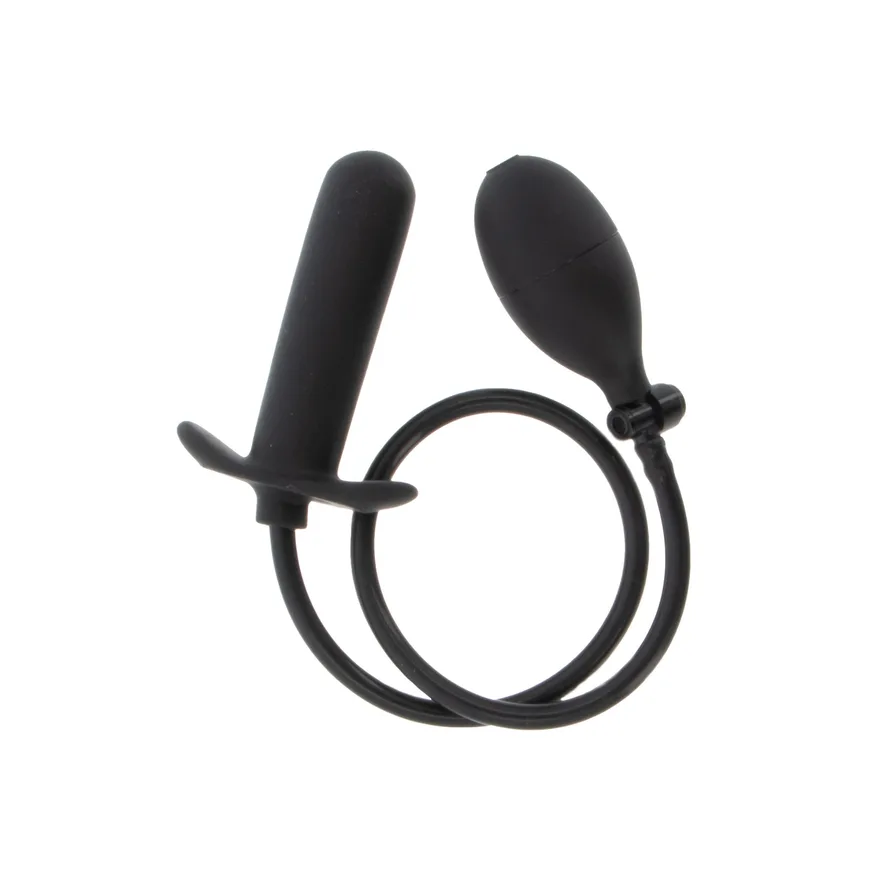
Extreme Inflatable Smooth Starter Plug 14.5 cm is the smallest inflatable anal plug in Hidden Desire’s Extreme series, and the one intended as the entry into the category. The concept is simple: a smooth, tapered plug made of silicone is inserted in the deflated state, and then it is inflated with a hand pump that sits on the other end of a fixed, mounted hose. Pressing the quick-release valve empties it again.
The manufacturer states the dimensions as an interval rather than as fixed values—this is the whole point of the product type. Insertable diameter is stated as 3–5.5 centimeters and insertable length as 10.5–14.5 centimeters. The material is listed as silicone in the spec table and as 100 percent pure silicone in the product text. The weight per unit is 0.15 kilograms. The package is a cardboard box measuring 25.5 × 9.5 × 6.5 centimeters, and the country of origin is China. Recommended consumer price is 31.99 euro. In Sweden, the item is sold by six stores at prices between 212 and 286 SEK.
This desk review is about the black variant with EAN 8713221835208, the manufacturer’s model number 16851, and variant-SKU 16851-BLACK. The barcode is printed in the header on the manufacturer’s own product page, which means it can be checked against the manufacturer’s side of things rather than only against the product feeds of the stores. The product is available in only one color and one size, so you don’t need to worry about any variant confusion—however, there are five sibling models in the same series with confusingly similar names, and we go through them below.
One thing is worth stating right away, because it determines how the rest of the text should be read. Hidden Desire is not a factory; it’s a brand. The name is a registered trade name owned by the Dutch wholesaler SCALA 2.0 B.V. in Wijchen, together with brands such as ToyJoy, Taboom, and Playhouse. This means that the technical documentation looks like a wholesaler’s product card and not like a manufacturer’s product sheet. There is no instruction manual in PDF format, no EU declaration of conformity, and no warranty text—and that in itself is information that belongs in the basis for making a purchase decision.
A typical anal plug has a fixed shape. It’s largest at its widest point, and that point has to pass during insertion. That’s where the category’s biggest practical problem lies: you have to make it through the maximum diameter before you get any use out of the product at all—and that’s also why so many plugs are bought in sizes that then never get used.
An inflatable plug reverses the order. In its deflated state, this model is 3 centimeters in diameter, which is on the low end of what’s sold as a beginner plug. Only once it’s in place does the pumping begin, and each press on the pump bulb adds a small amount of air. What can be established is that insertion therefore happens at the smallest measurement, while the final size can be significantly larger—up to 5.5 centimeters according to the manufacturer. So what you’re buying is not a single size, but a range.
The pump is the same type that sits on a blood pressure cuff: a pear-shaped silicone ball with a check valve, and next to it a side-mounted valve that releases the air when it’s twisted or pushed in. The manufacturer calls it a quick-release valve and explicitly describes it as a safety and comfort feature. The tube between the ball and the plug is fixedly mounted in this model, which has consequences we’ll come back to.
The Extreme series consists of multiple inflatable items with similar-sounding names, and stores regularly mix them up. The manufacturer’s own product cards make the differences unambiguous:
So the difference between the models is mainly length, not width. The step from Starter to Advance is four extra centimeters at the entrance and eight and a half extra centimeters in depth, while the maximum diameter stays at 5.5 centimeters. It’s a substantially different product even though the widest point is the same, and it’s worth knowing before you pay 124 SEK more in a Swedish shop for the Advance model.
The dimensions are the only thing that really differentiates inflatable plugs, and that’s why they’re the part of the specification that deserves the most space. The manufacturer publishes them in two places that match: in the spec table on the product page and in its own dimension graphic in the product gallery, where the inflated outline is drawn on top of the deflated plug with the specifications max Ø 5.5 cm, min Ø 3 cm, max 14.5 cm, and min 10.5 cm.
That both dimensions are given as ranges is not a sloppy wording but a description of how the product actually behaves: the balloon grows in all directions when air is added, and the plug therefore becomes both wider and longer. You can see it clearly in the manufacturer’s dimension graphic, where the gray outline stands out both to the sides and upwards compared with the black plug. Four extra centimeters in depth isn’t negligible, and it’s the one detail that most often disappears from the retail channel.
The numbers 3 and 5.5 centimeters sound modest next to each other, but the difference is bigger than it looks. An increase from 3 to 5.5 centimeters in diameter is 83 percent more in width. Since the cross-sectional area grows with the square of the diameter, the area instead becomes about 3.4 times as large. If you roughly calculate the volume—cross-sectional area times the length, so 3.4 times 14.5 divided by 10.5—you end up at about 4.6 times the deflated volume.
This calculation exercise is worth doing before you buy it for two reasons. The first is that it shows that the maximum setting isn’t a narrow step up from the minimum setting, but a completely different product. The second is that it explains why this model works as an entry into the category: you get 3 centimeters at insertion, which is on par with a small beginner plug, and you never need to go further than you want.
What you can’t calculate, though, is how the plug feels with every pump stroke. The manufacturer publishes neither the pump ball’s volume, the number of pump strokes to reach the maximum setting, nor the length of the hose—and none of the six Swedish stores does either. It’s a real gap in the documentation: two inflatable plugs with identical outer dimensions can require completely different numbers of pump strokes to get there, and that affects how precisely you can control the size.
There’s a contradiction here that’s worth its own heading, because it says something about how the category is documented.
The manufacturer’s own spec table doesn’t state an expansion figure at all. It lists insertable length, insertable diameter, material, weight, packaging, and country of origin—and then that’s it. The printed package, photographed by the manufacturer itself and published in the product gallery, does, however, have a round stamp with the text 275 % EXPANSION. The brand text that SCALA distributes to its retailers, and that can be read word for word at multiple stores in Europe, instead states up to 400 % expansion.
Neither of the two figures is defined. Is it about diameter, cross-sectional area, or volume? Based on the manufacturer’s own measurements, the diameter increase is 83 percent, the area increase is about 240 percent, and the volume increase is about 360 percent. That means the 275-percent figure is close to an area interpretation and the 400-percent figure is close to a volume interpretation—but neither of them matches the diameter, which is the measurement a buyer is actually thinking about.
The conclusion is simple and practical: ignore the percentage figures and instead read the centimeters. The two measurement ranges are the only ones published in two separate places in the manufacturer’s own material—and they match. The percentage figures are marketing, and they contradict each other in the manufacturer’s own material.
All six Swedish stores list the article under EAN 8713221835208, but they give the measurements in five different ways. It’s not a trivial matter, because it’s exactly the measurements you compare in this category.
None of the six stores publishes the weight. The fact that the product weighs 0.15 kilos only appears on the manufacturer’s product card, and it’s a good example of why it pays to go to the source instead of comparing store texts with each other.
The material question is the only characteristic of an intimate product that can’t be compensated for with experience or care, and in this category it’s also linked to safety: the plug should be stretched out with air without bursting, and it should be possible to clean it.
Silicone is non-porous. A non-porous surface can be cleaned, because there are no microscopic cavities where residue can be left behind. This is the single most important property of a material that needs to lie against the mucous membrane, and that’s why the material declaration carries more weight than almost all other lines in a specification.
For an inflatable product, there’s a second reason. The material must be able to stretch out to almost twice the diameter and then go back, again and again, without cracking or remaining stretched. Silicone has both high stretchability and good shape recovery, and that’s why the modern generation of inflatable plugs is made of silicone, while the older generation was made of latex or rubber. The manufacturer states silicone in the spec table and 100 percent pure silicone in the product text; the packaging bears the marking 100 % SOFT-SILICONE. So three independent places at the manufacturer say the same thing.
A caveat belongs here. The material specification obviously applies to the plug body and the pump ball, which are both black and matte in the manufacturer’s own images. The valve housing on the pump ball is glossy and looks like hard plastic in the manufacturer’s detail photo, but the manufacturer does not publish any material breakdown per component. That’s a difference versus, for example, CalExotics, which for its inflatable plug explicitly states silicone in the plug, the hose, and the pump ball, as well as ABS in the outlet valves. That breakdown would also have been valuable here.
Phthalates are a group of plasticizers used to make plastic—above all soft PVC—flexible. The Chemical Inspection Authority describes them as substances that can affect the endocrine system and make reproduction more difficult, and several of them are therefore restricted or prohibited within the EU in a large number of products. This product category is regularly the subject of supervision because it contains soft plastic against the skin and mucous membrane.
The good news is that silicone does not require phthalate plasticizers to become soft—the softness comes from the polymer’s own structure. A material specification that says silicone is therefore, in itself, better news than labels such as TPE or jelly rubber, which don’t say anything at all about which plasticizers are included.
The less good news is that the manufacturer does not publish any explicit declaration that the product is free from phthalates, BPA, or latex. The UK retailer text uses the wording body-safe, but that is a marketing term without a definition, and Vuxenkuls wording about medical silicone is a store claim that has no equivalent with the manufacturer. The latex issue is especially relevant in this category, because several competing inflatable plugs are still manufactured in latex—and a person with a latex allergy reacts faster on the mucous membrane than on normal skin. Stating the material as silicone is a strong indication, but a printed latex-free declaration would have been better.
The manufacturer states the weight per unit as 0.15 kilograms and the packaging as a cardboard box measuring 25.5 × 9.5 × 6.5 centimeters. That the weight is published is unusual enough to deserve a note—none of the six Swedish shops does it, and in this category it’s more common for the weight to be missing entirely.
150 grams is a bit low. By comparison, CalExotics states 0.13 kilograms for its inflatable plug in loose form and 0.17 kilograms with packaging—so, in practice, the same weight class, even though that product has both a suction-cup base and a detachable hose. That says something about the fact that, in the category, the weight is dominated by the pump ball and the hose rather than by the plug.
The packaging is a hanging display box with a window, and that makes it unsuitable as storage because it is neither airtight nor dust-protected. When you compare it with the sibling models, the box length matches the product: 25.5 centimeters for Starter, 28 centimeters for Advance, and 38.5 centimeters for Expert, while the width and height are identical 9.5 × 6.5 centimeters throughout the entire series. It’s a detail, but it confirms that it really is the same product platform in three lengths.
The order matters, and it isn’t obvious for someone who’s used to ordinary plugs. The plug should be inserted while fully deflated, that is, at a 3-centimeter diameter. Only when it sits in place behind the sphincter muscle does pumping begin, and it should happen in small steps with pauses in between. The manufacturer’s product text phrases it as: pump once the plug is seated well inside—not before.
Going slowly isn’t a courtesy phrase. The mucous membrane in the rectum lacks the same type of pain signals as the skin, which means a gradual stretching can feel manageable all the way until it doesn’t. A couple of pump strokes, a pause, and an assessment of how it feels is the right approach. If you determine that it’s enough at 4 centimeters, there’s no reason to go further—the whole point of the product is that you decide where on the scale you end up.
Removal happens in reverse order. The valve is opened, the air is released completely, and only then is the plug pulled out. Pulling out a still-inflated plug is the only really bad idea in this context, and it’s also why the valve’s placement and function are the most important design details of the entire product.
The manufacturer highlights the quick-release valve in the product text and explicitly describes it as a safety and comfort feature that allows pressure to be released when you want. In the manufacturer’s own detail images, it’s shown as a small cylinder mounted sideways just under the pump ball—so at the end that lies outside the body and is accessible with one hand.
Placement is what determines whether the valve works. If the emptying is on the plug itself, you have to reach in to empty it; if it’s at the pump ball, it’s enough to grip the ball. This model has the later solution, and that’s the right solution. And because it’s also a single-function valve—not a screw fitting that has to be unscrewed—emptying happens quickly even if you have lube on your fingers.
What the manufacturer does not publish is how quickly the valve empties, how it should be handled, or whether it can be replaced. There is no user manual to download, and since the valve is the only moving mechanical part in the product, that is where a fault reasonably occurs first. Inspect it before each use — Vuxenkul gives precisely that advice in its safety section, and it is the only place where such advice is written out.
In the manufacturer’s product photos, you can see a wide, wing-shaped flange in silicone at the plug’s foot, where the hose connects. It is not decoration. An anal product must have a base that is wider than the widest inserted part, because otherwise it can be pulled in completely — the rectum works inward, unlike the vagina, which has a stop.
On this particular product, the flange serves a double purpose. It acts as a stop, and it gives you something to hold onto during insertion while air is released. That it is soft and flexible instead of rigid is an advantage if the product needs to stay in place for a while, but it also means it is not a suction cup — the plug cannot be attached to a surface for hands-free use. If you want that, you need to go to a model with a suction-cup base.
A note about the shape: the manufacturer’s photos show a smoothly tapering plug without a marked neck. That means it does not snap into place behind the sphincter in the same way as a classic buttplug with a clearly defined waist; rather, it stays in place because it is inflated. That is the entire design idea, but it is also why the plug should not be emptied and left in.
Water-based. Both Joyland and Vuxenkul state water-based lubricant as a recommendation, and Vuxenkul also writes that it should be used generously. It’s good advice for two reasons. First, material-wise: silicone-based lubricant on a silicone product breaks down the surface over time and makes it porous, and a porous surface can no longer be cleaned properly. Second, anatomically: the rectum does not produce its own lubrication, so lubricant is not a convenience but a necessity.
Oil-based products like coconut oil leave a film that is difficult to remove and also break down latex condoms, which is relevant if the product is ever going to be shared. Generously using water-based lubricant, topped up as needed, is the simple answer — and for an inflatable plug, that is especially important, because the surface area increases during use, and what was enough to keep it slick at 3 centimeter is not necessarily enough at 5,5.
The manufacturer publishes a short disclaimer on the product page, and it is unusually concrete because it comes from a wholesaler level: the product must not be inflated beyond the stated maximum width and height, because it damages the product, and contact with sharp objects should be avoided. Vuxenkul conveys the same meaning in its own safety section and adds that the plug should be inspected before each use.
The wording about not pumping past the specified maximum dimension is the single most important sentence in the entire documentation, and it deserves to be understood properly. The problem is that the product has no pressure limiter, no overpressure valve, and no gauge. There is nothing that mechanically prevents you from continuing to pump past 5.5 centimeters — the only thing that tells you you’re there is how it feels, and as I said, sensation is a bad measuring tool for just that body part.
The consequences of overpressure are two, and they are different in seriousness. One is that the material stretches beyond its design limit and eventually breaks, and in the worst case this happens while the plug is in place. The other is that the tissue stretches beyond what it can tolerate. Neither of them is hypothetical, and that is why the manufacturer prints the warning.
The practical advice that follows from this is to count pump strokes. Since there is no gauge, the number of pressures on the ball is the only quantity you can keep track of. Pump to a level you know works, note how many strokes it took, and use that as a reference next time. It’s a clunky method, but it’s the only one available when the manufacturer neither publishes the volume of the pump ball nor a number of strokes to the maximum position.
On the manufacturer’s product photo, the hose runs uninterrupted from the plug’s base to the valve housing on the pump ball. There is no quick connector in the middle, and the manufacturer does not specify a removable hose. In practice, that means the pump ball always comes with the product: it can’t be detached so the plug remains on its own.
There’s a real difference versus some competitors. CalExotics explicitly states that it has a removable hose for its Large Silicone Inflatable Plug and writes that the plug keeps its size even when the hose is removed. Master Series Expander is marketed the same way, with a removable pump in the product name itself. For someone who wants to carry the plug around for a while without a pump ball hanging along, it’s a crucial feature — and it’s missing here.
The counterargument is that a fixed hose has fewer positions where air can leak and fewer parts that can break. That’s true. But it’s a design choice, not an advantage the manufacturer highlights, and for the user the net effect is a limitation.
The silicone’s great advantage — that the surface is pore-free and therefore can be cleaned — of course applies here as well. The question is what happens with the air chamber inside.
The outside is simple: lukewarm water and fragrance-free soap, or a cleaning agent intended for intimate products. The English brand text states the washing instructions as hot soapy water and toy cleaner, meaning warm soapy water and toy cleaning. Rinse the entire plug, the entire hose, and the outside of the pump bulb, and dry with a clean towel.
The inside can’t be cleaned. The air chamber in the plug, the inner channel of the hose, and the inside of the pump bulb are a closed system that can’t be opened or flushed through. As long as the system is airtight, there’s no problem — it’s just air in there. But that means that a product that has leaked is used up, because what has gotten in can’t be gotten out.
None of the sources states whether the product can be boiled, put in a dishwasher, or soaked in disinfectant. The manufacturer does not publish any such information at all. Considering that the air chamber is sealed and that heat causes enclosed gases to expand, boiling is obviously unsuitable, regardless of the fact that silicone as a material can handle high temperatures. Stick to soap and water.
Storage: dry, dust-free, and kept separate from other silicone products, which otherwise can stick together. Let the product dry completely and store it deflated — a plug that’s stored inflated is under constant stretching, which is exactly what an elastic material doesn’t tolerate well over time. No storage bag is included according to the manufacturer’s information.
The manufacturer does not publish any ingress protection rating and no information about water tightness for this article. None of the six Swedish stores do either. What can be established is that the product completely lacks electronics — there’s no battery, no motor, and no contacts — and that an IP rating therefore doesn’t mean the same thing as it does for a vibrator.
The practical answer is still to be careful. A closed air system with a mechanical valve is not the same as a sealed product: if water gets in through the valve, there’s no way out. Rinse the outside, but don’t immerse the pump bulb and the valve in water, and don’t use the product in a bathtub or pool without being aware of that risk. The absence of a rating is never a sign that the product would be approved.
In practice, lifespan is determined by two things: the silicone’s wear-out after repeated stretching and the valve’s airtightness. Neither publishes anything about it—there’s neither a stated lifespan, a number of uses, nor a guarantee period. Treat it like a consumable with a lifespan of a few years under normal use, and replace it at the first sign that it can’t hold pressure.
We do not have price data from shops in your market yet.
The manufacturer’s spec table states no expansion figure at all; the packaging states 275 percent and the retail channel up to 400. Read the centimeters instead.
Three comparisons are relevant: against the next step up in the same series, against the most established silicone competitor, and against the old latex school. All specifications below come from each respective manufacturer’s own product pages, and all prices from the shops’ product feeds on July 29, 2026.
The Advance model costs from 336 SEK versus 212 SEK for the Starter, so 124 SEK more. The manufacturer states an insertable length of 18.5–23 centimeters and an insertable diameter of 4–5.5 centimeters, versus 10.5–14.5 and 3–5.5 centimeters for the Starter. The weight is 0.16 kilograms versus 0.15, and the material is silicone in both cases.
Read those numbers carefully, because they say something that the shop descriptions don’t. The max diameter is identical—5.5 centimeters on both. What the Advance adds is therefore not width but length: eight and a half centimeters more in depth at the maximum position, and four centimeters more already at insertion. In addition, the minimum diameter is 4 centimeters instead of 3, which makes insertion itself more demanding.
The conclusion is simple. If you want a wider plug, you don’t get it for those 124 SEK—you get a longer one. If it’s depth you’re after, the Advance is the right model; if it’s girth, the Starter is exactly as wide and 124 SEK cheaper, and it’s also easier to insert. Anyone who really wants more width has to go all the way to the Expert model at 421 SEK, which is listed as 5.5–6.5 centimeters in diameter—but at the same time with 28–38 centimeters of insertable length, which is a completely different product category.
CalExotics Large Silicone Inflatable Plug costs from 421 SEK, so almost twice as much as the Hidden Desire plug. The manufacturer lists the measurement 13.25 × 3.75 centimeters before inflation, the material breakdown as silicone in the plug, hose, and pump bulb, and ABS in the exhaust valves; the weight as 0.13 kilograms loose and 0.17 kilograms with packaging; and the packaging dimensions as 7 × 10.25 × 21 centimeters.
Two differences are substantial. The first is that the CalExotics plug has a cup-suction base, which makes it usable hands-free against a smooth surface—something the Hidden Desire model can’t do. The second is that the hose is removable, and that the plug, according to the manufacturer, keeps its size when the hose is removed, which means the pump bulb doesn’t need to be taken along during use.
Two things speak in favor of Hidden Desire at the same time. The first is that CalExotics does not publish any maximum size after inflation at all — only the starting size, 13.25 × 3.75 centimeters. So you don’t know how big the product becomes, which is the only figure that matters in this category. The second is the price: 209 SEK is a lot of money for a suction cup and a quick connector. If you prefer a published final size over the two functions, Hidden Desire is the more transparent purchase.
Master Series Expander from XR Brands costs from 506 SEK and is the most extreme of the comparison items. The manufacturer states the total length as 11 inches, when deflated 5 inches insertable and 1.5 inches in diameter, and when inflated 7 inches insertable and 4 inches in diameter. Converted, that’s about 12.7 centimeters insertable and 3.8 centimeters in diameter in the deflated position, and about 17.8 centimeters insertable and a full 10.2 centimeters in diameter when inflated. The pump is removable.
The decisive difference is in the material range. XR Brands lists latex, rubber, and metal — not silicone. That has three consequences. Latex is unsuitable for people with latex allergies, and a reaction in the mucous membrane will happen faster than it would on the skin. Latex is also more porous than silicone and therefore harder to clean properly. And the manufacturer publishes a Prop 65 warning about cancer and reproductive harm for the item, which is a California labeling rule, but still information that’s difficult to ignore when you compare it to a product that is stated to be 100 percent silicone.
So, the expander is the product that goes furthest in size — 10.2 centimeters in diameter is almost twice as much as Hidden Desire’s 5.5 — and the only one of the three with a removable pump. But it costs 294 SEK more, it’s made of latex, and it’s aimed at a completely different level of experience. For someone looking for an entry point to inflatable plugs, it’s not even an even comparison.
Six Swedish stores sell the item with EAN 8713221835208. The cheapest is Joyland at 212 SEK, the most expensive is Sexonic at 286 SEK. That’s a difference of 74 SEK, or 35 percent, for exactly the same item number, the same color, and the same packaging.
The stock situation is unusually good in this comparison. Five out of six stores had the product in stock at the price check — it was the most expensive one, Sexonic, that lacked it. That means the lowest price is also a price you can actually buy at, which isn’t a given. At the same time, Joyland stated that only two units were left, so the list may look different shortly thereafter.
The price picture is tighter than it looks. Joyland at 212 SEK and Vuxenkul at 223 SEK are eleven kronor apart, while three stores—Blush Me, SexleksakerOutlet, and Vuxen—are essentially at the same level around 279 SEK. So it’s two price tiers rather than six, and the difference between them is 67 SEK or about a third of the lowest price. Shipping costs can weigh more than that: Blush Me and SexleksakerOutlet list 29 SEK in shipping in their product feeds, Joyland 69 SEK and Sexonic 98 SEK, while Vuxenkul lists free shipping. Always calculate based on the total amount at checkout rather than the list price.
A reference point: the manufacturer’s recommended consumer price is 31,99 euro. All Swedish shops are below that level when converted to kronor at reasonable exchange rates, which suggests the article has already been price-pressed rather than that any shop charges a premium price.
It’s for you if you’re curious about inflatable anal toys but don’t want to start with something big. The 3-centimeter entry size is on a par with a small beginner plug, and you never need to go higher on the scale than you want. It’s for you who want silicone rather than latex, you who want a published final size instead of an unspecified maximum setting, and you who want to spend under 250 SEK to try a product type before deciding.
It’s not for you if you want to be able to detach the pump and carry the plug alone—the hose is permanently mounted. It’s not for you if you want hands-free use with a suction cup against a surface, and it’s also not for you if you already know you want more than 5.5 centimeters in diameter; then the Expert model—or another manufacturer—is the right choice. It’s not for you if you require a printed phthalate and latex declaration, an instruction manual, or a warranty period from the manufacturer, because none of that is published.
One last thing belongs in the decision. This is a product without electronics, without a battery, and without a charging cable. That means it can’t stop working because a cell dies or a contact oxidizes—but it also means the only mechanical part, the valve, is the product’s weak point. There’s nothing to service and nothing to replace. When the valve or the balloon gives up, the product is used up, and at 212 SEK, that’s a reasonable trade-off.
The manufacturer does not publish any warranty period or any warranty terms for this item. This applies to the entire Extreme series: the product pages include specifications, a short warning text, and a sales restriction stating that the item may not be sold via Amazon, eBay, or other marketplaces—but there is no commitment about warranty. None of the six Swedish stores also publishes any manufacturer warranty for the item.
What applies instead are your statutory rights, and they are stronger than many people think. Under the Konsumentköplagen (Consumer Sales Act), you have three years of a right to complain about defects in the goods, regardless of what the manufacturer does or does not promise. An original defect—a valve that doesn’t seal tightly from the start, a seam that comes apart at the first inflation—is a defect within the meaning of the law and must be complained about to the shop you bought from, not to the manufacturer.
For purchases made at a distance, there is also a right of withdrawal for fourteen days under the Lagen om distansavtal och avtal utanför affärslokaler. Be aware that, in practice, the right of withdrawal is limited for hygiene products that have been taken out of a sealed package—that is exactly the situation Konsumentverket describes in its guidance, and it is particularly relevant for a product sold on a hanging cardboard package with a transparent window. The right to complain about defects applies, however, always, regardless of whether the packaging has been opened. If you have questions about what applies in your case, Konsumentverket advises via Hallå konsument.
Hidden Desire Extreme Inflatable Smooth Starter Plug 14.5 cm is ranked på plats 2 av 20 in butt plug best i test, where the entire category is compared against each other using five shared criteria. Guiden vinns av Lovense Hush 2 45 mm.
Every numerical piece of information in the text can be traced to one of the sources below. The links were checked manually on the specified date.
This page is machine-translated from Swedish. Read the Swedish original