
Review · Lubricant · Water-based
Pjur Aqua 100 ml: review
One of the most widely used water-based lubricants in Sweden, reviewed against the manufacturer’s own information, the MDR certificate, and price data from seven shops. Seven ingredients, CE marking with a notified body, compatibility with latex- and polyisoprene condoms, and six months of shelf life after opening — but no published pH, no osmolality, and two ingredient lists in circulation.
My rating
Pjur Aqua is an unusually well-documented water-based lubricant: a complete ingredient list, CE marking with a notified body, explicit compatibility with latex- and polyisoprene condoms, and suitability for sex toys. What’s missing is pH and osmolality, and glycerin is listed second, which means the manufacturer’s own FAQ points to it causing dryness or fungal issues compared with other products. At 99 SEK, the price is reasonable; at 179 SEK, it’s high.
- Seven ingredients according to the manufacturer, with phenoxyethanol as the preservative
- CE 0482 — Class IIb certificate from DNV MEDCERT
- Latex- and polyisoprene condoms according to the manufacturer
- Suitable for sex toys, rinses off with water
- Six months shelf life after opening (6M)
- 99–179 SEK at six shops for the same EAN
Pjur Aqua 100 ml at a glance
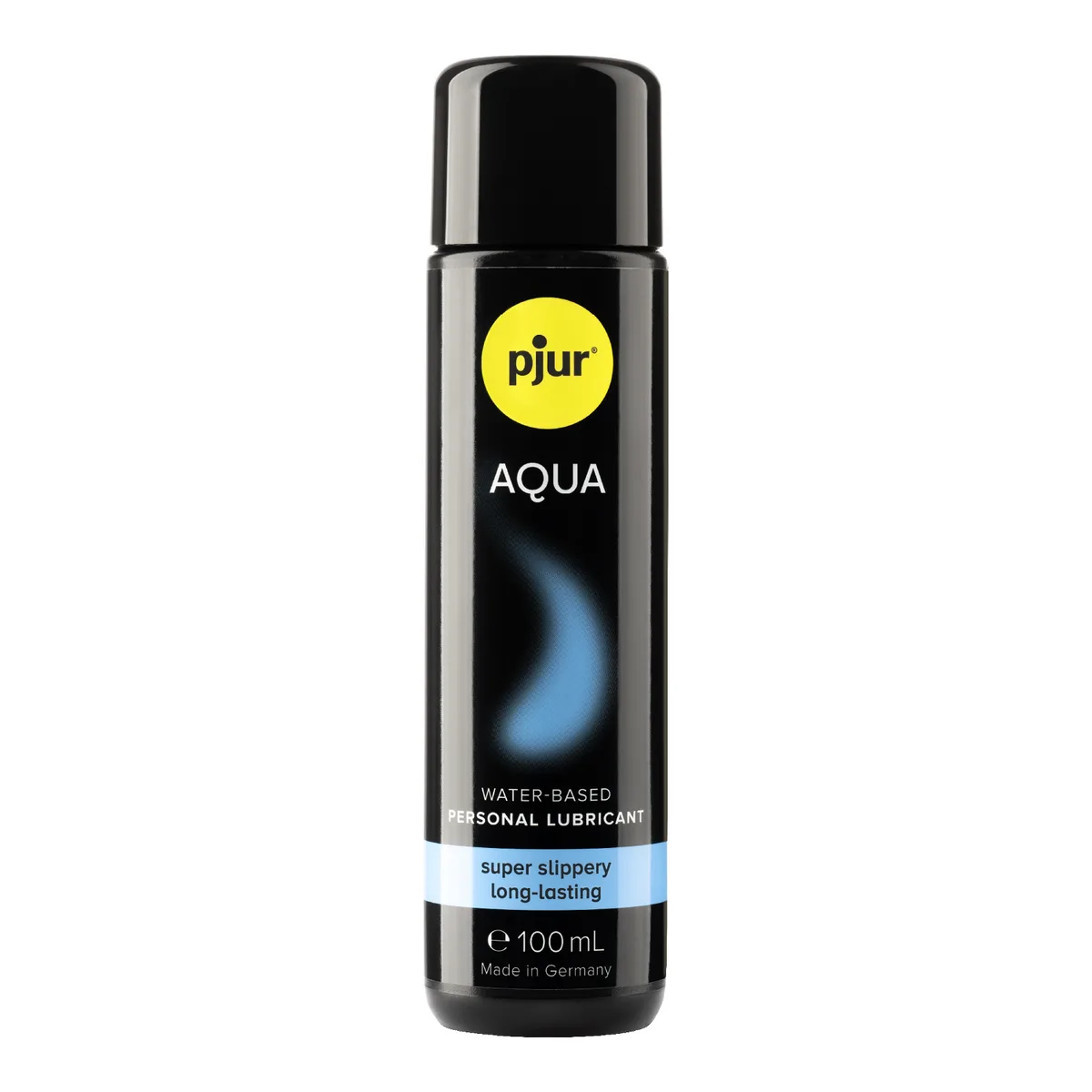
Pjur Aqua is a water-based lubricant from the German pjur, and it’s one of the most widely stocked in Swedish stores: seven stores had an item with the 100 ml bottle’s EAN in their product feeds at the price check on September 12, 2026. This review applies exclusively to the 100 ml variant with EAN 827160100278, which the manufacturer itself links to item number 10340-01.
What sets Pjur Aqua apart from many lubricants in the same price range is the documentation. The manufacturer publishes a complete ingredient list of seven ingredients; the bottle bears CE marking with the number of a notified body — 0482 — and the label has a durability symbol after opening marked 6M. The product is sold as a medical device, not as cosmetics. What the manufacturer does not publish, however, are the two values that say the most about how a water-based lubricant relates to mucous membranes: pH and osmolality.
In Sweden, the bottle cost between SEK 99 and SEK 179 at the six stores that reliably sell the correct product, and five of them had it in stock. The cheapest in-stock price was Blush Me at SEK 99, which corresponds to SEK 99 per 100 ml. A seventh store, Joyme, had the item in its feed for SEK 189 but sells it under the name pjur Basic — that is a different product, and why it is not included in the store price table is explained further down.
Four sizes, four EANs — which one applies here?
Pjur Aqua comes in four sizes. The variant table in pjur’s own store links 30 ml to EAN 0827160100261, 100 ml to EAN 0827160100278, 250 ml to EAN 0827160100285, and 500 ml to EAN 0827160100292. The leading zero is just filler for 13 digits; in the store feeds, the same number as 827160100278 is shown. The manufacturer’s image of the back of the bottle shows the same barcode printed on the label, together with the REF number 10340-01.
It’s worth keeping them separate, because pjur sells the same product under other numbers in other markets. The U.S. retailer WorldCondoms lists pjur Aqua 3.4 fl oz — meaning 100 ml — with the barcode 827160110086, and 8.5 fl oz with 827160110093. So if you search for the barcode in a foreign store, you can find the same lubricant under another number. In Sweden, it’s 827160100278 that applies for 100 ml, and that is the number all six stores in the table have in their flows.
The bottle’s appearance has also been changed. The manufacturer publishes a comparison image of the old and the new design, along with the message that buyers can get either one for a limited time. That explains why the product images in stores sometimes show the older bottle with blue AQUA text instead of the new one with a yellow logo. The volume and the EAN number are the same.
Is Pjur Aqua a medical device?
Yes. The back of the label bears the CE mark with the number 0482 and the symbol MD, which, according to the manufacturer’s symbol explanation, means that it is a medical device under EU Regulation 2017/745. The number 0482 belongs to DNV MEDCERT GmbH in Hamburg, which is the notified body that has issued pjur’s MDR certificate.
The certificate, which pjur publishes as a PDF, has the number 7250GB448240806 and applies from August 6, 2024 to May 15, 2027. It covers class IIb products in two groups: EMDN U0803, with the stated purpose “lubricant for vaginal dryness and/or as an accessory when used with condoms,” and EMDN M9002, with the purpose of preventing anal fissures and reducing the risk that the condom will break. The label’s English text describes Aqua as “water-based personal lubricant to relieve vaginal dryness” and “suitable for use with condoms” — meaning exactly the wording of the first group.
One nuance is important to get right: the certificate names no individual products. This applies to pjur’s quality management system for product groups, and the link to Aqua specifically runs via CE 0482 on the label. This is the normal order of products in class IIb, and it provides clearer traceability than a lubricant sold as cosmetics — but it does not mean that any authority has measured pH or osmolality and published the values.
Pjur places a lot of emphasis on the classification itself. On its quality page, the manufacturer states that lubricants that are introduced into the body fall under class IIb and that, from 2024, manufacturers must meet MDR requirements in order to continue selling products as lubricants. Pjur writes that the company belongs to the first and few lubricant manufacturers with MDR certification — a claim that is the manufacturer’s own description of the market and cannot be verified in the certificate.
The ingredients: seven substances, according to the manufacturer
Pjur’s product page and the label on the back of the bottle show the same ingredient list, in INCI names and in descending order: Aqua (Water), Glycerin, Ethoxydiglycol, Phenoxyethanol, Hydroxypropyl Guar Hydroxypropyltrimonium Chloride, Hydroxyethylcellulose, and Citric Acid. On the product page, there is also information that is not on the label: that hydroxyethylcellulose occurs in a concentration under 3 mg/ml (<3 mg/ml).
It is a short and readable list. It contains no oil, no fat, no perfume, and no added flavorings—the last is stated explicitly by the manufacturer (“Made without perfume or added flavours”). It contains no parabens. And it contains a preservative, phenoxyethanol, which is expected: WHO/UNFPA/FHI360’s advice on lubricants states that water-based lubricants must contain preservatives to prevent microbial growth, and mentions phenoxyethanol among the common alternatives to parabens.
What does each ingredient do?
Aqua is water and carries the whole product. Glycerin and Ethoxydiglycol are in second and third place. Pjur writes in its FAQ that glycols and glycerin are used in water-based lubricants, that they affect osmolarity, and that the amount is therefore kept under a certain threshold value. Which threshold value, and how high the concentration is in Aqua, is not published.
Phenoxyethanol is the preservative. Pjur mentions the substance itself in its FAQ as one of the preservatives that people with allergies or sensitivities may need to avoid, and in that case refers to silicone-based or preservative-free water-based products in its own range.
Hydroxypropyl Guar Hydroxypropyltrimonium Chloride and Hydroxyethylcellulose are the two thickening agents that give the gel its consistency—the first a modified guar derivative, the second a cellulose derivative. Citric Acid, citric acid, is normally used to adjust pH. That it is included says that the manufacturer controls the acidity level, but not to what value.
The guar derivative deserves its own comment. The name, with “trimonium chloride,” shows that it is a cationic, quaternary-modified guar. The WHO note advises purchasers to specifically avoid polyquaternium-15 and maybe polyquaternary compounds in general, pending more knowledge about their effect. No ingredient in Aqua is named polyquaternium, and neither the WHO note nor Pjur says anything about whether this particular guar derivative is covered by the precautionary advice. What can be established is that the question is open—not that the ingredient is problematic.
Two ingredient lists in circulation
The most interesting find in the review of the shops is that two of them publish a different ingredient list than the manufacturer. Blush Me and Vuxenkul both list ten ingredients: water, glycerin, ethoxydiglycol, hydroxypropylguar hydroxypropyltrimoniumchloride, hydroxyethylcellulose, citric acid, propylene glycol, benzyl alcohol, methylchloroisothiazolinone and methylisothiazolinone. Phenoxyethanol is missing from that list.
Lekosmek and Taboo, on the other hand, reproduce exactly the manufacturer’s current list with phenoxyethanol as a preservative, and Intima publishes no ingredient list at all. Sexonic does not either.
The difference is not cosmetic. Blush Mes and Vuxenkul’s list contains the preservatives methylchloroisothiazolinone and methylisothiazolinone. Methylisothiazolinone is a substance the EU has restricted in cosmetics: according to Regulation 2016/1198, the scientific committee for consumer safety assessed that 100 ppm was not safe with regard to sensitization, and since 12 February 2017 the substance in cosmetic products may only be used in products that are rinsed off. Lubricants are medical devices and not cosmetics, so the rule does not apply directly — but it explains why these substances are a relevant piece of information for someone who knows that they react to them.
The reasonable interpretation is that the shops’ list is an older version of the recipe that has been included in the product text, but pjur publishes no history of the recipe and no information about when it was changed. The manufacturer’s current list applies. Vuxenkul’s page also contains a built-in contradiction: the same page that states methylchloroisothiazolinone and methylisothiazolinone describes the formula as free from “unnecessary preservatives.” If you’re sensitive to isotiazolinones, the ingredient list on the bottle you actually receive is the only safe check — and since the manufacturer states that both old and new packaging may be delivered for some time to come, that check is worth doing.
Does Pjur Aqua contain glycerin and parabens?
Glycerin: yes, as the second ingredient. Parabens: no, neither in the manufacturer’s list nor in the older list that two shops reproduce. For most people, glycerin is an uncontroversial humectant, but pjur itself writes in its FAQ that glycerin and glycols can function as nutrition for Candida albicans, and it recommends silicone-based, preservative-free lubricants for women with recurring fungal infections and for women with diabetes. For vaginal dryness, the manufacturer recommends silicone-based products or water-based ones without glycerin and glycols.
It’s an unusually direct recommendation from a manufacturer, and it’s relevant specifically for Aqua. The label describes the product as a lubricant to relieve vaginal dryness, while the manufacturer’s own FAQ points it out as being intended for people who experience vaginal dryness and are bothered by products without glycerin and glycol. Aqua contains both. So someone who buys a lubricant mainly because of dryness has the manufacturer’s own support for choosing another product in the range.
pH and osmolality: the manufacturer does not publish
Pjur does not publish either the pH value or osmolality for Aqua. None of the values are listed on the product page, on the label, in the Swedish instructions for use, or in the manufacturer’s FAQ. None of the seven Swedish stores publishes either of them either.
It’s a gap shared with most lubricants on the market, but it’s noteworthy here for two reasons. The first is that pjur itself addresses osmolarity as a concept in its FAQ and explains that the amount of glycerin and glycols is kept below a threshold value so that the osmolarity is suitable. So the manufacturer knows that the value matters, but it doesn’t disclose it. The second is that the product is CE-marked as a medical device in class IIb—a classification that means the manufacturer has technical documentation that is reviewed by a notified body, but that does not require the values to be published for consumers.
What WHO’s guidance says
The most cited reference for these two values is WHO/UNFPA/FHI360’s guidance on lubricants for use with condoms from 2012. It’s written for procurement organizations, not for consumers, but it’s still the best benchmark available.
On pH, the note says that the pH of a healthy vagina normally lies between 3.8 and 4.5, and that a lubricant intended primarily for vaginal use should have a pH of around 4.5. For lubricants used primarily anally, or where it’s not possible to determine the use, a pH of 5.5–7 is recommended. Lubricants with a pH above 7 are not recommended.
On osmolality, the note says that vaginal secretions normally are 260–290 mOsm/kg and semen 250–380 mOsm/kg, that a lubricant ideally should not exceed 380 mOsm/kg, and that most commercial lubricants are 2,000–6,000 mOsm/kg. As an interim limit, a maximum of 1,200 mOsm/kg is recommended. The note links the value directly to the recipe: to stay under 1,200 mOsm/kg, the glycerol content should not exceed 9.9 weight percent and the propylene glycol content should not exceed 8.3 weight percent, and when blending glycols, the total glycol content should be kept below roughly 8.3 weight percent.
Pjur Aqua contains glycerin and ethoxy diglycol, but the concentrations are not published. Therefore, it is not possible to calculate where the product falls in relation to the WHO’s limits, and it is not possible to determine whether it is close to 380, close to 1,200, or in the range 2,000–6,000. The only thing that can be said based on the sources is that glycerin is second on the ingredient list, directly after water, and that the manufacturer itself states that the concentration is kept below a threshold value.
Who should choose something else?
The manufacturer’s own FAQ provides clearer guidance than most store texts. Pjur recommends silicone-based, preservative-free lubricants for the person who has recurring yeast infections or diabetes, and silicone-based or glycerin- and glycol-free water-based lubricants for vaginal dryness. For the person who is allergic or sensitive to preservatives, pjur recommends either silicone-based products without preservatives or the water-based alternatives pjur with Sensitive and pjur Woman Nude, which, according to the manufacturer, are free from preservatives, glycerin, and parabens.
Conversely, Aqua is not a problem according to the manufacturer’s own description for those who do not belong to those groups: pjur states that skin compatibility has been dermatologically tested, that biological compatibility has been tested by external laboratories, and that the product is intended for daily use. The warning text is the standard text pjur uses for all intimate lubricating gels: avoid contact with eyes and irritated skin or mucous membranes, consult a doctor in case of persistent irritation, store out of reach of children. Aqua is neither a contraceptive nor sperm-killing.
Condoms and sex toys
Compatibility is the part of the specification where Pjur Aqua is documented most clearly. Both the product information and the label expressly state that the lubricant works with latex and polyisoprene condoms, and the label says that it is suitable for sex toys.
Can you use Pjur Aqua with a condom?
Yes, with latex and polyisoprene condoms, according to the manufacturer. Pjurs FAQ adds that all of pjur’s lubricants are compatible with latex condoms and have undergone the tests required, and that Aqua additionally belongs to a shorter list — together with pjur Woman Aqua, pjur Back Door Regenerating and pjur Organic Touch — which is also suitable for polyisoprene condoms. Polyisoprene is the synthetic material that most latex-free condoms are made from, so this information is relevant for the person with a latex allergy.
Polyurethane condoms are not mentioned, neither on the product information, on the label, nor in the FAQ. A water-based lubricant without oils is usually not a problem for polyurethane, but this is a conclusion about the material category and not a statement from the manufacturer.
The instructions for use are specific about how the lubricant should be used with a condom: it is applied to the outside of the condom once it is on. Condom compatibility is also what lies behind the product’s medical device purpose—the MDR certificate’s Group U0803 describes the lubricant “as an accessory when used with condoms”.
Does it work with silicone toys?
The manufacturer states that Aqua is suitable for sex toys, and pjur’s FAQ says that water-based lubricants can be used with all toys. There is no explicit information about silicone sex toys specifically on Aqua’s product page, but in the same FAQ pjur answers the question for another water-based product in the range that water-based lubricants are safe for all types of toys, including silicone.
This is the practical main difference versus silicone-based lubricants, where compatibility with silicone sex toys is a real limitation. If you use silicone toys and want to avoid having to think about it, a water-based lubricant like Aqua is the easier combination. Taboo states in its product text that the lubricant is suitable for all sex toys and condoms, which is a shop claim that matches the manufacturer’s.
The bottle, the label, and shelf life
Pjur Aqua is delivered in a 100 ml bottle. What kind of closure it has—flip-top, screw cap, or pump—the manufacturer does not state in the text, and none of the shops does either. The manufacturer does not publish the bottle’s dimensions and weight, and while two shops list them, they contradict each other: Taboo states 80 grams and Joyme 120 grams, with dimensions of 35 × 35 × 145 millimeters. Both are shop claims, and the 40-gram difference for the same volume suggests that at least one of them has not been weighed.
The label, however, is unusually informative. In addition to the ingredient list and the CE marking, it bears the REF number 10340-01, the German pharmacy number PZN 00791148, the manufacturer’s name and address in Wasserbillig in Luxembourg, and the text “Made in Germany”. In its FAQ, pjur writes that all products are manufactured and filled in Germany, while legally, the manufacturer is the Luxembourg company.
The instructions for use on the label are in German, English, Dutch, French, and Spanish — but not in Swedish. Instead, the Swedish text is found on the manufacturer’s separate product information page, which the label’s information symbol with the address pjur.com refers to.
How long does Pjur Aqua last after opening?
The label bears the PAO symbol—a jar that has been opened—marked 6M, i.e. six months. The manufacturer’s symbol explanation defines the symbol as the period during which the product can be used safely after it has been opened for the first time. In addition, the label states “Store at room temperature” and includes a symbol to protect the product from sunlight.
Six months is a short shelf life for a lubricant, and it’s worth keeping in mind. Someone who buys 100 ml and uses a smaller amount at a time can still have a large part of the bottle left after half a year. It also affects the choice between the sizes: the manufacturer’s list price is 139.50 euro per liter for 100 ml and 131.80 euro per liter for 250 ml, a difference of just under six percent. With the same shelf life after opening, there’s therefore a bit to gain from the larger bottle for someone who doesn’t manage to use it up in time.
How do you remove it?
With water. The manufacturer writes that water-based lubricants are absorbed mostly by the top layer of skin, and that anyone who applied too much just needs to rinse it off with lukewarm water. No soap is required, according to the manufacturer. It’s a practical advantage compared with silicone-based lubricants, where pjur itself writes that stains on textiles don’t come out in a single wash.
Two safety details from the label belong here. There’s an explicit slip warning for smooth surfaces, which is worth taking seriously in the shower and bathtub. And pjur writes in its FAQ that the lubricants are safe to swallow in small quantities, but that larger amounts can have a laxative effect.
Where can you buy it — and what does it cost?
We do not have price data from shops in your market yet.

Pjur explains in its own FAQ that the amount of glycerin and glycols is kept below a threshold so that the osmolarity is suitable — but it publishes neither the threshold value nor the osmolality.
Pros
- Full ingredient list from the manufacturer, also printed on the label
- CE-marked medical device with notified body 0482
- Explicitly compatible with both latex and polyisoprene condoms
- Suitable for sex toys and is rinsed off with lukewarm water
- Without fragrance, added flavorings, oils, and parabens
- From 99 SEK — the same price per 100 ml as Fleshlube Water
Cons
- Neither pH nor osmolality is published, even though the manufacturer itself mentions osmolarity
- Contains glycerin and glycol — pjur itself advises against it in cases of dryness and fungal issues
- Only six months of shelf life after opening
- Two stores list an older ingredient list with isotiazolinones
- More than an 80 percent price difference: 99–179 SEK for the same bottle
- EasyGlide Waterbased costs about 40 percent less per milliliter
Rating in detail: five criteria, the same for the entire category
- Ingredients and declaration
- 8,0
- Full INCI for seven ingredients, CE 0482 on the label, and MDR certificates from the manufacturer.
- Mucosal compatibility
- 5,5
- pH and osmolality are not published; glycerin is listed in second place.
- Compatibility
- 8,5
- Latex and polyisoprene condoms and sex toys according to the manufacturer; polyurethane is not mentioned.
- Use and packaging
- 6,0
- Rinses off with water, but 6 months after opening and no Swedish text on the label.
- Price per milliliter
- 7,0
- 99 SEK per 100 ml – more expensive than EasyGlide and Just Glide at just under 60 SEK.
Pjur Aqua compared with the alternatives
Four comparisons are relevant: against a water-based lubricant in the same size and at the same price, against the cheapest water-based alternative in the catalog, against a glycerin-free alternative, and against a neutral water-based lubricant in a larger bottle. All prices are the lowest in-stock prices from the retailers’ product flows on September 12, 2026.
Against Fleshlube Water 100 ml
Fleshlube Water is sold in the same volume, 100 ml, and costs from 99 SEK—exactly the same lowest price as Pjur Aqua. So per 100 ml, they’re equally expensive. The choice between them is therefore not driven by price, but by what documentation exists for each product—and there is Pjur Aqua’s published ingredient list, explicit polyisoprene compatibility, and CE marking with a notified body, which is the benchmark the other product can be measured against.
Against EasyGlide Waterbased 150 ml
EasyGlide Waterbased is the cheapest water-based lubricant in this issue’s catalog: 150 ml for 89 SEK, which is a little over 59 SEK per 100 ml. Pjur Aqua costs 99 SEK per 100 ml at the cheapest shop, which makes EasyGlide about 40 percent cheaper per milliliter. That’s the biggest single objection to Aqua on the basis of price: the person who mainly wants a water-based lubricant at the lowest per-milliliter price has a significantly cheaper alternative.
Against Swede Original Woman Sensitive 120 ml
Swede Original Woman Sensitive is marketed as glycerin-free and costs from 149 SEK for 120 ml, which is thus a little over 124 SEK per 100 ml—about a quarter more expensive than Aqua per milliliter. The comparison is relevant for one single reason: pjur itself recommends lubricants without glycerin and glycol for people with vaginal dryness, and Aqua contains both glycerin and ethoxydiglycol. For that buyer, the price difference is the cost that the manufacturer’s own advice entails.
Versus Joydivision Aquaglide Neutral 200 ml
Joydivision Aquaglide Neutral is sold in 200 ml and costs from 149 SEK, which is 74.50 SEK per 100 ml. It is about a quarter cheaper than Aqua per milliliter, in a bottle that is twice as large. With Aqua’s six months’ shelf life after opening in mind, a larger bottle is not automatically an advantage—it also needs to be used—but the price difference per milliliter is clear.
Within pjur’s own range, it’s also worth noting the difference versus the silicone-based pjur Woman: 250 ml for 329 SEK, which is a little over 131 SEK per 100 ml. Aqua is the cheaper option from the same manufacturer, and the manufacturer’s own FAQ describes the silicone-based lubricants as free from preservatives.
Price range: 99 to 179 SEK at six stores
Six stores sell Pjur Aqua 100 ml with EAN 827160100278 in the store table. Cheapest is Blush Me at 99 SEK, most expensive are Lekosmek and Taboo at 179 SEK each. The difference is 80 SEK, or a little over 80 percent of the lowest price—a big spread for a product sold in identical form everywhere.
Five of the six had the bottle in stock at the price check on September 12, 2026: Blush Me at 99 SEK, Intima at 149 SEK, Vuxenkul at 160 SEK, as well as Lekosmek and Taboo at 179 SEK each. Sexonic was in the flow at 124 SEK but was out of stock. Vuxenkul lists 229 SEK as the regular price and 160 SEK as the campaign price, meaning a 30 percent discount; Blush Me’s price is without a discount mark.
The manufacturer’s own list price is 13.95 euro for 100 ml. Sexonic, which prices in euro, has exactly 13.95 euro as the regular price and sells the bottle at a reduced price of 11.30 euro. Lekosmek and Taboo also share the same article number, 617741, and the same price of 179 SEK, which suggests a shared supplier. Both offer free shipping from 699 SEK, which means that, in practice, a single bottle of lubricant ends up having the shipping added on top of the price.
Calculated per milliliter, Aqua costs 99 SEK per 100 ml at the cheapest store and 179 SEK per 100 ml at the most expensive ones. Blush Me states delivery in 1–2 days and that orders placed before 4:00 p.m. are shipped the same day. That means that price is the only thing that differs—and it differs a lot.
When the stores contradict each other
The review of the store pages resulted in four clashes worth reporting.
The first and most important concerns Joyme. Joyme’s product page is called "Pjur Basic – water-based lubricant 100 ml", and the product text describes a "pjur Basic Aqua". Pjur Basic is a separate product — WorldCondom’s product data lists pjur Basic Water Based 100 ml with the barcode 827160112080, not 827160100278. At the same time, Joyme’s product image shows an Aqua bottle in an older design, and in the product flow the item is listed under Aqua’s EAN for 189 SEK. Because it’s not possible to determine which of the two products an order from the page actually delivers, Joyme is not included in the store table.
The second concerns the ingredients. As described above, Blush Me and Vuxenkul state an ingredient list with propylene glycol, benzyl alcohol, methylchloroisothiazolinone, and methylisothiazolinone, while the manufacturer, Lekosmek, and Taboo list phenoxyethanol as a preservative. The manufacturer’s list applies.
The third concerns the weight: Taboo states 80 grams and Joyme 120 grams for the same 100 ml bottle. The manufacturer states no weight at all.
The fourth concerns Sexonic, which has two product pages with the same EAN 827160100278: "Pjur Aqua Water Based Lubricant 100 ml" for 11.30 euro and "Pjur Aqua Super Slippery 100 ml Naturel" for 16.19 euro, with a regular price of 19.99 euro. "Super slippery" is the text printed on the bottle itself, so both pages refer to the same product — but at prices that differ by almost five euros. In the store table, the cheaper page is shown.
Who is Pjur Aqua for — and who is it not for?
It’s right for you if you want a water-based lubricant with documentation you can verify: a complete ingredient list from the manufacturer, CE marking with a notified body, explicit compatibility with both latex and polyisoprene condoms, and a clear statement that it works with sex toys. It’s for you who uses silicone toys and wants to avoid having to think about the material question, and you who want to be able to rinse the lubricant off with just water.
It’s also for you who shops where it’s cheapest. At 99 SEK per 100 ml, Aqua is in the middle of the range; at 179 SEK, it’s at the expensive end — more expensive per milliliter than both Swede Original Woman Sensitive and pjurs own silicone-based Woman.
It doesn’t suit you who have recurring yeast infections, diabetes, or issues with vaginal dryness — not according to us, but according to the manufacturer’s own FAQ, which in those cases recommends silicone-based or products that are free of glycerin and glycol. It doesn’t suit you who want to know pH and osmolality before you buy, because none of the values are published. It doesn’t suit you who react to phenoxyethanol, and it also doesn’t suit you who react to isothiazolinones without first checking the label on the exact bottle you receive. And it suits you worse if you use a little lubricant only rarely: six months of shelf life after opening means that part of the bottle may need to be thrown away.
Complaints, right of withdrawal, and the hygiene exception
No voluntary manufacturer warranty states that pjur does not apply, and that’s normal for a consumable product. What applies are your statutory rights. Under the Consumer Sales Act (konsumentköplagen), you have three years to make a complaint for faults in the product — for example, a bottle that leaks during delivery or a seal that doesn’t work. However, normal use and a product that has passed its shelf life after opening is not a fault with the product.
For distance purchases, you have a right of withdrawal for fourteen days under the Distance Contracts Act and Contracts Outside Business Premises. The Swedish Consumer Agency (Konsumentverket), however, provides guidance that the right of withdrawal does not apply to goods that, for health or hygiene reasons, are sealed and where the seal has been broken. A lubricant that has been opened typically belongs to that category. You can normally withdraw an unopened bottle; an opened one probably not.
What applies in the specific case is determined by the shop’s terms within the framework of the law, and it’s worth reading them before you buy. If you have questions about what applies, the Swedish Consumer Agency (Konsumentverket) guides you via Hallå konsument.
Specifications: ingredients, compatibility, classification, packaging, and purchase
Base and ingredients
- Base
- Water-based
- Ingredients (INCI)
- Aqua (Water), Glycerin, Ethoxydiglycol, Phenoxyethanol, Hydroxypropyl Guar Hydroxypropyltrimonium Chloride, Hydroxyethylcellulose, Citric Acid
- The manufacturer’s list, the same as on the label
- Hydroxyethylcellulose content
- Under 3 mg/ml
- Stated on the product page, not on the label
- Glycerin
- Yes, second ingredient
- The concentration is not published
- Glycols
- Yes, ethoxydiglycol
- The concentration is not published
- Preservatives
- Phenoxyethanol
- Parabens
- No
- Fragrance and flavor
- No
- The manufacturer: without fragrance and added flavorings
- Oils and fats
- No
- Deviating ingredient list
- With propylene glycol, benzyl alcohol, and isothiazolinones
- Store information from Blush Me and Vuxenkul — the manufacturer’s list applies
Mucous membranes and compatibility
- pH
- Not published by the manufacturer
- Osmolality
- Not published by the manufacturer
- Latex condoms
- Yes
- Polyisoprene condoms
- Yes
- Polyurethane condoms
- Not published by the manufacturer
- Sex toys
- Yes
- Manufacturer’s FAQ: water-based lubricants can be used with all toys
- Dermatologically tested
- Yes, according to the manufacturer
- Contraception
- No — not spermicidal
- Cleaning
- Rinse off with lukewarm water
- Sound level
- Not applicable — no electronics
- Battery and charging
- Not applicable — no battery
Classification and labeling
- Product type
- Medical device (MD)
- CE marking
- CE 0482
- Notified body DNV MEDCERT GmbH
- MDR certificate
- 7250GB448240806, class IIb
- Valid from August 6, 2024 – May 15, 2027, covers product groups
- REF
- 10340-01
- PZN
- 00791148
- Manufacturer
- pjur group Luxembourg S.A., Wasserbillig
- Country of manufacture
- Germany
- "Made in Germany" on the label
- Language on the label
- German, English, Dutch, French, Spanish
- A Swedish user manual is available on the manufacturer’s website
Packaging, shelf life, and purchase
- Volume
- 100 ml
- Packaging type
- Bottle
- The type of closure is not specified
- Weight
- Not published by the manufacturer
- Store information: 80 g (Taboo) and 120 g (Joyme), respectively
- Dimensions
- Not published by the manufacturer
- Store pickup from Joyme: 35 × 35 × 145 mm
- Shelf life after opening
- 6 months (6M)
- Storage
- Room temperature, protected from sunlight
- EAN
- 827160100278
- 30 ml: 827160100261, 250 ml: 827160100285
- Sizes
- 30, 100, 250 and 500 ml
- Manufacturer’s list price
- 13.95 euro
- 139.50 euro per liter
- Price in Sweden
- 99–179 SEK
- Six stores, checked 12 September 2026
- Price per 100 ml
- 99 SEK
- Lowest price in stock
- Right of complaint
- 3 years
- According to the Swedish Sale of Goods Act (konsumentköplagen), regardless of the manufacturer’s assurances
Frequently asked questions about Pjur Aqua
What does Pjur Aqua contain?
Can you use Pjur Aqua with a condom?
What pH and what osmolality does Pjur Aqua have?
Is Pjur Aqua a medical device?
How long does Pjur Aqua last after the bottle is opened?
Does Pjur Aqua work for vaginal dryness or fungal infections?
Why is Pjur Aqua priced so differently in different stores?
Is pjur Basic the same as Pjur Aqua?
The best-in-test product
Pjur Aqua 100 ml is ranked etta av 12 in lube best i test, where the entire category is compared against each other using five shared criteria.
Related guides and searches
Sources
Every numerical piece of information in the text can be traced to one of the sources below. The links were checked manually on the specified date.
- The ingredient list Aqua (Water), Glycerin, Ethoxydiglycol, Phenoxyethanol, Hydroxypropyl Guar Hydroxypropyltrimonium Chloride, Hydroxyethylcellulose <3 mg/ml, Citric Acid; the four sizes 30, 100, 250, and 500 ml with article numbers 10330-01, 10340-01, 10350-01 and 10360-01 and EAN 0827160100261, 0827160100278, 0827160100285 and 0827160100292 in the page’s variant table; the list price 13.95 euro for 100 ml (139.50 euro per liter), 6.95 euro for 30 ml, 32.95 euro for 250 ml, and 59.95 euro for 500 ml; compatibility with latex and polyisoprene condoms, suitability for sex toys, that the product is manufactured without fragrance and added flavorings, that excess is washed off with lukewarm water, dermatologically tested skin compatibility, external testing of biological compatibility as well as the warning texts: pjur — official product page for pjur AQUA — kontrollerad 26 September 2026
- Back of the label: CE marking with notified body 0482, the MD symbol, REF 10340-01, PZN 00791148, the symbol for sustainability after opening labeled 6M, “Store at room temperature”, the barcode 8 27160 10027 8, the manufacturer pjur group Luxembourg S.A. in Wasserbillig, the ingredient list and the instructions for use in German, English, Dutch, French and Spanish: pjur — product image of the back for pjur AQUA 100 ml (EU) — kontrollerad 26 September 2026
- That the packaging design has been changed and that buyers can, for a limited time, receive either the old or the new bottle (“You may receive either of these packs for a limited time”): pjur — comparison image of old and new packaging for pjur AQUA 100 ml — kontrollerad 26 September 2026
- That pjur AQUA is also suitable for polyisoprene condoms, that all pjur lubricants are tested for latex condoms, that all products are manufactured and filled in Germany, that glycols and glycerin affect osmolality and that the amount is kept below a threshold value, that glycerin can be a source of nutrition for Candida albicans, that the manufacturer recommends silicone-based or glycerin- and glycol-free products for vaginal dryness, recurring fungal infections and diabetes, that phenoxyethanol and glycerin are mentioned as preservatives in case of allergy, that the silicone-based lubricants lack preservatives, that pjur with Sensitive and pjur Woman Nude are free from preservatives, glycerin and parabens, that water-based lubricants are safe for all types of toys including silicone, that the lubricants are safe to ingest but may have a laxative effect in large amounts, that silicone stains do not come out of textiles in a wash, as well as the symbol explanations for, among other things, sustainability after opening, CE marking and the MD symbol: pjur — frequently asked questions (FAQ) — kontrollerad 26 September 2026
- The manufacturer’s description of why lubricants are regulated as medical devices under the MDR, the risk classes I, IIa, IIb and III, that lubricants that are introduced into the body belong to class IIb, and what CE marking with an identification number for a notified body and the MD symbol mean: pjur — Quality promise — kontrollerad 26 September 2026
- EU certificate for quality management system no. 7250GB448240806 for pjur group Luxembourg S.A., issued by DNV MEDCERT GmbH (notified body 0482) in accordance with Annex IX, Chapter I and III, of Regulation (EU) 2017/745, valid from 6 August 2024 to 15 May 2027, covering class IIb products in the groups EMDN U0803 (lubricant against vaginal dryness and as an accessory to condoms) and M9002 (lubricant to help prevent anal fissures and reduce the risk of condom breakage): pjur / DNV MEDCERT — MDR certificate (PDF) — kontrollerad 26 September 2026
- The manufacturer’s Swedish instructions for intimate lubricating gels: intended use, application to the condom after it has been put on, dermatologically tested skin compatibility, external testing of biological tolerability, the warnings and safety instructions, and that pjur states that it manufactures medical devices of class IIb: pjur — Product information and instructions for use (Swedish) — kontrollerad 26 September 2026
- The recommendations on osmolality (preferably at most 1,200 mOsm/kg, ideally at most 380 mOsm/kg; vaginal secretions 260–290 and semen 250–380 mOsm/kg; most commercial lubricants 2,000–6,000 mOsm/kg), the limits of 9.9 weight percent glycerol and 8.3 weight percent propylene glycol, pH around 4.5 for vaginal use and 5.5–7 for anal or unspecified use, that pH above 7 is not recommended, that the normal pH of a healthy vagina is 3.8–4.5, that water-based lubricants must contain preservatives that can irritate, and caution with polyquaternium compounds: WHO/UNFPA/FHI360 — Use and procurement of additional lubricants for male and female condoms: advisory note (2012) — kontrollerad 26 September 2026
- That the SCCS has assessed 100 ppm methylisothiazolinone as not safe with regard to sensitization, that the substance in cosmetic products is thereafter only permitted in products that are rinsed off (at most 0.01 percent) and that the rule applies from 12 February 2017 — as well as that the mixture with methylchloroisothiazolinone is regulated in a separate entry: Commission Regulation (EU) 2016/1198 — EUR-Lex — kontrollerad 26 September 2026
- Store information: the price is 99 SEK, delivery 1–2 days, that orders placed before 4:00 pm are sent the same day, that the product is manufactured in Germany and an ingredient list with propylene glycol, benzyl alcohol, methylchloroisothiazolinone and methylisothiazolinone that does not match the manufacturer’s current list: Blush Me — product page for Pjur Aqua 100 ml — kontrollerad 26 September 2026
- Store information: EAN13 0827160100278, the price is 11.30 euro reduced from 13.95 euro and the discount is 19 percent: Sexonic — product page for Pjur Aqua Water Based Lubricant 100 ml — kontrollerad 26 September 2026
- Store information: the same EAN 827160100278 on a second product page in the same store, with the price of 16.19 euro reduced from 19.99 euro: Sexonic — product page for Pjur Aqua Super Slippery 100 ml Naturel — kontrollerad 26 September 2026
- Store information: the quantity is 100 ml, item number 16588, that the lubricant can be used with condoms and is fragrance- and flavor-free — without an ingredient list: Intima — product page for Pjur Aqua 100 ml — kontrollerad 26 September 2026
- Store information: regular price 229 SEK and campaign price 160 SEK (30 percent), EAN 827160100278 for 100 ml, the store’s item number ED0480-2, the sizes 30, 100, 250 and 500 ml, the claim that the formula is free from parabens and “unnecessary preservatives,” as well as an ingredient list with propylene glycol, benzyl alcohol, methylchloroisothiazolinone and methylisothiazolinone: Vuxenkul — product page for Pjur Aqua — kontrollerad 26 September 2026
- Store information: the price is 179 SEK, item number 617741, contents 100 ml, made in Germany, “dermatologically and toxicologically tested,” free shipping over 699 SEK, and an ingredient list that matches the manufacturer’s current: Lekosmek — product page for Pjur Aqua Glidmedel 100 ml — kontrollerad 26 September 2026
- Store information: the price is 179 SEK, item number 617741, EAN 827160100278, weight 80 grams, free shipping over 699 SEK, that the lubricant is compatible with all sex toys and condoms, and an ingredient list that matches the manufacturer’s current: Taboo — product page for Pjur Aqua 100 ml — kontrollerad 26 September 2026
- Store information: the product name “Pjur Basic – water-based lubricant 100 ml” and the description of “pjur Basic Aqua,” price 189 SEK, item number D-201644, weight 120 grams, dimensions 35 × 35 × 145 mm, and free shipping over 899 SEK — while the product image shows an Aqua bottle in an older design: Joyme — product page for Pjur Basic water-based lubricant 100 ml — kontrollerad 26 September 2026
- That pjur Basic Water Based 100 ml is a separate product with barcode 827160112080: WorldCondoms — product data in JSON format for pjur Basic Water Based 100 ml — kontrollerad 26 September 2026
- That pjur Aqua in the American retailer’s range has the barcode 827160110086 for 3.4 fl oz (100 ml) and 827160110093 for 8.5 fl oz — i.e., other numbers than the EU variants: WorldCondoms — product data in JSON format for pjur Aqua — kontrollerad 26 September 2026
- Three years of complaint right in case of defects in the goods: Konsumentköplag (2022:260) — Sveriges riksdag — kontrollerad 12 September 2026
- Fourteen days’ right of withdrawal for distance selling: Lag (2005:59) om distansavtal och avtal utanför affärslokaler — Sveriges riksdag — kontrollerad 12 September 2026
- Guidance on the right of withdrawal and the exception for sealed hygiene products: Konsumentverket (Swedish Consumer Agency) — kontrollerad 12 September 2026
- Prices, stock status, and item number at 7 stores for EAN 827160100278. Collected from the stores’ own product feeds on September 12, 2026: Adtraction (kanal Testkollen) and Addrevenue (kanal Testra) — kontrollerad 12 September 2026
- Comparison prices from the same product feeds on September 12, 2026: Fleshlube Water 100 ml (EAN 8428508034716) from SEK 99, EasyGlide Waterbased 150 ml (EAN 8718627520017) from SEK 89, Joydivision Aquaglide Neutral 200 ml (EAN 4028403117046) from SEK 149, Swede Original Woman Sensitive 120 ml (EAN 7350028782222, in the feed referred to as “Glycerinfritt Glidmedel”) from SEK 149, and pjur Woman 250 ml (EAN 827160107277, in the feed referred to as “Silikonbaserat Glidmedel”) from SEK 329; lowest in-stock price: Adtraction (kanal Testkollen) and Addrevenue (kanal Testra) — kontrollerad 12 September 2026
This page is machine-translated from Swedish. Read the Swedish original