
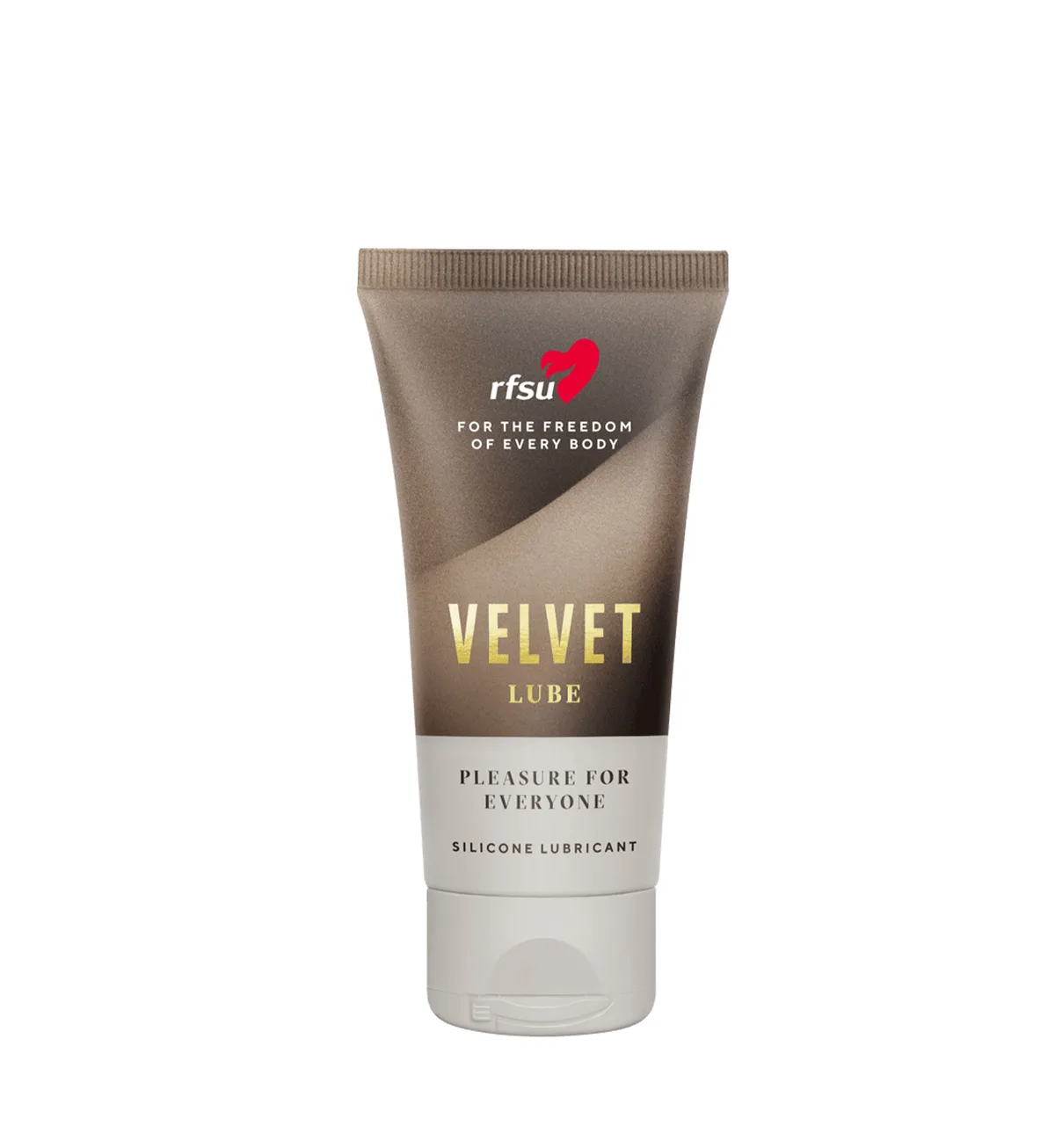
Review · Lubricant · Silicone-based
RFSU Velvet Lube 40 ml: review
A Swedish silicone lubricant reviewed against the manufacturer’s product page, label, and safety data sheet, as well as price data from five stores. Two ingredients, no perfume and no preservatives, compatible with all types of condoms according to RFSU — but 247,50 SEK per 100 ml, no use with silicone sex toys, and six months of shelf life after opening.
My rating
Velvet Lube has the shortest ingredient list a silicone lube can have—Dimethicone and Dimethiconol, nothing else—and it is published on the tube, on the product page, and in a safety data sheet. According to RFSU, it works with all types of condoms and in showers and baths. The price per milliliter, however, is high: 247.50 SEK per 100 ml versus 131.60 for pjur Woman. In addition, the manufacturer advises against using it with silicone sex toys and states a shelf life of six months after opening.
- Two ingredients: Dimethicone and Dimethiconol
- Fragrance-free, without glycerin, glycols, and preservatives
- Compatible with all types of condoms, according to RFSU
- Not for silicone sex toys, according to the manufacturer
- 40 ml tube, 6-month shelf life after opening, made in Sweden
- 99–129 SEK at five stores, 247.50 SEK per 100 ml
RFSU Velvet Lube at a glance
RFSU Velvet Lube is a silicone-based lubricant in a 40 ml tube from Swedish RFSU. The manufacturer calls the product “Velvet Lube – for silken-smooth feel that lasts a long time” and describes it as 100 percent silicone-based, fragrance-free, pH-neutral, gynecologically tested, and vegan, with certification from The Vegan Society. This review applies exclusively to the 40 ml tube with EAN 7310571600121.
The most noteworthy thing about the product is how short the ingredient list is. RFSU lists two ingredients — Dimethicone and Dimethiconol — and nothing else. No water, no glycerin, no glycols, no preservatives, no fragrance, and no aroma. The same two ingredients are printed on the back of the tube, are reproduced by all three pharmacies that sell it, and are repeated in RFSU’s own safety data sheet.
In Sweden, the tube is sold by five stores in this comparison, four for 99 SEK and one for 129 SEK, and all of them had it in stock at the price check on 12 September 2026. This gives a price of 247.50 SEK per 100 ml in the cheapest tier — significantly more per milliliter than the larger silicone lubricants in the same price comparison, which is the single clearest weakness. The rest of the review is about what the two ingredients mean, what the manufacturer publishes and does not publish, and where the documentation contradicts itself.
Which variant applies to the review?
Velvet Lube is available in this comparison in a single size, 40 ml. RFSU’s product page states no other volume. The EAN number is verified in four ways: the barcode on the back of the tube in RFSU’s own product image is read as 7 310571 600121, and Apoteket, Apotea, and Kronans Apotek publish the same number for the 40 ml tube. Mshop also lists 7310571600121 in its specification box. All five stores in the price comparison sell 40 ml, and none of them lists any other size under the same product.
RFSU does not publish the EAN number on its own product page, either in the text or in the page’s structured data. The connection between the product page and the barcode goes via the manufacturer’s image of the package, where the barcode, the 40 ml volume, and the ingredient list are visible on the same label.
Who manufactures Velvet Lube?
The label states RFSU AB, Färögatan 33, 164 51 Kista, and the text "Made in Sweden". RFSU’s product page says the same thing in Swedish: manufactured in Sweden. The safety data sheet has the same address and lists RFSU AB as the party providing the data sheet. So both the brand and the manufacturing are Swedish, and RFSU remains as the sender all the way from the product page to the label and the data sheet.
Ingredients: dimethicone and dimethiconol — nothing else
The ingredient list is the most useful piece of information in the entire specification, and it is published in four places that match: RFSU’s Swedish and English product pages, the label, and the safety data sheet, where it says "Contents according to INCI names on the label: Dimethicone, Dimethiconol". Apoteket, Apotea, and Kronans Apotek reproduce exactly the same two names.
What do dimethicone and dimethiconol mean?
Both are INCI names, meaning the standardized ingredient names used on cosmetic products in the EU. Dimethicone is polydimethylsiloxane, the most common silicone liquid in cosmetics. Dimethiconol is a closely related silicone polymer. Together, they make up the entire formulation — this is what RFSU means by "100 % silicone-based".
The order in the list also says something. The EU’s Cosmetics Regulation requires the ingredient list to be compiled in descending order by weight, where only components under one percent may be listed in any order. That dimethicone comes first therefore means that it is the main ingredient. RFSU does not publish how the distribution looks in percentages, and the safety data sheet’s composition table is blank because the product does not contain any substances that are subject to disclosure requirements.
Polydimethylsiloxane is not an unusual choice. The guidance from WHO, UNFPA, and FHI360 on lubricants for condom use states that silicone oils of this type are the most common lubricants that condom manufacturers themselves apply to condoms during manufacturing, and it describes silicone fluids as inert and with minimal effect on the latex film’s properties. WHO’s and UNFPA’s later procurement specification for lubricants requires that a silicone lubricant contains at least 30 percent polydimethylsiloxane. Velvet Lube, as stated on the label, is precisely the type of product that the specification describes.
Does Velvet Lube contain glycerin, parabens, or perfume?
No, according to the ingredient list. With two ingredients declared, there is no room for glycerin, propylene glycol, parabens, phenoxyethanol, or perfume—the cosmetics regulation requires that perfume be listed using the word “parfum” or “aroma,” and nothing like that is on the label. RFSU also explicitly states “perfume free” on the tube, and the safety data sheet describes the scent as “without perfume.”
The absence of preservatives is not a shortcoming; it is a consequence of the base. WHO’s and UNFPA’s specification requires preservatives for water-based lubricants, because water is what makes microbial growth possible. For silicone lubricants, there is no corresponding requirement in the specification. A water-free lubricant with two silicones simply does not need to be preserved in the same way as a water-based gel.
The absence of glycerin and glycols is also the information that makes the osmolality issue irrelevant for this particular product—more about that below.
What the safety data sheet shows
RFSU has prepared a safety data sheet for Velvet Lube, and Apoteket links to it from its product page. The document is version 1, issued on 2025-09-15, and states formula No. 7275. It’s unusual for a lubricant manufacturer to publish such a document at all, and it contains several details that the product page lacks.
The product is not classified as hazardous under the CLP regulation and has no hazard pictograms, signal words, or hazard statements. The physical state is listed as gel, the color as transparent, and the product as not soluble in water. The ingredients do not meet the criteria for PBT or vPvB, that is, substances that are persistent, bioaccumulative, and toxic. According to the data sheet, in case of eye contact the gel may cause temporary mild irritation and blurred vision. In case of skin contact, the advice states: “Wash the skin with soap and water”.
Two rows in the datasheet are worth highlighting in particular. The first is that the pH value is stated as “Not measured”, which is covered in the next section. The second is that the datasheet, under possible effects on skin contact, says that the product “can feel a little sticky if you get a lot on the skin,” while RFSU’s English product page promises that the formula does not become sticky. The two claims do not rule each other out—one applies to a normal amount, the other to an overdose—but the datasheet is more cautious of the two sources.
pH and osmolality: that’s why the numbers don’t fit a silicone lubricant
For water-based lubricants, pH and osmolality are the two most important figures to look for. The WHO/UNFPA/FHI360 advice from 2012 states that healthy vaginal pH normally lies between 3.8 and 4.5, that a lubricant for vaginal use should preferably be around 4.5, and one for rectal use between 5.5 and 7. For osmolality, the same document states that the value should preferably not exceed 380 mOsm/kg and, for now, at most 1,200 mOsm/kg, because lubricants with high osmolality can damage the surface layer of the mucous membrane.
Is Velvet Lube pH-neutral?
RFSU writes “fragrance-free and pH-neutral” on the product page and repeats it in its FAQ. However, the Safety Data Sheet from the same manufacturer lists the pH value as “Not measured”. It’s a contradiction between two RFSU documents, and both are presented here.
The contradiction has a reasonable explanation. pH is a measure of hydrogen ion activity in an aqueous solution, and a product that, according to the datasheet, consists of two silicones and is not soluble in water has no pH value in the real sense that there is something to measure. WHO’s and UNFPA’s procurement specification reflects the same thing: the requirement for pH between 5.0 and 7.0 explicitly applies to water-based lubricants, and for silicone lubricants only a viscosity requirement is given. “pH-neutral” should therefore be read to mean that the product does not add anything that affects the mucous membrane’s pH—not as a measured number. RFSU does not publish any numeric value, and there is nothing to relate to the WHO ranges.
What is osmolality—and why is the value missing?
Osmolality indicates how many dissolved particles a liquid contains per kilo of water, and it determines which direction water moves between the lubricant and the mucous membrane. The WHO guidance states that vaginal secretions normally lie at 260–290 mOsm/kg and semen at 250–380 mOsm/kg, while most commercial lubricants are at 2,000–6,000 mOsm/kg.
The same document points out the cause: it is above all the content of glycols — glycerol and propylene glycol — that drives up osmolality, and to keep it below 1,200 mOsm/kg, the glycerol content should stay under 9.9 weight percent and the propylene glycol under 8.3. Velvet Lube contains neither water nor glycols, and RFSU publishes no osmolality value. Osmolality is defined per kilogram of water, and in a water-free silicone lube there is no water to dissolve particles in. The procurement specification therefore only sets the osmolality requirement for water-based lubricants.
What can therefore be established is that the risk the osmolality discussion is about — that a glycol-rich lubricant draws water out of the mucous membrane — does not apply to a formulation without glycols. That doesn’t make silicone lube risk-free in general. The WHO guidance itself points out that silicone liquids are expected to be safe and effective as lubricants, but that there are no published clinical studies of that specific use, especially with latex condoms during anal sex.
Condoms, sex toys, and water: what Velvet Lube works with
Compatibility is the practical downside of choosing a pure silicone lube. The manufacturer states three things: the product is safe with condoms, it should not be used with silicone sex toys, and it is water-resistant enough for showers and baths.
Yes, according to the manufacturer.
Yes, according to the manufacturer. RFSU writes "safe to use with condoms" in the product information and, in its FAQ, answers that the product is "fully compatible with all types of condoms". The tube’s Swedish back-label text says "can be used with or without a condom". Mshop specifies in its product text that this applies to condoms "including latex" — a store claim, but it matches the manufacturer’s broader wording.
The WHO/UNFPA/FHI360 guidance gives the same picture from an independent perspective. It states that silicone-oil-based lubricants are compatible with natural rubber latex condoms, that almost all lubricants can be used with polyurethane condoms, and that oil-based lubricants — baby oil, petroleum jelly, coconut oil, body lotion — make latex condoms weaker. The guidance specifically warns that polyisoprene condoms are as sensitive to oil-based lubricants as latex condoms are. Silicone oil is not oil-based in that sense, and RFSU provides no reservations for any condom material.
What is not published is a result. RFSU does not refer to any standard for condom compatibility, and WHO’s guidance notes that, at the time the document was written, the ISO working group for test methods had not yet reached a generally accepted method. Compatibility therefore rests on the manufacturer’s responsibility and on the silicone oil’s known properties, not on a published protocol. Velvet Lube is also not a contraceptive—Mshop notes in its product text that anyone trying to get pregnant should choose another lubricant, but RFSU publishes no information about sperm friendliness in any direction.
Can you use Velvet Lube with silicone sex toys?
No, according to the manufacturer. RFSU expressly advises against using Velvet Lube with silicone sex toys, arguing that the material can be affected or damaged, and recommends a water-based lubricant instead for silicone sex toys. The same advice is also stated on RFSU’s category page for silicone-based lubricants, where the manufacturer writes that it can damage the material and affect the product’s service life.
That’s a significant limitation, since a large part of today’s sex toys are made of silicone. Mshop fills in the gap the other way around with the store information that metal, glass, and hard plastic “usually work great” with silicone-based lubricant. It’s a reasonable generalization, but there is no information from RFSU. Anyone with toys made of unknown material should rely on the manufacturer’s advice and not on the store text.
Water resistance—and what it means for cleaning
RFSU describes the product as water-resistant and writes that it works in both the shower and the bath. The safety data sheet provides the chemical explanation: the gel is not soluble in water. That is the property that distinguishes silicone lubricant from water-based lubricant, and it has two sides.
The advantage is that the lubricant isn’t rinsed away by water and doesn’t dry in. The disadvantage is that it also can’t be rinsed away with just water. The safety data sheet lists “Wash the skin with soap and water” as the measure in case of skin contact, and pjur gives the same advice for its silicone lubricant pjur Woman: mild soap and water. Mshop also points out that silicone can soak into fabric and recommends wiping off any excess right away. pjur warns about slip hazards on smooth surfaces for its silicone lubricant. RFSU doesn’t mention the risk for Velvet Lube, but it follows from the same property: a silicone lubricant that ends up on tile or in a bathtub is not rinsed away with water.
Cosmetic product or medical device?
Lubricants can be sold either as cosmetic products or as medical devices. WHO guidance states that lubricants in Europe are classified as medical devices of class I or IIa depending on what the manufacturer claims about them. The question determines which regulatory framework the product follows and what documentation exists.
For Velvet Lube, all available information points in the same direction. The safety data sheet states that a cosmetic safety report, CPSR, has been prepared according to the Cosmetics Regulation (EC) No 1223/2009. The label has an ingredient list with INCI names preceded by the word “Ingredients” and the sustainability symbol after opening—both are, according to Läkemedelsverket, typical characteristics of cosmetic products. On the manufacturer’s image of the back of the tube, there is no CE marking, which, according to the same authority, is the sign showing that a product is a medical device. RFSU also does not state any class and no notified body.
This means that Velvet Lube, as far as it can be determined from the manufacturer’s own documents, is a cosmetic product. It is not worse or better in itself, but it explains why there is no technical documentation of the kind that a medical device has. It is also worth noting that RFSU’s English product page describes use “to relieve dryness and discomfort”, and that the Swedish page mentions the product as a softening alternative for dryness in mucous membranes. Anyone using a lubricant for medical reasons—dryness associated with menopause, breastfeeding, or treatment—may need a product with medical-device documentation, and should then ask at a pharmacy.
“Gynecologically tested” is printed on the tube, and “dermatologically tested” on the product page, and Mshop writes “clinically tested.” For neither of the two tests does RFSU publish the study setup, number of participants, or results. The claims are reproduced here as the manufacturer states them, without it being possible to say what they mean in numbers.
Packaging and shelf life: 40 ml, tube and 6M
Velvet Lube is delivered in a tube that sits on the lid; RFSU’s product images show a brown and light gray tube with a light gray lid at the bottom. RFSU does not say in text how the lid is opened. The tube contains 40 ml. Mshop states the packaging dimensions as 10.20 × 5.50 × 3.60 centimeters and the weight as 0.05 kilograms, which are store details; RFSU publishes no dimensions.
RFSU states that the packaging is made of 50 percent recycled plastic. The label specifies the detail: "50% recycled plastic (cap excluded)". The recycled portion therefore applies to the tube but not the cap—an important nuance that the product page doesn’t mention. According to RFSU, the tube should be sorted as hard plastic packaging, and the safety data sheet states that small amounts of remaining gel can be put in household waste and that the tube should be recycled as plastic packaging.
How long does Velvet Lube last after opening?
Six months, according to the manufacturer. RFSU writes "shelf life: 6 months after opening" on the product page, and the label bears the PAO symbol—an open jar—with the text 6M. Lustly, Blush Me, and SexleksakerOutlet repeat the same information.
The symbol has a legal meaning. Under Article 19 of the Cosmetics Regulation, a cosmetic product doesn’t need to state a best-before date if its shelf life exceeds 30 months; instead, it must state how long the product is safe to use after opening, using exactly this symbol. That the tube bears the symbol and no best-before date is visible in the label image therefore suggests that the unopened shelf life is longer than 30 months, but RFSU does not publish an exact figure for it.
Six months is short for a lubricant without water and preservatives, and it’s the information that affects the economy the most. In other words, a 40 ml tube should be used up within half a year. RFSU and Mshop both state that it’s enough with a very small amount—Mshop writes an amount the size of a pea—but neither of them publishes how many uses a tube corresponds to. Someone who uses lubricant rarely is unlikely to throw away a half-full tube; someone who uses it often gets packaging that runs out quickly.
Storage
RFSU states that the tube should be stored at room temperature, at most 25 °C, protected from direct sunlight, and that freezing should be avoided. The safety data sheet adds that the product should be stored sealed in its original packaging in a dry and cool place, out of reach of children. That’s standard advice for a cosmetic product, but the 25 °C limit is worth noting for anyone storing lubricant in a car, a bathroom with underfloor heating, or a bag in the sun.
Where can you buy it — and what does it cost?
We do not have price data from shops in your market yet.

RFSU states pH-neutral on the product page. The manufacturer’s own safety data sheet states the pH value as not measured — for a water-free gel made from two silicones, there is no pH to measure.
Pros
- Two ingredients: Dimethicone and Dimethiconol — printed on the tube and published by RFSU
- No perfume, glycerin, glycol, paraben, or other preservative in the label
- No cyclic siloxane (D5), unlike pjur Woman
- Compatible with all types of condoms according to the manufacturer
- Safety data sheet published: not classified as hazardous, no substances subject to disclosure requirements
- The same price, 99 SEK, at four stores and almost the same at pharmacies
Cons
- 247,50 SEK per 100 ml — nearly twice as expensive per milliliter as pjur Woman
- Cannot be used with silicone sex toys according to the manufacturer
- Only 6 months of shelf life after opening
- RFSU states pH-neutral, but the safety data sheet lists the pH as not measured
- Requires soap to be washed off — not rinsed off with just water
- No study data behind “gynecologically tested” and “dermatologically tested”
The rating in detail: five criteria, the same for the whole category
- Ingredients and labeling
- 8,0
- Two ingredients on the tube, website, and safety data sheet — but “pH-neutral” versus “not measured.”
- Mucous membrane friendliness
- 8,0
- No fragrance, glycerin, glycol, or preservatives.
- Compatibility
- 6,5
- All types of condoms according to RFSU, but advised against for silicone sex toys.
- Use and packaging
- 5,5
- 40 ml tube, 6 months after opening, requires soap.
- Price per milliliter
- 1,5
- 247.50 SEK per 100 ml — four times as much as EasyGlide, most expensive in the field.
RFSU Velvet Lube compared with other silicone lubricants
Two silicone lubricants in the same price comparison are relevant to compare with Velvet Lube: Eros Classic Silicone Bodyglide in 100 ml and pjur Woman in 250 ml. Both are sold by Swedish shops in the same product listings and with the same price comparison date, September 12, 2026.
Against Eros Classic Silicone Bodyglide 100 ml
Eros Classic Silicone Bodyglide from the German Megasol costs from 149 SEK for 100 ml at Joyland, the cheapest store that had it in stock during the price check. That comes to 149 SEK per 100 ml versus Velvet Lubes 247.50 — so Velvet Lube is thus about two thirds more expensive per milliliter. For the same amount as in a Velvet Lube tube, 40 ml, you pay 59.60 SEK in the Eros bottle.
Megasol describes the product as a formulation in "100% EROS premium silicone quality" and sells it in eight sizes from 2 to 1,000 ml. Megasol does not publish an ingredient list on its overview page for silicone lubricants, which makes an ingredient comparison impossible using the manufacturer as a source. On the documentation page, Velvet Lube is therefore clearly better: two ingredients, published by the manufacturer and printed on the packaging, plus a safety data sheet.
pjur Woman 250 ml
pjur Woman costs from 329 SEK for 250 ml at Joyland, the cheapest of ten stores that had it in stock. That gives 131.60 SEK per 100 ml. Velvet Lube therefore costs almost twice as much per milliliter — about 88 percent more — and for 40 ml in the pjur bottle you pay 52.64 SEK.
Here you can find an ingredient list to compare. pjur lists Cyclopentasiloxane, Dimethicone and Dimethiconol, "Total 100% Silicone". That means two of the three ingredients are the same as in Velvet Lube. The difference is cyclopentasiloxane, which is the INCI name for the cyclic siloxane D5. Kemikalieinspektionen describes D5 as very difficult to break down and very bioaccumulative, and the substance is limited under Reach to less than 0.1 weight percent: in cosmetic products that are washed off from 1 February 2020, and in other cosmetic products from 7 June 2027. This says nothing about the safety of pjur Woman for the user — the limitation is justified by environmental reasons — but it is a concrete difference in the formulation, and Velvet Lube contains no cyclic siloxane.
Otherwise, the two products are the same in what can be compared: both are stated to be compatible with latex condoms, both are free from preservatives, and both are washed off with soap and water according to the respective manufacturer. The most obvious difference after price is the packaging: 250 ml versus 40 ml, where the smaller tube is easier to take with you but has an opened shelf life of six months to keep in mind.
What is the difference between silicone-based and water-based lubricant?
The difference is the base, and it controls almost everything else. A water-based lubricant consists mostly of water with thickening agents, humectants such as glycerin or propylene glycol, and preservatives. It’s easy to rinse off, works with silicone sex toys, and can have a pH and an osmolality that can be measured and compared against WHO’s recommendations. The downside is that the water evaporates and is absorbed, so the lubricant needs to be topped up.
A silicone-based lubricant that Velvet Lube contains no water. RFSU writes that silicone is not absorbed by the skin and therefore provides a glide that lasts significantly longer, and that it is water-resistant. The price you pay is that it doesn’t work with silicone sex toys, that it requires soap to be washed off, and that it can get caught in textiles. RFSU writes on its category page that silicone-based lubricants are often preferred for anal sex, because the anus lacks its own lubricant. Hybrid lubricants, such as RFSU’s own Magic Lube, combine the two bases.
Price range: 99 to 129 SEK, 247.50 SEK per 100 ml
Five shops sell Velvet Lube with EAN 7310571600121 in this comparison, and all five had the tube in stock at the price check on September 12, 2026. Four of them — Vuxen, Mshop, Blush Me, and SexleksakerOutlet — took 99 SEK. Lustly took 129 SEK, 30 SEK, or more than 30 percent more, and stated on its product page that only a few were left.
Calculated per volume, it’s 99 SEK for 40 ml, 247.50 SEK per 100 ml, which is exactly the comparison price that Mshop itself publishes. At Lustly it’s 322.50 SEK per 100 ml. Those are the figures that should be compared with Eros Classic Silicone Bodyglide at 149 SEK per 100 ml and pjur Woman at 131.60 SEK per 100 ml in the same price comparison. In other words, the small tube is the expensive way to buy silicone lube, even if it’s also the cheap way to try it.
With four shops at the same price, the choice is determined more by shipping than by the product price. Vuxen states free shipping from 799 SEK and delivery within 1–2 days. Mshop charges 39 SEK for shipping, with free shipping over 999 SEK. Blush Me states delivery in 1–2 business days for orders placed before 4 pm, and lists the shipping options Instabox, Postnord, and Bring. Lustly states free shipping over 799 SEK. Mshop’s 39 SEK shipping is almost 40 percent of an order value of 99 SEK, if nothing else is added to the same order.
The same tube at the pharmacy
Velvet Lube is also sold at pharmacies, with the same EAN. During the check of the pharmacies’ product pages on September 26, 2026, Apoteket took 99.90 SEK and Apotea took 99 SEK—that is, in practice, the same price as the sex shops. Kronans Apotek had a promotional price of 79.92 SEK online, with 99.90 SEK as the pharmacy price and as the lowest price over the last 30 days. The pharmacy prices are not in the price-comparison table, because they don’t come from the same product feeds, but they show that 99 SEK is the normal price for the tube in Sweden and that there is no shop that charges a noticeable markup beyond Lustly.
Who is Velvet Lube for—and who is it not for?
Velvet Lube is for you if you want a silicone lubricant with the shortest possible ingredient list. Two silicones, no fragrance, no glycerin, no glycols, no preservatives, and no cyclic siloxane—an unusually clean declaration, and it is published by the manufacturer on the packaging, on the product page, and in a safety data sheet. It also suits you if you want a glide that, according to the manufacturer, works with all types of condoms and in the shower or bath.
It suits you if you want a small package—for a trip, a bag, or to try silicone lube for the first time without buying a large bottle. 40 ml for 99 SEK is a low threshold in absolute terms, and the tube is sold both in sex shops and at pharmacies.
Velvet Lube is not for you if you use silicone sex toys. RFSU expressly advises against it, and there is no way around that limitation. It’s not for you if you want a low price per milliliter—247.50 SEK per 100 ml is nearly twice as much as pjur Woman and about two-thirds more than Eros Classic Silicone Bodyglide. It’s not for you if you use lube infrequently, because, according to the manufacturer, an opened tube lasts for six months. And it’s not for you if you’re looking for a lube with medical-device documentation for treatment of dryness—Velvet Lube has, according to the manufacturer’s own safety data sheet, been assessed under the cosmetics regulation.
Complaints, right of withdrawal, and the hygiene exemption
There is no guarantee in the strict sense for a lube, and RFSU states none. What applies are your statutory rights. Under the Swedish Sale of Goods Act (konsumentköplagen), you have three years of right to complain about defects in the goods—for a tube of lube, that in practice means a package that leaks, a cap that doesn’t close properly, or a product that deviates from what was promised upon delivery.
When buying online, you also have a fourteen-day right of withdrawal under the lagen om distansavtal och avtal utanför affärslokaler. However, the Swedish Consumer Agency (Konsumentverket) advises that the right of withdrawal does not apply to goods that, for health or hygiene reasons, are sealed and where the seal has been broken. An opened tube of lube typically falls within that description—an unopened one does not.
Two stores publish their own terms that are worth knowing. Lustly states a 30-day return policy but says it applies to unopened products. Mshop markets “100* days open purchase”—the asterisk refers to the store’s terms, and it’s worth reading them before you count on being able to return an opened hygiene product. If you have questions about what applies in your case, Konsumentverket guides you via Hallå konsument.
Specifications: ingredients, compatibility, packaging, and purchase
Base and ingredients
- Base
- Silicone, 100% silicone-based
- The manufacturer’s information
- Ingredients (INCI)
- Dimethicone, Dimethiconol
- Same on the tube, product page, and safety data sheet
- Proportion per ingredient
- Not published by the manufacturer
- Water
- No
- Not soluble in water according to the safety data sheet
- Glycerin and glycols
- No
- According to the ingredient list
- Parabens and other preservatives
- No
- According to the ingredient list
- Fragrance and aroma
- No
- “Perfume free” on the tube
- Cyclic siloxanes (D4, D5, D6)
- No
- According to the ingredient list
- Vegan
- Yes
- Certified by The Vegan Society according to RFSU
- Appearance
- Clear gel without perfume
- According to the safety data sheet
- Formula no.
- 7275
- According to the safety data sheet
pH, osmolality, and testing
- pH
- Stated as pH-neutral
- The safety data sheet states the pH value as “Not measured”
- Osmolality
- Not published by the manufacturer
- Water-free product without glycols
- Viscosity
- Not published by the manufacturer
- “Not measured” in the safety data sheet
- Gynecologically tested
- Yes, according to the manufacturer
- No study data published
- Dermatologically tested
- Yes, according to the manufacturer’s product page
- No study data published
- Hazard classification
- Not classified as hazardous
- According to CLP, safety data sheet version 1, 2025-09-15
Compatibility and use
- Latex condoms
- Yes
- Manufacturer: all types of condoms
- Polyisoprene and polyurethane condoms
- Yes
- Manufacturer: all types of condoms
- Silicone toys
- No
- The manufacturer advises against
- Metal, glass, and hard plastic
- Usually works
- Store information from Mshop — RFSU does not state anything
- Shower and bath
- Yes, water-resistant
- The manufacturer’s information
- Cleaning
- Soap and water
- According to the safety data sheet
- Areas of use
- Intercourse, masturbation, foreplay, and massage
- Vaginal, on the penis, and anal according to the manufacturer
- Contraceptive or sperm-destroying effect
- Not published by the manufacturer
- Noise level, battery, and charging
- Not applicable — no electronics
Packaging, shelf life, and classification
- Volume
- 40 ml
- Packaging type
- Tube
- Package dimensions
- 10.20 × 5.50 × 3.60 cm
- Store information from Mshop
- Weight
- 0,05 kg
- Store information from Mshop
- Recycled plastic
- 50 %
- The label: “cap excluded” — applies to the tube, not the cap
- Shelf life after opening
- 6 months
- PAO symbol 6M on the tube
- Shelf life, unopened
- Not published by the manufacturer
- Storage
- Room temperature, max 25 °C
- Avoid sunlight and freezing
- Country of manufacture
- Sweden
- Manufacturer
- RFSU AB, Kista
- Medical device
- No
- Cosmetic safety assessment according to 1223/2009, no CE marking on the label
- Sorting
- Hard plastic packaging
Purchase and rights
- EAN
- 7310571600121
- The barcode on the back of the tube
- Price
- 99–129 SEK
- Five stores, all in stock; checked 12 September 2026
- Price per 100 ml
- 247,50 SEK
- At the lowest price in stock
- Manufacturer guarantee
- Not specified by the manufacturer
- Right to make a complaint
- 3 years
- According to konsumentköplagen (the Consumer Sales Act), regardless of the manufacturer’s commitments
- Right of withdrawal
- 14 days
- This does not apply to sealed hygiene products where the seal has been broken.
Frequently asked questions about RFSU Velvet Lube
What does RFSU Velvet Lube contain?
Yes, according to the manufacturer.
Can you use Velvet Lube with sex toys?
Is Velvet Lube pH-neutral?
What is the difference between Velvet Lube and a water-based lubricant?
How long does Velvet Lube last after opening?
Is Velvet Lube a medical device?
Where is RFSU Velvet Lube cheapest?
The best-in-test product
RFSU Velvet Lube 40 ml is ranked på plats 11 av 12 in lube best i test, where the entire category is compared against each other using five shared criteria. Guiden vinns av Pjur Aqua 100 ml.
Related guides and searches
Sources
Every numerical piece of information in the text can be traced to one of the sources below. The links were checked manually on the specified date.
- The ingredients are Dimethicone and Dimethiconol, the volume is 40 ml, the information is 100% silicone-based, fragrance-free and pH-neutral, gynecologically and dermatologically tested, vegan and certified by The Vegan Society, made in Sweden, packaging made from 50% recycled plastic, shelf life 6 months after opening, safe with condoms and “fully compatible with all types of condoms”, advice against silicone sex toys, storage at room temperature (max 25 °C), avoid direct sunlight and freezing, sorted as rigid plastic packaging, water-resistant for shower and bath, and the areas of use are intercourse, masturbation, foreplay and massage: RFSU — official product page for Velvet Lube (Swedish) — kontrollerad 26 September 2026
- The English product page’s formulations: that the product does not become sticky (“does not dry out, absorb or become sticky”), that it can be used “to relieve dryness and discomfort”, and the same ingredient list, 40 ml, “Shelf life: 6 months after opening” and “Tube made from 50% recycled plastic”: RFSU — official product page for Velvet Lube (English) — kontrollerad 26 September 2026
- The back of the tube: the barcode 7 310571 600121, “INGREDIENTS: Dimethicone, Dimethiconol.”, “GYNECOLOGICALLY TESTED PERFUME FREE”, the PAO symbol 6M, the sender RFSU AB, Färögatan 33, 164 51 Kista, “Made in Sweden”, 40 ml, the vegan mark, “50% recycled plastic (cap excluded). Sort as plastic” and the Swedish text “Can be used with or without a condom” — and that no CE marking is visible on the label: RFSU — the manufacturer’s product image of the back of the tube — kontrollerad 26 September 2026
- RFSU’s description of silicone-based lubricants: long-lasting, advice against silicone sex toys, that a silicone-based lubricant is often preferred for anal sex, and that RFSU’s range in this category consists of Glow Lube, Magic Lube and Velvet Lube: RFSU — category page Silicone-based lubricant — kontrollerad 26 September 2026
- Safety data sheet version 1, issued 2025-09-15, formula no 7275: not classified as dangerous according to CLP, no reportable substances, physical state gel, color transparent, odor without fragrance, pH value “Not measured”, kinematic viscosity “Not measured”, solubility “Not soluble in water”, skin contact “Wash the skin with soap and water”, “May feel a little sticky if you get a lot on the skin”, temporary mild irritation and blurred vision in case of contact with the eyes, does not meet the criteria for PBT or vPvB, that a cosmetic safety report (CPSR) according to Regulation (EC) No 1223/2009 has been prepared, and that the gel can be disposed of as household waste and the tube can be recycled as plastic packaging: RFSU AB — Safety data sheet for RFSU Velvet Lube (published via Apoteket) — kontrollerad 26 September 2026
- Apoteket’s details: EAN 7310571600121, the price 99.90 SEK and the comparison price 2,497.50 SEK per liter, the ingredients DIMETHICONE, DIMETHICONOL and the link to the safety data sheet: Apoteket — product page for RFSU Velvet Lube, 40 ml — kontrollerad 26 September 2026
- Pharmacy assignment: EAN 7310571600121, pack size 40 ml, the price is 99 SEK, the comparison price is 2 475 SEK per liter, and the stock status “More than 100 units in stock”: Apotea — product page for RFSU Velvet Lube 40 ml — kontrollerad 26 September 2026
- Pharmacy assignment: EAN 7310571600121, the price is 99.90 SEK in pharmacies, the campaign price is 79.92 SEK online up to and including 25 October, and the lowest price in the last 30 days is 99.90 SEK: Kronans Apotek — product page for RFSU Velvet Lube 40 ml — kontrollerad 26 September 2026
- Store info: the price is 99 SEK, the previously lowest price for the last 30 days is 99 SEK, free shipping from 799 SEK, delivery within 1–2 days, and the product text that reproduces the manufacturer’s details: Adult — product page for RFSU Velvet Lube 40 ml — kontrollerad 26 September 2026
- Store info: EAN 7310571600121, article number 585640, the comparison price is 247.5 SEK per 100 ml, the package dimensions are 10.20 × 5.50 × 3.60 cm and the weight is 0.05 kg, compatibility with condoms “including latex”, that metal, glass, and hard plastic usually work, the advice to choose a different lube when trying to get pregnant, the advice about an amount the size of a pea, the wording “clinically tested”, 39 SEK shipping with free shipping over 999 SEK and “100* days open purchase”: Mshop — product page for RFSU Velvet Lube 40 ml — kontrollerad 26 September 2026
- Store info: an in-stock item with 1–2 days’ delivery for orders placed before 4:00 PM, the shipping options Instabox, Postnord, and Bring, as well as the product text that reproduces the manufacturer’s details about 6 months of shelf life after opening: Blush Me — product page for RFSU Velvet Lube 40 ml — kontrollerad 26 September 2026
- Store info: an in-stock item with 1–2 days’ delivery and the product text that reproduces the manufacturer’s details, including 6 months of shelf life after opening and the advice against silicone sex toys: SexleksakerOutlet — product page for RFSU Velvet Lube 40 ml — kontrollerad 26 September 2026
- Store info: the price is 129 SEK, the stock status “Few left in stock”, free shipping over 799 SEK, a 30-day return right that applies to unopened products, and the specification box with 40 ml, Sweden as the country of manufacture, and 6 months of shelf life after opening: Lustly — product page for RFSU Velvet Lube Silkeslen Silikonglid 40 ml — kontrollerad 26 September 2026
- That silicone-oil-based lubricants are compatible with natural rubber latex condoms, that almost all lubricants can be used with polyurethane condoms, that polyisoprene condoms are as sensitive to oil-based lubricants as latex condoms, that there are no published clinical studies of silicone liquids as lubricants, that the ISO working group for test methods for condom compatibility had not yet had a generally accepted method, that condom manufacturers use polydimethylsiloxanes with a viscosity of 200–350 centistokes, that normal vaginal pH is 3.8–4.5, that a vaginal lubricant preferably should have a pH of around 4.5 and a rectal pH of 5.5–7, that the osmolality preferably should not exceed 380 mOsm/kg and, until further notice, at most 1,200 mOsm/kg, that most commercial lubricants are at 2,000–6,000 mOsm/kg, that vaginal secretions are 260–290 and semen is 250–380, that the glycerol content should be kept under 9.9 and propylene glycol under 8.3 weight percent, and that, in Europe, lubricants are classified as medical devices in Class I or IIa depending on the product claims: WHO/UNFPA/FHI360 — Use and procurement of additional lubricants for male and female condoms: Advisory note (2012) — kontrollerad 26 September 2026
- WHO’s and UNFPA’s procurement specification: that silicone lubricants must contain at least 30 percent polydimethylsiloxane (dimethicone) with a viscosity of at least 5 cP, that the requirements for osmolality under 1,200 mOsm/kg and pH 5.0–7.0 apply to water-based lubricants, that preservatives are required for water-based lubricants, that lubricants must be free from added fragrance and color, and that the shelf life must be at least three years from manufacture: UNFPA — Safe lubricants for all: procurement specifications (technical report, May 2022) — kontrollerad 26 September 2026
- Comparison data for pjur Woman: the ingredients Cyclopentasiloxane, Dimethicone and Dimethiconol, “Total 100% Silicone,” no preservatives, compatible with latex condoms, the advice to wash the product off with mild soap and water, and the warning about the risk of slipping on smooth surfaces: pjur — official product page for pjur Woman — kontrollerad 26 September 2026
- Comparison data for Eros Classic Silicone Bodyglide: the description “100% EROS premium silicone quality” and the package sizes 2, 30, 50, 100, 175, 250, 500 and 1,000 ml (100 ml has item number ER21100) — and that the overview page does not publish any ingredient list: Megasol Cosmetic — EROS silicone-based lubricants — kontrollerad 26 September 2026
- The limitation of the cyclic siloxanes D4, D5 and D6 to below 0.1 weight percent: that it applies from 7 June 2026, that a limitation for D4 and D5 in cosmetic products that are washed off has applied since 1 February 2020, that for other cosmetic products it starts to apply on 7 June 2027, and that the substances are very difficult to biodegrade and very bioaccumulative: Kemikalieinspektionen — Limitation of three cyclic siloxanes, D4, D5 and D6 — kontrollerad 26 September 2026
- Cosmetics Regulation Article 19 labeling requirements: the sustainability symbol after opening when the shelf life exceeds 30 months, an ingredient list preceded by the word “ingredients” in descending order of weight, where components under 1 percent may be listed in any order: Regulation (EC) No 1223/2009 of the European Parliament and of the Council on cosmetic products — EUR-Lex — kontrollerad 26 September 2026
- That CE marking, possibly with four digits, can indicate that a product is a medical device, and that ingredient names according to INCI and the “open jar” symbol for sustainability are typical for cosmetic products: Swedish Medical Products Agency — Distinguish between cosmetic and medical device products — kontrollerad 26 September 2026
- A three-year right to complain for defects in the goods: Consumer Sales Act (2022:260) — Sveriges riksdag — kontrollerad 12 September 2026
- Fourteen days’ right of withdrawal for distance purchases: Law (2005:59) on distance contracts and contracts outside business premises — Sveriges riksdag — kontrollerad 12 September 2026
- Guidance on the right of withdrawal and the exception for sealed hygiene articles: Konsumentverket — kontrollerad 12 September 2026
- Prices, stock status, and article number at 5 stores for EAN 7310571600121. Retrieved from the stores’ own product feeds on 12 September 2026: Adtraction (channel Testkollen) and Addrevenue (channel Testra) — kontrollerad 12 September 2026
This page is machine-translated from Swedish. Read the Swedish original