
Review
Review: Satisfyer Pro 2 Generation 3
The successor with a removable top and USB-C — 298 SEK.
29 July 2026
 Best budget
Review · Clitoral stimulator · Air pressure technology
The model that made air pressure technology everyone’s business, reviewed against the manufacturer’s own specifications and price data from eleven Swedish shops. Eleven pressure-wave intensity levels, IPX7 according to IEC 60529, a 220 mAh lithium-ion battery with USB-C, and a 15-year warranty — at a price that differs by 173 percent between the cheapest and the most expensive shop.
The cheapest way into air pressure technology, and still the most sold. Eleven intensity levels controlled by two buttons, IPX7 that lets the whole product be rinsed off, USB-C instead of a proprietary charging cable, and a 15-year manufacturer warranty — the longest in the category. Run time is short: the manufacturer states about 60 minutes per charge, which takes about two hours. What you don’t get is interchangeable tip sizes or silicone over the entire body.
Satisfyer Pro 2 Next Generation is the model that, more than any other, made air-pressure technology a mass-market product. It is a clitoral stimulator that works with pulsing negative pressure rather than classic vibration; it is rated IPX7; it has eleven intensity levels; and it is currently sold by eleven Swedish retailers at prices between 219 and 599 SEK. The manufacturer offers 15 years of warranty — the longest warranty period in the entire product category.
It’s also a product that’s easy to misunderstand when you buy it online. Satisfyer has launched at least six different variants under the name “Pro 2,” with different item numbers, different functions, and price differences of several hundred kronor. This review is exclusively about the item with EAN 4049369015030, which Satisfyer themselves call Pro 2 Generation 2 and which is sold in Swedish retail as Pro 2 Next Generation. Check the EAN number before you buy — it is the only thing that reliably distinguishes the variants.
Air-pressure technology — Satisfyer markets it as Air-Pulse — is based on a diaphragm pump that creates alternating negative and positive pressure in a sealed chamber placed over the clitoris. The chamber never touches the clitoris directly. The stimulation happens through pressure waves in the air inside the head, which is why the manufacturer describes it as touch-free clitoral stimulation.
The difference versus a standard vibrator is a matter of principle, not a matter of degree. A vibrator transfers mechanical motion from an eccentric motor through the material to the skin. An air-pressure product transfers pressure changes through air. That explains two things that show up repeatedly in customer reviews about the entire product category: that the sensation is described as “suctioning” rather than “vibrating,” and that it feels more concentrated because the energy doesn’t spread throughout the entire product.
Practically speaking, it means that fit matters more here than it does with a vibrator. The chamber has to seal tightly around the clitoris for the negative pressure to build up. Satisfyer Pro 2 Next Generation has a head of fixed size without interchangeable tips, unlike, for example, the Womanizer Premium 2, which comes with two sizes. If the head fits poorly, there’s nothing to adjust — that is the model’s single most important limitation.
The naming is confusing enough that it deserves its own section. All three are sold in parallel in Swedish stores, often on the same page, and the price difference between them is smaller than the price difference between stores for the same model.
If you want app control, you shouldn’t buy Next Generation — it has none. If you want vibration in the shaft in addition to the pressure waves, you should buy Pro 2 Vibration. If you want the simplest and cheapest way into the category, Next Generation is the right choice, and it’s also in that role that it still sells best.
The materials are the only property of an intimate product that you can’t compensate for with experience or care, and they determine whether the product is still hygienic after three years. Satisfyer lists two materials for Pro 2 Next Generation: silicone and ABS plastic.
The silicone sits in the elongated head, meaning exactly the surface that lies against the body. The manufacturer’s own product graphics describe it as a coating of body-friendly silicone. The shaft and grip are ABS plastic, a hard thermoplastic that is non-porous but doesn’t have silicone’s soft feel.
This is a real difference compared to more expensive models. Lelo Sona 3 Cruise and Womanizer Premium 2 have silicone over the entire body. Satisfyer has it only where it’s needed for hygiene. For cleaning, it matters less — both medical silicone and ABS are non-porous surfaces that can be cleaned. For the feel in your hand, it matters, and that’s one of the clearest reasons for the price difference versus the premium segment.
Phthalates are a group of plasticizers used to make plastic — above all, soft PVC — flexible. The Swedish Chemicals Agency describes them as substances that can affect the endocrine system and make reproduction more difficult, and several of them are therefore restricted or prohibited within the EU in a large number of products. This product category is repeatedly the subject of supervision because it contains soft plastic against the skin.
Silicone and ABS are both materials that don’t require phthalate plasticizers to function. That’s the whole point of why the material declaration is more important than the specification list: a product that lists "TPE" or "jelly rubber" without any further specification says nothing about which plasticizers are included, while "silicone" and "ABS" are unambiguous.
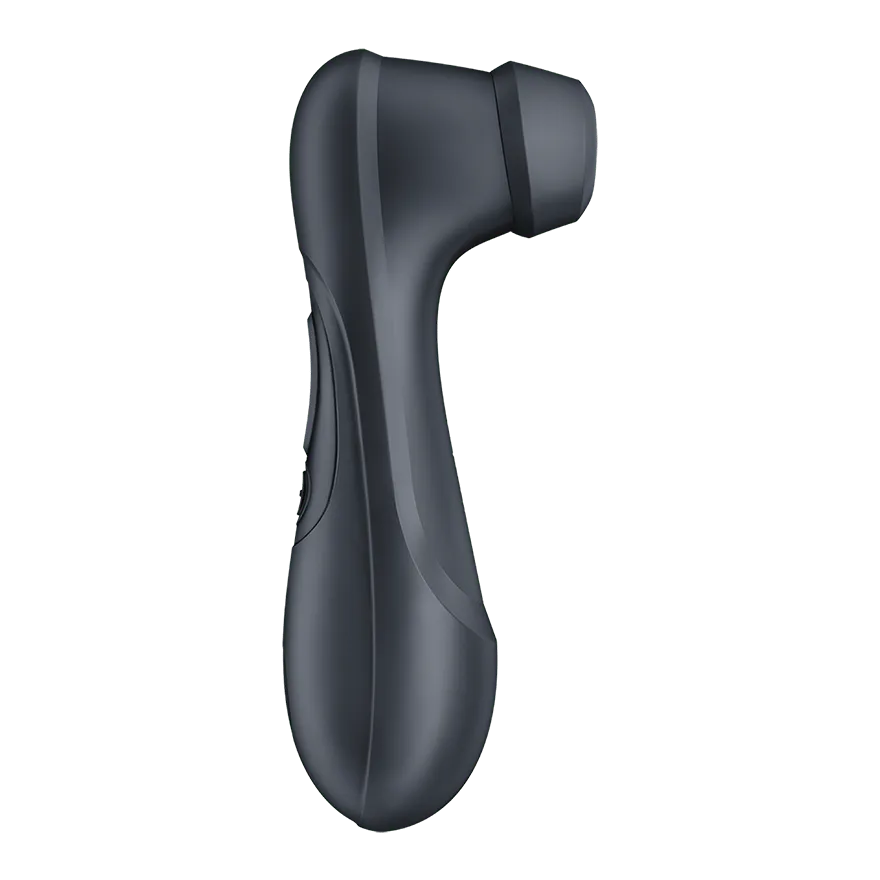
Satisfyer states the length is 165 millimeters, the width is 46 millimeters, and the height is 65 millimeters. The weight is 174.7 grams. That makes it a product that’s too large for a jacket pocket, but it fits without any problem in a toiletry bag or handbag.
Note that several retailers and price-comparison sites list the weight as 248 grams. That figure almost certainly refers to the product including the packaging and the charging cable. The manufacturer’s own information on the product page is 174.7 grams, and that’s the figure that applies to the product in your hand.
The shape is asymmetrical and tapers toward the middle, which provides a grip that you can hold with three fingers. The angle between the shaft and the head is fixed. That means you control the angle toward the body with your wrist, not with the product—unlike, for example, wand models where the head moves.
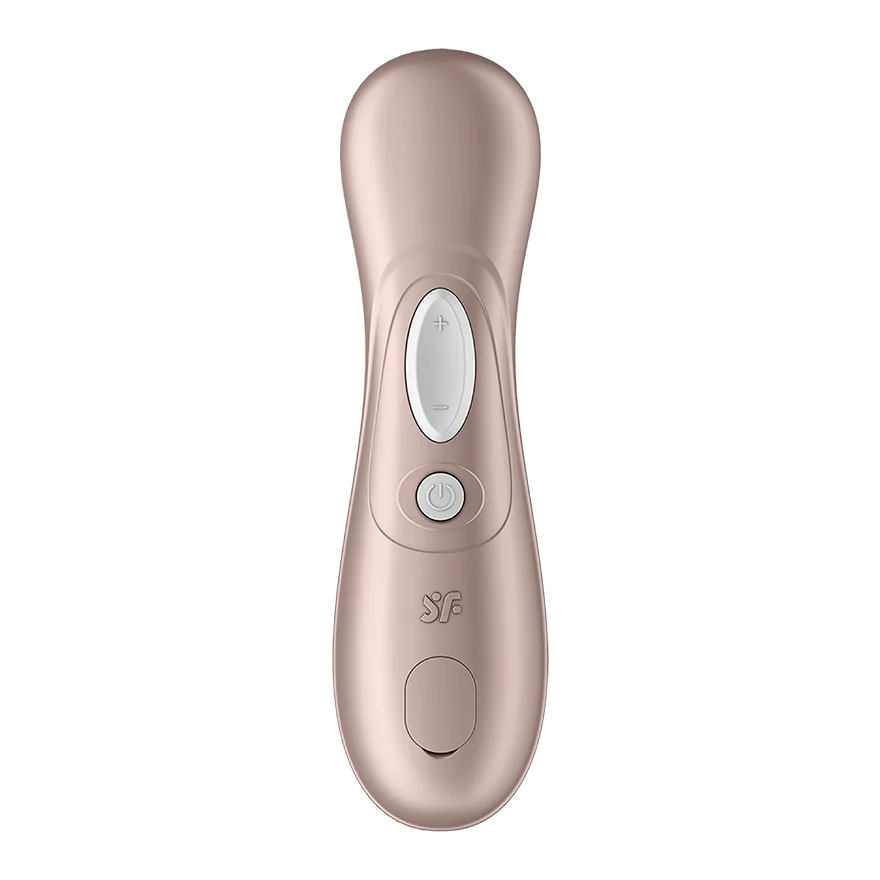
Satisfyer states it has eleven pressure-wave intensities. The controls are handled with two buttons: a rocker button with plus and minus that steps between intensities, and a separate on/off button underneath it. That’s the entire interface.
Simplicity is a deliberate design choice and one of the model’s strongest points. There’s no menu, no place to get lost in, and no app to pair. You can step up and down in intensity without looking at the product, which is relevant because the buttons are on the top side while the head rests against the body.
Eleven steps are more than most people use. The pattern in this product category is that the lowest steps are clearly separated, while the top ones are closer together, because the pressure difference per step decreases as the pump approaches its maximum output. Expect that, in practice, you’ll find three or four positions you return to.
That’s also why the number of positions is a poor buying criterion. A model with twelve programs that are only marginally different is worse than one with three distinct settings. What matters is the range between the weakest and strongest setting, and Pro 2 Next Generation is on par with much more expensive models there.
Satisfyer markets a whisper mode—Whisper Mode—for the Pro 2 Next Generation. What that means in measured decibels the manufacturer does not publish, and I haven’t found any measurement value from Satisfyer for this specific item.
It applies to retail as well. None of the eleven Swedish stores that sell the item state any decibel value; the only information that appears is qualitative—Joyland writes “sound level: low” in its specification list, with no measurement value behind it.
It’s worth saying plainly: there is no published dB value for Satisfyer Pro 2 Next Generation. Websites that list exact decibel figures for the model either present their own measurement or a value without a source. What can be established is that air-pressure products that are in the same category are consistently quieter than rotating eccentric motor products, because the sound comes from a diaphragm pump rather than an unbalanced weight, and that Satisfyer has chosen to highlight just quietness as a feature of the model.
Practical advice that applies regardless of model: place the product on a soft surface between uses. A hard tabletop works like a resonance box and noticeably amplifies the sound.
Satisfyer Pro 2 Next Generation is rated IPX7. The rating comes from the international standard IEC 60529, which defines enclosure classes for electrical equipment. The number 7 in the second position means the product is tested for submersion in water to a depth of one meter for 30 minutes.
The difference from IPX6 is greater than what a single step in the number suggests. IPX6 covers powerful water jets but not submersion. An IPX6 product can therefore handle a shower but not a bathtub, and it shouldn’t be held under running water—use common sense regarding buttons and the charging contact.
With IPX7, the entire product can be rinsed off without being careful. This is the single most important practical consequence of the rating and a genuine everyday benefit. If a product has no IPX information at all, you should treat it as not waterproof—lack of a rating is never a sign that it would be approved.
Rinse the product in lukewarm water after each use and use fragrance-free soap or a cleaning product intended for intimate products. Wipe it dry with a clean towel and let it air-dry before putting it away. Make sure in particular that the inside of the silicone head is dry, since the chamber is the only part where water can be left standing.
Avoid alcohol-based hand disinfectants on the silicone surface, and avoid chlorine and acetone altogether. Use a water-based lubricant. A silicone-based lubricant breaks down silicone surfaces over time and makes them porous—once the surface is porous, it can no longer be cleaned properly, only replaced. Oil-based products such as coconut oil leave a film that’s hard to remove.
A limitation worth knowing: the silicone head on the Pro 2 Next Generation is not removable. Models with a detachable top—such as the Satisfyer Pro 2 Generation 3 in certain versions—can be cleaned more thoroughly inside the chamber. If that’s crucial for you, you should choose a model with a removable top.
Satisfyers own quick guide for Pro 2 Generation 2 lists the technical battery data that the product page omits. The battery is a lithium-ion battery with 3.7 volts and 220 mAh. The charging voltage is 5 volts and the maximum charging current is 220 milliampere. Charging takes place via USB-C.
USB-C is a genuine practical advantage and sets the model apart from several pricier competitors. The Lelo Sona 3 Cruise is charged with a proprietary magnetic cable—if you lose it, no regular cable works and you need to order a replacement from the manufacturer. Here, any USB-C cable will do, the same one as for your phone.
220 mAh is a small cell. For comparison, a modern smartphone is around 4,000–5,000 mAh. It says something about what the product is built for: short usage sessions between charges, not hours of runtime.
The same quick guide lists the two time figures that the product page skips. Runtime is about 60 minutes and charging time is about two hours from an empty battery. The charging indicator blinks while charging and shows a steady light when the battery is full. The fact that charging takes twice as long as a full discharge is normal for a cell of this size—the charging current is limited to 220 mA, and lithium-ion cells also charge more slowly in the final phase.
Some individual retailers list longer runtimes than the manufacturer. Joyland writes "up to 1.5 hours" in its specifications list. That figure does not come from Satisfyer, and the manufacturer’s own figure of about 60 minutes is the one that applies.
What generally applies to lithium-ion batteries also applies here: capacity drops noticeably after roughly 300–500 charge cycles, the battery is not replaceable, and the product does best when it is not stored completely discharged for longer periods. With use a couple of times a week, it’s the battery—not the silicone—that sets the limit for lifespan.
We do not have price data from shops in your market yet.
Same EAN, same packaging, same product — and 380 SEK difference between the cheapest and the most expensive store.
Three comparisons are relevant: against premium alternatives that do the same thing but cost more, and against Satisfyer’s own newer sibling models. All the information below comes from each manufacturer’s own specifications.
Womanizer Premium 2 costs from 1,468 SEK in the stores we follow, so almost seven times as much. For that amount, you get an autopilot mode that automatically varies intensity, twelve steps, silicone over the entire body, and — most importantly — two interchangeable head size tips. Just the head size tips are the argument that carries the most weight, because the fit determines whether air-pressure technology works for you at all.
Satisfyer Pro 2 Next Generation does the same basic thing with the same principle. If you’re unsure whether air pressure suits you, it’s a hard-to-beat way to find out for under two hundred and fifty kronor. If you already know that the technology works for you, and you want automation and a customizable fit, Womanizer is the rational purchase despite the price.
Lelo Sona 3 Cruise costs from 1 513 SEK. It has silicone all over the body, a Cruise function that keeps the effect constant when the product is pressed against the body, and a consistently higher finish. It also has a proprietary magnetic charging cable, which is a real drawback: if you lose the cable, no standard USB cable works.
The price difference is about 1 300 SEK. What you pay for is materials and build quality, not a different operating principle. Both are air-pressure products for clitoral stimulation, and both are IPX7. If the product should last for five years and feel premium, Lelo is justified. If it should just do the job, it isn’t.
Generation 3 costs from 298 SEK, which is 79 SEK more than Next Generation at its cheapest. For that you get the Liquid Air function and a Bluetooth app with Satisfyer Connect. The app provides remote control and custom programs.
If you want app control, the price difference is so small that the choice is easy. If you don’t want an app, Generation 3 adds nothing you’ll notice — and an app that requires an account and Bluetooth pairing is a disadvantage for many people rather than a feature in this product category.
The most notable thing about Satisfyer Pro 2 Next Generation in Swedish retail isn’t the product, but the price spread. The same article number, the same EAN, the same packaging costs 219 SEK at the cheapest store and 599 SEK at the most expensive store. That’s a difference of 173 percent.
The price spread isn’t because some store sells a different variant — we checked the EAN number for all of them. It’s because stores price a model that’s been around for a long time and that most of them have in stock. That’s what makes this particular product one of the clearest examples of why it’s worth comparing prices before buying: the difference between the cheapest and the most expensive is greater than what the entire product costs at the cheapest store.
The prices in the table above are updated when the stores’ product feeds are updated, but always check the final price at checkout. Shipping costs are added at most stores below a certain order value and can change the ranking of a product in this price range.
It fits you if you want to try air-pressure technology without spending more than a thousand kronor, if you want an interface that you can learn in ten seconds, and if you want to be able to rinse off the entire product under running water. It also fits as a second product for your toiletry bag when the main product is more expensive and more delicate.
It doesn’t fit you if you know you need a different main size than standard—in that case, Womanizer with interchangeable heads is the right way to go. It also doesn’t fit you if you want app control, if you need more than about an hour of operating time between charges, or if you want silicone all over the body rather than only on the contact area.
Satisfyer provides a 15-year warranty on the Pro 2 Next Generation. That’s exceptionally long—the majority of competitors in the category are one to five years—and it’s one of the strongest arguments for the model.
The warranty, however, is a voluntary commitment from the manufacturer and does not replace your statutory rights. Under the Swedish Sale of Goods Act (konsumentköplagen), you have a right to make a claim for defects for three years, regardless of what the manufacturer promises. For distance purchases, you also have a right of withdrawal for fourteen days under the Distance and Off-Premises Contracts Act (lagen om distansavtal och avtal utanför affärslokaler).
Be aware that, in practice, the right of withdrawal is limited for hygiene products that have been taken out of their sealed packaging. The right to make a claim for defects applies, however, always. If you have questions about what applies in your case, Konsumentverket (the Swedish Consumer Agency) guides you via Hallå konsument (Hello consumer).
Satisfyer Pro 2 Next Generation isn’t included in any ranking yet. In best i test guides, the entire categories are compared against each other using five shared criteria, with what was left out shown.
Every numerical piece of information in the text can be traced to one of the sources below. The links were checked manually on the specified date.
This page is machine-translated from Swedish. Read the Swedish original