

Review
Review: ToyJoy Get Real Cock With Balls 25.5 cm
The larger PVC model: 25.5 cm overall and 21.75 cm insertable.
29 July 2026
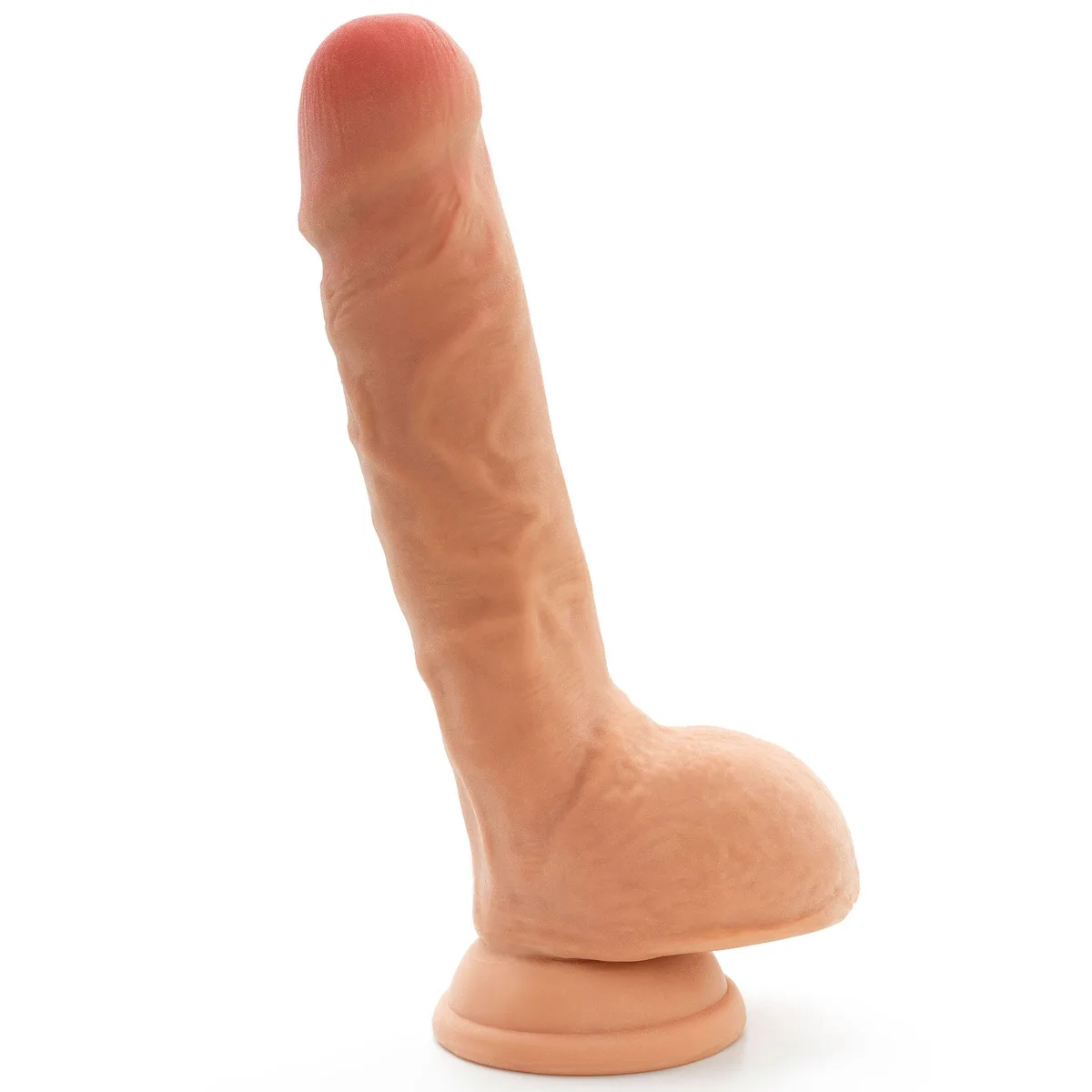 Best budget
Review · Realistic dildo · Dual density
Toy Joy’s nine-inch dual density dildo reviewed against the manufacturer’s own specifications and price data from six Swedish shop listings. Total length 23 cm, insertable length 16 cm, diameter Ø 4.7 cm, TPE with a soft outer skin over a firmer inner core and a suction-cup base — but no phthalate declaration, no waterproof rating, and no voluntary manufacturer warranty.
A significantly oversized realistic dual-density dildo at a price that’s hard to beat: Ø 4.7 cm makes it the thickest of the series’ models with scrotum, and the suction cup makes it usable both hands-free and in a harness. What you pay for is the documentation. Only 16 of 23 centimeters is insertable; the manufacturer does not publish any phthalate declaration, hardness, waterproof rating, or voluntary warranty, and two of six shop listings sell the barcode under the wrong length.
Toy Joy Dual Density Dildo 23 cm Balls is called Dual Density Dildo TPE 23 cm by the manufacturer and belongs to the Get Real by ToyJoy series. In ToyJoys own marketing language, it is called Dual Density Cock 9 Inch Balls, meaning nine inches with a penis. It’s a realistically shaped dildo without a motor, without a battery, and without electronics — the entire product is a single cast piece in two hardnesses, with a suction cup on the base.
The specification looks like this. The total length is 23 centimeters, the insertable length is 16 centimeters, and the insertable diameter is Ø 4.7 centimeters. The material is listed as TPE. The packaging measures 30 × 18 × 8 centimeters, the outer carton holds 20 units, and the country of origin is listed as China. The manufacturer’s list price is 44.99 euros. In Sweden, the item is available at six retailer listings at prices between 328 and 499 SEK, and four of them had the item in stock at the price check.
This review covers exclusively the item with EAN 8713221819482, the manufacturer’s item number 10177-SKIN in the color light-skin-tone. The number has been verified both ways: first in the product data on ToyJoys own website, and also with the brand owner, Scala, which prints both the barcode and the model number 10177. That matters here, because two Swedish stores sell this exact barcode under the name 25,5 cm — a deviation that gets its own section further down.
Dual density means that the product is cast in two materials with different hardness: a soft, yielding outer layer over a firm inner core. The manufacturer describes it as a combination of soft surface and solid core, and markets the construction under the names Soft Touch Technology and Flexi Shaft. The cross-section image in the product material clearly shows the principle: a light, thick outer skin around a darker core that runs through the entire shaft down to the base.
The point of the construction is easy to understand purely mechanically. A dildo cast from a single soft material is flexible but lacks rigidity — instead of being guided in, it bends. A dildo cast from a single hard material has the rigidity but feels like what it is. With two densities, the shaft gets its rigidity from the inside while the surface remains yielding, and that’s the property the entire product category is built on. That’s also why a dual density model costs more than a single-cast dildo in the same series: the casting requires two materials and two steps.
What the manufacturer does not publish is how firm the two layers are. There is no Shore value, no information about the layer’s thickness, and no information about how far down into the base the core goes. ToyJoy therefore publishes no measurable information at all about the property that is the product’s main selling point. It is in itself a common pattern in this category—but it means that “dual density” on the packaging is a description of the design, not a specification, and that two products that are both called dual density can feel completely different.
What can, however, be established is that the packaging has a test window. The blister card is labeled “Try me — Soft Touch Technology” and has a small exposed piece of material that you can press through the cardboard. It’s unusually well thought out for the price bracket, and it’s the only way to assess the softness before purchase—provided you’re standing in a physical store. If you buy online, you don’t get that opportunity, and then it’s worth knowing that the material specification TPE is the only thing you have to go on.
According to the trade magazine EAN Online, the series was launched in three versions with a diameter—seven inches, eight inches, and nine inches—and the manufacturer’s item numbers are in sequence. That makes them easy to tell apart if you know what to look for, and easy to mix up if you don’t.
Read that list once more, because it contains something odd. For the mid model at 20.5 centimeters, it is stated to have a 17.5-centimeter insertable length, while for this model at 23 centimeters, it is stated to have a 16-centimeter insertable length. That means the larger product would have a one-and-a-half-centimeter shorter usable length than the smaller one. You can’t reconcile that with the pictures, where the three models have the same proportions. Either one of the numbers is wrong in the manufacturer’s own specification, or the insertable length is measured differently between the items. The figure of 16 centimeters appears in the manufacturer’s measurement drawing and at the shop Taboo, so at least it’s consistently reported for this particular item—but the size comparison across the series doesn’t hold up.
Two nearby items from the same family often end up in the same search results as well. Dual Density Dong TPE 23,5 cm (article 10183) are the same material and almost the same total length, but without a penis, which gives 20,75 centimeters insertable and a slimmer diameter of 4 centimeters at a list price of 30,99 euro. Dual Density Vibrator TPE 23 cm (article 10194) has the same total length, but contains a motor, is cast in TPE/TPR, and has 19,5 centimeters insertable and 5 centimeters in diameter. If you want vibrations, you should buy it—this model has, as the shop Taboo also writes out, no motor at all.
The material issue is, by itself, the single most important item in the specification for a product that will be placed against mucous membrane, because it determines both how the product can be cleaned and how long it remains hygienic. The manufacturer states a single material for the entire product: TPE. This applies to both the soft outer layer, the solid core, and the suction cup.
TPE stands for thermoplastic elastomer. It’s an umbrella term for an entire family of plastic materials that behave like rubber but can be melted again and injection-molded like plastic. That very property is what makes the material suitable for dual density molding: two blends with different hardnesses can be sprayed into the same mold in two steps and fuse into a single unit without a seam.
The designation “TPE” is therefore a description of the material class, not a declaration of what’s inside. Two products that are both listed as TPE can contain completely different additives. That’s the most important difference compared to silicone: when a manufacturer writes silicone, you roughly know what you’re dealing with, while with TPE the question of plasticizers is left open. ToyJoy publishes no phthalate declaration, no latex declaration, and no BPA declaration for this item, whether on the product page or in the shared user manual. What there is instead is a symbol on the packaging that indicates a body-friendly material—one symbol, not a testing certificate.
The practical consequence is this: TPE is not a non-porous material in the same way as cured silicone. The surface has a microscopic structure that can hold onto moisture and residues, and the material does not tolerate boiling— the manufacturer’s own manual sets an absolute limit at 45 degrees and prohibits both heating and freezing. That means the product can be made clean but not sterile, and that’s the reason the manual explicitly advises against sharing intimate products without hygienic protection. If the product is to be used by more than one person, a condom is the only handling that works.
A detail from the manual that rarely shows up in store texts: ToyJoy writes that products should be stored separately from each other to avoid reactions between different materials. That’s a real risk with soft plastic materials—if two products lie against each other in a drawer, they can stick together or discolor each other. The manufacturer recommends a storage bag or a separate storage box, and none is included in the packaging.
Phthalates are a group of plasticizers used to make plastic—above all, soft PVC—flexible. The Swedish Chemicals Agency describes that certain phthalates can affect the testes and make reproduction more difficult, and that some are suspected to be endocrine disruptors. Several of them are therefore restricted within the EU.
Here it’s worth being exact, because the area is full of unsubstantiated claims. The Swedish Chemicals Agency states that there is no specific chemical legislation for sex toys—the product group is not covered by the toy rules, but by the same rules as for goods in general, primarily the REACH Regulation. This means that a limit value specification that applies to children’s toys does not automatically apply to this product.
The authority’s own supervision also provides a more nuanced picture than the rumor mill. In the 2016 supervision project, 16 companies were inspected and 44 sex toys were analyzed, mainly products in the lower price segment made of soft PVC. Only one of the 44 products contained a prohibited substance above the limit value—short-chain chlorinated paraffins in a dildo made of soft PVC—and three products contained the phthalate DEHP in concentrations above 0.1 weight percent. The authority’s conclusion was that compliance was relatively good, and that a likely explanation was that the stores purchased from large European suppliers with control over the contents.
That’s exactly the situation this article is in: it’s distributed by a large Dutch supplier with its own brand management. It’s not a guarantee, but it is a relevant circumstance. And you have a concrete tool if you want to know more: according to REACH Article 33, as a consumer you have the right to receive, free of charge, information within 45 days if the item contains any substance on the Candidate List in a concentration above 0.1 weight percent. You ask the store you buy from, and it’s free to ask.
The total length of a realistic dildo is a marketing measure. It counts the balls and the suction bulb—that is, parts that are never inserted. The length that actually determines how the product feels is the insertable length, and the manufacturer publishes both.
The dimension drawing in the product gallery answers the question: total length 23 centimeters, insertable length 16 centimeters, diameter Ø 4.7 centimeters. That means that seven of the twenty-three centimeters are located in the shaft and base — almost a third of the measurement stated in the product name. So anyone who buys based on the headline "23 cm" and counts on 23 centimeters of usable length will be surprised, and that is the most common misunderstanding in the entire product category.
The diameter is the measurement that matters most in practice. Ø 4.7 centimeters corresponds to a circumference of just under 15 centimeters, and it places the product above average in thickness rather than in the beginner-friendly compartment. The combination of 16 centimeters insertable and Ø 4.7 centimeters is therefore a deliberate choice toward the fuller side — not toward the longer one. If you want length rather than girth, the series Dual Density Dong 23.5 cm offers the opposite choice: 20.75 centimeters insertable but only 4 centimeters in diameter.
The packaging dimensions, 30 × 18 × 8 centimeters, tell you something about how it comes home to you. It’s a blister card in a cardboard box of that size, so it doesn’t fit in a mailbox. The outer carton of 20 units is intended for stores rather than consumers, but it confirms that the item is a volume product in the supplier’s range and not a special order.
The weight is the piece of information where the sources differ the most, and it’s worth presenting it openly rather than choosing one number and pretending it’s certain.
The manufacturer’s figure carries the most weight, and 520 grams is reasonable for a solid TPE piece with these measurements. It’s also supported by the series’ internal logic: 0.32 kg for the 18-centimeter model and 0.44 kg for the 20.5-centimeter model add up to a consistent step up to 0.52 kg. Joyme’s 558 grams is close and can reasonably be explained by the packaging. Taboo’s 250 grams doesn’t fit any of the patterns and should be treated as an incorrect figure until the shop corrects it. Expect about half a kilo in your hand — it’s heavy enough that the suction cup needs a proper base, which is the next question.
The product has no buttons, no modes, and no charging. Everything that sets it apart from a simple wand comes down to three design choices: the double density, the flexible shaft, and the suction cup in the base. The manufacturer describes all three, and they are what determine how the product can actually be used.
The suction cup is the feature that makes the biggest difference. It lets the product stay attached to a smooth surface — tile, a mirror, a floor surface, a bathtub side — and therefore be used without hands. It’s also what makes it compatible with a harness. Without a suction cup, a dildo is a handheld product; with a suction cup, it’s three products in one.
The manufacturer states that the base is a suction cup and highlights it in both the product text and the packaging symbol, but does not publish the suction cup’s diameter or its height. That’s a specific gap, because those two measurements are what determine how well it holds. For comparison, Pipedream publishes both dimensions for the King Cock 9 inch: the suction cup there measures 7.6 centimeters in diameter and 2.0 centimeters in height. Without corresponding figures for this item, it isn’t possible to compare holding power other than from pictures.
What can be established is the connection between weight and attachment. A suction cup holds through vacuum against a flat, clean, non-porous surface, and the load it’s meant to handle consists of the product’s own weight plus the force applied to it. With the manufacturer-stated 0.52 kilograms hanging on an unspecified suction-cup surface, the surface is decisive: tile and glass work, while painted wood surfaces and textured plastic rarely do. A tip that applies regardless of model is to lightly moisten both the suction cup and the surface before you press it into place, and to press the air out from the middle and outward.
The flexible shaft — the manufacturer’s Flexi Shaft — also plays a role here. A shaft that gives way absorbs some of the movement instead of transferring it like a lever against the suction cup, which in practice helps the attachment. The downside is that the same give makes the product less precise to control when you’re holding it in your hand. It’s a trade-off, not a pure advantage, and it’s built into the design.
Here, the sources differ in a way that’s worth stating. The manufacturer says nothing about harness compatibility for this item — neither on the product page nor in the shared manual. Two Swedish stores do, however: Vuxenkul lists the features "Sugpropp, Strap-on-kompatibel" and Lekosmek describes the product as intended to work with harnesses.
That’s a store claim, not a manufacturer claim, and it should be read as such. From a purely construction standpoint, though, the statement is still reasonable: a suction-cup base is the most common attachment in harnesses with an O-ring, because the wide plate prevents the product from sliding through the ring. What can’t be determined without the suction cup’s diameter is which ring size fits. If you already have a harness, you should base your choice on the ring’s inner dimensions and assume that a base wider than the ring is a prerequisite, not a guarantee.
Sixteen centimeters. It’s the manufacturer’s job to define that number in both the specifications and the dimensional drawing, and the store Taboo prints the same figure in its product text. The remaining seven centimeters are the shaft and suction cup.
That figure should be the one you actually compare. Get Real Dual Density Dong 23,5 cm has almost identical total length but 20,75 centimeters insertable, i.e. almost five centimeters more, simply because it lacks a shaft. King Cock 9 inches, which has a total length of 24,8 centimeters, is stated to have 19,0 centimeters insertable. This model therefore ranks at the bottom of the comparison by usable length even though it’s in the middle by total length — and that’s exactly the kind of difference that disappears when stores market by headline length.
The counterpoint is the diameter. With Ø 4,7 centimeters, it’s thicker than both the Dual Density Dong 23,5 cm (4 cm) and the series’ 20,5-centimeter model (4,5 cm). So if you choose this item over the others in the series, it’s the circumference you’re buying, not the length.
This is the clearest conflict of sources in the review, and it has practical consequences.
The store Taboo states in its specification table "Water-resistant IPx5: Ja". Vuxenkul states "Water-resistant: Ja" without a rating. ToyJoy does not publish any water-resistance rating at all for this item — and the manufacturer’s own user manual contains a rule that applies exactly in this case: products without a specified water-resistance rating must not be exposed to water. The manual divides the assortment into three compartments — waterproof products that may be submerged when all covers are closed, splash-proof products that may be cleaned with water but not submerged, and products without a rating that should not be exposed to water at all.
At the same time, the same manual instructs that the product must be cleaned before and after each use with lukewarm water and mild soap or a toycleaner, and rinsed thoroughly. The two instructions don’t fully line up, and the reasonable reading is that the water section is written for the motor-powered products in the range, while the cleaning section applies to all of them. For a fully molded product without electronics, there’s no housing into which water can get.
But the conclusion stands: The IPX5 claim is not backed up by the manufacturer. Treat it as the store’s own assessment, not as a rating.
Enclosure classes are defined in the international standard IEC 60529. The number in the second position indicates protection against water. IPX5 means protection against water jets from all directions — i.e. showering and running water, but not submersion. For submersion, IPX7 is required. The difference isn’t academic: an IPX5-rated product should not be left in a bathtub or in a filled sink.
For this product, the distinction matters less in practice, because there’s no electronics to protect. It does, however, matter for how you should generally read store tables: an IP rating is the result of testing according to a standard, and a class that only appears in a store table without any corresponding claim from the manufacturer is information with no testing behind it.
ToyJoys manual is concise but unambiguous on the points that apply to this product. Clean before and after each use. Use lukewarm water and mild soap or a cleanser intended for intimate products. Rinse thoroughly. Dry completely before putting the product away.
Lubricant is crucial for a soft plastic material. The manufacturer specifies water-based lubricant and states that both oil-based and silicone-based lubricants can damage certain materials. On a product molded in TPE, that warning isn’t theoretical: the wrong lubricant makes the surface sticky or dull, and once a surface has become sticky, it can’t be restored. The shop Taboo also notes that lubricant isn’t included in the delivery, which is correct—the package contains the product and nothing else.
The temperature limit is the guideline that’s most often broken. The manual prohibits heating, freezing, and temperatures over 45 degrees. This rules out boiling, dishwashing, and sterilization—which is exactly why sharing requires a condom rather than heat treatment. Storage should be dry, dust-free, and protected from direct sunlight, and the product should be kept by itself so it doesn’t react with other materials. The manufacturer recommends a bag or a box; no such item is included.
The manufacturer does not publish any lifespan, and neither does anyone else in the category. What you can say is what the manual itself identifies as the end: you should inspect the product before every use and stop using it if it’s damaged, cracked, torn, deformed, or has sharp edges. That’s the criterion, and with a soft plastic material, it’s usually the surface at the transition between the shaft and the balls, as well as the edge of the suction cup, that gives up first—because that’s where the material bends the most.
Two care choices determine how quickly it wears out. The first is the lubricant—right type keeps the surface intact, the wrong type breaks it down. The second is storage: sunlight, heat, and contact with other soft-plastic products are the three factors the manufacturer itself warns against. A product that’s kept washed, dry, and by itself in a bag lasts significantly longer than one that’s loose in a box with other items—and that’s the only guarantee you have—because there’s no optional manufacturer guarantee, which the section at the very bottom covers.
We do not have price data from shops in your market yet.
Seven of the twenty-three centimeters sit in the pouch and base. The measurement that determines the experience is sixteen — and it’s listed in the manufacturer’s own measurement drawing.
Four comparisons are relevant: two against sibling articles in the same series, one against the series’ vibrating variant, and one against the best-selling competitor in the format. All information below comes from each manufacturer’s own specifications.
The series’ 20.5-centimeter model (article 10176, EAN 8713221819475) has a list price of 36.99 euros versus 44.99 euros for this one, so eight euros less. For that difference, you get a product that is 2.5 centimeters shorter overall, 0.2 centimeters narrower (Ø 4.5 cm vs 4.7 cm), and 80 grams lighter (0.44 kg vs 0.52 kg). The material is identical, the construction is identical, and the packaging dimensions are identical.
And then the strange number again: the manufacturer states an insertable length of 17.5 centimeters for the 20.5-centimeter model, compared with 16 centimeters for the 23-centimeter model. The cheaper and smaller product would therefore have more usable length than the more expensive one. Either one of the pieces of information is incorrect, or they’re measured differently. If you choose based on diameter and total length, the 23-centimeter model is larger. If you choose based on the insertable length shown by the manufacturer, the smaller one is. It’s an uncomfortable conclusion, but that’s what the specification says.
The dong variant (article 10183, EAN 8713221821614) is the most interesting comparison in the entire review, because it costs 30.99 euros in list price — that is fourteen euros less — and at the same time has more usable length. Total length is 23.5 centimeters, insertable length is 20.75 centimeters, and weight is 0.35 kilos.
There are two differences. The first is the sheath: the dong variant has none, which explains why almost the entire total length is usable. The second is the diameter — 4 centimeters vs 4.7 centimeters, so noticeably narrower. If you shop by appearance, the sheath is a point in itself, and it’s the single most common reason to choose this model. If you shop by measurements, the dong variant is longer, narrower, lighter, and cheaper. It’s a straightforward choice between realism and usable length, and most store texts never mention it.
The vibrator variant (article 10194, EAN 8713221822970) has exactly the same total length, 23 centimeters, but 19.5 centimeters insertable and 5 centimeters in diameter. The material is listed as TPE/TPR and the product has multiple vibration modes. The list price is 34.99 euros, so ten euros less than this model despite containing a motor.
The price-to-value relationship is counterintuitive and worth noting: the passive product costs more in the list price than the motorized one in the same series. The reason is not evident from the manufacturer’s data. What can be established is that a motor also takes up battery space, and battery space is the part that makes a product sensitive to water and sets a limit for service life. If you want vibration, the choice is simple. If you don’t want it, there’s no reason to pay for electronics that are supposed to stay dry.
King Cock is the most sold series in this format, and the 9-inch model with a sheath (item PD5508-21) is the direct equivalent. Pipedream’s specifications are more detailed than ToyJoy’s: total length 9.8 inches / 24.8 centimeters, insertable length 19.0 centimeters, insertable diameter 5.2 centimeters, suction cup diameter 7.6 centimeters, and height 2.0 centimeters, weight 656 grams, and list price 47.99 dollars.
Two differences are decisive. The first is the material: Pipedream states PVC, ToyJoy states TPE. Molded PVC is exactly the material type that was identified by Kemikalieinspektionen as the most problematic— it was in a dildo made of soft PVC that the authority found its only exceedance of the limit value. That says nothing about this specific King Cock item, but the material specification TPE is, in that respect, a better starting point than soft PVC.
The second is documentation. Pipedream publishes the suction cup’s dimensions, an instruction file per item, and an explicit warranty period of 90 days. ToyJoy publishes neither suction cup dimensions nor any voluntary warranty at all. King Cock is also larger in every direction: 1.8 centimeters longer overall, three centimeters more insertable, half a centimeter thicker, and 136 grams heavier. If you’re unsure whether the format will suit you, that’s an argument in favor of this model rather than against it—but if it’s the data you base your decision on, Pipedream clearly wins.
Six shop listings list EAN 8713221819482. The cheapest is Vuxenkul at 328 SEK, and the most expensive is Taboo at 499 SEK. That’s 171 SEK, or a 52 percent difference, for the same barcode and the same item.
The inventory situation is unusually favorable in this review. Four of the six listings had the item in stock at the price check: Vuxenkul at 328 SEK, Lekosmek and Joyme at 459 SEK each, and Taboo at 499 SEK. Sexonics’ two listings at 402.79 SEK were sold out, which means the cheapest available and the second-cheapest available differ by 131 SEK.
The price spread has a partial, clearly visible explanation on the stores’ own pages. Vuxenkuls 328 SEK is a campaign price—the store lists 469 SEK as the regular price—and Lekosmeks 459 SEK is reduced from 489 SEK. This means that the lowest recorded price does not necessarily reflect the store’s normal pricing, and that the difference versus Taboos 499 SEK shrinks when the promotion ends. Shipping terms also differ: Lekosmek and Taboo offer free shipping over 699 SEK, and Joyme offers free shipping over 899 SEK, which in this price range means shipping is added if you only purchase this one item.
A look at the prices: the manufacturer’s own list price is 44.99 euro. All the Swedish listings are below it when the euro is converted to normal levels, which is expected—the list price is a recommended consumer price, not a floor.
This is the single most important observation in the review, and it affects what you actually get delivered.
Two of the six store listings sell EAN 8713221819482 under the name 25.5 cm. Joyme lists the item as "Get Real — Dual Density Dildo With Balls — 25.5 cm" and repeats 25.5 centimeters in the product text. Sexonic has two parallel listings of exactly the same barcode: one correctly under the name "ToyJoy Dual Density Dildo TPE 23 cm Skin" with article number 352, and another under the name "Get Real — Dual Density Dildo 25.5 cm Balls Skin" with article number 18350. Same EAN, two product names, two lengths, the same store.
The manufacturer decides the matter. Both ToyJoy’s and Scala’s product data link the barcode 8713221819482 to article 10177, which is called Dual Density Dildo TPE 23 cm and is described as Dual Density Cock 9 Inch Balls. Nine inches is 22.9 centimeters, so the 23 centimeters the manufacturer states. There is no dual density article at 25.5 centimeters with balls in the series’ sequence of article numbers; the nearest is the much more expensive Deluxe series, and the standalone Get Real model in PVC at 25.5 centimeters, which has a completely different barcode.
Practically speaking, this means three things. If you order from one of the two listings, you will most likely receive the 23-centimeter model, because it is the barcode that controls picking. Price comparisons between the six listings are still valid, since they all point to the same item. And a store that has the wrong length in the title will likely also be wrong in other fields—which is exactly what Joyme’s weight information of 558 grams and Taboos’ of 250 grams illustrate. Always read the EAN, not the title.
This is for you if you want a realistically shaped dildo with a scrotum in the fuller compartment and you prioritize girth over length. Ø 4.7 centimeters is the product’s strongest specification in relation to the price, and the double density means that this thickness can be handled with a soft surface instead of a hard one. It’s for you who want to be able to use it hands-free against tile or in a harness, and for you who want to get into the format for under 350 SEK instead of paying a premium price for silicone.
It’s not for you if you want maximum usable length—sixteen out of twenty-three centimeters is what you get, and the series’ own dong variant provides almost five more centimeters for less money. It’s not for you if you want to be able to boil or dishwasher-clean your products, because the manufacturer’s limit is 45 degrees. It’s not for you if you share products without a condom, since TPE can’t be sterilized. And it’s not for you if you require a phthalate declaration, a Shore hardness, or a published warranty before purchase, because ToyJoy publishes neither for this article.
One more thing belongs in the decision. This is a product without electronics, and that’s its biggest strength in terms of longevity. There’s no battery that degrades, no charging cable that gets lost, and no motor that stops working. What determines its service life is the material and how you take care of it, and both of those things are completely in your own hands.
Here’s the message, short and unambiguous. ToyJoy offers no voluntary manufacturer warranty. The manual states that the product is covered by the “applicable statutory warranty” and that it covers material and manufacturing defects during normal use. Excluded are normal wear and tear, accidents, improper use, lack of maintenance, your own modifications, and damage caused by failure to follow the instructions. Proof of purchase is required.
In other words: what you have are your statutory rights—nothing beyond them. It’s worth comparing with Pipedream, which provides 90 days of express warranty for the King Cock series—short, but published. What ToyJoy publishes is, in practice, a reference back to the law.
Under the Swedish Sale of Goods Act (konsumentköplagen), you have three years to make a complaint in the event of defects in the goods, regardless of what the manufacturer promises, and you direct that right toward the store you bought from—not toward ToyJoy. For distance purchases, there’s also a 14-day right of withdrawal under the Act on Distance Contracts and Contracts Outside Business Premises (lagen om distansavtal och avtal utanför affärslokaler). Be aware that in practice the right of withdrawal is limited for hygiene products that have been removed from a sealed package; the right to make a complaint in case of defects, however, always applies. If you have questions about what applies in your case, Konsumentverket advises you via Hallå konsument.
Finally, a right that is rarely used but is especially relevant for a soft-plastic product without an ingredients declaration: according to REACH Article 33, you can ask the store for information about whether the item contains any substance on the candidate list above 0.1% by weight. The store must respond at no charge within 45 days. This is the only way to get a written statement about the contents when the manufacturer does not publish anything.
Toy Joy Dual Density Dildo 23 cm Balls is ranked på plats 15 av 19 in realistic dildo best i test, where the entire category is compared against each other using five shared criteria. Guiden vinns av Silexd Silex-D Dual Density Silicone Dildo 17,6 cm.
Every numerical piece of information in the text can be traced to one of the sources below. The links were checked manually on the specified date.
This page is machine-translated from Swedish. Read the Swedish original