

Review
Review: Arcwave Ion 2
Arcwaves air pressure strokes with Pleasure Air — from 1,186 SEK.
29 July 2026
 Best budget
Review · Vibrating strokes · Open half sleeve
Arcwaves cheapest electronic stroker reviewed against the manufacturer’s own specifications and price data from seven Swedish shops. Ten vibration patterns in ten intensities, two motors from We-Vibe, pore-free CleanTech silicone, IPX7 according to IEC 60529, and a published battery of 700 mAh — at a price with an 85 percent difference between the cheapest and the most expensive shop.
The open half sleeve is Zing’s whole point: no upper limit for length, no lower limit for girth—pressure is something you control yourself with your hand or with the included band, and it has a contact surface that actually can be rinsed clean. The material is the same medical silicone as in Arcwave’s twice-as-expensive models; battery capacity is published, and the price starts at 849 SEK. What you pay for is 60 minutes of runtime, a magnetic cable that can’t be replaced with a regular USB cable, and a specification where neither weight, sound level, nor vibration frequency is listed.
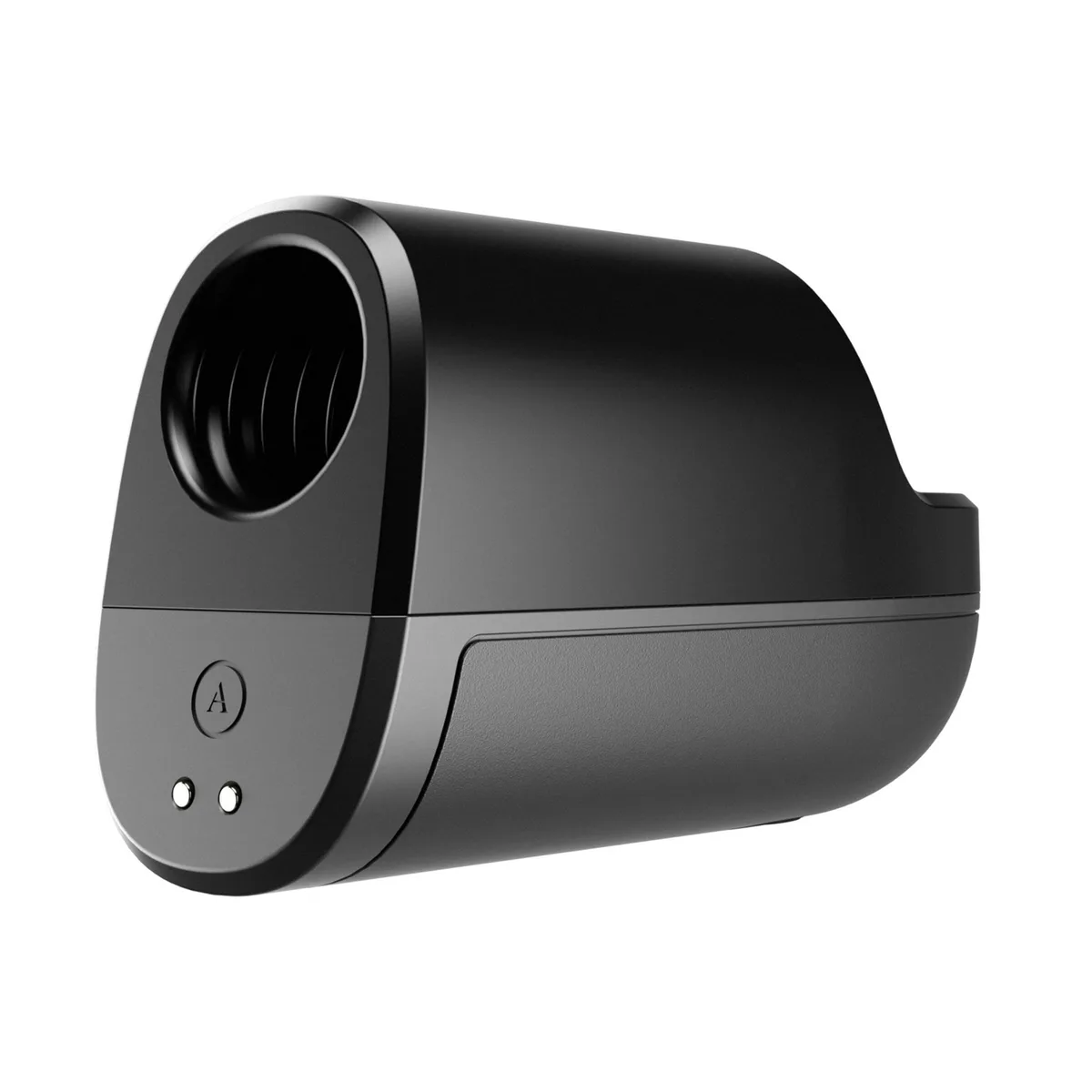
Arcwave Zing is the cheapest product in Arcwave’s range for men that still features the brand’s full choice of materials. It is a vibrating stroker: a short, open silicone sleeve with two vibration motors at the top, a flexible outer with grip patterning, and an elastic band that can be tightened around the sleeve to increase pressure. The manufacturer describes it in its own online manual as a half-sleeve with a shape they call Quick Clean Helix.
The specifications look like this: ten vibration patterns in ten intensity levels, two motors that Arcwave states come from the sister brand We-Vibe, medical-grade silicone and body-friendly ABS plastic, enclosure rating IPX7, 60 minutes of runtime on full power, 90 minutes of charging time, a lithium-ion battery of 700 mAh and 3.7 volts, and a two-year manufacturer’s warranty. The dimensions are 110 × 59 × 59 millimeters according to the manufacturer’s specification table. The model number is SAM1A. In Sweden, the item is sold by seven stores at prices between 849 and 1,569 SEK, and all seven had it in stock at the price check.
This review is about the only variant that exists: EAN 4251460612944, the manufacturer’s item number AWSM1SG9. Arcwave publishes only one color for Zing — black — and all seven Swedish stores list the same EAN. This means that the price comparison lower down is a comparison between stores, not between variants, which is unusual and makes the price spread all the more interesting.
A traditional stroker is a closed tube: you insert your penis into a channel that encloses the entire circumference, and the pressure is determined by the sleeve’s inner diameter. The advantage is that contact is even all the way around. The downside is twofold — the fit is fixed, and the channel is hard to reach for cleaning, since you can only reach in from the ends.
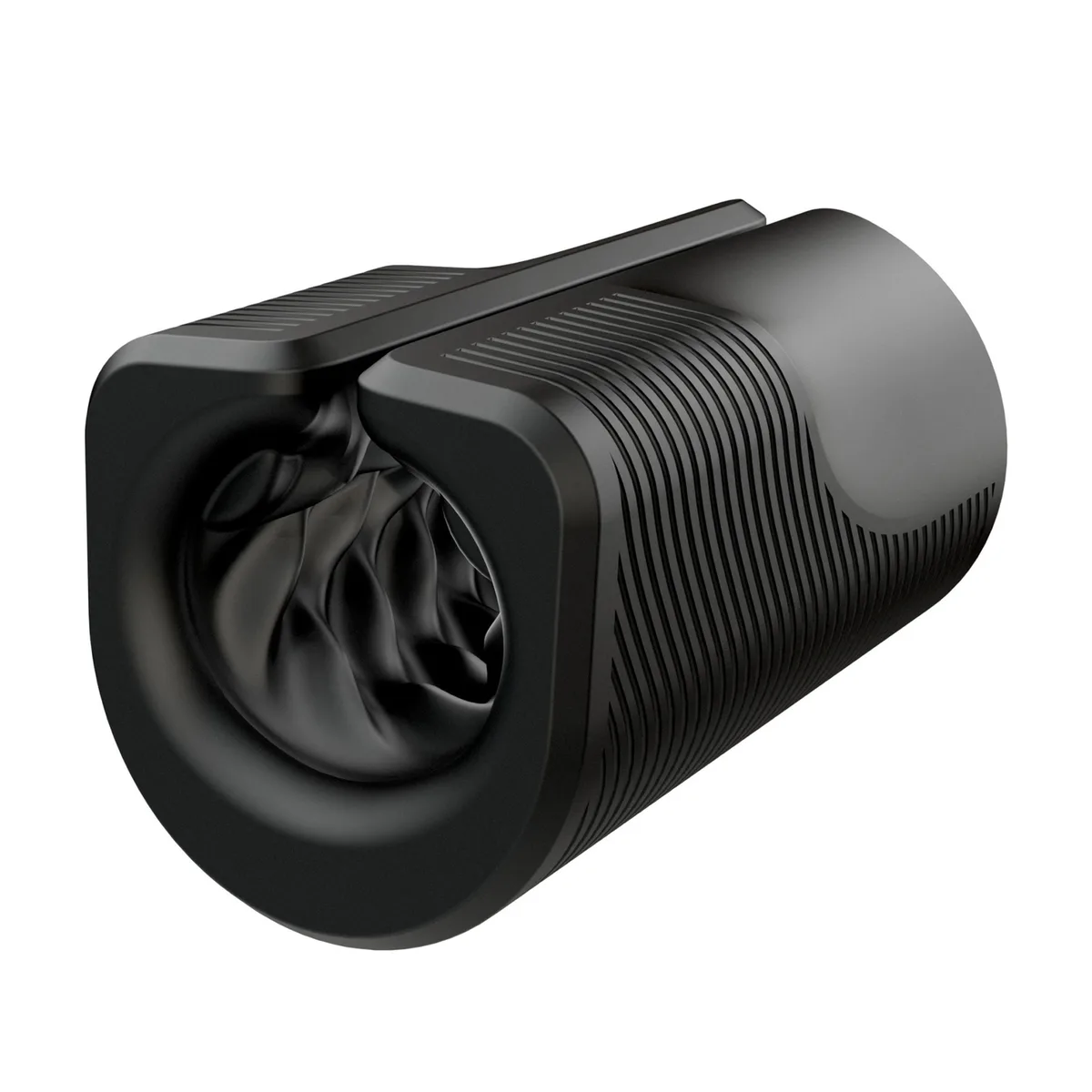
Zing is built the other way around. The sleeve is open along one side, so you can place the penis in it instead of inserting it, and the two halves can glide apart. That has three consequences worth understanding before buying. The first is the fit: because the sleeve stretches out instead of setting a limit, as the manufacturer itself puts it, there is no upper length limit and no lower circumference limit. The second is that you control the pressure yourself—either by squeezing the product with your hand or by tightening the included strap around it. The third is cleaning: an open sleeve can be pulled apart and rinsed on the inside, which is physically impossible on a closed channel.
The price is just as easy to describe. An open construction provides no built-in vacuum, and therefore you get neither suction nor air pressure. Zing does one thing: vibration against a larger contact area. What can be stated is that it is a different product category than Arcwaves own Ion 2, not a cheaper version of it.
Arcwave lists six products for men in its own store, and they get mixed up regularly in Swedish store texts because the names are short and the range is aimed at a younger audience. The three that are closest to Zing in price or function are these:
So the difference between Zing and Ion 2 is not that one is a simpler version of the other. They are two different stimulation principles from the same brand, with the same material choices and the same warranty, in two different body shapes. If you want air pulses toward the frenulum, you should buy Ion 2. If you want vibration over a larger area, with adjustable pressure and a product you can use without an erection, then Zing is the one in the range that does that.
The material question is the only property of an intimate product that cannot be compensated for with habits or care, and it determines whether the product is still hygienic after three years. Arcwave lists two materials for Zing: medical-grade silicone in the soft sleeve and body-friendly ABS plastic in the technical housing. It is the exact same material combination that the manufacturer specifies for Ion 2, so there is no downgrade despite Zing costing 337 SEK less at its lowest price.
CleanTech is Arcwave’s own name for the silicone used throughout the range, and unlike most brand names in this industry, the manufacturer provides a concrete list of properties. According to Arcwave’s FAQ, the material is non-porous, hypoallergenic, dimensionally stable in the range of approximately −30 to 170 degrees, non-flammable, impossible to melt, UV-resistant, and resistant to oil, solvents, and other chemicals.
The most important line in that list is the first one. A non-porous material can be cleaned, because there are no microscopic cavities where residue can remain. That is the single most decisive property of a material that is meant to be in contact with mucous membranes, and that is why the material declaration weighs more than almost every other line in a specification. The combination of non-porous silicone and an open sleeve is also unusually favorable: you can access the entire interior and trust that the surface can be cleaned.
The fact that the material can withstand 170 degrees does not mean that the product can. Arcwave is explicit in both the FAQ and the manual: Zing must not be boiled, must not be washed in a dishwasher, and must not be exposed to temperatures above 45 degrees, because the battery and motors can’t handle it. So the silicone’s heat resistance is a property of the material, not a user instruction. However, the manufacturer states that a ten percent chlorine solution can be used for cleaning if you want to go further than soap and water.
Phthalates are a group of plasticizers used to make plastic—above all flexible PVC—pliable. The Swedish Chemicals Agency describes them as substances that can affect the endocrine system and make reproduction more difficult, and several of them are therefore restricted or banned within the EU in a large number of products. This product category is recurring subject of oversight, because it is based on flexible plastic against skin and mucous membranes.
That context is where Arcwave’s recurring comparison to TPE should be read. On the product page, the manufacturer states plainly that CleanTech silicone is more hygienic than TPE stroker[s], and it is a comparison with real content. TPE is an umbrella term for thermoplastic elastomers, and the designation says nothing at all about which softeners are included or how tightly/densely the surface is sealed. Silicone says significantly more: the softness comes from the polymer’s own structure and requires no phthalate plasticizers, and the surface is non-porous.
An objection belongs here too. Arcwave does not publish any explicit assurance that Zing is free from phthalates, BPA, or latex in the way, for example, Womanizer does for its products. What can be substantiated is the material specification medical-grade silicone and body-friendly ABS plastic, as well as the CleanTech features in the manufacturer’s FAQ. In practice, it’s a strong declaration—but it’s a different thing from a point-by-point list that names the substances that are not included, and that difference is worth knowing if you compare brands based on just the material wording.
The specification table on Arcwave’s product page states 110 × 59 × 59 millimeters, with the package dimensions 148 × 106 × 80 millimeters. That makes Zing the clearly smallest product in this comparison: Arcwave’s own Ion 2 measures 153.5 × 51.98 × 83.19 millimeters, and Lelo F1’s V3 measures 144 millimeters in length with a diameter of 72 millimeters. So Zing is therefore about 30 percent shorter than Ion 2 and fits in a pouch without dominating it.
A note needs to be added here. The manufacturer provides two different measurements for the same product on the same page. The specification table says 110 × 59 × 59 millimeters. The question “How big is the Zing?” in the page’s own FAQ, just a few lines further down, answers 113 × 60 × 60 millimeters. The same duplicate information appears on both the European and the American product pages. The difference is three millimeters and lacks practical significance, but it says something about how carefully this type of specification should be read—and that’s reason enough not to treat any of the figures as an exact measurement.
The opening diameter is what the manufacturer specifies as 33 millimeters uncompressed, the same figure as for the first-generation Ion. However, the fit guidance is both concrete and internally contradictory. Arcwave writes that you need a minimum slack length of 60 millimeters and gives a maximum circumference of "20 mm, which is about 6.5 cm wide". The two numbers don’t add up: 20 millimeters can’t be 6.5 centimeters wide. If you work backward, a width of 6.5 centimeters corresponds to an approximately 20 centimeters circumference, which is the interpretation that makes sense— but the unit in the manufacturer’s own text is wrong, and it’s worth knowing if you’re trying to judge the fit from the numbers before you buy. The only conclusion you can draw without guessing is the one the manufacturer itself implies: there is no upper limit for length and no lower limit for circumference, because the sleeve is open.
Weight is the missing piece entirely. Arcwave publishes no weight for Zing, either on the product page or in the manual. So it isn’t possible to compare how heavy the product feels in the hand against Lelo F1’s V3, which is stated to weigh 314 grams, or against Satisfyer Men Heat Vibration, which is stated to weigh 193 grams. What you can say is that Zing is significantly smaller than both of them and lacks F1’s V3 aluminum housing—but that’s a conclusion about volume and materials, not a weight figure.
The interface on the Arcwave Zing consists of three buttons on the top side of the housing: one labeled A and a rocker button with plus and minus. The manual describes the commands exactly. You turn the product on by holding A pressed for one second until it vibrates and the LED lights up, and you turn it off the same way. A short press on A steps through the vibration patterns, plus and minus step through the intensities, and the LED blinks briefly every time a change is registered.
Three buttons is a deliberately simple interface, and it’s the same number that Lelo lists for the F1’s V3. The difference is that Zing has no app, no display, and no sensor that starts the product when it makes contact with skin. Everything is done with your thumb on the top of the housing.
A small inconsistency belongs here as well. The manual states that you hold A pressed for one second to turn on the product. The FAQ on the manufacturer’s product page states two seconds. It makes no practical difference—you hold the button until something happens—but it’s the same kind of carelessness as in the measurement information, and it’s a reason to read the manual as the main source rather than the store text.
Arcwave offers ten vibration patterns across ten intensity levels. That provides one hundred possible combinations, and it’s a noticeably wider range than on a product that only has one intensity scale. The manufacturer’s FAQ puts it the other way around as well: both motors deliver vibration throughout the sleeve, and there are ten intensities and ten pattern options.
What does not exist, however, is any documentation of what those ten patterns actually do. Arcwave does not name them, does not describe them, and does not illustrate them. Instead, the online manual contains an unedited production note in the place where the patterns would have been shown—text indicating that illustrations of the patterns should be there but are missing from the figure. It’s a published manual, not a draft, and the note remains.
The consequence for you as a buyer is concrete. You can’t know in advance whether the ten patterns are ten meaningfully different rhythms or ten variations of pulsing, and you can’t choose a pattern deliberately—you step through with the A button until something feels right. In this product category, the pattern is that the first settings are continuous and the later ones are pulsing or ramping up, but that’s an observation about the category, not a claim about Zing. Expect that in practice you’ll end up returning to two or three combinations.
The included band is the detail that most distinguishes Zing from other vibrating stroke products in this price range, and it’s easy to miss in the store text. The band is an elastic ring that’s tightened around the outside of the sleeve. The effect is that the two halves are pressed together, which increases pressure against the penis and keeps the product in place.
The manufacturer highlights two consequences of this. The first is that the band makes the product usable hands-free—without the band, you have to hold or squeeze Zing to get pressure; with the band, the sleeve does it for you. The second is that the band can be positioned at different places along the sleeve, which shifts the pressure and therefore the stimulation point. The manual covers the same thing from the opposite direction: without the band, you control the pressure individually for each movement by squeezing the product.
What can be concluded is that the band turns Zing into two products in one. With the band, it’s a passive vibrator that you put your penis into; without the band, it’s a manual stroker with vibration that you control the pressure for yourself. It’s unusual for that kind of variation to cost zero SEK extra—Arcwave lists the band as part of the standard delivery, together with the stroker, the storage pouch, the magnetic charging cable, the manual, and the safety information.
Arcwave says that Zing is powered by two motors from We-Vibe, which, just like Arcwave, is owned by WOW Tech Europe GmbH in Berlin. The manufacturer’s FAQ specifies the placement: both motors sit in the product’s upper section, and both deliver vibration throughout the sleeve.
The marketing text describes the vibrations as deep and "rumbly", meaning low-frequency rather than buzzing. However, a line has to be drawn there: Arcwave does not publish any frequency information for the motors, either in hertz or as an amplitude. The word "rumbly" is a description, not a measurement value. For comparison, Lelo provides exact frequencies for the F1’s V3 — 64 hertz for the suction motor and 93 hertz for the vibration motor — and it is that kind of information that makes two products comparable beyond marketing language.
What two motors instead of one means purely from a technical standpoint is that the vibration can be spread over a larger area without each individual motor having to work harder. It’s also a plausible partial explanation for the 60-minute runtime, which is the shortest among the compared models: two motors draw more power than one from the same cell.
Here, the answer is short and unambiguous. Arcwave does not publish any decibel value for Zing, either on the product page, in the FAQ, or in the online manual. The manufacturer also doesn’t make any quietness promise in its marketing — unlike, for example, Womanizer, which markets multiple models as whisper-quiet. So there is neither a figure nor a claim to test.
What can be established is that the product has two rotating vibration motors in a housing made of ABS plastic, and that sound from such a design is, for the most part, mechanical noise that propagates through the casing. For comparison, Lelo lists a maximum of under 75 decibels for the F1’s V3, which has both a suction and a vibration motor. Websites that state an exact decibel value for Zing either present their own measurement or a value without a source — there is no manufacturer information to rely on.
A practical tip that applies regardless of model: place the product on a soft surface between uses, and avoid letting it vibrate freely against a hard tabletop. A tabletop works like a resonance box and noticeably amplifies the sound.
Arcwave Zing is rated IPX7. The rating comes from the international standard IEC 60529, which defines enclosure ratings for electrical equipment. The number 7 in the second position means that the product is tested for submersion in water to a depth of one meter for 30 minutes. The manufacturer spells out the consequence directly in its own FAQ: Zing can be fully submerged in a bathtub or shower.
The difference from a splash-proof product is greater than the wording suggests. Splash protection covers water droplets and, at best, water jets, but not submersion. Such a product can handle a damp cloth and possibly a shower, but not a bathtub, and it should not be held under running water without thinking through how to use the buttons and the charging contact.
With IPX7, the entire Zing can be rinsed off without any precautions, and on this particular product it’s a bigger advantage than usual. An open sleeve that can be taken apart and that at the same time can be submerged means that the entire contact surface is accessible and can be rinsed—the only cleaning situation in this category that is actually easy. If a product lacks an IP rating, it should be treated as not waterproof. The absence of a rating is never a sign that the product would be approved.
A limitation should be included. IPX7 applies to the product, not the charging cable. The manual is clear that the charging cable must never be submerged in water or any other liquid, and that the product must not be used or cleaned while it’s charging.
The manual’s instructions are straightforward: rinse Zing directly under running warm water, use a cleaning product intended for intimate products both on the inside and the outside, and wipe it with a lint-free cloth. For deep cleaning, the manufacturer recommends water and antibacterial soap or a toy cleaner product, and Arcwaves FAQ adds that a ten-percent chlorine solution can be used if you want. Let the product dry thoroughly before putting it away—the storage bag is included in the delivery and is what the manufacturer recommends.
The question about lubricant has an unambiguous answer. Use a water-based lubricant. The manual explicitly advises against fragranced and alcohol-based lubricants, gels, and massage oils, and against silicone-based lubricant on silicone products. Silicone-based lubricant breaks down the silicone surface over time and makes it porous, and a porous surface can no longer be cleaned properly—only replaced. On a product where the sleeve isn’t sold separately, that in practice means the entire product is used up.
Three instructions belong here, because they are rarely included in store texts. The product and the battery must not be exposed to temperatures above 45 degrees, which rules out boiling and dishwashers despite IPX7. The product contains magnets—it should not be used directly over a pacemaker, and a card with a magnetic stripe should be kept away from it. And the manual points out a practical detail that’s easy to miss: don’t place the product’s soft side against an absorbent surface, because the silicone can pick up stains. Zing is also explicitly not designed for anal use.
Arcwave states the runtime is up to 60 minutes at full power and the charging time is up to 90 minutes. The manual’s electrical specifications specify the battery at 3.7 volts and 700 mAh, and state that charging takes place at 5 volts and 0.75 ampere via USB. The battery is of the lithium-ion type and, according to the manual, is not replaceable.
It’s worth noting that capacity is published at all—it’s far from a given in this category, and it makes Zing comparable with Lelo F1’s V3, which is stated to have 850 mAh at 3.7 volts. Zing’s cell is therefore just under 18 percent less than Lelo’s, while the difference in stated runtime is much larger: 60 minutes versus up to two hours. That difference is reasonably due to the fact that Zing states its runtime at full power, while Lelo states a maximum, and because Zing drives two motors. But this is an interpretation of two manufacturers’ different ways of measuring, not a comparison of the same thing—and that’s how it should be read.
Charging is done via a magnetic charging cable that attaches to two charging pins on the underside of the product and connects to USB. The cable is included in the delivery. The LED pulses while charging, lights with a steady glow when the battery is full, and blinks for four seconds when the charging level is below 25 percent. No USB adapter is included—the manual states that you should use an adapter whose output corresponds to the product’s rating of 5 volts and 0.75 ampere.
Magnetic charging is a trade-off, not a pure advantage. The advantage is that there’s no need for an opening in the housing, which makes it significantly easier to achieve IPX7 without a rubber plug—and on a product that’s built to be rinsed under the tap, that’s a real design win. The downside is that the cable is product-specific: if you lose the charging cable, no regular USB-C cable will work, and you’ll need to get a replacement. No magnetic replacement cable for Zing exists in the manufacturer’s accessories range—the only charging cable Arcwave sells separately is a micro-USB cable for Ions charging base. So a dropped or broken cable is a problem you have to solve via customer service, not by ordering it in the web shop.
Runtime is the weakest item in Zing’s specifications, and it’s worth saying plainly. 60 minutes is shorter than Arcwave’s own Ion 2, which is stated to be 90 minutes, and half of the two hours Lelo lists for the F1’s V3. The charging time of 90 minutes, on the other hand, is shorter than both—Ion 2 is stated at 120 minutes and F1’s V3 at two hours—so the ratio between runtime and charging is roughly 1:1.5 for Zing, versus 1:1.33 for Ion 2 and 1:1 for Lelo.
What it means in practice depends entirely on how you use the product. One hour of continuous operating time is enough for many use cases between charges, and for most people it is never a limiting factor. It is, however, if the product needs to be left uncharged for a long time between sessions, or if you take it on a trip without its own cable.
The general rule for lithium-ion batteries also applies here: capacity drops with the number of charge cycles, the battery is not replaceable, and the cell does best when it’s charged regularly instead of being stored fully discharged. The manufacturer writes in the manual itself that the product should be charged regularly even when it’s not being used. With use a couple of times a week, it’s the battery—not the silicone—that sets the limit for its service life—and since the cell is soldered in place, the product is, in practice, used up once the battery is.
We do not have price data from shops in your market yet.
The open sleeve removes the question that otherwise decides everything: does it fit? The manufacturer states no upper limit for length and no lower limit for girth.
Three comparisons are relevant: against Arcwave’s own air-pressure model, against the priciest competitor with published measurement data, and against the cheapest vibrating option from a major brand. All of the information below comes from each respective manufacturer’s own specifications, and all prices come from the stores’ product feeds on July 29, 2026.
Arcwave Ion 2 costs from 1 186 SEK, i.e. 337 SEK more than Zing at its cheapest. This is the comparison most people will make, because it’s the same brand, the same materials declaration—medical-grade silicone and body-friendly ABS plastic—the same IPX7, and the same two-year warranty.
The differences are somewhere else. Ion 2 is a closed stroker with Pleasure Air, meaning air pulses aimed at the frenulum. Zing is an open half-sleeve with two vibration motors. These are two different stimulation principles that target different areas: Ion 2 works point-by-point on a small area, while Zing works across the entire contact area of the sleeve. Ion 2 has a longer runtime—90 minutes versus 60—but also a longer charging time, 120 minutes versus 90. Ion 2 is also significantly larger: 153,5 × 51,98 × 83,19 millimeters versus Zing’s 110 × 59 × 59. And Ion 2 is delivered without a tightness-band, because a closed sleeve has no use for one.
The conclusion isn’t that one is better. If you want to try the Pleasure Air technology, there’s no shortcut—Ion 2 is the only way to get there within the brand, and those 337 SEK are the price you pay for the technology. If you want vibration, a product that works without an erection, adjustable pressure, and a noticeably smaller body, Zing does something Ion 2 doesn’t—and it costs less.
Lelo F1s V3 costs from 1 995 SEK, i.e. 1 146 SEK more than Zing. That’s more than double the price, and it’s worth asking what that difference buys you.
The answer is partly more technology and partly more information. F1’s V3 has both a suction motor and a vibration motor, app control via Bluetooth, an insertion depth of 110 millimeters, an opening that varies between 40 and 60 millimeters, and a body made of silicone, an aluminum alloy, and LEXAN 141R. The battery is listed as 850 mAh at 3.7 volts with up to two hours of operation, 90 days of standby, and automatic shut-off after 20 minutes. Lelo also publishes what Arcwave doesn’t: the weight of 314 grams, the frequencies 64 and 93 hertz, and a maximum sound level under 75 decibels. The warranty is two years plus a ten-year quality guarantee against Arcwave’s two years.
What Zing has in return is the open design. F1’s V3 is a closed channel with a defined insertion depth, which means it has an upper limit where Zing has none, and that it requires erection in a way that Zing doesn’t. Zing is also almost a quarter shorter and lacks F1’s V3’s aluminum housing. If you compare based on the range of functions and the reported measurement values, Lelo wins without discussion. If you compare based on freedom of fit, ease of cleaning, and price, Zing wins just as clearly.
Satisfyer Men Heat Vibration costs from 429 SEK, i.e. 420 SEK less than Zing. It’s the cheapest vibrating option from an established brand in this comparison, and it shows what actually separates the price tiers.
The Satisfyer measures 140 millimeters in height, 78 in width, and 82.6 in length, weighs 193 grams, is IPX7-rated, and is made from ABS plastic and silicone. It has both vibration and a heating function, which Zing doesn’t have. What it doesn’t have is an open sleeve, a tightening strap, or a published battery capacity — and Satisfyer also doesn’t state operating time or charging time on its product page for the model.
If you’re unsure whether a vibrating stroker will work for you at all, the Satisfyer is a cheap way to find out. If you already know you want vibration, and you want pore-free silicone across the entire contact area, adjustable pressure via a strap, and a published battery specification, the 420 SEK price difference is easy to justify. It isn’t big enough to be a hindrance — but it’s big enough to be a conscious choice.
Seven Swedish shops sell the item with EAN 4251460612944. Cheapest is Joyland at 849 SEK, most expensive is Mshop at 1,569 SEK. That’s a 720 SEK difference, or 85 percent, for exactly the same item number, the same color, and the same packaging — one of the biggest price spreads we see on a product that only comes in a single variant.
The stock situation is unusually favorable here. All seven stores had the product in stock during the price check, which means the price spread is real and not an artifact of cheaper stores happening to be out of stock. The next-cheapest are Blush Me and SexleksakerOutlet at 995 SEK each, i.e. 146 SEK more than Joyland. After that, the price jumps to 1,379 SEK at Lekosmek and Taboo, 1,395 at Vuxen, and 1,569 at Mshop.
It’s hard to explain why four stores are 530 SEK or more above the cheapest on a product that all seven have in stock at home with anything other than the stores’ own margin-setting. There are no variant differences to blame: Arcwave only publishes one color, one item number, and one EAN for Zing. The price check also shows that several stores list the product under completely different product names — "Vibrating Stroker", "kompakt vibratorstroker", "Masturbator" — which makes it difficult to find in search boxes and, reasonably, helps the price difference persist.
The prices in the table above are updated when the stores’ product feeds are updated, but always check the final price at checkout. Shipping costs are added at most stores under a certain order value, and in this price range the cheapest stores are often just below the threshold for free shipping—which can eat up some of the 146 SEK that separates the two cheapest options.
It’s for you if you want a vibrating product rather than a suction-based one, and if you value being able to vary the pressure yourself. It’s for you if you don’t want to be locked into a fixed inner diameter—the open sleeve has no upper limit for length and no lower limit for girth, which is a real advantage if closed stroker styles have felt either too tight or too loose. It’s for you if you want to be able to use the product without an erection, since you put the penis into the sleeve instead of inserting it. And it’s for you if you want to be able to rinse the entire contact surface under running water without having to wonder whether you’ll be able to reach it.
It’s not for you if you want air pressure or suction—there, Arcwave’s own Ion 2 and Lelo F1’s V3 are the relevant options. It’s not for you if you require a published sound level, vibration frequency, or weight before buying, because Arcwave publishes neither of these for this model. It’s not for you if you want to be able to charge with the same cable as your phone—the charging cable is magnetic and product-specific. And it’s not for you if you want the longest possible runtime: 60 minutes is the shortest in this comparison.
One more thing belongs in the decision, and it’s about replacement parts. Arcwave sells replacement sleeves for Ion, but not for Zing—the sleeve is stuck in the product and can’t be replaced. That means the condition of the silicone is the product’s condition. Treat it accordingly: water-based lubricant, no silicone-based lubricant, no heat over 45 degrees, and dry it thoroughly before storage. If you do that, it’s the battery that determines how long the product lasts, not the material.
Arcwave provides two years of voluntary manufacturer warranty on Zing, counted from the date of purchase, and the manufacturer itself states two years in the specification table. The warranty covers manufacturing defects, and in the event of an approved complaint, Arcwave replaces the product with the same or an equivalent product. The process requires an RMA number via the manufacturer’s form, and an approved complaint, according to Arcwave, provides a replacement product within 7–10 business days.
Read the exceptions before you count on the warranty. It does not cover normal wear and tear, personal preferences, damage caused by incorrect or careless handling, loss, or products that have been opened or tampered with. You must also be able to show a receipt, date of purchase, place of purchase, and the product’s serial number—and according to Arcwave, the serial number is on the underside of the packaging above the larger barcode. Save the box, or at least photograph that part. Without a serial number and receipt, the product is according to the manufacturer’s own terms not covered.
Arcwave’s 100-day satisfaction guarantee is also worth a clarification, since it’s often cited in store texts. According to the manufacturer, it applies only to purchases in Arcwave’s own web store, it gives a value voucher to shop for in the same store rather than money back, and it can be used for one item per order. So if you buy from any of the seven Swedish stores listed above, you’re therefore not covered by it.
What applies, however, are your statutory rights. Under konsumentköplagen, you have a right to complain for defects for three years, regardless of what the manufacturer promises—that is, one year longer than Arcwave’s own warranty. For distance purchases, you also have a right of withdrawal for fourteen days under lagen om distansavtal och avtal utanför affärslokaler. Be aware that, in practice, the right of withdrawal is limited for hygiene products that have been removed from a sealed package—the right to complain in case of defects, however, always applies. If you have questions about what applies in your case, Konsumentverket will guide you via Hallå konsument.
Arcwave Zing is ranked på plats 3 av 20 in masturbator best i test, where the entire category is compared against each other using five shared criteria. Guiden vinns av Satisfyer Men Vibration+.
Every numerical piece of information in the text can be traced to one of the sources below. The links were checked manually on the specified date.
This page is machine-translated from Swedish. Read the Swedish original