

Review
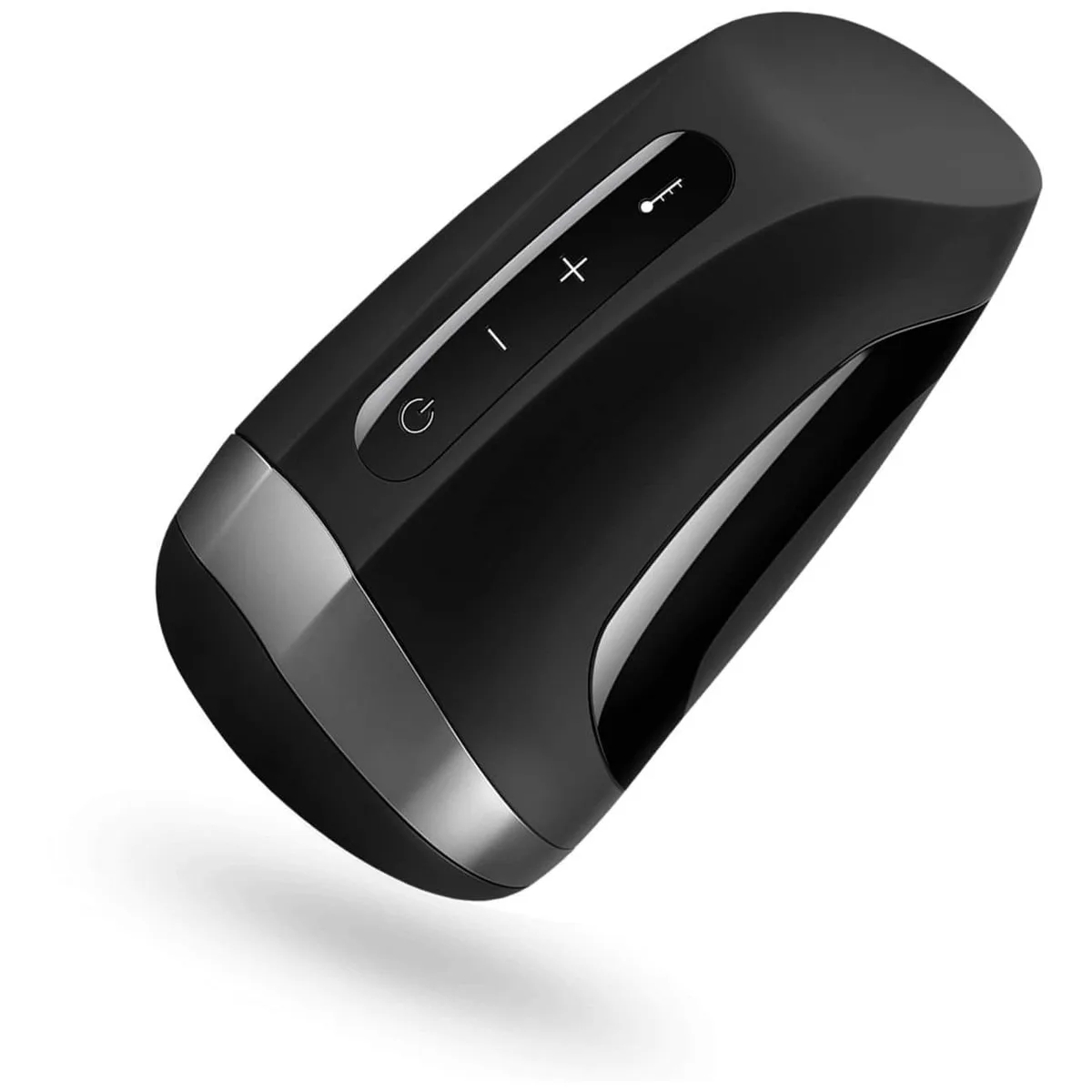
Review: Satisfyer Men Heat Vibration
Masturbator with heat and vibration — from 429 SEK.
29 July 2026
 Author's pick
Review · Masturbator · Pleasure Air air pressure
The only one with air-pressure technology reviewed against the manufacturer’s own specifications and pricing data from nine Swedish stores. Eight intensity levels, three Autopilot modes with published intervals, a sleeve in medical silicone that can be unscrewed, IPX7 according to IEC 60529, and a lithium-ion battery of 700 mAh — but only 90 minutes of runtime and a two-year warranty.
The only stroker based on air-pressure technology, and that’s the whole argument. Eight intensity levels and three Autopilot modes with published intervals, a silicone sleeve that can be unscrewed so the inside can be rinsed, IPX7 on both the sleeve and the unit, and a battery whose rated data is actually displayed. What you pay for is 90 minutes of runtime, a magnetic charging cable that can’t be replaced with a regular USB cable, a two-year warranty, and packaging that has lost the predecessor’s charging and drying base.
Arcwave Ion 2 is the second generation of the stroker that brought air-pressure technology from clitoral stimulators to a product for the male body. Arcwave is a brand within the same group as Womanizer and We-Vibe, and that’s also where the technology comes from: Pleasure Air, meaning pulsing air pressure in a sealed chamber instead of vibration from a motor. The manufacturer describes Ion 2 as the only stroker on the market that integrates Pleasure Air for the male body, and it directs the pressure waves specifically toward the frenulum — the skin band on the underside of the penis where the glans and shaft meet.
The specifications look like this. Eight intensity levels, three Autopilot modes, Smart Silence that starts and stops stimulation upon skin contact, a sleeve in medical-grade silicone that can be unscrewed for cleaning, an IPX7 enclosure rating, 90 minutes of operating time, 120 minutes of charging time, a built-in lithium-ion battery of 3.7 volts and 700 milliampere-hours, as well as a two-year manufacturer’s warranty. The product measures 153.5 × 51.98 × 83.19 millimeters, and the model number is ION11B. In Sweden, it’s sold by nine shops at prices between 1,186 and 1,899 SEK, and four of them had it in stock during the price check.
This review is exclusively about the item with EAN 4251460631112, the manufacturer’s article number AWKN2SG9. Arcwave sells Ion 2 in a single color — black — which makes this product unusually easy to compare on price with the rest of the category, where the same model often has four or five EAN numbers. Still, check the number before you pay, because several Swedish shops still sell the first-generation Arcwave Ion in parallel under an almost identical name.
Classic air-pressure technology is based on a pump creating alternating underpressure and overpressure in a sealed chamber. The chamber never touches the skin with any moving part — the stimulation happens through changes in air pressure inside the chamber. That’s the whole reason this product class is usually described as touch-free. The difference from a vibrator is fundamental rather than a matter of degree: a vibrator transfers mechanical movement from a motor through the material to the skin, while an air-pressure product transfers pressure waves through the air.
What Arcwave has done is to move that principle into a stroker. In Ion 2, the air-pressure sensor sits inside the sleeve — the manufacturer calls it the Pleasure Air sensor — and the manual is very clear about how the product is intended to be used: the penis is inserted so that the frenulum rests against the sensor. The rationale the manufacturer themselves gives is anatomical. The penis and the clitoris have the same tissue origin, and the so-called pacinian pressure receptors found in the clitoris are also found in the frenulum. The Pleasure Air technique was originally developed for the clitoris, and Arcwave states that their techniques have adapted it for male anatomy by creating stronger pressure waves over a broader area.
What that means in practice is that Ion 2 is two products in one. It works like a normal stroker if you move it back and forth, and it adds a point-targeted air-pressure stimulation that is independent of the movement. The manufacturer’s own instruction manual explicitly suggests that you combine the two — switching between letting Pleasure Air work still against the frenulum and stroking the product over the penis. What can be stated is that it’s a different kind of product logic than a pure stroker like Fleshlight, where all stimulation comes from the sleeve’s texture and your own movement.
A detail from the manual that rarely appears in store texts: Arcwave recommends that you try Ion 2 at least five times before judging it, because the sensation differs from anything else. It’s an unusually candid phrasing from a manufacturer, and it says something about the product category. Air pressure isn’t a stronger version of vibration — it’s something else, and some people don’t like it.
Both models are still sold in Swedish stores, often on the same page and sometimes with the same images. The differences can be listed exactly, because Arcwave publishes a manual for each model.
What you can say for sure, then, is that Ion 2 adds 30 minutes of runtime and an automatic mode, but at the same time removes three things from the package: the charging base, the drying mechanism, and the lubricant. The biggest difference to know before buying is that the first generation had a charging base that also dried the sleeve, and that Ion 2 only gets a fabric bag, because drying is the most time-consuming part of maintenance for a product with a closed silicone sleeve. Arcwave sells the base separately as an accessory, but it’s not included.
The material issue is the only characteristic of an intimate product that can’t be compensated for with habit or care, and it determines whether the product is still hygienic after three years. Arcwave lists two materials for Ion 2: medical-grade silicone and body-friendly ABS plastic. The breakdown is shown in how the product is built—the sleeve that the penis is inserted into is silicone, and the technical unit around it is plastic. The manufacturer calls its silicone CleanTech and describes the sleeve’s construction as made entirely from that material.
Silicone is a non-porous material, and Arcwave explicitly states that CleanTech is non-porous. A non-porous surface can be cleaned, because there are no microscopic cavities where residue can get trapped. It’s the single most important property of a material that’s supposed to sit against mucous membrane, and it carries more weight than almost every other line in a specification.
The manufacturer lists six properties for the material: hypoallergenic, material-stable in a range of roughly minus 30 to plus 170 degrees, not flammable, impossible to melt, UV-resistant, and with good resistance to oil, solvents, and other chemicals. Arcwave also describes CleanTech as denser and more hygienic than the TPE plastic that’s standard in typical massagers. It’s a marketing claim in that form, but the choice of material itself is controllable and makes a real difference.
Two consequences are worth highlighting. The first is that a silicone sleeve can handle significantly harsher cleaning than TPE—you can rinse it under running water and use cleaning agents without the surface breaking down. The second is that it doesn’t need to be powdered. TPE sleeves become sticky when they dry and require corn starch or talc to regain their surface, which is one of the most common reasons why cheap massagers get thrown out after half a year. At the same time, note the temperature limit that applies to the product itself and not the material: the manual states that the product and its battery must not be exposed to temperatures above 45 degrees, and the FAQ page explicitly forbids boiling and a dishwasher.
Phthalates are a group of plasticizers used to make plastic—above all, softened PVC—flexible. The Swedish Chemicals Agency (Kemikalieinspektionen) describes them as substances that can affect the endocrine system and make reproduction harder, and several of them are therefore restricted or banned within the EU in a large number of products. This product category is recurring subject to supervision, because it contains softened plastic that lies against the mucous membrane for longer periods of time.
Here it’s worth being careful about what is actually stated and what isn’t. Arcwave does not print the words “phthalate-free,” “BPA-free,” or “latex-free” for Ion 2, unlike the sister brand Womanizer, which does so for its products. What Arcwave does state is the materials: medical silicone and body-friendly ABS plastic. In practice, this is a message with the same meaning for the contact surface, because silicone doesn’t require phthalate plasticizers to be soft—the softness comes from the polymer’s own structure. A material label that says “silicone” therefore says more than almost any other wording in the category, and significantly more than terms such as TPE or “jelly rubber,” which say nothing at all about which plasticizers are included.
The ABS plastic in the technical unit is hard and does not come into contact with the skin in the same way. It’s a standard material in electronic housings; it is dimensionally stable and releases no plasticizers because it contains none. Arcwave using plastic in the housing is therefore not a hygiene problem—but it is a difference compared with a product like Womanizer Next, where the manufacturer specifies silicone over the entire body and therefore does without the seam between two materials.
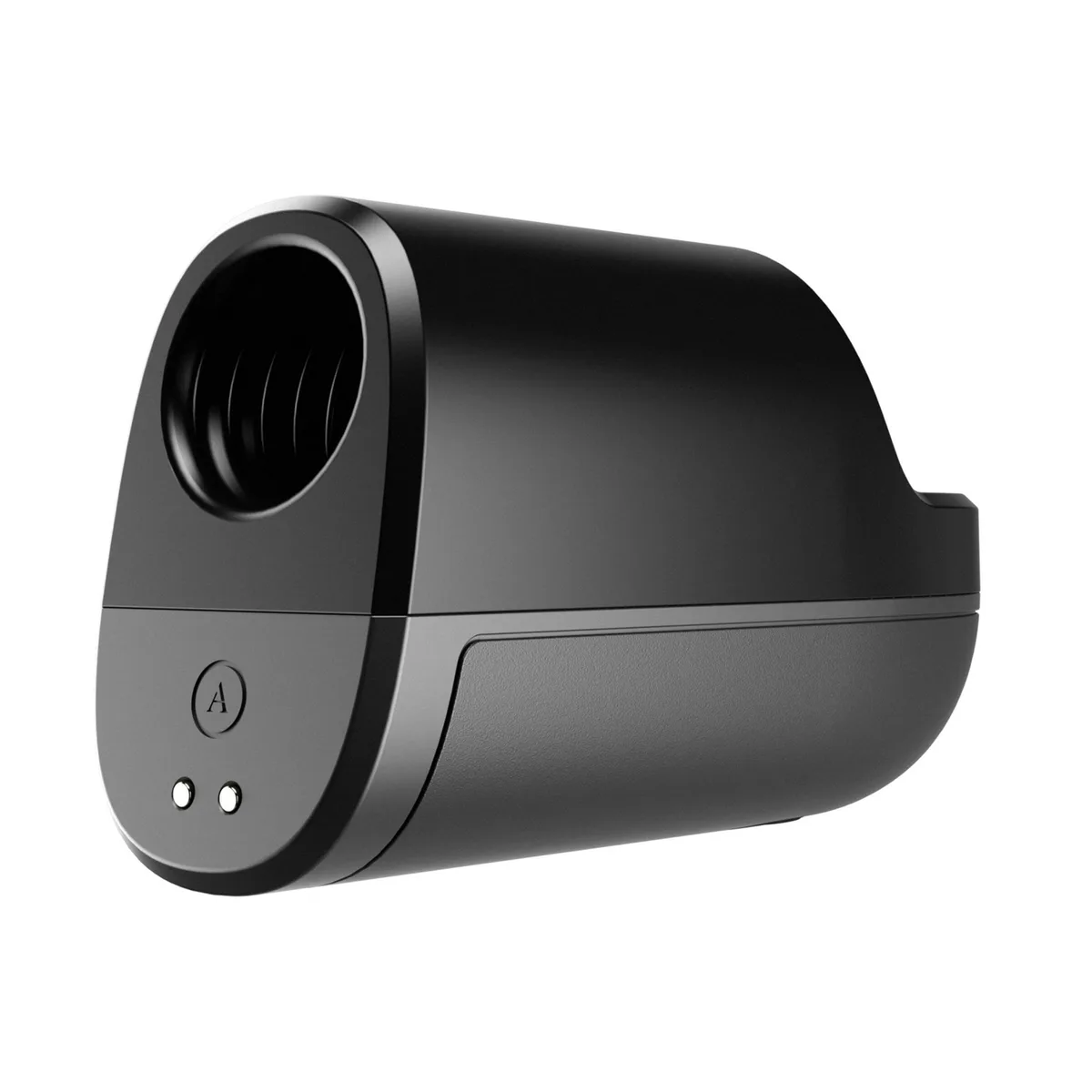
Arcwave specifies the product dimensions as 153.5 × 51.98 × 83.19 millimeters, and the packaging as 196 × 136.5 × 70 millimeters. The shape is closest to an elongated dome with a flat underside where the button and the charging pins sit, with an opening at either end. So it is not a cylinder like a classic stroker, and it is designed so it can rest against the palm of your hand.
The comparison with the predecessor is interesting. The manufacturer specifies the first generation of Ion as 140 × 83 × 50 millimeters—so Ion 2 is therefore 13.5 millimeters longer. Against a modern competitor, the image looks different: Lelo F1’s V3 measures 144 millimeters in length with a diameter of 72 millimeters, which makes it shorter but rounder. None of them is a product you put in a jacket pocket.
Arcwave does not publish a weight for Ion 2. The specification table on the manufacturer’s product page lists dimensions, packaging dimensions, materials, water resistance, battery, operating time, charging time, and warranty—but no weight, neither for the product nor for the delivery. It’s a noticeable gap in a category where weight matters for how the product feels in your hand during use, and it’s an issue Lelo, for example, addresses: 314 grams for F1’s V3. The weight figure for Ion 2 that circulates among retailers is usually shipping weight figures, not manufacturer data, and it should be treated accordingly.
The interface on the Arcwave Ion 2 consists of three buttons, grouped on the underside of the product. The manufacturer’s online manual names them: a button marked with a circled A that both starts and shuts off the product and switches between manual mode and Autopilot, plus a plus button and a minus button that step through the intensity. Next to the buttons are the two magnetic charging pins.
The manual specifies exactly how it works. You start the product by holding down the A button for two seconds until Pleasure Air and the LED light up, and it always starts at the lowest intensity. A short press on the same button switches between manual control and Autopilot. Plus and minus step between eight intensity levels, and the LED blinks briefly every time you change something. You turn it off by holding down the A button for two seconds again, and you can see that the product is off when the logo stops lighting up.
Eight steps are fewer than on several competing products, and it’s worth putting that in context. Womanizer Next has fourteen intensity levels and three depth levels using the same group’s technology. At the same time, the number of steps is one of the least meaningful figures in this category: what determines whether a product works for you is how wide the range is between the lowest and highest setting, not how many adjustment points the manufacturer has put in between. The fact that Arcwave kept exactly eight steps from the first generation to the second suggests the range is set intentionally and not as a marketing argument.
Autopilot is the only functional new feature of the Ion 2 compared with its predecessor, and the manual states exactly what the three modes work within. Soft Mode moves between intensity 1 and 3, Medium Mode between 3 and 6, and Intense Mode between 5 and 8. On the product page, the manufacturer describes them as preset patterns that switch randomly between intensity levels, so that each use is different from the previous one. The product provides both noticeable and audible feedback when Autopilot is turned on and off.
What can be established is that the modes overlap. Step 3 is included in both Soft and Medium, and steps 5 and 6 are included in both Medium and Intense. This means you don’t get three separate experiences, but three sliding ranges, and Intense Mode never goes below step 5. It’s a more transparent breakdown of the automation modes than most manufacturers provide, and it’s worth reading before purchase — if you choose Intense, the product never goes down into the quiet register.
The counterargument against automation modes in general also applies here. Random variation is either exactly what you want, or exactly what you don’t want, and there’s no middle position. The advantage is that you don’t have to find the buttons during use; the disadvantage is that you can’t stay on a mode that works. The fact that switching between manual mode and Autopilot is done with a single button press on one card is therefore a good design detail — you can jump out of the automation without turning anything off.
Smart Silence means that air-pressure stimulation doesn’t start until the Pleasure Air sensor is completely covered by skin. The manufacturer lists two reasons: it’s more discreet, because the product simply doesn’t make any sound until it’s supposed to, and it saves battery. Practically, that means you can turn the product on in advance without it starting to work, and it goes silent immediately when you pull away.
Ion 2 differs from the predecessor in a way that’s easy to miss. The first-generation Ion had its own button for Smart Silence. On Ion 2, there is no such button — the function is turned on and off by holding down the plus and minus button at the same time for five seconds, and the same command turns it off again. It’s a hidden command that can’t be figured out without the manual, and it’s the most likely reason why someone thinks the product “doesn’t start.”
A tip from the manufacturer’s own instruction manual that belongs here: place your thumb against the pressure pads on the product to increase the pressure in the chamber. More pressure provides stronger stimulation, and in practice it’s a fourth control option alongside the eight steps — without buttons.
Fit is the key question for a stroker, and it’s also the question where Arcwave’s documentation is weakest. The manufacturer does not publish a diameter for Ion 2’s opening, either when not expanded or at maximum expanded. The figure on Arcwave’s FAQ page — 33 millimeters unexpanded and tested expanded up to 44 millimeters — applies to the first-generation Ion. It’s clear from the fact that the same answer also describes a storage base that isn’t included with Ion 2, and that the dimensions given in the answer are for the predecessor’s 140 × 83 × 50 millimeters.
What can be established is that both models are open at both ends and built around the same CleanTech sleeve, and that the manufacturer describes the material as very flexible. Arcwave also states that the product works for both circumcised and uncircumcised penises. But if you stand there and choose a product based on measurements, the only honest conclusion is that the information is missing for Ion 2, and that a number taken from the predecessor’s FAQ answers is not the same as a published specification.
One more detail that is relevant for the fit: Arcwave sells a replacement sleeve in CleanTech silicone as a separate accessory for 69.90 euro, item number AWKN1AP9. In the product text, it is described as a replacement sleeve for Arcwave Ion, and the manufacturer does not state whether it fits Ion 2. It’s an item worth checking directly with Arcwave before you assume you’ll be able to replace the sleeve later on, since the sleeve is the part that wears out.
Arcwave markets Smart Silence as a discretion feature and writes that you never need to worry about unwanted sound, because the product switches off as soon as skin contact stops. The question is what the sound level is when the product is actually working, and there the answer has to be direct: Arcwave does not publish any measured decibel value for Ion 2, either on the product page, in the online manual, or on the FAQ page.
There’s also no comparison graphic of the kind Womanizer uses for its models, meaning there’s no scale with reference sound. Websites that state an exact decibel value for Ion 2 either show their own measurement or a value without a source from the manufacturer.
There are two things that can be concluded. First, that air pressure products in this category work with a pump instead of an unbalanced weight on a rotating shaft, which is a different sound source than a classic vibrator. Second, that a comparison can be made in the category when an actual number is published: Lelo specifies a maximum of under 75 decibels for the F1s V3. That says the most about how little exact information there is to compare in this product category, even when a manufacturer makes an effort to publish a value.
A practical tip that applies regardless of the model: don’t place the product on a hard tabletop while it’s working. A hard surface acts as a soundboard and noticeably amplifies the sound.
Arcwave Ion 2 is rated IPX7, and the manufacturer states that both the technical unit and the silicone sleeve have the rating. That’s an important clarification: the product consists of two parts that screw apart, and both can handle water on their own.
The classification comes from the international standard IEC 60529, which defines enclosure classes for electrical equipment. The number 7 in the second position means that the product is tested for immersion in water to a depth of one meter for 30 minutes. Arcwave states the consequence plainly in the manual: Ion 2 can be submerged in water without damage and rinsed directly under running warm water.
The difference compared to a splash-proof product is greater than the wording suggests. Splash protection covers water droplets and, at best, water jets, but not immersion. Such a product can handle a damp cloth and possibly a shower, but it should not be held under running water—use some common sense regarding the buttons and the charging contact instead. If a product is missing an IPX rating entirely, it should be treated as not waterproof—an absence of a rating is never a sign that the product would be approved.
Cleaning is the function Arcwave emphasizes the most, and it is based on a mechanism they call Twist to Open. You twist apart the upper part from the technical unit in one motion, which provides free access to the inside of the sleeve. The manual’s instruction is to rinse both the sleeve and the unit under warm running water, use a cleaning agent intended for intimate products both inside and outside, dry with a lint-free cloth, and then twist the parts back together again with the same locking.
It is a genuine advantage compared with stroke rs where the sleeve is fixed in place or has to be pulled out of a housing. The inside of a closed silicone sleeve is the only place in this product type where residue can actually remain, and a design that provides direct access to exactly that surface is worth more than most functions in a specification. Drying, however, is still the time-consuming part—and that’s exactly where Ion 2 fell behind the predecessor, because the DryTech base that dried the sleeve using drying-blanket pouches is no longer included.
The lubricant question is unambiguous in the manufacturer’s materials. Use a water-based lubricant. The manual explicitly advises against fragranced and alcohol-based lubricants, gels, and massage oils, and against silicone-based lubricant on silicone products. Silicone-based lubricant breaks down the silicone surface over time and makes it porous, and once the surface is porous it can no longer be cleaned properly—only replaced. Arcwave recommends CE-marked medical products from well-known manufacturers, dermatologically tested and free from preservatives, comedogenic oils, and fragrance.
The manual also covers three things that rarely appear in store texts. The product and its battery must not be exposed to temperatures above 45 degrees, which rules out boiling and the dishwasher despite IPX7. The product contains magnets, which means it should not be used directly over a pacemaker, and that cards with a magnetic stripe should be kept away from it. And Ion 2 is expressly not designed for anal use.
Arcwave states the operating time as 90 minutes and the charging time as 120 minutes. Here the manufacturer deserves credit for something unusual in the category: the battery’s rated data is written plainly in the manual’s safety section—3.7 volts and 700 milliampere-hours, a built-in lithium-ion battery that is not replaceable. Charging takes place at 5 volts and 0.75 ampere via USB, and a power adapter is not included.
Publishing the capacity makes a practical difference, because it makes the operating time checkable rather than just being a claim. Womanizer, for example, publishes neither capacity nor voltage for Next, which means the 240-minute operating time can’t be put in relation to anything. Lelo publishes 850 mAh and 3.7 volts for F1’s V3 and states up to two hours of operation.
Charging takes place via two magnetic charging pins on the underside of the product, to which the included magnetic charging cable is attached. The manual describes the charging indicator: the LED pulses while charging, stays steadily lit when the battery is fully charged, and blinks for four seconds when the charge is below 25 percent.
Magnetic charging is a trade-off, not a pure advantage. The advantage is that there’s no need for an opening in the housing, which makes it easier to achieve IPX7 without a rubber plug—and on a product that’s meant to be rinsed under the tap after every use, it’s a real benefit. The downside is that the cable is product-specific: if you lose the charging cable, no standard USB-C cable will work, so you have to get a replacement from the manufacturer. Arcwave sells such cables as separate accessories.
A difference from the predecessor belongs here. The first-generation Ion was charged by placing it in its charging and storage base with a micro-USB cable to the base, and the base handled both charging and drying at the same time. Ion 2 is charged directly on the product with a magnetic cable, which is easier and takes up less space—but means that charging and drying are now two separate steps.
A running time of ninety minutes isn’t much in absolute terms, but it should be put in relation to how it’s used. A stroker is used in sessions of minutes, not hours, and therefore 90 minutes is enough for a large number of occasions between charges. The comparison with the predecessor is also in favor of Ion 2: the first-generation Ion was stated to be 60 minutes at the highest intensity, i.e. half an hour less—Ion 2 lasts 50 percent longer.
Compared with the other premium option, it looks different. Lelo states up to two hours for F1’s V3, which is 30 minutes more, from a battery of 850 mAh versus Arcwave’s 700. Lelo also has an automatic shut-off after 20 minutes that Arcwave does not state any equivalent for Ion 2.
What applies generally to lithium-ion batteries also applies here: capacity drops with the number of charge cycles, the battery is not replaceable, and the product does best when it is charged regularly rather than stored completely discharged. The manufacturer writes in the manual itself that the product should be charged regularly even when it’s not in use. With use a couple of times a week, it’s the battery—not the silicone—that sets the limit for lifespan—and since the cell is permanently soldered, the product is essentially used up when the battery is.
We do not have price data from shops in your market yet.
The eight intensity levels are unchanged from the first generation. What the Ion 2 adds is Autopilot and 30 minutes of operating time — what it removes is the charging base, the cleaner, and the lubricant.
Three comparisons are relevant: versus Arcwave’s own previous generation, versus the other premium brand in the category, and versus the most sold expression of the same technology in a product for the clitoris. All information below comes from the respective manufacturers’ own specifications, and all prices are from the stores’ product flows on 29 July 2026.
The first-generation Arcwave Ion is sold from 1,295 SEK and Ion 2 from 1,186 SEK. At the price check, the newer model was therefore 109 SEK cheaper than the predecessor at its lowest price, which in itself is a reason not to buy gen 1 routinely. The price range otherwise overlaps heavily—the older model is listed up to 2,599 SEK.
Functionally, Ion 2 adds two things: Autopilot with three modes and 30 minutes longer run time, 90 minutes versus 60. At the same time, it removes three: the storage and charging base, the DryTech drying mechanism, and the 10 milliliters of lubricant that were included in the older package. The number of intensity levels is unchanged at eight in both models; the material is the same CleanTech silicone; Twist to Open is in both; and both are IPX7.
The conclusion is therefore not a given, and it depends on what you value. If you want automatic modes and longer runtime, Ion 2 is the upgrade—and it’s also cheaper. If you want a base that both charges and dries the sleeve without you having to think about it, then it’s only the older model that includes that function in the box. That a new generation comes with less in the packaging than the old one is worth knowing before assuming that newer is more complete.
Lelo F1s V3 costs from 1,995 SEK versus Ion 2’s 1,186 SEK. That’s a difference of 809 SEK, i.e. 68 percent more for Lelo. They’re both premium products for the same use, but they solve the task in completely different ways.
Lelo lists the dimensions as 144 × Ø 72 millimeters, the insertion depth as 110 millimeters, the opening diameter as 40 to 60 millimeters, and the weight as 314 grams. The materials are body-friendly silicone, an aluminum alloy, and LEXAN 141R. The battery is lithium-ion at 850 mAh and 3.7 volts, with a two-hour charge time and up to two hours of operation. It has two motors—one suction motor at 64 hertz and a vibration motor at 93 hertz—app control via Bluetooth, sensors that report back to the app, a stated maximum noise level of under 75 decibels, automatic shut-off after 20 minutes, and a two-year warranty plus a ten-year quality warranty.
The differences that actually matter: Lelo publishes three details that Arcwave doesn’t—weight, sound level, and the opening diameter—and adds app control and a vibration motor in addition to the suction technology. Arcwave instead has a technology that Lelo doesn’t, namely Pleasure Air aimed at the frenulum, a sleeve that unscrews completely for cleaning, and a price that is more than 800 kronor lower. If you choose based on the stated data and app features, Lelo wins. If you choose based on price, the cleaning design, and this kind of stimulation, Arcwave wins.
This comparison is not a buy comparison but a technical one. Womanizer Next is the clitoral stimulator from the same group and the same technology family, and it shows what Pleasure Air can do when the manufacturer puts its entire development effort into the function: fourteen intensity levels, three depth levels, 240 minutes of runtime, 120 minutes of charging time, IPX7, body-friendly silicone over the whole body, and a five-year manufacturer’s warranty. The price starts at 1,495 SEK, i.e. 309 SEK more than Ion 2.
What becomes clear from the comparison is where Ion 2 falls behind within its own parent company. Womanizer Next has nearly three times the operating time, nearly twice as many intensity levels, a deep control knob that has no equivalent with Arcwave, and a warranty that is two and a half times as long — five years versus two. That the same parent company offers a five-year warranty on one model and two years on another is one of the most telling pieces of information in the entire review.
Ion 2, on the other hand, adds something that Womanizer Next does not: a sleeve to insert, and thus the ability to combine air pressure with stroking. If you’re looking for Pleasure Air for male anatomy, there is practically no alternative — that’s the whole point of the product, and that’s also why the comparison with Womanizer can’t determine a purchase.
Nine Swedish stores sell the item with EAN 4251460631112. The cheapest is Joyland at 1,186 SEK, and the most expensive is Vuxenkul at 1,899 SEK. That’s a difference of 713 SEK, or 60 percent, for the exact same item number, the same color, and the same packaging.
The stock situation is unusually favorable compared with the rest of the category. Four of the nine stores had the product in stock at the price check — and the cheapest among them was also the cheapest overall: Joyland at 1,186 SEK, followed by Lustly at 1,599, Mshop at 1,799, and Vuxenkul at 1,899. That means you don’t have to choose between the lowest price and availability, which otherwise is the most common problem in price comparisons in this product category. At the same time, the difference between the cheapest and the second-cheapest available store is 413 SEK, i.e. 35 percent — that’s large enough that it pays to check who actually has the item at home before you place your order.
The price spread isn’t because one store sells a different variant. Ion 2 is only available in black, and all nine stores list the item either under EAN 4251460631112 or under their own item number tied to that specific listing. So this is about the stores’ own margin-setting for a model that hasn’t yet had time to become a price-pressured volume product — and that’s exactly the situation where it’s most worthwhile to compare before you pay.
The prices in the table above are updated when the stores’ product feeds are updated, but always check the final price at checkout. Shipping costs are added by most stores under a certain order value, and in this price range most stores are above the limit for free shipping.
It’s a fit for you if you’re curious about air-pressure technology and want it in a product built for male anatomy. It isn’t a marginal difference compared to a regular stroker—it’s a different kind of stimulation, targeted at a specific area, and in practice it isn’t found in any other product on the Swedish market. It’s for you who want to be able to take the product apart and rinse the sleeve’s inside under the tap, you who prefer silicone over TPE and don’t have to powder a sleeve after every use, and you who want an automatic mode with stated intervals rather than a vaguely described program.
It’s not for you if you want maximum operating time: 90 minutes is the shortest in this comparison, and Lelo F1’s V3 lists 30 minutes more. It’s not for you if you require published weight, measured sound level in decibels, or a specified opening diameter before purchase, because Arcwave does not publish any of those for this model. It’s not for you who wants to charge with the same cable as your phone—the charging cable is magnetic and product-specific. And it’s not for you who expects that a new generation includes everything that the old one did, because the charging base, the drying mechanism, and the lubricant have disappeared from the packaging.
One more thing belongs in the decision. The manufacturer states that you should try the product at least five times before you assess it, and that air pressure is a new kind of sensation. That wording is a reasonable reason to buy from a shop with clear return terms—but at the same time, be aware that in practice the right of withdrawal is limited as soon as the seal on a hygiene item is broken. Arcwave does not accept returns when the packaging’s seal is broken.
Arcwave provides a two-year manufacturer’s warranty on all products, counted from the purchase date on the receipt. The warranty covers manufacturing defects, and the manufacturer replaces defective products within the warranty period upon presentation of proof of purchase. If you receive a replacement product, the warranty continues from the original purchase date, not from the replacement.
Read the exclusions before you count on the warranty. It does not cover normal wear on parts, personal preferences, damage caused by incorrect use, careless handling, or loss, and it does not cover products where someone has made changes. In practice, that means that the silicone sleeve—the part that wears the most—is likely treated as a wear part, and that you should expect that a replacement sleeve will be at your own expense. However, no product registration is required; Arcwave states explicitly that they have no registration program and that it’s enough to save the receipt for the entire warranty period.
Two years is short in this category, and it’s worth stating plainly. Womanizer, within the same group, offers five years on Next. Lelo offers two years plus ten years of quality warranty on F1’s V3. Arcwaves’ two years is therefore the shortest manufacturer commitment among the products compared here — and shorter than the statutory complaint right of three years that applies regardless.
Arcwaves’ 100-day guarantee is also worth a clarification, because it’s often cited in store texts. According to the manufacturer, it applies to only purchases in Arcwaves’ own web shop, and it refunds the money in the form of a value voucher to shop for in the same shop — not cash. If you buy at any of the nine Swedish shops listed above, you’re therefore not covered by it.
What always applies, on the other hand, are your statutory rights. Under konsumentköplagen (the Swedish Consumer Sales Act), you have a three-year complaint right for defects in the goods, regardless of what the manufacturer promises — i.e., one year longer than Arcwaves’ own guarantee. For distance purchases, you also have a right of withdrawal for fourteen days under lagen om distansavtal och avtal utanför affärslokaler. Be aware that in practice, the right of withdrawal is limited for hygiene products that have been removed from a sealed package — but the complaint right for defects applies regardless. If you have questions about what applies in your case, Konsumentverket guides you via Hallå konsument.
Arcwave Ion 2 is ranked på plats 4 av 20 in masturbator best i test, where the entire category is compared against each other using five shared criteria. Guiden vinns av Satisfyer Men Vibration+.
Every numerical piece of information in the text can be traced to one of the sources below. The links were checked manually on the specified date.
This page is machine-translated from Swedish. Read the Swedish original