

Review
Review: Satisfyer Pro 2 Next Generation
Cheapest among the widely sold ones — 219 SEK and a 15-year warranty.
29 July 2026
Review · Masturbator · Heat and vibration
Satisfyer’s heated masturbator reviewed against the manufacturer’s own specifications, quick guide, and price data from nine Swedish stores. Eleven vibration programs, heating up to 39 degrees, medical-quality silicone, IPX7 according to IEC 60529, a 700 mAh battery that lasts for one hour — and a 15-year warranty that specifically excludes that battery.
The cheapest way to warm the silicone to body temperature, and the only one in Satisfyer’s men’s product range that combines heat with IPX7. A fifteen-year warranty is category-leading. What you pay for is a runtime of 60 minutes versus 3.5 hours of charging, an insert that is not stated to be removable, and manufacturer documentation that contradicts itself about both the number of programs and the temperature.
Satisfyer Men Heat Vibration is a masturbator with two things in the same housing: a vibration part and a heating element. That combination is what the entire product is built around, and it’s also the only feature that genuinely sets the model apart from the rest of Satisfyer’s lineup of men’s products. The manufacturer describes it as a product for stimulating the glans (the head of the penis), with a tapered tunnel and an opening wide enough that the product can be applied even when the penis is not erect.
The specification according to Satisfyer looks like this: eleven vibration programs, heating up to 40 degrees, enclosure rating IPX7, medical-grade silicone against the skin and ABS plastic in the housing, a lithium-ion battery, a magnetic USB charging cable included in the package, and a 15-year manufacturer’s warranty. The dimensions are 140 × 82.6 × 78 millimeters and the weight is 193 grams. From the manufacturer’s quick guide, you can also get what the product page doesn’t list: the battery is 700 mAh at 3.7 volts, the charging time is stated to be about 3.5 hours, and the usage time is stated to be about 60 minutes.
This review is exclusively about the black, rechargeable variant with EAN 4049369016372. Satisfyer sells the product in two colors, black and purple, and it also sells a battery-powered model that is named almost exactly the same but has a different enclosure rating and a different number of programs. Nine Swedish retailers sell the item at prices between 429 and 829 SEK, and five of them had it in stock during the price check.
Heat and vibration are two completely different ways to stimulate, and it’s worth keeping them separate before you pay for a product that does both. Vibration is mechanical: a motor with an unbalanced weight transfers movement through the material to the skin, and it’s that movement itself that you feel. Heat is thermal: an element raises the temperature of the insert, and what you feel is that the material sits closer to body temperature instead of room temperature.
The practical reason for a manufacturer to build heat into exactly this product category is simple. Silicone that has been stored in a drawer holds room temperature, meaning about 20 degrees, while the body sits around 37. The difference is noticeable right at first contact, and it’s the most common objection to the entire product category. A heating element removes that objection. What can be concluded, then, is that the heat doesn’t add a new kind of stimulation — it removes a disruption.
Satisfyer states that the heating is supposed to provide a more realistic sensation and that the product is intended to be used to build up arousal slowly. The manufacturer also provides a specific instruction that is worth reading before the first use: heat the product for two to five minutes, always test the temperature on the back of your hand or under your forearm before touching sensitive areas, and turn it off immediately if it feels too hot. It’s an unusually direct formulation for product text, and it should be taken seriously.
Satisfyer’s naming in the men’s range is a problem in itself. Three models are so close to each other in name and appearance that Swedish stores regularly mix them up, and the price difference between them is less than the price difference between stores for the same model.
So the difference is not a question of a newer or older generation. The three are sold in parallel and do different things. If you want heat and the ability to dip the product in water, it’s only this model that gives you both. If you want the strongest vibration, Men Vibration is the one with two motors. If you want heat as cheaply as possible and can live with AAA batteries and a lower waterproof rating, the battery version is 170 SEK cheaper.
Here there’s a contradiction worth its own section, because it affects how you read every shop text about the product. Satisfyer’s product page states eleven vibration programs. Satisfyer’s own packaging states 70 Programs. Both pieces of information come from the manufacturer, and both can be checked: the eleven is in the bullet list on the product page and is repeated in the manufacturer’s highlight graphic, while the 70 is printed on the box together with Glans Stimulation, Soft Silicone, Rechargeable and Waterproof (IPX7).
Satisfyer does not explain the difference anywhere. The most likely interpretation is that 11 refers to the number of patterns and that 70 refers to the number of combinations of patterns and intensity, but it is an interpretation and not an itemized specification — the manufacturer does not state it. Taboo, one of the nine Swedish stores, for its part lists 70 vibration combinations and three heat levels in its product text, but the heat levels are not present in any of Satisfyer’s own material.
Practically speaking, it matters less than it sounds. Eleven patterns is more than most people use, and the pattern across the whole product category is that you keep coming back to two or three. But the contradiction is a good example of why a number in a store text is worth nothing until you know which manufacturer specification it is based on — and why a comparison that is based on the number of programs is the weakest comparison you can make in this category.
The material question is the only characteristic of an intimate product that cannot be compensated for with experience or care, and it determines whether the product is still hygienic after three years. Satisfyer specifies two materials for Men Heat Vibration: silicone and ABS plastic. The silicone is described as super soft, body-friendly, and of medical quality.
The silicone is located in the insert, meaning the tunnel that lies against the skin, and in the soft opening. The manufacturer’s highlight graphic explicitly points out the lower, soft part of the product as body-friendly silicone. The hard housing with the buttons, the silver-colored trim strip, and the back are made of ABS plastic — a hard thermoplastic that is non-porous but lacks the silicone’s soft feel.
That the contact surface is silicone is what matters hygienically. Silicone is non-porous, and a non-porous surface can be cleaned because there are no microscopic cavities where residue can remain. This is the single most important property of a material that is intended to be in contact with mucous membranes, and that is why the material declaration weighs more heavily than almost all other lines in a specification. ABS is also non-porous, so for cleaning, the material choice in the housing is unproblematic — it comes down to feel, not hygiene.
One thing that Satisfyer, on the other hand, does not state belongs here: the manufacturer does not state that the silicone insert can be removed from the housing. Neither the product page nor the quick guide mentions a removable sleeve. It is a real limitation in a product that, by definition, is supposed to be cleaned from the inside, and it is the difference compared to a model like Satisfyer Men One, where the sleeve is a separate part. Here you are limited to rinsing through the tunnel without being able to turn it inside out.
Phthalates are a group of plasticizers used to make plastic—above all, flexible PVC—pliable. Kemikalieinspektionen describes them as substances that can affect the hormone system and make reproduction more difficult, and several of them are therefore restricted or banned within the EU in a large number of products. This product category is therefore repeatedly the subject of supervision, because it contains flexible plastic that comes into contact with the skin.
Silicone and ABS are both materials that do not require phthalate plasticizers to function. Silicone’s softness comes from the polymer’s own structure, not from an added plasticizing substance. That’s the whole point of why the material declaration is more important than the specification list: a product that states “TPE,” “jelly rubber,” or “cyberskin” without further clarification says nothing about which plasticizers are included, whereas “silicone” and “ABS” are unambiguous statements.
What Satisfyer, on the other hand, does not do is provide an explicit declaration of the type “phthalate-free, BPA-free, and latex-free.” Competitors in the premium segment do this routinely. Here you get the material names, and they are in themselves sufficiently unambiguous, but that extra commitment is not there to rely on.
Satisfyer states the height as 140 millimeters, the length as 82.6 millimeters, and the width as 78 millimeters. So it’s a short and wide object rather than an elongated one—designed to enclose only the glans and the front part, just as the manufacturer describes, and not to cover the entire length. The weight is given as 193 grams, which is low enough that you can hold it in one hand throughout use.
The comparison with the sibling models says something about the format. Satisfyer Men Vibration is listed as weighing 295 grams, and the battery-powered Heat Vibration 305 grams—so more than one and a half times as much as this model. Arcwave Ion 2, which is the premium product that most people compare with, measures 153.5 × 51.98 × 83.19 millimeters and is therefore longer and narrower.
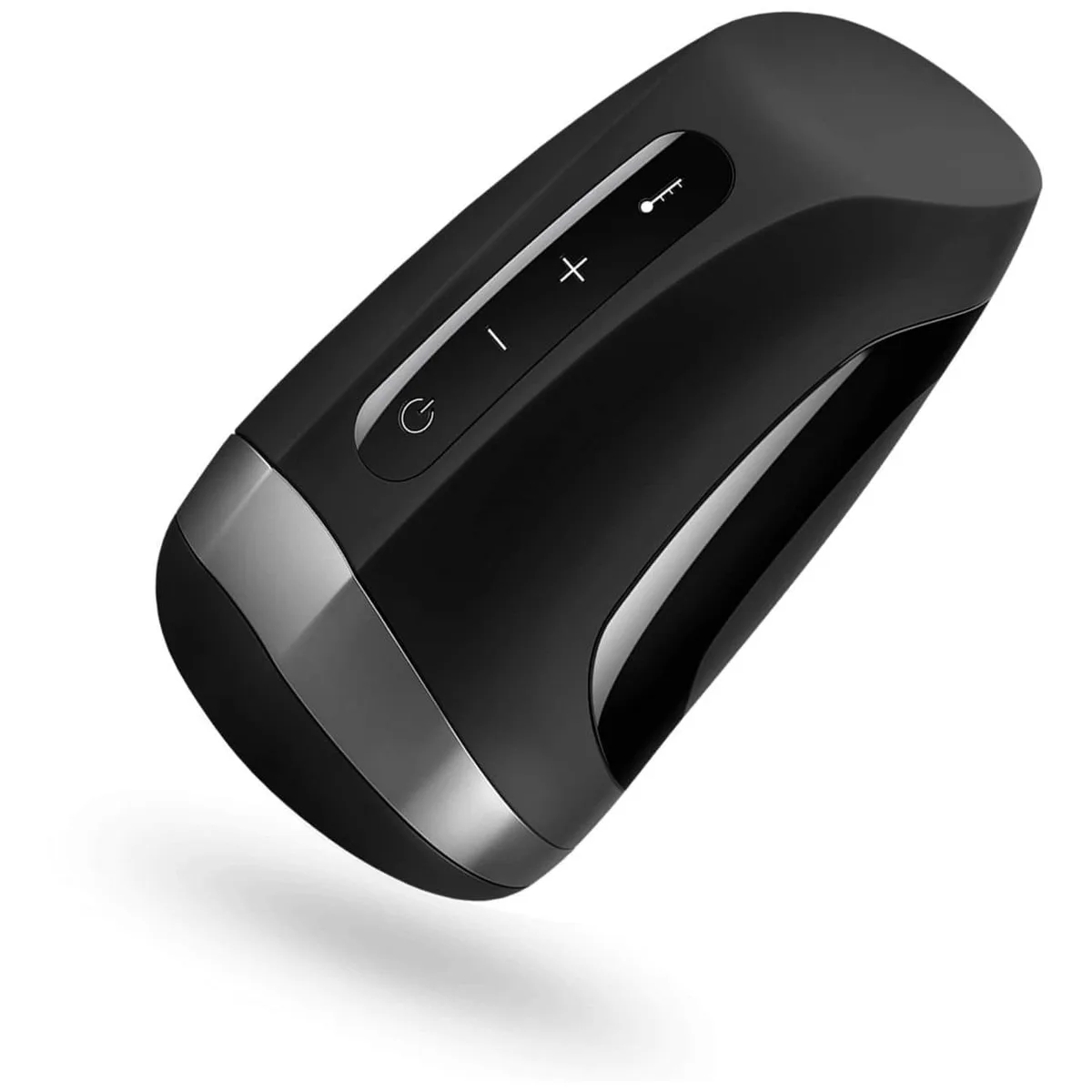
The shape is asymmetrical: a wide, rounded upper part that tapers downward toward the opening, with a button row on the top side. The manufacturer’s own images show four printed areas on the panel—a thermometer symbol for the heat, plus and minus for the vibration strength, and an on/off button at the bottom. The product page describes the controls as one-handed operation with on/off and plus/minus, and that matches the panel: the heat gets its own button and therefore does not interfere with switching between the vibration modes.
The package is an upright cardboard box in Satisfyer’s magenta with a product image and a printed feature list. The manufacturer does not publish any package dimensions for this model—unlike, for example, Arcwave, which states 196 × 136.5 × 70 millimeters for Ion 2. It doesn’t affect use, but it’s an example of how unevenly this category is presented even when the information comes directly from the manufacturers.
The interface is intentionally simple. Satisfyer describes it as control with on/off and plus/minus, convenient with one hand, and the manufacturer’s own product images show a panel with four touch areas: the heat button with a thermometer symbol at the very top, then plus, then minus, and the on/off button at the bottom. There are fewer controls than on the premium models in this category, and in this case that’s an advantage rather than a drawback—a product that you’re meant to hold with one hand in a position where you can’t see the buttons does better with fewer of them.
The fact that heat has its own button is the most important design detail. That means you can turn on the heating and let it work while you switch between vibration modes, and you can use the product entirely without heat if you want to. The consequence is that the model is, in practice, two products in the same housing—exactly what the manufacturer emphasizes on the packaging with the wording 2 in 1 Vibration + Heat.
The temperature information is the second contradiction in Satisfyer’s material, and it’s at least as clear as the program question. The product page’s body text states heating up to up to 40 degrees—the same wording in the German and English versions. Instead, the manufacturer’s own highlight graphic indicates up to 39 °C, and the packaging prints the same thing: Heats Up to 39 °C / 102 °F.
One degree is an insignificant difference in practice. The point isn’t the degree; the point is that two official details from the same manufacturer don’t agree, and that the product page is the one that gets the most weight. Count on 39 degrees—that’s the number stated on both the packaging and the feature graphic, i.e. on the material that comes with the product.
What 39 degrees means physically is also worth establishing, since the number sounds higher than it is. Normal body temperature is around 37 degrees. So an insert that maintains 39 degrees is only a little more than two degrees warmer than the body and far below the level where skin can be damaged. This is a product that makes the silicone body-warm, not a product that heats. That the manufacturer still urges you to test the temperature on the back of your hand first and to turn it off if you feel discomfort is reasonable, because sensitivity varies and because an element can always break.
What Satisfyer does not publish is how long the heating takes to reach full temperature. The product text states that the product should be warmed up for two to five minutes before use, but it does not provide any information on how quickly the heating element reaches 39 degrees or how the temperature is maintained during operation. It is also not stated whether the heat has multiple levels. One of the nine Swedish stores, Taboo, writes that the heat is set to three levels, but that information is therefore not found in the manufacturer’s own material and should be treated accordingly.
Satisfyer highlights the opening’s width as a separate argument: it should be wide enough to allow the product to be placed against the penis even when the penis is not erect. That is a real practical difference compared with sleeves with a narrow opening, which assume that you are already in position before the product can be used, and it ties in with the fact that the model is designed for buildup rather than the final phase.
Inside the opening, the tunnel narrows. The manufacturer’s highlight graphic describes it as a tapering tunnel for intensive glans stimulation, and that is also the whole idea behind the format: pressure and vibration are concentrated in the front portion instead of being distributed over the entire length.
However, Satisfyer does not publish any inner dimensions—neither the tunnel’s length, its diameter, nor how much the material stretches. That is by far the biggest gap in the specifications, because fit is crucial in this product category in a way that it is not for a vibrator. For comparison, Satisfyer lists an insertion depth of 7 centimeters for the sibling model Men Vibration, so that information is evidently possible to publish. One of the Swedish stores, Lekosmek, provides inner dimensions in its own product text, but that is the store’s responsibility and not the manufacturer’s, and it should not be confused with a specification.
Satisfyer lists Whisper mode—that is, whispering mode—as one of the product’s features. What that means technically is not explained in more detail in the manufacturer’s materials. Satisfyer does not publish any measured decibel value for Men Heat Vibration, either on the product page or in the quick guide. Websites that provide an exact decibel number for the model either present their own measurement or a value without a source.
What can be established is that the sound in a product of this type comes from the vibration motor, and a sealed, thick-walled construction dampens more than a thin housing. A practical tip that applies regardless of model: place the product on a soft surface between uses, because a hard tabletop works as a resonance box and noticeably amplifies the sound.
Satisfyer Men Heat Vibration is rated IPX7. The rating comes from the international standard IEC 60529, which defines enclosure classes for electrical equipment. The number 7 in the second position means that the product has been tested for submersion in water to a depth of one meter for 30 minutes. The manufacturer draws its own conclusion straight out: the product can be used safely in water and is easy to clean.
This is the difference that’s easiest to lose when two products have almost the same name. The rechargeable Men Heat Vibration is IPX7. The battery-powered Men Heat Vibration Battery Powered is IPX6.
According to IEC 60529, IPX6 means that the product can handle powerful water jets from all directions. So it can handle running water and showering. What it is not tested for is submersion. The difference is crucial in practice: with IPX7, the product can be placed in water in the sink or bathtub without thinking twice, with IPX6 it should only be rinsed off. That the difference exists is logical — the battery version has a cover for three AAA cells, meaning there is an opening in the housing, while the rechargeable model charges magnetically with no opening.
If a product completely lacks an IPX rating, it should be treated as not waterproof. The absence of a rating is never a sign that the product would be approved — it’s a sign that nobody has tested it.
Satisfyer’s own instructions are brief: rinse with lukewarm water, soap, and a disinfecting toy cleaner. Since the insert is not stated to be removable, it’s the tunnel that requires the most care — rinse it through several times and let the product dry completely with the opening facing downward before putting it away. Moisture that remains in a closed tunnel is the only hygienic weak point in the design, and it’s worth ten extra seconds every time.
The question about lubricant has a clear answer. The manufacturer recommends water-based lubricant in the opening, evenly distributed inside. Silicone-based lubricant should not be used on silicone products — it breaks down the silicone surface over time and makes it porous, and a porous surface can’t be cleaned properly anymore, only replaced. Oil-based products like coconut oil leave a film that’s difficult to remove and that becomes a breeding ground over time.
A temperature limit also belongs here, and it comes from the manufacturer’s quick guide. The storage temperature is specified as between −5 and +60 degrees. That rules out storing it in a car during summer, and it should be read together with what applies to all lithium-ion batteries: heat is the fastest way to destroy a cell. Boiling water and a dishwasher are out of the question despite IPX7.
This is the part of the specification that deserves the most attention, and it is also the only part that isn’t on the product page. Instead, the information is found in the manufacturer’s multilingual quick guide, which has a Swedish section: the battery is lithium-ion at 3.7 volts with a capacity of 700 mAh, the charging voltage is 5 volts, the maximum charging current is 500 mA, the charging time is stated as approximately 3.5 hours, and the usage time as approximately 60 minutes.
With a magnetic charging cable that connects to USB. The cable is included in the package, and the manufacturer’s highlight graphic points out the magnetic charging contact on the underside of the product. Magnetic charging is the same solution that premium brands use, and the reason is the same: there’s no need for an opening in the housing, which makes it easier to reach IPX7 without a rubber plug.
The downside is the same. The cable is product-specific, and a regular USB-C cable doesn’t work. If you lose it, you have to get a replacement—Satisfyer sells a separate USB charging cable in its own store. That’s a real difference compared with products that charge using a standard connector, and it’s worth knowing before you pack the product away for a trip.
A calculation example about charging: a maximum charging current of 500 mA against a cell of 700 mAh should, purely theoretically, give a charging time of around an hour and a half. The manufacturer states 3.5 hours. The difference is likely because the current is stepped down toward the end, as with all lithium-ion cells during charging, but this is an interpretation—Satisfyer does not provide a charging curve. The practical advice is simple: put it on charge the evening before, not half an hour before.
Sixty minutes of operation is short. It’s shorter than almost everything else in the broader category, and the explanation lies in the heating element. An element that’s supposed to raise the temperature of a silicone insert draws power in a completely different way than a small vibration motor, and 700 mAh at 3.7 volts corresponds to about 2.6 watt-hours of total energy. Spread over 60 minutes, that’s just under three watts on average—the majority of it goes to the heat.
Put it in relation to the charging time, and the picture becomes clear: 3.5 hours of charging for one hour of operation is a ratio of roughly 3.5 to 1. Arcwave Ion 2 states 120 minutes of charging for 90 minutes of operation, so about 1.3 to 1. That’s the sharpest difference between this model and a more expensive product, and you don’t see it in any store text.
Practically, 60 minutes still means more than the number suggests, because it’s stated for operation—and this product isn’t used for a full hour straight very often. Expect multiple uses per charge if the heat isn’t on all the time. But anyone who wants to be able to pick up the product without first checking the battery level should know that the margin is small.
What applies generally to lithium-ion batteries also applies here: capacity drops with the number of charge cycles, and the battery is not stated to be replaceable. With use a couple of times a week, it is the cell, not the silicone, that sets the limit for service life — and as shown further down, the battery is explicitly the exception from Satisfyer’s fifteen-year warranty.
We do not have price data from shops in your market yet.
The heat does not add a new kind of stimulation. It removes a disturbance—that the silicone is twenty degrees when the body is thirty-seven.
Three comparisons are relevant: versus Satisfyer’s own vibration model without heat, versus the battery-powered version of the same product, and versus the premium product that is most often compared against. All specifications below come from the respective manufacturer’s own product pages, and all prices come from the shops’ product feeds on July 29, 2026.
Satisfyer Men Vibration costs from 286 SEK, i.e. 143 SEK less than Heat Vibration at its lowest price. Both are IPX7, both are silicone and ABS, both have a lithium-ion battery and a magnetic USB charging cable, both have a whispering mode, and both have a 15-year warranty. So this isn’t a question of quality level—it’s a question of function.
But Vibration has fourteen vibration programs versus Heat Vibrations eleven, and above all two motors instead of one. The manufacturer also states a plug-in depth of 7 centimeters and an internal wave-shaped structure. It weighs 295 grams versus 193, i.e. more than 100 grams more, and measures 152 × 70.41 × 78.31 millimeters.
What Heat Vibration adds is the heat—and nothing else. If you want the strongest possible vibration for the money, Men Vibration is the obvious choice, and it’s also cheaper. If you want body-warm silicone at the first touch, the heat is worth 143 SEK, but you pay for it with three fewer programs and one fewer motor. It’s an unusually clear trade-off, and it should be a deliberate choice.
The battery-powered version costs from 259 SEK, i.e. 170 SEK cheaper. It has the same shape, the same heat function up to 40 degrees according to the manufacturer, the same materials, and the same 15-year warranty. It even has one extra program: twelve versus eleven.
Three differences still decide it. The first is the water-resistance rating: IPX6 versus IPX7, i.e. water jets versus submersion. The second is the power supply: three AAA batteries that are not included, versus a built-in lithium-ion battery and an included charging cable. The third is weight: 305 grams versus 193, because the cells weigh.
Which one is the right one depends on how you use the product. AAA batteries have a real advantage — they run out but never discharge in the cabinet, and they can be replaced in ten seconds instead of being charged in three and a half hours. If you want a product to take with you on a trip without a charging cable, the battery version is actually the better solution. If you want to be able to use the product in the bathtub, or avoid having to buy batteries, the extra cost of 170 SEK is well justified. What is not acceptable is that stores sell them under the same name without stating the difference, and several do that.
Arcwave Ion 2 costs from 1,395 SEK, meaning 966 SEK more than Satisfyer Men Heat Vibration at the lowest price — just over three times the price. It is the most well-known counterpart in the premium segment in the same product category, and the difference vs. Satisfyer is fundamental rather than just a difference in degree.
Arcwave works with air pressure technology, meaning pulsing pressure waves in a sealed chamber, while Satisfyer uses a vibration motor. These are two different ways of transferring energy to the body: changes in pressure through air to mechanical movement through materials. Ion 2 has no heat function at all — so it is not a more expensive version of the same thing.
On the measurable side, Arcwave states 90 minutes of operating time and 120 minutes of charging time, vs. Satisfyer’s 60 and 210 minutes, the same enclosure class IPX7, the same material combination silicone and ABS, dimensions 153.5 × 51.98 × 83.19 millimeters, and a two-year warranty. On paper, Satisfyer is superior: 15 years vs. 2. The differences in practice are that Arcwave provides a significantly better battery performance and a different technology, while Satisfyer provides heat, one-third of the price, and a warranty period that no other product in the category is anywhere close to.
Nine Swedish stores sell the item with EAN 4049369016372. Cheapest are Blush Me and SexleksakerOutlet at 429 SEK each, and most expensive is Vuxenkul at 829 SEK. That is a 400 SEK difference, or 93 percent, for the exact same item number, the same color, and the same packaging.
The stock situation is better than in most comparisons in this category. Five of the nine stores had the product in stock at the price check: Blush Me and SexleksakerOutlet at 429 SEK, Vuxen and Mshop at 499 SEK, and Joyland at 506 SEK. The four most expensive — Lekosmek at 524, Taboo at 599, Sexonic at 716, and Vuxenkul at 829 SEK — were all sold out. Stores that list a product as sold out may still have an older price in the feed, and that price is rarely what you actually end up paying when the item comes back in again.
A note about store data belongs here, because it affects what you find when you search yourself. One tenth store, Sinamatic, lists the same EAN on a completely different item — a pair of panties with a plug for 399 SEK. It’s a mislabeling in the store’s product flow and not this product, and that listing is therefore excluded from the table above. The phenomenon is more common than you’d think, and that’s exactly why the EAN number is worth checking at checkout when a price looks too good to be true.
The prices in the table are updated when the stores’ product flows are updated, but always check the final price at checkout. Shipping cost is added by most stores under a certain order value, and at this price level it’s not uncommon for the order to fall below the threshold for free shipping — a shipping fee can therefore, by itself, eat up the 70 kronor between the cheapest and the third-cheapest option. Check the shipping terms before you choose a store on the price tag.
It’s for you if you want heat and think that a cold silicone surface is what bothers you the most. It’s for you if you want a product that’s targeted to the glans rather than the entire length, if you want to be able to use it in the shower or bathtub thanks to IPX7, and if you want an interface with four buttons instead of a menu system. The price from 429 SEK also makes it a reasonable way to find out whether the heat function is something for you at all, before you pay three times as much for something else.
It’s not for you if you want the strongest possible vibration — that’s where Satisfyer Men Vibration with two motors is both more powerful and cheaper. It’s not for you if you want to remove and turn the sleeve for cleaning, because the manufacturer does not state that the insert is removable. It’s not for you if you need a long run time, since 60 minutes is short and charging takes three and a half hours. And it’s not for you if you require published inner dimensions before buying, because Satisfyer does not state the tunnel’s length or diameter.
One more thing belongs in the decision. Satisfyer’s own web shop shows an average rating of 3.6 out of 5 from 3,091 reviews for this model. It’s the manufacturer’s own number on the manufacturer’s own page — the place where you least expect a muted rating. It’s not a rejection — but the distribution, with 1,331 five-star ratings and at the same time 556 one-star ratings, says that the product strongly divides its users. That fits well with the fact that the entire model is built around a single function, the heat — which is either exactly what you were looking for or completely irrelevant to you.
Satisfyer offers a 15-year voluntary manufacturer warranty, which is the longest warranty period in the entire product category and one of the model’s strongest features on paper. But the terms deserve to be read before you count on them, because they contain three limitations that are rarely mentioned in store texts.
First, according to the terms, the warranty starts running first once the statutory limitation period for defects in the item has expired. So it is after, not parallel with, your statutory rights. Second, the warranty expressly excludes rechargeable batteries included in the delivery — and because, in practice, the battery is the part that first stops working on a rechargeable product, it is precisely that component that is left out of the warranty. Third, the warranty provider itself is responsible for the cost and risk when the product is sent in for assessment, and an original receipt is required.
The warranty also does not cover damage from improper use, use of accessories other than original accessories, external impacts, normal wear and tear, or your own attempts at repairs, and a warranty case must be reported in writing within one month of the time you discovered or should have discovered the defect. Satisfyer chooses between replacing the product or refunding the purchase price — and a money-back applies only if you bought from their own web shop. If you buy from any of the nine Swedish stores listed above, the replacement product is the only option.
What always applies, on the other hand, are your statutory rights. Under the Swedish Sale of Consumer Goods Act (konsumentköplagen), you have three years of right to complain about defects in the goods, regardless of what the manufacturer promises. For distance purchases, you also have a right of withdrawal for fourteen days under the Act on distance contracts and contracts outside business premises (lagen om distansavtal och avtal utanför affärslokaler). Note that in practice the right of withdrawal is limited for hygiene products that have been removed from a sealed package — but the right to complain about defects always applies. If you have questions about what applies in your case, Konsumentverket guides you via Hallå konsument.
Satisfyer Men Heat Vibration is ranked på plats 2 av 20 in masturbator best i test, where the entire category is compared against each other using five shared criteria. Guiden vinns av Satisfyer Men Vibration+.
Every numerical piece of information in the text can be traced to one of the sources below. The links were checked manually on the specified date.
This page is machine-translated from Swedish. Read the Swedish original