

Review
Review: Satisfyer Pro 2 Next Generation
Cheapest of the widely sold—219 SEK and 15 years of warranty.
29 July 2026
 Author's pick
Review · Suction machine · Mains-powered stroker
Autoblow’s mains-powered suction machine reviewed against the manufacturer’s own specifications, the operating instructions in the FCC filing, and pricing data from eight Swedish stores. Ten modes times ten speeds, 20–220 strokes per minute, 12 volt and 36 watts, WiFi only on 2.4 GHz, and a one-year warranty — at a price that differs by 39 percent between the cheapest and the most expensive store.
The most powerful and most connected product in the comparison: a mains-powered stroking machine with steel-screw drive, ten modes times ten speeds, 20–220 strokes per minute, and video sync, remote control, and an open API without a subscription. What you pay with is size, a cable that always has to be plugged in, a machine that can’t handle water at all, and a manufacturer that doesn’t publish measurements, weight, materials, or sound level.
Autoblow A.I. Ultra is the most expensive and most technically complex product in this comparison, and it’s built on a completely different principle than almost everything else on the site. This is not a handheld toy with a rechargeable battery. It’s a mains-connected machine with an electric motor and a steel screw that mechanically pulls a replaceable sleeve up and down. The manufacturer, the American Very Intelligent Ecommerce Inc., calls the category a blowjob machine; in Swedish it’s sold as a blowjob suction machine or a masterbation machine.
The specification looks like this: ten preinstalled modes, ten speeds in each mode, 20–220 strokes per minute according to the manufacturer’s printed packaging, operation via a mains adapter at 12 volts and 3 amps with a rated power of 36 watts, WiFi at 2.4 GHz for video synchronization and remote control, and a one-year manufacturer’s warranty for electronics and the motor. The machine has no battery at all, and it is expressly not waterproof.
This review is about the white EU variant with EAN 704751345990. The number is verified in four independent store feeds, and Sexonic also specifies the variant as "EU Plug, White" — so it’s the machine with a European plug, not the American one. Eight Swedish stores sell the item for prices between 1 795 and 2 495 SEK, and five of them had it in stock at the price check. The manufacturer’s own list price is 299,95 dollar with a campaign price of 199,95 dollar.
A regular masturbator is a passive casing that you move yourself. A stroking machine does the motion for you. The difference is fundamental, and it determines which properties actually matter in the specification: instead of material thickness and texture, it’s stroke speed, stroke length, motor power, and operating time that drive the result.
Autoblow solves the motion with what the manufacturer calls an "all steel leadscrew system" on the back of the packaging — a threaded steel screw that a motor turns, causing a carriage to move up and down along the screw. It’s the same mechanical principle as in a linear actuator in industrial equipment, and that’s the reason for both the machine’s weight and its rated power of 36 watts. A ball screw drive delivers high force and precise positioning, but by nature it’s more noise-producing than a vibration motor, because the entire mass is accelerated and braked twice per stroke.
What differentiates A.I. Ultra from the brand’s earlier machines, according to the manufacturer, is that the entire stroke moves, not just the outside of the sleeve. The retailer Joyland describes the difference from the predecessor AI+ on that exact point: where AI+ moved the sleev’s outer surface up and down, for A.I. Ultra the entire stroker housing moves along with the stroke. What that means in practice is that the grip on the shaft follows the movement instead of gliding over it, which is the mechanical prerequisite for simulating a hand or mouth that actually moves along the shaft.
Autoblow sells two machines today, and they do different things. It’s worth understanding the difference before you pay, because they’re often described with the same marketing terms.
The two can be connected. The manufacturer sells a cap that combines A.I. Ultra with VacuGlide so that the machine both sucks and strokes, and the same cap also works, according to the manufacturer, with Fleshlight products. It’s one of the few pieces of information in this category where a manufacturer explicitly builds for compatibility with a competitor’s sleeves.
Here the text must be honest about what can be substantiated. Autoblow does not publish any material declaration for A.I. Ultra, either on the product page, in the user manual, or in the FCC filing. The only thing the manufacturer writes about the material in the sleeve is that it is made of rubber and silicone, and that one version can be turned inside out while the other one cannot be turned inside out.
Four Swedish shops fill the gap with the same kind of information: Lekosmek, Lustly, Vuxen, and Taboo all state the material as ABS, silicone, and PU. This is a shop claim, not a manufacturer claim, and it should be read as a likely but unconfirmed description — ABS in the chassis, silicone in the sleeve, and polyurethane likely in the parts of the stroker housing. Vuxenkul’s specification table lists only “ABS,” and Taboos specification table lists only “Silicone” despite the same page’s body text stating all three. So the shops don’t even agree with themselves.
The single most important material issue for this product is not the chassis but the sleeve, because that’s the part that touches the skin and that’s the part that should be replaced. The manufacturer is clear on two points: the machine must not be used without a sleeve or with a sleeve from another brand, and the warranty does not cover the sleeve.
The range is broad. The manufacturer’s category page lists three orifices in two skin tones, each with its own internal texture, plus two special series: a Stamina Training series that is fifty percent wider and therefore provides less stimulation, and a Silicone Max Width sleeve that is stated to be one hundred percent silicone. An extra sleeve costs 49.95 dollars directly from the manufacturer.
The difference between rubber and silicone matters in everyday life. The manufacturer’s manual states that Autoblow’s rubber sleeves can be turned inside out for cleaning, but that the silicone sleeves can’t be. This is a direct consequence for hygiene: a sleeve that can be turned inside out is easier to get truly clean, while one that can’t must be rinsed through. The sleeve having holes at both ends — which the manufacturer states — means rinsing through actually works, and that’s a clear advantage over closed masturbators with a single opening.
The manufacturer does not publish the machine’s dimensions or its weight. Three shops — Lekosmek, Lustly, and Taboo — all state the weight as 2 270 grams, and Lekosmek also gives the package dimensions as 20,5 × 13,5 × 31 centimeters. That three independent shops land on exactly the same figure suggests the information comes from the distributor’s data sheet rather than someone guessing, but it’s still a shop claim.
The size order in itself is a clue. Two point three kilograms is roughly what a smaller kitchen appliance weighs, and it’s more than twice as much as Kiiroo Keon, whose manufacturer lists 1.1 kilograms. What can be established is that A.I. Ultra isn’t designed to be held in the hand throughout the entire session—it’s designed to stand still. The manufacturer also sells a separate mount that clamps the device to a tabletop, which is an indirect but clear indication of how it’s intended to be used.
The package dimensions say something else: you can’t hide this product in a drawer. A box with a height of 31 centimeters is, in practice, a device that needs its own place in the wardrobe, and the manufacturer accordingly sells a separate storage bag as an accessory. Discretion lies in shipping—the manufacturer states that everything is sent in unmarked brown cardboard—not in the size.
The most precise information about this device is neither on the product page nor in the store texts, but on the device’s own type plate that is scanned and included in the FCC file. It states DC 12V 3A 36W, along with the model number Autoblow AI ULTRA, the FCC ID 2A4AW-AUTOBLOWULTRA, the Canadian IC number 28195-AUTOBLOWULT, and the information that the device is manufactured in China.
Thirty-six watts is a lot in this product category—it’s about what a laptop charger draws—and that’s the number that explains why the manufacturer has done away with a battery. Autoblow states the reason plainly on its own product page: a cell that would have to handle that output for a longer session would either become large or run out, and lithium batteries also degrade over time. The manufacturer has chosen not to tie the machine’s service life to a cell.
The type plate also bears the CE, UKCA, and the Australian RCM marking, the symbol for indoor use, and the crossed-out wheeled bin for electrical waste. It doesn’t say anything about performance, but it does say that the product has been notified for sale in the EU and the UK—which isn’t a given in this industry.
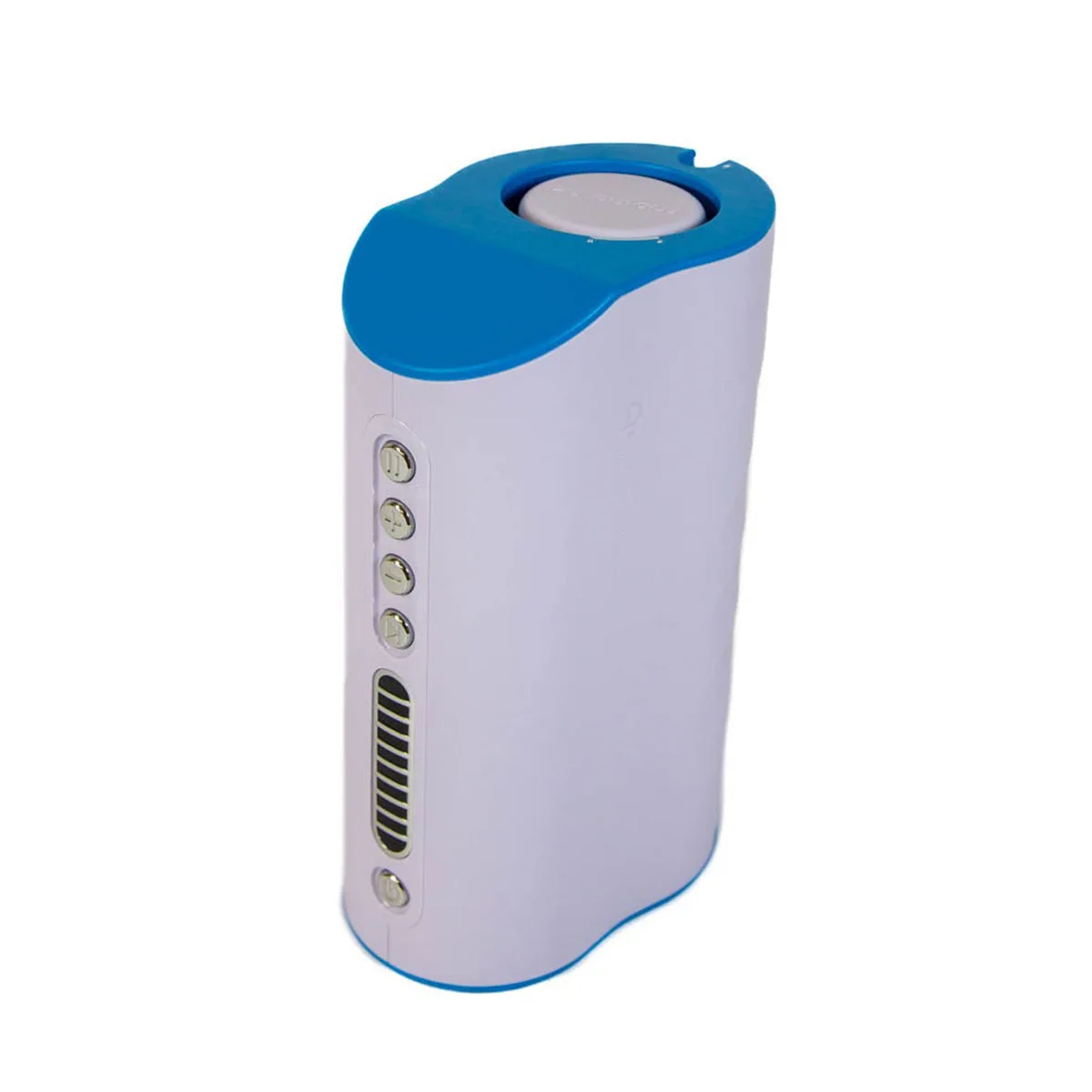
The interface on the device consists of four buttons in a row on the side: pause, plus, minus, and mode change, with a separate on/off button at the bottom. The manufacturer’s manual describes the logic briefly and clearly. Pressing the mode button activates mode 1, and each new press steps further through the ten modes. Plus and minus control the speed within the mode you’re in, and each mode can be run at ten speeds.
Feedback is provided with LEDs in two colors. Blue light shows which mode is active, and green light shows the speed. When you press the pause button, the movement freezes and the LEDs blink slowly in blue; a new press resumes the same mode at the same speed. That the pause function preserves the setting instead of resetting it is a small detail that matters a lot in practice, because the whole point of it is edging.
There is a third LED signal that’s worth knowing before buying. If the LEDs blink red and yellow, the motor has temporarily overheated and the machine stops. The manufacturer then states that it should be turned off and left for ten minutes before it is used again. It’s unusually clearly stated, and at the same time it’s a message that this machine has a thermal limit—the claim of unlimited operating time that appears in store texts applies to the power supply, not the motor.
Nine of the ten modes are fixed movement patterns. The tenth is what the manufacturer calls the AI mode, and that’s the product’s whole naming function. Autoblow describes it as meaning that the machine automatically combines sixteen different techniques and delivers a new combination every time the mode is selected. Adult describes the same thing in Swedish and adds that the artificial intelligence can move the sleeve to around 250 different positions.
What can be established is that “AI” here means something fairly concrete and fairly limited: a movement library created from analysis of real movement patterns, which is played back in random combinations. It’s not a model that learns from you while you use it, and the manufacturer doesn’t claim that either. The value is in the variation—the same mode doesn’t deliver the same thing twice—and it’s a real difference compared with a machine with ten fixed programs.
The library function builds on the same idea. When the machine is connected, you can download additional modes and replace the ten stored in memory. The manufacturer particularly highlights two categories: modes designed for shorter penises, which limit the upper turning position of the stroke so that contact isn’t lost, and slower modes intended for endurance training. The ability to change the machine’s basic behavior afterward is the feature that makes the biggest difference over time, and it costs nothing extra.
Here the descriptions from the manufacturer and the stores diverge, and the difference is worth clarifying. The manufacturer’s manual describes the function as a suction control: before use, you can adjust the suction force by turning the end cap on the stroker-housing. The manual also explicitly warns that if the lid is tightened too much, the machine won’t work as it should and it can stutter.
The stores describe the same detail as a diameter adjustment. Lekosmek and Taboo call it an "adjustable penis ring" with the range Ø 47–53 millimeters. Vuxen goes the farthest and states that the diameter is adjusted from 47 to 53 millimeters with a screwdriver, and that the machine is delivered set to 50 millimeters. The manufacturer publishes no millimeter value at all for this adjustment. So assume that the 47–53 mm range is correct—four stores repeat it—but treat it as a store claim, and use the manual’s description when you set up the machine: it’s a cap that you twist, and it should not be tightened down hard.
Ten positions times ten speeds gives a hundred combinations, and it sounds more impressive than it is. The pattern in this product category is that most people return to three or four settings, and that the difference between adjacent speed steps becomes less noticeable in the upper part of the scale. The stroke interval of 20–220 per minute spans a factor of eleven, which means that the lowest steps are much slower than most people expect—20 strokes per minute is one stroke every three seconds.
However, there is an argument that holds for the number: since the speed is separate from the position, you can keep a movement pattern you like and only change the tempo. That’s exactly the breakdown that’s missing on products where each new program changes everything at once, and it’s in practice what makes a hundred combinations something other than just a number on a box.
The connection is the feature that Autoblow markets the hardest, and it’s also the one that differentiates the machine the most from cheaper alternatives. Everything happens via a web app—that is, a normal web page—rather than a downloaded app. The manufacturer presents it as an advantage for privacy: there is no app in the phone’s app list and nothing to uninstall.
This is the most important practical detail in the entire review, and it isn’t found anywhere in the store texts. The machine’s FCC approval specifies the frequency range 2412–2462 MHz. This corresponds to channel 1 through 11 in the 2.4 GHz band. The machine therefore has no radio for 5 GHz.
The consequence is concrete. If you have a modern router that combines 2.4 and 5 GHz under a single network name, the connection can become complicated, and if you have only 5 GHz enabled, the machine won’t work at all. The solution is to temporarily separate the bands or create a guest network on 2.4 GHz. The approval also states that the device supports both 20 and 40 MHz bandwidth, and that the measured conducted output power is 0.0014 watt—meaning a very weak transmitter—which in practice means the machine should be positioned fairly close to the router.
Video synchronization means the machine’s movements follow a video. The manufacturer runs its own library, which is included with the purchase. How big it is depends on where on the manufacturer’s own site you’re reading: a heading states 600+ videos, while the site’s FAQ states more than 750. It’s the manufacturer’s own inconsistency, not two different products, and the only reasonable conclusion is that the library is somewhere in that size range and is growing. In addition, it’s possible to upload your own video together with a so-called funscript and sync it to anything.
Besides that, the manufacturer lists three additional features: a free mode where you define which part of the shaft is to be worked on, with what stroke length and at what tempo; a sharing link that gives another person remote control of the machine anywhere in the world; and an open API for anyone who wants to build their own integrations. The last one is unusual—most manufacturers in the category keep their protocols closed—and it’s the feature that most likely keeps the product usable even if the manufacturer’s own services were to change.
Two things should be considered. The connection is not necessary: the machine works fully offline with its ten modes straight out of the box, and the manufacturer’s own instruction site describes the offline mode as a complete use in itself. But everything that’s marketed as the product’s added value—the library, the video sync, the remote control—lies on the manufacturer’s servers. It’s a dependency situation that doesn’t exist with a mechanical product, and it’s worth being aware of in a price range around 2,000 SEK.
The message is unequivocal here, and it’s more important than anything else in this text. The manufacturer’s manual begins the warning section by stating that the product is an electrical device that must not be used in or near water, and that damage or death could be the result. During the care section, it says just as clearly: never submerge the Autoblow A.I. Ultra in water—only clean the outside with a damp cloth.
The manufacturer states no IP rating at all for the machine, and that’s correct: a product that’s meant to be plugged into a wall outlet during operation doesn’t belong in the bathroom. What you can rinse, however, is the stroke housing and the sleeve, which are lifted out of the machine and cleaned separately with soap and warm water.
There is a shop listing here that deserves to be pointed out, because it is safety-relevant. Taboos specification table for the product includes the line "Water-resistant IPx5: Yes". That information is not covered by the manufacturer and directly contradicts the manual’s explicit warning. The same table also lists the delivery contents as "Charging cable," even though the machine has no battery and does not charge.
Vuxenkul has the opposite information in its table — "Water-resistant: No" — which matches the manufacturer — but the same table also states "Power supply: Rechargeable," which is not correct. When two shops contradict each other and the manufacturer contradicts both, the manufacturer applies. Treat Autoblow A.I. Ultra as a device that can’t handle water at all.
The manual’s routine is simple and should be followed after every use. Remove the sleeve from the stroker housing, spray in soap, and wash it thoroughly through. The plastic housing is washed with soap and warm water. Then spray in a cleaning agent intended for sex toys, let it sit for one minute, and rinse it off. Dry the sleeve inside and out with a towel.
The manufacturer also provides a care tip that rarely shows up in the store texts: dust the sleeve with corn starch after cleaning and store it in a sealed plastic bag. This helps prevent the surface from becoming sticky and preserves the silky-smooth feel — the same principle that Fleshlight and other manufacturers of skin-like sleeves use. The machine itself should be stored cool and dry, away from direct sunlight.
The question about lubricant has a clear answer. The manufacturer states water-based lubricant on both the penis and inside the sleeve, and that more lubricant should be added every five to ten minutes during use. Silicone-based lubricant is explicitly not recommended because it can damage the sleeve’s material. This applies whether the sleeve is made of rubber or silicone, and it’s the most common reason a sleeve in this category becomes sticky and has to be replaced early.
We do not have price data from shops in your market yet.
Ten settings, ten speeds give one hundred combinations. The number that matters most is still the one on the nameplate: 36 watts, and no cable you can disconnect.
On the back of the packaging, Autoblow describes A.I. Ultra as the brand’s quietest machine so far and something that can be used discreetly without attracting attention. The manufacturer does not publish any measured decibel value — neither on the product page, in the user manual, or in the FCC document. None of the eight Swedish shops states a value either.
What can be concluded from the design is that a screw-driven machine with a 36-watt rated power cannot be as quiet as a handheld vibrator. The mass is accelerated and braked twice per stroke, and at 220 strokes per minute that happens a little over seven times per second. The fact that the sound increases with speed is a direct result of the mechanics. Websites that provide an exact decibel value for this machine either show their own measurement or a value with no source.
A practical tip that applies regardless of model: place the machine on a soft surface. A hard tabletop works like a resonance box and noticeably amplifies the sound—and since this machine weighs a little over two kilos and remains stationary during use, the surface is a more decisive factor here than for almost any other product in the range.
Three comparisons are relevant: versus the best-selling battery-powered stroking machine, versus the fastest one, and versus Autoblows own more expensive machine. All the information below comes from each manufacturer’s own specifications.
Kiiroo Keon is the most widespread competitor in the category, and it is based on an opposite design decision. Kiiroo states up to 230 strokes per minute, i.e. marginally more than Autoblows 220, a maximum stroke length of 75 millimeters, a weight of 1.1 kilos, a battery of 14.8 volts and 700 mAh, a charging time of four hours, and a running time of up to two hours. The material is listed as ABS, PC, and silicone with a TPE sleeve, and the warranty is one year—the same as Autoblows.
The differences that actually matter are three. Keon is half the weight and can be held in the hand; according to the retailers, A.I. Ultra weighs 2,270 grams and is built to remain stationary. Keon works without a cord for two hours; A.I. Ultra does not work at all without a cord, but it also never runs out. And Keon charges via a USB cable, which means that the machine’s service life in the long run is limited by the battery—precisely what Autoblow explicitly states as the reason for its own choice.
When you choose based on mobility and the ability to use the machine anywhere, Keon wins. When you choose based on power, unlimited session length, and the longest possible service life, A.I. Ultra wins. There is no comparison where one is objectively better—it’s two different answers to the same question.
Lovense Solace Pro addresses the same problem with higher numbers. Lovense states up to 300 strokes per minute, i.e. 36 percent faster than Autoblows 220, and a stroke-length adjustment in steps of 0.65 millimeters. This resolution is in an entirely different class from Autoblows ten speed steps, and it’s there so you can follow video material exactly.
What that means in practice depends on what you’re looking for. If you want maximum speed and fine-grained control, the numbers speak for Lovense. If you want a machine that can be controlled without installing an app, that has an open API, and that has no component that ages, the design speaks for Autoblow. It should also be said plainly that Lovense’s published specifications for Solace Pro are sparse beyond the two figures above—the manufacturer’s site also often responds with an error code to automated calls, which makes it harder to verify and control than Autoblows.
Within its own brand, VacuGlide 2 is the more expensive option, and it does something else. The manufacturer states 10–225 strokes per minute and twenty speed levels versus A.I. Ultras ten, and it adds suction via a vacuum piston instead of pure stroking-only operation. The price is $1,199.95 regular versus A.I. Ultras $299.95 — so four times as much.
The most interesting part is that they don’t rule each other out. The manufacturer sells a sleeve that connects A.I. Ultra with VacuGlide, and the same sleeve works with Autoblow on Fleshlight sleeves as well. So if you buy A.I. Ultra first, you’re not closing the door on suction later. For the large majority, A.I. Ultra is the right starting point, and VacuGlide 2 is a product for the person who already knows that stroking alone isn’t enough.
Eight Swedish stores sell the item with EAN 704751345990. The cheapest is Joyland at 1,795 SEK, and the most expensive is Lustly, Lekosmek and Taboo, all at 2,495 SEK. That’s 700 SEK, or a 39 percent difference, for the exact same item number and the same EU variant.
The stock situation is unusually favorable for this product. Fem av de åtta butikerna hade maskinen i lager vid priskontrollen: Joyland at 1,795 SEK, Vuxen at 1,996 SEK, and Lustly, Lekosmek and Taboo at 2,495 SEK each. The three that were missing stock were Blush Me at 1,849 SEK, Vuxenkul at 2,099 SEK, and Sexonic at 2,327 SEK. That means the cheapest available and the second-cheapest available differ by 201 SEK — not 700.
A comparison with the manufacturer’s own price is illuminating. Autoblow lists $299.95 as the regular price and $199.95 as the promotional price in its own store. So the Swedish price range is clearly above the manufacturer’s promotional price—which is to be expected when VAT, shipping, and a distributor’s margin are added—but it’s worth knowing that the list price from the factory is lower than what any Swedish store charges. At the same time, keep in mind that ordering directly from the USA means paying customs duties and VAT upon import, and that the return policy then follows the manufacturer’s terms instead of Swedish consumer law.
The prices in the table above are updated when the shops’ product feeds are updated, but always check the final price at checkout. In this price range, all stores are above the free-shipping threshold, which means that in practice the comparison between the five available stores is determined by price alone.
It’s for you if you want a machine that does all the work, if you don’t want to think about battery life, and if you want to be able to run long sessions without the performance dropping toward the end. It’s for you if you’re drawn to video sync and remote control, and especially if you appreciate that everything happens in a web browser without any app ending up on your phone. The open API also makes it interesting for anyone who likes building their own.
It’s not for you if you want something small and portable—2,270 grams and a cardboard box measuring 31 centimeters is the opposite of discreet storage. It’s not for you if you want to take the machine with you when you travel, since it has to be connected to wall outlets during operation. It’s not for you if you want to rinse the entire product under the tap: only the sleeve and the stroker housing can withstand water, the rest is an electrical device. And it’s not for you if you only have 5 GHz WiFi at home, because the radio in the machine only works on 2.4 GHz.
One more thing belongs in the decision. The ongoing cost isn’t zero. The sleeve is a wear part that is expressly excluded from the warranty, and an extra sleeve costs 49,95 dollar from the manufacturer. If you expect to replace the sleeve from time to time, the real cost over the years is significantly higher than the purchase price—and that’s exactly the line item that’s usually missing when this product category is compared with a one-time-purchased masturbator.
Autoblow’s warranty is short and clearly worded in the user manual. The electronics and the motor are covered for one (1) year from the date of purchase, for defects in workmanship or materials. The warranty applies only to the product’s main unit and provided that it has not been tampered with or taken apart—any attempt to open the machine voids the warranty.
The exclusions are more numerous than you might think. The warranty does not cover the reusable sleeve, cosmetic wear from normal use, or damage caused by accidents, misuse, or neglect. In other words: the two parts that are most likely to break down or wear out first—the sleeve and the outer surface layer—are excluded.
There’s also store information that differs. Lekosmek states "2 års produktgaranti" on its product page, meaning twice as long as the manufacturer promises. A store can of course offer its own, longer warranty than the manufacturer, but the difference isn’t explained on the page. Go by the manufacturer’s one year unless you have written notice from the store that something else applies.
The manufacturer’s return policy is also worth reading before ordering directly from Autoblow. Returns are accepted only for defective or damaged items within 30 days, and if the outer shipping carton has been opened, no returns are accepted at all — even if the machine itself is still in its shrink wrap. A return fee of five percent applies, an RMA number is required, and the return must be shipped within seven days. These are stricter terms than what Swedish consumers are used to.
What always applies when you shop at a Swedish store, on the other hand, is your statutory rights. Under konsumentköplagen, you have three years of right to complain about defects in the goods, regardless of what the manufacturer promises — meaning three times longer than Autoblows own warranty. For distance purchases, you also have a right of withdrawal for fourteen days under lagen om distansavtal och avtal utanför affärslokaler. Be aware that, in practice, the right of withdrawal is limited for hygiene items that have been removed from a sealed package — however, the right to complain about defects always applies. If you have questions about what applies in your case, Konsumentverket guides you via Hallå konsument.
Autoblow A.I. Ultra isn’t included in any ranking yet. In best i test guides, the entire categories are compared against each other using five shared criteria, with what was left out shown.
Every numerical piece of information in the text can be traced to one of the sources below. The links were checked manually on the specified date.
This page is machine-translated from Swedish. Read the Swedish original