

Review
Review: Satisfyer Pro 2 Next Generation
Cheapest of the widely sold — 219 SEK and a 15-year warranty.
29 July 2026
Review · Finger vibrator · Two motors
Fun Factory's finger vibrator reviewed against the manufacturer’s own specifications, the quick guide in the PDF, and price data from six Swedish stores. Two motors, four speed steps plus a random mode, a 110 mAh lithium-ion battery, IPX7 according to IEC 60529, and charging via standard USB-C — but the manufacturer states an operating time of both 35 and 60 minutes in its two separate documents.
The smallest product in the comparison, and the only one that’s carried in your hand instead of being held in it: 7 × 2 centimeters, 28 grams, two motors, and charging via standard USB-C. What you’re paying for is the battery — 110 mAh, according to the manufacturer’s own quick guide, provides about 35 minutes of operation — and documentation that contradicts itself regarding both operating time and what’s included. The material is silicone on the outside, but ABS and polycarbonate on the inside, and the 25-year warranty on the box doesn’t apply when you shop at a Swedish store.
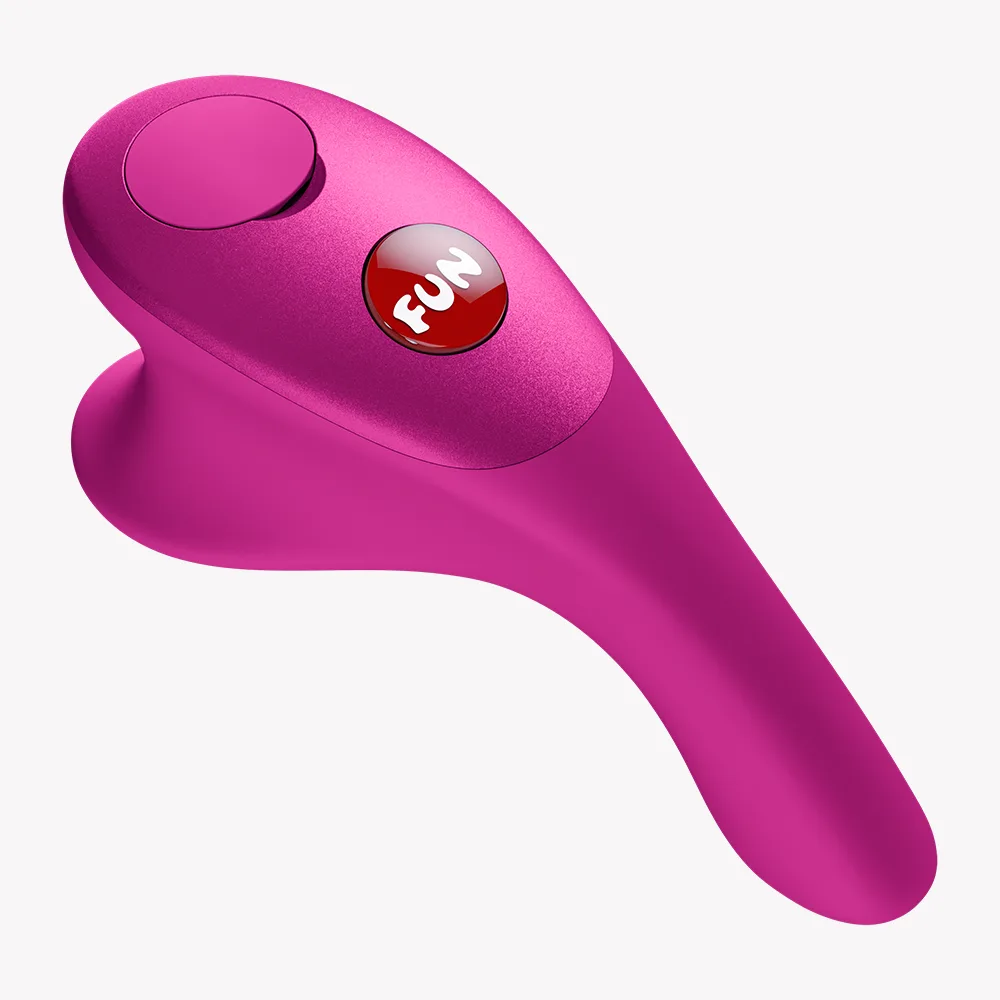
Fun Factory BE·ONE is a finger vibrator, and that category is worth explaining before the numbers come. A finger vibrator is not intended to be held like a pen or pressed against the body the way a clitoral stimulator is. It’s clamped in place between the index finger and the middle finger, making the whole hand the tool. The manufacturer classifies it as a pair vibrator, not as a solo product, and the entire design language follows from that: a broad, heart-shaped plate that sits on top of the fingers, a narrow “snout” that runs down between them, and a single button on the top side.
According to the manufacturer, the specification looks like this: two motors, four speed levels plus a fifth random rhythm program, button lock, enclosure rating IPX7, charging via USB-C, and a charging time of one to two hours. The dimensions are given as 7 × 2 centimeters and the weight as 28 grams. According to the manufacturer’s quick guide, the battery is a lithium-ion battery of 3.7 volts and 110 milliampere-hours. The item number for magenta is FF000948MG01.
This review is exclusively about the magenta variant with EAN 4255821800162. Fun Factory sells BE·ONE in three colors—magenta, black, and purple—and each color has its own barcode number in the manufacturer’s own variant data: black is 4255821800124 and purple is 4255821800148. Functionally, they are identical, but the number is the only thing that can reliably distinguish them when the shops list all three on the same page. In Sweden, the item is sold by six shops at prices between 286 and 385 SEK, and three of them had it in stock at the price check.
What makes the product interesting to review is not the technology itself, but how much the documentation varies. The manufacturer states the runtime as 60 minutes on the product page and about 35 minutes in its own quick guide. The length is given as 7 centimeters by the manufacturer and as 7.3 or 7.4 centimeters by four Swedish shops. The weight is stated as 28 grams in the specification table, 26 grams in the manufacturer’s variant data, and 50 grams at one shop. All of that is sorted out below, and in any case the same rule applies: the manufacturer’s figures carry the most weight, and the discrepancy is stated instead of being averaged out.
The technically distinguishing feature is that BE·ONE has two motors instead of one. The manufacturer states two strong motors both in the bullet list on the product page and as a symbol on the packaging, and describes the function as vibrations acting via two contact points instead of setting an entire finger or the whole hand into vibration.
What that means in practice can be reasoned about based on the design. A vibrator with a single motor has one point where the amplitude is greatest, and the farther away from the motor, the more the movement of the material is dampened. With two motors at either end of a small housing, the movement is distributed over two points—exactly what the shape of BE·ONE is designed for: the wide plate on top of the fingers and the narrow tip between them. What can be established, then, is that the design is intended to provide stimulation in two places at the same time, not to deliver more power to one place.
The manufacturer publishes no power specs for the motors—neither RPM, amplitude, or frequency—and not even any breakdown of battery capacity between them. What exists is the capacity for the entire product, 110 mAh, and it should be enough for both motors at the same time. It is a partial explanation for why the runtime in the quick guide is as short as about 35 minutes: two motors on a battery that is roughly a quarter the size of the brand’s own Laya III reduce the runtime by a corresponding amount.
The color choice is cosmetic, but the item number is not. The manufacturer’s own variant data links color, item number, and barcode in a way that makes it possible to check exactly which item a store actually sells:
All six Swedish stores that sell the magenta variant list either the barcode 4255821800162 directly or their own item number that is tied to that specific color. Sexonic shows the EAN number openly in its item register, Taboo lists both its own item number D-244207 and the barcode, and Vuxen incorporates the entire EAN number into its own item number. It is unusually clear for this product category and makes the price comparison unusually reliable—you know that all six stores are talking about the same item.
One caveat still deserves to be mentioned here, however. The manufacturer’s marketing materials use both the spelling BE·ONE and Be-One, and Swedish stores write "Be One", "Be·One", and "Beaone" interchangeably. If you search for the name in a store search, it’s worth trying several spellings before concluding that a store doesn’t have it.
The material is the only characteristic of an intimate product that cannot be compensated for with experience or care, and it determines whether the product is still hygienic after five years. Here, there’s a difference between what the manufacturer’s product page says and what the manufacturer’s own quick guide says, and the difference is not cosmetic.
The product page says “body-friendly silicone” in the bullet list and describes the materials as body-friendly, hypoallergenic, and non-porous. The quick guide is more specific and lists three materials: ABS, PC, and silicone. PC stands for polycarbonate. That means the product isn’t all-silicone; it’s a combination where the silicone is on the outside, and two hard plastics form the housing and the control part. Fun Factory’s own FAQ describes the same principle for the range overall: the toys are stated to consist of medical-grade silicone, while the battery housing and the control part are stated to be made of body-friendly thermoplastic.
This is not a criticism of the product. Almost every rechargeable vibrator in this price range is built that way, and We-Vibe states the exact same combination—ABS plus body-friendly silicone—for the Tango X. But that’s a criticism of the marketing, and it’s worth knowing before you compare BE·ONE with a product that is truly silicone all the way through.
Silicone is a non-porous material. A non-porous surface can be cleaned, because there are no microscopic cavities where residue can get trapped and remain. That’s the single most important property of a material that should rest against mucous membranes, and that’s why the material declaration weighs more heavily than almost all other lines in a specification. The manufacturer explicitly states that BE·ONE is non-porous and hypoallergenic.
On this particular product, it’s the silicone that makes contact with the body. The broad plate and the nub between the fingers are silicone-coated, while the small round FUN button on the top side is the visible part of the control part. The seam between the soft and hard materials is the point that’s worth paying attention to when cleaning—it’s where residue collects on all products built that way, regardless of brand.
A property that follows from the silicone surface and matters for a finger vibrator in particular: soft silicone provides friction against the skin. That’s an advantage when the product needs to stay in place between two fingers without a strap or ring, and it’s probably why the manufacturer can claim that it stays in place completely without any fastening device. The downside is the usual thing with silicone: the material attracts dust and lint in a storage pouch, and it shows clearly on a dark magenta-colored surface.
Phthalates are a group of plasticizers used to make plastic—above all, soft PVC—flexible. The Swedish Chemicals Agency (Kemikalieinspektionen) describes them as substances that can affect the endocrine system and make reproduction more difficult, and several of them are therefore restricted or prohibited within the EU in a large number of products. Intimate products are a recurring category in supervision, just because they contain soft plastic that lies against the skin and mucous membranes.
Fun Factory states in its FAQ that all products in the range are free from plasticizers, BPA, and phthalates. It is a commitment at the range level rather than a declaration on BE·ONE’s product page specifically, and that difference is worth noting— the manufacturer does not publish any phthalate-free information specifically for BE·ONE, either on the product page or in the quick guide. The packaging indicates “body-safe materials” as a symbol but does not specify which substances are meant.
That silicone is the main material is, in itself, good news. Silicone does not require phthalate plasticizers to be soft—the softness comes from the polymer’s own structure—and therefore a silicone indication is more informative than labels such as “TPE” or “jelly rubber,” which do not say anything about which plasticizers are included. By comparison, We-Vibe states phthalate-free, BPA-free, and latex-free directly in the specification for Tango X. Latex is not mentioned at all in Fun Factory’s material for BE·ONE, which is worth knowing if you have a latex allergy.
The manufacturer gives the dimensions as 7 × 2 centimeters. It’s a product that fits in a clenched hand, and it’s significantly smaller than almost everything else in the vibrator category—Fun Factory’s own Laya III measures 107 × 50 × 41 millimeters, and We-Vibe Tango X is 9.98 × 2.29 × 2.43 centimeters.
However, the length information is not unambiguous. The manufacturer states 7 centimeters, Vuxen states 7.3 centimeters, and Blush Me, Lekosmek, and Taboo all state 7.4 centimeters. Three to four millimeters in itself is nothing, but the pattern says something: the shops have obviously received a more precise figure from the distribution level than the rounded number that the manufacturer publishes. The manufacturer weighs the most in this roundup, but if you plan based on millimeters, you should count on a little over seven centimeters rather than exactly seven.
The weight is messier than that. The manufacturer’s specification table states 28 grams, while the manufacturer’s own variant data states 0,026 kilograms—so 26 grams—for the same item number. Taboo states 50 grams. None of the information is specified to refer to the product by itself or the full delivery with cable and booklet, and Fun Factory does not publish any separate shipping weight. The reasonable reading is to treat 28 grams as the product’s weight and Taboo’s 50 grams as a package weight, but that’s a conclusion, not a published claim.
No matter which figure is correct, the order of magnitude is the same—and it’s the product’s strongest feature: BE·ONE weighs about one third of Fun Factory’s own Laya III, which is stated to weigh 85 grams. A product that weighs under thirty grams and is seven centimeters long disappears in a toiletry bag, and that’s exactly what the manufacturer builds its travel advantage on.
The shape deserves its own line. The wide section is heart-shaped with a cutout at the top, and from there a narrow, slightly bent tip runs downward. The cutout isn’t decoration—it’s where your fingers slide in. The design means the product has absolutely no adjustability: it fits the finger gap it fits, and there are no straps, rings, or size options. That’s the most important fit question you should ask before buying it, and it’s also the only question in the entire review that no specification can answer.
The interface on BE·ONE is as simple as it can be: a single button with the FUN logo. The manufacturer’s quick guide describes all the controls on one page. You start and turn off the product by holding the button pressed in for one to two seconds, and you switch modes with short presses that step from 1 to 5 and then back to 1 again.
It’s the opposite of a model with a separate mode button, plus and minus buttons, and a display. The advantage is that you can operate the product blindly, which matters when it’s sitting between two fingers and your hand is busy with something else. The downside is that you can’t skip backward in the scale—if you want to go from mode four to mode two, you have to go via five and one. With five modes it’s a small thing, but it’s still worth knowing.
The manufacturer lists four speed steps and a pattern, and describes the fifth mode a bit more closely in its product text: once you’ve clicked through all four vibration settings, you reach a random mode that keeps varying itself, with unpredictable switching between vibration intensity and speed. The packaging summarizes the same thing as "5 modes".
So it’s not five programs in the usual sense. It’s four fixed intensity levels plus one automatic mode, and that’s an important difference when you compare it with products that list ten or twelve modes. Fun Factory’s own Laya III, according to its quick guide, has seven speed steps plus three patterns, i.e. ten modes in total—more than twice as many adjustable steps for a product that’s often sold cheaper. The difference in the number of settings doesn’t say anything about how powerful any of them are, but it does say something about how finely you can adjust.
Four steps are on the low side for the category, and that’s the clearest trade-off in the entire specification. On the other hand, the product class is different: BE·ONE is intended to enhance touch with your hand, not replace it, and in that role the number of levels matters less than it does for a product that stays still against the body. What can still be stated, though, is that you get fewer choice options here than practically all alternatives in the same price range.
The manufacturer lists a tangle lock as an explicit feature in the specifications, and it’s a more significant line than it looks. A seven-centimeter-long product with a single large button on the top is exactly the kind of item that switches on by itself in a bag, and a product that turns on in a suitcase doesn’t just drain a small battery—it creates precisely the situation nobody wants in a security checkpoint.
There is, however, a gap in the documentation. The manufacturer’s quick guide for BE·ONE does not show how the tangle lock is locked or unlocked, even though the feature is listed on the product page. Fun Factory’s FAQ describes a general unlocking method for the range—keep the plus button and the FUN button pressed at the same time for about one to four seconds—but that assumes a model with a separate plus button, which BE·ONE does not have. So how the lock is handled on a one-button model is not made clear in the material the manufacturer publishes openly, and that’s a reasonable thing to check in the included booklet before packing the product away for a trip.
The manufacturer describes the grip as something that lets the product slide in smoothly between two fingers entirely without any extra attachment hardware, and the manufacturer’s own product image shows it positioned between the index finger and the middle finger, with the wider part on top of the knuckles. The cutout at the top of the heart-shaped form is what the fingers rest in, and the nozzle points downward from the top side of the hand toward the fingertips.
The consequence of this design is that the contact surface against the body is not the product, but your own hand. The vibrations are conducted into the fingers, and it’s the fingers that do the work. This is also why the manufacturer describes it as a foreplay tool rather than as a clitoral stimulator: it’s built to enhance strokes rather than to be held still against a single spot.
That makes the fit the only real uncertainty in the purchase. There’s no adjustment, no strap, and no size variant, and the manufacturer doesn’t publish any information about what finger gap the design is dimensioned for. If you have wide fingers or want to be able to let a partner use it just as comfortably, it’s worth factoring in that the product costs under three hundred kronor — it’s a relatively inexpensive guess, but it’s still a guess.
The answer here has to be short and honest. Fun Factory does not publish any decibel value for BE·ONE — neither on the product page, in the quick guide, on the packaging, or in its FAQ. For this model, the manufacturer also doesn’t use words like "whisper-quiet" or "discreet sound level" in its specification, unlike what several competitors do.
None of the six Swedish stores lists any measurement either. What can be established purely on technical grounds is that the sound from a vibrator comes from the motors’ unbalanced weights and from how the housing resonates, and that a product with two motors in a small, rigid housing made of ABS and polycarbonate has no obvious construction advantage in terms of sound. If a site states an exact decibel figure for BE·ONE, then it’s either its own measurement or a number without a source from the manufacturer.
A practical tip that applies regardless of model: don’t place the product on a hard tabletop while it’s running. A surface made of wood or glass works as a resonance box and noticeably amplifies the sound. For this specific product, the effect is also less relevant than usual, because during operation it’s normally held in a hand and therefore dampened by the hand itself.
Fun Factory BE·ONE is rated IPX7. The rating comes from the international standard IEC 60529, which defines enclosure classes for electrical equipment. The number 7 in the second position means the product has been tested for submersion in water up to a depth of one meter for 30 minutes. The manufacturer lists the class in three separate places: in the bullet list on the product page, in the specification table in the quick guide, and as a symbol on the packaging. Fun Factory’s FAQ describes it in general for the range — all rechargeable toys from the brand are stated to be completely waterproof.
The quick guide’s cleaning page also shows the product fully submerged in a water container, with a crossed-out charging cable next to it. The meaning is unambiguous: the product may be rinsed and submerged, but never with the cable connected.
Here there is a concrete contradiction between the sources that is worth spelling out. Taboo lists the enclosure rating IPX5 for BE·ONE on its product page, while the manufacturer lists IPX7, and Lekosmek, Blush Me and SexleksakerOutlet also list IPX7.
The difference between the classes is not cosmetic. IPX5 means protection against water jets — that is, splashes and showers — but it says nothing about submersion. IPX7 means that the product has been tested to be able to lie under water. An IPX5 product should not be taken into the bathtub; an IPX7 one can. When a store’s claim stands against the manufacturer’s, the manufacturer wins, and in this case the manufacturer is additionally supported by three of the other five stores, as well as by the packaging’s own symbol. The IPX5 claim should be regarded as an error in the store text.
A general rule that applies to all products in the category: if a product lacks an IPX rating entirely, it should be treated as not waterproof. The absence of a classification is never a sign that the product would be approved for water.
Rinse the product in lukewarm water after every use and use fragrance-free soap or a cleaning product intended for intimate products — the manufacturer’s quick guide explicitly shows both a water bath and a cleaning spray. Make sure the USB-C cover is closed before the product goes into water. Wipe it off and let it air-dry before putting it away.
The question about lubricants has an unambiguous answer with this manufacturer. Fun Factory’s FAQ states that all suitable lubricants can be used as long as they are water-based, and it simultaneously strongly warns against oils and creams: sun oil and sunscreen, lip balm and lipstick, essential oils, coconut oil, and cooking oils of all kinds. The manufacturer writes that such products can cause irreversible damage to the control part and to the entire toy, and that you risk losing your right to a guarantee if you use them. It’s an unusually harshly worded warning, and it is worth taking seriously just because it is linked to the warranty.
Water-based lubricant should also not be used on silicone products. It breaks down the silicone surface over time and makes it porous, and a porous surface can no longer be cleaned properly — it’s just a matter of replacing it.
For storage, the manufacturer’s quick guide specifies a temperature range of −5 to +60 degrees and shows the product lying in a bag, along with a symbol advising against storing it together with sharp objects. That the upper limit is 60 degrees means that boiling and dishwashing are ruled out despite IPX7—water resistance and heat tolerance are two different things, and this is one of the most common misunderstandings about this product category.
Fun Factory is one of the manufacturers that actually publishes battery data, and that deserves praise. The quick guide states a 3.7-volt lithium-ion battery with a capacity of 110 milliampere-hours, a maximum charging current of 100 milliampere, and a charging voltage of 5 volts. It’s more information than most competitors provide, and it makes it possible to calculate the product instead of guessing.
110 mAh is small. Fun Factory’s own Laya III has, according to its quick guide, 420 mAh—almost four times as much—in a housing that weighs 85 grams versus BE·ONE’s 28 grams. That’s the direct cost of the format: a product that is meant to fit between two fingers simply doesn’t have room for a larger cell.
The biggest contradiction in the entire specification is between two of the manufacturer’s own documents. The product page states a runtime of 60 minutes. The quick guide states about 35 minutes. It’s the same manufacturer, the same model, and the same article number.
There’s no way to determine which number is correct based on published material, but it is possible to reason. The quick guide is the document that comes with the product and includes the full technical specification with voltage, capacity, and charging current—that’s the more technical of the two sources. A comparison with Laya III points in the same direction: 420 mAh gives, according to Laya III’s quick guide, about 60 minutes of runtime across seven speed steps. That 110 mAh would last just as long with two motors is difficult to reconcile with that figure. So count on roughly about half an hour of runtime per charge, and treat the 60-minute figure as a best-case value at the lowest intensity.
Taboo, in turn, states 60 to 90 minutes of use time—so even more than the manufacturer’s most generous figure. That information has no support in any of the manufacturer’s documents and should be disregarded.
Via USB-C. The manufacturer lists USB-C both in the bullet-point list and in the charging section of the quick guide, and the charging connector sits under a silicone flap in the top of the product—the same design that makes IPX7 possible without magnetic charging. The charging time is stated as one to two hours on the product page and as about two hours in the quick guide. During charging, the FUN button’s LED blinks; when it shines with a steady light, the battery is fully charged.
Charging the product with standard USB-C is a real advantage and stands in sharp contrast to premium models with magnetic, product-specific charging cables. If you lose the cable, any USB-C cable will work—the same cable as for your phone. Both Vuxen and SexleksakerOutlet spell that out in their product texts.
What is actually included in the package, however, is unclear, and here too the manufacturer contradicts itself. The product page’s delivery contents list a toy, a charging cable without a USB adapter, and a booklet with instructions for use and play ideas. The quick guide’s charging section says the opposite, explicitly, that no USB-C charging cable is included. The stores also don’t give the same information: Taboo lists the charging cable as included, while Vuxen, Blush Me, and SexleksakerOutlet simply state that no charger is included. Expect to need your own USB-C cable and your own wall adapter, so you won’t be disappointed.
One more detail belongs here. The manufacturer’s German product text talks about an included case— "das dazugehörige Case"—that is supposed to provide hygienic transport and storage. No case is included in the official delivery list. Either the text is a leftover from an earlier packaging version, or the list is incomplete. Rely on the list.
What generally applies to lithium-ion batteries also applies here: capacity drops with the number of charge cycles, and a 110 mAh cell gets charged more often than a 420 mAh cell with the same use. More charge cycles per year means that aging happens faster in calendar time. With use a couple of times per week, it’s the battery—not the silicone—that sets the limit for how long the product lasts.
The manufacturer publishes no information about whether the battery can be replaced, and the design with a fully sealed IPX7-rated body makes that unlikely. The quick guide also doesn’t mention any number of cycles or an expected lifespan. The practical advice is the usual: don’t store the product completely drained for a long time, and stay within the stated temperature range of −5 to +60 degrees.
We do not have price data from shops in your market yet.
The product page states a runtime of 60 minutes. The quick guide states about 35 minutes. Same manufacturer, same model, same item number.
Two comparisons are relevant: against the manufacturer’s own cheapest clitoral product and against the best-selling mini vibrator from a competing premium brand. All information below comes from the respective manufacturers’ own specifications, and all prices come from the stores’ product feeds on 29 July 2026.
Laya III is Fun Factory’s clitoral massager for the clitoris and is sold from 166 SEK, so it’s cheaper than BE·ONE, which costs from 286 SEK. On paper, Laya III wins almost every line: 420 mAh vs 110, seven speed steps plus three patterns vs four plus one, and about 60 minutes of runtime according to its own quick guide vs BE·ONE’s about 35. Both are IPX7, both charge via USB-C, and both are stated to be made of silicone in combination with hard plastic—Laya III of silicone and ABS, BE·ONE of silicone, ABS and polycarbonate.
So the price difference and the specification difference point in the same direction, but the products don’t do the same thing. Laya III is 107 × 50 × 41 millimeters and weighs 85 grams; it’s placed against the body and stays still. BE·ONE is 7 × 2 centimeters and weighs 28 grams; it sits in the hand and moves with it. If you want a clitoral stimulator, buy Laya III—and it’s not even close. If you want vibrations in your hand during caresses, you can’t solve that at all with Laya III.
The conclusion is that the comparison is mostly useful as a price tag for the format: you pay 120 SEK more and get a quarter of the battery, half as many settings, and a third of the weight. The first two are disadvantages; the third is the whole point.
We-Vibe Tango X costs from 679 SEK, so more than double the price of BE·ONE. The manufacturer lists the dimensions as 9.98 × 2.29 × 2.43 centimeters, the material as ABS and body-friendly silicone free from phthalates, BPA and latex, a rechargeable lithium-ion battery, runtime up to two hours, charging time 90 minutes, enclosure rating IPX7, and a two-year warranty.
The differences that actually matter: Tango X has up to four times longer runtime than BE·ONE’s roughly 35 minutes, and We-Vibe states phthalate-, BPA- and latex-free directly in the specification instead of on a general FAQ page. Both are IPX7 and both charge via USB. What We-Vibe does not publish, however, is battery capacity in mAh, which Fun Factory does—on that specific point, the cheaper product is better documented.
The product type also differs. Tango X is a bullet vibrator that you hold in your hand or place against the body; BE·ONE is worn in the hand. If you want a small, powerful point stimulator with long runtime, Tango X is worth the money. If you want vibrations that go along with the hand during foreplay, Tango X doesn’t do that job, no matter how good the specification looks.
Six Swedish shops sell the item with EAN 4255821800162. Cheapest is Sexonic at 286 SEK, most expensive is Blush Me and SexleksakerOutlet at 385 SEK each. That’s 99 SEK, or about a 34 percent difference for the exact same item number, same color and same packaging.
The stock situation, however, changes the picture completely. Only three of the six shops had the product in stock during the price check: Vuxen for 289 SEK, as well as Blush Me and SexleksakerOutlet for 385 SEK each. The cheapest shop overall — Sexonic at 286 SEK — therefore did not have it in stock, nor did Lekosmek and Taboo at 369 SEK. The difference between the cheapest available option and the second-cheapest available option is thus 96 SEK, not three.
Also note that Vuxen’s price of 289 SEK is a promotional price. The store lists 385 SEK as the recommended price and deducts 25 percent in a branded campaign. This means the price picture may look different when the promotion ends, and that 385 SEK is the price that three of the six shops otherwise have. Shops that list a product as sold out may also keep an old price in the feed, and that price is rarely what you actually end up paying once the item is back in stock again.
The price spread does not depend on any shop selling a different variant — all six list the magenta variant under EAN 4255821800162 or under a separate number tied to that exact color. In this price range, shipping costs are also a larger share of the total than usual: several shops offer free shipping only at an order value of a few hundred SEK, which can erase the entire price difference between the cheapest and the most expensive. Always check the final price at checkout.
It’s for you who want to enhance touch with your hand rather than replace it. The format is the whole idea of the product: 7 × 2 centimeters, 28 grams, no strap and no fastening device. It’s for you who want to be able to charge with the same cable as your phone, for you who want to be able to rinse off the entire product under running water thanks to IPX7, and for you who prefer one button over four. It’s also for you who want a travel-friendly second product without risking either a pricey charging cable or a pricey product — under three hundred SEK, it’s among the more cost-effective ways to try the format.
It’s not for you who want long runtime. About 35 minutes, according to the manufacturer’s quick guide, is short, and 110 mAh is small even for the format. It’s not for you who want to fine-tune—four speed steps are on the low side, and you can’t step back down in the scale. It’s not for you who want a clitoral stimulator to place against your body; there, Laya III is both cheaper and better suited. And it’s not for you who require a published sound level or a material declaration written specifically for the model, since Fun Factory neither publishes a decibel value nor a phthalate statement for just BE·ONE.
One last thing belongs in the decision, and that is the fit. The product sits between your index finger and your middle finger without any adjustment, and the manufacturer does not publish any information about which finger size the construction is designed for. It is the only characteristic in the entire review that no specification can answer, and it determines whether the product becomes usable or ends up lying around.
The warranty issue is where the sources diverge the most, and it is worth clarifying properly because the shops cite completely different figures.
The packaging for BE·ONE bears the symbol “25-year guarantee”, and Taboo consistently writes “25 years’ warranty from Fun Factory” on its product page. Lekosmek instead states a two-year product warranty. Both are partly right, and the explanation is found in the manufacturer’s own FAQ.
It states a 25-year warranty for toys purchased directly from Fun Factory, that is, via the manufacturer’s own web shop or in the brand’s former own stores. In another place in the same FAQ, it also lists a 24-month warranty for Fun Factory toys in general, likewise with a receipt. The manufacturer also expressly states that complaints about toys that were not purchased directly from Fun Factory must be directed to the seller and cannot be handled by them.
So the conclusion for a Swedish buyer is clear: if you buy from any of the six shops listed above, it is 24 months from the manufacturer that applies, and that is the shop you should turn to. The 25-year warranty printed on the carton is tied to buying directly from Fun Factory. That it is still printed on the packaging sold in Swedish retail is a reasonable reason not to let that figure affect your buying decision.
Also read the warranty warning in the FAQ before you count on the protection. The manufacturer states that using oils and creams—sun oil, sun cream, lip balm, essential oils, coconut oil, and cooking oils—can cause irreversible damage and that you risk losing your warranty entitlement. That an oil-based product could cost you your warranty is unusually strongly worded, and it makes the choice of lubricant an economic issue rather than just a materials issue.
What always applies, on the other hand, are your statutory rights. Under konsumentköplagen, you have a right to make a complaint (reklamation) for defects for three years, regardless of what the manufacturer promises—so longer than the 24 months Fun Factory states apply for trade via resellers. For distance purchases, you also have a right of withdrawal for fourteen days under the lagen om distansavtal och avtal utanför affärslokaler. Be aware that in practice the right of withdrawal is limited for hygiene products that have been removed from a sealed package—however, the right to complain about defects always applies. If you have questions about what applies in your case, Konsumentverket guides you via Hallå konsument.
One small but concrete point: the manufacturer states the WEEE registration number DE66139642 for the product. That means it is registered as electronic waste in the German producer register and that it must be taken to electronics recycling when it is used up—not in household trash. An integrated lithium-ion battery is also a fire risk in regular waste, so it is not just a formality.
Finally, a note about who the manufacturer actually is, since that affects where a complaint should be sent. The quick guide lists FUN FACTORY Germany GmbH at Am Lenkwerk 3 in Bielefeld as the manufacturer, while the product page lists Triple A Import GmbH at the same address as the responsible party, and the manufacturer’s FAQ lists Triple A Sales GmbH as the contracting party for the right of withdrawal. The address is the same in all cases. This is a change of company name rather than three different companies, but save the receipt—it is the document that every warranty text here refers to.
Fun Factory Be One Finger Vibrator Magenta is ranked på plats 4 av 14 in mini vibrator best i test, where the entire category is compared against each other using five shared criteria. Guiden vinns av Svakom Echo 2.
Every numerical piece of information in the text can be traced to one of the sources below. The links were checked manually on the specified date.
This page is machine-translated from Swedish. Read the Swedish original