

Category
All reviewed products for couples
Products for couples, sorted by rating and source-backed values.
 Best budget
Review · Bondage harness · Torso and arms
Fetish Submissive Bondage body harness reviewed against the manufacturer’s own specifications and pricing data from six Swedish stores. Chest strap 74–104 cm, waist and hip strap 70–102 cm, vegan leather with nickel-free buckles and studs, 418 grams, and a Swedish price from 295 SEK — but without a published polymer, strength rating, or care instructions.
An easy arm restraint with unusually concrete size specifications for the price range: three adjustment ranges in centimeters, published weight, and nickel-free metal against the skin. What you pay for is the documentation—the polymer in the vegan leather, the strap width, the strength, and the care instructions are not published, and there is no manufacturer warranty beyond the right to complain under the law.
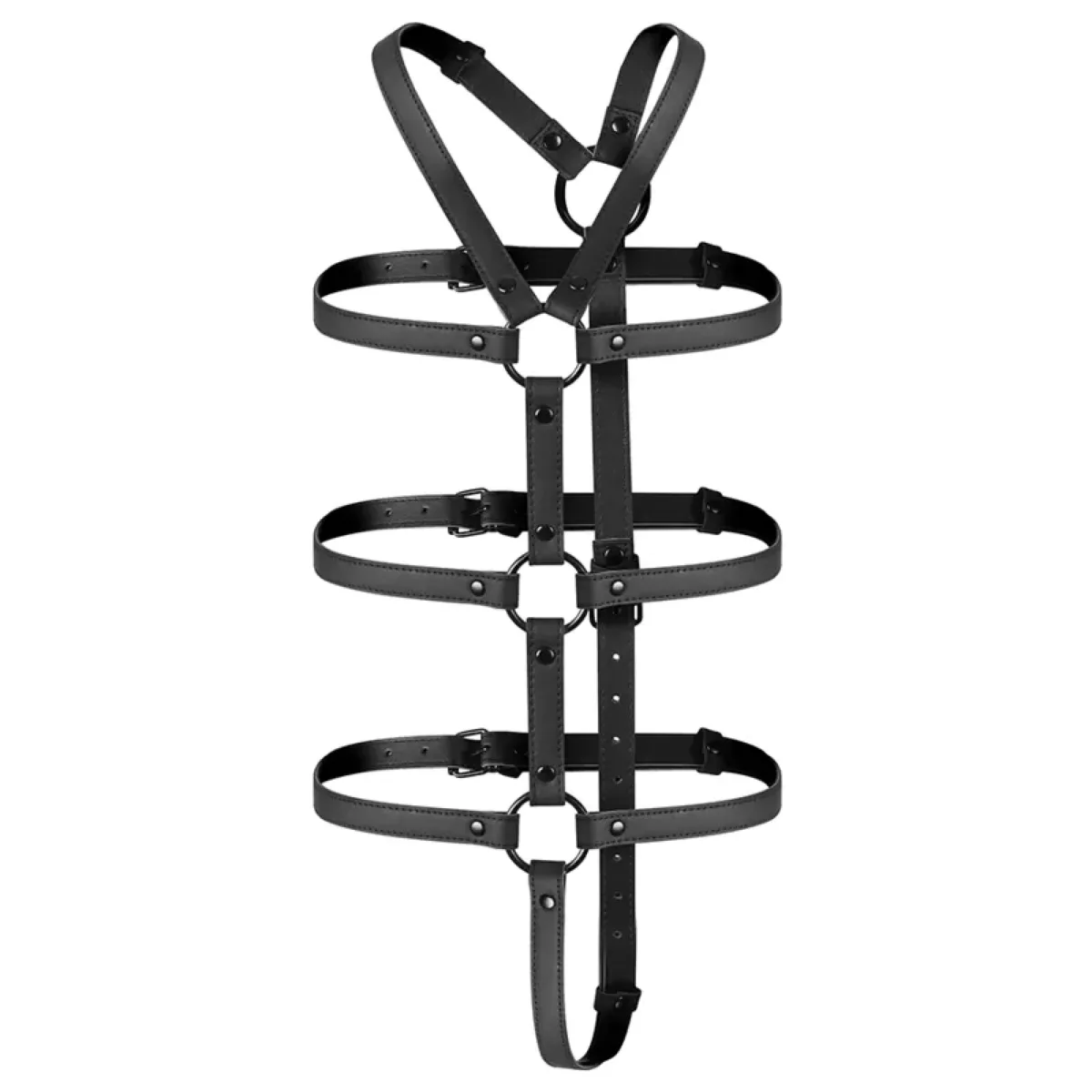
Bondage Adjustable Harness Torso & Arms is a body harness made of vegan leather that secures the upper body and arms with three horizontal straps and a vertical strap over the torso. It is sold in Sweden under the brand Fetish Submissive Bondage, and behind the brand is the Spanish manufacturer and distributor International Dreamlove S.A. in Carmona, outside Seville. The product was launched, according to the manufacturer’s own product page, on Friday, February 9, 2024, and has the reference number D-237014.
The specification is short but unusually specific for the category. The manufacturer states three adjustment ranges: the chest strap 74–104 centimeters, the waist strap 70–102 centimeters, and the hip strap 70–102 centimeters. The weight is stated as 418 grams, and the package measures 180 × 70 × 294 millimeters. The material is stated as high-quality vegan leather with nickel-free details, and the construction is described as ergonomic with robust buckles. The recommended approximate retail price is 34.99 euros, including 21 percent Spanish VAT. In Sweden, the item is sold by six stores at prices between 295 and 359 SEK, and five of them had it in stock at the price check.
This review is exclusively about the black variant with EAN 8435566047640. The number has been checked in two independent ways: the barcode on the manufacturer’s own packaging image, and a Spanish retailer that lists exactly the same product title and the same manufacturer text under the same EAN. All six Swedish shops also list the same number, either directly or via their own item number tied to it. It is worth checking, because Fetish Submissive Bondage has several similar harnesses in the same series that are closely priced.
There are two completely different categories that are both called harness on Swedish shop websites. The first is the strap-on harness, which carries a dildo and has a hole or an O-ring in the crotch. The second is the body harness, which carries nothing at all and is meant either to restrict movement or to be seen. This product belongs to the second category. The manufacturer’s own description is unambiguous: it is intended for dominance and submission play and to provide both physical restriction and a visual expression.
The construction is shown in the manufacturer’s front and back diagrams on the back of the package. Two shoulder straps run from the shoulders, cross each other on the back, and meet at an O-ring. Three horizontal straps run around the body—one over the chest and over the upper arms, one around the waist and over the forearms, and one around the hips. A vertical strap ties together the three horizontal straps at the front via O-rings. It is the placement of the horizontal straps on the outside of the arms that makes the harness an arm fixation and not just a chest harness.
What can be established purely from a design standpoint is that the restraint is soft and gradual, not absolute. The straps are held in place by buckles with holes, and the degree of restraint is determined by how tightly they are pulled. In other words, it sets the product apart from handcuffs and cuffs, where the lock is either closed or open. A harness of this type therefore provides a range of restraint rather than a single position, and in practice that is the most important difference from a classic restraint product.
The brand appears in Swedish stores under three different spellings — Fetish Submisive, Fetish Submissive and Fetish Submissive Bondage — which makes it difficult to find any brand-specific website. There isn’t one either. Fetish Submissive Bondage is one of several private-label brand lines at International Dreamlove S.A., a Spanish wholesaler company that, according to its own website, is registered in the commercial register in Sevilla and has its warehouse in Parque logístico Carmona.
There is a practical consequence for anyone who wants to verify information before purchase: there is no manufacturer website aimed at consumers to go to, and thus no manual, no care instructions and no warranty page. All official product information is on the wholesaler’s B2B page, and that’s also where all the Swedish store texts are translated from. So the fact that the stores all say the same thing is therefore not because multiple independent sources confirm the information — it’s because they all have the same single source.
The series includes several related products that appear in the same Swedish stores: a chest harness with neoprene and a metal chain, a set of a collar and wrist restraints, an adjustable spreader bar in four parts, and a breathable gag ball. Two of them are used as comparisons further down, because they have published measurements and therefore can be compared with this harness in something other than price.
The material aspect is the only characteristic of a body-hugging product that can’t be compensated for through experience, and with a harness it’s doubly interesting because two completely different materials press against the skin: the strap material and the metal in the buckles, studs and rings. The manufacturer comments on both, but with different levels of precision.
The manufacturer states the material as high-quality vegan leather and repeats the wording both in the product text and as one of three declared features on the back of the packaging, where it appears as an icon with the text Vegan Leather / Cuero Vegano. The Swedish retailer SexleksakerOutlet writes it plainly as “100 % veganskt”.
The label says exactly one thing with certainty: the material contains no animal leather. What it says about the chemistry, however, is nothing. The manufacturer does not specify which polymer the vegan leather consists of, and that’s a real gap. Faux leather is mainly made from two polymers. Polyurethane is one of them, and for that one the plasticizer question is practically irrelevant because the softness is in the polymer’s own structure. Softened PVC is the other, and that’s where it comes in: the Kemikalieinspektionen (Swedish Chemicals Agency) describes phthalates as a group of plasticizers used specifically to make PVC flexible, and several of them are restricted or banned within the EU because they can affect the hormonal system.
It should be made clear that nothing in the manufacturer’s information suggests that this harness would contain restricted phthalates—on the contrary, the materials are expressly described as body-safe. But the difference between “body-safe materials” as a marketing phrase and a material declaration that can be checked is the whole point of a specification. A product that states “silicone” or “polyurethane” has provided a verifiable statement. A product that states “vegan leather” has provided an ethical statement, not a chemical one. It’s a reasonable remark to make in this price range, and it should be weighed against the fact that the harness is worn on the outside of the skin and not against mucous membranes—the exposure is different than with an internal product.
Nickel-free is the item in this specification that has the strongest connection to real risk, and it’s also the only one the manufacturer has elevated to its own icon on the packaging: Nickel Free / Libre de Níquel. The harness is full of metal—buckles on three straps, a couple of dozen rivets, and four O-rings—and when the harness is worn, all that metal is in contact with the skin.
The Kemikalieinspektionen (Swedish Chemicals Agency) describes nickel metal as causing allergy when it comes into contact with the skin, and as the most common cause of contact allergy and eczema. The EU’s nickel rules apply to nickel that is released from products intended for long-term contact with the skin, and the example products the authority lists are strikingly relevant here: jewelry, buckles, rivets, and zippers. A body harness of this kind therefore falls squarely into the category the regulation is written for.
1177 describes the symptoms of nickel allergy as swelling, itchy rashes, bumps and blisters or dry, cracked skin where the contact occurred, and notes that the allergy is persistent once it has occurred. That’s why nickel-free is worth more than a line in a bullet-point list. For someone who already has a nickel allergy, what matters is whether the product can be used at all. For someone who doesn’t have it, it’s about not exposing yourself unnecessarily.
A reservation belongs here. The manufacturer states a nickel-free design, but publishes no test certificate and no information about which alloy the metal parts are made of. The information is a statement from the manufacturer, not a documented measured value, and it should be read as a statement. If you’re a known nickel allergy sufferer, it’s reasonable to handle a new product with metal against the skin carefully regardless of what the packaging says.
The manufacturer states the weight as 418 grams and the packaging dimensions as 180 × 70 × 294 millimeters. The Swedish shop Joyme reproduces the same two details under the heading Additional information, with the measurements written in a different order — 294 × 180 × 70 millimeters — which is the same box turned the other way. It’s unusual for a Swedish shop and the manufacturer to match down to the gram, and that they do it like this strengthens the credibility of the figure.
What exactly those 418 grams refer to, however, can’t be determined. The manufacturer does not distinguish between the product’s weight and the shipment’s weight, and since the same page states both weight and packaging dimensions in the same block, the most reasonable interpretation is that the figure is a shipping weight including the cardboard. Assume that the straps in your hand weigh less than that. As a comparison, the manufacturer lists 242 grams for the significantly smaller chest harness in the same series and 398 grams for the necklace-and-ankle/hand-wrist set, which gives a sense of how the weight figures relate to each other within the series.
None of the sources publishes the strap width or the material’s thickness. These are two values that, in practice, determine how much a harness presses at a given tightening, and they are therefore completely missing. The strap width and thickness are not published by the manufacturer, and they can’t be worked out from any other published value either. The same applies to the O-rings’ inner diameter, which determines whether the harness can be connected to ropes, carabiners, or other fastening products.
The entire usability of the product hinges on three numbers. The chest strap is adjustable between 74 and 104 centimeters, the waist strap between 70 and 102 centimeters, and the hip strap between 70 and 102 centimeters. All six Swedish shops reproduce exactly the same three ranges, and they match the manufacturer’s Spanish original. That in itself is a good sign: when six shops and the manufacturer say the same thing about the measurements, there’s no interpretation question left.
The manufacturer does not publish step-by-step instructions, but the construction provides the answer. The chest strap should lie over the chest and outside the upper arms, the waist strap around the waist and outside the forearms, and the hip strap around the hips. The vertical strap at the front holds together the three horizontal straps via the O-rings, and the shoulder straps cross over the back. The natural order is to first adjust the three horizontal straps without the arms inside, and only then insert the arms and tighten.
What can be established about the buckles is that they are of the simple hole-strap type — the same principle as a standard belt. The result is that the adjustment is done in steps, not continuously, and the strap length is determined by the distance between the holes. The manufacturer publishes neither the number of holes nor the distance between them, so it is not possible to say exactly how fine-grained the adjustment is from the specification. The advantage of the hole strap over Velcro or a sliding buckle, however, is that the adjustment does not creep under load.
A practical detail that follows from the construction: since the arms sit inside the two upper straps, the wearer cannot adjust them themselves when the harness is on. So the person tightening the harness needs to be satisfied with the adjustment before the arms go in, or have someone else adjust it. It’s not a flaw — it’s exactly what the product is for — but it’s worth knowing before the first time.
The question is easier to answer than it looks, because the manufacturer has published both the minimum and maximum measurements. The chest strap range of 74–104 centimeters covers a broad middle segment of adult bodies, but it is just a middle segment. If your chest measurement is below 74 centimeters or above 104 centimeters, the harness does not fit, and there are no alternative sizes in the range — the product is sold in a single version in black.
Worth noting is that the chest strap on this harness is not only supposed to fit the ribcage but the ribcage plus both upper arms. So the upper limit of 104 centimeters should not be compared with a chest measurement taken on a bare torso with the arms along the sides, in the way you measure for clothes. The same applies to the waist strap of 70–102 centimeters, which should fit the waist plus the forearms. That is by far the most common reason why a harness of this type turns out to be too small, even though the measurements looked right on the screen.
The hip strap is the only one of the three that lies directly against the body without the arms inside, and for that one it’s 70–102 centimeters straight away. That the waist and hip straps have identical ranges despite being positioned in different places suggests that they are the same component mounted twice, which is a reasonable construction in this price range.
The manufacturer’s own product images show how the selen is built. The straps are stitched along both edges; the crossovers are held together by rivets; and the four points where the horizontal and vertical straps meet come together in O-rings. Three of the straps have buckles. The material is the same in all straps, and there is no padding, no lining strap, and no neoprene—it's pure strap material all the way through.
It’s worth comparing it with the chest harness in the same series, where the manufacturer explicitly states that neoprene is used in selected batches to increase comfort during longer use and reduce friction. This harness has no such purpose. The manufacturer states ergonomic design but does not mention any comfort material in the contact surfaces, and it’s a real difference between the two products that doesn’t show in the price.
When it comes to strength, the specification says nothing at all. There is no information about break load, no information about seam type, and no information about what metal the rivets and rings are made of, beyond the fact that they are nickel-free. It’s by far the biggest gap in the documentation, and it has a direct practical consequence: the product should not be used to bear body weight. Nothing in the manufacturer’s materials suggests that it is constructed for suspension, and the absence of a published break load is, by itself, reason enough to never test it.
Here, you can’t rely on the manufacturer, because the manufacturer publishes no safety information beyond the three icons on the packaging. What follows, therefore, is reasoning that can be derived from the construction, not stated information—and that’s also exactly how it should be read.
A harness that holds the upper arms against the torso with a strap does two things at the same time. It restricts the movement of the arms, which is the intended effect. And it applies pressure around the upper arm, which is a consequence. The tighter the strap is pulled, the greater both effects become—they can’t be separated. What can be concluded is that a strap without padding distributes the pressure over a narrower area than a wide, padded cuff does at the same level of tightening.
The practical consequence is that the tightening should be the minimum needed to achieve the desired restriction, not the tightest harness the product allows, and that time is a separate variable: an adjustment that works for ten minutes is not automatically the same as one that works for an hour. Numbness, tingling, coldness, or color changes in the hands or fingers are reasons to loosen the straps right away.
Another design implication is worth saying plainly: with the arms fixed against the body, the wearer cannot take action during a fall and cannot loosen the buckles themselves. This means the harness relies on someone else being present and able to undo it quickly. Being able to open a webbing strap takes longer than opening Velcro, and that’s a trade-off that comes with the buckle type.
Here there is a clear gap to report. The manufacturer does not publish any care or washing instructions, and the back of the packaging contains no washing symbols. The three icons shown there are about vegan leather, nickel-free materials, and adjustability—nothing about cleaning. None of the six Swedish stores fill in the gap either.
What I can say without going beyond the sources is that the material is polymer-coated faux leather with metal parts, and that such materials generally do not withstand machine washing, soaking, or high temperatures. Wiping the surface and letting it air-dry is the cautious way to handle it, and it should be the starting point precisely because the manufacturer doesn’t say anything else. Hanging the harness up rather than folding it reduces the risk of permanent creases in the straps.
One more thing that follows from the design: the product is not designed to be used with lubricant or oils. There’s no information about how the material reacts to oil-based products, and since it can’t be controlled, contact should be avoided. Silicone-based lubricant is especially worth keeping away, because it’s difficult to remove from a stitched strap.
It’s unusual for a product in this price range to have measurements as precise as this one does—three adjustment ranges, packaging dimensions in millimeters, and weight in grams are more than many more expensive products in the same category disclose. The more obvious it becomes what’s missing. The following information is not published by any source, whether the manufacturer or the shop:
None of the closures are disqualifying on their own. Taken together, though, they say something about what kind of product this is: a simple, widely distributed item from a wholesaler’s own private-label line, documented as far as the trade requires and no further. The price reflects that, and expectations should, too.
We do not have price data from shops in your market yet.
Three adjustment ranges in centimeters, a published weight, and nickel-free metal — more documentation than the price range usually provides. And at the same time no polymer, no strength, and no care instructions.
The most relevant comparisons are within the same series, for the simple reason that they have published measurements from the same manufacturer and therefore can be compared against each other on something other than wording. All the information below comes from International Dreamloves’ own product pages, and all Swedish prices come from the shops’ product feeds on July 29, 2026.
The chest harness in the same series costs from 259 SEK and has EAN 8435566047671. The manufacturer states a neck circumference of 33–55 centimeters and a chest circumference of 63–90 centimeters, a weight of 242 grams, and packaging dimensions of 200 × 70 × 203 millimeters. The material is listed as vegan leather in combination with neoprene and a metal chain, and the construction is nickel-free, just like the torso section.
The differences that actually matter are two. The first is the scope: the chest harness fixes nothing—it goes around the neck and chest, while the torso section keeps both arms against the torso. These are two different product categories even though both are called harness. The second is comfort in the material—the manufacturer explicitly specifies neoprene in selected batches of the chest harness to reduce friction during longer use, which the torso section completely lacks.
The conclusion is simple. If you want arm restriction, there is only the torso section. If you want the visual expression and a neck piece, and you care that the material has a softer contact surface, the chest harness is both cheaper and more comfortable on paper—but it doesn’t do the same thing.
The collar and wrist set in the same series costs from 329 SEK and has EAN 8435566047657. The manufacturer states a collar of 39–48 centimeters, a waist of 81–114 centimeters, and an adjustable vertical back strap of 20–30 centimeters, a weight of 398 grams, and packaging dimensions of 240 × 69 × 220 millimeters. Here too it’s vegan leather and nickel-free construction, and the manufacturer explicitly states that the set can be tied both in front of you and behind your back.
This is the closest competitor in terms of function, because both products fix the arms. The difference is in where. The set fixes the wrists in cuffs connected to a collar, while the harness fixes the entire arms against the torso with wide straps. The set therefore provides point-by-point fixation at the wrists and requires that the wrists can withstand the pressure; the harness distributes the restriction over the upper arm, forearm, and torso.
Two practical differences. The set’s waist span of 81–114 centimeters starts higher and ends higher than the harness’s 70–102 centimeters, which makes the set the better option for larger bodies and the harness the better option for smaller ones. And the set’s ability to attach the arms both in front of and behind the body gives two positions where the harness only has one. For 34 SEK more than the harness at its lowest price, the set is therefore a reasonable option to compare against before you decide — it’s not a more expensive version of the same thing.
To put the price level in context: the same Swedish shops sell the Svenjoyment Adjustable Chest Harness for 659 SEK, i.e. more than double compared to the torso harness’s 295 SEK. That says something about the range in the category, but the comparison should be made with caution — it’s a different manufacturer, a different product type, and a specification that isn’t taken from the same source.
The general pattern in the category is, however, worth knowing before you compare price tags: what separates a cheap harness from an expensive one is rarely the number of straps but rather the strap width, the material thickness, whether the contact areas are padded, and whether the manufacturer discloses strength. Those four pieces of information are not published for this harness, and that’s why, in practice, a direct comparison to a more expensive alternative becomes a comparison between a documented and an undocumented product.
Six Swedish stores sell the item with EAN 8435566047640. Cheapest are Blush Me and SexleksakerOutlet at 295 SEK each; then Sextoycity at 299 SEK, Sexonic at 313 SEK, Vuxen at 349 SEK, and Joyme at 359 SEK. The difference between the lowest and highest price is 64 SEK or just under 22 percent for the exact same item number and the same color — an unusually small spread in this category.
The stock situation is also unusually good. Fem av de sex butikerna hade produkten i lager vid priskontrollen, and the three cheapest were among them. That means the cheapest price is also a price you can actually buy at, which is far from always the case. The only store without stock status in the stream was Sexonic, whose own product page at the same time showed that the item was in stock — an example of how a product feed and a store page can say different things, and of the fact that it’s the feed that is shown in the table above.
Three of the stores also report a regular price above the campaign price: Blush Me and SexleksakerOutlet list 349 SEK as the regular price versus 295 in the campaign, and Sextoycity lists 399 SEK versus 299. Sexonic lists 34,99 euro as the list price versus 28,34 euro in the campaign. That the list price of 34,99 euro is the same as the manufacturer’s recommended approx. price is worth noting — it gives a reference point for measuring the Swedish prices against that isn’t the store’s own comparison figure.
The prices in the table above are updated when the stores’ product feeds are updated, but always check the final price at checkout. In this price range, all stores are below their respective free-shipping thresholds, which means that shipping is a real part of the total price and can change the order among the four cheapest.
It’s for you if you want an arm fixation with a wide adjustment range and you value that the measurements are actually published — 74–104, 70–102 and 70–102 centimeters are three numbers you can measure against before you order, and it offers more than most competitors in the same price range. It’s for you if you want nickel-free metal against your skin, and for you who want to get into the category without spending more than a couple of hundred SEK.
It’s not for you if your measurements are outside the ranges, since the product is available in only one version and one size. It’s not for you if you want padded contact surfaces — where the chest harness in the same series, with its neoprene, is the better choice. It’s not for you if you want to be able to vary between fixation in front of and behind the body, which the necklace and wrist set handles but the harness doesn’t. And it’s not for you if you require published strength, material declarations at the polymer level, or care instructions before purchase, because none of those three pieces of information are available to get.
One last thing belongs in the decision. The harness is a product that requires two people to really work — it has to be tightened by someone else, and it has to be removed by someone else. Anyone looking for something to use alone should look at a completely different type of product, because the arm fixation is the whole point and at the same time the whole limitation.
Neither the manufacturer nor any of the six stores lists any voluntary manufacturer’s warranty for this product. That in itself isn’t strange for an item without electronics at this price point, but it means that only the protection provided by the law applies — and it’s worth knowing exactly what that protection covers.
Under the Swedish Sale of Goods Act (konsumentköplagen), you have three years’ right to file a claim for defects in the item. It’s important to distinguish a claim from a warranty: the right to file a claim applies to original defects, meaning defects that were present when you received the item, even if they only turn out later. A seam that comes loose or a rivet that detaches after a short period of normal use is an example of something that can be an original defect. Normal wear and tear isn’t.
When buying at a distance, you also have a right of withdrawal for fourteen days under the Act on Distance Contracts and Contracts Outside Business Premises. Here is a practical limitation that is particularly relevant for this product category: Konsumentverket’s guidance discusses the exception for sealed goods for reasons of health protection or hygiene, which cannot be returned if the seal has been broken. The product is delivered in a hanging package, and how an individual store applies the exception varies. So, if you want to be able to cancel the purchase, it’s a good idea to check the store’s return terms before you open the package — the right to complain in case of defects applies, however, always, regardless of the package.
One or two of the stores make commitments beyond what the law requires. Sextoycity states a 30-day right of return on its product page, which is twice as long as the legally required withdrawal period. Such promises are voluntary and can change, so read them in the store at the time of purchase. If you have questions about what applies in your case, Konsumentverket provides guidance via Hallå konsument.
Bondage Adjustable Harness Torso & Arms isn’t included in any ranking yet. In best i test guides, the entire categories are compared against each other using five shared criteria, with what was left out shown.
Every numerical piece of information in the text can be traced to one of the sources below. The links were checked manually on the specified date.
This page is machine-translated from Swedish. Read the Swedish original