

Review
Review: We-Vibe Sync Go Purple
C-shaped couples vibrator with IPX7, 90 minutes of operating time, and a two-year warranty.
29 July 2026
Review · Double vibrator · Two motors
Double-ended vibrator for shared penetration, reviewed against the manufacturer’s own specifications and price data from five Swedish stores. 31.2 centimeters, 15.5 centimeters insertable per end, two motors with nine vibration modes, 280 grams of silicone, and a magnetic charging cable—but no published waterproof rating, and three stores that list three different charging times.
A specialized product that does one thing: it lets two people share the same vibrator at the same time, with one end each that is 15.5 centimeters long and a motor at each end so that the vibration doesn’t fade out over 31 centimeters. The silicone covers the entire body, and the interface is a single button. What you pay for is a specification full of gaps: no published water-resistance rating, no phthalate declaration, no warranty period, no battery capacity—and three hours of charging for max one hour of operation according to the manufacturer’s own packaging.
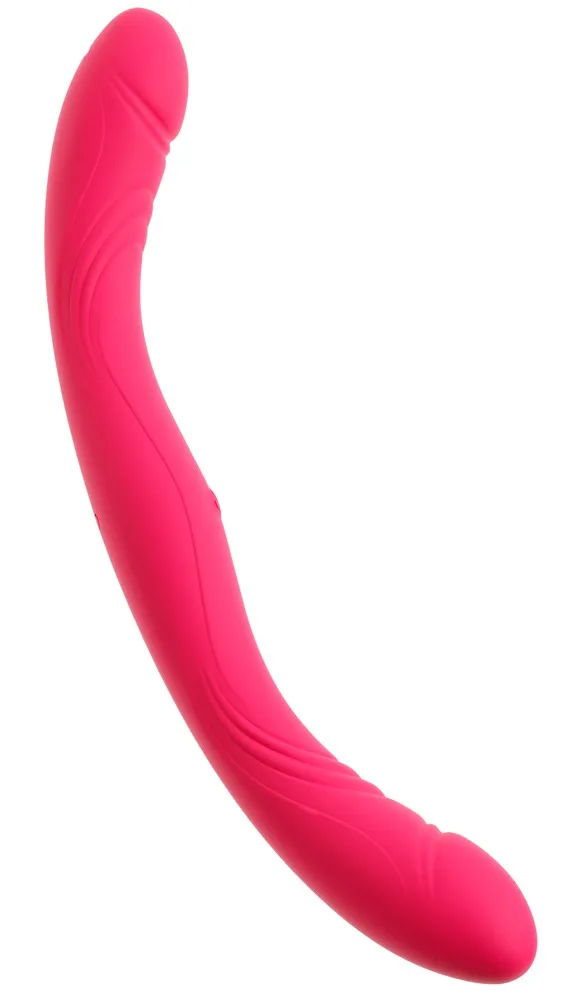
Couples Choice Double Vibrator is a double-ended, flexible vibrator in silicone with a motor at each end. The manufacturer states the total length as 31.2 centimeters, the insertable length as 15.5 centimeters per end, and the diameter as 2.5–3.5 centimeters. The weight is given as 280 grams. The material is listed as silicone, and on the packaging it says Soft touch silicone. The color is pink, and the brand Couples Choice is, according to the manufacturer's own labeling, an ORION brand — Joyland lists the same item under You2Toys, which is the same group's umbrella brand.
Functionally, the specification is brief: two motors, nine vibration modes, and a single button in the middle of the toy. The manufacturer states that the nine modes feel intensely at both ends and that they are controlled by pressing the button in the middle of the product. On the back of the packaging, the charging time is also listed as about 180 minutes and the operating time as max about 60 minutes; charging takes place via a magnetic charger. Pressing and holding for three seconds puts the product into standby or turns it off, and pressing for one second steps through the nine modes.
This review is exclusively about the pink variant with EAN 4024144494057, the manufacturer's item number 54056100000. The manufacturer's recommended consumer price is 49.95 euros. In Sweden, the item is sold by five stores at prices between 469 and 549 SEK, and four of them had it in stock at the price check on September 12, 2026.
What makes this product worth a careful review is not the specification itself, but the gap between the manufacturer's information and the stores' listings. Five Swedish stores sell exactly the same item number, and they state three different charging times, three different operating times, and two incompatible answers to the question of whether the product is waterproof. The manufacturer itself answers two of those questions and is silent about the third. What can be determined, and what cannot, is therefore half of this text.
A double vibrator is an oblong, flexible product with two insertable ends and at least one motor. It is designed so that two people can use the same product simultaneously, with one end each, but it also works for one person who wants two insertable ends to switch between. The manufacturer explicitly describes both types of use and points out two positions where the shape really comes into its own: the doggy position, where both lie with their buttocks against each other on all fours, and the crab position, where both sit opposite each other with their hands and feet on the surface.
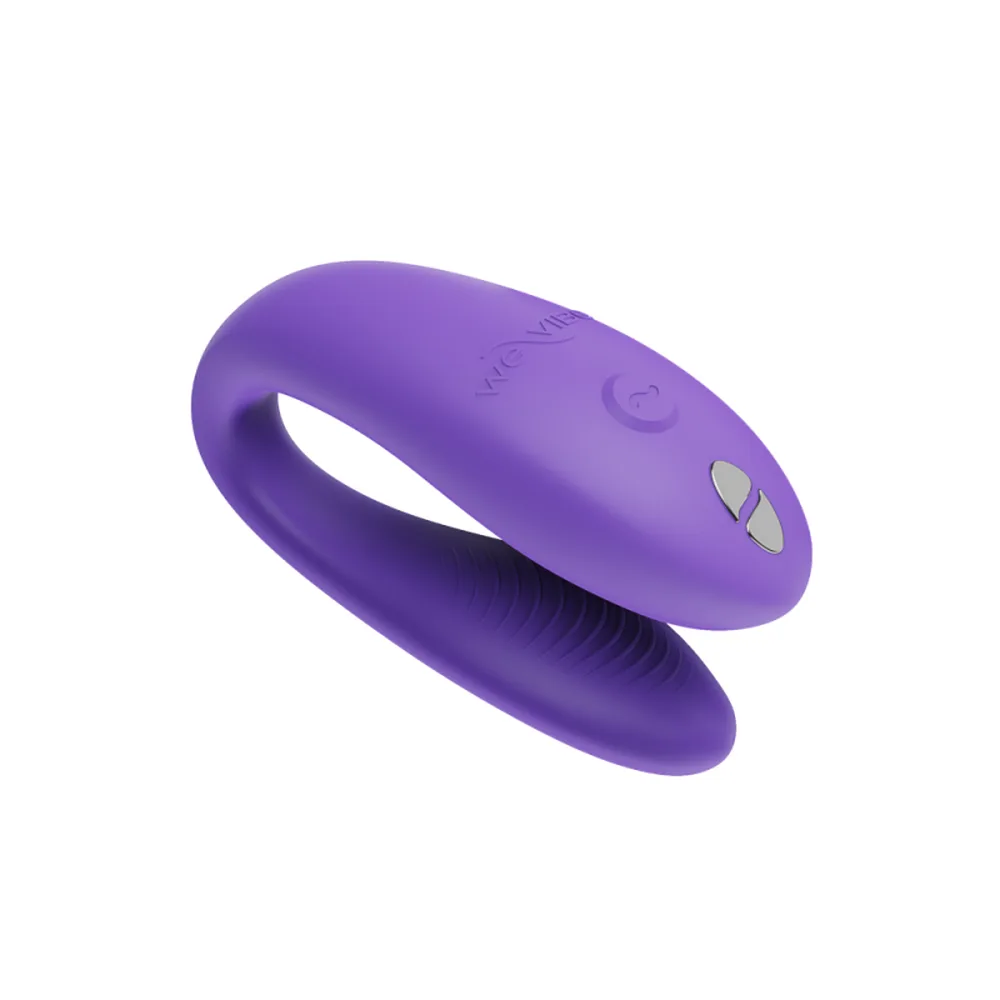
It’s worth distinguishing this category from a couple vibrator in the usual sense. A C-type couple vibrator — We-Vibe Sync Go is the standard example — is worn by one partner during intercourse and stimulates the clitoris and the G-spot at the same time while penetration happens in the usual way. A double vibrator instead replaces penetration and requires both partners to have their own end. These are two completely different product types that happen to end up in the same store category, and that difference determines whether this particular product is the right purchase.
Another thing that sets this product apart from a regular double dildo is that it has motors. A double dildo without a motor is a simple silicone rod that doesn’t need charging, doesn’t have any electronics that can break, and therefore in practice lasts until the silicone gives up. The motors make the product more versatile, but they also bring in a battery, a charging cable, and a sealing issue that otherwise wouldn’t exist. What can be established is that every such additional component is also a component that can fail first.
The Couples Choice assortment contains two products whose names are so close to each other that they’re regularly confused in search results and store lists. They are completely different products.
The difference that matters most in practice is in the manufacturer’s own bullet points. Duo Vibrator is explicitly labeled as waterproof. Double Vibrator is not. Same manufacturer, same brand, same product page details — and one has a checkmark in the box but the other doesn’t. That is the single most important piece of information in the entire review, and I’ll return to it in the section about waterproofing.
The material issue is the only property of an intimate product that can’t be compensated for with experience or care, and it determines whether the product is still hygienic after five years. The manufacturer lists a single material for Double Vibrator: silicone. The package’s icon row repeats this with the label Soft Touch, and the product text talks about a silky-smooth Soft Touch surface that makes both ends slide in easily.
Having the entire product made of silicone and not a combination of silicone and hard plastic is a real advantage here, and it comes down to the shape. A product that is supposed to be flexible along its entire length can’t have a hard plastic shaft in the middle. That means there’s no seam between a soft section and a hard one where dirt can collect, and no edge that can rub. The only break in the surface is the button and the two charging contacts in the middle of the back side.
Silicone is a non-porous material. A non-porous surface can be cleaned, because there are no microscopic cavities where residue can get stuck. That is the single most important property of a material that’s meant to sit against mucous membranes, and that’s why the material declaration weighs more heavily than almost all other entries in a specification.
"Soft Touch" is, on the other hand, not a technical term but a description of the surface. It says that the silicone has a matte, velvety finish instead of a glossy one, and it has two practical consequences. One is that the surface feels drier and more grippy than glossy silicone. The other is that matte silicone surfaces attract lint and dust more readily than glossy ones, which makes storing it in its own pouch or box more desirable than with a glossy product. No storage pouch is included — the manufacturer’s included items consist of the product and a USB charging cable, nothing else.
The shape is worth mentioning on its own. The manufacturer describes a stylized acorn shape at both ends, along with soft ribbed and wave-like structures along the shaft. The ends are therefore not identical in appearance, but they are identical in dimensions: an insertable length of 15.5 centimeters and the same diameter range of 2.5–3.5 centimeters are given for both. Mshop writes that one end is narrower and softer than the other and especially suited for anal use. That’s a retailer claim with no counterpart from the manufacturer, which states the same measurements for both ends.
Phthalates are a group of plasticizers used to make plastic — especially flexible PVC — pliable. The Swedish Chemicals Agency (Kemikalieinspektionen) describes them as substances that can affect the endocrine system and make reproduction more difficult, and several of them are therefore restricted or banned within the EU in a large number of products. This specific product category is repeatedly the subject of oversight because it contains skin-contact flexible plastic.
Here there’s a gap worth calling out directly. The manufacturer does not publish any explicit declaration that Double Vibrator is free from phthalates, BPA, or latex. What it states is the material: silicone. Joyland states in its product database table that the item is phthalate-free, but that’s a store claim, not a manufacturer claim, and it is not listed at ORION.
How serious it is depends on what you mean by it. Silicone itself doesn’t require phthalate plasticizers to become soft — the softness comes from the polymer’s own structure — and a correct material specification like “silicone” is therefore better guidance than labels like “TPE” or “jelly rubber,” which don’t say anything at all about which plasticizers are included. But an explicit declaration is still something different from a conclusion the reader has to draw themselves. Compare with We-Vibe, which on its product page for Sync Go states that the material is body-friendly silicone, free from phthalates and BPA, and made without latex. That is the wording you want to see, and it’s missing here.
The manufacturer states the total length as 31.2 centimeters, the insertable length as 15.5 centimeters per end, and a diameter that varies between 2.5 and 3.5 centimeters along the product. The weight is given as 280 grams. Four of the five Swedish shops — Taboo, Lustly, Lekosmek, and Joyland — provide the same length and weight details, which is unusually strong agreement in this category.
There are two discrepancies. Mshop lists the diameter as 3.20 centimeters in its dimension table while the same table also states the insertable diameter as 2.5–3.5 centimeters; it’s probably a rounding of the same interval rather than a conflicting measurement, but it’s the shop’s information and not the manufacturer’s. Mshop also gives the weight as 0.41 kilograms. That figure appears in a field together with the package dimensions, 31.50 × 8.20 × 5.20 centimeters, and should reasonably be read as shipping weight, including the cardboard and cable. The manufacturer’s 280 grams is the product weight.
What does 31.2 centimeters mean in practice? It’s a product that doesn’t fit in a travel case without further ado and that is noticeably longer than almost everything else in the category for couples. That more than half of the length—31 centimeters total versus 15.5 per end—can be inserted in every direction means that a bit over a third of the product is always positioned between the users. That’s where the button sits, and it’s that part that gives it the flexibility the manufacturer highlights. With 280 grams distributed over 31 centimeters, the product is also light relative to its size, which matters when nobody is holding it.
The diameter range 2.5–3.5 centimeters corresponds to a circumference of roughly 8 to 11 centimeters. It places the product in the mid-range in terms of girth: it’s wider than a typical bullet vibrator and narrower than a realistic full-size dildo. Joyland lists the firmness as medium, which is a store claim but a reasonable description of a silicone product that should be flexible enough to form an arc between two people.
The interface is as simple as it can be. The manufacturer specifies a single button, placed in the middle of the toy, and the back of the packaging describes exactly how it works: a press for three seconds puts the product into standby or turns it off, and a press for one second steps through nine vibration modes. There’s no display, no plus and minus buttons, and no app.
Having the button in the middle is a direct result of the shape. On a product that’s inserted at both ends, the middle is the only part that’s accessible, and the manufacturer points out that the modes are therefore conveniently controllable regardless of which side is used. It’s a thoughtful solution to a problem that other double vibrators solve with a remote control—and no remote control is included here.
With a button, in two press variations. A long press for three seconds turns it on and off. A short press for one second switches modes. After the ninth mode, the sequence starts over. The manufacturer doesn’t publish how the nine modes are distributed between constant strengths and pulsing patterns, and it also doesn’t say whether the product remembers which mode it was in when it was turned off.
The practical thing about having a single button is that nobody needs to learn anything. The impractical part is that you always have to step forward: if you want to go back one step, you have to go around the loop. On a product that sits between two bodies, where the button isn’t visible, it makes a real difference compared with a rocker switch with plus and minus. Expect that in practice you’ll end up with two or three modes and then stay there.
There’s a difference here between the manufacturer’s description and several stores’ descriptions that’s worth clearing up, because it affects what you can expect from the product.
The manufacturer writes that the two motors provide nine powerful vibration modes that feel intensely at each end, and that they are controlled with a press of a button in the middle of the toy. The packaging states nine vibration modes, in the singular, linked to the single button. So the most reasonable reading is this: nine modes in total, driving both motors, with one motor at each end so that the vibration feels equally strong at both ends.
Several Swedish stores instead write “9 vibration modes per end,” which is a direct translation of the manufacturer’s “9 vibration modes in each end,” and in itself it isn’t wrong. Lustly, however, goes one step further and writes that you can let both ends vibrate equally, differently, or alternate in sync with the moment. That claim has no counterpart with the manufacturer, who describes one button and nine modes—not two independent controls. Assume that the two motors are synchronized. If you need to be able to control the ends independently of each other, this is not the product you should buy.
What two motors instead add is smoothness. On a long, flexible product with a single motor in the middle, the vibration is noticeably dampened toward the ends, because soft silicone is a poor medium for conducting mechanical movement over longer distances. With one motor at each end, you avoid that damping. That’s the entire technical point of the design, and it’s reasonable given that the product is 31 centimeters long.
The manufacturer is unusually specific about how the product is intended to be used by two people and names two positions. In the dog position, both are on all fours, with their buttocks facing each other. In the crab position, both sit facing each other with hands and feet on the surface. In both cases, the product lies like an arc between the users, and the button is accessible for both.
That’s unusually helpful information in a product description, and it explains why the length is what it is. It also explains a limitation: both positions require the bodies to be at roughly the same height and that the distance between them can be kept fairly constant. It’s not a product that works equally well in all positions, and it’s not what the manufacturer claims either.
An observation about intended use belongs here, and it is not cosmetic. The manufacturer’s consumer page explicitly states that both sides can be inserted either vaginally or anally. The manufacturer’s own customer information sheet for the same item number, in the section about vibrators, states that the product is only suitable for vaginal use. Those are two statements from the same manufacturer about the same item that don’t go together. The cautious interpretation is that the information sheet is general safety wording for vibrators, while the product page describes this specific model—but anyone planning to use the product anally should know that the manufacturer’s documentation contradicts itself on this point, and that the product lacks the base plate or ring that is otherwise recommended for anal use.
The manufacturer does not publish any measured decibel value for Couples Choice Double Vibrator, either on the product page, on the consumer page, or on the packaging. There is also no “whisper” or “silence” marking in the icon row on the packaging; instead it lists Vibration, 2 Motors, Flexible, Rechargeable, Water Based Lube Only, and Soft Touch.
Lekosmek describes the performance as powerful and quiet. It’s a store phrasing with no measurable figures behind it, and it should be read as marketing. So there’s no number you can compare with—unfortunately, not for the entire category. We-Vibe also doesn’t publish any decibel value for Sync Go.
What can still be established in principle is that a product with two motors makes noise from two points, and that a soft, thick silicone casing dampens sound better than a thin hard-plastic casing. A practical tip that applies regardless of model: place the product on a soft surface between uses. A hard tabletop works like a resonance box and noticeably amplifies the sound. Never state a decibel value unless someone has measured it—and the person who finds one for this model should check where it comes from.
This is the point where a data-driven comparison is most useful, because three different sources provide three different answers about exactly the same item number.
The manufacturer states no water resistance at all. There is no IP rating on the product page at ORION Wholesale, none on the consumer page at orion.de, and no water-resistance icon on the packaging—despite the fact that the packaging has room for six icons and uses all six for something else. That the absence is deliberate is shown by the comparison within the same product line: for Couples Choice Duo Vibrator, the same manufacturer explicitly writes “Wasserdicht” in the bullet list and adds that it can be used in a bath and shower. For Double Vibrator, that line is missing.
Taboo states IPX5. It is a specific rating, but it has no support from the manufacturer, and Taboo provides no own source. Mshop instead states "100% watertight" and writes in the body text that the product can be taken into the shower or bath. The two statements are not just different; they are incompatible: IPX5 is explicitly not a submersion rating.
The rule in such situations is simple. The manufacturer wins, and the manufacturer says nothing. Treat the product as not waterproof until ORION publishes a rating. That the charging contacts are magnetic and lack rubber plugs suggests the housing is more sealed than one with an open USB port, but magnetic charging is a design detail, not a testing result.
Enclosure classes are defined in the international standard IEC 60529. The number in the second position indicates protection against water. IPX5 means that the product has been tested against water jets from a nozzle — in other words, running water, a shower spray, and rinsing off. IPX7 means something completely different: submersion in water to a depth of one meter for 30 minutes.
The difference is decisive in practice. An IPX5 product can be rinsed under the tap but should not be put in a bathtub. An IPX7 product can be left submerged. That’s why Taboo’s and Mshop’s statements can’t be reconciled: one allows rinsing off, the other allows taking a bath, and they can’t both be right.
As long as the manufacturer does not publish any rating, the safest advice is to wipe the product with a damp cloth and soap instead of holding it under running water, and under no circumstances submerge it. If a product completely lacks an IP rating, it should be treated as not waterproof. The absence of a rating is never a sign that the product would be approved.
The manufacturer recommends a specific toy cleaning product for cleaning and care. Wipe the product after each use, be careful around the button and the two charging contacts in the middle of the back, because they are the only interruptions in the silicone surface, and let it air-dry before putting it away. If you share the product between different body openings or between two people, a condom over each end is the only way to do it hygienically correctly, and the condom should be replaced with every change.
The lube question is the only point where the manufacturer is really specific, and it is also printed on the packaging as one of six icons: Water Based Lube Only. The consumer side formulates the reason: a silicone-containing lubricant can attack the silky surface. It’s not a warranty issue but a material issue—silicone-based lubricant breaks down the silicone surface over time and makes it porous, and a porous surface can no longer be cleaned properly; it can only be replaced. Oil-based products like coconut oil also leave a film that is difficult to remove. All five Swedish shops repeat the recommendation about water-based lubricant, which is unusually consistent.
No storage pouch is included. With a 31-centimeter-long product in matte silicone, it’s worth arranging your own fabric pouch or box—partly because silicone attracts dust, and partly because silicone surfaces that lie against each other for a long time can become stuck to each other.
The manufacturer’s own packaging text is unambiguous: charging time approx. 180 minutes, operating time max approx. 60 minutes. It’s three hours of charging for at most one hour of use, i.e. a ratio of three to one. It’s a weak figure, and it deserves to be stated plainly because it disappears in most shop texts.
Here’s what it looks like at the shops. Joyland states a charging time of 180 minutes and up to one hour of operating time—so exactly as the manufacturer claims. Taboo states approx. 120 minutes of charging and approx. 90 to 120 minutes of use time. Mshop states approx. 90 minutes of charging and 60 to 90 minutes of operating time. So two out of three shops that publish battery data give a shorter charging time and a longer operating time than the manufacturer itself. None of them provides a source. Use 180 minutes and max 60 minutes.
With a magnetic charging cable for USB. The back of the package expressly states "Magnetic charger", the manufacturer’s product image shows a black USB cable with a magnetic two-pin connector on the other end, and the contacts sit like two small pins in the middle of the product’s back next to the button. Joyland describes the cable as a magnetic USB cable, which matches the manufacturer’s image.
Magnetic charging is a trade-off, not a pure advantage. The advantage is that there’s no need for an opening in the housing, which makes the construction more sealed and, as here as well, makes it possible to place the charging point in the middle of a product that is otherwise completely closed. The drawback is that the cable is product-specific: if you lose the charging cable, no standard USB-C cable will work. Unlike large brands, ORION has no published spare-part sales for exactly this cable, which makes the cable the product’s weakest point over time. Put it in one specific place from day one.
A practical tip that applies to magnetic charging connectors in general: wipe the two pins before you attach the cable. Residue from lubricants and moisture between the contacts are the most common reasons why magnetic charging won’t start, and for a product without a published IP rating it’s especially important that the surface is dry when the cable is connected.
The manufacturer does not publish the battery’s capacity in mAh, its voltage, or its type for this model. The only information provided is that the product is rechargeable and charges magnetically via USB. Without the capacity, it’s not possible to convert the runtime into power consumption, and it’s not possible to compare how heavily the cell is loaded between models. It also isn’t possible to assess whether the 180 minutes of charging time depends on a larger cell or on a lower charging current.
The lack of this information isn’t unique, but it’s noticeable compared to others. We-Vibe states at least the battery type — a rechargeable lithium-ion polymer battery — for the Sync Go, along with 90 minutes of runtime and 90 minutes of charging time. Knowing that the battery is of the lithium-ion type matters for how you take care of it.
What generally applies to rechargeable lithium-based cells likely applies here as well: capacity drops with the number of charge cycles, and the product is best off being charged regularly instead of being stored completely discharged. Since the battery is enclosed in a silicone casing without a flap, it’s not replaceable, and in practice the product is used up when the cell is. With a one-hour runtime, it also means that each time you use it accounts for a large share of a full cycle, which is a reason not to leave it lying around and running down unnecessarily.
We do not have price data from shops in your market yet.
Three hours of charging for up to one hour of operation. It is not an estimate — it is printed on the manufacturer’s own packaging.
Two comparisons are relevant: with the other double product in the same lineup, and with the couple’s vibrator that is the default choice in the category. All the information below comes from the respective manufacturers’ own specifications.
The Duo Vibrator is the other double product from Couples Choice, and it has a completely different design. Instead of a 31-centimeter-long shaft with two insertable ends, you get two separate toys: a 20-centimeter vibrator with a 15-centimeter insertable length and a diameter of at most 3.8 centimeters, plus a removable vibrating penis ring that is 10.5 centimeters long with a diameter of 3.1 centimeters. The weight is listed as 216 grams and the material as silicone. The recommended price is 69.95 euro, versus 49.95 for the Double Vibrator.
Functionally, the Duo Vibrator has two motors with seven vibration modes each—that is, two separate toys that are controlled independently, which in practice is the independent control that some shops incorrectly attribute to the Double Vibrator. And Duo Vibrator is labeled as waterproof while Double Vibrator is not.
The conclusion is that the two products solve different problems. If you need a product that both of you can have inside at the same time, there’s only Double Vibrator. If you want two toys that can be used separately, that you can regulate independently, and that you can also take with you into the shower, Duo Vibrator is the better buy—and the 20 euros difference in the recommended price buys you an entirely different toy, not just a single function.
We-Vibe Sync Go is the C-shaped couple vibrator that usually turns up first when someone searches for "parvibrator", and the comparison is instructive precisely because the products are so different despite ending up in the same category.
Sync Go measures 77.4 × 29.7 × 45.2 millimeters—so under eight centimeters in length compared with Double Vibrator’s 31.2 centimeters. It’s worn by one partner during intercourse and stimulates the clitoris and the G-spot at the same time, instead of replacing penetration. We-Vibe states a body-friendly silicone that is free from phthalates and BPA and made without latex, a rechargeable lithium-ion polymer battery, 90 minutes of operating time, 90 minutes of charging time, an IPX7 enclosure rating, and a two-year warranty.
Where Double Vibrator stands weakly on four out of five points that can be measured. Operating time is max 60 minutes versus 90. Charging time is 180 minutes versus 90—so twice as long charging for two-thirds as long use. Water resistance is undisclosed versus a stated IPX7. The material declaration is “silicone” versus an explicit disclaimer that it is free from phthalates, BPA, and latex. ORION does not publish any warranty duration at all, while We-Vibe states two years.
What Double Vibrator has that Sync Go doesn’t is the idea itself: two insertable ends, two motors, and a product that two people can share at the same time without anyone having to carry it. It’s a specific function that no C-shaped couple vibrator can replace. The question, then, isn’t which is better, but which of two completely different things you want—and that’s why both exist in the same category.
Five Swedish shops sell the item with EAN 4024144494057. Lustly is the cheapest at 469 SEK, and Mshop is the most expensive at 549 SEK. That’s an 80 SEK or 17 percent difference for exactly the same item number, same color, and same packaging—a much narrower spread than is normal in this category, and a sign that the item has established itself as a volume product with roughly the same margin everywhere.
The situation in stock, however, changes the picture. Lustly, which has the lowest price, had the item out of stock at the price check on September 12, 2026. Four stores had it in stock: Joyland at 495 SEK, Lekosmek and Taboo at 499 SEK each, and Mshop at 549 SEK. The lowest price you can actually buy it for is therefore 495 SEK, and the difference between the cheapest and the most expensive available store shrinks to 54 SEK. Stores that list a product as out of stock may still keep an old price in the feed, and that price is rarely what you actually end up paying when the item comes back into stock again.
The price spread does not depend on any store selling another variant. Taboo and Mshop both publish the barcode, 4024144494057, on their product pages, and Taboo and Lekosmek also state the same article number as the manufacturer uses in its range. So it’s simply the stores’ own margin setting for an identical item.
The manufacturer’s recommended retail price is 49.95 euro. That all Swedish prices fall within the range 469–549 SEK means that the stores largely stick close to the recommended price rather than below it. The prices in the table above are updated when the stores’ product feeds are updated, but always check the final price at checkout. Shipping costs are added by most stores below a certain order value, and in this price range all five stores are under the threshold for free shipping—which may matter more than the 54 SEK difference between the stores.
It’s for those of you who specifically want a product that two people can use at the same time, with one end each, and who know that you want that. It’s for those of you who prefer full silicone over a combination of silicone and hard plastic, and for those of you who want a product with such a simple interface that no one needs to read any manual—one button, two press options, nine settings. It also fits the person who uses it alone and wants two insertable ends with different shapes to switch between. With two motors instead of one, you also avoid the damping that would otherwise occur on a 31-centimeter-long silicone product.
It’s not for those of you who want to be able to control the two ends independently of each other—this function is not available according to the manufacturer, regardless of what individual store text snippets may suggest. It’s not for those of you who want to use the product in the shower or bathtub, because the manufacturer does not publish any water-tightness rating at all, and the stores’ information contradicts each other. It’s not for the person who needs more than one hour of runtime, or who is bothered by having to charge it for three hours to get that one hour. And it’s not for the person who requires an explicit declaration of phthalates, BPA, and latex, or a published warranty period from the manufacturer before purchase, because neither of those is available here.
One more thing belongs in the decision. A double vibrator measuring 31.2 centimeters is a product that assumes that both partners are on board with the idea and that you are prepared to try your way to a position that works. The manufacturer itself points out two, and both require that the bodies are in about the same height. It’s a specialized product, not an all-round vibrator — and it is only assessed fairly against what it actually is.
ORION does not publish any manufacturer warranty for Couples Choice Double Vibrator, either on the product side, on the consumer side, or on the packaging. It is in sharp contrast to branded goods in the same category — We-Vibe states two years for Sync Go — and that means that in practice you are referred to your statutory rights. The manufacturer is listed as OV-Großhandel in Flensburg, Germany, and it is the shop you bought it from that is your counterparty in Sweden.
What always applies is the Swedish Consumer Sales Act (konsumentköplagen). You have three years of right to complain about defects in the item, regardless of what the manufacturer promises or does not promise. A defect that shows up within the first two years is also assumed to have been there from the beginning unless the seller shows otherwise, which is the rule that matters most in practice when a battery or a motor stops working prematurely.
For distance purchases, you also have a right of withdrawal for fourteen days under the Distance Contracts and Contracts Outside Business Premises Act (lagen om distansavtal och avtal utanför affärslokaler). Be aware that in practice the right of withdrawal is limited for hygiene products that have been taken out of a sealed package — the right to complain about defects still applies regardless. If you have questions about what applies in your case, Konsumentverket (the Swedish Consumer Agency) guides you via Hallå konsument.
A specific piece of advice that follows from all of the above: save the receipt and save the charging cable. Without a published warranty and without spare parts being sold, the receipt is your only tool if something breaks, and the cable is the only part you can’t replace with something you already have at home.
Couples Choice Double Vibrator Pink is ranked på plats 15 av 15 in couples vibrator best i test, where the entire category is compared against each other using five shared criteria. Guiden vinns av We-Vibe Sync O Petrol Green.
Every numerical piece of information in the text can be traced to one of the sources below. The links were checked manually on the specified date.
This page is machine-translated from Swedish. Read the Swedish original