

Review
Review: We-Vibe Melt 2
We-Vibe’s air pressure model with the same app and the same warranty.
29 July 2026
 Author's pick
Review · Dual vibrator · C-shaped with app control
We-Vibe’s smallest C-shaped dual vibrator reviewed against the manufacturer’s own specifications and price data from eight Swedish stores. Full silicone without phthalates, BPA, or latex, IPX7 per IEC 60529, 90 minutes of runtime, magnetic charging, hard travel pouch, and app control with long-distance mode—at a price where there’s a 77 percent difference between the cheapest and most expensive store.
The smallest and cheapest of We-Vibe’s three C-shaped couple vibrators, and the only one that comes with a hard travel case in the package. Body-safe silicone with no material seams, IPX7, and an app that offers twelve patterns, Touch Mode, and long-distance control. What you pay for is runtime — 90 minutes is the shortest in the comparison — and that the intensity can only be adjusted from your phone, because the product has a single button and no remote control.
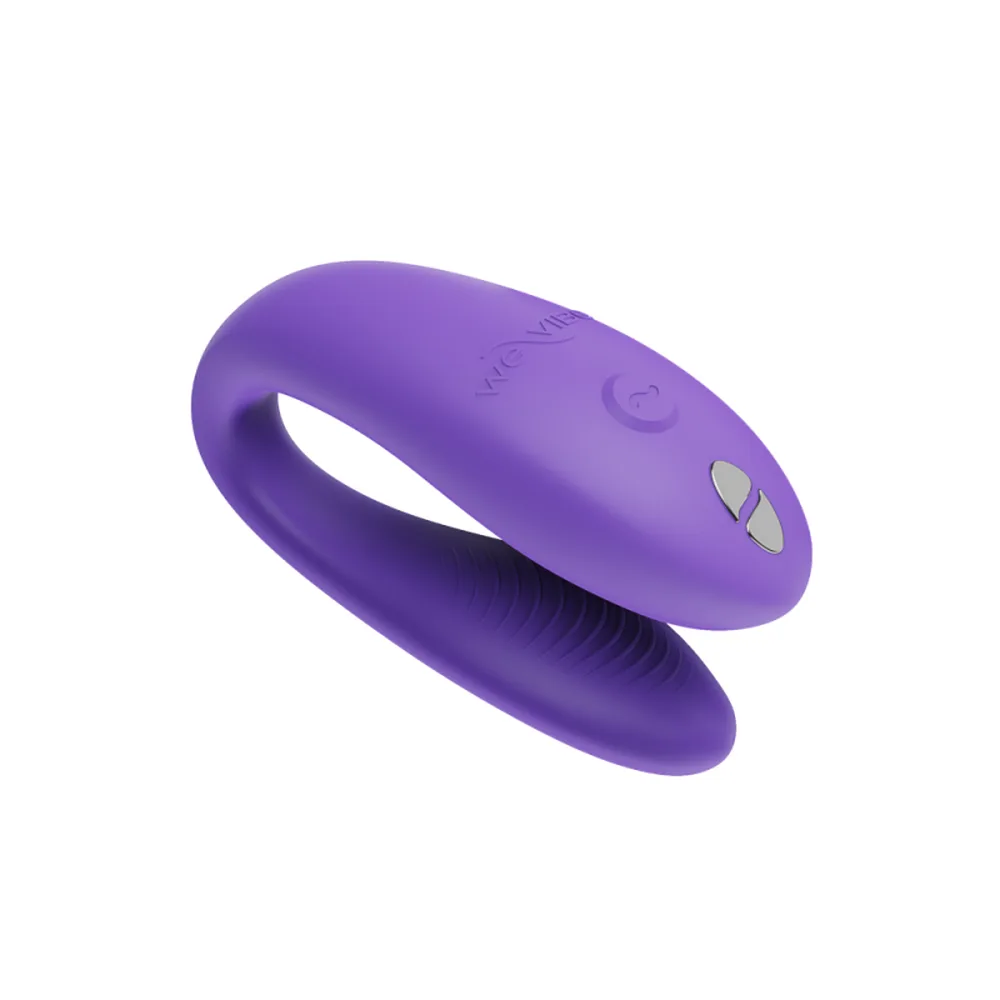
We-Vibe Sync Go is the smallest and cheapest of We-Vibe’s C-shaped couple vibrators. The manufacturer describes it as a travel-friendly couple vibrator, and has built the entire product around that positioning: it’s shorter than the sibling models, it’s delivered in a hard travel case instead of a fabric pouch, and it has a single control on the product itself. Everything else is handled from the We-Vibe app.
The specification looks like this. The dimensions are 77.4 × 29.7 × 45.2 millimeters according to the manufacturer’s own dimension sketch. The entire product is covered in body-friendly silicone, which, according to We-Vibe, is phthalate- and BPA-free and manufactured without latex. The enclosure rating is IPX7. The battery is a rechargeable lithium-ion polymer battery that provides 90 minutes of operating time and charges in 90 minutes. The warranty is two years. In Sweden, the item is sold by eight stores at prices between 846 and 1,499 SEK, and six of them had it in stock at the price check.
This overview is exclusively about the purple variant with EAN 4251460619769, the manufacturer’s article number SNSY5SG4. We-Vibe sells Sync Go in two colors — Light Purple and Turquoise — and the turquoise one has its own number, SNSY5SG8 with EAN 4251460619776. Functionally, they are identical, but several Swedish stores list the colors on the same product page, so check the number before comparing prices.
The C-shape is We-Vibe’s signature design and has been in the brand’s range since the brand started. The principle is simple: the product is a bent silicone body with two arms. The narrower, ribbed arm is inserted into the sleeve and sits against the G-spot area, while the wider outer arm lies on the outside against the clitoris. The opening between the arms allows the product to stay in place during intercourse, and both partners feel the vibrations through the material. The manufacturer’s manual describes use exactly like this: apply a little water-based lubricant, insert the G-spot stimulator, and let the outer clitoral part rest against the clitoris.
The difference vs a regular vibrator is that the product isn’t held in the hand during use. That places different requirements on it than for a handheld model. The shape must be able to stay in place on its own, the material must be able to be squeezed between two bodies without permanently deforming, and the controls must be manageable without anyone needing to look at the product—hence the app and a single button. That’s also why the measurements matter more in this category than in most others: a C-shape that’s too large or too stiff simply won’t stay in place.
What can be said specifically about the Sync Go is that it’s made short. With a total length of 77.4 millimeters, it’s shorter than both We-Vibe Chorus, which the manufacturer lists as 78 millimeters in length and 44 millimeters in height, and Lelo Tiani 3, which is listed as 78 × 44.5 × 32 millimeters. The differences are small in absolute terms, but in this product category everything is measured in millimeters, and the outer arm width of 29.7 millimeters is the measurement that determines how wide the product sits against the clitoris.
We-Vibe has three C-shaped pair vibrators in its range at the same time, and they’re regularly mixed up in Swedish shop texts. The differences are real and can be read directly from the manufacturer’s own specifications.
The most important difference isn’t the number of modes but what’s included in the box. Sync Go is the only one of the three that comes with a hard travel pouch, and the only one that completely lacks a physical remote control. Chorus has a remote control but not full silicone. Sync 2 has a longer runtime and an adjustable fit but comes with a fabric bag. So which one is right depends less on performance and more on whether you want to be able to pack the product away protected, whether you want to be able to control it without a phone, or whether you want the longest runtime.
Material is the only property of an intimate product that can’t be compensated for with experience or care, and in this category it matters more than anywhere else — by definition, a sex toy is used by more than one person. We-Vibe states a single material for Sync Go: body-friendly silicone, free from phthalates and BPA, and made without latex. This applies to the entire product, not just the contact surface.
Silicone is a non-porous material. A non-porous surface can be cleaned, because there are no microscopic cavities where residue can get trapped. This is the single most important property of a material that should sit against mucous membranes, and the reason why the material declaration weighs more than almost every other line in a specification.
Having the whole body covered in silicone has two consequences here. The first is hygienic: there is no seam between a silicone part and a plastic part where dirt can collect. Compare this with We-Vibe Chorus, where the manufacturer lists ABS and body-friendly silicone as materials — there is a material transition there, and it’s exactly in such joints that cleaning usually fails. Lelo Tiani 3 is specified in the same way as silicone and ABS plastic. Sync Go therefore has the simpler construction of the three to keep clean, and in a sex toy that’s an argument of weight rather than a minor detail.
The second consequence is mechanical. An all-silicone body without a hard-plastic section bends evenly, and flexibility is a prerequisite for a C-shape to stay in place against two bodies that move. The manufacturer’s manual names five parts on the product: the We-Vibe button, the magnetic charging pins, the outer stimulator, the inner stimulator, and the travel pouch. That’s the whole product — there are no removable parts, no screws, and no cover. The downside of this construction is that nothing can be replaced if something breaks; the advantage is that there is no gap where water or residue can end up staying.
Phthalates are a group of plasticizers used to make plastic — especially soft PVC — flexible. Kemikalieinspektionen describes them as substances that can affect the hormone system and make reproduction more difficult, and several of them are therefore restricted or prohibited within the EU in a large number of products. This product category is subject to recurring supervision precisely because it contains soft plastic against the skin and mucous membranes.
We-Vibe explicitly states that the silicone in Sync Go is free from phthalates and BPA and manufactured without latex. This is a clear, unambiguous declaration, unlike labels such as “TPE” or “jelly rubber,” which say absolutely nothing about which phthalate plasticizers are included. Silicone doesn’t require phthalate plasticizers to become soft—the softness comes from the polymer’s own structure—and therefore listing silicone as the material is, in itself, better information than almost any other entry in a product specification.
The latex information is relevant for anyone who is allergic to latex. Latex allergy causes reactions on mucous membranes faster than on ordinary skin, and a product that sits inside the vagina for a longer period of time is precisely the use case where that information matters. The fact that the manufacturer spells it out, instead of settling for “body-friendly material,” is a plus.
The manufacturer states the length as 77.4 millimeters, the width as 29.7 millimeters, and the height as 45.2 millimeters. The same three figures are also shown in We-Vibe’s own dimension sketch on the product page, which is unusually clear for the category. The measurements place Sync Go among the smaller C-forms: the Lelo Tiani 3 is listed as 78 × 44.5 × 32 millimeters, and the We-Vibe Chorus as 78 millimeters in length, 33 millimeters in width, and 44 millimeters in height.
However, one value is missing, and it’s worth saying plainly. We-Vibe does not publish any weight for Sync Go, either on the product page or in the online manual. It’s a striking omission in a product category where weight determines whether the product stays in place. By way of comparison, Lelo lists 42 grams for the Tiani 3. If you want to know what Sync Go weighs, the information isn’t available from the manufacturer, and numbers that circulate in store text can’t be traced back to We-Vibe.
One more thing about the shape. We-Vibe lists the feature “adjustable fit” for Sync 2 but not for Sync Go, whose feature list instead consists of a travel case, IPX7, USB charging, an ergonomic shape, and app control. What the manufacturer means by that difference isn’t specified in the specification, but it exists in their own materials—and it’s worth knowing if you’re choosing between the models with fit as the main question.
The travel case deserves its own line, because it’s the very reason the model exists. The manufacturer describes it as a durable and discreet case that protects the product while traveling, and you can see it clearly in We-Vibe’s own picture of what’s included in the packaging: a hard shell in dark plastic with a ridged pattern. It’s the only one of We-Vibe’s three C-forms that gets a hard case instead of a bag—and unlike most marketing claims, it’s a difference you can check when the cardboard box is sitting on the kitchen table.
The interface on Sync Go is the simplest imaginable. The manufacturer’s manual names a single control on the product — the We-Vibe button — and describes it in two sentences: press the button to turn Sync Go on, press again to step between ten different pattern modes. That’s the entire onboard control.
Having a single button is both the model’s greatest strength and its clearest limitation. The strength is that you don’t need to look at the product, which is the whole point when it sits between two bodies. The limitation is that a single button can’t do two things at once: what We-Vibe calls intensity is controlled in the app, with a slider-bubble that moves up and down. If you want finely adjustable strength without having a phone in your hand, this isn’t the model you should buy — because both Sync 2, which the manufacturer specifies has ten intensity levels, and Chorus, which has a separate remote control measuring 37 × 96 millimeters, are better suited.
Without the app, you get power on, off, and stepping between modes. The manufacturer’s product page names nine vibration patterns: Low, Pulse, Wave, Cha-Cha, Tease, Tempo, Ramp, Heartbeat and Step. The manual also states that the button steps between ten pattern modes. The two numbers don’t match, and the difference is explained in the manufacturer’s own material. We-Vibe doesn’t specify which number is correct. The practical answer is that you get a handful of clearly different patterns and that the exact number won’t be what determines your purchase — but it’s worth knowing if you compare figure for figure between models.
The manual also describes how the product acknowledges. During pairing, it vibrates twice when it enters pairing mode and three times when the connection is complete, and the LED blinks during that time. That kind of haptic feedback isn’t cosmetic in this product category — it’s the only way to know what’s happening when the button is under the cover.
The app is where the difference between Sync Go and a simple couple vibrator actually arises. We-Vibe describes four main functions on its own app page. Single Vibe controls the intensity with a bubble that you pull up and down and provides twelve vibration pattern options to choose from, in addition to the ability to create your own. Multi Vibe applies to products with more than one motor. Touch Mode controls the product with your finger on the screen — the faster you move, the higher the intensity, and when your finger stops, the product stops. Playlist Mode lets you chain together patterns in your own order with the selected intensity and length.
Long-distance mode is the feature that sells the model. Both parties install the app: one phone keeps the Bluetooth connection with the product, and the other gets control via an invitation in the app. We-Vibe states that the app also has chat and video calling, so feedback happens in the same interface. The combination with the travel case is clearly intentional: this is a product meant for couples who, at times, aren’t in the same room.
Two things should be considered before the app is counted as a pure plus function. The first is that the manufacturer states that Sync Go can only be paired with one app-connected device at a time—if another phone takes over, the product has to be re-paired. The second is fundamental: a product whose full functionality requires an app depends on the app being kept around, working on upcoming operating system versions, and on the manufacturer being willing and able to maintain it. The basic function with the button continues to work regardless, but what you’re paying a premium for is the app.
Here, We-Vibe is unusually specific, and the information is in the manual rather than on the product page. Pairing is done by holding the button down until the product vibrates twice and the LED starts blinking; a long press of five seconds instead resets the product. We-Vibe’s app page also describes a simpler alternative: scan the barcode on the packaging with the app, and it will recognize the product right away. So, keep the box until pairing is done.
The manufacturer states a range of up to 30 ft with line of sight—just under nine meters—and about 20 ft, a little over six meters, in 360 degrees around the product. That figure determines whether the “same room” mode works from the sofa to the bedroom, and it’s rare to find it printed out. The radio section operates in the 2402–2480 MHz band with a maximum output power of −0.81 dBm, meaning the usual low-power Bluetooth band. The model number is SCA2A.
The question of how much a couple vibrator can be heard is reasonable, and the answer has to be honest: We-Vibe publishes no measured decibel value for Sync Go, either on the product page or in the online manual. The product page’s feature list doesn’t even mention sound, unlike the Sync 2 page, where “whisper quiet” is listed as a point without any measurement.
That means that every decibel figure you see for Sync Go comes from someone other than the manufacturer. For comparison, Lelo states a maximum sound level of 50 dB and a frequency of 125 Hz for Tiani 3—that’s about as concrete as it gets in this category, and it says something about how few manufacturers disclose measurement values at all.
What can, however, be established is the design premise. Sync Go is worn against and partly inside the body, which dampens the sound compared with a handheld product that sits freely in the air. A practical tip that applies regardless of the model: never place the product on a hard tabletop while it’s running. The tabletop functions as a resonance box and noticeably amplifies the sound.
We-Vibe Sync Go is rated IPX7. The rating comes from the international standard IEC 60529, which defines enclosure classes for electrical equipment. The number 7 in the second position means that the product is tested for submersion in water to a depth of one meter for 30 minutes. The manufacturer states the consequence plainly: Sync Go is completely waterproof and can be used in a bathtub or in the shower, and it’s easy to clean.
The difference compared with a splash-proof product is greater than the wording suggests. Splash protection covers water droplets and, at best, water jets, but not submersion. Such a product can handle a damp cloth and possibly a shower, but not a bathtub, and it should not be held under running water without thinking through the button and charging contact.
With IPX7, the entire product can be rinsed off without being careful. It’s a genuine advantage in an adult toy, because cleaning between uses is the whole basis for two people to be able to share a product. If a product has no IPX rating at all, it should be treated as not waterproof—an absence of a rating is never a sign that the product would be approved.
One thing that IPX7 does not cover is heat. The manufacturer writes in the manual that the product and its battery must not be exposed to temperatures above 45 degrees. Boiling and the dishwasher are therefore out of the question, even though the product can withstand submersion—and that also applies if you’re in the habit of boiling other silicone products. Sync Go contains electronics and a permanently affixed battery.
The manual’s instructions are short and clear: rinse the product in warm water with a cleaning agent intended for intimate products and dry it with a lint-free cloth. Do it before and after every use—the manufacturer’s safety section expressly says both, and that’s a sensible order for a product that has been in its case since last time.
The lubrication question is easy to answer, but also easy to get wrong. We-Vibe recommends water-based lubricant and explicitly advises against fragranced and alcohol-based lubricants, gels, and massage oils. Silicone-based lubricant should not be used on silicone products—it breaks down the silicone surface over time and makes it porous, and a porous surface can no longer be cleaned properly; it only needs to be replaced. Oil-based products such as coconut oil leave a film that is difficult to remove, and that doesn’t belong here either.
The manual also covers two things that rarely appear in store texts. The product contains magnets—the charging prongs are magnetic—which means it should not be used directly over a pacemaker, and cards with a magnetic stripe should be kept away from it. And Sync Go is explicitly not designed for anal use. This isn’t a formality: the product has no lock and has no part that prevents it from sliding too far inside.
Storage is the only point where this model has an advantage over the entire range. The travel case is hard, which means the product can lie in a bag without the button being pressed in by something else, and it doesn’t collect dust and textile fibers the way a silicone surface in a fabric bag does. The manufacturer also recommends dry storage without direct sunlight.
We-Vibe states the operating time as 90 minutes and the charging time as 90 minutes. It’s a symmetrical and easy-to-remember specification, but it’s also the model’s weakest point in the comparison. We-Vibe Sync 2 is listed for up to 120 minutes of operating time, and Lelo Tiani 3 for two hours. Sync Go therefore has the shortest operating time of the compared models—which is the expected consequence of it also being the smallest of them.
Ninety minutes is plenty for an occasion. It’s on the go that the time limit is noticeable, and that’s exactly where it’s worth considering: a full charge takes as long as it lasts, so a product that’s empty when you pack it isn’t ready until one and a half hours later.
Charging happens via magnetic charging prongs on the product’s top side. The manual names them explicitly, and they are shown as two metal points next to the button in the manufacturer’s product images. The cable is connected to any USB port or a standard USB power adapter, which, according to the manufacturer, is not included in the package.
Magnetic charging is a trade-off, not a pure advantage. The advantage is that you don’t need any opening in the housing, which makes it easier to achieve IPX7 without a rubber plug. The downside is that the cable is product-specific: if you misplace the charging cable, no standard USB-C cable will work, so you have to get a replacement from the manufacturer. The manual also emphasizes that only the included original cable should be used. We-Vibe’s warranty terms explicitly exclude consumables such as batteries and charging cables, so a broken cable is always your own cost. And because the cable comes along in the context of the travel pouch, it’s also easier to forget it in a hotel room than a cable that you leave in your home cable drawer.
The charging indicator is described in the manual and is easy to read: a quickly blinking light means the product is charging, a steady light means fully charged, and a light that’s off means either the product has run out of power or the charger isn’t seated correctly on the product. The last line isn’t a detail—magnetic contacts that are sitting at an angle look like they’re seated correctly.
We-Vibe doesn’t publish battery capacity in mAh for Sync Go. What the manufacturer does state, though, in the manual’s section on electrical ratings, is voltage and current: the built-in lithium-ion battery is labeled 3.7 volts and 0.24 ampere, and charging via USB takes place at 5 volts and 0.5 ampere. That’s more information than most manufacturers provide, but it isn’t the same thing as capacity, and that’s why it’s not possible to calculate run time into power consumption or compare how heavily the cell is burdened between models.
The difference versus a competitor that provides it is immediately visible. Lelo lists 3.7 volts and 70 mAh for the Tiani 3, a charging time of two hours at 5.0 volts and 70 milliamperes, and 90 days of standby time. You can work that out. With We-Vibe, you can’t—and it’s a reasonable objection to a specification that is otherwise unusually complete.
What generally applies to lithium-ion batteries also applies here. Capacity decreases with the number of charge cycles, the battery is not user-replaceable according to the manual, and the product does best when it’s charged regularly instead of being stored fully discharged—the manufacturer itself writes that it should be charged regularly even when it isn’t used. With use a couple of times a month, it’s the battery, not the silicone, that sets the limit for lifespan, and because the cell is fixed in place, the product is practically used up when the battery is.
We do not have price data from shops in your market yet.
One single button is the whole point when the product sits between two bodies — and the whole limitation when you want to change the intensity without picking up your phone.
Three comparisons are relevant: versus We-Vibe’s own full-size C-form, versus the model with a physical remote control, and versus the other premium brand in the category. All of the information below comes from each manufacturer’s own specifications, and all prices come from the stores’ product feeds on July 29, 2026.
We-Vibe Sync 2 costs from 1,295 SEK, i.e. 449 SEK more than Sync Go at its cheapest. For that difference, according to the manufacturer’s specifications, you get up to 120 minutes of runtime instead of 90, ten intensity levels on the product, and the adjustable fit feature, which We-Vibe does not list for Sync Go. Charging time is stated as up to 90 minutes, i.e. the same. Both are silicone throughout without phthalates, BPA, or latex, both are IPX7, both have a two-year warranty, and both are controlled by the same app.
What Sync Go adds is the size and the case. Sync 2 is listed as 41.7 × 74.8 millimeters and comes with a fabric pouch and a 2 ml sample of lube, while Sync Go comes in a hard travel case. If you want a product that stays at home in the nightstand drawer, Sync 2 is the more reasonable of the two—longer runtime and more controls on the product itself are clear advantages when the phone is still within reach. If you want one that comes along in your bag, the order is reversed.
One thing not to misunderstand: the difference between the models isn’t that one has an app and the other doesn’t. Both are controlled with the We-Vibe app, with the same twelve patterns in Single Vibe and the same long-distance mode. The difference is how much you can do without the app.
We-Vibe Chorus costs from 1,495 SEK, i.e. 649 SEK more than Sync Go. The decisive difference is that Chorus comes with a physical remote control that the manufacturer specifies as 37 × 96 millimeters. It solves exactly the problem that Sync Go leaves unsolved: controlling the intensity without anyone having to pick up the phone.
However, the price tag has a real downside. Chorus is specified by the manufacturer as ABS and body-friendly silicone, i.e. not all-silicone like Sync Go. Runtime is the same, 90 minutes, but charging time is longer—120 minutes versus Sync Go’s 90. The dimensions are 78 millimeters in length, 33 millimeters in width, and 44 millimeters in height, so it’s only marginally wider than Sync Go and practically the same length.
The conclusion is that Chorus is bought for the remote control and nothing else. If you pay 649 SEK extra, you get a control that works without a phone, but you pay with a material change that makes the product somewhat harder to clean and with a charging time that’s twice as long. It’s a reasonable trade-off for someone who knows that the phone is the wrong tool in that particular situation, and a bad trade-off for everyone else.
Lelo Tiani 3 costs from 1,179 SEK, i.e. 333 SEK more than Sync Go. The dimensions are close: 78 × 44.5 × 32 millimeters versus Sync Go’s 77.4 × 29.7 × 45.2. The insert part is specified as 78.2 millimeters and the weight as 42 grams.
The real difference is how much the manufacturers report. Lelo publishes battery capacity (3.7 volts and 70 mAh), charging current (5.0 volts and 70 milliampere), operating time (two hours), standby time (90 days), maximum sound level (50 dB), vibration frequency (125 Hz), and weight (42 grams). We-Vibe publishes neither weight, mAh capacity, nor sound level for Sync Go. Lelo also states that the company follows ISO 3533, the international standard for safety requirements for sex toys, and provides a two-year warranty plus a ten-year quality warranty, compared with We-Vibe’s two-year warranty.
On the other hand, according to the manufacturer, Tiani 3 is silicone and ABS plastic, so it is not full silicone, and it comes with a wireless remote control powered by two AAA batteries — an accessory that can run out at the wrong time. If you compare based on reported specifications and warranty length, Lelo clearly wins. If you compare based on the materials, price, and the ability to pack the product away in a hard case, Sync Go wins.
Eight Swedish shops sell the item with EAN 4251460619769. The cheapest is Joyland at 846 SEK, and the most expensive is Vuxenkul at 1,499 SEK. That’s a difference of 653 SEK, or 77 percent, for the exact same item number, the same color, and the same packaging.
The inventory situation softens the picture. Six of eight shops had the product in stock at the price check, and the two that lacked stock were Sexonic at 976 SEK and just Vuxenkul at 1,499 SEK. If you only count what can actually be purchased, prices range from 846 SEK at Joyland to 1,099 SEK at Lustly — 253 SEK, or 30 percent spread, which still provides plenty of reason to compare before you pay. The next-cheapest shop with stock is Vuxen at 899 SEK, so only 53 SEK above the cheapest.
The price spread is not because any shop sells a different variant. All eight list the item either under EAN 4251460619769 or under their own item number, which is linked specifically to that lilac Sync Go. This means it comes down to the shops’ own margin setting. For comparison, We-Vibe’s own European web shop charges 109 euro for the same model.
The prices in the table above are updated when the shops’ product feeds are updated, but always check the final price at the checkout. Shipping cost is added by most shops below a certain order value, and in this price range, several shops are right around the threshold for free shipping — which can eat up some of the 253 SEK difference between the cheapest and the most expensive available shop.
It’s made for couples who want to take a C-shaped couples’ vibrator with them. The travel case, the 77.4-millimeter size, and the fact that the entire product is silicone with no seams all point in the same direction: this is the model that’s built to lie in a toiletry bag and withstand being packed. It also fits the person who wants to get into the We-Vibes ecosystem as cheaply as possible—846 SEK is 449 SEK under Sync 2 and 649 SEK under Chorus.
It’s especially well suited for couples who, from time to time, don’t live in the same place. The long-distance mode in the app, the chat and video function, and the fact that the product can be controlled from anywhere else are the whole product idea—and that idea works the same way regardless of where the other phone is.
It doesn’t fit you if you want to be able to adjust the strength without using a phone. In that case, you should look at Chorus with its remote control or Sync 2 with its ten intensity levels on the product. It also doesn’t fit you if you want the longest possible runtime—the shortest among the compared options is 90 minutes. It doesn’t fit you if you require published weight, battery capacity, and measured sound level before buying, because We-Vibe publishes neither for this model. And it doesn’t fit you if you want to be able to charge with the same cable as your phone: the charging connector is magnetic and specific to the product, and the cable is excluded from the warranty.
One more thing belongs in the decision. Sync Go isn’t designed for anal use—the manufacturer states this plainly in the manual’s safety section—and it has absolutely no lock or wider base. It’s a real use case that’s ruled out, not a legal disclaimer.
We-Vibe offers a two-year voluntary manufacturer’s warranty on Sync Go. The terms state the warranty period as 24 months counted from the first delivery to the customer, but at the same time at most two years after the manufacturing date. The second half of that sentence is worth reading twice: a product that’s been sitting in a store shelf for a while may therefore have less remaining warranty than 24 months counted from your purchase day.
In an approved warranty claim, the manufacturer decides itself whether to replace the product with a new one of the same type or to refund the purchase price, and it covers the transport, travel, labor, and materials costs for a replacement. The fault must be reported in writing within two months from the time it was discovered or should have been discovered, and you need to be able to show proof of purchase. The serial number is, according to the manufacturer, located on the underside of the packaging above the larger barcode—yet another reason to save the box.
Read the exceptions before you count on the warranty. It does not cover minor faults that do not affect usability, wear parts such as seals, or consumables such as batteries and charging cables. It also does not apply in the event of normal wear and tear, intentional damage, incorrect commissioning, use for purposes other than the intended use, attempted repairs by yourself or a third party, or use of aggressive chemicals and cleaning agents. In practice, this means that the two parts that are most likely to stop working first—the battery and the charging cable—are both outside the warranty.
We-Vibes 100-day satisfaction guarantee is also worth a clarification, since it is often cited in store texts. According to the manufacturer, it applies only to purchases in We-Vibes own web shop, it provides a value voucher to shop for in the same shop rather than a cash refund, and it can be used for one item per order. So if you buy at any of the eight Swedish stores listed above, you are therefore not covered by it.
What always applies, on the other hand, are your statutory rights. Under the Consumer Sales Act (konsumentköplagen), you have the right to make a complaint for three years for faults with the product, regardless of what the manufacturer promises—so one year longer than We-Vibes own warranty. For distance purchases, you also have a right of withdrawal for fourteen days under the Act on Distance Contracts and Contracts Outside Business Premises. Be aware that in practice the right of withdrawal is limited for hygiene products that have been taken out of a sealed package—however, the right to complain in the event of a fault always applies. If you have questions about what applies in your case, Konsumentverket guides you via Hallå konsument.
We-Vibe Sync Go Purple is ranked på plats 3 av 15 in couples vibrator best i test, where the entire category is compared against each other using five shared criteria. Guiden vinns av We-Vibe Sync O Petrol Green.
Every numerical piece of information in the text can be traced to one of the sources below. The links were checked manually on the specified date.
This page is machine-translated from Swedish. Read the Swedish original