

Review
Review: Satisfyer Pro 2 Next Generation
Cheapest among the widely sold air-pressure products — from 219 SEK.
29 July 2026
Review · Clitoral stimulator · Air pressure technology
The air pressure product is designed to stay between two bodies, reviewed against the manufacturer’s own specifications and price data from nine Swedish stores. Twelve intensity levels, six suction patterns, IPX7 according to IEC 60529, app control via Bluetooth, and a two-year warranty — at a price where there is a 30 percent difference between the cheapest and the most expensive store.
The only air pressure product in this price range that is designed to stay between two bodies during intercourse, with silicone over the entire body, IPX7, twelve intensity levels, six suction patterns, and app control. What pulls down the rating is the two-year warranty, a magnetic charging cable instead of USB-C, and that the sister product Womanizer Premium 2 costs less with better specifications.
We-Vibe Melt 2 is a clitoral stimulator that uses air-pressure technology instead of classic vibration, and, unlike most in the category, is designed to fit between two bodies during intercourse. The manufacturer states twelve intensity levels and six suction patterns, with control via the We-Vibe app and an IPX7 rating. The body is fully molded in body-friendly silicone, the warranty is two years, and the item is currently sold by nine Swedish retailers at prices between 1,271 and 1,649 SEK.
This review applies exclusively to the purple variant with EAN 4251460632010. We-Vibe lists it internally as the item number SNEL2SG4, and in the manufacturer’s own technical documentation the product is called MLT20B. Melt 2 is also sold in a sage green variant with a different EAN, and the predecessor Melt—without the “2”—is still in the range with both the manufacturer and several Swedish retailers. Check the EAN number before placing an order; it is the only thing that reliably distinguishes the variants when stores use the same product image for all of them.
On the manufacturer’s European shop, Melt 2 costs 149 euros. It’s worth having that as a reference point when comparing Swedish shop prices, because it says something about where in the lineup We-Vibe themselves place the model: it sits in the middle of their own price range, not at the top.
We-Vibe calls the technology Pleasure Air and describes it as soft but firm waves of air pressure that draw in and massage the clitoris without touching it. The principle is the same across the entire product category: a diaphragm pump alternately builds up underpressure and overpressure in a sealed chamber that is placed over the clitoris, and the stimulation is delivered through pressure changes in the air inside the chamber. That’s why the manufacturer can describe the stimulation as touch-free.
The difference vs a regular vibrator is fundamental and not a matter of degree. A vibrator transfers mechanical motion from a motor through the material to the skin. An air-pressure product transfers changes in pressure through air. That explains two things that come up repeatedly in descriptions of the entire product category: that the sensation is described as suction-like rather than vibrating, and that it feels more concentrated, because the energy doesn’t spread throughout the entire product body.
In practice, this means that the fit matters more here than it does with a vibrator. The chamber has to seal reasonably tightly around the clitoris for the underpressure to build up. Melt 2 has a head in a fixed size with no replaceable tips. This is the single most important limitation of the model, and it sets it apart from Womanizer Premium 2—a product from the same group—that is delivered with two stimulation heads in different sizes. If the head doesn’t fit, there’s nothing to adjust.
Both models are sold in parallel and both are available in Swedish retail, which makes the confusion worth its own section. The manufacturer states twelve intensity levels for both, IPX7 for both, silicone without phthalates and BPA for both, and a two-year warranty for both. The runtime is the same: up to two hours. Charging time is stated as 90 minutes in both cases.
What actually comes with the “two” are three things. First, six suction patterns in addition to the twelve intensity levels — the older Melt has only the intensity levels. Second, Smart Silence, the function that makes the product start only upon skin contact. Third, a new and clearly larger body: We-Vibe lists 126 × 24 × 10 millimeters for Melt, while Melt 2, according to the manufacturer’s dimension sketch, is 138.3 millimeters long and 43.60 millimeters wide.
On the other hand, there’s a feature that the older model has and that the “two” isn’t marketed with: an extended standby mode via the app that lets Melt stay in standby for four hours before it goes to sleep. For someone who pauses often, it’s a real difference.
The price difference in Swedish retail is less than you might think. Melt costs from 1,101 SEK in the price basis this site follows, and Melt 2 from 1,271 SEK. 170 SEK for six suction patterns, Smart Silence, and a larger body is a reasonable deal if you want the patterns. If you don’t want them, the older model is still fully usable.
Material is the only property of an intimate product that can’t be compensated for with experience or care, and it determines whether the product is still hygienic after three years. Here, Melt 2 has a clear advantage over cheaper competitors.
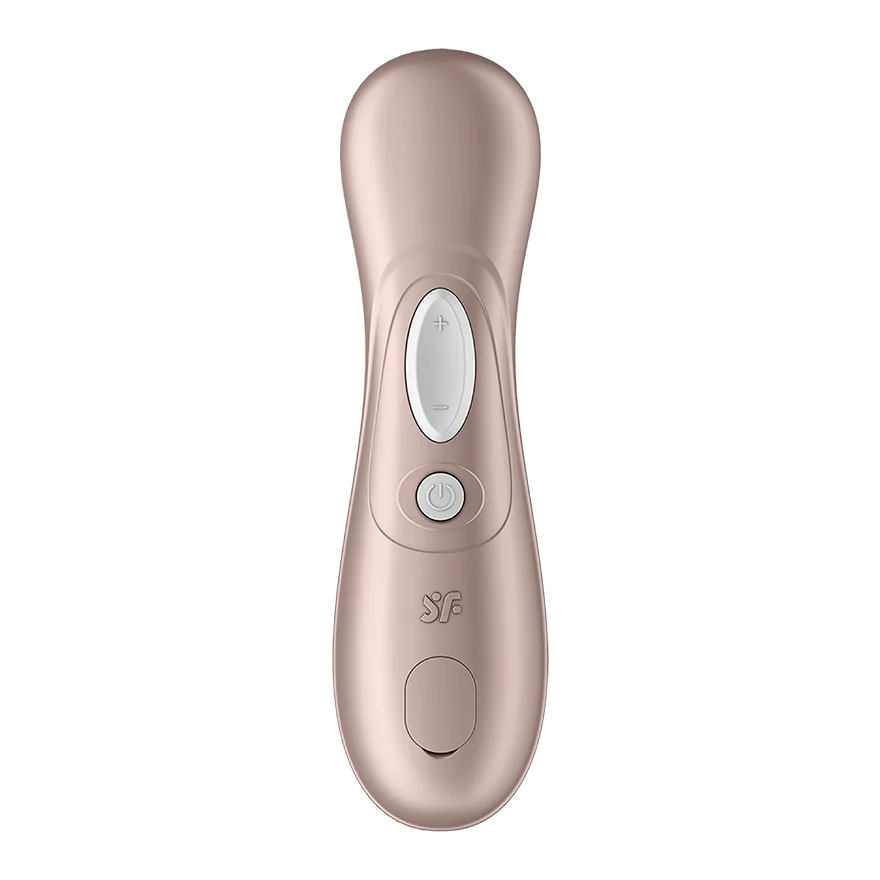
We-Vibe lists a single material for Melt 2: body-friendly silicone, made without phthalates, without BPA, and without latex. It’s not a split construction with silicone in the head and hard plastic in the shaft, which is the usual solution in the price range below the thousand-kronor mark. Satisfyer Pro 2 Next Generation, to take the most-sold example, lists silicone in the head and ABS plastic in the shaft and grip.
What that means in practice is two things. The entire surface that can come into contact with the body is non-porous and can be cleaned in the same way, without having to keep track of where the material changes character. And the grip becomes softer — which matters for this model in particular, because the whole point of the shape is that it should be able to rest between two bodies without chafing.
The downside of one-piece molded silicone is that the surface attracts dust and lint, and that it doesn’t tolerate silicone-based lubricants. The manufacturer’s own manual is explicit on that point: do not use silicone-based lubricants on silicone products, and avoid scented or alcohol-based gels and massage oils altogether.
Phthalates are a group of plasticizers used to make plastic — above all softened PVC — flexible. Kemikalieinspektionen describes them as substances that can affect the hormone system and make reproduction more difficult, and several of them are therefore restricted or banned within the EU in a large number of products. This product category is specifically a recurring subject of supervision, because it contains softened plastic that lies directly against the skin.
Silicone is a material that doesn’t require phthalate plasticizers to work. That’s the whole point of reading the material declaration instead of the specification list: a product that states "TPE" or "jellygummi" without further clarification says nothing about which plasticizers are included, while "silicone" is unambiguous. We-Vibe’s declaration for Melt 2 also explicitly mentions both BPA and latex, which is relevant for anyone with a latex allergy.
The manufacturer’s dimension sketch on the product page states the length as 138,3 millimeters and the width as 43,60 millimeters. Vuxen, one of the nine stores that sells the item, lists the total length as 13,8 centimeters, which matches the manufacturer’s information.
We-Vibe does not publish any weight, either on the product page or in the manual. It’s an annoying gap with this particular product, because the entire design idea is based on the fact that it should be able to stay in place between two bodies — and then the weight is one of the few figures that actually says something about how it behaves. As a point of reference, the sister company Womanizer lists 141,4 grams for Premium 2, a product in the same technology family but with a clearly larger body (155 × 50 × 35 millimeters).
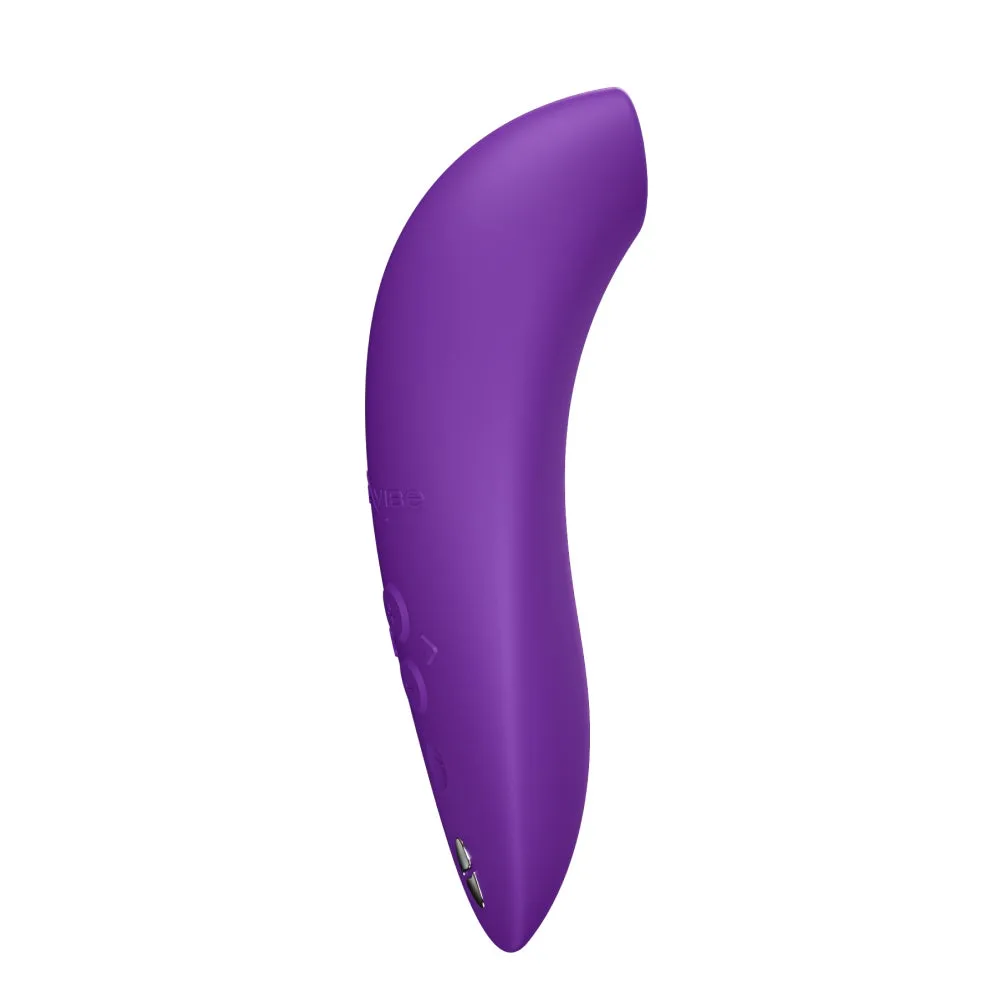
The shape is asymmetrical and curved, with the open Pleasure Air chamber at the narrow end and the buttons on the underside of the wider section. The angle between the head and the body is fixed and cannot be adjusted. That means you control the direction toward the body with your wrist or with your body position, not with the product.
We-Vibe lists twelve intensity levels and six suction patterns for Melt 2. The combination gives more modes than most people use, but the breakdown is, in principle, good: the intensity and the pattern are controlled separately, so you can increase the strength without losing the pattern you’ve chosen.
That’s also why the number of modes is a poor purchase criterion in itself. A model with twelve slightly different programs is worse than one with three distinct ones. What matters is the range between the weakest and strongest mode and how clearly the patterns differ — and there is no published number you can compare, either with We-Vibe or with the competitors.
The manufacturer’s manual describes five control buttons. The Plus button turns the product on and increases intensity step by step. The Minus button lowers it, and a long press turns it off. The arrow buttons move forward and back to step between suction patterns. The fifth button bears the We-Vibe logo and has two functions: a five-second press starts pairing with the app, and a short press switches Smart Silence.
Four directional buttons are more than on a typical air pressure product, where two buttons are the norm. It gives you more control, but it also means you need to know which button is which without looking, because the buttons are on the underside when the head is against your body. The symbols are molded into the silicone in the same color as the rest of the body, so they’re touchable but not visible in the dark.
The manual also describes a travel lock: hold plus and minus at the same time for two seconds, so Melt 2 pulses twice and locks itself. The same grip unlocks it. It’s a feature that’s easy to dismiss until the product turns on in a bag, and it’s missing on several significantly more expensive models.
Smart Silence is described by the manufacturer as the vibrations starting only upon skin contact. The construction is therefore not sound-dampening, but a sensor-controlled start: the product is silent as long as it isn’t lying against the skin, and it turns on when it is. The same function is also available on the Womanizer Premium 2, which is marketed by the same group.
It’s a genuinely useful function in the situation Melt 2 is built for—switching between two people and setting it aside temporarily—but it shouldn’t be confused with the product being quiet during use. When it works against the body, it makes noise.
It’s worth saying outright: We-Vibe does not publish any measured dB value for Melt 2, either on the product page or in the manual. Websites that provide exact decibel figures for the model either show their own measurement or a value without a source.
What can be established is that air pressure products that are classified overall as quieter than rotating eccentric motors, because the sound comes from a membrane pump instead of from an unbalanced weight, and that We-Vibe has chosen to highlight discretion specifically as a feature of the model through Smart Silence. Practical advice that applies regardless of the model: place the product on a soft surface between uses, because a hard tabletop works as a resonance box.
Melt 2 can be controlled from the We-Vibe app, both in the same room and remotely. The manufacturer highlights app control as one of the model’s main functions, and it is also what most clearly distinguishes the Melt series from the cheaper air-pressure products on the market, where app support is either completely missing or limited to newer variants.
The manual’s technical appendix states the radio band 2402–2480 MHz and a maximum output power of −0,83 dBm. We-Vibe’s own EU declaration of conformity for Melt 2, dated 30 December 2024, states the same radio band but a maximum output power of −6,69 dBm. Both pieces of information come from the manufacturer and cannot be reconciled; however, both are well below the limit values, and the difference has no practical significance for the user. It’s the usual Bluetooth low-energy bands and a very low transmitter power, which in practice means that the range in the same room is good but that walls and distance quickly affect it. Remote control over the internet works via the app and not directly via Bluetooth — the Bluetooth link always goes between the phone and the product.
Pairing is done with a five-second press of the We-Vibe button. That an app is required for the remote function also means that the function depends on the manufacturer continuing to maintain the app. It is a real risk with all app-controlled hardware, and something to factor in when the product costs over one thousand SEK.
Yes. According to the manufacturer, all twelve intensity levels can be reached with the plus and minus buttons directly on the product, and the patterns are stepped through using the arrow buttons. The app is an add-on for remote control and custom programs, not a prerequisite for the product to work. So someone who wants to avoid an account and a Bluetooth connection can use Melt 2 as a regular button-controlled product — but then you pay for a function you don’t use, and you should consider a cheaper model.
We-Vibe states IPX7 for Melt 2 on the product page’s own function graphic, with the addition that it can be used in a bath or shower. The rating comes from the international standard IEC 60529, which defines enclosure classes for electrical equipment. The number 7 in the second position means that the product has been tested for immersion in water to a depth of one meter for 30 minutes.
The difference compared with IPX6 is greater than what one step in the number suggests. IPX6 covers powerful water jets but not immersion. An IPX6 product can handle a shower but not a bathtub, and it shouldn’t be held under running water without thinking it through first — pay attention to the buttons and the charging contact.
With IPX7, the entire product can be rinsed off without any care, which is the single most important practical consequence of the rating. If a product completely lacks an IPX rating, it should be treated as not waterproof—the absence of a rating is never a sign that it would be approved. There is still one important limitation: the manual is clear that the charging cable and the charging connection must never be submerged in water, and that the product must not be used or cleaned while it is charging.
The manufacturer’s own guidance is brief: rinse Melt 2 in warm water and dry it with a lint-free cloth, preferably with a cleaning agent intended for this type of product. Make sure especially that the inside of the Pleasure Air chamber is dry, because that is the only part where water can be left standing.
Avoid alcohol-based hand sanitizer on the silicone surface, and avoid chlorine and acetone entirely. Use a water-based lubricant. Silicone-based lubricant breaks down silicone surfaces over time and makes them porous—once a surface is porous, it can no longer be cleaned properly; it only needs to be replaced. Oil-based products such as coconut oil leave a film that is difficult to remove.
Two limitations worth knowing. The Pleasure Air head on Melt 2 is not detachable, which means the chamber cannot be cleaned internally as thoroughly as on models with a removable top. And the manual states that the product must not be exposed to temperatures above 45 degrees—boiling it or putting it in a dishwasher is therefore out of the question, regardless that silicone as a material can handle more.
We-Vibe specifies a USB-rechargeable lithium-ion polymer battery and a runtime of up to 120 minutes. Two hours of runtime is plenty of time in this product class and more than most people need between charges.
The charging time, however, is a strange story. In the specifications tab on the manufacturer’s own product page, it says up to 90 minutes. On one of the functional images further down on the same page, it instead says that you get up to two hours of use from a 150-minute charge. The two pieces of information come from the same page from the same manufacturer and cannot be reconciled. If you plan the charging, go by the longer figure, and treat the shorter one as a best-case scenario.
With a magnetic cable, not with USB-C. The manual describes magnetic charging pins on the product, and the included cable has a magnetic end for Melt 2 and a standard USB-A connector for the power source. The manufacturer explicitly states that only the original cable should be used and that no power adapter is included.
It’s a real drawback compared with products that charge via USB-C. If you lose the cable, no regular phone cable works, and you have to order a replacement. The advantage is the other side of the same coin: without an open connection in the housing, it’s easier to design water resistance, which is linked to the IPX7 rating.
The electrical specifications in the manual are 3.7 volts and 0.42 amperes for the built-in lithium-ion battery, and 5 volts and 0.5 amperes when charging via USB. We-Vibe does not publish any battery capacity in milliampere-hours, which makes it impossible to convert runtime into power or to compare cells between models. That’s a task that Satisfyer, for example, publishes in its quick guides.
The manual states that the battery is not replaceable. So it’s the battery—rather than the silicone—that sets the limit for the product’s lifespan. The manufacturer’s own advice for extending it is to charge the product regularly even when it’s not in use, to store it dry and away from direct sunlight, and to never expose it to temperatures above 45 degrees.
Add that the charging cable and the product should be checked regularly for damage, and that the product should not be used if you see cracks or signs of deterioration in the surface material. The manual also mentions that the magnets in the charging solution can affect pacemakers and cards with a magnetic stripe—a detail that rarely appears in product descriptions, but that is included in the manufacturer’s own safety text.
We do not have price data from shops in your market yet.
Womanizer Premium 2 comes from the same group, costs 107 SEK less, and has fourteen intensity levels, double the runtime, and a five-year warranty.
Three comparisons are relevant: with the company’s own predecessor, with the sibling in the premium segment, and with the cheaper air-pressure products. All specifications below come from the respective manufacturers’ own product pages, and all prices come from the same price base as the store table above.
Melt costs from SEK 1,101 and is sold by seven stores. Melt 2 costs from SEK 1,271 and is sold by nine. The difference is SEK 170, i.e. a bit over fifteen percent.
For that amount, you get six suction patterns that the older model doesn’t have, Smart Silence, and a body that’s 138.3 millimeters long and 43.60 millimeters wide instead of 126 × 24 × 10 millimeters. Everything else is practically the same: twelve intensity levels, IPX7, silicone without phthalates and BPA, up to two hours of operation, an indicated charging time of 90 minutes, and a two-year warranty on both.
The conclusion is simple. If you want the patterns, the upgrade is cheap. If you want the smallest possible product that fits between two bodies, the older Melt is actually narrower—24 millimeters versus 43.60—and it also has the extended standby mode that the second one isn’t marketed with.
This is the awkward comparison, since Womanizer and We-Vibe are sold by the same parent company. Womanizer Premium 2 costs from 1,164 SEK on the same price basis—meaning it is 107 SEK less than Melt 2—and the specification is stronger in several areas: fourteen intensity levels versus twelve, 240 minutes of operating time versus 120, Autopilot 2.0 that automatically varies the intensity, the same Smart Silence function, two interchangeable stimulation heads in the package, and a five-year warranty versus Melt 2’s two.
Womanizer Premium 2 weighs 141.4 grams and measures 155 × 50 × 35 millimeters, so it is a clearly larger and heavier product. And that is exactly where Melt 2 has its argument: Premium 2 is designed to be held in the hand against the body, while Melt 2 is designed to stay in place between two bodies during intercourse. If you need that shape, there’s no shortcut. If you don’t need it, Premium 2 is the rational purchase, with longer operating time, a longer warranty, a choice of fit, and a lower price.
The category has a clear bottom. Womanizer Starlet 3 costs from 699 SEK on the same price basis, and Satisfyer Pro 2 Next Generation from 219 SEK. None of them has app control, none has Melt 2’s couple-friendly shape, and the Satisfyer model has silicone only in the head and ABS plastic in the rest of the body.
On the other end are Lelo Sona 3 Cruise from 1,513 SEK and Womanizer Next from 1,495 SEK. Melt 2 is therefore right in the middle of the upper tier of the category, and it should be assessed in that role: it isn’t the cheapest way into air-pressure technology, and it isn’t the most fully equipped product for the money. It is the only one among them that is built specifically to be used by two people at the same time.
Nine Swedish stores sell the item with EAN 4251460632010. The cheapest is Joyland at 1,271 SEK, and the most expensive is Mshop at 1,649 SEK. That is a difference of 378 SEK, or 30 percent, for exactly the same item in exactly the same packaging.
Seven of the nine stores had the product in stock at the price check. The price spread isn’t because any store sells a different variant—the EAN number is checked for all of them—but because stores price a model that has been in the range for a while. The difference corresponds to roughly a third of the product’s price, which makes price comparisons the single most profitable minute you can spend on this purchase.
The prices in the table above are updated when the stores’ product feeds are updated, but always check the final price at checkout. Shipping costs are added at most stores below a certain order value and can change the ranking between the stores that are close to each other in price.
It’s right for you if you want air-pressure stimulation that works during intercourse without either of you having to hold the product all the time, if you want to be able to hand over control to a partner via the app, and if you want silicone over your entire body instead of a split-material construction. The closure mechanism and IPX7 also make it a product that’s easy to take with you.
It’s not for you if you know you need a different head size than the standard—there Womanizer Premium 2 with its two stimulation heads is the right way to go, and it also costs less. It’s also not for you if you want USB-C and don’t want a separate charging cable, if you require a published weight and battery capacity before buying, or if you want the longest possible warranty in the category.
We-Vibe states a two-year warranty for Melt 2. The manufacturer’s warranty terms specify this as 24 months counted from the first delivery to the customer, however no more than two years after the time of manufacture, and the terms apply to purchases within the EU, Switzerland, Norway, and Iceland. The warranty covers material, manufacturing, and design defects—does not cover normal wear and tear, incorrect use, or damage caused by careless handling.
Two years is short in this category. Womanizer, the same group, offers five years on Premium 2. It’s hard to justify for the buyer that the sister company provides more than twice as long a warranty on a cheaper product, and that’s the clearest weakness in Melt 2’s offering.
However, the warranty is a voluntary commitment from the manufacturer and does not replace your statutory rights. Under konsumentköplagen (the Swedish Sale of Consumer Goods Act), you have three years of complaint rights for defects in the goods, regardless of what the manufacturer promises. For distance purchases, there is also a right of withdrawal for fourteen days under lagen om distansavtal och avtal utanför affärslokaler.
Be aware that, in practice, the right of withdrawal is limited for hygiene products that have been taken out of their sealed packaging. The right to make a complaint for defects, on the other hand, always applies. If you have questions about what applies in your case, Konsumentverket guides you via Hallå konsument.
We-Vibe Melt 2 is ranked på plats 9 av 32 in clitoral stimulator best i test, where the entire category is compared against each other using five shared criteria. Guiden vinns av Womanizer Premium 2 Red Gold.
Every numerical piece of information in the text can be traced to one of the sources below. The links were checked manually on the specified date.
This page is machine-translated from Swedish. Read the Swedish original