

Review
Review: Satisfyer Power Ring
Cheaper, smaller, and with a fifteen-year warranty — but without a remote control.
29 July 2026
Review · Penis ring · Couples vibrator with remote control
XOCOON’s couples model is reviewed against the manufacturer’s own dimension drawing, functional graphics, and user manual, as well as pricing data from six Swedish shops. Double loop at 4.5 and 3 centimeters, clitoris arm at 3.5 centimeters, IPX7 according to the manufacturer and up to 90 minutes of operating time — but the material, weight, battery capacity, and warranty time are never published, and that is the most important objection to the model.
A lot of product for the money: double loop, remote control, IPX7, and 90 minutes of continuous operating time for 336 SEK. The manufacturer’s dimension drawing is also unusually detailed. What you pay for is the documentation—XOCOON does not publish any material, weight, battery capacity, sound level, or warranty period. The charging connector is product-specific, and the charging time is longer than the operating time.
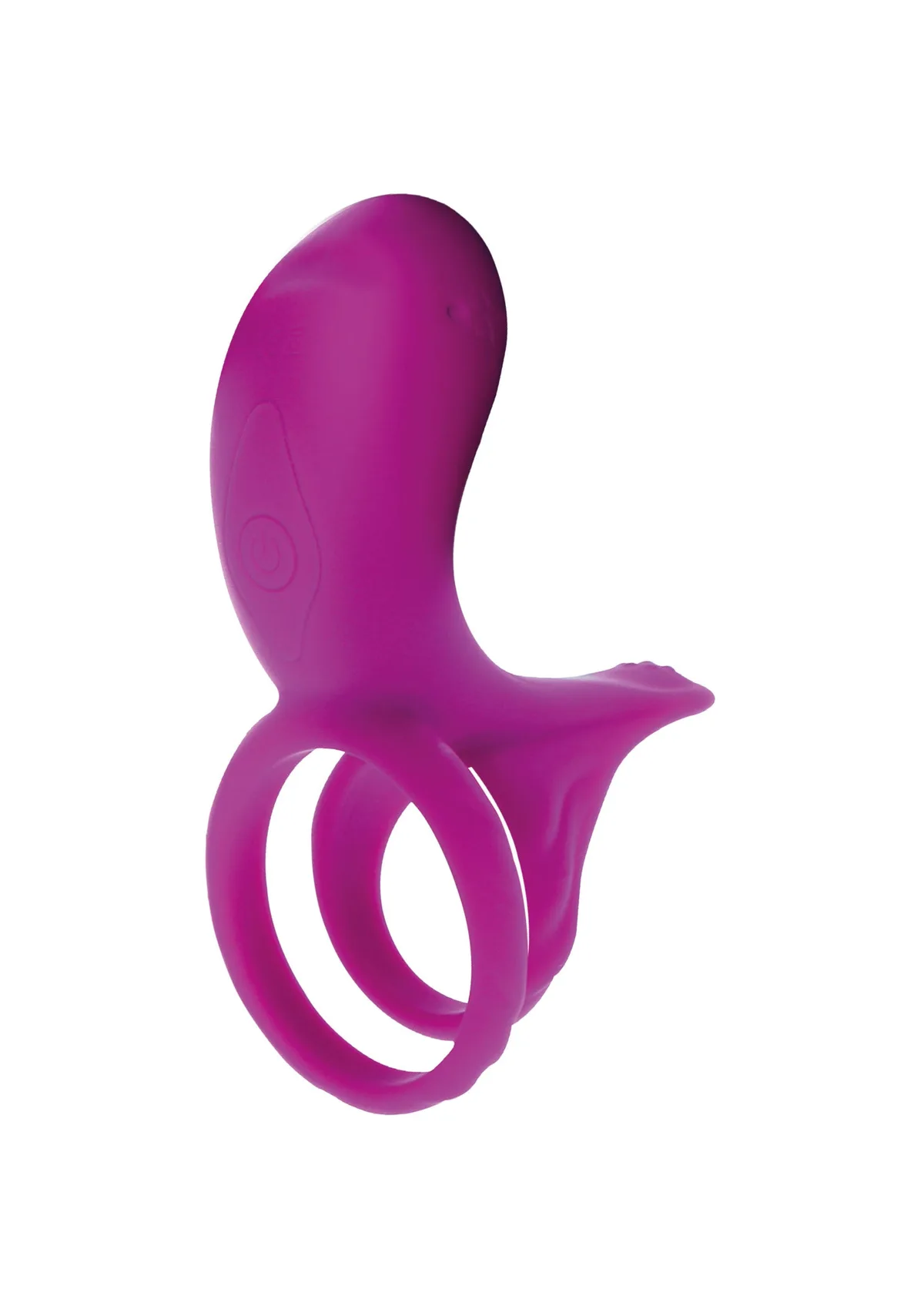
The XOCOON Couples Stimulator Ring is a vibrating penis ring with dual loops and a forward-facing arm that rests against the partner’s body during penetration. It is controlled both with a button on the ring itself and with a separate wireless remote control, and according to the manufacturer it is classified as IPX7. The model is from the Dutch brand XOCOON; the product number for this item is 11102, and the only color variant of the model is called Fuchsia.
The specification that can be verified looks like this: total height 10.5 centimeters, total width 7 centimeters, the width of the vibrator head 2.5 centimeters, the length of the clitoral arm 3.5 centimeters, the larger loop 4.5 centimeters, and the smaller 3 centimeters. The stores consistently list six vibration modes in three speeds, a charging time of 120 minutes, and up to 90 minutes of operating time. In Sweden, the item is sold by six shops at prices between 336 and 499 SEK, and four of them had it in stock at the price check.
This review is exclusively about the item with EAN 8713221828064, the manufacturer’s item number 11102_FUCHSIA. The number has been verified directly against the variant table in the manufacturer’s own product data, where that exact item number carries the barcode. It’s worth checking, because XOCOON sells a closely related model — Couples Vibrator Ring, EAN 8713221828071 — and at least one Swedish shop has mixed up the two in its product text.
What needs to be said plainly right here is that the manufacturer’s own documentation is unusually thin. XOCOON does not publish material, weight, battery capacity, operating time, or number of vibration modes in writing on the product page. Some of this information is instead found in the manufacturer’s own product images—the measurement drawing and the function graphic are actually detailed—but the rest comes from the shops, and shop-provided information doesn’t carry the same weight as a commitment from the person who makes the product. The review below consistently distinguishes between the two.
A cock ring works mechanically and requires no electronics at all for its basic function. The elastic loop sits around the base of the penis and slows the venous backflow, which, according to the manufacturer’s own description, makes the penis more sensitive, delays orgasm, and helps the erection last longer. It is the part of the product that works even with an empty battery.
The vibration is the other half, and it is aimed first and foremost at the other partner. The motor housing sits on top of the ring, and the 3.5-centimeter arm points forward from the loop, so that it lies between the bodies during penetration. XOCOON describes the effect as the stimulation ring providing more pleasure and sensation around the vulva and clitoris while penetration is ongoing. So it is a product designed to do two things at the same time for two people, which is also why it’s more complicated to assess than a regular vibrator: it has to fit two bodies at the same time.
What sets this model apart from most simple vibrating rings is the double loop. The manufacturer’s dimension drawing shows two separate loops with different sizes, 4.5 and 3 centimeters in height, respectively, and in the manufacturer’s product photos they are clearly visible as two distinct silicone bands that meet at the motor housing. Joyland describes the construction as a double ring for penis and scrotum. The manufacturer itself never states which loop is intended for what, and that is one of several things a reader would reasonably expect to find in a product description but doesn’t.
XOCOON sells two cock rings that are so close to each other in name that mix-ups are inevitable, and one of the Swedish shops has already made one.
The mix-up is concrete. Vuxenkul sells the item under the correct EAN — 8713221828064 — but the entire product text on the page is about Couples Vibrator Ring and describes its extended part in detail. If you buy it there, you’ll very likely get the right one, because the barcode determines it, but the product description you read before you click describes a different model. That is exactly the kind of error that makes it worthwhile to compare the EAN instead of the product name.
The dimensions are the part of the specification where XOCOON actually delivers. The manufacturer publishes a dimension drawing in the product gallery where six different measurements are shown, which is more than many of the much more expensive brands offer. The total height is stated as 10.5 centimeters and the total width as 7 centimeters. The vibrator head is 2.5 centimeters wide.
That also explains a contradiction that otherwise looks ominous in the retail trade. Blush Me and Joyland state the length as 10.5 centimeters. Vuxenkul states the length as 7 centimeters. Both are correct — they have simply taken different measurements from the same drawing. One store lists the height, the other the width. None of them states which measurement they are quoting, and that makes the figures unusable on their own. Only with the manufacturer’s drawing in front of you can you interpret them.
The drawing shows two separate loop measurements: 4.5 centimeters for the larger loop and 3 centimeters for the smaller one, measured in height in an unstretched position. These are important figures for a product of this type, because the fit determines whether it works at all, and they are also unusual to find published.
Two caveats belong here. First, the height measurement in the drawing is not the inner diameter or circumference — the silicone is stretchable, which Vuxen explicitly states in its specification table, and a loop with a height of 3 centimeters in an unstretched position therefore stretches significantly further when it’s on. Second, the manufacturer does not state an upper limit for how much the material can be stretched. SexleksakerOutlet says the product fits most sizes, but that’s store phrasing with no numbers behind it.
What can be established purely in practical terms is that a double loop sits more securely than a single. With two contact points instead of one, the motor housing doesn’t rotate as easily around the base of the penis, which in turn is the condition for the arm to stay where it’s supposed to. That’s also the reason double rings generally sit more uncomfortably for someone who isn’t used to them — the force is distributed across two points, and both have to fit.
The drawing states 3.5 centimeters for the forward-facing arm, i.e., the part that lies against your partner’s body. In the manufacturer’s product photos, you can see that the arm ends in a grooved section with a couple of transverse ridges, which is the most common design for increasing friction against the skin without increasing the vibration strength.
Here is a store listing that is directly misleading. Blush Me lists 3,50 centimeters under the heading “insertable length”. It is the same figure as the manufacturer’s arm length, and the arm is not an insertion part — it is an external stimulation arm. The manufacturer’s user manual also emphasizes that this type of product is designed so it cannot be inserted too deeply and that part of the product is always supposed to be outside the body. So read that line on Blush Me as the arm’s length, not as an insertion length.
Neither XOCOON nor any of the six Swedish stores publishes the product’s weight. The manufacturer’s own product data states the weight as zero grams, which only means that the field was never filled in. It’s a genuine gap: weight is the measure that determines how much a ring pulls downward when it sits on, and on a product with a motor housing on top of the loop it matters more than on a smooth ring.
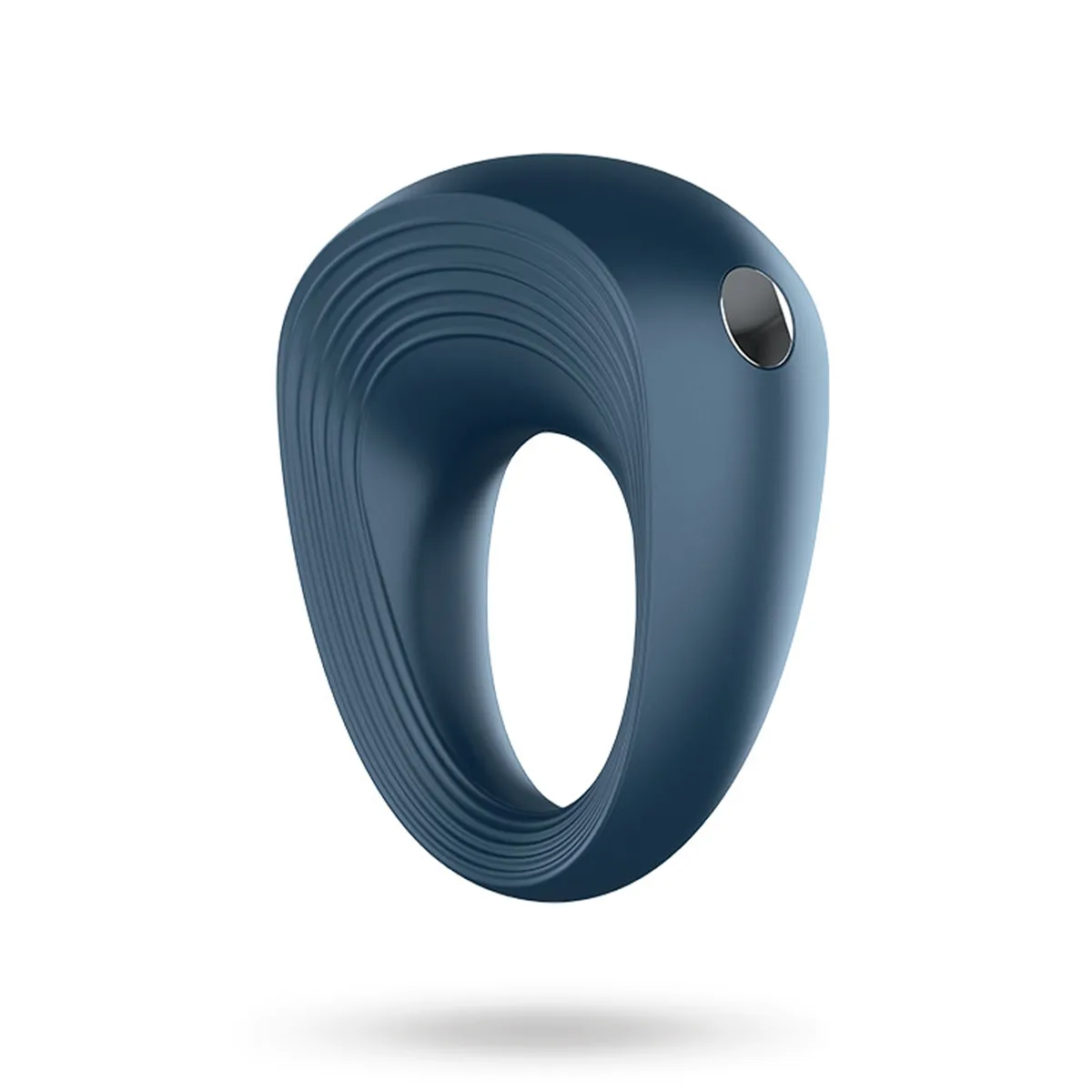
For comparison, Satisfyer lists 23,5 grams for its Power Ring, which is a significantly smaller product: 55,2 × 44,4 × 21,8 millimeters versus XOCOON’s 105 × 70 millimeters in height and width. That the XOCOON ring weighs more than that is unavoidable given the size, but how much more you can’t say without guessing, and that’s why it isn’t stated here.
The question of material is the single most important feature of a product that sits against mucous membranes, and it’s also the area where this product has its most serious documentation shortcoming. XOCOON provides no material at all for the Couples Stimulator Ring — neither on the product page, in the product data, nor in the user manual that applies to this product group. Instead, the manual refers to the packaging: anyone who is allergic to any of the materials used is asked to read what it says there. It’s an instruction that can only be followed after purchase.
The stores fill the gap, but not consistently. Joyland and Vuxen state silicone. Blush Me states high-quality silicone. Vuxenkul states ABS and silicone. The last piece of information is the interesting one, because it describes a two-part construction — hard plastic in the motor housing, silicone on the outside — which is by far the most common construction in this price range, and also what Satisfyer states for its Power Ring. There is nothing in the manufacturer’s materials that determines which of the store listings is correct.
Silicone is a non-porous material. A non-porous surface can be cleaned, because there are no microscopic cavities where residue can get left behind. That is the most important property of a material that is meant to sit against mucous membranes, and the reason why the material declaration weighs more heavily than almost any other line in a specification.
If Vuxenkuls’s claim about ABS and silicone is correct, that in itself is not a problem—if so, the ABS plastic sits inside the motor housing, under the silicone, and does not come into contact with the skin. What matters instead is the seam. On a product where a silicone cover meets a plastic housing, there is always a joint, and the joint is the place where dirt collects and where water can get in despite an IPX rating. In the manufacturer’s close-up images, there is no visible seam on the motor housing, but photos are not a material declaration.
Joyland also states two additional material properties: the surface is described as silk-smooth, and the hardness as medium. These are store details, and they don’t carry the same weight as a manufacturer’s commitment—but they are at least consistent with how the product looks in the manufacturer’s own photos.
Phthalates are a group of plasticizers used to make plastic, above all flexible PVC, pliable. The Swedish Chemicals Agency describes them as substances that can affect the endocrine system and make reproduction more difficult, and several of them are therefore restricted or banned within the EU in a large number of products. This product category is repeatedly subject to supervision precisely because it contains flexible plastic intended for use against the skin.
XOCOON makes no promises at all about phthalates, BPA, or latex for this model. Joyland states “Phthalate-free: yes” in its attribute table, but that is a store claim. The difference compared to, for example, We-Vibe, is striking: We-Vibe writes for the Pivot 2 that the material is body-friendly silicone free from phthalates and BPA and made without latex, and it is the manufacturer itself that stands behind the wording.
Purely chemically speaking, silicone does not require phthalate plasticizers to become soft—the softness comes from the polymer’s own structure. If the material really is silicone, then the risk is therefore small. But the fact that the conclusion must be drawn by the reader instead of being stated in the manufacturer’s documentation is itself a point worth noting, and someone with a latex allergy has nothing to go on here.
Five of the six Swedish stores use the same wording: with the included wireless remote control, you switch between six different vibration modes and three speeds, and the vibrations can also be adjusted directly via the button on the toy. The text is word-for-word identical at Blush Me, SexleksakerOutlet, Vuxen, and Joyland, which suggests that it comes from a shared distributor description rather than four independent sources.
The manufacturer itself states no number of vibration modes in writing anywhere. The product page only mentions that the ring has a built-in vibrator. It’s a strange gap in a product whose main selling point is precisely its range of functions, and it means that the number of modes remains a store claim no matter how consistent it is.
Here, however, there is manufacturer data, and it is unusually concrete. XOCOON publishes a functional graphic with the heading “How to use” in the product gallery, and it states the control logic step by step. On the ring itself, there is a single button marked with a power symbol: hold it for three seconds to turn it on or off, click once to step to the next vibration pattern, and hold it for three seconds to enter standby mode.
A one-button control on a product intended to be worn on the body is a trade-off. The advantage is that it can be found blindly—there is only one thing to press. The downside is that the stepping is one-way: if you want to go back a step, you have to go all the way around the entire list. It is the same logic that Satisfyer uses on the Power Ring, where ten programs are stepped through with a single button, and it works specifically because the program list is short.
The remote control is shown in the manufacturer’s functional graphic as a teardrop-shaped, black device with two buttons. The upper one is a power button that is held for three seconds to turn it on or off; the lower one is a function button that you click to switch modes. This matches the information from Vuxenkul’s store listing that the control options are buttons and a wireless remote control.
The point of having a remote control on this particular product is not discretion over distance, but that the person wearing the ring doesn’t have to look for a button that is wedged between two parts of the body. It is a practical argument that carries more weight here than with most other product types.
Two questions, though, get no answer. The manufacturer does not publish the remote control’s range, its radio technology, or what battery it is powered by, and none of the stores state that either. The remote control is not shown in the manufacturer’s water-resistance image, and there is no information about it being waterproof—assume that it isn’t, and keep it out of the shower even if the ring can be rinsed.
The way the calculations are done deserves its own discussion, because the stores count differently. The body text from all the stores states six vibration settings and three speeds, which reasonably means six patterns that each can be run at three settings—that is, eighteen combinations. Joyland’s own feature chart says the same thing: six different steps and three different speeds.
But Joyland’s bullet list at the top of the same page says “9 exciting vibration modes”, which doesn’t match six, three, or eighteen. It is a contradiction within one and the same store page, and since the manufacturer publishes no number at all, it cannot be resolved against an authoritative source. Count on six patterns at three strengths, but treat exact mode counts in the marketing as uncertain.
To put it into perspective: Satisfyer states that the Power Ring has ten pure vibration programs, with no separate intensity control. Six patterns times three speeds gives more combinations on paper, but it says nothing about how different they actually feel—and in this product category, the pattern in practice is that you end up returning to two or three settings.
The enclosure rating is one of the few technical details where the manufacturer actually speaks out. XOCOON publishes a product image showing the ring in water under the text “Waterproof IPX7”. The same rating is repeated by Blush Me, SexleksakerOutlet, Joyland, and Vuxen, and Vuxenkul states “water-resistant: yes”. So the stores don’t contradict the manufacturer here, which is worth noting because that’s unusual.
The rating comes from the international standard IEC 60529, which defines enclosure classes for electrical equipment. The number 7 in the second position means that the product is tested for immersion in water to a depth of one meter for 30 minutes. The letter X in the first position does not mean that dust protection is missing, but that it has not been tested and therefore is not declared.
The difference from a splash-proof product is greater than the wording suggests. Splash protection covers water droplets and, at best, water jets, but not immersion. With IPX7, the entire ring can be rinsed under running water without extra care, and it can be used in the shower and bathtub. If a product completely lacks an IPX rating, it should be treated as not waterproof—having no rating is never a sign that the product would be approved.
A caveat: the manufacturer’s user manual includes a section that applies to all models in the product group and distinguishes between waterproof and splash-proof products, with the instruction that splash-proof products must not be used in water but may be cleaned with water. So the general manual does not decide the question for this particular article. What does, however, is the IPX7 image, which is model-specific.
The manufacturer’s instructions are unambiguous and apply before and after each use: clean with warm water and mild soap or a cleaner intended for sex toys, and make sure the product is completely dry before putting it away. The manual explicitly saying “before and after” is not a formality—if a product sits in a drawer, the dust it collects can end up in the body.
The question about lubricant is the most important care tip. XOCOON states that a water-based lubricant should be used for extra comfort, and that oil- and silicone-based lubricants can damage the materials. Joyland says the same thing in its specifications table. Silicone-based lubricant breaks down a silicone surface over time and makes it porous, and a porous surface can no longer be cleaned properly—only replacing it. Oil-based products such as coconut oil also leave behind a film that is difficult to remove.
The storage instructions in the manual cover two things that rarely appear in store texts: the product should be stored dry, dust-free, and at room temperature without direct sunlight, and it should be kept separate from other products to avoid chemical reactions between different materials. The manual suggests a small box or a satin pouch. No storage pouch is included according to the manufacturer’s information — you’ll have to arrange that yourself.
The stores consistently state that 120 minutes of charging provides up to 90 minutes of runtime. Joyland says the same thing in other words: battery life up to 1.5 hours. That’s a runtime that falls in the middle of the category—We-Vibe lists up to 120 minutes for the Pivot 2, while Satisfyer lists about 40 minutes for the Power Ring.
However, the fact that the charging time is longer than the runtime is a worse ratio than you would want to see. Two hours of charging for one and a half hours of use means the product needs to be planned for, and that it can’t handle being left uncharged between uses. Even here, the information is based on store data: XOCOON publishes neither charging time nor runtime.
The manufacturer’s function graphic has its own charging section, labeled “How to recharge,” and there the letters DC sit next to a round connector and a cable. The manual adds: connect the charging cable to a USB port, use only the included USB charging cable because another cable can damage the product, don’t force the connector in—first align it with the port—and never charge in or near water.
In practice, this combination means that the cable has USB on one end and a product-specific DC connector on the other. If you drop the cable, then no regular USB-C cable works as a replacement, and the manufacturer does not sell the cable separately in its web shop. On an IPX7-rated product, a physical connector is also always the weakest point: unlike magnetic charging, it requires an opening in the housing. The manual’s instruction that the product must be completely dry before it’s charged is therefore a real instruction, not a standard phrase.
The LED handles the feedback. According to both the manufacturer’s graphics and the store texts, it blinks while charging and shines with steady light when the battery is fully charged. No indication of low battery level during use is mentioned by either the manufacturer or the stores.
XOCOON does not publish either the battery’s capacity in mAh, its voltage, or its chemistry. The manual only confirms that the product contains a battery, through the disposal instructions saying that the product and the batteries in it must not be thrown away with household trash. Since the capacity is missing, it’s not possible to calculate the operating time into power consumption, and it’s not possible to compare how heavily the cell is loaded against other models. Satisfyer publishes that figure for its rings; XOCOON does not.
Joyland lists the battery type as “Rechargeable via USB, 23A”. That line doesn’t add up — a rechargeable USB battery and a battery designation for the model 23A are two different things, and it’s reasonable to assume that the latter refers to the remote control rather than the ring. Joyland doesn’t specify which, and since the manufacturer publishes no battery data at all, there’s no source to check the information against. Treat it as unclear.
What applies generally to rechargeable cells applies here as well: the capacity drops with the number of charge cycles, and a product with a fixed built-in battery is, in practice, used up when the cell is. The manufacturer mentions nothing about whether the battery is replaceable, and for a one-piece silicone product in this price range, you should assume that it isn’t.
There is no published decibel value for the XOCOON Couples Stimulator Ring. The manufacturer doesn’t mention sound level at all, either in text or in the product graphics, and none of the six Swedish stores provides a figure or even an assessment of the type “whisper-quiet”. It’s unusual enough to deserve a note, because silence is otherwise one of the most common marketing arguments in the category.
What we can establish without guessing is that the sound from this type of product comes from a motor inside a silicone housing, and that a silicone housing dampens more than a hard plastic housing. What it works out to in decibels for this specific model, neither we nor anyone else who hasn’t measured it knows. A practical tip that applies regardless of model: place the product on a soft surface between uses, since a hard tabletop acts like a resonance box.
We do not have price data from shops in your market yet.
The manufacturer draws out six measurements to the millimeter but never states which material the product is made of. That is the entire review in one sentence.
A penis ring differs from most other products in the category by affecting blood circulation. That is the entire point of the design, and it is also why fit is a safety issue and not just a comfort issue. XOCOON’s manual lays out three relevant points: always check the product before use and do not use it if the material is broken, sharp, or rough; do not use it on irritated skin or areas that have been recently injured; and stop immediately if you feel discomfort or pain.
The manufacturer, however, does not state any maximum duration of use for the ring, and none of the six stores does either. That is the most common safety instruction for this product type, and it is missing here. The manual also does not address what to do if the ring gets stuck, which is the situation that is described least often and is usually searched for the most.
Two things belong in this section, both from the manufacturer’s manual: the product is sold as an adult product and not for medical use, and it should not be shared with others. The second point is a hygiene rule rather than a legal disclaimer — a product with seams and a textured grooved arm cannot be sterilized at home.
Three comparisons are relevant: against XOCOON’s own other couples ring, against the cheapest widely sold vibrating ring, and against an app-controlled premium product. All specifications below come from each respective manufacturer’s own pages, and all prices come from the stores’ product feeds on 29 July 2026.
Couples Vibrator Ring costs from 495 SEK at the cheapest store that had it in stock, versus 336 SEK for Stimulator Ring. The difference is 159 SEK. With the manufacturer itself, the difference is smaller: 49.99 versus 44.99 euros.
The functional difference is the design of the forward-facing part. For Stimulator Ring, the manufacturer’s dimension drawing specifies an arm of 3.5 centimeters, and the description is about stimulation around the vulva and clitoris. For Vibrator Ring, the manufacturer explicitly states that the extended part is so long that it can be used during full penetration. These are two different ways of using it, not two price tiers for the same thing.
Note that the manufacturer does not publish any dimension drawing for Vibrator Ring, so there is no number available to compare arm lengths with. What can be established is that Stimulator Ring is the model in which XOCOON actually provides its measurements, which in itself is an argument in its favor given how thin the documentation is on both sides.
Satisfyer Power Ring costs from 209 SEK, meaning it is 127 SEK less than the XOCOON ring at the cheapest price. Both are vibrating penis rings, both are IPX7, and both are charged via a USB cable.
Satisfyer is significantly smaller: 55.2 × 44.4 × 21.8 millimeters and 23.5 grams, compared to XOCOON’s 105 millimeters in height and 70 in width. It has a single loop instead of a double one, no remote control, ten vibration programs on a single button, and a runtime of about 40 minutes—barely half of XOCOON’s stated 90. The material is stated by the manufacturer itself as ABS plastic and silicone, and the warranty is fifteen years.
The crucial difference, however, isn’t the hardware but the documentation. Satisfyer publishes measurements, weight, material, battery capacity, voltage, charging current, charging time, and runtime in a quick guide that can be downloaded before purchase. XOCOON publishes a dimension drawing and a button graphic. If you want a product whose specifications can be checked in advance, Satisfyer is the safer choice—and it’s also cheaper. If you want double-loop, remote control, and longer runtime, none of that is available at Power Ring.
We-Vibe Pivot 2 is priced at 796.85 SEK at Sexonic and 899 SEK at the cheapest store that had it in stock, so that’s between two and three times the XOCOON ring’s 336 SEK.
For that, you get app control via We-Vibe’s own app, a lithium-ion polymer battery with up to 120 minutes of runtime and up to 90 minutes of charging time, IPX7 and—most important in this context—a manufacturer’s declaration of the material: body-friendly silicone free from phthalates and BPA and made without latex. The warranty is two years, so shorter than Satisfyer’s fifteen but longer than XOCOON’s, which isn’t available.
This comparison pinpoints what the price difference in this category actually buys. It’s not more vibration modes—according to the stores, the XOCOON ring has six patterns in three speeds, while the Pivot 2 is controlled via app and button. It’s documentation, a material warranty, and a charging time that’s shorter rather than longer than the runtime. Whether it’s worth 563 SEK is a reasonable question to ask, but the difference is real and it can be pointed out.
Six Swedish stores sell the item with EAN 8713221828064. Cheapest is Joyland at 336 SEK, and most expensive is Vuxen at 499 SEK. That’s 163 SEK or a 49 percent difference for exactly the same item number and the same color.
The stock situation is unusually good for this category: four out of six stores had the product in stock at the price check. So Joyland at 336 SEK is both the cheapest overall and the cheapest in terms of availability, which isn’t a given—the usual pattern is that the cheapest listing in the feed is a sold-out item with an old price still shown. The two that lacked stock were Vuxenkul at 349 SEK and Sexonic at 402.79 SEK.
Two observations about the store channel belong here. Sexonic lists the same article on two separate product pages with different internal item numbers but the same EAN and the same price — the same item twice, not two variants. And Joylands regular price in the feed is 499 SEK versus a current price of 336, which means that the cheapest row is a promotional price and not a permanent low price.
Shipping cost is added at multiple stores: the feeds show 59 SEK at Joyland, 29 SEK at Blush Me and SexleksakerOutlet, 98 SEK at Sexonic, and free shipping at Vuxenkul. For a product in the three-hundred-kronor class, shipping can change the ranking, so go by the final total in checkout rather than the product price.
It’s for you if you want a couples product where one partner doesn’t have to hold on to anything, and where stimulation happens at the same time for both. The double loop and the remote control are the two features that really set it apart from the cheapest vibrating rings, and 90 minutes of rated operating time is more than twice as much as Satisfyer’s Power Ring states. In addition, since the manufacturer publishes a complete dimension drawing, you can judge the fit before you order, which is more than most competitors offer.
It’s not for you if you want to be able to control the specifications before purchase. Material, weight, battery capacity, number of vibration modes, sound level, the remote control’s range, and the warranty period are all details that the manufacturer does not publish. It’s also not for you if you have a latex allergy or, for other reasons, need a material declaration from the manufacturer—it simply isn’t there, and Joyland’s “phthalate-free” is a store claim.
And it’s not for you if you want a product that charges with the same cable as your phone. The charging connector is DC type, and the manufacturer explicitly warns against using any other cable than the one included. If you lose it, the product is practically used up, since XOCOON doesn’t sell the cable separately.
The answer is short. XOCOON does not provide any of its own time-limited manufacturer warranty for this product. The manual’s warranty section explicitly refers to the statutory warranty, states that it covers material and manufacturing defects under normal use, excludes normal wear and tear, and counts the start date from the day of purchase with the receipt as valid proof of purchase. No number of years is ever mentioned.
That comparison with the competitors therefore becomes clear: Satisfyer provides fifteen years of warranty on the Power Ring, We-Vibe two years on the Pivot 2, and XOCOON nothing beyond the law. For a product in the three-hundred-kronor class, it’s not decisive, but it’s one of the things that explains why a more expensive ring can be cheaper in the long run.
What always applies are your statutory rights. Under konsumentköplagen (the Swedish Sale of Goods Act), you have three years to lodge a complaint about defects in the item, regardless of what the manufacturer promises—so this is more than what XOCOON’s own manual promises. With distance selling, you also have a right of withdrawal for fourteen days according to the Act on distance contracts and contracts outside business premises (lagen om distansavtal och avtal utanför affärslokaler). Be aware that in practice the right of withdrawal is limited for hygiene products that have been taken out of a sealed package—however, the right to lodge a complaint about defects always applies. If you have questions about what applies in your case, Konsumentverket guides you via Hallå konsument.
One last practical detail that’s easy to miss: the manual states that the packaging material should be recycled according to local rules, and that the crossed-out waste bin on the product means that it and the battery inside it should be taken for separate collection for electronics. It’s not a buying argument for you, but it’s the only instruction on what you should do with the product when the battery is depleted—and since the battery is likely permanently built in, that is the instruction that determines the product’s end.
XOCOON Couples Stimulator Ring is ranked på plats 5 av 16 in cock ring best i test, where the entire category is compared against each other using five shared criteria. Guiden vinns av Satisfyer Swordsman Vibrating Cock Ring Blue.
Every numerical piece of information in the text can be traced to one of the sources below. The links were checked manually on the specified date.
This page is machine-translated from Swedish. Read the Swedish original