

Review
Review: Cuties Vibrating Mini Butt Plug Turquoise
Same manufacturer, same series — and the same thin datasheets.
29 July 2026
Review · Mini vibrator · Seven vibration modes
ORION’s mini vibrator in the Cuties series reviewed against the manufacturer’s own specifications, the manufacturer’s customer information, and price data from five Swedish stores. 12.5 centimeters, 61 grams, seven vibration modes on one button, and silicone with a PU coating — but with no published battery capacity, charging time, operating time, IP rating, sound level, or warranty time. The price differs by 67 percent between the cheapest and the most expensive store.
An honest little product with an unusually thin spec sheet. The manufacturer states 12,5 centimeters, 61 grams, seven vibration modes, silicone with a PU coating, and ABS, as well as water resistance — but it publishes neither battery capacity, charging time, operating time, IP rating, sound level, nor warranty time, and the customer information that comes with the product also advises against submerging it in water. What you get for 229 SEK is a compact, ridged mini vibrator without a learning curve. What you don’t get is published figures you can compare.
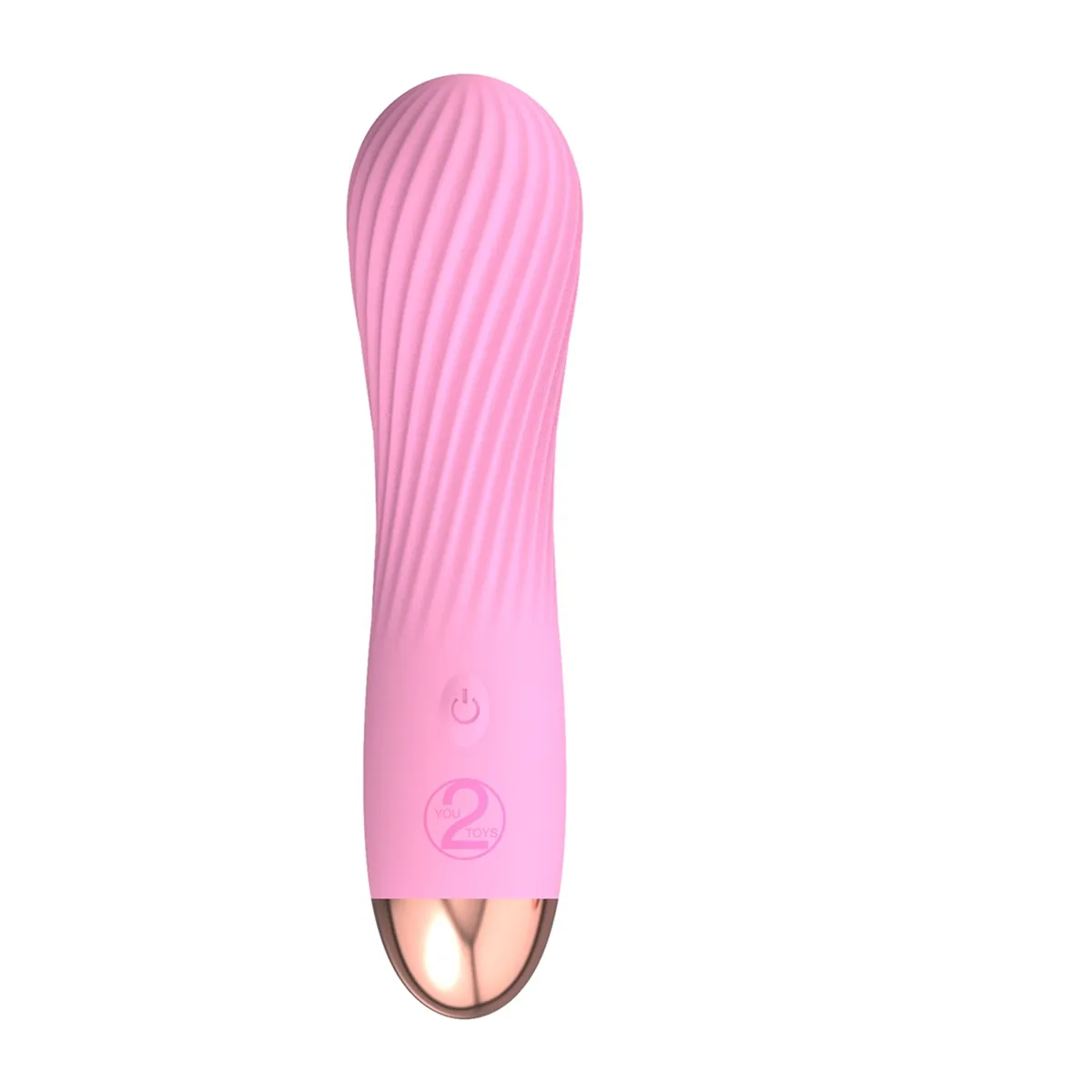
Cuties Mini Vibrator Pink is a mini vibrator in the cheapest part of the category: a straight, ridged wand in pastel pink with a single button, seven vibration modes, and a charging cable in the package. The manufacturer is the German ORION, which sells the Cuties line as its own brand and, in the delivery description, calls the product "1 x Vibrator Cuties von You2Toys". That’s why Swedish stores list the exact same item under three different names — Cuties Mini Vibrator Pink, Cuties Mini Ruffles Vibrator, and You2Toys Cuties Pink Ribbed Mini Vibrator.
The specification looks like this according to the manufacturer: total length 12.5 centimeters, diameter 2.3–3.0 centimeters, weight 61 grams, material silicone, ABS, and PU, seven vibration modes, waterproof, and rechargeable via the included USB cable. The packaging is a cardboard tray measuring 17.6 × 8.6 × 4.5 centimeters; fifty units fit in a carton, and the manufacturing country is listed as China. The manufacturer’s recommended list price is 29.95 euro. In Sweden, the item is sold by five stores between 209 and 349 SEK, and four of them had it in stock during the price check on September 12, 2026.
This review is exclusively about the pink variant with EAN 4024144553693, the manufacturer’s item number 05511390000. Today, the Cuties line contains a large number of items in five generations and several pastel colors, and each color and generation has its own item number and its own EAN. Check the number when comparing prices, because several stores use the same product name for models that differ in both length and number of modes.
The manufacturer explicitly labels the product as second generation Cuties, and that is not a marketing detail but the information that determines which product you actually get. The generation designation controls three things in the specification: the number of vibration modes, the body shape, and whether the model is listed as waterproof.
The second generation has seven vibration settings. The fourth and fifth generations have ten. This is the single most common mix-up in this series, and you can see it right away in Swedish store texts that mix up the numbers. The manufacturer lists seven settings for item 05511390000 on both the wholesale side and the consumer side, and the same seven are printed on the packaging along with the symbols for silicone, water resistance, and USB charging.
The shape is a straight rod without a bend and without a tapering neck. The ridged texture runs in a spiral over the upper two thirds of the body and is the whole point of the model—the manufacturer describes it as a "Rillenstruktur", meaning a ridged structure, in combination with a velvety Soft Touch surface. The body ends with a gold-plated tip, and on the smooth section just above it sits both the on/off button and the DC-marked charging contact, according to the manufacturer’s own product images. The button being on the smooth lower part—not in the middle of the ridged section—is a practical consequence of the shape: you can find it with your thumb without looking.
Three generations sit close together on the store shelf and are often mixed up, because they are called the same thing and cost about the same. This is how the manufacturer’s own specifications distinguish them:
The conclusion isn’t straightforward. Newer generations have more settings, and in the fifth generation’s case a smaller product, but only the second generation is listed as waterproof by the manufacturer. What can be stated, then, is that the upgrade isn’t unambiguous: you trade three vibration settings for an explicit water-resistance claim. If you want both, there is no Cuties model that gives you that—at least not according to the features lists the manufacturer publishes today.
The material question is the only property of an intimate product that cannot be compensated for with experience or care, and it determines whether the product is still hygienic after three years. The manufacturer lists three materials for this model: silicone, PU, and ABS. It’s a more detailed declaration than most in this price range provide, and it’s worth unpacking, because the three materials behave completely differently over time.
Silicone is a non-porous material. A non-porous surface can be cleaned, because there are no microscopic cavities where residue can get trapped. This is the single most important property of a material that is meant to sit against mucous membrane. ORION describes in its own material guide that silicone is odorless and phthalate-free, easy to clean with warm water and soap, and as a material that does not absorb foreign odors and does not react with soap, alcohol-based toy cleaners, or water-based lubricants. The only disadvantage the manufacturer itself puts forward is that silicone is not compatible with silicone-based lubricants.
ABS is hard plastic. The manufacturer’s material guide describes it as strong, durable, odorless, and phthalate-free, and it particularly emphasizes that ABS conducts vibrations efficiently. On this product, it’s reasonably the base and the inner casing that are ABS—that’s where the motor and the charging connection are located, and the gold-plated end, in the manufacturer’s product images, has a hard, glossy surface rather than silicone’s matte finish. However, the manufacturer does not specify which part is which material, and that’s a real gap in the declaration: you get to know what is included but not where it sits.
The third material is the one that deserves the most attention, and it’s also the one that no store text brings up. PU stands for polyurethane, and in ORION’s own material guide, PU is not a structural material but expressly a coating: it’s described as a perfect surface layer on products made of ABS or silicone, giving a velvety and seamless surface and being odorless and skin-friendly.
In practice, that means that the “Soft Touch” feel that both the manufacturer and all five Swedish stores market is a surface layer on top of the silicone, not a property of the silicone itself. And the manufacturer lists three disadvantages of that layer on its own: strong cleaning agents and massage oil can damage PU; the coating should not be exposed to silicone-containing lubricants when it sits on top of a silicone product; and the layer can be worn off if the product is cleaned too roughly. The manufacturer adds that the worn-off coating is not dangerous.
This is the most important single task in the entire materials section, and it only appears in the manufacturer’s material guide — not on the product page and not in any Swedish shop text. The conclusion that can be drawn is specific: the velvety surface is a consumable part. Clean with lukewarm water and mild soap according to the manufacturer’s own instructions, not with scrubbing motions, harsh agents, or oil, if you want the product to feel the same in a year as it does now.
Phthalates are a group of softeners used to make plastic — above all soft PVC — flexible. The Kemikalieinspektionen (Swedish Chemicals Agency) describes them as substances that can affect the endocrine system and make reproduction more difficult, and several of them are therefore restricted or banned within the EU in a large number of products. This product category is in fact a recurring subject of supervision, because it contains soft plastic that sits against skin and mucous membranes.
In its material guide, ORION explicitly states that both silicone and ABS are phthalate-free, and the PU coating is described as a synthetic raw material that is odorless and skin-friendly. None of the three material groups requires phthalate softeners to become soft — the softness of silicone comes from the polymer’s own structure. It’s a significantly better material description than labels like "TPE" or "jelly rubber," which say nothing at all about which softeners are included.
What the manufacturer, however, does not do is publish an explicit phthalate-, BPA-, or latex declaration for the individual item. The information is provided at the material level in the material guide, not as a product assurance on the item page. For anyone who is latex-allergic, it’s worth noting: the general customer information instead encourages the buyer to read the information on the packaging to avoid allergic reactions, for example to latex, which is a weaker formulation than a straightforward statement. The material line lists silicone, ABS, and PU and does not mention latex.
The manufacturer states a total length of 12.5 centimeters and a diameter that varies between 2.3 and 3.0 centimeters along the body — so it’s thickest in the ribbed section and tapers toward the base. The manufacturer’s own dimension graphic repeats both values with an “approx.” in front: approximately 12.5 centimeters in length and max Ø approximately 3.0 centimeters. The packaging measures 17.6 × 8.6 × 4.5 centimeters, and the manufacturer writes on the front of the package that the image shows the product in its natural size.
The insertion depth is an estimate that only exists halfway. The German and English product text does not state any insertion depth for the pink model. The Danish translation on the same page states 8 centimeters, and the page for the purple sister model with the same body shape states 8 centimeters straight out in German. What can be concluded is therefore that the manufacturer assumes an insertion depth of about 8 centimeters for this body shape, but that the information is not stated in the text that applies to this particular item.
The weight information deserves a comment in itself. The manufacturer’s product text states 61 grams. The same page’s structured measurements field states 115 grams. The two values on the manufacturer’s own page don’t match, and the manufacturer doesn’t explain the difference. The pattern in the sister models points in one direction: the green second-generation model has 88 grams in the text and 155 grams in the measurements field, and the fifth generation is stated to be 115 grams in the measurements field. It looks like the text weight refers to the product and the measurements field refers to the packaging or shipping weight, but that’s an interpretation and not something the manufacturer writes. Assume that the product in hand weighs about 61 grams—Lekosmek and Taboo state the same figure, Taboos structured product data states 65 grams, and Mshop states 0.10 kilograms for the entire delivery.
Put the numbers in context: 12.5 centimeters and just over sixty grams make the product smaller and lighter than almost everything else in the vibrator category. The manufacturer is blunt about what it’s for—the heading on the product page, translated, reads, "the little one for the handbag". That’s also the whole argument for this model, and we’ll get back to why it’s hard to beat that argument on price.
The interface consists of a single button. It sits on the smooth lower part of the body, below the ribbed structure and above the gold-plated base, and it controls everything: on, off, and scrolling between the seven vibration modes. The manufacturer describes the controls in one sentence—the seven vibration modes are controlled with a button press—and there is no display, no remote control, no app, and no separate intensity control.
It should be read as a feature, not as a drawback. An interface with one button has nothing to learn, can be handled in the dark, and has no setting that can go wrong. It’s also the direct opposite of the products in the premium segment, where separate controls for strength, patterns, and an automatic mode offer more combinations but require that you find the right one among them.
The manufacturer does not publish how the modes are divided—meaning how many of the seven are constant control strengths and how many are pulsing patterns. What can be established is that seven modes on a single button means you scroll linearly: to go back to mode one from mode four, you need to press through the three in between. On a product with seven steps, that’s a manageable amount of button presses. On a model with twenty modes, the same solution becomes tedious, and that’s one of the concrete advantages of the series keeping the number down.
The pattern in this product category is that the lowest steps are clearly separated, while the top ones are closer together, because the difference per step decreases as the motor approaches its maximum power. The manufacturer does not publish motor power, frequency, or amplitude for this model, so there is no way to document how the seven modes are distributed.
What you can document, however, is the form factor, and that says a lot about where the stimulation ends up. The body is thickest in the ridged section—3.0 centimeters—and the manufacturer describes the thickened top with the ridged structure as the part that reaches the hotspots. The shops describe the same thing in their own way: Joyland lists the product’s hardness as “medium,” and Vuxenkul describes the silicone as super soft. The manufacturer’s own customer information sets out a limitation that’s worth reading before purchase: the product is stated to be intended for vaginal use only, and the feature list on the product page includes the line “For vaginal use”. There is thus no anal function, which is relevant because a straight wand without a locking base could otherwise look like an alternative.
Here there is a real contradiction between the sources, and it’s worth presenting plainly because it affects what you think you’re buying.
The manufacturer states seven vibration modes. It appears on the wholesaler page for item 05511390000, on the consumer page for ORION, and is printed on the side of the packaging as “7 VIBRATION MODES”. Four of the five Swedish stores write the same thing: Joyland lists “7 different steps,” Vuxenkul “7 different vibrations,” and Lekosmek and Taboo “7 different vibration modes”.
Mshop writes something else. In the store’s bullet list, it says "10 vibration modes for a thrill", while the body text on the same page hedges to "7 to 10 vibration modes (depending on generation)". Where a store contradicts the manufacturer, the manufacturer wins, and the ten-mode information applies to the fourth and fifth generations of Cuties — not the second-generation article 05511390000 that Mshop actually sells. The store lists the correct EAN, 4024144553693, so this is a wrong product description, not a different item. Count on seven modes.
This question gets a short answer. The manufacturer does not publish any measured decibel value for Cuties Mini Vibrator Pink, either on the wholesaler page, on the consumer page, or in the customer information. None of the five Swedish stores states a measurement either. So information about the exact sound level for this model that circulates on other sites has no support from the manufacturer.
There’s an indirect clue in the manufacturer’s own product range: the fifth generation of Cuties is marketed with the wording "klein, leicht, diskret leise"—small, light, discreetly quiet—while the second-generation description contains no claim about silence at all. It’s a marketing argument and not a measurement, but it says something about how the manufacturer positions the two generations relative to each other. Lekosmek and Taboo write in their product texts that the product provides "up to 90 minutes of silent pleasure"; it’s a store claim without a stated measurement value and should be read as such.
A practical piece of advice that applies regardless of model: place the product on a soft surface instead of on a hard tabletop. A hard tabletop works like a resonance box and noticeably amplifies the sound.
The manufacturer lists the product as waterproof. The word appears in the bullet list on the wholesaler page ("Waterproof"), in the feature list, in the body text in all languages, on the consumer page ("Wasserdicht: Für feuchten Spaß in Bad und Dusche"), and as a symbol printed on the side of the packaging. Four out of five Swedish stores repeat it; Vuxenkul makes it "fully waterproof".
What the manufacturer, on the other hand, does not do is provide an enclosure rating. No IP rating is published for this article, whether IPX4, IPX6, or IPX7. It matters, because "waterproof" is a marketing word without a definition, while an IP rating is a test result according to an international standard. IEC 60529 defines what each digit means: IPX4 covers splashing from all directions, IPX6 powerful water jets, and IPX7 submersion to a depth of one meter for thirty minutes.
The difference between these classes is significant in practical use. A product that can handle splashes can be rinsed under the tap, but it doesn’t belong in the bathtub. An IPX7-rated product can be lowered down. Without a published class, there’s no way to know which of the situations applies, and the cautious interpretation is always the lower one. For comparison, We-Vibe lists an enclosure class of IPX7 for its Tango X, so it’s a tested value rather than a word.
And here it gets serious. ORION publishes a customer information document that is linked directly from the article page for 05511390000 and is dated May 2024. In that document, both before first use and in the care instructions, it says: "Do not submerge the device in water" — do not submerge the unit in water, with the added instruction that you should make sure that no water gets into the battery compartment.
So it is the manufacturer’s own document that contradicts the manufacturer’s own product page. The customer information is written as a general text for the entire vibrator range and therefore also applies to models that aren’t waterproof, which is the reasonable explanation—but it’s linked from this specific article, and it’s the only document the buyer gets with the product. What can be established is that you can’t rely on a tested rating, and that the only written instruction that comes with the product advises against submersion.
Mshop reaches the same conclusion on its own: the store lists water resistance as “Splash-proof” in its specification table and writes in the body text that the product is “splash-proof” and that you should avoid letting it lie submerged for a longer period of time. It’s a store statement that differs from the manufacturer’s product page—but it’s also the only store statement that aligns with the manufacturer’s own instruction document. Practical recommendation: rinse the product under the tap, feel free to use it in the shower, but don’t treat it as a bathtub product.
The manufacturer’s instructions are short and unambiguous: clean with warm water and mild soap, and if you want a more thorough cleaning, use a special toy cleaner. The customer information adds that the product should cool down after each use before it’s put away, that it should be stored clean, cool, and dry and protected from direct sunlight, and that it should be stored separately from products made of other materials to avoid chemical reactions. Moisture is stated to be able to damage both the battery and the motor.
The lubricants question has a single answer, and the manufacturer gives it on both sides: water-based. ORION states plainly that silicone-based lubricants can attack the material. That applies doubly here, because the product has both a silicone surface and a PU coating on top of it—the material guide advises against silicone-containing lubricants for both. Oil-based products such as coconut oil and massage oils should be avoided for the same reason: the manufacturer explicitly states that massage oil can destroy the PU coating.
A couple of safety instructions from the customer information belong here, since they are rarely included in the store texts. The product should be kept out of reach of children because small parts can be swallowed; it must neither be frozen nor heated; it is not intended for medical use; and it should not be passed on to a third party for hygiene reasons. If skin irritation or discomfort occurs, stop using the product.
This is the specification’s weakest point, and it has to be said plainly. The manufacturer does not publish the battery capacity in mAh, its voltage, the charging time, or the operating time for this item. Not on the wholesaler side, not on the consumer side, and not in the linked customer information. The only thing that’s stated is that the product is rechargeable and that a USB charging cable is included in the package.
With the included USB cable. According to the manufacturer, the delivery contents are exactly two things: a vibrator and a USB charging cable. The cable plugs into a small connector in the gold-plated base, marked DC on the manufacturer’s own product images, and it is therefore not a USB-C connection but a product-specific DC connector with USB-A on the other end.
It’s a trade-off, not a pure disadvantage. The advantage is that the solution is cheap and that the connector is small. The disadvantage is concrete: if you drop the cable, no regular USB-C cable will work. On a product that costs from 229 SEK, that effectively means that a missing cable can make the entire product unusable. Store the cable together with the product.
The manufacturer mentions a practical detail that’s hard to find anywhere else: the product glows with a steady light when it’s fully charged. The customer information adds two things. Only charge with a suitable charger in a wall outlet and follow the mains adapter’s instructions. And unplug the product as soon as the battery is fully charged—the manufacturer explicitly states this as a way to extend the battery’s service life. For transport safety reasons, lithium batteries are also supplied charged to only 40–50 percent, so charge the product once before first use.
Two of the five stores fill in the gap on their own. Lekosmek and Taboo both write, in identical wording, that the product, after about two hours of charging, provides up to 90 minutes of use. It is a store claim that has no equivalent with the manufacturer, and it should be read as a store claim. Three of the stores state no run time at all, and Mshop is content with writing that the product "often lasts for several moments of pleasure".
Why does the missing capacity matter? Without mAh figures, it’s not possible to convert the run time into power consumption, and it’s not possible to compare how heavily the cell is stressed between models. It’s also not possible to judge whether a stated charging time is reasonable. By comparison, We-Vibe publishes both run time (up to two hours) and charging time (90 minutes) for Tango X, and it also lacks an mAh figure — so the lack is partly industry-typical, but not completely.
What applies generally to lithium-ion batteries also applies here: capacity decreases with the number of charge cycles, the battery is not replaceable on a product with this design, and the cell does best when it’s charged regularly instead of being stored fully discharged. With use a couple of times a week, it’s the battery, not the silicone, that sets the limit for the lifespan — and since the product is sealed, it’s practically used up when the cell is fully discharged. The manufacturer’s customer information refers to collection points for electronic waste and reminds that batteries don’t belong in household waste.
We do not have price data from shops in your market yet.
The manufacturer’s product page says it is waterproof. The manufacturer’s own customer information, linked from the same page, says do not submerge the device in water.
Three comparisons are relevant: versus the two newer generations within the same series, and versus a mini vibrator from the premium segment that publishes what this model does not publish. All information below comes from each manufacturer’s own specifications, and all Swedish prices from the stores’ product feeds on September 12, 2026.
The Cuties mini vibrator from the fourth generation, article 54024840000, is the most direct competitor because it comes from the same manufacturer and is sold in the same shelves. It measures 13.6 centimeters versus 12.5, has a diameter of 2.2–3.2 centimeters versus 2.3–3.0, and offers ten vibration modes versus seven. The materials are the same — silicone, PU, and ABS — and the button is shaped like a heart-shaped gemstone. The manufacturer’s recommended approximate retail price is 39.95 euro versus 29.95 euro.
So what speaks in favor of the fourth generation are three extra modes and a slightly larger body. What speaks against it are two things. First, it’s more expensive in the manufacturer’s own price list. Second — and more importantly — the feature list for the fourth generation does not include "Waterproof", unlike the other generation’s. Instead, the manufacturer describes it as flexible and wave-shaped. If you want a model that the manufacturer itself calls waterproof, then it’s the second generation that applies — and it’s an unusual example of how the older product has a specifications line that the newer one lacks.
The fifth generation, article 54029800000, is the series’ most compact mini vibrator: 10.5 centimeters long and 2.1 centimeters in diameter, so two centimeters shorter and almost one centimeter slimmer than our model. It has ten vibration modes, a diamond structure for grip, and a soft directional structure on the tip, and the manufacturer markets it as small, light, and discreetly quiet. The suggested retail price is 29.95 euro, i.e. the same as the second generation’s.
The comparison therefore comes down to what you prioritize. The fifth generation gives you more modes and a smaller product for the same list price. The second generation gives you a thicker body with a ridged structure, and the only one of the three that the manufacturer lists as waterproof. The difference in diameter — 3.0 versus 2.1 centimeters at most — is also big enough that the two aren’t interchangeable: one is a slim pin, the other a fuller shaft.
We-Vibe Tango X is the opposite end of the same category and a reasonable reference object, since it shows exactly what’s missing in Cuties’ specifications. Tango X measures 9.98 × 2.29 × 2.43 centimeters, is made from ABS and body-friendly silicone that is explicitly stated to be free from phthalates, BPA, and latex, has seven vibration patterns and eight separate intensity steps, a USB-charged lithium-ion battery with up to two hours of runtime and 90 minutes of charging time, an IPX7 ingress protection rating, and a two-year warranty. The list price is stated as starting from 89 euro.
The differences that actually matter aren’t primarily about the sound or the feel — that can’t be compared based on specifications. It’s what’s actually stated. Tango X has a tested ingress protection rating, a published run time, a published charging time, and a published warranty period. Cuties Mini Vibrator Pink has none of those. Tango X also has two independent controls — patterns and intensity — which gives 7 × 8 = 56 combinations, versus seven modes on a single button.
On the other hand, Tango X costs almost three times as much in the manufacturers’ own price lists—89 euro versus 29.95—and it’s a bullet with no ridged structure and no fuller body. If you want a simple, thick, ridged mini vibrator for under 250 SEK, you won’t get that from We-Vibe. The conclusion is banal but true: you don’t primarily pay for performance in the higher segment—you pay for documentation, and whether that documentation is worth the difference is a reasonable question to ask before buying.
Five Swedish retailers sell the item with EAN 4024144553693. Cheapest in the listings is Vuxenkul at 209 SEK, and the most expensive is Mshop at 349 SEK. That’s a difference of 140 SEK or 67 percent for the exact same product number, same color, and same packaging.
However, the stock situation changes the picture. Vuxenkul, which has the lowest price, had the product marked as sold out at the price check. Of the four stores that had it in stock, Joyland was the cheapest at 229 SEK, followed by Lekosmek and Taboo at 298 SEK each, and Mshop at 349 SEK. So the relevant price spread for anyone who wants to buy today is 229 to 349 SEK—a difference of 120 SEK or 52 percent.
Two of the prices are promotional prices according to the stores’ own pages: Joyland lists a regular price of 295 SEK and Vuxenkul lists 299 SEK. That means someone who compares at another time may get a different ranking, and that the difference between the stores in normal circumstances is smaller than it looks right now. The price spread isn’t because any store sells a different variant—all five list EAN 4024144553693 or an own product number that’s linked to that specific pink second-generation model.
Finally, set the price in relation to the manufacturer’s own. ORION’s recommended approximate retail price is 29.95 euro, which is a sign that this is a normal-priced volume item rather than a product with a large margin to haggle on—the Swedish store prices are around the same level. Still, always check the final price at checkout. A product in this price range ends up under every Swedish store’s free-shipping threshold, which means the shipping cost is added across all five and can weigh more heavily than the price difference between the two cheapest stores. That’s why it’s worth adding a lube bottle or a toy cleaner in the same order instead of ordering them separately later.
It’s right for you if you want the smallest possible effort. 12.5 centimeters, a little over sixty grams, and a single button is a product with no learning curve, and the manufacturer’s own positioning—“the small one for the handbag”—is honest. It’s for you if you want a travel-friendly second product that doesn’t cost anything to lose, you want a ridged structure and a fuller body rather than a slim bullet, and you’re shopping for under two hundred and fifty kronor and want a silicone surface rather than an unidentified soft plastic.
It’s not for you if you want documented values. The manufacturer does not publish battery capacity, charging time, operating time, IP rating, sound level, or warranty period—and that’s five lines that other manufacturers in the category actually fill in. It’s not for you if you want to be able to lower the product into a bathtub without hesitation, because “waterproof” without an enclosure rating is not the same as IPX7—and because the manufacturer’s own included information sheet advises against submersion. It’s not for you if you want to be able to charge with the same cable as your phone, because the connector is a product-specific DC connection rather than USB-C. And it’s not for you if you want more than seven modes—then the fourth or fifth generation in the same series is the reasonable choice.
One last thing belongs in the decision. According to the manufacturer’s own material guide, the velvety Soft Touch surface is a PU coating that can be worn away with aggressive cleaning and that takes damage from strong cleaning agents and massage oil. It’s not a reason to refrain, but it is a reason to treat the product as a consumable with a lifespan rather than as an investment—and at this price point, that’s a completely reasonable expectation.
ORION does not publish any manufacturer warranty for Cuties Mini Vibrator Pink. Neither the wholesaler side, the consumer side, nor the linked customer information contains a warranty commitment or a warranty period. It’s a noticeable difference compared with several competitors in the category—We-Vibe lists two years for Tango X—and that means that in practice you’re limited to your statutory rights.
On the other hand, they’re stronger than many think. Under konsumentköplagen, you have three years of right to complain about defects in the goods, regardless of what the manufacturer promises or chooses not to promise. The right to complain is directed at the store you bought from, not at the manufacturer, and it applies to defects that existed at delivery—which in practice is what matters for a product where the battery is the part that wears out.
For distance purchases, you also have a right of withdrawal for fourteen days under the Act on Distance Contracts and Contracts Outside Business Premises. Note that in practice the right of withdrawal is limited for hygiene products that have been removed from a sealed package—and this product is delivered by the manufacturer in a cardboard tray, meaning a carton package rather than a sealed blister, which can affect the assessment in the individual case. The right to complain in case of defects always applies, however. Several of the shops also offer a longer cooling-off period than the law requires; check the terms of the shop you choose. Do you have questions about what applies in your case? Konsumentverket will guide you via Hallå konsument.
Finally, the manufacturer’s customer information includes a detail worth saving: used products must be handed in free of charge at a collection point for electronic waste, and batteries that can be removed must be separated first. ORION also states that batteries they sell or have sold can be returned free of charge to their warehouse in Flensburg. The symbol that indicates this—a crossed-out wheeled trash bin—is found on the product or on the packaging.
Cuties Mini Vibrator Pink is ranked på plats 14 av 14 in mini vibrator best i test, where the entire category is compared against each other using five shared criteria. Guiden vinns av Svakom Echo 2.
Every numerical piece of information in the text can be traced to one of the sources below. The links were checked manually on the specified date.
This page is machine-translated from Swedish. Read the Swedish original