

Review
Review: Satisfyer Pro 2 Next Generation
Cheapest of the widely sold ones — 219 SEK and 15 years of warranty.
29 July 2026
Review · Massage wand · Mains-powered wand vibrator
Doxy’s smaller mains-powered massage wands reviewed against the manufacturer’s own specifications, two manuals, and price data from six Swedish shops. 28 centimeters, 350 grams, silicone head over a core of cast metal, eight vibration modes, approximately 20 watts and 9,000 revolutions per minute—however, without a battery, without an IP rating, and without a published noise level.
A mains-powered wand vibrator that trades mobility for raw power: around 20 watts and 9,000 revolutions per minute according to the manufacturer, eight modes with a pulsing function, silicone head over a cast metal core, and no cell that ages. What you pay for is the cord; that the product is not waterproof and completely lacks an IP rating; a screw head that the manufacturer itself states may come loose; and twelve months of warranty on an older platform where spare parts are no longer manufactured.
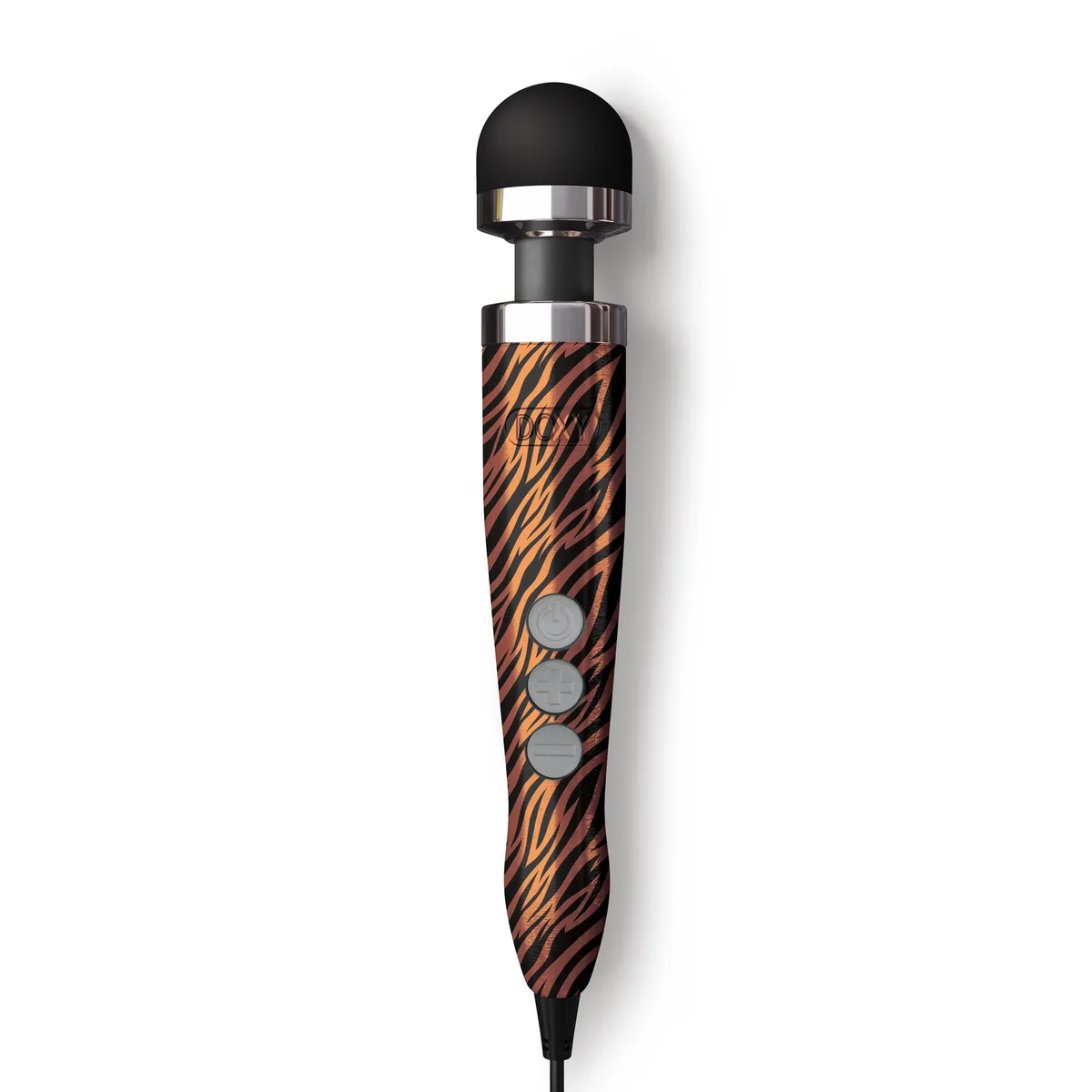
Doxy Number 3 is the smaller of Doxys mains-powered massage wands made of cast metal. The model is called different things depending on who sells it: the manufacturer calls it Doxy Die Cast 3, Swedish stores write alternately Doxy No. 3, Doxy Number 3, and Doxy 3 Wand. It is the same product, and the variant this review is about is the one with the hand-painted tiger pattern and EAN 712758998019.
The specifications look like this according to the manufacturer: body length 28 centimeters, head diameter 4.5 centimeters, body circumference 12 centimeters, and weight 350 grams. The body is cast and hand-finished aluminum; the head is silicone over a core of cast metal, and the power comes from a power supply unit via a three-meter-long cord. Doxy states eight vibration modes for the Die Cast series, an output of about 20 watts, and a maximum speed of about 9,000 revolutions per minute. In Sweden, the item is sold by six stores at prices between 1,195 and 1,759 SEK, and two of them had it in stock at the price check on September 12, 2026.
Two things need to be said right away, because they determine whether the product is right for you or not. It has no cordless operation and no battery — it has to be plugged into a wall outlet to work. And it is not waterproof. The manufacturer states clearly that all mains-powered Doxy products are not waterproof, and that buttons, the neck, and the head are only sealed against accidental liquid. There aren’t any details hidden in the fine print—these are two basic requirements.
A wand vibrator — a massage wand in Swedish — is a wand with a large, rounded head on a flexible neck. The shape originally comes from body massage wands intended for the neck, shoulders, and calves, and it is still that shape that makes this product category recognizable. Doxy describes the intended use broadly: externally over larger areas of skin, during foreplay, and for muscle tension in the shoulders, back, and legs.
The difference versus a small vibrator isn’t primarily the intensity but the character of the vibration. The manufacturer explains its own design like this: under the soft silicone head sits a massive cast metal head, which means heavier counterweights can be mounted in the motor. Doxy also writes that the heavy metal body absorbs unwanted vibration internally and transfers more energy outward into the body instead of into the handle. That’s the explanation for why heavy wands are perceived as deeper despite similar figures on paper—the manufacturer points out itself that depth isn’t just about RPM.
Keeping the cord in place is a deliberate design choice, not a lagging behind. A power supply unit does not need to account for a cell’s capacity, and therefore there is no runtime to consider: the product runs as long as it’s plugged in, with the reservation for the automatic shutoff described further down. This is the only design feature in this comparison where the battery’s aging doesn’t set a limit on the product’s service life. The price of that is just as simple to describe—you’re tied to a wall outlet and a three-meter cable.
Doxy's model name is the most common source of wrong purchases in this category, especially because Swedish stores translate them differently. Three models are close to each other:
The tiger pattern, according to the manufacturer, is found on both Die Cast 3 and Die Cast 3R, which makes the risk of mix-ups concrete: two different products with the same pattern, the same length, and the same weight, where one has a cord and the other has a battery. Always check that the item you put in your shopping cart is the plug-in one if that's the cord you want — or vice versa. If you want to be sure, the EAN number is the only reliable way, and for this variant it's 712758998019.
The material issue is the only characteristic of an intimate product that can't be compensated for with experience or care, and it determines whether the product is still hygienic after five years. Doxy divides the material into two clear parts: a body made of cast, hand-finished aluminum and a head made of silicone that sits over a core of cast metal.
In its FAQ, the manufacturer describes the silicone as 100% body-safe, non-porous, and of platinum quality. The most important of the three words is non-porous. A non-porous surface can be cleaned, because there are no microscopic cavities where residue can remain. That's the single most important property of a material that will lie against skin and mucous membranes, and that's why the material declaration weighs more than almost all other lines in a specification.
The term platinum quality refers to how the silicone is cured. Platinum-catalyzed silicone doesn't require the plasticizers that soft molded plastic needs in order to become flexible — the softness comes from the polymer's own structure. This is relevant because phthalates, the most common group of plasticizers in soft PVC, according to Kemikalieinspektionen can affect the hormonal system and make reproduction more difficult, and several of them are therefore restricted or prohibited in the EU. Specifying silicone as the material is, in itself, a better indication than labels like TPE or jelly rubber, which don't say anything at all about which plasticizers are included.
Here it’s worth noting one thing from the manufacturer’s own material. Doxy’s older instruction booklet states that the massage head is made of medical PVC without latex and without unwanted phthalates, while the current FAQ and the product page describe a silicone head. The booklet covers the entire older wand family, so the wording should most likely be read as referring to the original Doxy wand and not Die Cast 3—but anyone reading the manufacturer’s documents in order will come across both materials, and Doxy does not publish a materials table by model that clarifies which applies where.
The aluminum body has a practical consequence in addition to its weight: metal is cold in your hand when you pick it up, and that’s a difference from silicone-coated products like the Womanizer Next. The manufacturer also points out that each unit is hand-painted, that the web renderings are illustrations, and that therefore the shade differs between units. So the tiger pattern on your wand will not look identically to the picture in the store—that’s the manufacturer’s own note, not a disclaimer from our side.
Doxy expressly states that the silicone head is screwed on and can be unscrewed, both for easier cleaning and so that you can attach accessories that are sold separately. It’s a genuine hygiene benefit. On a product with a fixed head, the seam between the head and the neck can’t be reached, and that seam is precisely where residue collects.
But the same design has a documented problem, and the manufacturer spells it out itself. Doxy states in its FAQ that some units of Die Cast 3 and Die Cast 3R developed a fault in which the silicone head could gradually loosen or separate over time, and that the cause was precisely the original screw construction. The manufacturer describes a temporary fix—carefully securing the silicone with a small amount of flexible adhesive around the inner collar—and writes that the head-and-neck system was redesigned completely for the next product generation for that reason.
It’s unusually straightforward for a manufacturer, and that should be taken into account. The consequence is also reinforced by two other pieces of information in the same documentation: replacement heads are no longer manufactured and, according to Doxy, can’t be ordered, and the manufacturer’s newer owner manual now advises against unscrewing the head altogether, as this can affect performance and safety. So the recommendations that sell the product and the recommendations that protect it point in different directions.
The manufacturer states a body length of 28 centimeters, a head diameter of 4.5 centimeters, and a body circumference of 12 centimeters. The weight is listed as 350 grams. The packaging measures 41 × 11 × 6 centimeters and weighs 790 grams, which means that just over half of the shipping weight is cardboard, the power supply unit, and the cord.
That weight is the whole point of the model and at the same time its clearest limitation. 350 grams in your hand is noticeably substantial—a mobile phone typically weighs around 200 grams—and the added weight is what makes the vibration feel deep rather than superficial. At the same time, it’s the weight that determines how long your wrist can keep the wand at an angle to your body. The comparison within Doxy’s own range is the most telling: Die Cast Max Plug-in weighs 690 grams, so almost twice as much, and it’s 37 centimeters long compared to Number 3’s 28.
One deviation should be noted. The manufacturer states 350 grams, and so do the retailers Vuxen and SexleksakerOutlet. Retailer Taboo, however, lists 340 grams on its product page. The difference is ten grams and has no practical significance, but it shows how store data drifts from the manufacturer’s stated information when it’s copied over in listings. The winner is the manufacturer: count on 350 grams.
The 4.5-centimeter head diameter is the second figure that determines the fit. It’s a compact head for a wand, and the manufacturer describes it as intended for more pinpoint-focused stimulation than the larger models. For comparison, Doxy lists 6 centimeters for Die Cast Max Plug-in, and Magic Wand states 2¼ inches—just under 5.7 centimeters—for Magic Wand Original. Number 3 is therefore the narrowest of the three, and that difference is felt most by someone who wants to cover a larger area at once.
The interface is as simple as you can make it. Three buttons sit on the top side of the handle: a power on/off button at the top, a plus button in the middle, and a minus button at the bottom. Plus and minus step the vibration up and down. That’s the whole control.
The manufacturer lists eight vibration modes for the Doxy Original and Die Cast series, and specifies that they include several ascending pulse modes that vary both intensity and rhythm. It’s fewer steps than on a modern air-pressure product—Womanizer Next has fourteen intensity steps and three depth levels—but here the scale covers a significantly larger performance range, and step by step the difference is therefore greater.
What can be concluded about the button placement is that it’s on the top side of the handle, clearly below the neck. That means you can reach them with your thumb in the grip shown in the manufacturer’s and the retailers’ product images, with the handle in your palm and the head facing outward. The buttons are light-colored and set into the pattern, which makes them visible even against the dark tiger background.
The pulse mode is the only function on the product that isn’t self-explanatory, and it’s worth its own walkthrough because two of the manufacturer’s own documents describe it differently.
The principle is the same in both: you turn off the wand, then hold down the on/off button instead of pressing it briefly, and release. The vibration then starts accelerating from the lowest level up to the highest level in a rising cycle rather than staying steady. The plus and minus buttons no longer control the strength but how quickly the cycle builds up. To return to normal, steady vibration, you turn it off and back on with a brief press.
The difference lies in how long the button should be held down. The manufacturer’s older instruction booklet states two seconds, while the multilingual owner manual from June 2026 states about three seconds. In practice, it hardly matters—if you hold the button for three seconds, you’ve passed the two-second limit—but it’s an example that Doxy’s documentation has been revised multiple times without the old versions being withdrawn. If you read a manual online, it’s worth checking which edition it is.
Doxy publishes two power-related figures in its FAQ: that the Doxy Original and Doxy Die Cast operate at around 20 watts and that the head’s maximum RPM is around 9,000 revolutions per minute. The figures are given for the Doxy Original and Doxy Die Cast as a family, not separately for the Die Cast 3, and the manufacturer does not publish any own power or RPM value specifically for this model. That the smaller model would have exactly the same numbers as the larger one isn’t a conclusion you can draw from the text—it’s an order of magnitude, and that’s how it should be read.
What the numbers still indicate is something about the design. Twenty watts is a completely different order of magnitude than what a small lithium-ion battery can deliver, and that’s the direct explanation for why mains-powered wand vibrators are at the top of the power category. The 9,000 revolutions per minute corresponds to 150 rotations per second, i.e., a vibration range of roughly 150 hertz at top speed.
For comparison, Magic Wand lists two fixed speeds of about 5,000 and 6,000 RPM for Magic Wand Original. Doxy’s upper figure is therefore clearly higher, but the two products also differ in how they reach those figures: Magic Wand has two modes, while Doxy lists eight. What can be stated is that Doxy provides more steps along the way and a higher top end, while Magic Wand offers a simpler product with two hard choices.
The product turns off by itself after a period of continuous operation, and that is intentional. The reason is heat: a motor that works at twenty watts in a closed metal housing heats up, and the manufacturer explicitly states that damage caused by overheating or use beyond the recommended limits is not covered by the warranty.
Here there is another deviation in the manufacturer’s materials, and it is bigger than the two-second question. Doxys FAQ states that the shaft is programmed to shut off after 20 minutes, while the owner’s manual from June 2026 states automatic shut-off after 30 minutes of continuous operation. The older instruction booklet, in turn, states that there is no automatic shut-off at all; instead, it gives an instruction: don’t run it longer than 20 minutes in a row, and then let it rest for 20 minutes. The owner’s manual recommends 15–20 minutes of cooling down.
The practical advice is the same regardless of which number applies to your specific unit: plan on a session of about twenty minutes and then a break. So if the shaft goes quiet in the middle, it is not a fault—instead, according to the manufacturer, you only press the on/off button again and continue.
The manufacturer describes the product as exceptionally quiet and highlights that there is no vibration in the handle. Both claims are listed as bullet points on the product page. The question is what that means in numbers, and the answer has to be honest: Doxy publishes no measured decibel value for Die Cast 3, either on the product page, in the FAQ, or in any of the two manuals.
None of the six Swedish stores lists any decibel value either. Websites that publish an exact value for this model either report their own measurement or a number without a source, and there is no manufacturer statement you can verify against.
What can, however, be established is a technical principle. The sound from a vibrator largely comes from an unbalanced weight rotating inside a housing that can vibrate. Doxy describes its own design as a heavy metal body that absorbs vibration internally and transfers energy outward instead of into the handle. A heavier body vibrates less under the same force, which indicates that the sound comes primarily from the head and not from the entire shaft. How much that translates into decibels can’t be worked out from the specification.
A practical tip that applies regardless of model: place the product on a soft surface between uses, and don’t hold it against a tabletop while it is running. A hard surface acts like a resonance box and noticeably amplifies the sound.
This is the most important individual point in the entire review, because it is often assumed the other way around. Doxy states in its FAQ that all Doxy mains-powered products are not waterproof and that they should never be used near water or submerged. According to the manufacturer, buttons, the neck, and the head are sealed against accidental liquid exposure—so against an accidental splash, not against intentional soaking.
The owner manual is just as clear: mains-powered models are not designed for use near water and are sealed only against accidental splashes. The older instruction booklet expressly prohibits submerging the product in liquid and using it in or near baths and showers. All four Swedish shop pages that list the feature—Vuxen, Taboo, and SexleksakerOutlet—also state "not waterproof". There is therefore no disagreement between the manufacturer and the retailers on this point.
An enclosure class according to the IEC 60529 standard is written as IPX followed by a number, where the number indicates how much water the product has been tested against. IPX4 means splashes from all directions; IPX7 means immersion to one meter for thirty minutes. The difference between them is not a marketing distinction, but two different tests.
Doxy does not state any IPX class at all for the Die Cast 3. The manufacturer publishes IPX4 for its cordless Die Cast models and IPX7 for Doxy Go, but for the mains-powered models there is no number—only the wording that they are not waterproof. The absence of a rating should never be read as meaning that the product can still handle water. It should be read just the opposite way.
There is wording in the manufacturer’s warranty terms that makes the consequence concrete. The warranty does not cover "liquid damage beyond the product’s IP rating". For a product that has no IP rating, this wording in practice means that all liquid damage is outside the scope of the warranty. It’s a good example of why missing information can cost money and not just be a gap in a datasheet.
Doxy’s own cleaning instructions follow directly from the water issue: unplug the plug, use antibacterial hand soap and warm water, and do not rinse the product under running water, since splashes can get into the unit. Wipe the wand with a cloth before and after use. A cleaning product intended for sex toys can also be used, according to the manufacturer. The owner manual adds that the silicone head is cleaned with mild soap and water and that the product must dry completely before being put away.
The question about lubricants has also been discussed between generations, and it’s worth knowing which version applies. The older instruction leaflet states that a water- or silicone-based lubricant can be used, while the manufacturer’s current FAQ recommends water-based and advises against silicone-based because prolonged exposure can affect silicone tips depending on the formula. Follow the newer advice. A silicone-based lubricant breaks down silicone tips over time and makes them porous, and a porous surface can no longer be cleaned properly—only replaced, which in this case is no longer possible because replacement heads are not manufactured. Oil-based products are discouraged in both editions, and the owner’s manual explicitly states that oil-based lubricants should be avoided.
Regarding storage, the manufacturer states that the serial number is on the silicone head or on the plug-in adapter, and that it should be kept legible for any warranty matters. It’s a practical detail that’s easy to lose: the adapter is the part that most often ends up in a different box than the wand.
The manufacturer states that the power supply is provided via a plug-in power supply unit that delivers low DC voltage to the wand, and that adapters for UK, EU, US, and AU/NZ are included in the package. The owner’s manual states a universal voltage of 100–240 volts at 50–60 hertz for the mains-powered models. According to the product page, the cable is three meters long, which corresponds to ten feet.
Three meters is generous in context. Magic Wand lists six feet for the Magic Wand Original, so it’s just under 1.9 meters—almost a full meter shorter. In practice, three meters is the difference between being tied to the outlet behind the bed and being able to move freely in a normal bedroom.
At the same time, the cable is the part of the construction that is most likely to break first on a product without a battery, and there are two things in the manufacturer’s documentation that are worth taking seriously. The older leaflet explicitly forbids carrying the wand by the cable and winding the cable around the body. It sounds obvious, but that’s exactly how a cable is stored when nobody thinks about it—and a damaged cable on a mains-powered product is a different matter than a broken USB cable.
Yes. The manufacturer writes that all Doxy products work safely at all voltages and that four plug-in adapters are included with purchases made directly from Doxy: UK, EU, US, and AU/NZ. The owner’s manual specifies the voltage range as 100–240 volts at 50–60 hertz, which in practice covers in principle all electrical grids you’re likely to come across.
However, there is one discrepancy between the manufacturer and the store that must be accounted for. The retailer Lekosmek states 230-volt mains power, and the retailer Taboo states 220 volts, that is, two different fixed values instead of the manufacturer’s range. The manufacturer’s position is this: according to Doxy, the unit is a universal unit for 100–240 volts, and the stores’ figures should be read as descriptions of the European mains network rather than as a limitation of the product itself. However, none of the six stores indicates which adapters are actually included in the Swedish package, and that is information worth asking about before a trip.
We do not have price data from shops in your market yet.
The cheapest available item is also the most expensive in the list. Four of six stores list a lower price — for an item they don't have in stock.
Four comparisons are relevant: against the large sister model, against the cordless variant of the same wand, against the classic competitor in the wand category, and against an entirely different technology in an entirely different price bracket. All information below comes from each manufacturer’s own specifications.
Die Cast Max Plug-in is the large mains-powered model in the same family, and the only comparison where everything except the size is the same. The manufacturer states a 37-centimeter body length, a 6-centimeter head diameter, a 16-centimeter circumference, and 690 grams, versus Number 3’s 28 centimeters, 4.5 centimeters, 12 centimeters, and 350 grams. Both have a three-meter cord and the same type of power supply unit. The manufacturer’s price is 189.99 euros for Max versus 129.99 euros for Number 3 at the time of the check.
So, in practice, Number 3 is essentially a halved Die Cast: about half the weight, one quarter smaller head, and three quarters of the length. Doxy describes Number 3 itself as the smaller sister, and that is literally true. If you want maximum surface area and maximum mass, you choose Max—and you pay for it in both money and wrist load. If you want to be able to aim the head exactly at a small area, and be able to hold the wand longer, then Number 3 is the model made for that.
Die Cast 3R is the most interesting comparison, because the manufacturer lists exactly the same external dimensions and the same weight for both: 28-centimeter body length, 4.5-centimeter head diameter, 12-centimeter circumference, and 350 grams. The difference is the power supply. 3R is charged via USB, while Number 3 plugs into the wall. The packaging differs accordingly: 32 × 11 × 6 centimeters and 590 grams for 3R versus 41 × 11 × 6 centimeters and 790 grams for Number 3, because the power supply unit and the three-meter-long cord take up space.
The manufacturer’s price is 139,99 euro for 3R versus 129,99 euro for Number 3, meaning ten euro more expensive for the cordless one. Doxy does not publish either battery capacity in mAh, operating time, or charging time for the Die Cast 3R on the product page, which makes it impossible to calculate how long it lasts per charge. That in itself is an argument for the corded version if operating time is what worries you: a mains-powered wand has no cell that loses capacity over the years, and it’s the cell that otherwise usually determines when a product is used up.
Against that is equally simple math in the other direction. 3R can be used anywhere, it can be taken with you without needing to find an outlet, and it’s easier to pack. In practice, the choice between them is not a quality choice but a mobility choice.
Magic Wand Original is the product that defined the wand category and the natural reference. The manufacturer Vibratex lists two speeds of about 5,000 and 6,000 revolutions per minute, a length of about 12 inches (a little over 30 centimeters), a head of 2¼ inches (just under 5.7 centimeters), a weight of 1.2 pounds (just under 545 grams), a six-foot cord (a little under 1.9 meter), mains power at 110–120 volts, a soft vinyl head, and a one-year warranty. The price is listed as 99.95 dollars regular and 79.95 dollars during the promotion.
Three differences matter. The first is the control: two fixed speeds versus Doxy’s eight modes with a pulse function. The second is the voltage—Magic Wand Original is specified for 110–120 volts, while Doxy states universal voltage 100–240 volts, and that’s a practical difference in Europe that you can’t get around. The third is the material: a vinyl head versus Doxy’s silicone head, and silicone is the non-porous of the two.
Magic Wand, on the other hand, is cheaper from the manufacturer and has a larger head relative to Doxy Number 3. If you choose based on price and ease, Magic Wand comes out strong. If you choose based on the material against the skin, the number of steps, and the fact that the product should work in a Swedish wall socket without detours, Doxy comes out stronger.
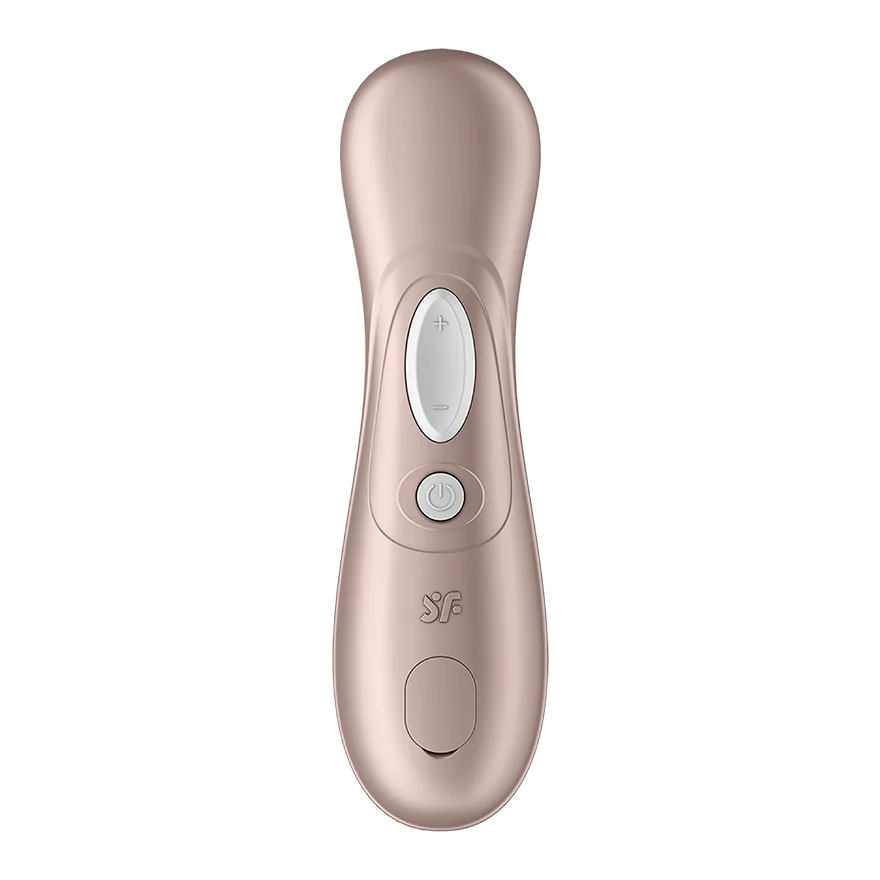
The comparison against Satisfyer Pro 2 Next Generation is not a comparison between better and worse, but between two completely different ways to stimulate. The Satisfyer is an air-pressure product that works touch-free with pressure waves in a closed chamber, it’s rated IPX7, and it’s charged via USB-C, and it costs a fraction of what Doxy Number 3 does. Doxy is a wide, heavy vibration product for external massage over larger areas.
The person who already knows that air pressure works for them has no reason to pay the wand price to get the same thing — it doesn’t. And vice versa: the person who wants deep, rumbling vibration over a larger area must not get it from an air-pressure product no matter how many intensity steps it has. The two products compete for the same budget but not for the same feel, and that’s why many have both.
Six Swedish stores sell the item with EAN 712758998019. Cheapest in the feed is Vuxen at 1,195 SEK, and the most expensive are Lekosmek and Taboo at 1,759 SEK each. It’s 564 SEK, or a 47 percent difference, for the same item number, the same pattern, and the same packaging.
But the spread in prices isn’t the most important number here; it’s the stock status. Only two of the six stores had the product in stock at the price check on September 12, 2026: Lekosmek and Taboo, both at 1,759 SEK. The four lower prices — 1,195, 1,595, 1,595, and 1,683 SEK — all belonged to stores that listed the item as sold out. That means the cheapest available item is also the most expensive in the list, and the 1,195 SEK price in practice is a historic price rather than an offer you can take advantage of today.
It’s a pattern worth recognizing. Stores that list a product as sold out may keep an old price in the feed, and that price is rarely what you actually end up paying when the item comes back in again. Vuxen also shows its price as discounted from a regular price, which suggests that 1,195 SEK was a clearance price on the last units.
One last reference point belongs here, too. The manufacturer’s own euro price for Die Cast 3 was 129.99 euro at the time of the check, discounted from 161.99 euro. We don’t show any conversion to kronor because we don’t have a source for the exchange rate that day, but the figure gives a sense of where the product sits in the manufacturer’s own pricing — and for the fact that the Swedish prices aren’t extreme compared to that.
The prices in the table above are updated when the stores’ product feeds are updated, but always check the final price at checkout. Shipping costs are added by most stores under a certain order value, and in this price range, both of the stores that have the item on hand are above the threshold for free shipping with several actors.
It’s a good fit for you who want deep, powerful vibration over a larger area and don’t mind having a cord. It’s a good fit for you who want a battery-free product, because it removes the most common reason a vibrator becomes unusable after a few years. It’s a good fit for you who want a smaller, more controllable head than the largest wand models—4.5 centimeters versus 6 on Die Cast Max—and who want to be able to use the product in multiple countries without a transformer, thanks to the universal voltage of 100–240 volts.
It’s not for you if you want to use the product in the shower or a bathtub. It’s not waterproof; it has no IP rating, and the manufacturer’s warranty excludes liquid damage beyond an IP rating that doesn’t exist. It’s not for you if you want to rinse off the product under the tap—the manufacturer’s own instruction is that it should be wiped dry, not rinsed. It’s not for you if you want to take something with you on a trip without needing a power outlet and a three-meter cable. And it’s not for you if you want fourteen finely adjustable steps and an app; that interface exists on other products in other categories.
One more thing belongs in the decision. The screw-on head is both the model’s hygiene advantage and its well-known weakness. The manufacturer itself states that the head on some specimens of the Die Cast 3 can loosen over time, which is why the design was changed for the next generation, and that replacement heads are no longer manufactured. That means anyone buying this model in 2026 should go into the purchase with their eyes open: you’re buying an older product platform at full new price, and the part that can break first can’t be ordered new.
Doxy states a 12-month manufacturer’s warranty against manufacturing defects. The warranty page specifies that it applies to purchases made on doxymassager.com after October 22, 2025, while the FAQ states October 20, 2025— a small inconsistency in the manufacturer’s own material, but the same warranty period in both cases. The exceptions are clear: accidental damage, incorrect use, liquid damage beyond the product’s IP rating, normal wear and tear, cosmetic damage such as paint chipping and scratches, and your own repairs or modifications.
Two things are especially relevant for a Swedish buyer. The first is that the manufacturer itself directs purchases made via a retailer back to the retailer: Doxy writes that the first point of contact should always be the store you bought from, because the purchase agreement is with them. The second is that Doxy 2.0 Ltd is a new company from 2025 that explicitly states that it neither manufactures, services, nor handles warranty claims for older Doxy products purchased before October 2025, after the previous company CMG Leisure Ltd went into administration. The old instruction booklet still refers warranty matters to CMG Leisure Ltd.
There is also a contradictory claim in the trade that should be stated. The retailer Lekosmek states a two-year product warranty, while the manufacturer states twelve months, and Vuxen and SexleksakerOutlet state twelve months in line with the manufacturer. Of course, a store can offer a longer own warranty than the manufacturer does, but what Lekosmeks promise covers is not clear from the product page. Ask the store before you rely on it.
What always applies, on the other hand, are your statutory rights, and in this case they are more valuable than the manufacturer warranty. Under konsumentköplagen, you have three years of complaint rights for defects in the goods, regardless of what the manufacturer promises and regardless of which company owns the brand today. In distance sales, you also have a right of withdrawal for fourteen days under lagen om distansavtal och avtal utanför affärslokaler. Be aware that in practice the right of withdrawal is limited for hygiene products that have been taken out of a sealed package—however, the right to make a complaint for defects always applies. If you have questions about what applies in your case, Konsumentverket guides you via Hallå konsument.
Doxy No. 3 massager wand with cord — Tiger is ranked på plats 10 av 11 in wand vibrator best i test, where the entire category is compared against each other using five shared criteria. Guiden vinns av We-Vibe Wand 2 Purple.
Every numerical piece of information in the text can be traced to one of the sources below. The links were checked manually on the specified date.
This page is machine-translated from Swedish. Read the Swedish original