

Review
Review: Satisfyer Pro 2 Next Generation
Cheapest of the widely sold ones—219 SEK and 15 years of warranty.
29 July 2026
Review · rabbit vibrator · Two motors
Dreamtoys’ slimmest dual vibrator reviewed against the manufacturer’s own specifications, against the manual from Tonga BV, and against price data from four Swedish stores. Two motors, three speeds, and seven patterns, 19 centimeters long and 2.3 centimeters in diameter, silicone and ABS, IPX6, and 90 minutes of charging time — at a price where there’s an 18 percent difference between the lowest and highest-priced store.
The slimmest rabbit vibrator in the comparison: 2.3 centimeters in diameter versus 3.6 on the sibling model and 3.7 on Lelo Ina 3. Two motors provide vibration in the clitoris arm and not just in the shaft, and ten settings are just as many as the premium competitors offer. What you pay for is an IPX6 rating that stops at the shower, a one-button interface without separate controls, a product-specific DC charging cable, and a specification where neither weight, battery capacity, noise level, nor warranty period is published.
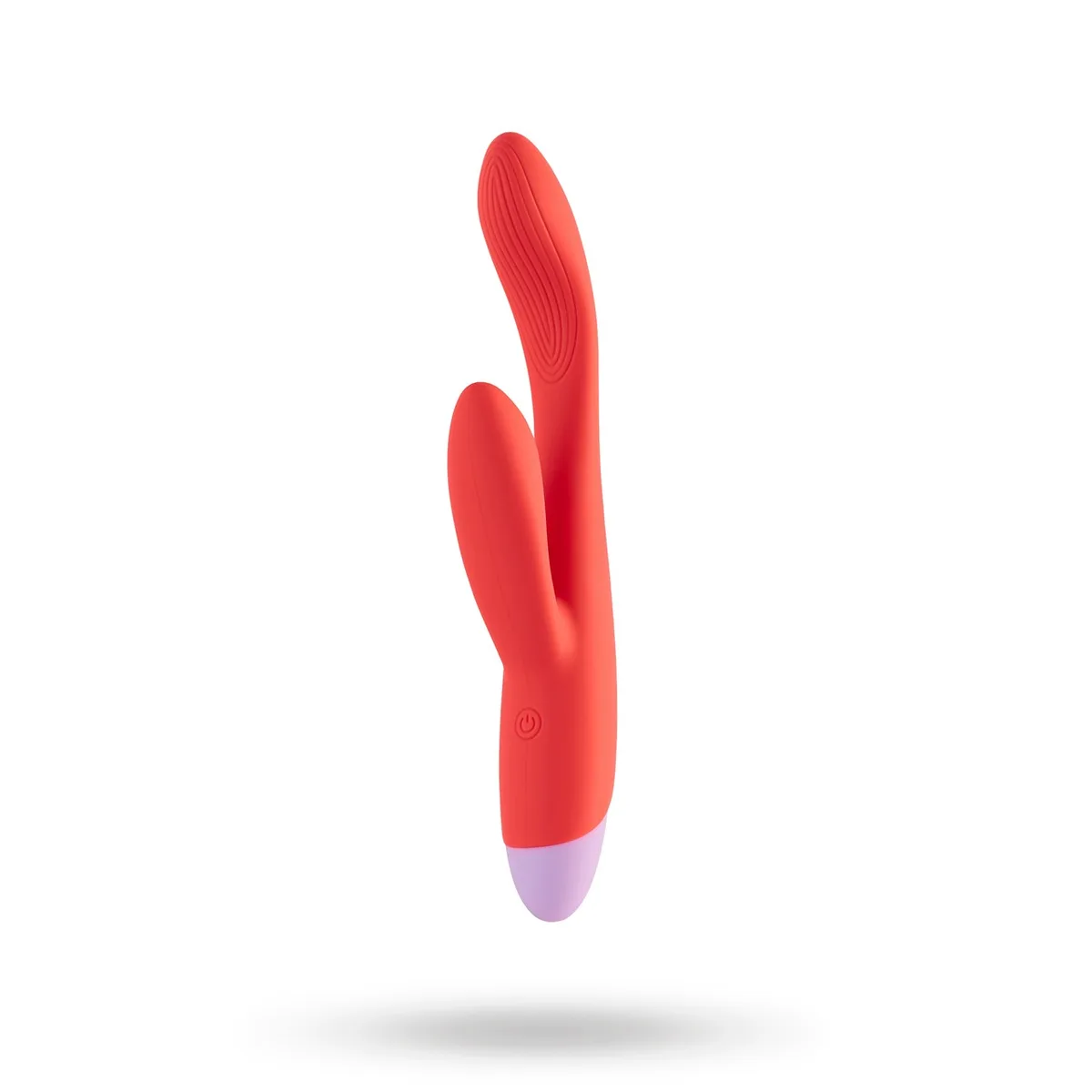
Double Beat Duo Vibrator is a rabbit vibrator from Dream Toys’ Love Signal series. It has two motors—one in the curved inner arm and one in the outer clitoral arm—and the manufacturer states that they work simultaneously for combined inner and outer stimulation. The entire product is controlled with a single button, and the programs consist of three speeds and seven vibration patterns.
The specification looks like this according to the manufacturer: 19 centimeters total length, 2.3 centimeters in diameter, silicone and ABS as materials, ingress protection class IPX6, 90 minutes of charging time, 90 minutes of operating time at the lowest speed, and 50 minutes at the highest. The manufacturer’s recommended price is 29.99 euro. In Sweden, the item is sold by four stores at prices between 295 and 349 SEK, and all four had it in stock during the price check on September 12, 2026.
This review covers the red variant with EAN 8720365107702, which the manufacturer lists as item number 22268 and, in the distribution chain, the reference LS22268. The number is verified in the gtin13 tag on Intima’s product page, in the item number field on Vuxen, Blush Me, and SexleksakerOutlet, and also with the Spanish retailer Eroticfresh, which links the same EAN to the manufacturer’s reference. The manufacturer does not publish an EAN on its own product page, which makes this chain worth mentioning: the identification relies on item number 22268, which is printed in the manual.
One more thing about the name. The stores call the product four different things—Blush Me writes "Double Beat Duo Vibrator Rabbitvibrator", Vuxen and SexleksakerOutlet write "Double Beat Duo Vibrator", and Intima sells it as "Love Signal Double Beat" under the Love Signal brand instead of Dream Toys. It’s the same item. Dreamtoys is the brand, Love Signal is the collection, and Double Beat is the model. Behind it all is Tonga BV in Axel, the Netherlands, which is listed as the manufacturer in the manual.
The manufacturer uses the word duovibrator; the stores say rabbitvibrator, and both refer to the same design: a product with two arms, where the inner one is intended for vaginal stimulation and the G-spot, and the outer one lies against the clitoris. The point of the shape is that the two happen simultaneously without you needing to hold two separate products.
What sets this model apart from the simplest rabbit vibrators is that it has two motors instead of one. The difference is technical and concrete. In a one-motor rabbit, the motor is usually located in the shaft, and the outer arm gets its vibration because the entire housing shakes. The vibration becomes weaker the farther away from the motor you get, and the outer arm is, in practice, a passenger. With its own motor in the clitoral arm, the vibration instead comes from the arm itself.
However, it’s important to read the specifications carefully before making too much of it. The manufacturer states two motors and ten programs, but nowhere does it say that the motors can be controlled independently of each other. The interface consists of a single button, and it practically says the same thing: there’s no way to increase the inner and decrease the outer. Two motors here means that both arms get power, not that you get two controls. It’s a crucial difference versus more expensive models in the category, and it’s easy to miss in store descriptions.
Love Signal is a broad collection, and three of the models are close to each other in the lineup. The manufacturer’s own specifications clearly set them apart:
So the difference between Double Beat and Twin Toned Duo is not the number of modes—both have three speeds and seven patterns—but the thickness and the battery. Double Beat is the slimmer of the two, and the manufacturer’s own figure of 2.3 centimeters makes it one of the narrowest rabbit vibrators sold in Sweden. Twin Toned Duo charges longer and lasts longer at high speed, but is more than fifty percent thicker.
The material issue is the only feature of an intimate product that can’t be compensated for with experience or care, and it determines whether the product is still hygienic in a few years. The manufacturer lists two materials for Double Beat: silicone and ABS. Intima describes the construction as flexible silicone around a fixed core, and it’s the most common solution in this price range—the silicone sits against the body, and the ABS plastic supports the construction.
Silicone is a non-porous material. A non-porous surface can be cleaned, because there are no microscopic cavities where residue can get trapped. This is the single most important property of a material that is meant to lie against mucous membrane, and that is why the material declaration carries more weight than almost all other lines in a specification. The manufacturer describes silicone itself as latex-, BPA-, and phthalate-free, hypoallergenic, and non-porous.
ABS plastic is also non-porous and is described by the manufacturer as rigid, lightweight, and good at transferring vibrations. It’s precisely that last property that explains why the combination is so common: a soft silicone arm alone dampens the vibration, while a rigid core carries it on. The price you pay is that a product with an ABS core is not as flexible as an all-silicone product, and that the manufacturer advises against boiling—which matters for cleaning further down.
What can be established is that the manufacturer does not publish how the materials are distributed in concrete terms. There is no information on which parts are ABS and which are silicone, and no information on the hardness of the silicone. The purple tip at the very bottom of the handle can be seen in the product images as a separate part, but what it is made of is not stated. The manufacturer does not publish a material breakdown by part—only that the product consists of silicone and ABS.
Phthalates are a group of plasticizers used to make plastic—above all, soft PVC—flexible. Kemikalieinspektionen describes them as substances that can affect the hormone system and make reproduction more difficult, and several of them are therefore restricted or banned within the EU in a large number of products. This specific product category is repeatedly subject to supervision because it contains soft plastic in contact with skin.
The manufacturer’s manual bears the symbol “PHTHALATE FREE” together with the words “body safe”. It’s a commitment, and it should be read as a commitment—but it’s still worth more than labels like “TPE” or “jelly rubber”, which say nothing at all about which plasticizers are included. Neither silicone nor ABS requires phthalate plasticizers to work, so the material information and the commitment point are pointing in the same direction.
The packaging also states “100 % silicone” in its symbol row, which can’t be reconciled with the specification’s “silicone and ABS” if you read it literally. A reasonable assumption is that the symbol refers to the surface that lies against the body. There’s ambiguity in the manufacturer’s own material information, not a sign that there are two versions of the product—the specification table, the manual, and all four Swedish shops state silicone and ABS.
The manufacturer states a total length of 19 centimeters and a diameter of 2.3 centimeters, and the same figures are shown in the official size chart, where 19 cm (7.5 inch) and 2.3 cm (0.9 inch) are indicated. The product sketch in the manual repeats the length of 19 cm.
There is a discrepancy here that is worth noting. Intima, Vuxen and the Spanish retailer Eroticfresh all list 2.2 centimeters as the maximum diameter, while the manufacturer lists 2.3 centimeters. The difference is one millimeter and has no practical significance, but it shows how store data has diverged from the source over time. When the shop and the manufacturer disagree, the manufacturer’s information applies, and it is 2.3 centimeters.
The weight information is a clearer gap. The manufacturer does not publish any weight for Double Beat, either on the product page or in the manual, and none of the four Swedish stores does either. The only figure that can be found comes from the Spanish retailer Eroticfresh, which lists a gross weight of 0.165 kilogram. Gross weight normally means the product including packaging, so the actual product weight is under 165 grams — but exactly how much under cannot be substantiated. For comparison, Lelo lists 150 grams for Ina 3, which is a significantly larger product at 200 × 65 × 45 millimeters.
The same Spanish source also lists the carton dimensions as 26 × 8 × 6 centimeters. The manufacturer does not publish any packaging dimensions. This matters mainly for the person wondering how big the package will be in the mailbox — 26 centimeters is too long for most letter slots.
The insertable length is also unpublished. The manufacturer’s 19 centimeters is the total length, and from the product images it appears that a substantial part of it is made up by the handle below the clitoral arm. Neither the manufacturer nor any of the stores states how many centimeters of the 19 are actually insertable. It is information that Lelo publishes for Ina 3 — 110 millimeters out of 200 — and the absence of it is one of the clearest differences between a budget specification and a premium specification.
The interface on Double Beat is as simple as it can be. The manufacturer’s manual points out two details on the product: the button, marked with a one, and the charging port, marked with a two. There is nothing else. The product images show a single round power button embossed into the silicone a bit down the handle.
According to the manufacturer, you start the product by holding in the button for three seconds, at which point an LED lights up and the vibration starts immediately. A short press moves you on to the next vibration pattern. You turn it off by holding in the same button for three seconds again, and the LED goes off.
That means, in practice, that you can only move forward in the list. If you want to go back to the previous setting, you have to press through the entire loop. On a product with ten programs, that means that, in the worst case, you need nine presses to go back one step. That’s the direct cost of a user interface without a minus button, and it’s worth factoring in before buying — especially since the button is on the handle and therefore isn’t visible when the product is in use.
The manufacturer states "3 speeds + 7 patterns", meaning three speeds and seven vibration patterns, and the packaging repeats the same thing as "7 rhythms & 3 intensities". The Spanish retailer sums it up as ten settings, which is the same information expressed differently.
This breakdown is typical for the price category. The first three steps are constant vibration with increasing intensity. The seven that follow are rhythmic patterns — pulses, waves, step-by-step increases — that run at a fixed intensity. What can be established is that the intensity and the pattern aren’t two independent controls here: if you choose a pattern, you also get the intensity that the pattern is built for.
Comparing it with the Lelo Ina 3, which also lists ten programs, the number is identical. The difference lies somewhere else: Lelo publishes a battery capacity, an insertable length, and a warranty, and then it costs accordingly. That’s why the number of programs is a poor metric for comparing products, and it applies to the entire category.
A one-button interface has two real advantages. There’s nothing to learn, and there’s nothing you can accidentally press wrong in the dark. For someone who wants a product that just works, that’s an argument, not a drawback.
The drawbacks are just as concrete. You can’t jump back. You can’t control the two motors separately, even though there are two of them. And you can’t turn off one arm if you only want the other. The last one is the most common objection to budget rabbit vibrators in general: the inner and outer arm rarely fit all bodies equally well at the same time, and without separate controls there’s no way around it.
What can be established is that the manufacturer neither states a memory function — that the product starts in the setting you last used — nor any quick-stop function. If you want to turn it off, you hold the button for three seconds, which is the only way.
Double Beat is rated IPX6, and the manufacturer consistently prints the class instead of words like "waterproof". It’s actually a deliberate choice: Dreamtoys’ own knowledge page explains that they use IPX classes just because concepts like waterproof, water-resistant, and splashproof vary between brands and leave the buyer guessing. It’s unusually straightforward for the price category, and it deserves praise.
The classification comes from the international standard IEC 60529, which defines enclosures (ingress protection) classes for electrical equipment. The number 6 in the second position stands for protection against powerful water jets—not for submersion. The manufacturer’s own wording is that an IPX6 product can be rinsed under running water or used in the shower for up to ten minutes, and that you should avoid longer exposure than that.
This is the single most important line in the entire specification, and it’s easy to read past. The manufacturer defines IPX7 as full submersion to 90 centimeters for up to 30 minutes, and IPX6 as rinsing or showering for up to ten minutes. The practical difference is the bathtub: Double Beat is not classified for being submerged in water. It can be rinsed, it works in the shower, but it should not be left in a filled washbasin, and it should not be used in the bath.
Adults says the same thing in its quick-facts box, with the words “Only splash-proof.” The wording is stricter than the manufacturer’s own, which explicitly allows running water, but the conclusion is the same: no submersion. When the store and the manufacturer differ, you go by the manufacturer’s instructions, and those say that rinsing is allowed.
This is also why comparisons with more expensive models diverge. We-Vibe lists IPX7 for Nova 2, and Lelo describes Ina 3 as one hundred percent waterproof. That means both can be submerged. Double Beat can’t—and that’s a real limitation in everyday life, not least when it comes to cleaning.
The manufacturer’s instructions are clear, and somewhat unusual: rinse or spray the product with an alcohol-free cleaning agent for intimate products after each use, dry it with a clean, lint-free cloth, and put it away in the storage pouch only once it is completely dry. The reason they give is that cleaning agents made for the purpose are gentle on the skin and remove bacteria completely—preventing infections and extending the product’s lifespan.
The lubricant issue is just as clear. The manual spells it out in all caps: do not use silicone-based lubricant. The manufacturer’s materials page explains why: silicone-based lubricants break down the silicone surface over time and make it porous, and a porous surface can no longer be cleaned properly—it can only be replaced. A water-based lubricant is what to use. Oil-based products, such as coconut oil, also leave a film that’s hard to get rid of.
Two things that rarely show up in store texts belong here. The manufacturer’s materials page states that ABS plastic can’t handle boiling, which—together with the IPX6 rating—means that boiling and a dishwasher are ruled out even if you’ve seen the advice given for other silicone products. And the manual’s warning box states that the product is not intended for therapeutic use, that it should not be used on swollen or inflamed skin, and that prolonged and frequent use is not recommended.
The manufacturer states a charging time of 90 minutes and splits the operating time into two numbers: 90 minutes at the lowest speed and 50 minutes at the highest. It’s a more honest way of presenting it than the usual single-number claim, because the runtime of a vibrator always depends on how hard the motors run, and it’s worth noting that a manufacturer in this price range goes to the trouble of doing so.
With the included cable, which the manufacturer consistently calls an "USB-pin". The manufacturer’s own detailed image shows what it means physically: a small round hole in the silicone and a round DC-type connector at the end of the cable—not a USB-C connector. The other end of the cable goes into a USB port. In the same image, the markings DC, UKCA and CE are visible, as well as the symbol for separate collection of electrical waste embossed into the silicone.
It’s a trade-off, not a pure advantage. The advantage of having a small, round pin is that the hole in the housing can be made minimal, which is part of the explanation for why the product is able to handle IPX6 in the first place. The downside is that the cable is product-specific: if you lose the charging cable, no regular USB-C cable works. It’s a real difference compared to, for example, Satisfyer’s models, which charge with any USB-C cable, and it’s a risk that increases over time—a thin DC cable is exactly the kind of accessory that disappears in a desk drawer.
According to the manufacturer, an LED blinks while the product is charging and lights with a steady glow when it’s fully charged. Charging takes 90 minutes from an empty battery. The manufacturer also states that the product is delivered partially charged, but recommends fully charging it before first use.
The manufacturer does not publish the battery capacity in mAh, its voltage, or its type for Double Beat, either on the product page or in the manual. None of the four Swedish stores publishes it either. What’s stated is that the product is rechargeable and that the cable is included.
It’s worth noting because the competitors do. Lelo states 500 mAh and 3.7 volts for the Ina 3, along with the charging voltage of 5.0 volts and the charging current of 500 milliampere. Without the capacity, you can’t convert operating time into power consumption, and you can’t compare how heavily the cell is loaded between models. You also can’t judge how much capacity remains after a couple of hundred charging cycles.
What generally applies to lithium-ion batteries in this product category reasonably applies here too: capacity decreases with the number of charging cycles, the cell is fast-soldered in place, and the product is, in practice, used up when the battery is. The manufacturer also does not state whether the battery can be replaced, but the product is fully cast in silicone with no visible opening, which makes the matter fairly clear.
A note about the manufacturer’s documentation belongs here, because it affects a figure that many people base their purchase on. The specification table on the product page states a run time of 90 minutes at the lowest speed. The manual states 90 minutes. The package states "90 min play time". The product description on the same product page also states 90 minutes. But in the bullet list of sales arguments, at the very bottom of exactly the same page, it instead says "use time at low speed 70 minutes".
Four out of five items in the manufacturer’s own material say 90 minutes, and all four Swedish shops have adopted the 90 figure. What can be concluded is that the 70 figure stands alone, and that it is likely a remnant. But it’s there, on the manufacturer’s own page, and anyone relying on an exact 90-minute run time should know that the manufacturer isn’t completely consistent on this point.
The figure for the highest speed—50 minutes—is, on the other hand, the same everywhere. It’s also the most relevant figure in practice, because two motors at full power are what actually drains the battery. Expect it to last under an hour if you use it hard, and significantly more if you don’t.
The manufacturer publishes no measured decibel value for Double Beat, either on the product page, in the manual, or on the packaging. None of the four Swedish shops gives any either. So there’s nothing to compare in terms of sound levels, and claims about the matter that circulate without a source should be treated accordingly. What you can say is that a product with two eccentric motors in a rigid ABS frame normally makes more noise than one with a single motor, because two unbalanced weights create two sound sources, and the rigid core conducts sound as well as it conducts vibration.
We do not have price data from shops in your market yet.
Two motors here mean that both arms get power—not that you get two controls. The entire product is controlled with a single button.
Three comparisons are relevant: against the coarser model in the same series, against an established premium rabbit, and against an app-controlled model in a completely different price range. All information below comes from each manufacturer’s own specifications, and all Swedish prices come from the stores’ product feeds on September 12, 2026.
Twin Toned Duo is the same manufacturer, the same collection, and the same basic design: two motors, three speeds, seven patterns, silicone and ABS, IPX6, and the same total length of 19 centimeters. The recommended price is 44.99 euros versus Double Beats 29.99 euros.
What Twin Toned Duo adds is thickness and battery. The diameter is 3.6 centimeters versus 2.3, so just over fifty percent more, and the runtime is 80 minutes at the lowest and 60 minutes at the highest speed versus Double Beats 90 and 50. Charging time is longer in return: 100 minutes versus 90.
The conclusion is more straightforward than in most comparisons. If you want fullness, Twin Toned Duo is the only way to get it within the series—and it also lasts ten minutes longer at full power. If you want something slim—because it’s your first rabbit, because 3.6 centimeters is too much, or simply because you prefer it—that’s the Double Beat model, and it’s cheaper. In practice, it’s a choice about thickness, not quality.
Lelo Ina 3 is one of the most sold premium rabbits and a reasonable benchmark. It measures 200 × 65 × 45 millimeters, weighs 150 grams, is made from body-friendly silicone and ABS plastic, has a lithium-ion battery of 500 mAh and 3.7 volts, is charged for two hours at 5.0 volts and 500 milliampere, goes up to two hours on a single charge, has an insertable length of 110 millimeters and a diameter of 37.09 millimeters, is one hundred percent waterproof, and has ten settings. The warranty is two years, with a ten-year quality guarantee thereafter, and the box includes a USB charging cable, a satin pouch, a warranty card, and a manual.
The number of settings is therefore identical—ten versus ten. Everything else is different. Ina 3 is significantly thicker with its 37 millimeters versus Double Beats 23, it can be submerged in water, it has a published battery capacity, a published insertable length, a published weight, and a published warranty. Double Beat has a shorter charging time—90 minutes versus 120—and a slimmer body.
What’s worth saying plainly is that this comparison isn’t about which product is best, but about what you pay for. With Ina 3, you buy disclosed data and a warranty. With Double Beat, you buy the same number of programs and roughly the same runtime for a fraction of the money, and in return you accept that several lines in the specification simply aren’t there.
We-Vibe Nova 2 measures 217 × 85 × 39 millimeters, is made of body-friendly silicone without phthalates, BPA, or latex, and has a USB-charged lithium-ion battery with up to 90 minutes of charging time and up to 120 minutes of operating time. It is IPX7-rated and is controlled via an app. The warranty is two years, and the price is listed from 149 euro. The package includes a USB cable, quick start guide, manual, a lubricant sample, and a linen storage bag.
The charging time is interestingly the same as Double Beats: 90 minutes. The operating time is longer—up to 120 minutes versus 90 at the lowest speed—and the differences after that are the expected ones: app control, IPX7 instead of IPX6, and a published warranty.
For those wondering whether stepping up is worth the money, the relevant question is what you will actually use. App control is a real feature for couples who are apart, and a nonexistent feature for someone who will never open the app. IPX7 matters in the bathtub and when cleaning. What the more expensive models sell primarily, though, is something a bit more straightforward: a specification you can verify, and a manufacturer warranty you can rely on.
Four Swedish stores sell the item with EAN 8720365107702. Cheapest are Blush Me and SexleksakerOutlet, both at 295 SEK. Next comes Vuxen at 329 SEK and Intima at 349 SEK. There is a 54 SEK or 18 percent difference between the lowest and highest store for the exact same item number.
Eighteen percent is an unusually small spread in this category, and that says something about the product. A model sold by only four stores and that sits close to the manufacturer’s recommended price of 29.99 euro has not yet become a price-pressured volume product. By comparison, it often differs by a hundred percent or more between the lowest and highest store on the most widely distributed models.
All four stores had the item in stock during the price check on September 12, 2026, which means the cheapest price is also the one you can actually buy for. It’s not a given—on many products, the cheapest store is sold out, and the price in the feed is an old price that doesn’t apply when the item is back in stock.
The prices in the table above are updated when the stores’ product feeds are updated, but always check the final price at checkout. In this price range, all four stores are below their respective thresholds for free shipping, so shipping cost is added and can very well erase the entire 54 SEK price difference. Intima charges 59 SEK in shipping under 995 SEK, which means the most expensive store can become cheaper than the cheapest if you’re already buying something else there.
It fits you if you want a slim rabbit vibrator. With 2.3 centimeters in diameter, it’s slimmer than most in the category, and significantly slimmer than both the sibling model Twin Toned Duo at 3.6 centimeters and Lelo Ina 3 at 3.7 centimeters. For anyone who doesn’t want anything bulky, and for anyone buying their first rabbit, choosing exactly this one is a reasonable reason.
It fits you if you want an interface without learning: one button, ten settings, hold for three seconds to turn on and off. It fits you if you want two motors rather than one, and thereby vibration in the clitoris arm that isn’t only a result of the shaft shaking. And it fits you if you want silicone against the body and a manufacturer that writes “phthalate-free” in the manual and states its protection rating with IPX numbers instead of vague terms.
It doesn’t fit you if you want to be able to control the two motors separately—there’s no way to do that. It doesn’t fit you if you want to use the product in the bath, because IPX6, according to the manufacturer’s own definition, ends at showering and rinsing. It doesn’t fit you if you want to charge with the same cable as your phone, because the charging port is a round DC socket and not USB-C. And it doesn’t fit you if you require published battery capacity, weight, insertable length, sound level, or warranty period before purchase, because the manufacturer publishes none of them.
One more thing belongs in the decision. Double Beat is designed as an affordable entry-level product, and the price from 295 SEK reflects that exactly. Anyone who wants a product to keep for ten years with a warranty to lean on will have to look in another price range. Anyone who wants to know whether a rabbit vibrator is even a fit, without spending a thousand kronor on finding out, has one of the cheaper ways to get there here—with a manufacturer that actually publishes a manual and a specifications table, which is more than many competitors in the same price range do.
The manufacturer does not publish any warranty period for Double Beat. Neither the product page, the manual, nor the packaging states any voluntary manufacturer warranty, and none of the four Swedish stores refers to any. It’s a clear difference from the premium segment—Lelo states two years of warranty plus a ten-year quality warranty for Ina 3, and We-Vibe states two years for Nova 2.
However, the absence of a manufacturer warranty doesn’t mean you’re left without protection. Under the Swedish Consumer Sales Act (konsumentköplagen), you have three years of right of complaint for defects in the goods, regardless of what the manufacturer promises or does not promise, and that right is directed at the store you bought from—not at Tonga BV in the Netherlands. For a product in this price range, in practice it’s the only warranty that matters, and it lasts three years.
For distance purchases, you are also entitled to a right of withdrawal for fourteen days according to the Act on Distance Contracts and Contracts Concluded Outside Business Premises. Be aware that, in practice, the right of withdrawal is limited for hygiene products that have been removed from a sealed package — the right to complain for defects, however, always applies. If you have questions about what applies in your case, Konsumentverket (the Swedish Consumer Agency) guides you via Hallå konsument.
A practical tip that follows from the lack of a warranty: save the receipt and save the charging cable. The cable is product-specific and is not included in any standard assortment, and a product whose charging cable has gone missing is, in practice, unusable. Store it in the same bag as the product.
Dream Toys Double Beat Duo Vibrator is ranked på plats 15 av 21 in rabbit vibrator best i test, where the entire category is compared against each other using five shared criteria. Guiden vinns av We-Vibe Nova 2.
Every numerical piece of information in the text can be traced to one of the sources below. The links were checked manually on the specified date.
This page is machine-translated from Swedish. Read the Swedish original