

Review
Review: Satisfyer Pro 2 Next Generation
Cheapest among the widely sold — 219 SEK and a 15-year warranty.
29 July 2026
Review · Vibrating egg · Wireless remote control
Dream Toys remote-controlled insert eggs reviewed against the manufacturer’s own packaging and measurement materials and against price data from three Swedish stores. Seven vibration patterns in four intensities, 100 percent silicone, 19 centimeters total length and 3.2 centimeters width, IPX6 according to IEC 60529, and 60 minutes of playtime — but neither charging time, battery capacity, sound level, nor warranty period is published.
A simple and honest remotely controlled plug-in egg: full silicone, a molded pull-out cord, and seven patterns in four intensities for 329 SEK. What you’re paying for is the sealing class — IPX6 covers showers but not submersion — and a playtime of 60 minutes, one third of what Svakom Elva states. The documentation is also thin: charging time, battery capacity, sound level, and warranty period are not published by anyone.
Eggcitement Wearable Vibrating Egg is a remote-controlled vibrating egg from Dream Toys, sold under the collection name Love Signal. The product type is one of the simplest available in the category: an oblong silicone body with a motor inside, a fixed pull-out cord on one end, and a separate wireless remote control. No app, no screen, no sensors — and that’s exactly why the specification above is unusually easy to check line by line.
The manufacturer’s own packaging states seven rhythms with four intensity levels each, i.e. 28 combinations, one motor, enclosure rating IPX6, 60 minutes of play time, charging with the included cable, and a remote control with a seven-meter range. The dimension sketch gives a total length of 19 centimeters including the cord, and a maximum width of 3.2 centimeters, and the material is listed as 100 percent silicone. That’s the entire published specification — and it’s shorter than in almost all the other reviews on this site.
This text is about the item with EAN 8720365107955. The number has been checked against all three shops in Sweden that sell it: Vuxen lists it as the item number on its product page, and Blush Me and SexleksakerOutlet sell the same item under the same number. The prices were between 329 and 359 SEK at the price check on September 12, 2026, and all three shops had it in stock.
What makes this product interesting to review isn’t what’s stated in the specification, but what isn’t. Charging time, battery capacity, sound level, warranty period, and the egg body’s own length are completely missing from the manufacturer’s materials. That in itself is a result, and it’s the kind of gap that’s easy to miss when you only read the shop text — because the shop text only repeats what the manufacturer has written.
The name says wearable vibrating egg, and in Swedish shop listings the model is sometimes filed under the heading panty vibrator. It’s worth clarifying before buying, because the two things aren’t the same. A panty vibrator in the usual sense is a flat device that’s pinched into or placed in the panty and sits on the outside of the body against the clitoris. Eggcitement is an insert egg: the body is inserted vaginally, the cord remains hanging outside, and the vibration happens from within.
“Portable” therefore means that the egg can stay in place while you’re doing something else, not that it attaches to an item of clothing. The difference matters for someone who’s looking for clitoral stimulation — you don’t get it directly from this design, but through the internal pressure and vibration. If you want both, then a product like We-Vibe Jive 2, which is built for the same internal placement, or a dual-vibrator concept with an external arm, is a more accurate route.
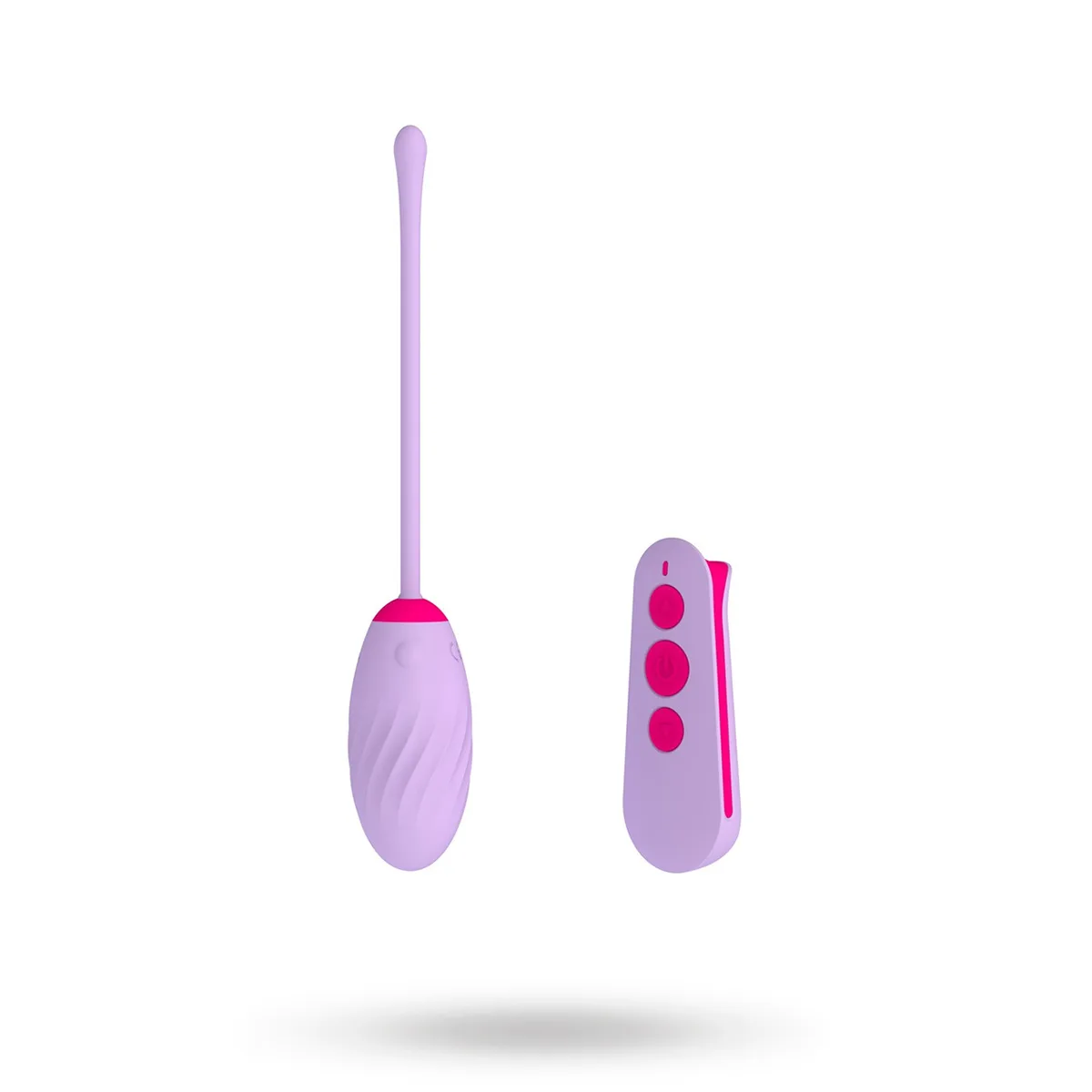
The shape is clearly visible in the manufacturer’s own images: a teardrop-shaped body that’s widest in the middle and tapers toward the cord, with spiral-shaped ridges over the lower half. Vuxen describes the texture as ridged in its product data. The ridges are passive — they do nothing electrically; instead, they provide structure against the mucous membrane and a slightly less smooth surface to grip.
This article appears under three different names, and it’s worth knowing about this when comparing shops. Swedish shops sell it as the Eggcitement Wearable Vibrating Egg under the Dream Toys brand. The manufacturer’s packaging is labeled love signal at the top and Eggcitement — Remote egg at the bottom. The manufacturer’s own dimension sketch calls the same product My Egg-citement.
When the manufacturer’s own material uses two spellings of the product name, that’s an inconsistency in the manufacturer’s documentation—not two different variants. It’s the same egg, the same remote control, and the same icon row in both images.
Love Signal is a collection within Dream Toys, not its own brand. The same collection name appears on other items sold by European retailers — for example, an anal plug set in the series with EAN 8720365107849, so in the same number series as the egg. Dream Toys, in turn, is published by the Dutch supplier Tonga, according to the trade magazine EAN Online. That chain is relevant for just one reason: it explains why there is no public product page where you can read the specifications. Tonga’s catalog is a trade channel aimed at shops, not consumers, and that’s why the packaging and image material are the only manufacturer sources you can go by.
The material question is the only characteristic of an intimate product that can’t be compensated for with experience or care, and it determines whether the product is still hygienic after a few years. The answer is unambiguous, and it comes from three directions. The manufacturer’s packaging has an icon labeled 100 % silicone. Blush Me lists the material as “high-quality silicone” in its feature table. Vuxen lists “Silicone” in its quick facts. Three sources, same message.
Silicone is a non-porous material. A non-porous surface can be cleaned, because there are no microscopic pores where residue can get trapped. It is the single most important property of a material that is meant to sit against mucous membranes, and on an insertion attachment it weighs more than on almost any other product type—during use, the entire body is kept inside, and the only part you can wipe off from the outside afterward is the cord.
Silicone also has three properties that are practically relevant here. It is temperature-stable within the range a body operates in. It is chemically resistant to mild soap. And it retains its shape—a silicone casing over a motor does not become brittle in the same way as soft-gelled plastic, which hardens as the plasticizer migrates out of the material over the years.
What the manufacturer, on the other hand, does not do is break down the material specification by individual component. “100% silicone” appears as an icon on the packaging, and the manufacturer’s images show that both the egg-shaped body and the remote control have a soft, matte surface with the same character. But the material of the remote control is not stated separately anywhere, and the remote control is also not a part that goes inside the body—so this issue is less important than it sounds, but it belongs in an honest review.
Phthalates are a group of plasticizers used to make plastic, especially soft-gelled PVC, flexible. The Chemicals Agency describes them as substances that can affect the endocrine system and make reproduction more difficult, and several of them are therefore restricted or banned within the EU in a large number of products. This product category is a recurring subject of oversight precisely because it contains soft plastic against skin and mucous membranes.
Silicone doesn’t require phthalate plasticizers to become soft. The softness comes from the polymer’s own structure, and that is why a material label that says “silicone” on its own is better information than terms like TPE or jelly rubber, which don’t say anything at all about which plasticizers are included.
But there is a difference between stating a material and making an explicit declaration. The manufacturer makes no commitment that Eggcitement is free from phthalates, BPA, or latex, either on the packaging or in the image material, and none of the three Swedish stores prints it either. That is a concrete difference compared with We-Vibe, which for the Jive 2 explicitly states body-friendly silicone free from phthalates and BPA and made without latex. For someone with a latex allergy, that exact line is the one you want to see—latex allergy causes reactions on mucous membranes faster than on regular skin, and an intimate product is precisely the kind of use where the information matters. You don’t get that here.
The manufacturer’s dimensioned sketch lists two measurements: 19 centimeters, corresponding to 7.5 inches, for the full length, and 3.2 centimeters, corresponding to 1.3 inches, as the maximum width. The 19 centimeters are measured from the upper end of the cord to the lower tip of the egg—this is shown by the measurement arrows in the sketch—which means that a significant portion of the length is the cord and not the body. The manufacturer does not publish how long the egg body itself is as a separate measurement, and that is the figure most people actually want. The sketch clearly shows that the cord makes up most of the total length and the body only a smaller part, but no specific figure can be read from the image—therefore the row is listed as missing in the specification table instead of with an estimated value.
The width of 3.2 centimeters, on the other hand, is a straight measurement and the most useful number in the entire specification. It corresponds to 32 millimeters at the widest point, which happens to be exactly the same diameter that Svakom states for Elva (Ø32 millimeters). So the two products are equally wide, even though they’re sold in completely different price ranges. For someone who has never used an insertable egg, 32 millimeters is a relevant figure to compare with something you already know before you place an order.
Weight is a store-provided detail. The manufacturer’s packaging and image material state no weight at all. All three retailers list 65 grams in the product text, using the wording that the egg “weighs only 65 grams”. Since all three stores use the same supplier text, it is in practice the same information repeated three times—not three independent measurements—but it is reasonable in relation to the size. For comparison, Svakom lists 80 grams for Elva, which is the same width but has a shorter body and also contains ABS plastic and metal in addition to the silicone.
On an insertable egg, the cord is the most important mechanical detail, more important than the motor. The manufacturer describes it as a powerful pull-out cord, and the retailers translate it as “a steady pull-out cord for easy and safe use” and “firm and secure pull-out cord for easy removal.”
The construction can be read from the manufacturer’s own images. The cord is not an attached line, but a tapered extension made of the same silicone as the body, with a thickening at the top that serves as a grip. The transition between the body and the cord is concealed by a pink ring. The fundamentally important difference is that the cord is molded as one piece with the housing instead of being tied or glued: a knot or a glued joint is always the weakest point, and that point sits exactly where the load ends up being applied.
No pull strength for the cord is published by the manufacturer, and there’s really no manufacturer in the category that does either. What can be established is that the construction is the better of the two variants that occur, and that the cord is also long enough—the main part of the 19 centimeters—to always reach beyond.
The interface is split across two units. The remote control is the one you use to control it, and the manufacturer’s product image shows exactly what it includes: a small indicator light at the very top, beneath it a button labeled with an upward arrow, in the middle a larger button with an on/off symbol, and at the bottom a button with a downward arrow. Three buttons and a lamp—nothing else. What each button does in detail—whether the up arrow steps intensity or switches patterns—the manufacturer does not describe, and no manual is published openly.
On the top of the egg, you can see, in a close-up from the manufacturer, a raised round button and an embossed on/off symbol. Neither the manufacturer nor any of the stores describes what the button on the egg does, and it isn’t possible to determine from the pictures whether the egg can be started and stepped without the remote control, or whether the button is only a power switch. It’s one of the gaps that would have been easy to fill with a manual, and one of several reasons not to lose the remote control.
The manufacturer’s packaging states seven rhythms and four intensities, and the function graphic formulates the same thing as “seven rhythms with four speeds each.” The store texts multiply it out into 28 unique combinations. The math checks out, but it’s worth understanding what the two numbers stand for, since they aren’t interchangeable.
The seven rhythms are time patterns: how the vibration is distributed over time, meaning even vibration, pulses, waves, stair-steps, and similar. The four intensities are strength: how hard the motor runs. A time pattern without a strength control is blunt, and a strength control without patterns becomes monotonous—so it’s the combination of the two that’s described. But 28 should be read as seven patterns, each of which can be run in four strengths, not as 28 different experiences.
The comparison with the category puts the number in proportion. Svakom lists eleven vibration modes plus one intelligent mode and five intensity levels—so more strength steps but fewer patterns. In this product class, the pattern is that the number of programs is the number manufacturers like to have printed on the packaging, while the number of intensity steps is what determines how well you can fine-tune. Four steps is few. It’s enough to distinguish weak from strong, but not enough to find a mode halfway between two that nearly match.
The range is stated as up to seven meters, both on the manufacturer’s packaging and in the store texts. It’s a reasonable and honest figure for a simple radio remote control, and it’s also a figure that describes the best-case scenario. Which radio technology or which frequency band the remote control uses is not published, so it isn’t possible to say anything about how it behaves through a wall or in an environment with a lot of other radio traffic.
What seven meters means in practice is: the same room. It’s enough from the couch to the kitchen counter and across a bedroom. It isn’t enough for partner play where one person is in another part of the home, and it’s a completely different thing than app control. An app-controlled product like We-Vibe Jive 2 can be controlled over the internet, meaning without any distance limit at all. If you’re specifically looking for that function, Eggcitement is the wrong product, and it’s that difference that justifies the big price gap between the two.
A detail that’s actually unusual in this price range: the remote control is rechargeable. The retailers state that both the egg and the remote control are charged with the included magnetic USB cable, and that no loose batteries are needed. What’s typical in the segment is a remote control with a button-cell battery of the type CR2032. The advantage is that you don’t have to search for batteries when the remote runs out. The downside is that you have two things to charge instead of one, and that a drained remote control means you can’t control the product at all if the egg’s own button turns out not to do the job.
Both the packaging and the functional graphics expressly indicate a single motor. It’s a detail that’s easy to overlook, but it explains a lot about how the product behaves: all vibration originates from a point inside the egg body and is distributed from there through the silicone. Products with two motors can instead place vibration in two zones and run them at different rhythms, which is the technical basis for the “double-stimulation” modes available on more expensive models.
Which type of motor it is is not published. The difference between a rotating eccentric motor and a linear motor affects both the frequency content and the sound image, and that information simply isn’t found in the material. What can be established is that a motor in a 3.2-centimeter-wide body is a small motor, and that’s one of the explanations for why the runtime is where it is.
Here, the answer should be short and it has to be short. Neither the manufacturer nor any of the three stores states any decibel value for Eggcitement, and the manufacturer also doesn’t make any marketing claim about quietness—there’s no “whisper” icon on the packaging and no comparison graphic of the kind that, for example, Womanizer uses.
That means that every exact decibel figure that appears for this model somewhere else either comes from someone’s own measurement or has no source. What can be established on a technical basis is three things: the product has a motor and not several, the casing is silicone over the entire body which dampens more than hard plastic, and an insert is generally heard less than an external product because the body lies between the motor and the room. How much less it is is not something that can be put a number to based on published material.
A practical piece of advice that applies regardless of model: never place the product on a hard tabletop while it’s running. The tabletop acts as a resonance box and noticeably amplifies the sound, and it’s the most common reason a product is perceived as much louder than it actually is.
The manufacturer’s packaging states the enclosure rating IPX6 with the addition “shower friendly,” and the functional graphic repeats the same rating. The rating comes from the international standard IEC 60529, which defines enclosure classes for electrical equipment. The number in the second position indicates protection against water, and there the difference between 6 and 7 is not a grade difference but two different things.
IPX6 means the product is tested against powerful water jets from all directions. It’s more than splash protection: an IPX6-rated product can be rinsed under a tap and withstand a shower without you needing to think about the angle. IPX7 means something else — that the product is tested for submersion in water to a depth of one meter for 30 minutes. So an IPX6 product is not approved for submersion, and it doesn’t matter how long or how shallow.
The practical consequence is simple to formulate: shower yes, bathtub no. Rinse under running water yes, put in a sink filled with water no. It’s a real limitation specific to this product type, because an insert is the category where you most of all want to be able to rinse the entire body properly afterwards — and that limitation is what separates the model from both comparison items. Both Svakom Elva and We-Vibe Jive 2 are IPX7.
If a product completely lacks an IPX rating, it should be treated as not water-resistant at all. The fact that Dream Toys states a rating at all, and moreover the lower of the two that are realistic, is in that sense a more honorable message than just writing “waterproof” without a rating.
There’s a discrepancy here that’s worth reporting. Blush Me and SexleksakerOutlet both write “Water-resistant (IPX6): Shower-friendly and very easy to clean,” which is a correct rendering of the manufacturer’s information. Vuxens snabbfaktatabell instead states “Waterproof: Only splash-proof”.
The two claims don’t add up. According to IEC 60529, IPX6 is more than splash protection — splash protection corresponds to IPX4, and IPX6 covers powerful water jets. Adult wording therefore underestimates the product on paper. The manufacturer’s wording weighs more, and it’s IPX6 that applies. But it should also be said that Vuxen’s wording is pointing in the right direction in what actually matters to the user: the product must not be submerged. Someone who reads “water-resistant” and interprets it as safe for a bathtub makes a more expensive mistake than someone who reads “only splash-proof” and is unnecessarily cautious.
Rinse the egg in lukewarm water after each use and use unscented soap or a cleaning agent intended for intimate products. Be especially careful at the transition between the body and the cord, where the pink collar sits — that’s a joint where residue can get left behind — and around the magnetic charging contact on the top side of the egg. Wipe with a clean towel and let it air-dry before putting the product away. Keep it under running water, but don’t put it in water, since IPX6 doesn’t cover submersion.
Use a water-based lubricant. Silicone-based lubricants should not be used on silicone products — they break down the silicone surface over time and make it porous, and a porous surface can no longer be cleaned properly, only replaced. Oil-based products like coconut oil leave a film that’s difficult to remove and can also affect condoms if such are used at the same time. On a plug-in attachment with a ridged surface, this rule is extra important, since the ridges provide more places where a degraded surface can start.
Store the product dry and preferably in its own bag. Silicone against silicone can, over time, leave impressions and discolorations when two different silicone blends are pressed against each other. No storage pouch is included according to the stores’ delivery descriptions — the model differs from Svakom Elva, where a storage pouch is listed in the package.
The manufacturer’s packaging states 60 minutes of playtime. It’s the only battery-related figure that’s published, and it’s short. One hour is enough for an individual occasion with a margin, but not for an evening with pauses in between, and not if you forget to charge between uses.
Compared to the category, the difference is big. Svakom states a three-hour operating time for Elva. We-Vibe states up to four hours for Jive 2. So Eggcitement is therefore at about one third and one quarter of the operating time of the two comparison objects, respectively. It’s the single most clearly visible compromise in the specification, and it ties in with the price — a larger battery costs both in purchase price and in space, and space is limited in a body that’s 3.2 centimeters wide.
With a magnetic cable that connects to USB. The manufacturer’s packaging states “rechargeable (cable incl)”, meaning the cable is included, and the shops write that both the egg and the remote control are charged with the included magnetic USB cable. The manufacturer’s product image shows how the connection sits: a small heart-shaped magnetic plate that attaches to the top of the egg, with the cord hanging freely.
Magnetic charging is a trade-off, not a pure advantage. The advantage is that no opening in the housing is needed, which is a requirement for reaching IPX6 at all without a rubber plug—and a rubber plug is always the part that wears out first on a wet product. The disadvantage is that the cable is product-specific: if you lose the charging cable, no standard USB-C cable works, and since the manufacturer has no consumer sales in Sweden, it’s unclear where a replacement should be purchased. It’s a real risk to factor in, and it’s bigger here than with a product from a brand with its own web shop and spare-part sales.
The manufacturer does not publish the battery’s capacity in mAh, its voltage, or its charging time. None of the three shops fills in the gap either. That means three things in practice. You don’t know how long a charge takes, you can’t convert the runtime into power consumption, and you can’t compare how heavily the cell is stressed versus another model.
That it can be better is shown by the competitors. Svakom states 300 mAh and 3.7 volts for the Elva, charging voltage 5 volts, and a two-hour charging time. We-Vibe lists a lithium-ion polymer battery and up to a 90-minute charging time for the Jive 2. With those figures, you can calculate: 300 mAh that lasts three hours means an average current draw of roughly 100 milliamperes. No corresponding calculation is possible for Eggcitement, and that’s why the rows are listed as “not published” in the table further down instead of with an estimated value.
What generally applies to rechargeable cells also applies here: capacity drops with the number of charging cycles, the battery in a product of this kind is not replaceable, and the product is best charged regularly rather than being stored completely discharged. With a runtime of 60 minutes, the number of charging cycles is also higher per hour of use than with a model with three or four hours of operation—which is an argument that is rarely mentioned but affects its lifespan.
We do not have price data from shops in your market yet.
Seven patterns in four intensity levels are printed on the packaging. Charge time, battery size, noise level, and warranty period don’t — and that says just as much about the product.
Two comparisons are relevant: versus a remote-controlled egg from a brand that publishes its entire specification, and versus an app-controlled wearable from a premium brand. All the information below comes from each manufacturer’s own product pages.
Svakom Elva is the most direct comparison, because it is the same product type: a remotely controlled egg intended for internal use. Svakom states the dimensions as Ø32 × 80 millimeters and the weight as 80 grams. Eggcitement is 3.2 centimeters wide, meaning exactly the same 32 millimeters, and it weighs 65 grams according to retailers. So the two are essentially equally wide, and Eggcitement is the lighter of the two.
Then the differences start. Svakom states a battery of 300 mAh and 3.7 volts, three hours of runtime, two hours of charging time, and the charging voltage of 5 volts. Eggcitement states 60 minutes of play time and nothing else. Svakom states IPX7, meaning immersion in a one-meter-deep water for 30 minutes; Eggcitement states IPX6, meaning powerful water jets but not immersion. Svakom states five vibration modes plus an intelligent mode and five intensity levels; Eggcitement states seven patterns in four intensities. Svakom states a two-year replacement warranty with ten years of quality support; Eggcitement states no warranty period at all.
Two things work against Svakom. The material is listed as silicone, ABS and metal, so it is not fully silicone as Eggcitement’s packaging states, and Svakom does not publish a range for its remote control — where Eggcitement has a published figure of seven meters. But the overall picture is clear: Elva is the better-documented and technically stronger product, and it is also the more expensive.
We-Vibe Jive 2 is a wearable of the same basic type but in a different price range and with a different philosophy. We-Vibe states body-friendly silicone that is expressly free from phthalates and BPA and manufactured without latex, a rechargeable lithium-ion polymer battery, up to four hours of runtime, up to 90 minutes of charging time, IPX7 and a two-year warranty. Control is done with a button on the product, with a remote control and with an app.
The difference that matters most is the app. An app-controlled product can be controlled over the internet, meaning without any distance limit, while Eggcitement’s remote control stops working after seven meters. If you want partner play at a distance, there is no way to get there via Eggcitement. Next comes runtime — four hours versus one — and the protection class, where IPX7 means that the entire product can be submerged.
What We-Vibe, on the other hand, does not publish is measurements and weight on its product page, which is a reminder that even premium brands have gaps. For someone who needs to know exactly how wide the product is before buying, Dream Toys’s dimension sketch is actually more useful than We-Vibe’s product page.
In summary, Eggcitement stands for conscious simplicity. You get full silicone, a properly cast pull-out cord, seven patterns in four strength settings, a remote control that is charged instead of using button cells, and a published width measurement that makes it possible to know what you’re ordering. You don’t get an app, no submersion, no long operating time, no published charging time, and no warranty period from the manufacturer.
It’s a reasonable package for the price range, but it should be chosen with open eyes. Anyone who shops for the “remote-controlled egg” and thinks they’re getting the app-controlled pair from a distance will be disappointed. Anyone who wants a simple, fully silicone-covered product for the same room gets one like that.
Three Swedish stores sell the item with EAN 8720365107955. The cheapest is Blush Me and SexleksakerOutlet at 329 SEK each, and the most expensive is Vuxen at 359 SEK. That’s 30 SEK, or just over nine percent difference for the same item number and the same packaging—an unusually small spread in this category, where it’s completely normal to see a 100 percent difference between the cheapest and the most expensive store for a product that’s been around for longer.
The stock situation is unusually good. Alla tre butiker hade produkten i lager vid priskontrollen 12 september 2026, which means that the lowest price is actually the price you can buy at, not a ghost price in a feed for an out-of-stock item. The fact that only three stores carry it at all is because it’s a new item—it showed up in the Swedish product feeds during September 2026.
The small spread is likely explained by that. A newly listed item hasn’t yet had time to build different campaign history at different stores, and all three are close to the recommended price. It also likely means that shipping cost has more impact on the final total than the difference between stores: 30 SEK is less than what shipping costs at most, and the free shipping threshold sits far above the product price in all three stores. So compare the grand total at checkout and not just the row in the table above.
It’s for you if you want to try a remote-controlled plug-in egg without paying a premium for it, and if you want full silicone rather than a shell where only parts of the surface are silicone. It’s for you if you want a published width measurement to compare it against—3.2 centimeters is a figure you can rely on, not an assumption. It’s for the person who wants a remote control that charges using the same cable as the product, and who doesn’t want a button-cell battery that runs out at the wrong time. And it’s for partner play in the same room, where seven meters is plenty of distance.
It’s not for you if you want to be able to lower the product into water. IPX6 covers showering and rinsing, but not a bathtub, and in that category both Svakom Elva and We-Vibe Jive 2 are a class better. It’s not for you if you want long runtime — 60 minutes is one third of Elva’s three hours. It’s not for you if you want to control it remotely, because there’s no app. It’s not for you if you require an explicit declaration about phthalates, BPA, and latex before purchase, because the manufacturer provides none. And it’s not for you if you want clitoral stimulation — the design uses a plug-in insert, no matter what the word “wearable” suggests.
One last thing belongs in the decision. This product has unusually little documentation, even by the standards of this category. It’s not proof that it’s bad — the package’s seven details are more than some brands manage — but it means that you’re buying a product where charging time, battery size, sound level, and warranty period are unknown until the package is on the table. In the 329 SEK price range, it’s a risk many people can reasonably accept. In the thousand kronor price range, it wouldn’t be.
The manufacturer does not publish any warranty period for Eggcitement, neither on the packaging nor in the available image material, and none of the three Swedish stores states any manufacturer warranty on the product side. It’s a clear difference compared to the comparison objects: Svakom lists a two-year replacement warranty for Elva, with ten years of quality support, and We-Vibe lists a two-year warranty for Jive 2.
That doesn’t mean you’re left without protection, and it’s important to distinguish between the two things. A manufacturer’s warranty is a voluntary promise in addition to the law. Your statutory rights apply regardless. According to konsumentköplagen, you have three years of right to make a claim for defects in the goods, and it applies to the store you bought from — not Dream Toys and not the supplier in the Netherlands. If the motor stops working or the housing comes loose within that time, and the defect is due to a deficiency that already existed at the time of purchase, it’s the store’s responsibility.
For distance purchases, you also have a right of withdrawal for fourteen days under lagen om distansavtal och avtal utanför affärslokaler. Be aware that in practice the right of withdrawal is limited for hygiene products that have been taken out of a sealed package — Konsumentverket provides guidance on what applies. The right to make a claim for defects in the goods, however, always applies, and in this case it’s the only warranty you can rely on. Save the receipt, and it’s also a good idea to keep the packaging, because it’s the only place where the product’s specifications are actually printed.
Dream Toys Eggcitement Wearable Vibrating Egg is ranked på plats 5 av 11 in panty vibrator best i test, where the entire category is compared against each other using five shared criteria. Guiden vinns av Lovense Ferri.
Every numerical piece of information in the text can be traced to one of the sources below. The links were checked manually on the specified date.
This page is machine-translated from Swedish. Read the Swedish original