

Review
Review: Satisfyer Pro 2 Next Generation
Cheapest among the widely sold—IPX7, USB-C and 15-year warranty.
29 July 2026
Review · Tongue stimulator · Vacuum pump · Vibrating egg
Three stimulation principles in one product, reviewed against the manufacturer’s own specifications and price data from five Swedish stores. Nine modes for the oscillating tongue, three for the vacuum pump, and one vibrating egg on the silicone cord — but a specification where neither IP rating, battery capacity, charging time, weight, nor sound level is published by the manufacturer.
Most function per dollar in the comparison: an oscillating tongue with nine settings, a vacuum pump with three suction settings, and a thrusting egg that can be operated independently of the other two—for 495 SEK. What you pay for is the documentation. The manufacturer publishes neither an IP rating, battery capacity, charging time, operating time, weight, sound level, nor a material declaration about phthalates, and the manufacturer’s own sources disagree about how many settings the egg has.
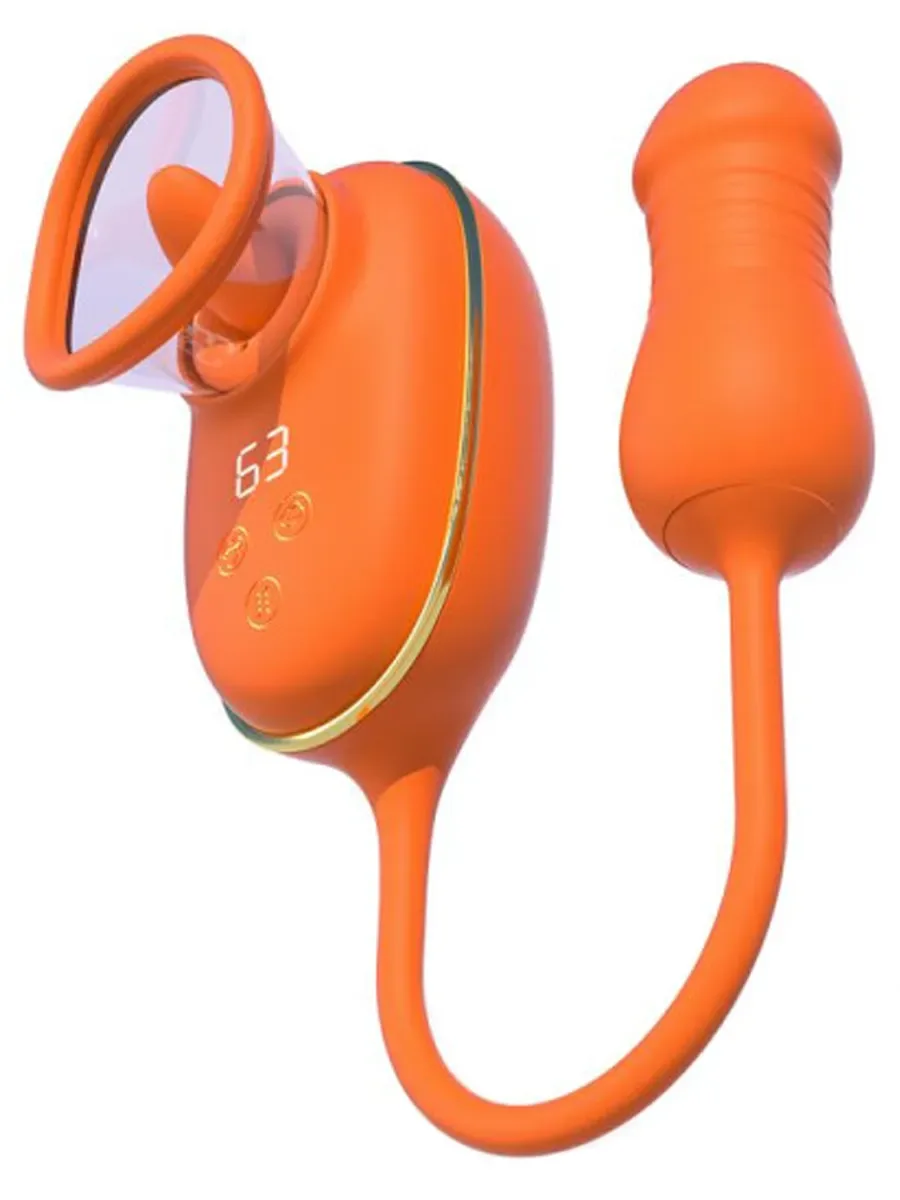
Engily Ross Lizer Pro is sold in Sweden under the longer name Lizer Tongue Stimulator, Vacuum Pump & Thrusting Egg Vibrator, and the name already tells you what the product is trying to be: three separate stimulation principles combined into one unit. An oscillating silicone tongue for external stimulation, a removable cover that turns the same tongue into a vacuum pump, and a vibrating egg with thrusting up-and-down movement that sits at the end of a flexible silicone cord.
The manufacturer lists nine tongue positions, three suction positions for the vacuum pump, and ten modes for the egg, and states that the functions can be used independently of each other. The material is listed as premium silicone; the product is described as water-resistant and charges via USB. Total dimensions are 45.9 × 6.1 centimeters. In Sweden, the item is sold by five stores at prices between 495 and 699 SEK, and all five had it in stock at the price check.
This review applies exclusively to the item with EAN 8436615004997 and the manufacturer’s reference ER00499. That number is verified in the manufacturer’s own product data, and it is the same number that all five Swedish stores list. It’s worth checking, because the brand sells a simpler model that is only called Lizer — without Pro — under a completely different item number, and the two get mixed up in search results and in the stores’ category pages.
One more thing belongs here already. The brand’s own web address, engilyross.com, returns an error message and has no working product page. The manufacturer’s information is instead on the product page at Lovecherry, the company behind the brand, and in the manufacturer’s own product and packaging images. That’s where all the manufacturer details in this text come from — and it also explains why the specification is more streamlined than on products from brands with their own web shop.
The tongue function is the original idea in the entire Lizer series. A small silicone tongue sits in a recess on the top side of the control unit and moves in an oscillating pattern— the manufacturer’s function graphic describes the movement as a 360-degree rotation. It is intended for external stimulation, and the manufacturer itself lists nipples, the clitoris, and the glans as areas of use. So the tongue makes contact with the skin, unlike air-pressure products where a sealed chamber works with pressure waves without direct contact. It is a fundamental difference: here there is mechanical movement against the skin, not pressure changes in the air.
The vacuum pump is a removable cover that is placed over the tongue. When the cover is in place over the sealing area and the pump creates a negative pressure in three steps, while the tongue can continue to work inside. The manufacturer describes the combination as meaning that the vacuum increases sensitivity while the tongue continues to stimulate, and it explicitly states that the cover can be removed and put back on at any time. The construction is therefore not an air-pressure chamber in the sense of Satisfyer’s or Womanizer’s—it is a suction cup with a mechanical tongue at the bottom.
The egg is the function that distinguishes the Pro model from the original. It sits permanently on a flexible silicone cord that originates from the control unit, and it combines vibration with an up-and-down striking motion. It is the part intended for internal use while the tongue or the vacuum cover works externally. The fact that the cord is fixed—not a detachable connection—is a design detail with practical implications that is worth thinking through before purchase, and it comes up again further down.
Three models in the range are close enough to be confused, and Swedish shops don’t help: the same product is listed as a “vibrator” at Taboo, as a “vagina pump” at Lekosmek, and as a “intercourse vibrator” at Vuxen.
The comparison between Lizer and Lizer Pro is the most illuminating, because it shows exactly what the extra few crowns buy: the egg and the thrusting movement. The tongue and the vacuum pump are the same functions with the same number of settings on both models. If you only want the tongue and vacuum, there’s no reason to pay for the Pro version.
The material issue is the only property of an intimate product that can’t be compensated for with experience or care, and it determines whether the product is still hygienic a few years from now. The manufacturer states a single material for Lizer Pro: premium silicone. Blush Me writes “high-quality silicone,” and Vuxen “Silicone.” None of them breaks down the specs per part.
Silicone is a non-porous material. A non-porous surface can be cleaned, because there are no microscopic cavities where residue can get trapped. This is the single most important property of a material that’s meant to lie against the mucous membrane, and that’s why the material declaration weighs more than almost all other lines in a specification.
But the label “premium silicone” doesn’t cover the entire product, and you can see that in the manufacturer’s own pictures. The vacuum cover is transparent and rigid—so it isn’t silicone but a hard plastic, with a soft silicone edge where it meets the skin. The control unit also has a glossy ring in gold-colored metal or metallized plastic around the edge, and a digit display underneath the surface. The manufacturer does not specify what materials those parts are made of, and it provides no material breakdown per component. What can be established is that the silicone is definitely where it matters most—on the tongue, on the egg, on the cord, and on the control unit’s housing—but that anyone who wants a complete material declaration gets nothing.
The design has a detail that deserves a note. The cord between the control unit and the egg is permanently mounted at both ends in both versions. That provides a hygienic advantage—there’s no seam or connection where liquid can penetrate—but at the same time it means that if the cord is damaged, the entire product becomes unusable, because the egg can’t be replaced or detached. The vacuum cover, on the other hand, is removable, as the manufacturer itself emphasizes, and it’s the only part that can be cleaned separately.
Phthalates are a group of plasticizers used to make plastic—above all, soft PVC—flexible. The Swedish Chemicals Agency describes them as substances that can affect the endocrine system and make reproduction more difficult, and several of them are therefore restricted or banned within the EU in a large number of products. This particular product category is a recurring subject of regulatory oversight, because it contains soft plastic against skin and mucous membranes.
Here comes the first really clear deficiency in the documentation. Engily Ross does not state anywhere that Lizer Pro is free from phthalates, BPA, or latex. The wording stops at “premium silicone.” That’s a difference compared to, for example, Womanizer and Satisfyer, both of which clearly declare the absence of phthalates, BPA, and latex in plain text on their product pages. None of the five Swedish retailers fills in the gap either.
How serious it is depends on how you read it. Silicone does not require a plasticizer to become soft—the softness comes from the polymer’s own structure—so the material information itself is a better signal than terms like “TPE” or “jelly rubber,” which say nothing at all about which plasticizers are included. In addition, the manufacturer’s product image of the back of the control section also shows the CE marking, the UKCA marking, and the WEEE symbol for electronics recycling, which means the product is intended to comply with EU regulations. But a voluntary material declaration is an active promise, and that promise is not present here. It’s a minus that’s hard to argue away.
The manufacturer states the dimensions as 45.9 × 6.1 centimeters, and the same figures are shown in the manufacturer’s own product image as “Total Lenght: 459mm” and “Width: 61mm”. Blush Me writes 45.90 cm, Vuxen writes “Totallängd 45.9 cm,” and Taboo breaks it down as “Längd: 45,9 cm” and “Diameter Ø: ~ 6,1 cm”. All five sources are therefore in agreement on the numbers.
The figure of 45.9 centimeters, however, is easy to misunderstand, and it’s worth sticking with it. It’s the product’s total extent with the cord extended—not the size of any single part. The comparison with the predecessor makes it clear: the original model Lizer, which has exactly the same hand unit and the same vacuum cap but no egg and no cord, is given by the same manufacturer as 10.5 × 5.9 centimeters. The width of 5.9 versus 6.1 centimeters is, in practice, the same, which confirms that it’s the same head. The 35-centimeter difference in length is therefore the cord plus the egg. Assume a hand unit around ten centimeters—not a product that’s nearly half a meter long.
Weight is a retailer’s claim. The manufacturer publishes no weight for Lizer Pro. The reseller Taboo lists 240 grams in its specification table. None of the other four stores states any weight at all, so the figure can’t be verified against a second source. Treat it as an indication from one store—not as a manufacturer specification.
The color is a little contradiction of its own. All of the manufacturer’s product images show a clearly orange product with a gold-colored detail ring. Blush Me lists the color as “Red” in its feature table. The other stores don’t state any color at all, and the manufacturer doesn’t name the color in the product name. It’s a minor issue — but if you order believing you’re getting a deep red product, the one you pull out of the box will be orange.
The interface is clearly visible in the manufacturer’s own product images. On the front of the control panel there is a numeric display that shows a two-digit number, and below it there are three buttons with separate icons — one for the tongue, one for the vacuum pump, and one for the egg. It’s unusual for a product in this price range to have a display at all, and it serves a real function here: with three independent functions running at the same time, you need some form of feedback about which step you’re on.
That the functions are independent is the manufacturer’s own wording and the most important information about how to use it. You can run the tongue alone, the vacuum alone, the egg alone, or all three at the same time, and change one of them without the others switching positions. That’s the difference from products where pressing each button advances through a preprogrammed overall mode where everything changes at once.
The tongue is the function the brand built the entire series around, and the number of modes is the only value that is identical in all sources: nine. The manufacturer’s product page writes “9 modos de lengua oscilante,” the function graphic writes “9 ROTATION PATTERNS,” the packaging writes “9 CLIT LICKING TONGUE MODES,” and all five Swedish stores also write nine. That’s the piece of information you can trust the most in the entire specification.
What the nine modes differ in isn’t published, though. The function graphic shows nine small symbols with different rotation patterns, suggesting that the difference lies in movement patterns rather than in pure speed — but the manufacturer never describes what each mode does, and nothing is mentioned about a program for gradual ramping or automation. What you can tell from the information available is that, according to the manufacturer’s graphic, the tongue works in 360 degrees, meaning a circular movement rather than a back-and-forth motion.
According to all sources, the vacuum pump has three modes. It works by placing the transparent cover over the tongue so that a sealed space forms against the skin, after which the pump creates a vacuum. The manufacturer emphasizes that the cover can be taken off and put on at any time, and that’s a genuine advantage: it allows the same product to be used both as a pure tongue stimulator and as a suction product without you needing to turn anything off.
There’s a practical objection, and it comes from the only published customer review in Swedish retail. Vuxen has a review dated April 24, 2025, where the customer writes that the product is complicated to use, that the placement has to be adjusted all the time, and that the casing gets in the way when both parts are used at the same time. It’s one customer’s opinion and should be weighed accordingly—but it points exactly to what the design invites: a handheld unit that both has to be held in place on the outside and, at the same time, has to handle an egg at the other end of a cord, which requires two things to be positioned correctly at the same time.
The egg is the entire reason the Pro model exists. It’s grooved in the middle, rounded on top, and sits on a silicone cord that, according to the manufacturer’s images, is about three decimeters long. The motion is described as thrusting—a jabbing up-and-down movement—combined with vibration.
The fact that the cord is fixed has two consequences that pull in opposite directions. The advantage is that there’s no contact or connection that can come loose or corrode, and that the entire unit is loaded in one place. The downside is that the egg can’t be used independently, that the cord length sets a limit on how you can position yourself, and that damage to the cord makes the entire product unusable. A broken cord on a product where everything is connected is, in practice, the end of the product.
This gets messy, and the mess comes from the manufacturer itself. Three of the manufacturer’s own sources say three different things about the egg:
The packaging print sits closest to the bullet list and states “10 VIBRATION & THRUSTING MODES”. The Swedish shops have chosen different sides: Blush Me, SexleksakerOutlet, Lekosmek, and Vuxen all state ten vibration modes and ten thrusting modes, while Blush Me and SexleksakerOutlet also summarize the entire product as “22 different modes”. That summary only adds up with the bullet list’s count: 9 heavy modes + 3 vacuum modes + 10 combined egg functions = 22.
What can be established is that nine weight modes and three vacuum modes are safe values, while the egg is stated to be between nine and twenty modes depending on which of the manufacturer’s own sources you read. We present this as ten combined modes, because that is the count that both the packaging and the Swedish retail total for 22 modes are based on — but the difference is worth knowing if you compare the model to a competitor by number of programs. In this category, the number of modes is still one of the least meaningful comparison figures: in practice, most end up with three or four settings.
Here’s the answer, short and unambiguous. Engily Ross does not publish any decibel value for Lizer Pro, nor any descriptive wording such as “whisper-quiet” or “discreet”. None of the five Swedish stores provide anything about the sound level either. The manufacturer uses the word “silencioso”, quiet, in the description of the sibling model Drako — but not for Lizer Pro.
What can be said about the construction. The product contains at least three separate drive systems: an oscillating weight mechanism, a vacuum pump, and a motor in the egg that both vibrates and drives a thrusting motion. A thrusting motion requires that a mass is accelerated and braked in every stroke, and that is the type of mechanics that normally makes more noise than a pure vibration motor. With all three functions running at the same time, it’s reasonable to expect more sound than from a single-function product — but since no measurement is published, it isn’t possible to put a number on it, and we don’t. Websites that state an exact decibel value for this model report either their own measurement or a value without a source.
The manufacturer writes that Lizer Pro is “resistente al agua” on the product page and “Waterproof resistant” in the product gallery. That’s all. No IP rating is stated by the manufacturer. Four out of five Swedish stores only repeat the word “waterproof.” The fifth, Taboo, writes in its specification table “Water-resistant IPx5: Yes.”
Enclosure ratings are defined in the international standard IEC 60529. The number 5 in the second position means that the product is tested against water jets from a nozzle from all directions. The number 7 means that it is tested for immersion in water to a depth of one meter for 30 minutes. The difference is crucial in practice: IPX5 covers rinsing under running water and use in the shower, but not immersion. So an IPX5 product should not be taken into the bathtub and should not be placed in a bowl of water.
Here two sources face each other in a way that deserves to be presented plainly. Blush Me and SexleksakerOutlet state that the waterproof design makes the product “perfect for use in both the shower and the bath.” Taboo classifies the same article as IPX5, which does not include baths. The manufacturer itself says neither the one nor the other. Our assessment is that you should follow the more cautious information: rinse off the product, feel free to use it in the shower, but do not submerge it in bathwater. If an IP rating is missing from the manufacturer, the absence is never a sign that the product could handle more—it means that no one has promised anything.
There’s also a design detail that calls for caution. The vacuum cap creates a sealed space against the heavy mechanism, and that space is exactly where water remains for the longest time. A product with a mechanical tongue set into a recess has more seams and more cavities than a smooth vibrator, and that’s where you should focus your attention when cleaning.
The manufacturer is unusually specific on this point and explicitly recommends water-based lubricant as well as cleaning with a cleaning product for intimate products both before and after each use. Lekosmek repeats the same instruction in its product text.
Water-based lubricant should not be used on silicone products. It breaks down the silicone surface over time and makes it porous, and a porous surface can no longer be cleaned properly—only replaced. Oil-based products like coconut oil leave behind a film that’s difficult to remove and that collects dirt. On this model, the advice is especially important because the cord and the egg cannot be replaced separately: if you damage the material, the entire product is used up.
Practically speaking, the three functions mean three places to clean. Remove the vacuum cap and rinse it separately—that’s the only part that can be detached. Rinse off the tongue and the recess it sits in, and be careful with the edge around the tongue. Wipe the cord along its entire length and rinse the egg. Let everything air-dry before the product is put away. The manufacturer does not state that a storage pouch is included, and a product with just over three decimeters of cord doesn’t fit in a normal small toiletry bag without rolling up the cord.
The manufacturer only says that the product is “recargable por USB.” No charging time, no run time, no battery capacity, no voltage. It’s the single thinnest part of the entire specification, and at the same time it’s the part that determines how the product works in everyday life.
The manufacturer’s own product image of the back of the control section provides the answer that the text does not: two magnetic charging contacts sit under the embossed brand marking. Charging therefore happens with a magnetic cable that attaches to the back, not through an opening in the housing. The packaging image shows the included white USB cable, and Taboo confirms in its specification table that the charging cable is included in the package.
Magnetic charging is a trade-off and not an unqualified advantage. The advantage is that there’s no need for an opening in the housing, which makes it easier to keep water out—which in turn is part of the reason the product can be called waterproof. The downside is that the cable is product-specific: if you lose the charging cable, no standard USB-C cable works as a replacement. That’s a real difference compared with, for example, Satisfyer Pro 2 Next Generation, which charges with any USB-C cable. And because the brand lacks a functioning website, it’s not obvious where a replacement cable should be ordered.
Charging time is a shop claim. Taboo states about 120 minutes. No other shop—and not the manufacturer—provides any charging time at all.
Engily Ross does not publish the battery’s capacity in mAh, its voltage, or its type for Lizer Pro. It’s worth noting because the competitors do: Satisfyer states 220 mAh and 3.7 volts for the Pro 2 Next Generation in its quick guide. Without the capacity, you can’t convert an operating time into power consumption, and you can’t compare how heavily the cell is loaded between models.
Operating time is also a shop claim. Taboo states about 60 to 90 minutes. It’s the only figure that exists; it comes from a single retailer, and it’s a range rather than a value. In terms of the design, the order of magnitude doesn’t seem unreasonable: three drive systems that need to be powered from a battery in a handheld device of about ten centimeters draw more power than a single vibration motor, and a one to one and a half hour operating time is roughly what you can expect from a cell in that size class. But we don’t present it as a manufacturer figure, because it isn’t.
What generally applies to rechargeable lithium cells also applies here: capacity decreases with the number of charging cycles, the battery isn’t replaceable in a product of this type, and it does best when charged regularly rather than stored fully discharged. With use a couple of times a week, it’s the battery—not the silicone—that sets the limit for service life.
We do not have price data from shops in your market yet.
Nine heavy modes and three suction modes are safe values. The egg is stated to have nine, ten, or twenty modes depending on which of the manufacturer’s own sources you read.
Three comparisons are relevant: against the brand’s own predecessor, against the brand’s other dual-purpose product, and against the cheapest way in to mechanical clitoral stimulation. All specifications below come from the respective manufacturers’ own product pages, and all prices come from the shops’ product feeds on July 29, 2026.
The original model Lizer, reference ER00255, costs from 449 SEK. Lizer Pro costs from 495 SEK. So the difference is 46 SEK, or ten percent—significantly less than you’d think from the name.
Functionally, they are almost identical in two out of three points. Both have nine settings for the oscillating tongue and three settings for the vacuum pump; both are listed as premium silicone; both are waterproof; and both are charged via USB. In practice, the handheld device is the same: the original measures 10.5 × 5.9 centimeters, while the Pro model’s width is stated as 6.1 centimeters.
The differences are two. The original has nine vibration modes in the actual handheld device, meaning vibration in the part you hold. The Pro model moves the vibration out to the egg and adds the striking movement. And the original is a compact product that fits in your hand, while the Pro model has a little over three decimeters of cable to manage.
The conclusion is straightforward: if you want an internal part, 46 SEK is extremely cheap for that function, and the Pro model is the obvious choice. If you only want the tongue and vacuum, you pay for a cable and an egg you won’t use—and then the original is both cheaper and easier to handle.
Drako, reference ER00253, costs from 379 SEK and is therefore 116 SEK cheaper than Lizer Pro. It also combines tongue and internal stimulation, but solves it in the opposite way: instead of two parts on one cable, Drako is a bent vibrator in one piece, 19.9 × 3.7 centimeters, where the tongue sits on the clitoral arm and the striking movement is at the tip.
The manufacturer lists ten settings for Drako’s 360-degree oscillating tongue and ten settings for striking movement and vibration, driven by three separate motors with independent control. Drako is also explicitly described as quiet and flexible—two qualities the manufacturer does not attribute to Lizer Pro. What Drako doesn’t have is the vacuum pump.
So the choice between them isn’t about price—it’s about shape. Drako keeps everything together in a single unit that is positioned once, which directly addresses the objection that Vuxens only customer review of Lizer Pro raises—that the placement has to be adjusted all the time. Lizer Pro has in return a function that Drako completely lacks, and it allows the three parts to be placed independently of each other. If you want vacuum, you should buy Lizer Pro. If you want a product that stays put, you should look at Drako.
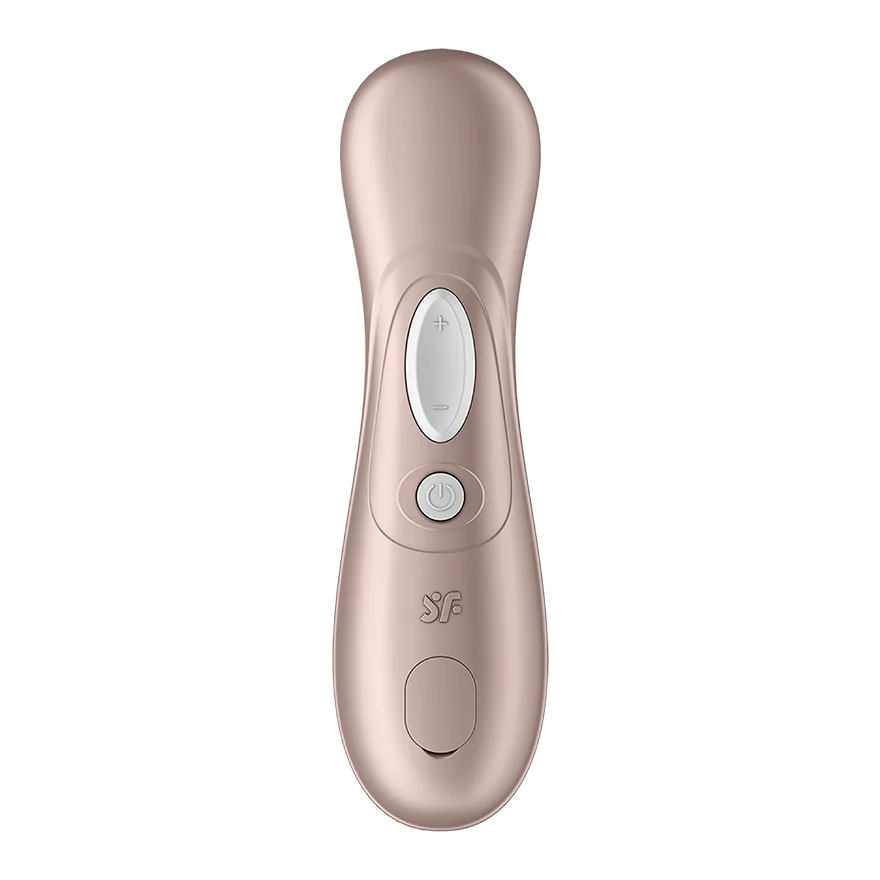
Satisfyer Pro 2 Next Generation costs from 254 SEK, i.e. 241 SEK less than Lizer Pro at its cheapest. In practice, it’s about half the price, and the two products solve the same task in completely different ways.
Satisfyer works with air pressure technology: a sealed chamber is placed over the clitoris and stimulates with pressure waves in the air, without direct contact. Lizer Pro works with mechanical contact — a tongue that moves against the skin — plus a suction that holds the area in place. Which of the principles works best is individual and can’t be determined from a specification.
Where the specifications speak clearly, though, is in the documentation. Satisfyer publishes the enclosure rating IPX7, battery capacity 220 mAh, voltage 3.7 volts, charging via standard USB-C, and a 15-year manufacturer’s warranty. Engily Ross does not publish any IP rating, battery capacity, voltage, charging time, or warranty terms in the text. For someone who chooses based on the data presented, there’s no fair match.
What Lizer Pro has and Satisfyer doesn’t is width: three functions instead of one, an internal part, a numeric display, and the ability to run everything at the same time. If you pay an extra 241 SEK, you’re paying for the number of functions — not for better documented technology.
Five Swedish stores sell the item with EAN 8436615004997. Cheapest are Blush Me and SexleksakerOutlet at 495 SEK each; then Vuxen at 556 SEK, and the most expensive are Lekosmek and Taboo at 699 SEK each. That’s a difference of 204 SEK or 41 percent for exactly the same item number and the same packaging.
All five stores had the product in stock during the price check, which is unusually favorable — on many models, the cheapest store is precisely the one that’s sold out. Here, then, you can actually shop at the lowest price. Three of the stores also state an ordinary price of 695 SEK in their product feeds, which means that 495 SEK is shown as a discounted price and not as the store’s normal price.
The price spread isn’t because any store sells a different variant. All five list the item either under EAN 8436615004997 or under their own item number that’s linked to that specific EAN code, and Taboo also publishes the manufacturer’s reference ER00499. So this is about the stores’ own margin setting. Still, always check the final price at checkout: shipping costs are added by most stores under a certain order value, and in this price range several stores are below the threshold for free shipping.
It fits you if you want multiple stimulation modes in the same product without having to buy three things. Three independent functions for under five hundred SEK is objectively a lot of function per krona, and the ability to run heavy, suction, and internal support movements at the same time is not available in any of the single-function products that dominate the category. It also fits you if you like the suction feel but not air-pressure technology — this is a mechanical suction cup with a tongue at the bottom, which is a completely different sensation than a pressure wave chamber.
It doesn’t fit you if you want a product you can set in place once and then forget. Two parts that both have to sit correctly at the same time require more of the user, and that’s exactly what the only published Swedish customer review brings up. It also doesn’t fit you if you choose based on documented data: here the manufacturer is missing IP class, battery capacity, charging time, noise level, weight, and a materials declaration about phthalates, BPA, and latex. And it doesn’t fit you if you want to be able to charge with the same cable as your phone — the charging connector is magnetic and product-specific.
One last thing belongs in the decision. The construction has no replaceable parts. The egg is fixed to the cable, the cable is fixed to the control unit, and the battery is not replaceable. The only part that can be removed is the vacuum cup. That makes the product easy to handle, but also vulnerable: if a single part breaks, the whole product is used up. In this price range, that’s a reasonable trade-off — but it is a trade-off, not a detail.
The warranty question is typical for the entire product. Engily Ross does not publish any warranty terms in the text—neither on the product page nor anywhere else that can be checked—the brand’s own website doesn’t work. The only thing that exists is the packaging: on the back of the cardboard, the marking “3 YEARS WARRANTY” is shown in the manufacturer’s own product image. What that warranty covers, what it excludes, who it should be addressed to, and how it is made valid are nowhere stated. None of the five Swedish stores also indicates any warranty period.
A warranty without published terms is, in practice, difficult to lean on. Compare it with Satisfyer, which offers a 15-year manufacturer’s warranty with published terms, or Womanizer, which offers five years and shows exactly what is excluded. Here you get a number printed on a cardboard box—and nothing more.
What always applies, however, are your statutory rights, and they are stronger than most people think. Under the Swedish Sale of Goods Act (konsumentköplagen), you have three years to complain about defects in the goods, regardless of what the manufacturer does or does not promise, and it is directed at the store you bought it from — not at the manufacturer in Spain. With distance purchases, you also have a right of withdrawal within fourteen days under the Act on distance contracts and contracts outside business premises (lagen om distansavtal och avtal utanför affärslokaler). Be aware that, in practice, the right of withdrawal is limited for hygiene products that have been removed from a sealed package — however, the right to complain about defects always applies. If you have questions about what applies in your case, Konsumentverket guides you via Hallå konsument.
Buying from a Swedish store is therefore the practically most important measure for exactly this product. With a manufacturer that lacks a functioning website and published warranty terms, the Swedish store’s responsibility under the Swedish Sale of Goods Act (konsumentköplagen) is what provides your entire real protection.
Engily Ross Lizer Pro isn’t included in any ranking yet. In best i test guides, the entire categories are compared against each other using five shared criteria, with what was left out shown.
Every numerical piece of information in the text can be traced to one of the sources below. The links were checked manually on the specified date.
This page is machine-translated from Swedish. Read the Swedish original