

Review
Review: Satisfyer Double Joy Couple Vibrator with App
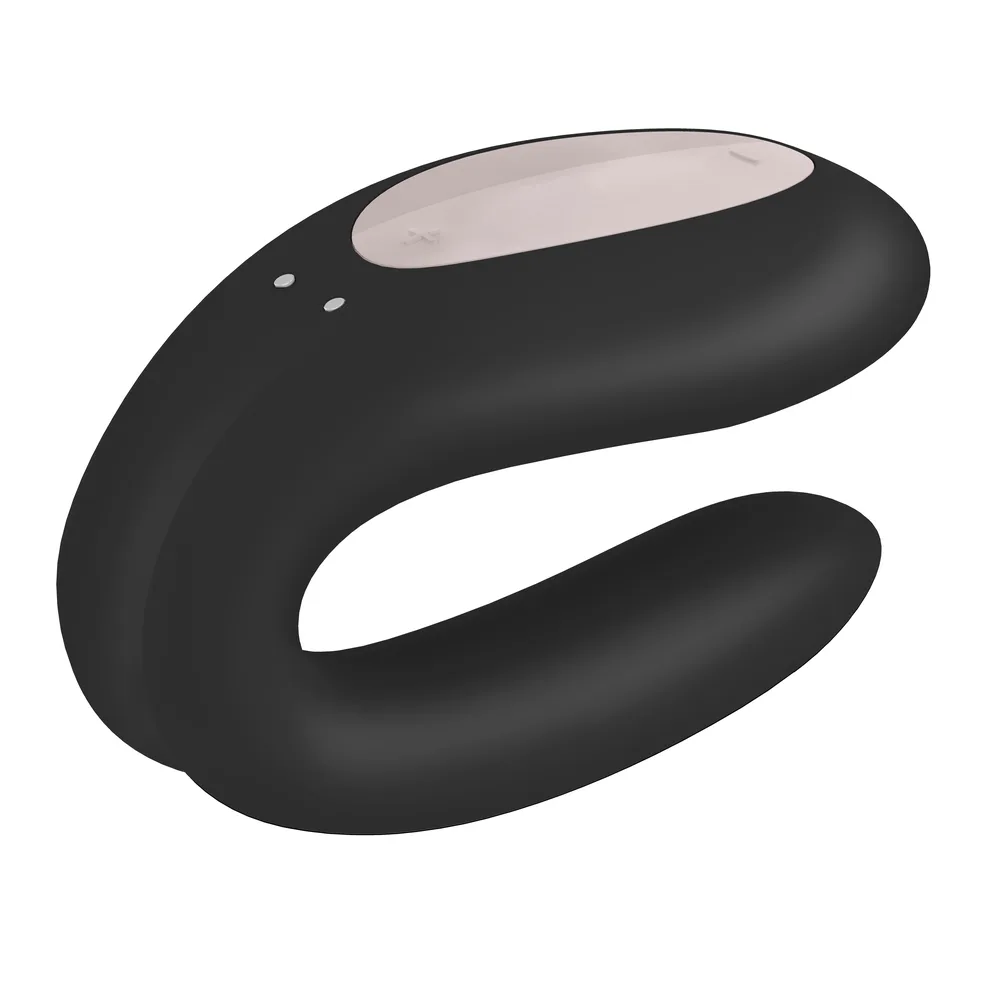
Same shape and the same ten programs—with 220 mAh, published operating time, and a 15-year warranty.
13 September 2026
 Best budget
Review · Couple vibrator · App-controlled C-shape
App-controlled couple vibrator in a C-shape reviewed against the manufacturer’s own product images and price data from three Swedish stores. Two motors, ten vibration modes, full silicone, and a 98-millimeter curved body—at 299 SEK. But Erospace states IPX7 on its function graphic and IPX6 on the packaging, and does not publish battery capacity, runtime, charging time, or the app’s name.
The cheapest way into the C-shaped dual vibrator: one-piece full silicone, two motors, ten modes, and app control for 299 SEK, with all three stores in stock. What you pay for is the documentation. Erospace publishes neither battery capacity, operating time, charging time, sound level, the app name, nor warranty terms, and the manufacturer’s own materials contradict themselves about waterproofness: IPX7 on the function graphics, IPX6 on the box.
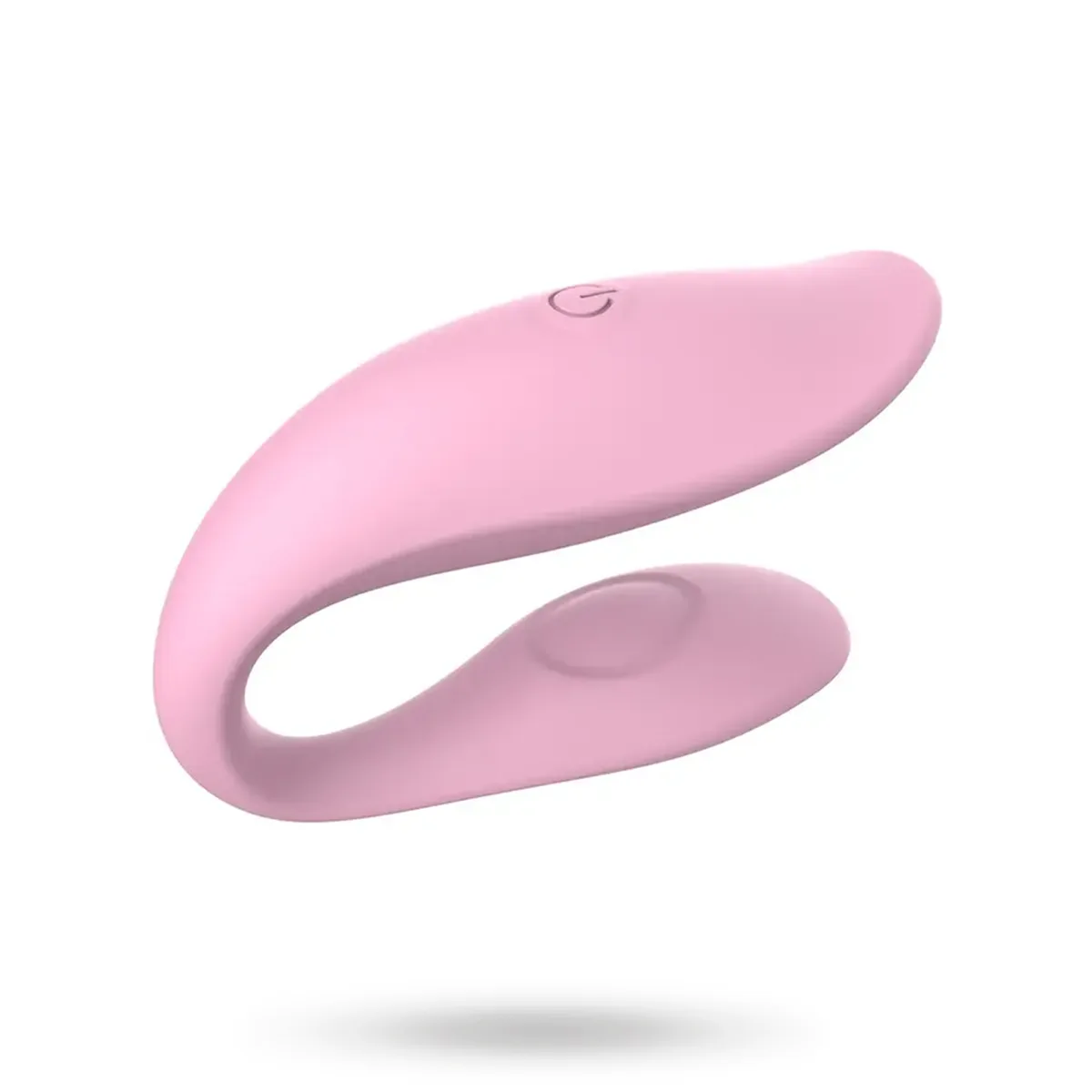
Erospace C-type Vibrator App Control is a pair vibrator of the type that is worn during intercourse: a bent silicone body in a C-shape, where one end is inserted vaginally and the other rests on the outside against the clitoris. The manufacturer’s packaging gives the product the model designation A7 and places it in the Sweet Play series, and on the front of the cardboard box the product name is printed as C-type Vibrator APP Controlled. It is the same item that the Swedish stores sell under the shorter name.
This review exclusively covers the specification, and it is worth noting how short it is. Erospace’s own dimension sketch states the total length as 98 millimeters, the width of the outer arm as 23 millimeters, and the width of the inner arm as 19 millimeters. The packaging promises body-friendly materials, a two-year warranty, and a built-in lithium-ion battery. The function graphic for the Sweet Play series adds app control via Bluetooth and the enclosure class IPX7. The retailers provide the weight of 88.5 grams, the material as silicone, the color as pink, charging via USB, and ten vibration functions divided across two motors. In Sweden, the item is sold by three stores for 299 or 395 SEK, and all three had it in stock at the price check 12 September 2026.
This review is exclusively about the pink variant with EAN 5906647270026. The number is checked at all three stores: Blush Me and SexleksakerOutlet list it as the item number, and Vuxen shows the same number in the Artnr field on its product page. This is a check that matters here, because Erospace has at least one more C-shaped model in the range — more about it lower down.
The C-shape — some manufacturers call it a U-shape — solves a mechanical problem. A vibrator that is supposed to stay in place during intercourse cannot have a handle, because the handle would get in the way. Instead, it has to clamp itself in place. The solution is a bent body made of soft but springy material: the inner arm is inserted vaginally and rests against the front vaginal wall, the outer arm is bent out over the pubic bone and lies against the clitoris, and the material’s own springiness keeps both in place without anyone needing to hold on to anything.
In practice, this means that the product stimulates three things at the same time. The inner arm provides pressure and vibration to the area commonly called the G-spot, the outer arm provides vibration to the clitoris, and the penis that passes between the arms transfers the vibrations through the silicone. That’s why this product category is marketed toward couples rather than individual users, even though it works just as well solo — Erospace’s own text and all three stores state that it can be used both during intercourse and on your own.
What can be established purely from a construction standpoint is that the C-shape makes high demands on two things: the material’s springiness and the placement of the motors. Erospace has placed a motor at each end, i.e. one at the tip of the inner arm and one at the tip of the outer arm, according to the retailers’ joint product text. That placement is logical — vibration is quickly dampened by soft silicone, and a single centrally placed motor would lose a lot of its power on the way out to the contact surfaces.
The measurements then determine whether the shape works for your body, and that is the single biggest uncertainty with a product of this type. The manufacturer’s dimension sketch gives a total length of 98 millimeters for the bent body, but Erospace does not publish any information about how long the insertable part is or how wide the distance between the arms is when at rest. Just the span between the arms is the measurement that determines whether the product stays in place or glides out of position, and the fact that it isn’t listed is a real shortcoming in the supporting information.
Erospace is a Polish brand that divides its range into four lines: Sweet Play, Men's Play, Wild Play, and Natural Play. This product belongs to Sweet Play and has the model number A7 printed large on the front of the box. However, that number is never shown in the Swedish stores’ product names, which makes it difficult to compare between countries.
Practically speaking, this means that you can’t compare prices based on the name "Erospace C-type" alone. Two different items with two different EAN numbers carry almost the same description, and one of them additionally has a remote control instead of an app in some listings. Check the barcode before you pay — it’s the same advice as in the rest of the category, but here it’s unusually easy to get it wrong.
The material issue is the only characteristic of an intimate product that cannot be compensated for with experience or care. It determines whether the product is still hygienic after a few years, and it is especially important for a product like this, because the whole body lies against the mucous membrane during use and because the shape means it can’t be kept away from it.
Erospace states on its own site for the Sweet Play series that the products in the collection are made from certified medical silicone described as completely hypoallergenic, soft, and harmless to the body. The stores repeat the same thing: Blush Me lists the material as high-quality silicone in its material chart and describes it as soft, body-safe medical silicone in the main text, while Vuxen instead writes “Silicone” in its factual box.
Silicone is a non-porous material, and it is by far the single most important characteristic. A non-porous surface can be cleaned, because there are no microscopic cavities where residue can remain. Silicone also tolerates repeated cleaning without breaking down; it is chemically stable and doesn’t require plasticizers to become flexible—the softness comes from the polymer’s own structure. This product is also made as a single piece without any visible seam between the arms, which means there’s no joint where dirt can collect.
However, that’s where what can be substantiated ends. The term “medical silicone” is not a protected designation and doesn’t say anything about what kind of certification is intended. Erospace publishes no material declaration for the individual product, no datasheet, and no downloadable manual. The brand’s website is a brand presentation with four series pages—it has neither a product catalog, article numbers, nor specification sheets. It’s unusually thin compared with how competitors in the same category work.
Phthalates are a group of plasticizers used to make plastic—above all, soft PVC—flexible. Kemikalieinspektionen describes them as substances that can affect the hormone system and make reproduction more difficult, and several of them are therefore restricted or banned within the EU in a large number of products. Intimate products are a recurring target of oversight precisely because they contain soft plastic against the skin and mucous membrane.
Erospace packaging writes "Body safe materials" and the series graphic repeats the same wording. Neither the packaging, the functional graphic, nor the brand’s website contains an explicit statement that the product is free from phthalates, BPA, and latex. That is a clear difference versus the larger competitors: We-Vibe prints that exact wording—body-friendly silicone made without phthalates, BPA, and latex—on the product pages for both Sync 2 and Chorus.
How bad is it? Reasonably assessed, the risk is low, because silicone itself does not need phthalate plasticizers and because the product is sold within the EU, where the most problematic phthalates are restricted. But "body safe" is a marketing term without a definition, while "without phthalates, BPA, and latex" is a specific claim that can be held up against the manufacturer. In addition, for someone who is allergic to latex, the information is completely missing, and latex allergy causes reactions on the mucous membrane faster than on normal skin.
The manufacturer’s dimension sketch lists three measurements: 98 millimeters total length, 23 millimeters as the width of the outer, wider arm, and 19 millimeters as the width of the inner, narrower arm. The stores present the same figures in a different form—Blush Me states length 9.80 cm, minimum diameter 1.90 cm, and maximum diameter 2.30 cm, and Vuxen states total length 9.8 cm, maximum diameter 2.3 cm, and minimum diameter 1.9 cm. The details therefore do not contradict each other, which is worth noting because it is unusual in this price range.
The weight, on the other hand, is not a manufacturer’s figure. Erospace does not publish any weight. All three retailers state 88.5 grams, which is reasonable for a full-silicone product of that size with two small motors and a small battery. The figure also has one decimal, which usually indicates actual weighing somewhere in the supplier chain rather than a rounded estimate. Still, treat it as a store claim.
Size puts the product in context. 98 millimeters is the total length of the bent body, meaning it is measured around the shape and not as the insertable length. For comparison, Satisfyer lists 91.4 millimeters in length, 41.8 millimeters in width, and 57.4 millimeters in height for Double Joy, and We-Vibe lists 41.7 × 74.8 millimeters for Sync 2. Erospace is therefore in the same size class as the established competitors, and it is lighter than Satisfyer Double Joy only if you compare using the store figures—Satisfyer itself states 78 grams, i.e., ten grams less than the 88.5 grams the stores list for Erospace.
A detail that is clearly visible in the manufacturer’s images, and that no text mentions: the inner arm has ridges on its top side—that is, the side that lies against the front shaft wall. Retailers’ product text calls them "discreet ridges for extra pleasure". Structurally, it is a surface that increases friction against the mucous membrane and, in practice, also increases the need for lubricant.
The interface on the product is as simple as it can be. The manufacturer’s product image shows one single button, marked with a standard power symbol, placed on the top side of the outer arm. There is no display, no plus and minus buttons, and no separate button for switching programs. All control on the product is therefore done by pressing the same button repeatedly.
The retailers’ shared product text states ten vibration functions and that the control works "via an app or directly on the device". That is the only description of how the button works. Erospace does not publish an instruction manual, so how many seconds you hold the button in order to start, step through, or turn off is not shown in any available material. On products with the same button layout, the pattern is usually a long press for on and off and short presses to step through further, but that is a category pattern, not an instruction for how this specific model works.
What can be established is that a one-button solution has a clear consequence during use: you can only step forward. If you end up in a mode that’s too far, you have to go all the way through the entire list again. With ten modes, that means, at worst, nine presses to get back one step, and that is exactly the situation where the app becomes more than just an accessory.
App control is the product’s main argument—it’s in the product name—and that’s why it is notable how little is published about it. Erospace does not name the app, does not state which operating systems are supported, does not provide a Bluetooth version, and does not state a range. The only information is a screenshot in the manufacturer’s own product photo and a Bluetooth symbol next to the text "App controlled" on the screenprint.
The screenshot is still informative if you read it carefully. It shows an app with at least three tabs at the top—Classic, Music, and a third that is partly obscured—and beneath them a grid with mode icons labeled Mode1 to Mode8, where each icon has its own waveform image. The fact that there is a Music tab means the app has some form of sound control, meaning that the vibrations follow music or microphone sound. The third tab suggests there are the app’s own user-defined patterns. None of these functions are mentioned in any product text.
The absence of an app name is not a formality. An app-controlled product depends on the manufacturer continuing to maintain the app, that it remains available on the App Store and Google Play, and that it works with upcoming versions of iOS and Android. Without a name, it’s not possible to check how the app is rated, when it was last updated, or which permissions it requests. By comparison, Satisfyer names its app — Satisfyer Connect — and explicitly states support for iOS and Android, and We-Vibe refers to the We-Vibe app on the product pages for both Sync 2 and Chorus.
One more thing that belongs here. Satisfyer publishes radio data for Double Joy in its quick guide: 2402–2480 MHz and an output power of +6 dBm. Those are the figures that say something about range and about how the transmitter behaves. Erospace publishes nothing comparable, even though the product has CE marking in the silicone and is therefore covered by the same regulations for radio equipment.
Ten vibration functions are the retailers’ figure, reproduced identically by all three. The manufacturer’s own material states no number at all — neither the packaging nor the series graphics mention a figure, and the app screen in the product image shows eight modes in view without it being possible to determine whether the list continues below the bottom edge of the image.
That’s an important difference from how the number is usually presented. Ten modes can mean ten intensity steps of the same vibration, or ten different patterns — pulses, waves, ramps — with fixed strength. The two things feel completely different, and no source indicates which of them applies here. The app image’s icons show waveforms rather than a rising scale, which points toward patterns, but that’s an interpretation of an image and not a published statement.
The comparison with the competitors is still informative. Satisfyer lists ten vibration programs for Double Joy, and We-Vibe lists ten intensity levels for Sync 2 and ten basic modes for Chorus with names such as Low, Medium, High, Pulse, Wave, and Ultra. Ten is therefore the category’s normal number, and Erospace is neither above nor below. The number of modes therefore isn’t what differentiates the products — instead, it’s the documentation, the warranty, and the battery data.
A practical note about two motors: since both motors are controlled by the same button and the same mode, there is no published support for regulating them independently of each other on the product itself. No source states whether the app can control the arms separately. On products where this is possible, it’s usually an explicit selling point, and the fact that it’s missing here rather suggests that both motors move together.
Erospace functional graphics for the Sweet Play series include a point with a crossed-out speaker symbol and the text "Silence performance" — the spelling is the manufacturer’s own. The brand’s series page develops the theme and describes quiet operation as one of the collection’s main arguments, with the justification that the products should be able to be used and stored discreetly. The shop’s product text briefly says "quiet-running motor".
No measured decibel value is published, either by the manufacturer or by any of the three shops. There is also no comparison graphic of the type that some manufacturers use to suggest an order of magnitude. Anyone who sees a decibel figure for this model somewhere else should assume that it either comes from its own measurement or has no source at all.
What can, on the other hand, be said in general is that a portable penis vibrator of this kind has two factors that point to a low noise level and one that speaks against it. For: the motors are small because they have to fit into the tips of the arms, and they are completely encased in soft silicone that dampens. Against: the product is used in direct contact with the body and often under a blanket, which in practice dampens it further. Expect it to be heard the most when it is lying freely on a hard surface — a tabletop works as a resonance box and noticeably amplifies the sound regardless of the model.
Here is the clearest contradiction in the entire material, and it comes from the manufacturer itself. Erospace functional graphics for the Sweet Play series state Waterproof IPX7. The same manufacturer’s packaging image shows the carton’s side panel, and there it instead says Waterproof IPX6 in the vertical list of six commitments. Both images come from the same image package that Erospace provides to retailers.
All the shops have chosen the higher number. Blush Me and SexleksakerOutlet write "Waterproof according to IPX7" in their product texts, and Vuxen settles for "Waterproof: Yes" in its fact box and "100% waterproof" in its bullet-point list. None of them mentions IPX6.
The classifications come from the international standard IEC 60529, which defines enclosure classes for electrical equipment. The number in the second position describes protection against water, and the step between 6 and 7 is not gradual but fundamental.
IPX6 means that the product is tested against strong jets of water from all directions. It can handle showers, running water, and thorough rinsing. IPX7 means that the product is tested for submersion in water to a depth of one meter for 30 minutes. It can handle bathtubs and swimming pools. The difference is therefore exactly the question of whether the product can be submerged or not, and that is something that matters for a product that is marketed as suitable for the bath.
What should you do about that? The cautious answer is the only reasonable one: treat the product as IPX6 until the manufacturer corrects its own information. Rinse it under the tap, feel free to use it in the shower, but avoid placing it on the bottom of a bathtub. The difference in risk is small in practice, but if it were to leak, it would be the battery and electronics that take the damage, and a warranty issue based on two conflicting statements from the same manufacturer becomes difficult to pursue.
Rinse the product in lukewarm water after each use and use fragrance-free soap or a cleaning product intended for intimate products. Be extra careful with the ridges on the inner arm and with the indentation around the button — these are the two places where residue can get stuck. Wipe it off with a clean towel and let it air-dry before putting the product away. Erospace does not state whether any storage bag is included, and it publishes no complete ingredient list for the packaging at all.
The question of lubricant has a clear answer even without manufacturer instructions. Use a water-based lubricant. A silicone-based lubricant should not be used on silicone products — it breaks down the silicone surface over time and makes it porous, and a porous surface can no longer be cleaned properly; it can only be replaced. Oil-based products such as coconut oil leave a film that is difficult to remove and that also degrades condoms. For this particular product, the advice is especially relevant, because the ridges on the inner arm increase friction and therefore also increase the need for lubricant.
Two things that normally appear in a manual are missing here, and it’s worth mentioning them for that reason. The manufacturer does not state a maximum temperature for the product or the battery, which means you should avoid boiling and the dishwasher purely as a matter of principle — lithium-ion batteries generally do not tolerate high temperatures, and a built-in battery cannot be removed. The manufacturer also does not say whether the product contains magnets, a detail that matters for someone who has a pacemaker.
The packaging side panel contains a battery symbol and the text “BUILT-IN LITHIUM-ION BATTERY”. That is all the manufacturer information there is about the power supply. The fact that the battery is described as built-in in practice means that it is not intended to be replaced by the user, and thereby that the product’s lifespan ultimately is the battery’s lifespan.
The manufacturer’s dimension sketch and product image clearly show the charging connector: two letters, DC, embossed in the silicone on the outer arm’s side, and just below them a small round contact pin. So it’s not a USB-C port in the product, but a product-specific connector of the type used together with a magnetic or plug-in charging cable, where the other end has USB. Blush Me correspondingly states USB as the charging type in its specification table, and Vuxen simply writes Rechargeable in its facts box.
The construction has an advantage and a disadvantage. The advantage is that no opening in the housing is needed, which is the very prerequisite for a product of this kind to be able to handle water at all. The disadvantage is that the cable is product-specific—if you lose it, no regular USB cable will work, and since Erospace has no public web shop or spare parts list, there is no obvious way to order a new one. There is a real risk to factor in when buying at this price level: a lost cable can in practice make the product unusable.
The same image shows two additional markings embossed in the silicone: the CE mark and the crossed-out waste bin. The latter means that the product should be taken to electronic recycling and not thrown away with household trash—relevant precisely because the battery is fixed inside.
This is where the biggest gap in the entire specification is. Erospace does not publish the battery’s capacity in mAh, its voltage, the run time per charge, or the charging time. None of the three Swedish stores fills in any of those details either. So there is no way to know how long the product lasts on a charge.
The contrast versus the competitors is sharp and worth putting numbers on. Satisfyer publishes in its quick guide for Double Joy: a lithium-ion battery at 3.7 volts, a capacity of 220 mAh, a charging voltage of 5 volts, a charging time of about 4.5 hours, and a usage time of about 60 minutes. We-Vibe states up to 120 minutes of run time and up to 90 minutes of charging time for Sync 2, and 90 minutes of run time and 120 minutes of charging time for Chorus. All three are specified with numbers.
What does that mean for a buyer? Above all, that you can’t plan. A parvibrator is typically used in sessions of twenty to forty minutes, and the difference between a product that lasts 60 minutes and one that lasts 120 determines whether it needs to be recharged after each session or after every third one. What can still be established, however, is that a product with two motors in a 98-millimeter-long body must have a small battery — there simply isn’t room — and that the runtime is therefore likely in the lower part of the category. But it’s a reasoning about volumes, not a conclusion, and it should be read as just that.
What generally applies to lithium-ion batteries also applies here: capacity decreases with the number of charge cycles, the cell is best off being charged regularly rather than stored completely discharged, and since the battery is built in, the product is, in practice, used up when the cell is. With the two-year warranty in mind, it’s reasonable to view the product as a consumable with a few years of service life rather than as a long-term purchase.
We do not have price data from shops in your market yet.
The same manufacturer states IPX7 on its functional graphics and IPX6 on the side panel of the box. The difference between them is exactly the question of whether the product can be submerged in water.
Three comparisons are relevant: against the best-selling budget competitor, against the category’s premium option, and against Erospace’s own sibling model. All the information below comes from each manufacturer’s own specifications, and the prices for Erospace come from the product feeds in the shops 12 September 2026.
Satisfyer Double Joy Connect App is the direct competitor: same shape, same two motors, same app control, same ten programs. Satisfyer states its own price as 717.95 SEK in its Swedish shop, which is 419 SEK more than Erospace 299 SEK at the lowest price. The question is what those 419 kronor buy.
In terms of pure functions, almost nothing. Both have two motors, both have ten settings, both are IPX7 according to the manufacturer, both are controlled via an app, and both work without an app. Satisfyer is marginally smaller and lighter: 91.4 × 41.8 × 57.4 millimeters and 78 grams versus Erospace 98 millimeters and 88.5 grams, according to the shops. The material, however, is worse on paper for Satisfyer — ABS plastic and silicone versus Erospace full silicone.
On everything else, the difference is big. Satisfyer names the app (Satisfyer Connect) and lists iOS and Android. Satisfyer publishes a quick guide with battery 3.7 volts and 220 mAh, charging voltage 5 volts, charging time about 4.5 hours, usage time about 60 minutes, radio frequency 2402–2480 MHz, and output power +6 dBm. And Satisfyer provides 15 years of warranty against Erospace’s two.
The conclusion is easy to put into words. If you pay 419 SEK extra, you don’t get more functions — you get to know what you’re buying, and you get a warranty that’s seven and a half times longer. Whether it’s worth the money depends on how much you care about being able to control a task before you trust it.
We-Vibe is the brand that made the C-shaped couple vibrator into its own product category, and two of their models are relevant here. Sync 2 measures 41.7 × 74.8 millimeters, states a runtime of up to 120 minutes, a charging time of up to 90 minutes, IPX7, ten intensity levels, control via the We-Vibe app, and a two-year warranty. The manufacturer’s list price is 159 euros. Chorus measures 78 × 44 × 33 millimeters and comes with a separate remote control measuring 96 × 37 millimeters, states a 90-minute runtime and a 120-minute charging time, IPX7 on the product but only splash protection on the remote control, ten basic modes with names such as Low, Medium, High, Pulse, Wave, and Ultra, and a regular price of 209 euros.
What We-Vibe adds, in addition to Erospace, is four things that can all be substantiated: published runtime and charging time, an explicit materials declaration that the silicone is made without phthalates, BPA, and latex, a named app, and a documented package contents down to the storage pouch and a lubricant sample. Chorus also has a physical remote control, which solves exactly the problem that a one-button solution creates.
What Erospace adds is the price. Sync 2 costs about five times as much when calculated based on the manufacturer’s own list price, and Chorus more than that. For someone who wants to try whether the shape even works for the body—and it really isn’t a given that it does—it makes a big difference in what a failed purchase costs. Also note that the warranty period is the same: We-Vibe offers two years, just like Erospace.
Erospace also sells a C-shaped model called Vibrator type C – Astro. It has its own EAN, 5904703650300, is stated to be 95 × 31 millimeters, is sold in black, and is described with a twelve-step vibration range instead of ten modes. So it’s shorter, significantly wider, and has more steps.
The point of the comparison isn’t to recommend one over the other—if possible, the basis for Astro is even thinner—but to show how easy it is to buy the wrong one. Two items from the same brand, with almost the same name and almost the same description, have different dimensions, different color, different barcode, and a different number of steps. Check the EAN number in the store’s product information before you pay. For this review, it is 5906647270026 and nothing else.
Three Swedish stores sell the item with EAN 5906647270026. Blush Me and SexleksakerOutlet both list it at 299 SEK, while Vuxen lists it at 395 SEK. That’s a difference of 96 SEK or 32 percent for the exact same item number, same color, and same packaging.
The stock situation is unusually good here compared with the rest of the category: all three stores had the product in stock when prices were checked. That means that the lowest price is also the available price, which is by no means a given—in more expensive models, it’s common for the cheapest store to be sold out and for the actual lowest price to be several hundred kronor higher.
Blush Me also lists 395 SEK as the regular price and 299 SEK as the current price, a 24 percent discount. So Vuxens 395 SEK isn’t a markup but rather the regular list price in Sweden, and the two cheaper stores offer campaign pricing. It’s worth knowing for one reason: campaign prices go back. If you see 299 SEK when you read this, it’s probably still a campaign, and if you see 395, the campaign has ended rather than the price being increased.
The prices in the table above are updated when the stores’ product feeds are updated, but always check the final price at checkout. In this price range, shipping cost is a significant part of the total—shipping of sixty or eighty kronor corresponds to a quarter of the product’s price—and it very well may make the most expensive store the cheapest if you’re anyway buying something else there.
It’s for you if you want to try the format without tying up a couple of thousand kronor. C-shaped pair vibrators are the product category where the fit varies the most between bodies, and there’s no way to know in advance whether it will stay in place. Making that try for 299 SEK instead of 1,500 is a rational decision. It also fits you if you place value on the entire product being silicone rather than silicone over ABS plastic, and if you want app control with music synchronization—the app view shows a Music tab—without paying a premium price for it.
It’s not for you if you want to know how long the battery lasts before you buy. It’s not for you if you want a named app with update history you can control, if you require an explicit statement about phthalates, BPA, and latex, or if you want to lower the product into the bathtub—there, the contradiction between IPX7 on the graphics and IPX6 on the box means the cautious choice is to avoid it. It’s also not for you if you want to be able to buy a new charging cable if it disappears, because the connector is product-specific and the manufacturer has no public spare-parts channel.
One more thing belongs in the decision. This product is designed and priced as an entry-level product, not as a main purchase. The two-year warranty, the built-in battery without a stated capacity, and the product-specific cable all point in the same direction: count on a few years, not a decade. If the shape works for you, and you want the same thing with documentation, warranty, and an app you can look up, the step up to Satisfyer Double Joy or We-Vibe Sync 2 is clearly defined — and you already know then that the money isn’t wasted.
Erospace provides a two-year warranty. The information appears both on the side panel of the packaging and on the serial graphics, in both cases as "2 years warranty" with a shield symbol, and it is repeated in Blush Mes and SexleksakerOutlets product texts. No warranty terms are published — there is no page from Erospace that states what the warranty covers, what is excluded, or how to report a case. Also note that Vuxens product text completely lacks the sentence about the warranty, while the other two shops have it. It is likely an editorial shortening of the same supplier text, but that means the information isn’t present with all three.
Two years is the minimum level for the category. We-Vibe also offers two years on Sync 2 and Chorus. Satisfyer offers 15 years on Double Joy. The difference between two and fifteen years is not insignificant for a product whose service life is determined by a built-in lithium-ion battery, because it is precisely that component that loses capacity over time.
What always applies, however, are your statutory rights, and they are independent of what the manufacturer promises. Under konsumentköplagen, you have three years to make a claim for defects in the goods — in other words, one year longer than Erospace’s own warranty. In practice, the difference is that a claim is made against the store you bought from and assumes a defect that was present at delivery, while a manufacturer warranty is a voluntary commitment that is often easier to use but here lacks published terms.
For purchases made at a distance, you also have a right of withdrawal for fourteen days under the law on distance contracts and contracts concluded away from business premises. Be aware that, in practice, the right of withdrawal is limited for hygiene products that have been removed from a sealed package—however, the right to make a claim for defects always applies. If you have questions about what applies in your case, Konsumentverket (Swedish Consumer Agency) provides guidance via Hallå konsument (Hello, Consumer).
Erospace C-type Vibrator App Control is ranked på plats 11 av 15 in couples vibrator best i test, where the entire category is compared against each other using five shared criteria. Guiden vinns av We-Vibe Sync O Petrol Green.
Every numerical piece of information in the text can be traced to one of the sources below. The links were checked manually on the specified date.
This page is machine-translated from Swedish. Read the Swedish original