

Review
Review: We-Vibe Sync Go
C-shaped couples vibrator with IPX7 and 90 minutes of operating time.
29 July 2026
Review · G-spot vibrator · U-shaped with app control
Satisfyer’s lightest g-spot vibrator reviewed against the manufacturer’s own specifications, quick guide, and EU declaration of conformity, as well as price data from nine Swedish stores. Two motors, ten vibration programs, IPX7 according to IEC 60529, one lithium-ion battery of 220 mAh with about 60 minutes of operating time — and a fifteen-year guarantee whose terms and conditions do not include Sweden.
A well-specified couple vibrator in the cheaper half of the category: two motors, IPX7, real battery data in mAh, and an app with more features than the competitors. What you pay for is the battery—about 60 minutes of runtime versus about 4.5 hours of charging time—the category’s worst ratio—and a fifteen-year warranty that, according to the manufacturer’s own terms, does not apply in Sweden.
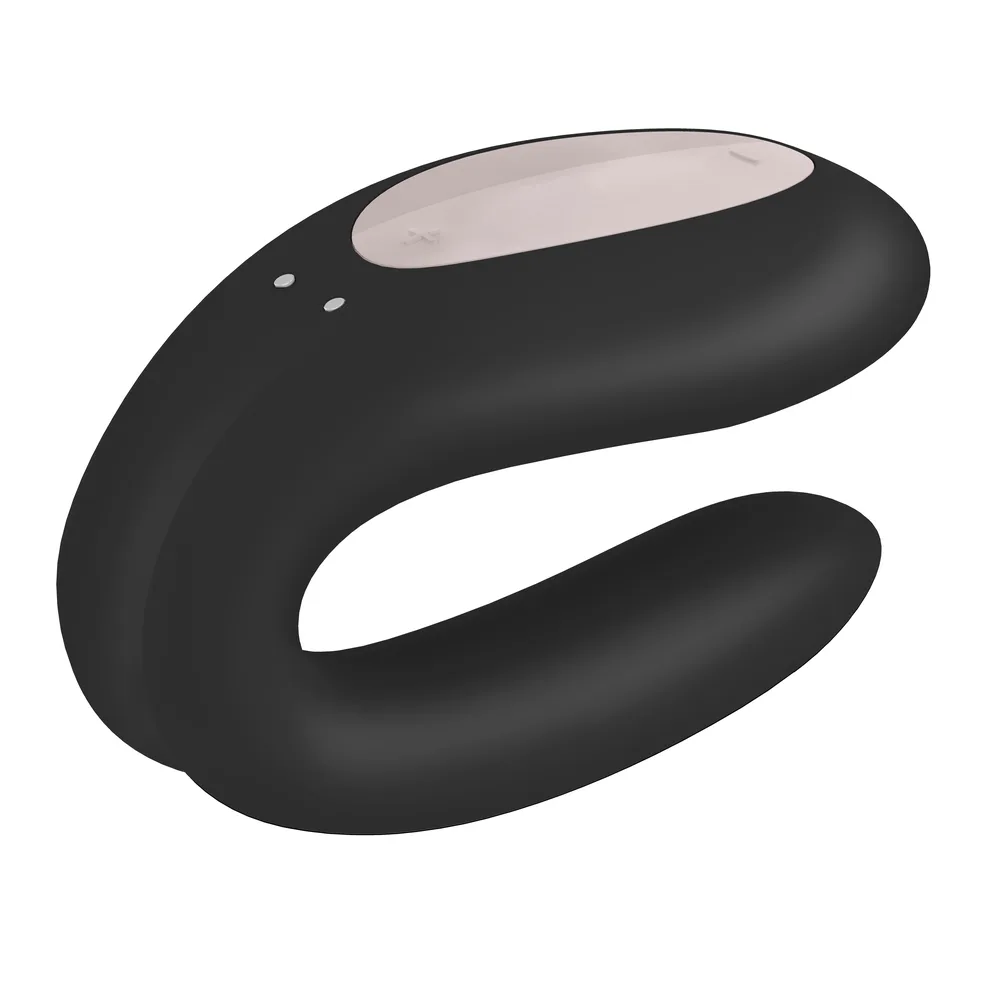
Satisfyer Double Joy is a couple vibrator with a U-shape: one arm is inserted vaginally, the other rests on the outside against the clitoris, and both arms have their own motor. It’s designed to stay in place during intercourse, and that’s the whole point of the shape — unlike a handheld vibrator, it should not be held; it should be worn. The manufacturer describes it as a product for the clitoris, G-spot, and penis at the same time.
The specification looks like this: 91.4 × 41.8 × 57.4 millimeters, 78 grams, silicone over ABS plastic, enclosure class IPX7, two motors, ten vibration programs, one lithium-ion battery of 220 mAh and 3.7 volts, approximately 60 minutes of operating time, approximately 4.5 hours of charging time via a magnetic USB cable, and control either with the buttons on the product or via the Satisfyer Connect app. In Sweden, the item is sold by nine stores at prices between 349 and 534 SEK — but only two of them had it in stock at the price check on 12 September 2026.
This review is exclusively about the black variant with EAN 4061504002392. Satisfyer builds its EAN numbers using the prefix 4061504 plus a six-digit article number, and 4002392 is, according to the manufacturer’s own compliance page, “Double Joy Black.” The same page lists 4001708 as Double Joy White and 4002408 as Double Joy Violett. The model is now also sold in light blue, which has its own number. Functionally, the colors are identical, but check the number if you compare prices between shops—several of them list the colors on the same product page.
The basic idea is simple. The product is folded around the pubic bone so that the shorter, narrower arm lies inside the sheath and the wider, thicker arm sits on the outside over the clitoris. The inner arm reaches the G-spot area; the outer arm covers the clitoris. Because the product is soft and flexible, it should be able to stay in place when a partner penetrates, whereby the inner arm ends up between the vaginal wall and the penis and the vibration reaches both.
It’s a different product category than a clitoral stimulator, and it should be evaluated accordingly. An air-pressure product like the Satisfyer Pro 2 works on one spot on one body. A U-shaped couple vibrator works on three spots on two bodies, and the trade-off is that none of the three points gets as concentrated energy as a specialized product provides. What can be concluded from the specifications is that Double Joy solves this with two separate motors instead of one, so the vibration doesn’t have to travel through the entire unit from a single source.
The fit is at the same time the category’s weak point, and you can’t read it from the specs. The manufacturer provides a single measurement for the inner arm—there is no specified insertion depth and no adjustable angle. The shop Joyland states, as the shop’s information, that the penetrating length is 7 centimeters and that the width varies between 1.9 and 3.4 centimeters, and Mshop lists in a similar way an inner length of 7 centimeters and a width of 1.9 centimeters. None of those figures comes from Satisfyer, but they are the closest available information about how much of the product actually ends up inside.
Satisfyer sells several couple vibrators with similar names, and they’re routinely mixed up in Swedish retail. Three of them are so close to each other that it’s worth keeping them separate before you pay.
So the difference between Double Joy and Double Fun is not the number of programs — both have ten according to the manufacturer — but the remote control, the size, and the weight. If you want to be able to hand over control without anyone having to get out a phone, Double Fun is the model that solves that. If you want the smallest and lightest of the three, Double Joy is it.
Material is the only characteristic of an intimate product that can’t be compensated for with experience or care, and it determines whether the product is still hygienic after five years. Satisfyer lists two materials for Double Joy: ABS plastic and silicone. The same wording appears in the manufacturer’s materials section on the product page and in the specifications line in the quick guide, in all languages.
Silicone is a non-porous material. A non-porous surface can be cleaned, because there aren’t microscopic cavities where residue can get trapped. This is the single most important property of a material that is meant to sit against mucous membranes, and that’s why the material declaration weighs more heavily than almost every other line in a specification.
ABS plastic, on the other hand, is a hard structural plastic. It doesn’t sit against the skin on this type of product, but forms the internal structure — the battery compartment, the motor housing, and the oval control panel on the top side, which in the product images is molded in a lighter, harder plastic than the rest of the body. It means, in practice, that Double Joy has a material seam: the boundary between the light panel and the black silicone. It’s the only point on the product where dirt can collect in a joint, and that point deserves extra attention when cleaning.
Compared with a product that is fully silicone over the entire body — We-Vibe states that Sync 2 is completely covered in silicone — it’s a step down. Compared with products where only the contact surface is silicone and the entire grip is shiny hard plastic, it’s a step up. Double Joy sits in between, and that’s a reasonable place for a product in this price range.
Phthalates are a group of plasticizers used to make plastic—especially flexible PVC—pliable. The Swedish Chemicals Agency describes them as substances that can affect the endocrine system and make reproduction more difficult, and several of them are therefore restricted or prohibited within the EU in a large number of products. This product category is repeatedly the subject of supervision because it contains skin-contact flexible plastic.
There is a clear gap in the manufacturer’s documentation. Satisfyer does not publish an explicit phthalate-, BPA-, or latex declaration for Double Joy—neither on the product page, in the quick guide, nor in the EU declaration of conformity. What is stated is that the materials are ABS plastic and silicone, and that the product is “body-friendly silicone.” Two stores fill the gap in on their own: Joyland states “Phthalate-free: Yes,” and Mshop writes that the materials are free from phthalates. These are store details, not the manufacturer’s, and they should be read as such.
That it is still a less significant problem has to do with the chemistry. Silicone does not require phthalate plasticizers to become soft—the softness comes from the polymer’s own structure—and ABS plastic is a hard thermoplastic that is also not softened with phthalates. The EU declaration of conformity also shows that the product has been tested against the RoHS Directive 2011/65/EU with the amending directive (EU) 2015/863, and the latter explicitly refers to four phthalates in the list of restricted substances in electronics. The standards EN 62321-7-1, EN 62321-7-2, and IEC 62321-1 are named in the declaration. This is not the same as a phthalate declaration on the product page, but it is more than what many competitors report.
The information about latex is completely missing. If you’re allergic to latex, then you therefore can’t get a statement from the manufacturer that the product is latex-free. Silicone and ABS plastic normally do not contain natural rubber latex, but that’s an argument, not a commitment—and for a product that sits against the mucous membrane, the difference is relevant.
Satisfyer states the length as 91.4 millimeters, the width as 41.8 millimeters, and the height as 57.4 millimeters. The weight is given as 78 grams. This makes Double Joy one of the smallest products in its category: Satisfyer’s own Double Fun weighs 96.5 grams and Double Love 102.6 grams. Weighing under eighty grams matters for a product that is meant to stay in place without being held—the lighter it is, the smaller the risk that it slips out of position.
The dimensions, however, are disputed in the retail channel, and it’s worth knowing before you place an order. The manufacturer’s 91.4 millimeters are close to Lekosmek’s store listing of 9.10 centimeters, but Joyland, in its own specification table, states a total length of 7.8 centimeters—more than a centimeter shorter. The manufacturer’s dimensions apply, but the deviation is large enough to deserve a note, and it serves as a reminder of why a measurement in a store text should never be used to determine fit.
One detail that no one publishes at all is the packaging dimensions. Satisfyer does not provide outer dimensions for the cardboard box, and neither do any of the nine stores. The product image of the package shows a standing cardboard box with Satisfyer’s usual color coding, but the size can’t be read from it.
The shape is symmetrical around a U-bend with different-thickness arms. The outer, wider arm carries the control panel and two LEDs; the inner, narrower arm is smooth. The bend is fixed—there’s no joint and no adjustment screw—and the fit therefore depends entirely on anatomy. It’s the single most important limitation with the entire product class, and Double Joy does nothing to address it.
Double Joy can be used entirely without a phone. The manufacturer explicitly writes that the product “can also be used without the app,” and the quick guide shows the button sequences: a press on the plus button starts the product, and a press that is held for two seconds turns it off. The mode is changed with the mode button, and pairing with the app is done by making two presses, each held for four seconds.
Having the core functions on the product matters here more than it does for a solo product. A paravibrator is used in situations where nobody wants to look for a phone, and a product that requires an app to even change the intensity becomes, in practice, an app with an accessory. Double Joy doesn’t belong to that category—on the other hand, it lacks the wireless remote control that comes with both Double Fun and Double Love.
Using the buttons on the oval panel on the outer arm. The manufacturer’s quick guide shows a plus and a minus marking and a separate mode symbol, and the product images show the same two symbols embossed in the panel along with two LEDs. The panel is on the top side of the product, meaning it faces away from the body when the outer arm rests against the clitoris, so the buttons can be reached while the product is in place.
Two things Satisfyer does not publish, though. The manufacturer does not state either how many physical buttons the product has or what the LEDs indicate beyond battery status. The quick guide shows that flashing lights mean the battery is charging and a steady glow means it is fully charged, but nothing about whether the diodes also show which program is active. In practice, that means you have to count presses to know where in the list you are.
There is a contradiction here that deserves its own section, because it shows up in almost every store text. Satisfyer’s product page lists ten vibration programs. The bullet list under the product heading says “10 vibration programs,” and the same number appears on the product pages for both Double Fun and Double Love. At the same time, the manufacturer’s own quick guide shows the number 12 on the mode button in the graphic that explains how to switch modes. Satisfyer does not explain anywhere why the two numbers differ.
The stores have landed on both answers. Mshop writes ten preset vibration modes; Lustly states “Vibration programs: 12” in its specification table. None of them is wrong in relation to any manufacturer source—they’ve just read different documents.
What can be established is that the difference plays no practical role in how the product feels, since, according to the manufacturer, the app provides an essentially unlimited number of patterns in addition to the preset ones. But it does matter for how much you should trust a specification: if the manufacturer can’t keep the same number in two of its own documents, that is a reason to check the other values against more than one source. That is exactly why the battery data in this review are taken from the quick guide and not from a store text.
Satisfyer Connect is free and, according to the manufacturer, available for iOS, Android, and Apple Watch. The connection is either via Bluetooth when the phone is nearby, or via the internet when it is not, which is what makes long-distance control possible. The manufacturer lists four functions in addition to the preset programs: custom vibration patterns that can be drawn and saved, ambient sounds that are converted into vibration, a Spotify playlist that is converted into vibration, and a video chat where another user can control the product. Patterns can also be shared with other users. Satisfyer states that the app is GDPR-compliant.
The radio component is the only one in the entire specification that is documented down at standard level, and that deserves to be noted. The quick guide states the radio frequency as 2402–2480 MHz and the output power as +6 dBm, so standard Bluetooth in the 2.4-gigahertz band. The EU declaration of conformity names the directive 2014/53/EU and the applicable standards ETSI EN 300328-1 V2.2.2, ETSI EN 301489-1 V2.2.3, and ETSI EN 301489-17 V3.2.2, together with EN 62368-1 and EN 62479. The declaration is signed in Bielefeld on April 28, 2020 and states the model designation J2008-16-black.
What the manufacturer does not state is the range in meters for the Bluetooth mode. That is a piece of information that competitors in the same price category often publish, and its absence means you have to assume the standard indoor Bluetooth range—several meters through walls, more in line of sight—without any assurance you can rely on.
Satisfyer does not publish any measured decibel value for Double Joy, either on the product page, in the quick guide, or in the EU declaration. There is also no sound comparison or marketing graphic with a reference value, which some other manufacturers use. Therefore, every circulating decibel figure for this model will either come from someone’s own measurement or lack any source entirely.
An interesting detail is that Satisfyer lists an explicit whisper mode ("whisper mode") in the bullet list for both Double Fun and Double Love—but not for Double Joy. Even so, the shop SexleksakerOutlet still prints "Viskningsläge" in its bullet list for Double Joy. That is a shop claim that is not supported by the manufacturer, and it should not be taken as a function you’re guaranteed.
What can be established generally is that a product with two small motors that are encapsulated in silicone against the body is heard less in the room than a handheld vibrator that sits freely in the air, because the body dampens it. A practical tip that applies regardless of model: place the product on a soft surface between uses. A hard tabletop works like a resonance box and noticeably amplifies the sound.
Satisfyer classifies Double Joy as IPX7, and it states this in two places: in the bullet list ("Waterproof (IPX7)") and in the feature table, where the row is named "Waterproof (IPX7): Yes". The classification comes from the international standard IEC 60529, which defines enclosure classes for electrical equipment. The number 7 in the second position means that the product is tested for submersion in water to a depth of one meter for 30 minutes. The manufacturer also states that the product can be used in a bathtub and a whirlpool, and that it can be cleaned with lukewarm water and soap.
This is the clearest contradiction in the entire material, and it is worth presenting word-for-word because it affects how you can treat the product:
The manufacturer’s statement applies: the product is rated IPX7. The difference compared with a splash-proof product is greater than the wording suggests. IPX5 covers water jets but not submersion; "splash-proof" covers, at best, drops. With IPX7, the entire product can be rinsed off without any caution and used in the bathtub. The fact that five shops give four different answers to the same question is, in itself, a reason to read the manufacturer’s page before trusting the shop’s text — and that applies far beyond this particular model.
Rinse off the product in lukewarm water after every use and use fragrance-free soap or a cleaning agent intended for intimate products — that is the instruction Satisfyer gives on the product page, and the cleaning pictograms in the quick guide show the same thing: the product under water, together with a bottle of cleaning agent. Be extra careful at the seam around the bright control panel, because it’s the product’s only joint.
Use a water-based lubricant. The manufacturer explicitly recommends it on the product page; Joyland states the same thing in its shop data, and the quick guide’s usage image shows a drop labeled "+Lube". Silicone-based lubricant should not be used on silicone products — it breaks down the silicone surface over time and makes it porous, and once the surface is porous it can no longer be cleaned properly; you can only replace it. Oil-based products such as coconut oil leave a film that’s hard to remove.
The quick guide states the storage temperature as between −5 °C and +60 °C and shows with pictograms that the product should not be stored in direct sunlight. The upper value is worth noting: 60 degrees rules out both boiling and the dishwasher, despite IPX7. The lower value means the product should not be left in a car overnight during winter, which is a real problem for a lithium-ion battery.
This is the chapter where Double Joy is the most transparent and, at the same time, the weakest. Satisfyer publishes complete battery data in the quick guide—which more than many competitors do—and the figures are not flattering.
The manufacturer specifies a lithium-ion battery of 3.7 volts and 220 mAh, the charging voltage as 5 volts, the maximum charging current as 80 milliamperes, the charging time as about 4.5 hours, and the usage time as about 60 minutes. The exact same table appears in the earlier 2021 version of the quick guide, which means the information hasn’t changed since the launch.
So it’s four and a half hours of charging for one hour of operation. That makes it the worst ratio in the category among the models that can be compared with published figures: We-Vibe states up to 120 minutes of runtime and up to 90 minutes of charging time for Sync 2, meaning twice the runtime with just one third of the charging time. The explanation lies in the low charging current—80 milliamperes into a 220 mAh battery gives a charging time in that range even if the cell is small.
With a magnetic charging cable that connects to USB. The manufacturer lists "Magnetic USB charging cable included" in the bullet points; the quick guide’s first page shows a cable with a magnetic connector above the product; and the shop Joyland describes the same thing in its product text. The quick guide states the interface as USB and the charging voltage as 5 volts, meaning standard USB voltage from any charger or computer.
Magnetic charging is a trade-off, not a pure advantage. The advantage is that there’s no need for an opening in the casing, which makes it easier to achieve IPX7 without a rubber plug. The downside is that the cable is product-specific: if you lose the charging cable, no regular USB-C cable works, and you have to get a replacement. Satisfyer sells a separate USB charging cable in its own web shop, so it’s a solvable situation—but it’s an extra order, and it costs money.
The quick guide also shows the charging indication: a blinking LED means the battery is charging, while a steady light means it’s fully charged. Satisfyer does not publish how many charging cycles the battery is specified for, and that’s information that practically no manufacturer in the category provides.
An hour of runtime sounds short, and in the comparison, it is. But it should be measured against what the product is built for. Double Joy is a couples vibrator that’s worn during intercourse, not a massage wand for long sessions, and one hour of continuous operation is enough for most use cases with plenty of margin.
The problem is the charging time, not the operating time. Four and a half hours means the product can’t be “quick-charged” before the evening—if you forget to charge it when it’s drained, it won’t be ready in half an hour. The practical advice therefore becomes to charge it directly after use instead of before, which is also what’s best for a lithium-ion battery: the cell does worse when it’s stored fully drained than when it’s left charged.
One last thing belongs here, and it’s more important than it sounds. The battery is soldered in and can’t be replaced—nowhere is it stated that it would be replaceable, and the product’s construction with fully cast silicone practically rules that out. With use a couple of times a month, it’s the battery, not the silicone, that sets the limit for lifespan. Satisfyer’s own warranty terms also explicitly exclude the included rechargeable batteries from the fifteen-year warranty, which means that just that part most likely to run out first is outside the warranty.
We do not have price data from shops in your market yet.
Four and a half hours of charging for one hour of operation. It is the worst ratio in the category among the models that can be compared using published figures.
Three comparisons are relevant: versus the best-selling U-shaped couple vibrator from another premium brand, versus Satisfyer’s own big sister in the same series, and versus Satisfyer’s own luxury model. All the information below comes from each respective manufacturer’s own specifications.
We-Vibe Sync 2 is the product Double Joy is most often compared to, and it’s built on the same principle: a C- or U-shape with an inner and an outer arm, two motors, and app control. The differences in the specifications are, however, noticeable.
We-Vibe states the dimensions as 41.7 × 74.8 millimeters, so it’s a slightly shorter product than Double Joy’s 91.4 millimeters. The material is listed as body-friendly silicone that is completely covering and explicitly made without phthalates, BPA, and latex—the declaration Satisfyer doesn’t provide. Both are IPX7. Where the comparison is decided is the battery: We-Vibe states up to 120 minutes of operating time and up to 90 minutes of charging time, versus Satisfyer’s roughly 60 minutes respectively roughly 4.5 hours. Sync 2 therefore has double the operating time on one-third of the charging time.
Sync 2 also has ten intensity levels and is delivered with a physical remote control in addition to the app. Double Joy counters with two things: it publishes actual battery data in mAh and volts, which We-Vibe doesn’t, and Satisfyer’s warranty period is fifteen years versus We-Vibe’s two—with the reservations about the warranty’s territorial coverage that are listed further down in this text. If you choose based on operating time, material declaration, and remote control, Sync 2 wins without discussion. If you choose based on disclosed battery data and purchase price, the picture looks different.
Double Fun Connect App is the same product family, and in Satisfyer’s own web store it costs 883.95 SEK compared with 717.95 SEK for Double Joy—a difference of 166 SEK. For that difference, you get three things according to the manufacturer’s own pages: a wireless remote control, an explicit whisper mode, and a slightly larger body at 93.5 × 42 × 61.7 millimeters and 96.5 grams versus Double Joy’s 91.4 × 41.8 × 57.4 millimeters and 78 grams.
Everything else is the same: the same ten vibration programs, the same IPX7, the same ABS plastic and silicone, the same fifteen-year warranty, and the same Satisfyer Connect app. The question, then, is straightforward to phrase. Is a physical remote control worth 166 SEK and an extra 18.5 grams? For couples where one of the partners wants to be able to control it without picking up a phone, the answer is probably yes. For the person who still ends up using the app, the answer is no, and then Double Joy is the lighter and cheaper of the two.
Double Love Connect App is Satisfyer’s most expensive couple vibrator in this form. The dimensions are 86 × 57 × 42 millimeters, and the weight is 102.6 grams—so it’s shorter but wider and significantly heavier than Double Joy. The material is listed as ABS plastic and silicone just like on Double Joy, but the manufacturer highlights that the model also has details in real metal. IPX7, ten vibration programs, and a fifteen-year warranty are shared. Double Love is also delivered with a wireless remote control.
The metal details are an aesthetic and tactile difference, not a functional one. So someone who chooses Double Love is choosing appearance, weight, and a remote control—not more programs or a better battery. What can be established is that all three models share the same feature set, and that the price steps within the series pay for control and materials rather than performance.
Nine Swedish stores sell the item with EAN 4061504002392. The cheapest are Blush Me and SexleksakerOutlet at 349 SEK each; the most expensive is Sexonic at 534 SEK. That’s 185 SEK, or a 53 percent difference, for exactly the same item number, the same color, and the same packaging.
The stock situation is more important than the price spread here. Only two of the nine stores had the product in stock at the price check on 12 September 2026: Mshop at 429 SEK and Joyland at 495 SEK. That means the actual price difference for someone who wants to get the item at home this week is 66 SEK, not 185. Stores that list a product as sold out may still have an old price in the feed, and that price is rarely what you actually end up paying when the item comes back in again.
Two stores also set their own reference prices in the margin. Blush Me and SexleksakerOutlet both state a regular price of 695 SEK against their campaign price of 349. Vuxen states a recommended price of 499 SEK and, at the same time, as Swedish price-marking practice requires, shows that the lowest price in the past thirty days was 359 SEK. Satisfyer’s own price in its Swedish web store is 717.95 SEK, i.e. higher than all nine stores—which is the normal pattern in this industry and a reminder that the manufacturer’s price is not a benchmark for what you should pay.
The price spread isn’t due to any store selling a different variant. Sexonic publishes EAN13 4061504002392 directly on its product page, and Vuxen states the article number SAT4002392, which is the same item. This is about the stores’ own margin-setting for a model that has been on the market for several years. The prices in the table above are updated when the stores’ product feeds are updated, but always check the final price at checkout—shipping costs are added at most stores under a certain order value, and in this price range all stores are below the threshold for free shipping.
It’s for couples who want a product that stays in place during intercourse and gives both of you something, rather than a product that one person holds. It’s for you who want app control with real content—your own patterns, sound-controlled vibrations, a Spotify connection, and long-distance control are more features than most competitors offer in this price range. It’s for you who want the lowest possible weight in the category: 78 grams is less than both Double Fun and Double Love. And it’s for you who want to be able to rinse off the entire product under running water, because IPX7 applies to the whole body.
It’s not for you who need a long runtime. Around 60 minutes is half of We-Vibe Sync 2’s 120, and the charging time of about 4.5 hours means the product can’t be saved at the last moment. It’s not for you who want a physical remote control—there is one on Double Fun and Double Love, not here. It’s not for you who require an explicit declaration from the manufacturer of phthalates, BPA, and latex, because Satisfyer does not provide any for this model. And it’s not for you who assume that a fifteen-year guarantee applies everywhere—it doesn’t, which the next section explains.
One more thing belongs in the decision, and it applies to the entire product class. A U-shaped paired vibrator with a fixed bend either matches your anatomy or it doesn’t, and you can’t determine that in advance from a specification. The manufacturer provides no insertion depth and no adjustment option. That suggests buying the model from the cheapest store that has it in stock rather than paying for the most expensive variant in the series before you know whether the shape works for you.
Satisfyer advertises a fifteen-year warranty, and it’s included in the bullet list on the product page for Double Joy. Read the terms before you count on it, because they include three limitations that are rarely quoted in store texts.
First, the territorial scope. Satisfyer’s warranty terms expressly state that the warranty only applies within Germany, Austria, Italy, France, Spain, and the United Kingdom. Sweden isn’t included in the list. So if you buy the product in a Swedish store, you’re not covered by the manufacturer’s fifteen-year warranty according to the wording of the terms, regardless of what the store writes.
Second, when it starts running. The terms state that the warranty takes effect only after the statutory limitation period for breach of contract in the buyer’s country has expired. The warranty is therefore in addition to the statutory right; it doesn’t replace it.
Third, the exclusions. The warranty doesn’t cover the included rechargeable batteries, damage from incorrect use or care, use of other accessories than the original accessories, and attempts at self-repair. Anyone who invokes the warranty must also send in the product at their own expense and risk, and must report the defect within one month from when it was discovered. Since the battery is the part that is most likely to run out first, and since it is explicitly excluded, the practical value of the fifteen-year warranty for this product is less than the number suggests.
What always applies, however, are your statutory rights. Under the Swedish Sale of Goods Act (konsumentköplagen), you have a three-year right to make a complaint for defects in the goods, regardless of what the manufacturer promises. In the case of distance selling, you also have a right of withdrawal for fourteen days under the Act on Distance Contracts and Contracts Outside Business Premises. Be aware that in practice the right of withdrawal is limited for hygiene products that have been taken out of a sealed package—however, the right to complain for defects always applies. If you have questions about what applies in your specific case, Konsumentverket (the Swedish Consumer Agency) guides you via Hallå konsument.
Satisfyer Double Joy Pair Vibrator with App is ranked på plats 6 av 15 in couples vibrator best i test, where the entire category is compared against each other using five shared criteria. Guiden vinns av We-Vibe Sync O Petrol Green.
Every numerical piece of information in the text can be traced to one of the sources below. The links were checked manually on the specified date.
This page is machine-translated from Swedish. Read the Swedish original