

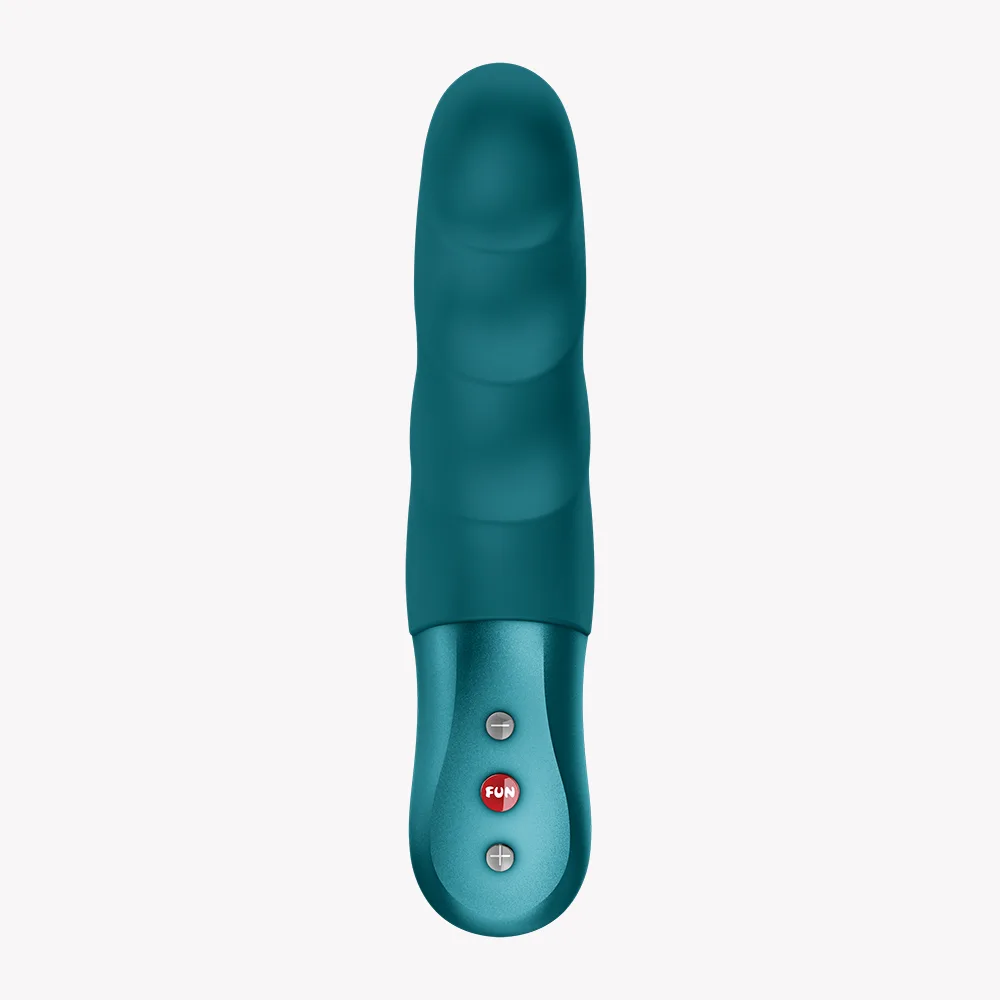
Review
Review: Fun Factory Stronic Petite
The series’ smallest pulsator — 170 mm, 218 grams, and 500 mAh.
29 July 2026
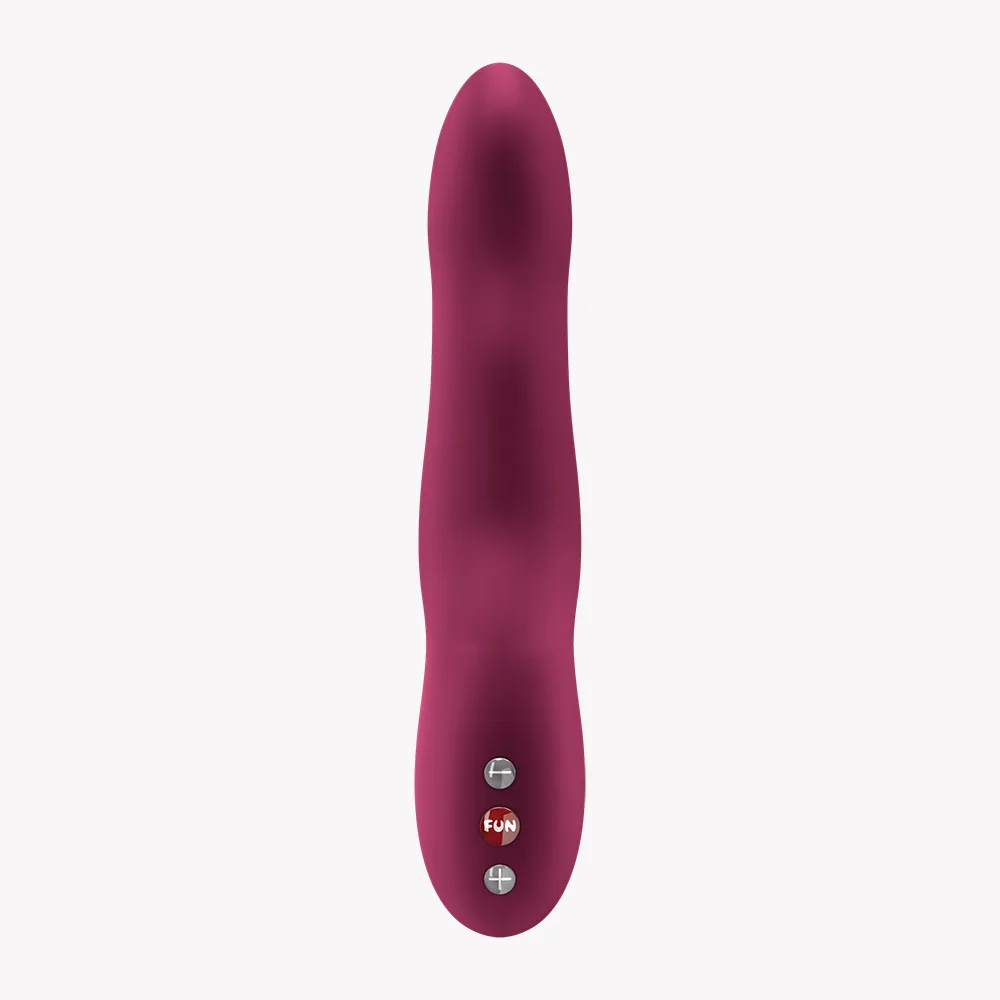 Author's pick
Review · Pulsator · Pulse function for the G-spot
Fun Factory’s wave-shaped pulsator reviewed against the manufacturer’s own specifications, the quick guide in the PDF, and price data from five Swedish stores. Seven speed steps plus three patterns, 211 × 41 × 41 millimeters, IPX7 according to IEC 60529, lithium-ion 800 mAh, and about 40 minutes of operating time via USB-C — at a price where the difference between the cheapest and most expensive store is 85 percent.
The most finely adjustable pulsator in Fun Factory’s Stronic series: seven pure speed steps plus three patterns, compared with four speeds on the Stronic Flow. It has the series’ largest battery cell at 800 mAh, charges with standard USB-C, and is IPX7 over the entire body. What you trade off is the operating time — about 40 minutes on a three-hour charge — and a specification where neither insertable length, stroke length, nor sound level is published. The USB-C cable is also not included.
Fun Factory Stronic Wave is a pulsator, not a vibrator. The difference is not marketing—it’s in the design: instead of putting the entire product into vibration with an unbalanced weight, a pulsator moves a weight back and forth along its own axis, so that the tip makes a real thrusting motion. Fun Factory calls the principle Stronic Technology, and Stronic Wave is the model in the series where the shaft is also wave-shaped, with an upward-curved tip aimed at the G-spot. The manufacturer classifies it as a G-spot pulsator.
The specifications look like this. Length 211 millimeters, width 41 millimeters, and height 41 millimeters. Weight 276 grams. Ten thrust programs, which the manufacturer’s own quick guide specifies as seven speed steps plus three patterns. The material, according to the quick guide, is ABS, polycarbonate, and silicone. The enclosure rating is IPX7. The battery is a 3.7-volt lithium-ion battery with 800 milliampere-hours; runtime is stated as approximately 40 minutes, and charging time as approximately 3 hours via USB-C. In Sweden, the item is sold by five stores at prices between 395 and 729 SEK, and four of them had it in stock at the price check on 12 September 2026.
This review is exclusively about the variant in the color Bordeaux, with EAN 4255821802876, the manufacturer’s article number FF001048WR01. The number is checked in three ways: in Fun Factory’s own article data, in the gtin13 tag on Sexonics’ product page, and in the article number at Vuxen. The stores alternately label the color as red, wine red, and bordeaux, but it’s the same item. Two Swedish stores also label it as "dildo med vibrator", which is misleading—the product does not vibrate; it thrusts.
A typical vibrator has a motor that rotates an eccentric weight. The imbalance makes the entire housing shake, and that shaking is what gets transferred to the skin. The frequency is high, often on the order of tens of rotations per second, and that’s why the sensation is described as buzzing or humming.
A pulsator works in a different way. Inside the shaft sits a weight that is driven back and forth along the product’s lengthwise direction. The motion is slow enough to be perceived as individual jolts rather than as a vibration, and because the mass is moved in the longitudinal axis, the entire product moves a little bit at a time. That’s why pulsators are described as handsfree: when the product is in place, the hand doesn’t need to provide the motion.
What can be stated purely from a technical standpoint is that an impact motion costs significantly more energy than a vibration. Moving a mass a few millimeters back and forth means accelerating and braking it with every stroke, and that energy can’t be recovered. That explains, by itself, the most striking figure in the entire specification: 800 milliampere-hours only provides about 40 minutes. We’ll get back to the calculation example a bit further down, but that’s the trade-off you’re making when you buy a pulsator instead of a vibrator.
Fun Factory doesn’t state how long the impact motion is in millimeters, nor how many jolts per minute the different speed steps produce. Neither stroke length nor jolt frequency is published by the manufacturer, in any of the documents that are available. It’s a real gap in the documentation, because those two numbers are exactly what would make it possible to compare two pulsators with each other other than by the number of programs.
Fun Factory sells several pulsators at the same time, and the names don’t say anything about size. Three models are close to each other in the range and are often mixed up in Swedish shops.
So the price difference between the three is two euros from the manufacturer. What differs is size, shape, and how the programs are distributed across speeds and patterns. Stronic Wave has the most pure speed steps of the three—seven versus Flow’s four and Petite’s five—and the largest battery cell. If you want the smallest product, Petite is the answer. If you want the longest, it’s Flow. If you want the finest gradation of the jolt strength, it’s Wave.
The material issue is the only property of an intimate product that cannot be compensated for with experience or care, and it determines whether the product is still hygienic after five years. There is also a discrepancy between the manufacturer’s different documents here that is worth printing out, because it explains why Swedish stores list three different materials for the same item.
The manufacturer’s product page only writes “soft, body-friendly silicone” and provides no material breakdown at all in its specification table. The manufacturer’s own Quick Start Guide, which is provided as a PDF behind the button Anleitung on the same page, is different and is exactly: ABS, PC, silicone. PC stands for polycarbonate. This means in practice that the silicone sits on the outside of what goes into the body, while the chassis underneath and around the operating part is hard plastic. Fun Factory’s own FAQ describes the same breakdown in general: the silicone is listed as medical silicone, while the battery compartment and control elements are stated to be made of body-friendly thermoplastic.
Among the Swedish stores, only Joyland reproduces the material correctly as “ABS plastic, silicone”. Blush Me writes “high-quality silicone” and Vuxen only “silicone”. When a store listing is pitted against the manufacturer, the manufacturer wins, and the discrepancy is worth knowing before you buy: the person who thinks they are buying a product entirely made of silicone gets a product whose insertion part is silicone-coated, and whose grip and button area are made of plastic.
Silicone is a non-porous material. A non-porous surface can be cleaned because it does not have microscopic cavities where residue can get trapped. It is the single most important property of a material that is meant to lie against mucous membrane, and that is why the material declaration carries more weight than almost all other lines in a specification. Fun Factory describes its silicone as medical, hypoallergenic, non-porous, vegan, and halal.
That the insertable part is silicone and the rest is hard plastic isn’t a problem in itself — on the contrary, it’s the usual solution in this price range, and it’s the surface that comes into contact with the mucous membrane that determines the hygiene question. But there is a practical consequence. The seam between silicone and plastic is a joint, and joints are the only place on a product of this kind where residue can end up sitting. Rinse that part extra carefully, and check it while you still have the product under the water.
Joyland also lists two properties that the manufacturer does not publish: the surface is described as silky-smooth and wavy, and the hardness is given as medium. These are store details, not manufacturer details, and they should be read accordingly — Fun Factory does not publish a hardness value in Shore A for the silicone on any of its Stronic models.
Phthalates are a group of plasticizers (softeners) used to make plastic—above all plasticized PVC—flexible. The Swedish Chemicals Agency (Kemikalieinspektionen) describes them as substances that can affect the endocrine system and make reproduction more difficult, and several of them are therefore restricted or banned within the EU in a large number of products. This particular product category is repeatedly the subject of supervision because it contains skin-contact flexible plastic.
Fun Factory states in its FAQ that all products are free from plasticizers (softeners), BPA, and phthalates. Joyland repeats the claim in its own specification with the line "Phthalate-free: Yes". The packaging also bears a symbol labeled body-safe materials. It is an unambiguous declaration, unlike terms such as "TPE" or "jelly rubber," which say nothing at all about which plasticizers (softeners) are included.
What can be established in principle is that neither silicone, ABS, nor polycarbonate requires phthalate plasticizers (softeners) in order to have its properties. Silicone’s softness comes from the polymer’s own structure, and ABS and polycarbonate are rigid engineering plastics that are not plasticized at all in this type of application. The material selections themselves therefore make the declaration plausible, which is not always the case when a manufacturer claims phthalate-free.
The manufacturer states the length is 211 millimeters, the width 41 millimeters, and the height 41 millimeters, as well as the weight 276 grams. The fact that the width and height are given to exactly the same number, and that two Swedish stores present the measurement as a diameter, points to a round cross-section—meaning that the variations in shape are accounted for by the waves along the shaft, and not by an oval profile.
The Swedish stores confirm the measurements. Joyland states a length of 21 centimeters and a diameter of 4 centimeters; Blush Me states 21.10 centimeters and 4.10 centimeters, respectively, as the maximum diameter. Both are within the rounding error compared with the manufacturer’s millimeter values, which is unusually neat in this category—the usual thing is that the stores give the measurements for a completely different variant.
The weight information of 276 grams deserves a comment, and it turns out in the product’s favor. The weight is not the result of poor construction but a direct consequence of the technology: it’s the moving mass inside the shaft that creates the impact, and a lighter product would produce a weaker impact. If you compare within the series, the pattern becomes clear. Stronic Petite weighs 218 grams, Stronic Wave 276 grams, and Stronic Flow 303 grams, and they are 170, 211, and 220 millimeters long, respectively. The weight follows the size.
If you use it against a conventional G-spot vibrator, the difference is noticeably clear instead. Lelo Ina Wave 2, which is shorter but wider than Stronic Wave — 200 millimeters vs. 211 in length and 65 millimeters vs. 41 in width — is listed as weighing 176 grams. Stronic Wave therefore weighs about 57 percent more, even though it is the narrower of the two. That’s what the built-in moving mass costs in grams.
Fun Factory does not publish the insertable length, either on the product page or in the quick guide, and none of the five Swedish stores lists it either. That’s a relevant gap, because the grip section with its three buttons takes up the lower third of the product in the manufacturer’s own images. So don’t assume that the full 211 millimeters are insertable. By way of comparison, Lelo lists 110 millimeters insertable length for Ina Wave 2 — a detail that’s easy to publish and that Fun Factory has chosen not to publish.
The interface consists of three buttons on the underside of the grip section: a minus, the manufacturer’s round FUN button in the middle, and a plus. According to the manufacturer’s quick guide, you start up and shut off the product with a press on the FUN button for one to two seconds, and you step through the programs with the plus and minus. The manufacturer’s own image instructions show the scale in both directions, from 1 to 10 and from 10 to 1.
It’s a deliberately simple interface. There’s no display, no app, and no Bluetooth. Three buttons and ten settings are the whole control system. The advantage is that there’s nothing to learn and nothing that can stop working because a phone has been updated. The downside is that you don’t see which setting you’re on, so you have to count button presses — and since the buttons are on the grip and aren’t visible during use, it’s practically a matter of pressing until it feels right.
Both the manufacturer’s product page and the stores say “ten pulse programs,” but it’s an oversimplification that hides what’s actually interesting. The quick guide specifies the set as seven speed steps plus three patterns. That’s an important difference. Seven speed steps means seven even levels to choose from, where the pulse runs at the same tempo all the time. The three patterns, instead, are alternating sequences, where the tempo varies according to a preprogrammed schedule.
The distribution differs between the models in the series, and that’s where a real specification difference lies. Stronic Flow has four speeds and four patterns, Stronic Petite has five speeds and three patterns, and Stronic Wave has seven speeds and three patterns. That adds up to ten programs for Wave and eight for both Flow and Petite — but the one who wants to be able to fine-tune an even tempo has almost twice as many speed steps to work with on Wave as on Flow.
What can be established in practice is that a steady speed and a pattern serve different functions. A steady rhythm is something you can get used to; a pattern isn’t—that’s the whole point of it. So the pattern modes are not “more speeds,” but a different kind of stimulation, and a comparison that only counts modes is therefore misleading no matter which model you look at.
The manufacturer’s main selling point is that Stronic Wave thrusts on its own. You can state it purely mechanically: the movement that reaches the body is created inside the product, not by the hand. That’s what sets a pulsator apart from a regular dildo or vibrator, where the movement always has to be provided from the outside.
What that means in practice is that the product needs something to work against. A pulsator held loosely in the air uses some of its motion to move itself. The shape of Stronic Wave is designed to counteract that—the wave-shaped shaft provides resistance against surrounding tissue, and the manufacturer explicitly states that the bent tip is aimed at the G-spot. In addition, the wide, flattened grip area at the bottom functions as a stop.
A limitation that must be spelled out: Joyland explicitly states that the product is not intended for anal use. It’s a store claim and not wording that Fun Factory repeats in its quick guide, but the advice is well-justified regardless of the source. A pulsator has no wide base that prevents it from sliding in, and a product that moves under its own power is exactly the kind of product where the lack of a stop matters.
Here the answer has to be short and honest: Fun Factory does not publish any measured decibel value for Stronic Wave, either on the product page, in the quick guide, or on the packaging. None of the five Swedish stores lists any number either. Websites that state an exact decibel value for this model either show their own measurement or a value without a source.
What you can, however, reason about is the construction. A pulsator moves a mass back and forth, and each reversal involves braking and acceleration that the chassis has to absorb. It’s a fundamentally different sound profile than that of a rotating eccentric motor: more a rhythmic, low-frequency tapping than a steady hum. Low-frequency sound also travels better through solid surfaces than high-frequency sound, which makes a simple piece of advice more relevant here than for a regular vibrator: never let the product work while lying on a hard tabletop, which acts as a resonance box.
Fun Factory Stronic Wave is rated IPX7 at three separate, independent locations in the manufacturer’s materials: in the product page’s bullet list, in the quick guide’s technical data, and as a symbol on the packaging. The rating comes from the international standard IEC 60529, which defines enclosure classes for electrical equipment. The number 7 in the second position means that the product is tested for submersion in water to a depth of one meter for 30 minutes.
Fun Factory’s FAQ states the consequence plainly for the entire range: all rechargeable products from the manufacturer are completely waterproof. The quick guide’s cleaning section shows the product submerged in water, not just rinsed.
The difference from a splash-proof product is greater than the wording suggests. Splash protection covers water droplets and, at best, water jets, but not submersion. Such a product can handle a damp cloth and possibly a shower, but not a bathtub, and it should not be held under running water without thinking twice about the buttons and the charging contact.
On Stronic Wave, the charging contact is precisely the point where IPX7 becomes relevant. Unlike products with magnetic charging, where the housing is completely sealed, Stronic Wave has a real USB-C input. It sits under a red rubber plug that seals tightly against the housing—this is clearly visible in the manufacturer’s own detail image. This means two things. The first is that waterproofing depends on the plug really being inserted. The second is that the plug is a movable rubber part, meaning it is one of the few parts on the product that wears out from being opened and closed. Always wipe the product before you open the plug to charge.
If a product is missing an IPX rating entirely, it should be treated as not waterproof. The lack of a rating is never a sign that the product would be approved.
Fun Factory’s instructions are simple: clean with lukewarm water and a mild soap. The quick guide shows the product submerged and also recommends the manufacturer’s own cleaning product. Rinse before first use and after every time, and be extra careful along the seam between the silicone and the plastic part.
The lubricant question is very clear from the manufacturer. Never use a silicone-based lubricant on a silicone product. Fun Factory’s FAQ explicitly warns against it, stating the reason that the silicone-based gel is very difficult to remove from the product without leaving residue. Over time, the effect is that the surface breaks down and becomes porous, and a porous surface can no longer be cleaned properly—only replaced. Joyland recommends water-based lubricant in its own specification, which is the right advice.
The manufacturer goes further than that. The FAQ warns about oils and creams in general — sunscreen, lip balm, essential oils, coconut oil, and all kinds of cooking oils — with the clear statement that they can cause irreversible damage to the control unit and the entire product, and that use can make the warranty invalid. It’s unusually bluntly worded, and it’s worth taking seriously.
Storage also has its own instructions in the quick guide. The product should be stored between −5 and +60 degrees, in a bag of the kind shown in the quick guide, and not together with sharp or pointed objects. The specified temperature limits apply to storage, not cleaning — so boiling and the dishwasher are out of the question despite IPX7, because boiling water is far above +60 degrees.
The quick guide’s safety section covers three things that rarely show up in store texts. Remove piercings and jewelry in the intimate area before use. Do not use the product on irritated or damaged skin, and stop if pain or discomfort occurs. And stop using it if it becomes unusually warm, has mechanical damage or deformations, or has changed color — three concrete signs that a seal or a cell is on its way out.
Battery data is the area where the manufacturer’s quick guide provides the most, and it’s also the area where Stronic Wave has its clearest weakness. The cell is a 3.7 volt lithium-ion battery with a capacity of 800 milliampere-hours. The charging voltage is 5 volts, the maximum charging current is 500 milliamperes, the charging time is about 3 hours, and the operating time is about 40 minutes.
Via USB-C. The port is located under a red rubber plug on the side of the grip area, and the manufacturer’s quick guide lists the connection as USB. It’s a real advantage compared with the magnetic, product-specific charging cables that several competing brands use: if you lose the cable, any regular USB-C cable will work, and Vuxen highlights exactly that in its own product text — all Fun Factory products now have USB-C and can be charged with a cable you already have.
However, there’s a statement in the quick guide that none of the five Swedish stores reproduce: USB-C charging cable is not included in the delivery. It is explicitly stated in the manufacturer’s own charging instructions. Practically speaking, it’s a minor issue since most households have several USB-C cables lying around, but it’s a piece of information that should be in the product text, and isn’t. For comparison, Lelo explicitly states that a USB charging cable is included in the packaging for Ina Wave 2.
The charging time of around 3 hours is long compared to the size of the cell. If you calculate using 800 milliampere-hours at the specified maximum charging current of 500 milliampere, you theoretically get 1.6 hours. That the manufacturer still states roughly double suggests that charging is ramped down toward the end of the cycle, which is normal and gentle for lithium-ion cells— but that means that a fully depleted product isn’t usable again after a quarter of an hour.
This line is the most important thing in the entire specification, and it’s worth working out. 800 milliampere-hours at 3.7 volts corresponds to about 2.96 watt-hours of stored energy. If you divide that by 40 minutes, i.e. two-thirds of an hour, the average power consumption comes out to about 4.4 watts. That’s a lot for a handheld product.
The comparison within the series shows the same thing. Stronic Flow has 700 mAh and about 40 minutes of runtime, which works out to about 3.9 watts. Stronic Petite has 500 mAh and about 30 minutes, i.e. about 3.7 watts. So Stronic Wave draws the most of the three: it has the largest cell in the series, but it doesn’t buy any extra time for that— it’s more power.
Compared to a conventional vibrator, the difference is dramatic. Lelo states 520 mAh at 3.7 volts for Ina Wave 2, i.e. about 1.92 watt-hours, and a runtime of up to two hours. That gives about 0.96 watts. So Stronic Wave therefore consumes roughly four and a half times as much power as a G-spot vibrator in the same size class, and gets one-third the runtime despite having a battery that’s 1.5 times larger. That’s the price of moving mass instead of shaking it, and it’s a physical limitation rather than a design flaw.
What that means in practice is that Stronic Wave should be charged before use, not after, and that it isn’t a product you take with you without a cable. Forty minutes is more than enough for a single occasion, but the margin is small if the product has been left unused for some time. Lithium-ion cells self-discharge slowly, and the manufacturer doesn’t publish any standby time for Stronic Wave—by comparison, Lelo states up to 90 days of standby for Ina Wave 2.
A final note about battery life. Fun Factory doesn’t say whether the cell is replaceable, and the quick guide contains no instructions for replacement. With an IPX7 rating and a sealed USB-C plug, a fully sealed design is the likely outcome, which means that, in practice, the product is used up when the cell is. Lithium-ion capacity drops with the number of charge cycles, so a product that’s charged after every use ages faster than one that’s used longer per charge— and 40 minutes of runtime makes many charge cycles more or less unavoidable.
We do not have price data from shops in your market yet.
800 milliampere-hours at 3.7 volts are enough for 40 minutes. That’s about 4.4 watts — four and a half times as much as a G-spot vibrator in the same size class draws.
Three comparisons are relevant: against the smallest pulsator in the same series, against the largest in the same series, and against a conventional G-spot vibrator from another premium brand. All the information below comes from each manufacturer’s own specifications and quick guides.
Stronic Petite is the series’ smallest pulsator: 170 × 38 × 37 millimeters and 218 grams, versus Stronic Waves at 211 × 41 × 41 millimeters and 276 grams. The difference is 41 millimeters in length and 58 grams in weight. Both are IPX7, both are charged via USB, and both have a 3.7-volt lithium-ion battery. From the manufacturer, one euro separates them: 62.95 versus 63.95.
Where they differ for real is in the battery and the program setup. Petite has 500 mAh and about 30 minutes of operating time, Wave 800 mAh and about 40 minutes. Petite has five speed levels plus three patterns, Wave seven plus three. Petite is also charged with a lower maximum charging current, 300 mA versus 500 mA, which is expected for a smaller cell. The material is listed by the manufacturer as silicone and ABS for Petite, while the Waves quick guide also lists polycarbonate.
The conclusion is simple. If you want something smaller, lighter, and more discreet to store, Petite is the right choice—and you pay for it with ten minutes less operating time and two fewer speed levels. If you want the longer shape with waves and a curved G-spot tip, and finer gradation of the rhythm, Wave is the right choice. The price difference from the manufacturer is so small that it shouldn’t be the deciding factor—shape should decide.
Stronic Flow is the series’ largest: 220 × 45 × 38 millimeters and 303 grams, versus Stronic Waves at 211 × 41 × 41 millimeters and 276 grams. So Flow is 9 millimeters longer, 4 millimeters wider, 3 millimeters lower, and 27 grams heavier. Both are listed in the quick guides with the same material set—ABS, polycarbonate, and silicone—same IPX7, same lithium-ion voltage, same maximum charging current of 500 mA, same charging time of about 3 hours, and same operating time of about 40 minutes.
Two differences remain, and they’re both in Waves favor if you value adjustability. The battery is larger in Wave: 800 mAh versus Flows 700 mAh, despite the same stated operating time. The program setup differs more: Wave has seven speed levels and three patterns, Flow four speed levels and four patterns. Anyone who wants to be able to fine-tune a steady rhythm gets almost twice as many steps on Wave. Anyone who would rather switch between pre-programmed sequences gets one extra pattern on Flow.
From the manufacturer, Flow costs 64.95 euros versus Waves 63.95 euros. That’s one euro apart for two products that, on paper, are almost identical in everything except shape and program distribution. So the choice between them is about length—and about what kind of stimulation you want to be able to control.
This comparison is the most enlightening, because the two products solve the same task in two completely different ways. Lelo Ina Wave 2 measures 200 × 65 × 45 millimeters, weighs 176 grams, and is specified as body-friendly silicone and ABS plastic. It has a lithium-ion battery of 520 mAh and 3.7 volts, charges in 2 hours at 5.0 volts and 500 milliamperes, has a runtime of up to 2 hours, a standby time of up to 90 days, twelve settings, and an interface with five buttons. Lelo also states an insertable length of 110 millimeters, a diameter of 37.09 millimeters, a frequency of 60 hertz, and automatic shut-off after 20 minutes.
The differences that actually matter:
If you choose based on the published specs, runtime, and what’s in the box, Lelo wins. If you choose based on what you actually want—an impact motion and not a vibration—then Ina Wave 2 isn’t part of the discussion. In that case, it comes down to pulserators, and then Stronic Wave is one of the best-documented in the category thanks to the quick guide.
Five Swedish stores sell the item with EAN 4255821802876. The cheapest is Joyland at 395 SEK, and the most expensive is Blush Me and SexleksakerOutlet at 729 SEK each. That’s a difference of 334 SEK, so just under 85 percent, for the exact same item number, the same color, and the same packaging.
The stock situation is favorable here, unlike in many other comparisons. Four of the five stores had the product in stock at the price check on September 12, 2026, and the cheapest among them was one of them. The only one that showed as sold out in its product listing was Sexonic at 534 SEK—meaning one of the stores in the middle of the price range. The difference between the cheapest and the second-cheapest available store is 104 SEK—Joyland 395 SEK versus Vuxen 499 SEK.
The price spread is not because any store sells a different variant. Sexonic lists the gtin13 number 4255821802876 in its own structured product data, Vuxen uses the same number as the article number, and both Blush Me and SexleksakerOutlet use the EAN number directly as the article number. Joyland is the only one with its own internal number, but the product page’s specifications — 21 centimeters, 4 centimeters in diameter, ten thrusting modes, up to 40 minutes of battery life — match the manufacturer’s values line by line.
As a reference, the product costs 63,95 euro in Fun Factory’s own German web store. This is the manufacturer’s own list price, not a Swedish price, but it gives an idea of where the model is intended to be positioned. The fact that the price range in Sweden reaches so far in both directions around that level is, in itself, an argument for comparing before you pay.
The prices in the table above are updated when the stores’ product feeds are updated, but always check the final price at checkout. Shipping costs are added at most stores under a certain order value, and in this price range all five stores are below the usual free-shipping thresholds — which can even out some of the difference.
It’s for you if you want a real thrusting motion and not a vibration, and if you want it hands-free. It’s for you if you want to fine-tune the pace — seven clean speed steps are more than any other model in the series offers. It’s for you if you want to be able to rinse off the entire product under running water and use it in the shower or bathtub, and if you want to be able to charge it with the same cable as your phone instead of with a product-specific magnetic cable. The shape — wave-shaped shaft, curved tip — is also explicitly made for G-spot stimulation, which makes it a reasonable choice if that’s the stimulation you’re after.
It’s not for you if you need a long runtime. Forty minutes is short, and a three-hour charge means an empty product won’t be usable again on short notice. It’s not for you if you want the smallest possible product — here, Stronic Petite is 41 millimeters shorter and 58 grams lighter. It’s not for you if you want an app, remote control, or a display, because there’s nothing like that. It’s not for you if you require a published insertable length, measured sound level, or details about stroke length and thrust frequency before purchase, because Fun Factory does not publish any of that. And according to Joyland’s own product page, it should not be used anally.
One more thing belongs in the decision. Anyone who has never tried a pulsator should know that it isn’t a more powerful vibrator but a different kind of product. The movement is slower, more distinct, and more mechanical, and it feels in a completely different part of the spectrum than a buzzing sound. This isn’t an upgrade from a vibrator—it’s a complement to one. Buying it while assuming it will do the same thing but better is the most common way to end up disappointed with the category.
The warranty question requires a clarification, because the manufacturer’s own materials contain two different statements. The packaging for Stronic Wave is labeled with a symbol for 25-year warranty. Fun Factory’s FAQ confirms the number, but with a condition that’s easy to miss: the 25 years apply to products purchased directly from Fun Factory, via the manufacturer’s own web shop or their previous own stores, and with proof of purchase.
In another place in the same FAQ, there is another statement: 24-month warranty on all Fun Factory products with proof of purchase. The manufacturer also states that complaints for products that have not been purchased directly from Fun Factory must be addressed to the seller, meaning the shop. So if you buy any of the five Swedish stores listed in the table above, 24 months is the realistic starting point, not 25 years—even if the symbol on the box says something else.
The manufacturer also lists an exception that applies regardless of which figure is used: using oils and creams can make the warranty invalid. Sun cream, lip balm, essential oils, coconut oil, and cooking oils are expressly listed. So this isn’t just advice about product care—it’s a warranty condition.
What does apply, however, is your statutory rights, and in this case they’re stronger than the manufacturer’s 24 months. Under the Swedish Sale of Goods Act (konsumentköplagen), you have three years of right to make a complaint for defects in the goods, regardless of what the manufacturer promises. For distance purchases, you also have a right of withdrawal for fourteen days under the Distance Contracts Act (lagen om distansavtal och avtal utanför affärslokaler). Be aware that, in practice, the right of withdrawal is limited for hygiene products that have been removed from a sealed package—Fun Factory itself states that exception in its FAQ—while the right to make a complaint for defects still applies anyway. If you have questions about what applies in your case, Konsumentverket guides you via Hallå konsument.
A final note on who is behind the product, since the information differs between the manufacturer’s documents. The quick guide names FUN FACTORY Germany GmbH in Bremen as the manufacturer. The product page’s facts box, however, lists Triple A Import GmbH in Bielefeld as the manufacturer and the responsible person in the EU’s sense. Both pieces of information come from Fun Factory themselves and are not contradictory—the latter is the legally responsible importer—but it is that address that a complaint case ultimately ends up with.
Fun Factory Stronic Wave Thrusting Pulsators is ranked på plats 2 av 12 in thrusting vibrator best i test, where the entire category is compared against each other using five shared criteria. Guiden vinns av Fun Factory Bi Stronic Arc Thrusting Rabbit Pulsator.
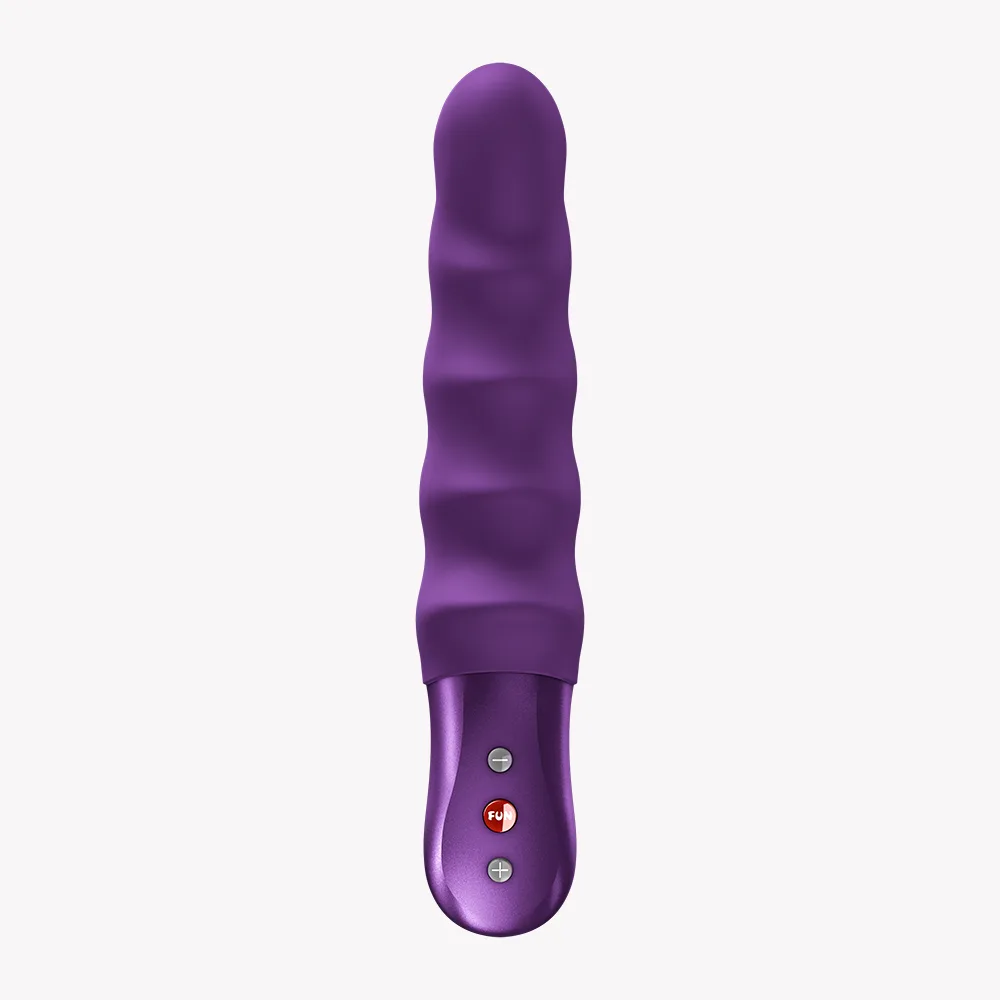
Every numerical piece of information in the text can be traced to one of the sources below. The links were checked manually on the specified date.
This page is machine-translated from Swedish. Read the Swedish original