

Review
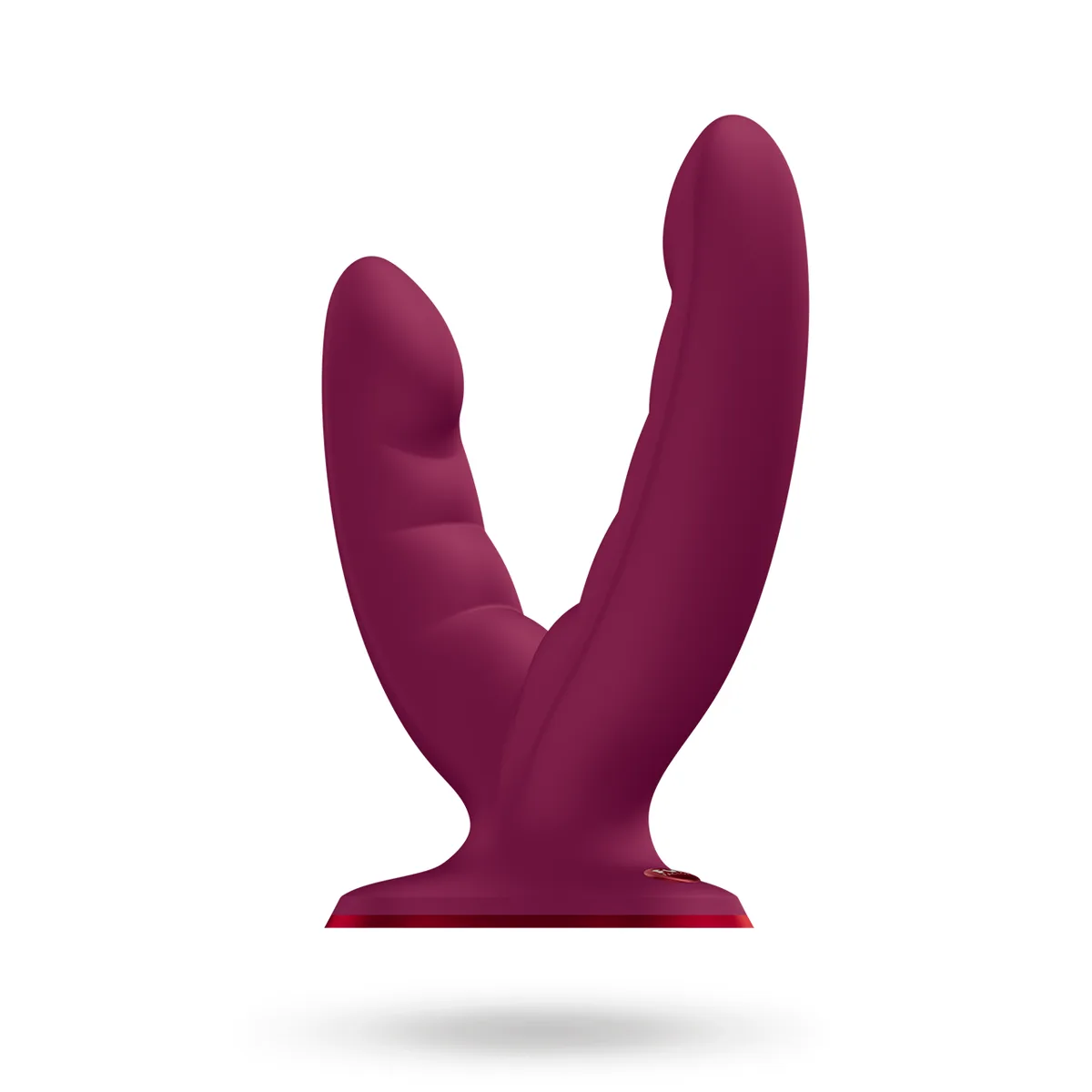
Review: Fun Factory Ryde Double Dildo
Grinding dildo with suction cup and self-attachment in medical-grade silicone.
29 July 2026
 Author's pick
Review · Strapless strap-on · Silicone without a harness
ToyJoys selfria strap-on reviewed against the manufacturer’s own dimension sketch, instructions for use, and price data from five Swedish stores. One-piece silicone, 23 centimeters total length, 14 centimeters shaft, and the diameters 3.8 and 4.5 centimeters — without a motor, battery, or charging cable, and with three details where the stores contradict the manufacturer.
The simplest and easiest way into a battery-free strap-on: one-piece cast silicone, 23 centimeters total and nothing that can be removed or break. The manufacturer’s dimension drawing is complete, and the lack of a battery means the product, in practice, has no upper limit on its service life. What you pay for is a thin specification — neither weight, ingress protection class, nor a phthalate declaration is published — and the fact that two shops market the product more broadly than what the manufacturer’s own manual allows.
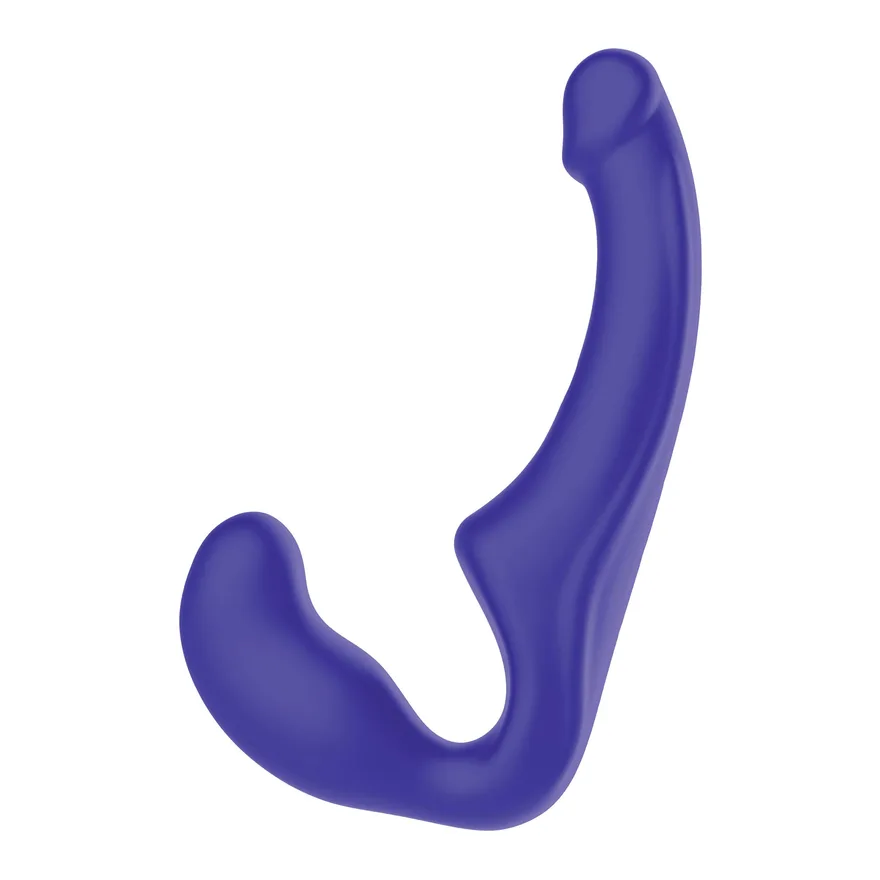
Get-Real Toyjoy Strapon Strapless is a strap-on without a harness. The whole point is in the word strapless: there is no harness, no straps, and no buckle to adjust. Instead, the product is shaped like a U, where one end is inserted into the receiver and held in place by the pelvic floor muscles, while the other end points outward and is used for penetration. It’s the same basic idea that made the shape known under the nickname Bend Over Boyfriend, and it’s exactly how the manufacturer itself presents the item.
The specification is brief, and it’s not due to carelessness on our part, but simply because there isn’t any more published information. The manufacturer states silicone as the material and publishes a dimension drawing: total length 23 centimeters, shaft 14 centimeters, width 9.5 centimeters, diameter 3.8 centimeters on the penetrating part and 4.5 centimeters on the insertion part. There is no motor, no battery, no charging connector, and no electronics whatsoever. In Sweden, the item is sold by five stores at prices between 356 and 479 SEK, and three of them had it in stock at the price check on September 12, 2026.
This review is exclusively about the purple variant with EAN 8713221832979, the manufacturer’s item number 10146, and the variant designation 10146-PURPLE. That number is more important than usual here, because ToyJoy sells four different strapless strap-ons, and three of them are called Bend Over Boyfriend in some form. Swedish stores mix the names freely: the same item is called "Toyjoy Strapon Strapless" at Lekosmek, "Toyjoy Strapless Strapon" at Taboo, "Bend Over Boyfriend Silicone" at Vuxen and Vuxenkul, and "ToyJoy Strapless Strap-on Silicone 23 cm PURPLE" at Sexonic. However, all five list the same barcode or the same item number, so the name chaos is cosmetic — but that makes the EAN number the only reliable way to compare prices.
A typical strap-on consists of two parts: a dildo and a strap that is tightened around the hips and thighs. The strap carries the load, and the dildo sits in a ring at the front. That provides stability but requires getting dressed, adjusting it, and often buying two products that fit together.
A strapless strap-on removes the harness and transfers the entire attachment to the body. The curved end is inserted vaginally in the wearer, and it’s the pelvic floor muscles’ grip on that part — not any external support — that keeps the outer part in place. The manufacturer describes the construction as ergonomically shaped to sit snugly and at the same time stimulate the G-spot and massage the clitoris of the person wearing it. So it’s not just a solution for the partner; the attachment part itself is designed as a stimulator of its own.
What you can say purely from the design is that this solution has a built-in tradeoff that no manufacturer can engineer away. The larger and heavier the outer part is, the larger the lever arm it creates against the attachment, and the more muscle work is required to keep it in place. So the measurements don’t just determine the fit; they also determine how much force is needed, and that’s why the dimension sketch is the most important single source for this product. If you can’t get a grip on the insertion part, then it doesn’t matter how good the rest is.
ToyJoy has four strapless strap-ons in its range, and the names overlap so much that they’re hard to tell apart in a store list. This is how they look from the manufacturer, with their respective barcode and the manufacturer’s own price in euro:
Practically, that means that "Bend Over Boyfriend" in a Swedish store header can be at least three different articles in three different price tiers. Check the barcode before comparing prices — it’s provided in plain text by Taboo, Vuxenkul and Sexonic, while Vuxen uses it directly as the article number and Lekosmek lists the manufacturer’s internal numbers 10146.
The material question is the only property of an intimate product that cannot be compensated for with experience or care, and it determines whether the product is still hygienic after five years. The manufacturer states a single material for item 10146: silicone. The same information is repeated at all Swedish shops that list the material. The product is molded in one piece — there are no seams, no contact surface against a hard plastic core, and no removable part.
Silicone is a non-porous material. A non-porous surface can be cleaned, because there are no microscopic cavities where residue can remain. This is the single most important property of a material that is meant to lie against mucous membranes, and that is why the material declaration weighs more heavily than almost all other lines in a specification.
That the product is molded in one piece also makes the difference bigger than it sounds. On a typical strap-on, there are at least three interfaces where dirt can collect: between the dildo and the ring, between the ring and the harness, and in the fabric weave of the harness itself. Fabric parts cannot be cleaned in the same way as silicone, and a harness used by multiple people is, in practice, a textile that should be machine washed. There is nothing like that here. The entire product can be rinsed off as a single object, and that is the most concrete hygienic advantage of a selfri construction.
One thing the manufacturer is clear about in its instruction manual, however, is that intimate products should not be shared between people without suitable hygienic protection. It’s worth noting this here, because the product is by nature used by two people at the same time and because both ends are body-contact surfaces.
Phthalates are a group of plasticizers used to make plastic — above all flexible PVC — pliable. Kemikalieinspektionen describes them as substances that can affect the hormone system and make reproduction more difficult, and several of them are therefore restricted or banned within the EU in a large number of products. This product category is a recurring subject of supervision because it contains soft plastic against skin and mucous membranes.
Silicone doesn’t require phthalate plasticizers to become soft — the softness comes from the polymer’s own structure. The material listing “silikon” is therefore, in itself, a better indication than terms like TPE or jelly rubber, which don’t say anything at all about which plasticizers are included.
But here, accuracy has to come before enthusiasm. ToyJoy does not publish an explicit declaration that item 10146 is free from phthalates, BPA, or latex. The manufacturer writes "silicone" and stops there. In the general user manual, the material information is instead referred to the packaging, and the same document tells the user not to use the product if they are allergic or sensitive to any of the materials listed on the packaging. It’s an honest but sparse way of handling it, and it differs from how, for example, Fun Factory phrases its information about its silicone. If you want a written phthalate declaration before buying, it isn’t available to download online for this item.
The manufacturer publishes a dimension sketch in the product gallery, and it is the authoritative source for all measurements. The sketch gives four values: the total length, 23 centimeters, along the product’s long side; 14 centimeters for the penetrating shaft measured down to the point where the insertion part begins; 9.5 centimeters as a horizontal measurement at the bottom of the image; and the diameters Ø 3.8 centimeters and Ø 4.5 centimeters for the outer and inner parts, respectively.
There’s a detail worth pausing on here, because it affects how you read the store text. In the manufacturer’s sketch, the 9.5 centimeters are a width measurement, not a length. The measurement line is horizontal under the product and spans the entire curved shape. Several Swedish stores nevertheless give the same figure as "insertable length 9.5 cm (insertion part)"—that’s what Taboo does, and the same wording appears again in the product texts from Lekosmek and Vuxenkul. It’s a reasonable but not substantiated interpretation: the manufacturer’s sketch simply does not mark the insertion part’s depth separately. What that means in practice is that you should assume 9.5 centimeters is the product’s total width when you assess whether the shape fits, and treat the figure as approximate if you interpret it as insertion depth.
The diameter of the insertion part, 4.5 centimeters, is the figure that matters most. The construction is based on that part filling out enough for the muscles to get a grip, and 4.5 centimeters is at the upper end of the range for a product of this type. It’s also the only piece of information all sources agree on: the manufacturer, Taboo, Vuxen, Vuxenkul, and Lekosmek all state 4.5 centimeters.
As for the outer part, however, there’s disagreement. The manufacturer’s sketch shows Ø 3.8 centimeters, and Taboo and Lekosmek reproduce the same value. Vuxen instead states a minimum diameter of 3 centimeters in its quick facts box. Where the manufacturer and a store contradict each other, the manufacturer’s statement applies, so go by 3.8 centimeters—but the discrepancy is worth knowing if you compare the product to something else based on a store page.
ToyJoy does not publish any weight for item 10146. The weight field in the manufacturer’s own product data is empty, and the dimensional sketch does not include any weight.
The retailer Taboo lists 224 grams in its specification box. This is the only weight information that can be found for the item, and it should be read as a store figure—not the manufacturer’s value. The order of magnitude, however, is reasonable to take into account: Fun Factory states 433 grams for its Share Lite, which is longer, wider, and thicker. That a smaller product in the same material class weighs about half of that is consistent with the proportions.
Weight isn’t a technical detail for this type of product. Since the entire construction relies on muscle grip, every gram at the outer end translates directly into how much effort is required to keep the product in place during movement. So the difference between 224 and 433 grams isn’t a minor detail in a data sheet—it’s the difference between two fairly different user experiences, and it’s one of the strongest arguments for the smaller model if you’re unsure whether the shape works for you.
The product has no buttons, no modes, and no learning curve in the interface. Everything you can configure is how it sits. The manufacturer’s own instructional image in the product gallery shows the principle: the shorter, curved end is inserted vaginally by the wearer so that it follows the front wall, while the shaft points straight forward. Both Lekosmek and Vuxenkul also describe an upward-facing section in the transition between the two ends, intended to rest against the clitoris of the person wearing the product.
Based on the shape, what can be established is that the angle isn’t adjustable. On a harness, you can move the ring up or down and change the shaft’s direction; here, the angle is molded into the material. The only variable is how far the insertion part is inserted and how the wearer stands. This makes the product easier to get started with and, at the same time, less adaptable than a harness-based solution—a trade-off worth making deliberately before you buy.
This is the most common question about strapless strap-ons, and the honest answer is that no manufacturer publishes a measurement for it—neither ToyJoy nor Fun Factory. There’s no specified force value, no recommended training level, and no specification to rely on.
What can, however, be reasoned about is the geometry, and it is published. The insertion part has a diameter of 4.5 centimeters—so the wider of the product’s two ends—which gives the musculature something to grip. The shaft is 14 centimeters and 3.8 centimeters in diameter, and the total width is 9.5 centimeters. The farther out from the attachment the force acts, the larger the torque becomes. A 14-centimeter-long shaft therefore provides noticeably more leverage than a short insert would.
The practical conclusion that can be drawn from the specification is that this product type works best at a calmer pace and with support from the hand as needed, and that it is not designed to sit completely motionless during vigorous movements. It’s a design characteristic of the entire category, not a defect of this particular model.
The manufacturer’s instructions are unambiguous on this point: use only water-based lubricant, because oil-based and silicone-based lubricants can damage certain product materials. That’s exactly the rule that applies to silicone products in general.
The mechanism is worth understanding because it determines the product’s service life. Silicone-based lubricant consists of the same family of polymers as the product itself. That means the lubricant gradually breaks down the surface instead of sitting on top of it, and the result is a material that starts to feel sticky and eventually becomes porous. A porous surface can no longer be cleaned properly—it can only be replaced. Oil-based products such as coconut oil leave behind a film that is difficult to remove and that collects residue.
With this particular product, the advice matters twice as much as usual, because both ends are body-close surfaces and because the entire attachment is based on friction against the musculature. Plenty of water-based lubricant on the shaft and sparingly on the insertion part is the trade-off that the shape itself implies. Taboo also explicitly notes that lubricant is not included in the delivery—and it’s not included at any of the shops.
This is the most important contradiction in all the material, and it is safety-relevant.
ToyJoy’s own instruction manual states the rule: products intended for anal use are designed with a flared base and should only be used as intended. Article 10146 has no flared base—it’s shaped like a U where both ends are rounded and tapered, which is clearly shown by the manufacturer’s own dimensional sketch. The manufacturer’s product text for the article doesn’t mention anal use at all; it describes insertion vaginally for the wearer and penetration by the partner.
The stores say something different in part. Taboo states that the penetrating part is “ideal for both vaginal and anal stimulation,” and Vuxenkul lists the stimulation area as both “Anal & Prostata” and “Vulva & Vagina.” These are store texts, not manufacturer specifications, and they conflict with the manufacturer’s own instructions.
What applies in practice: the outer end is fixed in the product and in the holder, so it is not loose in the way that makes a dildo risky. But the manufacturer’s wording is general and written for the entire range, and anyone who wants to stick to what the manufacturer actually says should read the product as designed for vaginal use. That two stores market it more broadly than the manufacturer does is a factual observation that should be reported, not a recommendation.
ToyJoy does not publish any ingress protection rating for article 10146, either on the product page or in the user manual. Instead, the user manual explicitly refers to the packaging: “Refer to the packaging for the water resistance rating of your product.” The same document categorizes products into three groups — fully waterproof, splash-proof, and products without a rating — and states that products without specified water resistance must not be exposed to water at all.
Two stores indicate a value anyway. Taboo writes “Water-resistant IPx5: Yes” in its specification box, and Vuxenkul lists “Water-resistant: Yes” without a number. These are store details. Neither of them is supported by any manufacturer material we can find; the manufacturer’s own documentation does not directly contradict them, but it also does not support them.
The ingress protection ratings come from the international standard IEC 60529. The number in the second position indicates protection against water. IPx5 means that the product is tested against water jets from a nozzle — i.e., showering and running water. Immersion is not included. First, IPx7 means that the product is tested for immersion to a depth of one meter for 30 minutes, and this is the class required for a product to be used in a bathtub without reservations.
So the difference is bigger than it looks. If Taboo’s information is correct, the product is approved for rinsing off but not for lying under water. If instead you follow the manufacturer’s own categorization, where the absence of a rating means the product should not be exposed to water, the conclusion becomes even more cautious — but that conclusion is hard to take seriously for a product without electronics.
What can be established without a source conflict is this: the product is cast silicone in a single piece without a battery compartment, a charging port, seams, or a rubber plug. There is physically no opening where water could get in to damage anything. Practically, it is therefore insensitive to water in a way that an electrical product can never be, regardless of whatever number is shown in a store table. Even so, we do not list any IP rating in the specification table as if it were the manufacturer’s, because it is not.
The manufacturer’s instructions are specific and apply to this product in full. Clean before and after each use. Use lukewarm water with mild soap or a cleaning agent intended for intimate products. Rinse thoroughly afterward, and dry the product completely before putting it away.
The storage instructions contain a detail that rarely appears in store texts, and it is specific to materials of this kind: products should be stored kept separate from each other to avoid reactions between different materials. Silicone that is in direct contact with another silicone or with soft-plasticized plastic for a long time can discolor or become tacky at the contact surface. The manufacturer recommends a bag or a separate storage box—but no such item is included in the delivery from any of the five stores.
Two limits from the user manual are worth knowing. The product must not be heated, frozen, or exposed to temperatures above 45 degrees, which rules out both boiling and the dishwasher as a cleaning method. And it should be inspected before every use: a silicone product with cracks, tears, deformations, or sharp edges should not be used, because a damaged surface can no longer be cleaned properly.
Item 10146 has no vibration. Vuxenkul states this explicitly in its specification table; the manufacturer’s product text mentions no motor; and the dimension sketch shows a solid shape without a battery compartment or a charging contact. It is an active design choice rather than a drawback—the vibrating variant is called Bend Over Boyfriend Vibrator, and it is its own item with its own number.
The consequence for lifespan is the most underestimated advantage of the entire product category. On a rechargeable product, it is almost always the lithium-ion cell that sets the limit: capacity drops with the number of charge cycles, the battery is rarely replaceable, and the product is practically used up when the cell is—even if the silicone is in perfect condition. There is no such ticking clock here. The only thing that can break is the material itself, and silicone that is cared for according to the instructions and is never exposed to silicone-based lubricants has no natural end limit.
The consequence for the function is just as clear on the other side. There is nothing to regulate, no positions to switch between, and no stimulation beyond that form. If you want vibration, you have to buy another article—and then the price difference becomes immediately large, which is shown in the comparison below.
There is no sound level to report here, and it’s not a gap in the specification. A product without a motor emits no operating noise, and that in itself is an argument for this type over a vibrating model if discretion matters a lot.
We do not have price data from shops in your market yet.
In the manufacturer’s own diagram, the 9.5 centimeters are a width measurement. Three Swedish stores report the same figure as the length of the insertion part.
Three comparisons are relevant: versus the most established selfria competitor from another brand, versus ToyJoy’s own vibrating top model, and versus the simpler sibling item in the same range. All details below come from the respective manufacturer’s own product pages, and the Swedish prices from the stores’ product feeds on September 12, 2026.
Fun Factory Share Lite is the most well-known selfria strap-on from a premium brand, and it’s the only direct competitor with a fully published size chart. The manufacturer states a length of 252 millimeters, a width of 115 millimeters, a height of 44 millimeters, and a weight of 433 grams, a body-friendly silicone material, that the product is fully waterproof, and a manufacturer price of 53.95 euro.
The comparison therefore becomes unusually concrete. Share Lite is 2.2 centimeters longer, 2 centimeters wider, and—according to the shop’s detail about 224 grams—about twice as heavy as the ToyJoy model. For a construction that is entirely based on a muscle grip, that’s a significant difference, and it goes in ToyJoy’s favor: less mass at the far end means less twisting moment on the attachment.
On the other side, there are two things. Fun Factory publishes a complete specification table with weight and water resistance from the manufacturer itself, while ToyJoy refers to the packaging and leaves the weight blank—so anyone who wants to be able to check what they’re buying has more to go on with Fun Factory. And Share Lite is listed by the manufacturer as fully waterproof, which is a manufacturer claim and not a shop claim.
Conclusion: if you choose based on the data presented and on a brand that publishes the entire specification, Share Lite wins. If you choose based on the product being as light and easy to handle as possible—which for this type of product is what determines whether it works at all—then the ToyJoy model wins.
Do you want the same basic form but with vibration? ToyJoy takes its own route to get there. Nymphea Strapless Strapon, article 10369, with barcode 8713221837523, has three motors, a remote control for changing settings, body-friendly silicone, and a rechargeable battery, according to the manufacturer. The manufacturer’s price is 67.99 euros versus 39.99 euros for article 10146 — that is 28 euros more from the manufacturer itself.
The manufacturer’s own instruction image for Nymphea also shows a detail worth factoring in: charging happens via a DC connection with a thin pin cable, not via USB-C. A product-specific charging cable is always a risk in the long run, because a lost cable can’t be replaced with the one that’s in the box at home.
That trade-off becomes clear. Nymphea provides vibration and remote control, but it also introduces everything that article 10146 does not need: a battery that ages, a charging cable that can go missing, electronics that can stop working, and an enclosure issue that actually matters. The person who chooses the simple model buys fewer functions, but also fewer things that can go wrong.
The confusing comparison is the one to ToyJoy’s own Classics item 10358, which is called exactly Bend Over Boyfriend and has barcode 8713221119339. It costs 35.99 euros from the manufacturer, compared with 39.99 euros for the Get Real model — that is 4 euros less.
ToyJoy publishes no product description, no dimensions, and no material specification for article 10358 — the product page contains only the name. That makes a fair comparison impossible based on manufacturer data, and that in itself is a reason to choose the Get Real article: it has at least a published dimension sketch and a material specification.
The practical advice is simple. If you see "Bend Over Boyfriend" in a Swedish store at a suspiciously low price, check the barcode before you compare. If it’s 8713221119339, it’s the Classics item, not this one. If it’s 8713221832979, it’s the right product.
Five Swedish stores sell the item with EAN 8713221832979. Cheapest is Sexonic at 356 SEK, most expensive is Taboo at 479 SEK. That’s 123 SEK, or just under a 35 percent difference, for the exact same article number, the same color, and the same packaging.
The stock situation changes the picture more than the price spread does. Three of the five stores had the product in stock at the price check on September 12, 2026: Vuxen at 399 SEK, Lekosmek at 429 SEK, and Taboo at 479 SEK. Both Sexonic at 356 SEK and Vuxenkul at 399 SEK were marked as sold out in the feed. So the lowest price you can actually buy at is 399 SEK, not 356 — a difference of 43 SEK compared with the bottom of the list, and 80 SEK, or 20 percent, up to the most expensive store.
Stores that list a product as sold out can keep an old price in the feed, and that price is rarely what you actually end up paying when the item comes back in. This is especially true here, where the cheapest listing comes from a store outside Sweden and where the price difference compared with the Swedish stores that have stock is small enough that the shipping cost can make up for it.
The price spread isn’t because any store is selling a different variant. All five list either the barcode 8713221832979 in plain text or the manufacturer’s item number 10146. Vuxenkul also uses the distributor’s own number SC4060-1 alongside the EAN, which is worth knowing if you search for item numbers and get zero results: that number belongs to the intermediary, not the manufacturer. The prices in the table above are updated when the stores’ product feeds are updated, but always check the final price at checkout.
It’s for you if you want to try a strap-on without buying two products and learning how to adjust a harness. It’s for you if you want silicone in one single piece with no seams, fabric sections, or a hard-plastic core. And it’s for you if you want something you can rinse off as a single object. It’s for you if you want to avoid charging, avoid having to keep track of a cable, and avoid having a battery that would make the product unusable in four years. And it’s for you if you prioritize low weight: 224 grams according to the store listing is about half the weight compared with the most well-known competitor, and with this type of product, weight isn’t a detail — it’s the deciding factor itself.
It isn’t for you if you want vibration — in that case, Nymphea or Bend Over Boyfriend Vibrator is the right item, and both cost significantly more. It isn’t for you if you require maximum stability during vigorous movement; there, a harness has a mechanical advantage that no selfri construction can match. It isn’t for you if you require a published phthalate declaration, a published weight, or a published ingress protection rating before purchase, because ToyJoy doesn’t publish any of that for this item. And it isn’t for you if you’re looking for a product that the manufacturer itself states is suitable for anal use — ToyJoy’s instructions explicitly link anal use to a flared base, which this shape doesn’t have, regardless of what two of the stores write.
One last thing belongs in the decision. This product is the cheapest and easiest way into a form that either works for you or it doesn’t, and that’s determined by geometry and musculature rather than by price. Finding that out for 399 SEK without a battery, cable, or electronics is a significantly cheaper test than finding that out for the Nymphea price — and if the shape turns out to fit, this item isn’t a compromise you need to trade away, since it lacks everything that would otherwise wear out.
ToyJoys user manual formulates the warranty briefly and without embellishment: the product is covered by the applicable statutory warranty, which covers material and manufacturing defects during normal use. Normal wear and tear, accidental damage, improper use, lack of maintenance, own modifications, and damage that is due to the instructions not being followed are excluded, and proof of purchase is required when making a claim.
In practice, this means that ToyJoy does not offer any voluntary manufacturer warranty beyond the law—unlike manufacturers such as Satisfyer and Womanizer, which provide their own warranties of 15 and 5 years, respectively. For a product without electronics, that is not a disadvantage in itself, because the faults that warranties usually cover in this category almost always are in the motors and batteries. But it means that what you can rely on is Swedish legislation and the store’s own terms and conditions—nothing more.
Under the Swedish Sale of Goods Act (konsumentköplagen), you have three years to complain about defects in the product. For distance purchases, you also have a right of withdrawal within fourteen days under the Act on Distance Contracts and Contracts Outside Business Premises (distansavtalslagen). Be aware that in practice the right of withdrawal is limited for hygiene products that have been removed from a sealed package—however, the right to complain for defects always applies. If you have questions about what applies in your case, Konsumentverket (the Swedish Consumer Agency) guides you via Hallå konsument.
A final note about the manufacturer’s documentation. The user manual refers, for the EU declaration of conformity, to the address www.TOYJOY.eu/compliance. At the inspection date, that address responded with 404, both with and without www. For this article, it has no practical significance, because the requirement for an EU declaration of conformity applies to products with radio equipment, and this product neither has electronics nor wireless functionality. But it says something about how well the manufacturer’s documentation trail is maintained, and it is worth knowing for anyone buying one of the vibrating models in the same series.
Get-Real Toyjoy Strapon Strapless is ranked på plats 2 av 12 in strap-on best i test, where the entire category is compared against each other using five shared criteria. Guiden vinns av Lovense Lapis.
Every numerical piece of information in the text can be traced to one of the sources below. The links were checked manually on the specified date.
This page is machine-translated from Swedish. Read the Swedish original