

Review
Review: Satisfyer Pro 2 Next Generation
Cheapest of the widely sold — 219 SEK and 15-year warranty.
29 July 2026
Review · Panty vibrator · App-controlled via ActiveJoy
Spanish IntoYou’s app-controlled panty vibrator reviewed against the manufacturer’s own specifications and pricing data from four Swedish stores. Ten vibration modes, six control methods in an app that doesn’t require registration, integrated magnet, a 29 mAh battery with up to 50 minutes of runtime, and a three-year warranty — but without a published IP rating, weight, or delivery contents list, and with two different length measurements in the manufacturer’s own material.
The cheapest way into app-controlled panty vibration, and the only one of the compared ones whose app neither requires an account nor personal information. Ten modes, six control methods, an integrated magnet, and a three-year warranty for 359 SEK is a fair deal. The price is paid in battery and documentation: 29 mAh provides up to 50 minutes of operation compared with Lovense Ferris 195, and the manufacturer does not publish an IP rating, weight, battery type, sound level, or delivery contents—moreover, two different length measurements appear on the same product page.
IntoYou Panty Vibrator With App is a panty vibrator, meaning a vibrator that’s designed to be worn in your underwear instead of being held in your hand. It stays in place thanks to a magnet, it has no remote control in the packaging, and it’s controlled instead from the mobile phone via the manufacturer’s own app ActiveJoy. The brand behind it is Spanish IntoYou, which according to its own contact details is run by Accessories Unlimited, S.L. in Callosa de Segura outside Alicante.
According to the manufacturer, the specification looks like this: ten vibration modes, ultra-soft silicone, an integrated magnet, the claim that the product is waterproof, a battery of 29 milliampere-hours that charges in 35 minutes and lasts up to 50 minutes, Bluetooth up to ten meters locally, and unlimited range over the internet. The dimensions are stated as 8.4 × 3.4 × 2.8 centimeters in the product text — but the manufacturer’s own dimension graphic says 86 millimeters in height, and that is one of several contradictions that are worth going through before you pay.
This review covers the red variant with EAN 8436615002801. IntoYou sells the panty vibrator in two colors, red and blue, and the manufacturer’s image files for the red one are labeled with the article number IN-280, while the blue ones are labeled IN-281. In Sweden, the article is sold by four stores at prices between 359 and 595 SEK, and all four had it in stock during the price check on 12 September 2026.
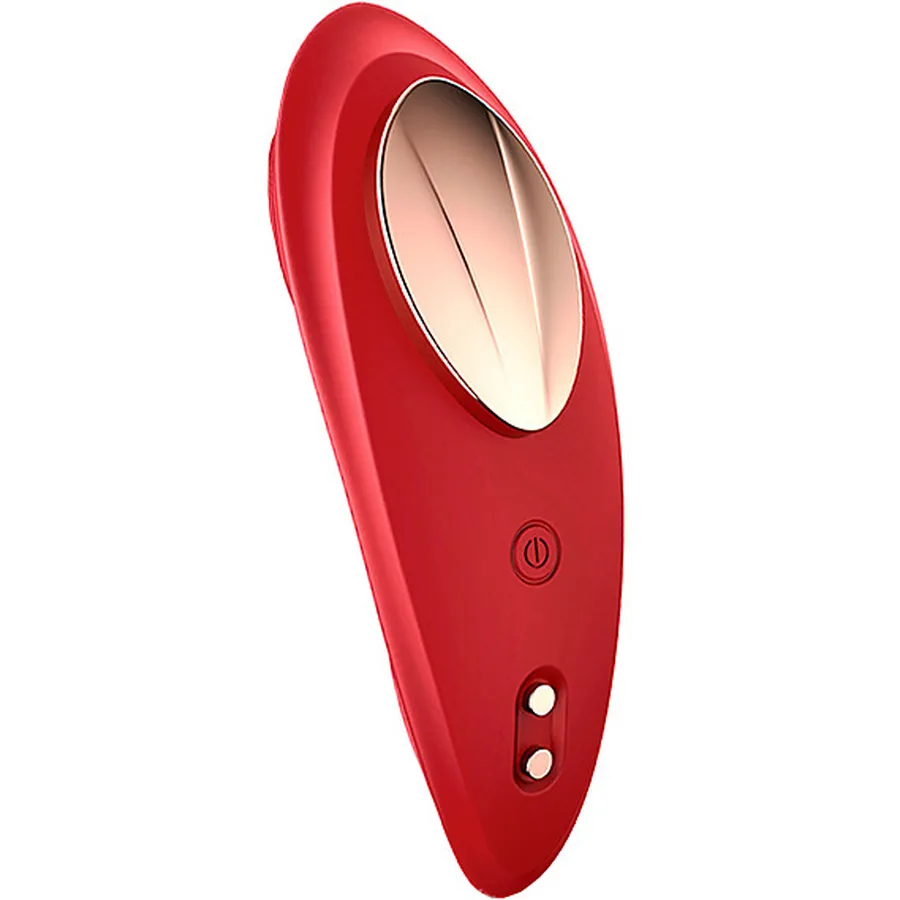
A panty vibrator differs from a handheld vibrator in a single but decisive point: it’s meant to stay in place without anyone holding it. That means that the shape, weight, and attachment method make a bigger difference to how it works than the number of programs. Here, the design is based on a curved silicone body with a wider, flatter section that sits on the outside and a narrower, ribbed section that folds toward the body. Joyland describes the surface as ribbed and silky-smooth and the firmness as medium — the only one of the four Swedish stores that reports firmness at all.
The attachment is a magnet integrated into the product. The manufacturer describes it as a magnet that keeps the product in its position in any type of underwear, and the principle is the same as with competitors in the category: one magnet part is on the outside of the fabric and holds the unit against the inside. What can be established is that the solution does not require a clip that can come loose, but that it also assumes a garment that is thin enough for the magnetic force to pass through. The manufacturer does not publish any information about how thick the fabric the magnet can handle, and none of the stores do either.
One thing that’s easy to miss in the product descriptions: this therefore isn’t a product with a separate remote control in the box. Comparable models from other brands are often delivered with both an app and a physical remote control—We-Vibe, for example, lists a wireless remote control among the items included for Moxie+. With IntoYou, the phone is the remote control, and the only control available without a phone is the button on the product itself.
ActiveJoy is IntoYou’s own app and, according to the manufacturer, it is free, with no subscriptions and no hidden fees. The most unusual thing about it is the registration requirement—or rather, the absence of one: the manufacturer explicitly states that the app does not require an account, an email address, or any form of personal data, that it complies with the EU’s data protection regulation, and that it does not store intimate or sensitive data because it does not request it. The app is stated to be available for both iOS and Android.
It’s worth pausing on this, because it’s a real difference from the category norm. Most app-controlled intimate products require registration, which means that a user profile linked to this specific type of product ends up in a database somewhere. That the manufacturer highlights this issue in its own documentation, instead of keeping silent about it, is the clearest single selling point in the entire specification—provided you value that.
What the app can do is described by the manufacturer in two steps. From the product side: control at short range via Bluetooth, control over the internet without a distance limit, Touch Control where the intensity follows the finger on the screen, synchronization with music, as well as a video mode and a video chat mode where the vibrations respond to what is being played. From the manufacturer’s own overview image: six named modes—Automatic mode, Touch mode, Music mode, Remote mode, Shake mode, and Audio mode. Shake mode means that you shake the phone to activate the product, and Audio mode that it responds to sound.
The material question weighs more here than it does for a handheld product, simply because a panty vibrator lies against skin and mucous membranes for longer continuous periods and during movement. The manufacturer states a material in the product text: ultrasoft silicone. In its FAQ, IntoYou goes further and writes that all products in the range are made from medical silicone, which is hypoallergenic and free from phthalates and harmful substances.
Silicone is a non-porous material. A non-porous surface can be cleaned, because there are no microscopic cavities where residue can get trapped. It is the single most important property of a material that is meant to lie against mucous membranes, and that is why the material declaration weighs more than almost every other line in a specification.
The term "medical silicone" is, at the same time, not a protected term and does not, by itself, imply certification. What can be established is that the manufacturer has chosen to print both the material type and the absence of phthalates in a document that is publicly available on its own website—more than most do in the price category. The store descriptions are close but not identical: Blush Me lists the material as "high-quality silicone" in its fact box, Vuxen and Joyland only write "silicone," and SexleksakerOutlet uses the manufacturer’s own wording "ultrasoft silicone." None of them repeats the phthalate information.
One thing that neither the manufacturer nor any of the stores specifies is the gold-colored, glossy inlay that sits in the middle of the product’s exterior. It is clearly a different material than the silicone around it—but IntoYou does not publish any material specification for that part, either on the product page or in the FAQ. Since that surface ends up against the underwear rather than against the skin, it is a smaller objection than it would be on an insertion product, but it belongs in a complete materials disclosure, and it is missing.
Phthalates are a group of plasticizers used to make plastic—above all, flexible PVC—pliable. Kemikalieinspektionen describes them as substances that can affect the hormone system and make reproduction more difficult, and several of them are therefore restricted or banned within the EU in a large number of products. Intimate products are a category that is repeatedly subject to oversight precisely because it contains flexible plastic against the skin.
IntoYou says in its FAQ that the products are free from phthalates and harmful substances. It’s a clear-cut formulation, unlike terms like "TPE" or "jelly rubber," which say nothing at all about which plasticizers are included. Silicone also doesn’t require phthalate plasticizers to become soft—the softness comes from the polymer’s own structure—and therefore “silicone” as a material specification is, in itself, a better indication than almost any other piece of information in a product specification.
What the manufacturer doesn’t print is BPA and latex. That’s where IntoYou differs from We-Vibe, which for the Moxie+ explicitly states body-friendly silicone free from phthalates and BPA and made without latex. In practice the difference is small for someone who isn’t allergic to latex, because silicone doesn’t contain natural rubber latex—but for someone who is actually allergic, a printed commitment is worth more than an assumption, and it isn’t here.
This point deserves its own heading, because it shows just how bad it can look even when a manufacturer publishes its measurements. The product page on intoyou.eu lists 8.4 × 3.4 × 2.8 centimeters, in both the Spanish and the English version. The manufacturer’s own size graphic, which is in the same image gallery on the same product page, instead shows total height 86 mm, total width 34 mm, and depth 28 mm.
So the width and depth are identical in both sources—34 and 28 millimeters. It’s only the length that differs, and it differs by two millimeters. In other words, the manufacturer publishes two different length measurements for the same product, on the same page. The store data leans toward the graphic: Joyland lists 8.6 × 3.4 × 2.8 centimeters; Vuxen lists total length 8.6 centimeters and maximum diameter 3.4, Blush Me lists 8.60 and 3.40 centimeters respectively. Only SexleksakerOutlet follows the product text’s 8.4 centimeters.
Practically speaking, two millimeters naturally make no difference for how the product sits. What matters is what the contradiction says about how carefully the specification is controlled in other respects—and it’s reasonable to carry that question into the rest of this text. We present both values in the spec table instead of choosing one and pretending the other doesn’t exist.
In terms of size, the product lands in the middle of the category. We-Vibe lists 85 × 23 × 27 millimeters for the Moxie+, so it’s almost exactly the same length but eleven millimeters narrower. Lovense publishes no measurements at all for Ferri on its product page. What can be stated is that this type of product falls within a range of eight to nine centimeters, and that the differences concern width rather than length.
Neither IntoYou nor any of the four Swedish shops publish a weight for this product. It’s a real gap in a category where weight matters: a panty vibrator that’s too heavy pulls on the clothing and shifts, and the weight is one of the few figures that directly says something about how the product behaves when you move.
Lovense shows that it’s possible by stating 35 grams for Ferri. We-Vibe publishes no weight for Moxie+ on its product page, so IntoYou isn’t the only one with the gap. But since the manufacturer publishes three dimensions, a battery capacity, a charging time, and an operating time, the weight is the only obvious specification line that’s missing—and you can’t estimate it from the dimensions, because silicone thickness, motor size, and battery vary a lot between models in the same format.
The interface is split in two. On the product there’s a single button, labeled with the usual on/off symbol and visible in all the manufacturer’s product images. In the app you’ll find the six control modes. The manufacturer lists ten vibration modes, and all four Swedish shops repeat the same number—that’s the only specification line where all five sources say exactly the same thing.
What those ten modes include is not specified by the manufacturer or the shops. Vuxen describes them as ten intensity levels, Blush Me and Joyland as ten modes or settings, the manufacturer as ten vibration modes. The difference isn’t academic: ten intensities of the same vibration is something completely different from ten different patterns. The image material in the shops’ product feeds shows ten different wave symbols under the heading ten vibration modes, which points more to patterns rather than sheer strength, but no breakdown into intensity steps and patterns is published.
IntoYou says in its FAQ that all the toys in the range have physical controls and that the app is a complement, not a requirement. That means the product can be used without a phone, which is a more important feature than it sounds: an app-controlled product that requires the app depends on the phone having battery, on Bluetooth working, and on the app still being available in the shops in a few years.
What the button actually does—whether it steps through all ten modes or only starts and turns off—is not shown in the manufacturer’s published materials, and none of the four shops describes it either. What can be established from the images is that there is exactly one button, which logically limits how much can be controlled from the product: with one button you get short presses to step through and a long press to turn off, or no stepping at all.
The manufacturer’s own overview image names six modes, and in practice they cover three different use cases. Automatic mode is the pre-set program(s), and it’s the mode that corresponds to what you get without an app. Touch mode lets the intensity follow your finger on the screen, meaning manual real-time control. Music mode synchronizes the vibrations with music, and Audio mode lets the product react to sound in the surrounding environment. Shake mode activates the product when you shake the phone, and Remote mode is remote control between two people.
In addition to the six, the product page also describes a video mode and a video chat mode, where the vibrations respond in real time to the content being played. The manufacturer’s page about app control adds a practical detail about the remote mode: the control is shared by two people exchanging a code, not by setting up accounts with each other as friends. This ties in with the fact that the app has absolutely no registration at all—so the connection must be made in some other way.
What can be established is that the feature list is unusually long for the price. Lovense lists seven patterns and three intensity levels for Ferri, with unlimited patterns via the app; We-Vibe lists ten modes for Moxie+. IntoYou is therefore at the same level as the more expensive competitors in terms of number, and above them in number of modes. What differentiates them isn’t the length of the feature list, but how much technical documentation lies behind it.
The manufacturer states up to ten meters for local Bluetooth control and unlimited range via the internet. Vuxen repeats the ten-meter limit, and so do Blush Me and SexleksakerOutlet. Joyland describes the wireless control as “Bluetooth/WiFi”, which is the shop’s own wording—the manufacturer talks about Bluetooth locally and the internet for remote control, not about the product itself connecting to a wireless network.
Ten meters is standard for Bluetooth Low Energy under ideal conditions, and what can generally be concluded is that the body significantly dampens the signal. A product worn in underwear always has a person between it and the phone, which is the worst possible placement from a radio perspective. Which Bluetooth version the product uses, the manufacturer does not publish, which matters because it determines both range and power consumption.
Remote control over the internet works, in principle, differently: there the phone keeps the Bluetooth connection locally, while the commands go over the network from the other party. That means the distance limit disappears, but also that both an internet connection and the manufacturer’s server infrastructure are needed. A product whose remote mode depends on a service is vulnerable to the service being shut down—this is the same trade-off that applies to all app-controlled products in the category, regardless of brand.
A panty vibrator is meant to be worn under clothes among other people, and the noise level is therefore not a matter of comfort but the whole point of the product. Here the answer must be honest: IntoYou does not publish any measured decibel value, either on the product page or in the FAQ.
What the manufacturer writes is that the motor is powerful and completely silent in the product text, and in the FAQ that the products have quiet high-performance motors. The stores follow suit with the same kind of wording: both Blush Me and SexleksakerOutlet write “powerful but quiet motor” in their bullet list. None of them states a number. That’s marketing language, not a measurement, and a site that provides an exact decibel value for this model either presents its own measurement or a value without a source.
What can be established is that the product’s format in itself sets the limits. A unit that measures 34 millimeters in width can accommodate a small motor, and a small motor with low power draw—the battery is 29 milliamp-hours—has a physical limit for how much sound energy it can generate. Lovense also does not publish any decibel value for Ferri, and We-Vibe none for Moxie+. So the absence of measurement data is more of a category norm than a lack specifically with IntoYou, but it makes it impossible to compare the models on the point that matters most.
A practical tip that applies regardless of model: the sound from a vibrator in underwear is amplified by rigid materials. Thin cotton dampens, while stiff fabric and hard surfaces reflect. Anyone who places the product on a table while it’s running will find that it sounds significantly louder than when worn.
The manufacturer states that the product is waterproof—“Impermeable” in the Spanish product text, and “Waterproof” in the English one. All four Swedish stores repeat the claim. What none of them specifies is an enclosure class rating. IntoYou’s FAQ formulates it even more vaguely and writes that most models are water-resistant or submersible, without saying which of the categories this model belongs to.
Enclosure classes are defined in the international standard IEC 60529. IPX7 means that the product has been tested for submersion in water to a depth of one meter for 30 minutes. Both We-Vibe and Lovense state IPX7 for their corresponding models, meaning it’s a value that can be looked up in a standard and that presumes that a test has been carried out.
The word “waterproof” without classification implies nothing. It can mean that the product can tolerate being rinsed under the tap, and it can also mean that it can handle a bathtub — and the difference between the two is exactly the difference that determines whether the product survives a year. What can be established is that the charging contacts on this model sit as two exposed metal pins on the surface, a design that in itself does not require any opening in the housing and therefore is beneficial for water-tightness. But without a published rating, it’s an indication, not a guarantee.
The practical advice then becomes: treat the product as resilient to rinsing and moisture, not as bathtub-safe. If a product lacks an IP rating, the absence should never be interpreted as approval.
Rinse the product in lukewarm water after each use and use an unperfumed soap or a cleaning agent intended for intimate products. Be especially careful with the ridged part — the ridges are exactly the geometry where residue remains, and Joyland is the shop that explicitly describes the surface as ridged. Wipe dry with a clean towel and let it air-dry before putting the product away. Wipe the charging pins before attaching the product to the cable.
Joyland recommends a water-based lubricant, and that’s the right recommendation for a silicone product. A silicone-based lubricant should not be used on silicone — it breaks down the surface over time and makes it porous, and a porous surface can no longer be cleaned properly; it only can be replaced. Oil-based products like coconut oil leave a film that’s difficult to remove and can also affect the magnet’s attachment to the fabric.
The manufacturer publishes no care or storage instructions on the product page, and there is no delivery list stating whether a storage pouch is included. It’s a difference from We-Vibe, which lists a storage pouch, extra magnet clips, a USB cable, a quick guide, a remote control, and a two-milliliter sample of lubricant for Moxie+. What’s in IntoYou’s box in addition to the product and the charging cable can’t be read from anything.
Here lies the product’s clearest weakness, and you can see it right in the manufacturer’s own figures. IntoYou states a battery of 29 milliampere-hours, a charging time of 35 minutes, and an operating time of up to 50 minutes. The battery type is not specified, which is worth noting — whether it’s lithium-ion or lithium polymer is not written anywhere.
Put the numbers in context. 29 milliampere-hours distributed over 50 minutes of operation corresponds to an average current draw of roughly 35 milliamperes, which is at the very bottom of what a vibration motor draws. That is fully consistent with a small motor in a small body, but it also explains why the operating time looks the way it does: the cell is very small. By comparison, Lovense lists 195 minutes of battery life for Ferri and up to two hours for Moxie+ — that is roughly four and two and a half times as long, respectively.
With a magnetic charging cable. The manufacturer’s own product image has the text "Ultra-Easy USB magnetic charge" and shows the two charging pins on the back of the product together with the magnetic cable end. The image in Joyland’s image pack shows the full cable: a magnetic mount with two pins on one end and a standard USB-A connector on the other.
That means two things in practice. The positive: no opening in the housing is needed, which is one of the requirements for a small product to be able to be kept sealed. The negative: the cable is product-specific, and if you lose it, neither USB-C nor micro-USB will work. The connector on the other end is also USB-A, not USB-C, which means that anyone who only has a USB-C charger at home also needs an adapter. Lovense uses the same principle for magnetic charging for Ferri; We-Vibe lists a USB cable for Moxie+.
In turn, the charging time of 35 minutes is the shortest in the comparison. We-Vibe lists 90 minutes for Moxie+ and Lovense one hour for Ferri. What can be established is that charging time and battery size are linked: a small cell charges quickly. Based on how much operating time you get per charging minute, IntoYou is about 1.4 minutes of operation per charging minute, Lovense a little over 3, and We-Vibe just under 1.4 — so in practice it is fairly even with We-Vibe and clearly worse than Lovense.
Operating time is the other big contradiction in this product’s spec sheet, and unlike the measurement question, it varies between manufacturers and stores. The manufacturer lists up to 50 minutes on both the Spanish and the English product pages. Three of the four Swedish stores — Blush Me, SexleksakerOutlet, and Vuxen — list up to 42 minutes. Joyland lists up to 40 minutes.
The rule we apply is that the manufacturer wins when a store contradicts it, and it is 50 minutes that is shown in the spec table. But the discrepancy is too systematic to be a coincidence: three stores that independently of each other arrive at exactly 42 minutes have, with all likelihood, gotten the figure from the same older distributor source. What can be established is that the range between the highest and the lowest published value is 25 percent, and that anyone planning an evening based on 50 minutes should count on some margin.
The wording “up to” also does some of the work for the manufacturer. Runtime for vibrators is almost always stated at the lowest intensity, and a product that runs on the highest setting all the time rarely reaches more than half of the stated time. This applies to all brands and doesn’t specifically distinguish this model—but with 50 minutes as a starting point, there’s less of the stated time for it to be eaten into than there is with the competitors.
We do not have price data from shops in your market yet.
29 milliampere-hours distributed over 50 minutes of operation corresponds to an average current draw of about 35 milliampere. The cell is very small — and you can see it in the operating time.
Two comparisons are relevant, and both apply to the two models that dominate the app-controlled panty vibrator category: We-Vibe Moxie+ and Lovense Ferri. All the information below comes from each respective manufacturer’s own specifications, and the prices for IntoYou are from the retailers’ product feeds on September 12, 2026.
We-Vibe lists 85 × 23 × 27 millimeters for the Moxie+, which is almost exactly the same length as IntoYou but 11 millimeters narrower. The material is stated as body-friendly silicone free from phthalates and BPA and made without latex. The battery is of the lithium-polymer type and charges via USB; the runtime is stated as up to two hours and the charging time as 90 minutes. The enclosure rating is IPX7, the number of modes is 10, and the warranty is two years. In the package, according to the manufacturer, there are extra magnet clips, a USB cable, a quick guide, a wireless remote control, a storage pouch, and a lubricant sample of two milliliters.
Compare that with IntoYou: the same number of modes, the same approximate length, the same magnet principle—but 50 minutes of runtime versus 120, no published IP rating versus IPX7, no remote control included in the package versus a wireless one, and no published delivery list at all versus We-Vibe’s detailed list. What IntoYou has that We-Vibe doesn’t is an app without registration and a significantly shorter charging time.
The conclusion is straightforward. Moxie+ is the more complete product on every point that can be measured except for charging time. The question is how much more it costs, and everyone can check that in-store—we have price data for IntoYou from four Swedish feeds, but no corresponding verified price information for Moxie+ in this review.
Lovense states for the Ferri: silicone and ABS plastic, weight 35 grams, lithium-ion battery, charging time one hour, battery life 195 minutes, standby time 100 hours, seven patterns and three intensity levels with unlimited patterns via the app, enclosure rating IPX7, magnetic charging, and a one-year warranty.
The comparison works out in two directions. On the battery, Ferri is superior: 195 minutes versus 50, which is almost four times as much, and Lovense also states 100 hours of standby time—an item that IntoYou does not publish at all. On the materials, IntoYou wins in principle—full silicone versus silicone plus ABS—but Ferri is also the only one of the three that publishes a weight, and 35 grams is information that actually can be used.
On control, it’s more even than the numbers suggest. Ferri has seven patterns and three built-in intensity levels, while IntoYou has ten modes; both are expanded via an app. But Lovense requires an account in its app, and IntoYou does not. For someone who buys an app-controlled intimate product and is on the fence specifically about the account requirement, that is the only difference that matters. The warranty also speaks in IntoYou’s favor: three years versus Lovense’s one.
In summary, IntoYou Panty Vibrator With App is the cheapest way into app-controlled panty vibration of the three, and it pays for that with battery life and with documentation. You get the same number of modes, more control methods, an app that doesn’t require registration, and a longer warranty. You don’t get a published IP rating, not a published weight, not a published shipping/contents list, not a published battery type, and not more than 50 minutes of operating time.
It’s a reasonable trade-off for someone who knows what she’s buying, and a bad deal for someone who expects to be able to wear the product for an entire evening. It’s the only question that needs to be answered before putting it in the shopping cart.
Four Swedish shops sell the item with EAN 8436615002801. Cheapest are Blush Me and SexleksakerOutlet at 359 SEK each, then Vuxen at 495 SEK, and most expensive is Joyland at 595 SEK. That’s a difference of 236 SEK, or just under 66 percent, for exactly the same item in the same color.
The stock situation is unusually favorable here: all four stores had the product in stock at the price check. That means the price spread is real and directly usable—unlike a situation where the cheapest store has sold out and the price you actually pay is several hundred SEK higher. Both Blush Me and SexleksakerOutlet list 595 SEK as the regular price and 359 SEK as the campaign price, which is the same regular price Joyland charges.
The price spread isn’t because any store sells a different variant. Blush Me, SexleksakerOutlet, and Vuxen all list the item under EAN 8436615002801; Joyland uses its own item number 27874 but describes the same red model with the same ten modes and the same ActiveJoy app. So it’s simply the stores’ own pricing for a relatively new item.
The prices in the table above are updated when the stores’ product feeds are updated, but always check the final price at checkout. Shipping costs are added by most stores under a certain order value, and in this price range all four are under the threshold for free shipping — which can level out some of the difference between the cheapest and the most expensive.
It’s for you if you want to try an app-controlled sex toy without paying a premium price, and you value the fact that the app doesn’t require an account, an email address, or personal information. It’s for you if you want lots of control modes — automation, touch, music, sound, vibration, and remote control — rather than a long technical specification. It’s for you if you use the product for shorter sessions and have the charger nearby, because a 35-minute charge is quick enough to fit between two occasions the same evening.
It’s not for you if you want to wear the product for hours. With up to 50 minutes according to the manufacturer, and 40 to 42 minutes according to the stores, it’s a product for a limited occasion and not for a whole night out. It’s not for you if you require a published ingress protection rating before you take anything into the bathtub. It’s not for you if you want to be able to charge with the same cable as your phone — the magnetic charging cable is product-specific and it also ends in USB-A. And it’s not for you if you want to know exactly what’s in the box before you order, because no delivery contents list is published.
One more thing belongs in the decision. There are two colors, red and blue, each with its own manufacturer article number — IN-280 and IN-281, respectively. This review applies to the red one under EAN 8436615002801. The specifications are identical on the manufacturer’s both color variants, so the choice is only about color, but check the number if you compare prices between stores.
IntoYou states that it offers three years of warranty on all products in the range, in accordance with applicable European legislation, and that manufacturing faults during that period are handled by customer service. Three years is longer than Lovense’s one year for Ferri and longer than We-Vibe’s two years for Moxie+, which in context is a real advantage.
An important clarification: three years is also exactly the complaint right you already have under Swedish konsumentköplagen if the item is faulty. The manufacturer’s warranty therefore, in practice, doesn’t give you any more time than the law already does — it gives you a route to the manufacturer in addition to the store. It’s not worthless, but it’s also not the extra reassurance that a fifteen-year or five-year manufacturer warranty provides in other parts of the category. What the warranty excludes — wear parts, accessories, the charging cable — IntoYou does not publish.
The manufacturer also writes that intimate products that have been removed from their packaging seal are not accepted for returns except in the event of a manufacturing defect, for hygiene and safety reasons. This matches how Swedish law works: for distance purchases, there is a right of withdrawal within fourteen days under the lagen om distansavtal och avtal utanför affärslokaler, but in practice the right of withdrawal is limited for hygiene products that have been removed from a sealed package. The right to complain about defects, on the other hand, always applies. If you have questions about what applies in your case, Konsumentverket guides you via Hallå konsument.
Finally, a note that belongs under the heading traceability. The manufacturer’s own shop page for the red variant states in its structured data gtin 8436615002818 and article number IN-281 — exactly the same values that the blue page lists, despite the image files on the red page being named IN-280. The Swedish shops, however, consistently list the red one under 8436615002801. It is a duplication in the manufacturer’s own shop data, not a sign that the shops sell the wrong item, but it is worth knowing if you try to match article numbers between the manufacturer’s page and a Swedish shop.
IntoYou Panty Vibrator With App is ranked på plats 4 av 11 in panty vibrator best i test, where the entire category is compared against each other using five shared criteria. Guiden vinns av Lovense Ferri.
Every numerical piece of information in the text can be traced to one of the sources below. The links were checked manually on the specified date.
This page is machine-translated from Swedish. Read the Swedish original