

Review
Review: Satisfyer Double Joy G-spot vibrator with app
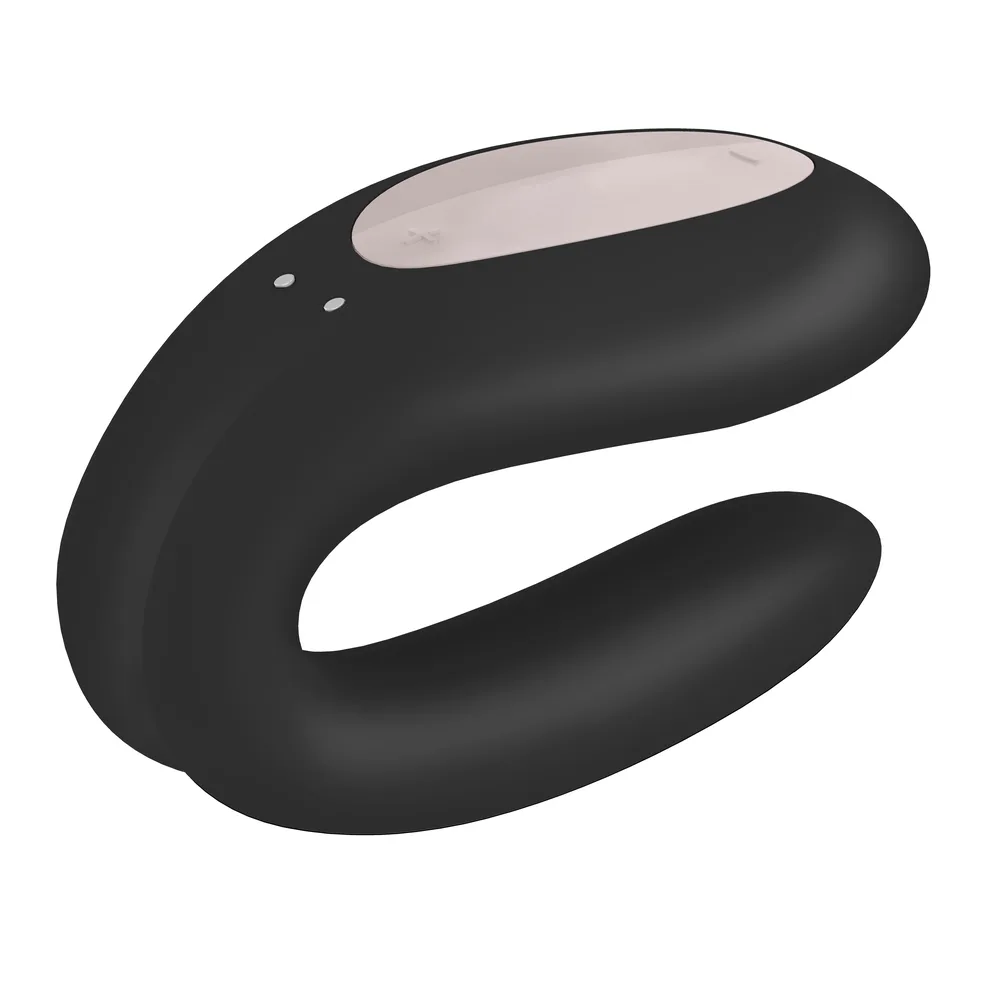
The same ten programs and the same IPX7 — but with published weight and a 15-year warranty.
13 September 2026
Review · Couple vibrator · Bendable body with remote control
Reviewed against the manufacturer’s own information, product images, and pricing data from three Swedish stores. Two motors, ten vibration modes, premium silicone, IPX7, and a wireless remote — for up to 349 SEK. But IntoYou does not publish battery capacity, run time, charging time, weight, or sound level for Lovit, even though exactly those details are in the brand’s own app-controlled couple vibrators.
The only body-controllable pair vibrator in IntoYou’s range that can be bent after the body, and the only one that is rated IPX7. Two motors, ten vibration modes, full silicone, a wireless remote control, and a three-year warranty for 349 SEK are a reasonable starting point, and all three Swedish stores had it in stock. What you pay for is the documentation: neither battery capacity, operating time, charging time, weight, sound level, nor a materials declaration is published — even though IntoYou lists those exact details for its app-controlled models.
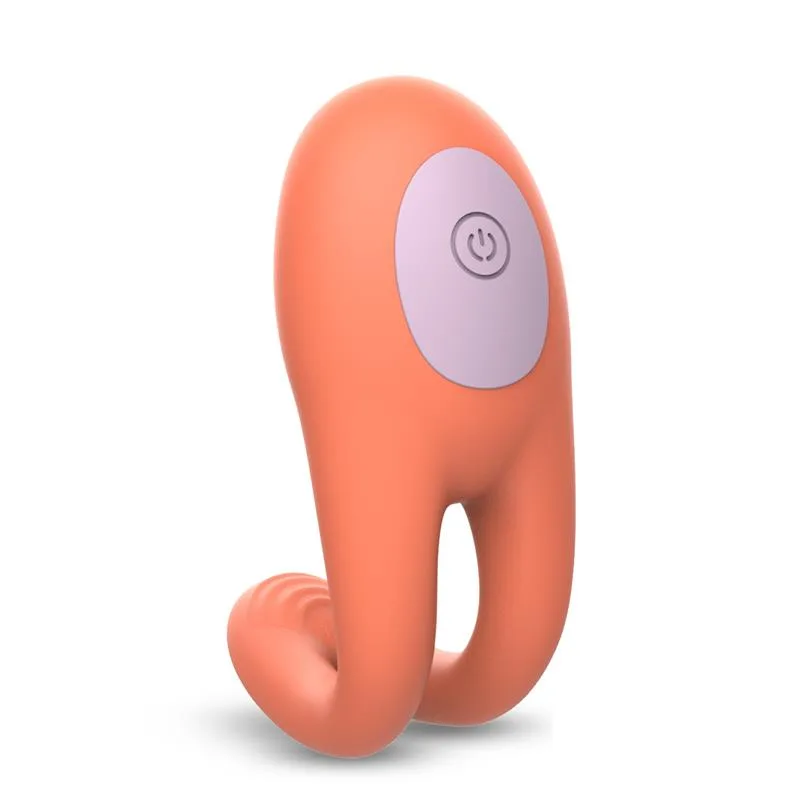
IntoYou Lovit is a couples vibrator built around a single idea: that the whole body should be bendable. While almost all competitors in the category have a fixed C-shape that has to fit a specific anatomy, Lovit has a design that the manufacturer describes as completely flexible — you shape it yourself and it keeps its shape. That feature is what makes it sell as both a couples product, a penis ring, and a solo vibrator in the same text.
The specification is short but unambiguous in the parts the manufacturer actually publishes: two motors, ten vibration modes, ultra-soft premium silicone, a wireless remote control powered by a battery, magnetic USB charging, and an IPX7 enclosure rating. The manufacturer’s own dimension sketch shows 40 millimeters across the width of the head and 115 millimeters along the bent outer contour. In Sweden, the item is sold by three stores for 349 or 399 SEK, and all three had it in stock at the price check on September 12, 2026.
This review is about the orange variant with EAN 8436626093249, the manufacturer’s item number U-324. The number has been checked both with IntoYous distributor and with all three Swedish stores, and it’s the same item everywhere — Vuxen lists it under its own item number with EAN as a suffix, but the base number is identical. The product was launched in April 2026, which explains why it’s still only available at a handful of Swedish stores.
What makes this product interesting to review is not what the manufacturer writes, but what the manufacturer doesn’t write. IntoYou publishes complete battery data for its app-controlled models — down to the decimal place in milliampere-hours — but neither battery capacity, operating time, charging time, weight, nor sound level is published for Lovit. That’s a difference worth understanding before you pay for it, and we’ll come back to it multiple times below.
A typical couple vibrator is a spring. It has a pre-set C-shape; it’s pressed apart when it’s put into place, and it stays there by trying to spring back. It works excellently when the anatomy matches the designer’s assumptions and worse when it doesn’t, because there’s no adjustment—the shape is the shape.
Lovit solves the problem in the opposite way. The manufacturer states that the structure is completely flexible and that the product can be bent and adjusted in several different positions. Technically, that means the silicone body has a bendable core instead of a springy one: you bend it into the position you want, and it stays there, instead of pressing back. What can be established is that it shifts the fit question from the designer to the user. If it doesn’t fit right away, it’s not the product that’s wrong—it’s the angle—and the angle can be changed.
The manufacturer lists three ways to use it in its own text. The wide part with the ridged surface is intended toward the clitoris or for insertion, the middle has two soft silicone straps that can be used as a penis ring, and during intercourse it lies between the bodies. What’s worth noting is that all three positions are based on the same bendable body: you don’t switch attachments—you switch the shape.
There’s also a downside, and it’s just as simple. A bendable core is a mechanical component that sits inside the silicone, and it’s subjected to fatigue every time you bend it. The manufacturer doesn’t publish any information about how many bends the construction is intended for, and that’s exactly the kind of information that would have been relevant for this particular product.
IntoYou has a wide range of couple products, and the names don’t always say what sets them apart. Three lines are close to each other and are easily mixed up.
So the difference is therefore not just the app. Lovit is the only one of the three that is rated IPX7 and the only one that is bendable, but it is also the only one where the manufacturer does not publish a single battery value. If you want app control and reported operating time, you should buy one of the other two—but then you pay about twice as much and get a product that does not tolerate submersion.
The material issue is the only feature of an intimate product that neither experience nor care can compensate for, and it determines whether the product is still hygienic after a few years. The manufacturer lists a single material for Lovit: ultra-soft premium silicone. Blush Me writes high-quality silicone in its feature table, Vuxen writes silicone in general, and Talonze specifies silicone as its only material information. All sources therefore point in the same direction.
Silicone is a non-porous material. A non-porous surface can be cleaned because there are no microscopic cavities where residue can be left behind. It is the single most important property of a material that is supposed to be placed against mucous membranes, and that is why the materials line weighs more heavily than almost all other lines in a specification.
On Lovit, the choice of material also has a direct functional consequence. Silicone is what makes it possible to build in a formable core in the first place: the material stretches and returns without cracking when bent, which rigid plastic does not do. The manufacturer’s own images show a completely seamless body where the head, middle section, and arm are molded as one piece, with a single insert in a different color around the power button. It’s a better construction than a joined product, because every seam is a place where dirt can collect and where two materials can separate from each other.
What can be established about that specific button insert is that it is another surface than the rest of the body—it looks smoother and stiffer in the images. Which material it is is not published by the manufacturer, and it is the only point on the product where the material issue remains unanswered. The same applies to the remote control, which is black and glossy and most likely plastic, but which has no published material specification at all.
Phthalates are a group of plasticizers used to make plastic—above all flexible PVC—pliable. The Swedish Chemicals Agency (Kemikalieinspektionen) describes them as substances that can affect the endocrine system and make reproduction more difficult, and several of them are therefore restricted or banned within the EU in a large number of products. This product category is therefore repeatedly the subject of regulatory supervision because it contains flexible plastic against skin and mucous membranes.
IntoYou does not publish an explicit statement that Lovit is free from phthalates, BPA, or latex, either on its brand page, in its questions and answers section, or in the product text that the distributor reproduces. What is stated is the material — premium silicone — and the adjectives soft and safe. It is a weaker wording than what We-Vibe uses for Sync 2, where it explicitly says that the material is made without phthalates, BPA, and latex.
How serious is it? It needs to be put into context. Silicone doesn’t require phthalate plasticizers to become soft — the softness comes from the polymer’s own structure — and the material specification silicone is therefore, in itself, a better indication than almost any other material information in the category. The product is CE-marked, which is reflected in the silicone in the manufacturer’s own close-up, and it’s sold by a Spanish company within the EU under the EU’s chemical regulations. But there’s still a difference between being subject to a rule and publishing that you comply with it. For someone who is allergic to latex, the absence of the information is a real shortcoming, since a latex allergy causes reactions on the mucous membrane faster than on regular skin.
The manufacturer publishes a dimension sketch in its own product gallery, and it gives exactly two values. The 40 millimeters are marked with a straight arrow across the wide part and are therefore the head’s width. The 115 millimeters are marked with an arrow that follows the product’s curved outer contour, from the top of the head, around the bulge, and out to the tip of the longer arm.
It’s important to read that number correctly. 115 millimeters is not a straight total length — it’s a measurement along the curve of a product that can also be bent. The straight length between the outer endpoints is shorter, and exactly how much shorter depends on what shape you’ve given the product. The manufacturer does not publish any straight total length, any height, any depth, or any weight, and none of the three Swedish shops fills that gap either. Vuxen only states the property flexible, Blush Me states color and charging type, and SexleksakerOutlet reproduces the product text verbatim.
Still, put the numbers into context, because they say something about the size class. IntoYou’s app-controlled pair vibrator measures 9.2 × 3.3 centimeters, and Couty measures 10.3 × 3.4 centimeters. We-Vibe Sync 2 is listed as 41.7 × 74.8 millimeters and Satisfyer Double Joy as 91.4 × 41.8 × 57.4 millimeters, with a weight of 78 grams. Lovit’s 115 millimeters along the curve and 40 millimeters across the head place it in the upper part of that range — it’s wider across the head than all four comparison products and longer when measured along the body. That makes sense for a product that’s intended to be used both as an insertable part and as a penis ring.
The color is orange, or coral as it looks in the manufacturer’s images. Blush Me lists orange as its color in its specification table. No other color variant of Lovit is available at any of the sources we have checked, which makes the EAN check easier than on products sold in five colors with one number for each color.
The interface on the product itself is as simple as it can be. The manufacturer’s own images show a single button, placed in a light oval inset on the top of the head and marked with the usual power symbol. Everything that happens on the product happens through that same button: you turn it on, you step through the modes, and you turn it off.
It’s a deliberate choice, and it has both pros and cons. The advantage is that there’s nothing to learn and nothing to look for in the dark. The drawback is that you can only move forward in the mode list—if you want to go back one step, you have to go the long way around. Exactly how the button works in detail, how long it should be pressed to turn it off, and whether there’s a memory mode that resumes from where you left off, the manufacturer does not publish anywhere. There’s no downloadable user manual, no online manual, and no datasheet for Lovit with either IntoYou or the distributor.
The manufacturer states that the product has two motors, and on the front of the packaging the number 2 appears with the word MOTORS underneath. The placement is evident from the design: one motor in the wide head and one in the longer arm—so one at each end of the bendable body. Practically, that means both contact surfaces vibrate at the same time regardless of how you have bent the product. It is not stated whether the motors can be controlled independently of each other—and since there’s only one button, and the remote has two, most likely they are linked.
The remote control is the product’s biggest selling point after flexibility, and it’s also the part where the documentation is thinnest. The manufacturer’s image shows a black, rounded device with two buttons: one on top with a wave symbol and one on the bottom with the power symbol, with IntoYous logo underneath them. The manufacturer states that it is wireless and is powered by batteries.
It’s obvious, but it’s an important piece of information. That the remote control is battery-powered—and not rechargeable like the product—means it contains a replaceable cell battery that will run out sooner or later. What type of battery it is, the manufacturer does not publish, and neither does whether the battery is included in the delivery. This is information that should be on the packaging, and none of the three Swedish stores list it either. Expect it to be a standard-type button cell battery, but also expect that you’ll have to open the control to find out which one it is.
The range is the second gap. No source states how far the remote control reaches — not in meters, not in radio technology, and not in frequency bands. ETO’s launch note describes the function as an opportunity for play at a distance, and the manufacturer’s own text says the same thing, but there is no figure. Compare this with IntoYou’s app-controlled models, where the manufacturer states Bluetooth up to 15 meters locally and unlimited distance over the internet. On Lovit, then, it is not only unknown how far the control reaches — it is safe to say that it does not work over the internet, because it is a radio remote control and not a phone.
What you actually get, therefore, is play in the same room, and it’s still a meaningful feature: when a couple vibrator sits between two bodies, it is practically impossible to reach with your hand during sex, and a control that your partner holds solves exactly that problem.
Ten modes are standard in the category. We-Vibe Sync 2 specifies ten intensity steps, Satisfyer Double Joy specifies ten vibration programs, and IntoYou’s own app models specify ten modes per motor. So Lovit is exactly at the category’s normal level.
What sets the products apart is what those ten steps include. IntoYou does not say whether Lovit’s ten modes are ten intensity levels, ten patterns, or a mix. The manufacturer’s icon on the packaging shows a waveform that varies in amplitude, which suggests that it is patterns rather than pure intensity steps, but the icon is marketing and not a specification. Otherwise, the pattern in this product category is that the first three or four steps are steady intensities and the rest are pulsing programs, and that most users return to two or three of them.
The practical consequence of ten modes on one button is worth an entire line. If you want mode seven, you press seven times, and once you’ve passed it, you have to press three more times. With the remote’s wave button it goes faster because you can step through modes without moving your hand to the product — and that’s really the strongest argument for why the remote should be included even when you use the product alone.
The sound level is the single most common question about a couple vibrator, because the product is used in situations where sound matters. The answer has to be honest: IntoYou publishes no decibel value for Lovit, and nothing either about sound level in words. Neither the product text, the packaging panels, nor any of the Swedish stores mention silence at all.
It’s unusually honest in a way, because many manufacturers instead just write “whisper-quiet” without backing it up. But it gives you nothing to work with. What can be generally established is that a vibrator with two motors in a bendable body has more sources of sound than one with a single motor, and that the sound from an eccentric motor is carried through the material it’s seated in. Soft silicone dampens more than hard plastic, which works in Lovit’s favor compared with a product like Satisfyer Double Joy, where ABS plastic is included in the design.
A practical tip that applies regardless of the model: place the product on a soft surface between uses. A hard tabletop works like a resonance box and noticeably amplifies the sound. And if sound level is critical for you, choose a product where the manufacturer actually publishes a value—that’s still the only way to compare.
IntoYou explicitly states the IPX7 enclosure class for Lovit, both in the product text and in the bullet list of features. The rating comes from the international standard IEC 60529, which defines enclosure classes for electrical equipment. The 7 in the second position means that the product is tested for submersion in water to a depth of one meter for 30 minutes.
Vuxen only writes “waterproof” in its quick facts, and Blush Me writes “water-safe” in its bullet list, but Blush Me’s longer product text reproduces the manufacturer’s IPX7 wording verbatim. So there’s no conflict between the sources here—the stores are just less precise than the manufacturer.
The difference between the classes is greater than the wording suggests. IPX6 covers powerful water jets from all directions but does not cover submersion. An IPX6 product handles showers and rinsing under the tap, but not bathtubs and not being left lying in water. IPX7 handles both.
What’s interesting is that IntoYou’s own app-controlled couple vibrators—APP-Controlled Couple Toy and Couty—are both listed as IPX6, meaning a class below Lovit. The explanation is likely technical: a Bluetooth module with an antenna makes different demands on the housing than a simple radio receiver. The consequence for you is, in any case, unambiguous. If you want to be able to take the product into the bath, Lovit is the only one of IntoYou’s couple products that the manufacturer itself says you can.
A reminder that applies to the entire category: if a product lacks any IPX information, it should be treated as not water-resistant. The absence of a rating is never a sign that the product is approved. By the way, Lovit’s remote control has no published IPX class at all, and since it’s battery-powered with a cover that should be possible to open, you should assume it doesn’t stand up to water.
Rinse the product in lukewarm water after each use, and use an unfragranced soap or a cleaning product intended for intimate products. Since the body is molded as a single piece without seams, there are no gaps for anything to work its way into — the only transition is around the button insert, and that is also the only place where you should be careful. Wipe it with a clean towel and let it air-dry before putting the product away.
Never use a silicone-based lubricant on a silicone product. It breaks down the silicone surface over time and makes it porous, and a porous surface can no longer be cleaned properly—only replaced. Oil-based products such as coconut oil leave a film that is difficult to remove and also break down latex condoms. Water-based lubricant is the only one that does not affect the material—and IntoYou itself recommends water-based lubricants for its other products.
The manufacturer does not publish a maximum permissible temperature for Lovit. Lithium-ion batteries and molded silicone with a built-in metal core do not belong in boiling water or in a dishwasher in any case, regardless of the IPX rating, and that also applies even when the manufacturer does not state it. Store the product bent in a neutral position rather than hard-angled—this reduces strain on the formable core—and do not store it together with products made of other soft materials, since different soft plastics can react with each other.
Charging takes place via a magnetic charging cable. The manufacturer’s own close-up shows the cable attached to two round contact points on the side of the product, and next to them, the marking DC 5V is embossed directly into the silicone together with the CE mark and the symbol indicating that the product may not be disposed of with household waste. The packaging panel states USB MAG CHARGE, and the manufacturer’s icon in the gallery indicates USB MAG RECHARGEABLE.
With the included magnetic cable, connected to any USB port. The 5 volts that are embossed on the product are the standard voltage for USB, which means that a regular phone charger, a computer port, or a power bank works as a power source.
Magnetic charging is a trade-off, not a pure advantage. The advantage is that there’s no need for any opening in the housing, which is a big part of the reason the product can be rated IPX7 without a rubber plug — and on a product that’s also meant to be bent, every gap in the housing is a weak point. The downside is that the cable is product-specific: if you lose the charging cable, no standard USB-C cable will work, so you have to get a replacement. IntoYou does not publish a spare parts channel for charging cables, and none of the three Swedish shops sells the cable separately. It’s the same design choice that We-Vibe and Womanizer make, but at least those manufacturers have a clear channel for spare cables.
Blush Me lists USB as the charging type in its specification table, and Vuxen lists rechargeable operation — both correctly, but neither of them mentions that the cable is magnetic and product-specific. That’s exactly the kind of thing it’s worth knowing before buying rather than after.
This is where the product’s clearest documentation gap is. IntoYou does not publish the battery’s capacity in milliampere-hours, its voltage, the operating time on a charge, or the charging time for Lovit. None of the three Swedish shops fills the gap, and none of the three resellers outside our list that we checked does either. The only electrical value that is published is the charging voltage of 5 volts, and it’s stamped on the product rather than provided in a specification.
That it’s a deliberate choice and not an oversight can be shown. In its own app-controlled couple vibrators, IntoYou reports exactly the information that’s missing here: 30.7 mAh, 40 minutes of charging time, and up to 60 minutes of operating time for APP-Controlled Couple Toy, and 46 mAh, 70 minutes of charging time, and up to 90 minutes of operating time for Couty. Same manufacturer, same range, same website — but not the same openness.
What does that mean for you? Two things. First: without capacity, you can’t convert operating time into power consumption, and you can’t compare how heavily the cell is loaded against a competitor. We-Vibe states up to 120 minutes of operating time and up to 90 minutes of charging time for Sync 2 — those are numbers you can plan around. With Lovit, you know nothing until you’ve charged it and run it down.
Since: what generally applies to lithium-ion batteries also applies here. Capacity drops with the number of charging cycles; the battery is built in and cannot be replaced, and the product does best when it’s charged regularly instead of being stored completely discharged. With use a couple of times a week, it’s the battery—not the silicone—that sets the limit for lifespan—and because the cell is fixed in place, the product is, in practice, used up when the battery is. The symbol for separate electronics recycling on the product body is a reminder of exactly that: it should be taken for recycling, not in the trash.
We do not have price data from shops in your market yet.
The same manufacturer states 30.7 mAh, a charging time of 40 minutes, and a runtime of 60 minutes for its app-controlled couple vibrator — and not a single battery value for Lovit.
Three comparisons are relevant: against the manufacturer’s own app-controlled couple vibrator, against the category leader We-Vibe, and against the best-selling app-controlled couple vibrator from Satisfyer. All the information below comes from each manufacturer’s own specifications, and all Swedish prices come from the shops’ product feeds on 12 September 2026.
IntoYou APP-Controlled Couple Toy costs 57.37 euros from the manufacturer, while Couty costs 62.99 euros. Lovit costs 349 SEK at the cheapest Swedish store. That’s about half as much for a product from the same manufacturer in the same category, and the price difference buys you a clear division of functions.
The app models give you the ActiveJoy app with local Bluetooth up to 15 meters and remote control over the internet with no distance limit, independent control of each motor, music synchronization, and video mode—and they give you published battery data. Lovit gives you instead a bendable body that none of the app models have, IPX7 instead of IPX6, a physical remote control that doesn’t require anyone to pick up the phone, and a price that’s about half.
The conclusion is simple and depends entirely on what you want. If you want truly distant remote control, only the app models offer that. If you want a product that can be shaped to fit the body, that can handle the bathtub, and that works without a phone, Lovit is the cheaper one—and in that sense the more straightforward choice—but you have to accept that you don’t know how long the battery lasts.
We-Vibe Sync 2 is the category reference product. The manufacturer specifies the dimensions 41.7 × 74.8 millimeters, body-friendly silicone that is explicitly made without phthalates, BPA, and latex, a USB-charged lithium-ion battery with up to 120 minutes of operating time and up to 90 minutes of charging time, ingress protection rating IPX7, ten intensity levels, and a two-year warranty.
Line it up against Lovit, and the image becomes clear. Both are IPX7, both have ten settings, both are full silicone, and both charge via USB. Where Lovit wins is in the warranty period — IntoYou offers three years versus We-Vibes two — and in that Lovit is flexible rather than springy, which is a real design difference and not a detail. Where We-Vibe wins is in everything that has to do with reporting: runtime, charging time, material declaration, and an app with adjustable fit.
The price question can’t be determined fairly here, because we only have Swedish price data for Lovit’s EAN. What can nevertheless be established is that We-Vibe Sync 2 is in a different price class than 349 SEK, and that the difference between the products in everything that matters is the difference between a budget product with thin documentation and a premium product with thick.
Satisfyer Double Joy Connect App costs 68.95 euros from the manufacturer. The dimensions are 91.4 × 41.8 × 57.4 millimeters, the weight is 78 grams, the material is ABS plastic and silicone, the battery is lithium-ion, the enclosure rating is IPX7, and the number of vibration programs is ten. The warranty period is 15 years.
Two differences matter. The first is the material: Satisfyer uses ABS plastic together with silicone, while Lovit, according to the manufacturer, is premium silicone all the way through. Full silicone is better both to the touch and for hygiene, and it’s a genuine advantage for Lovit in that comparison.
The second is the warranty, and there it goes the other way with a vengeance. Satisfyer’s 15 years is five times longer than IntoYou’s three, and for a product whose service life in practice is determined by a built-in battery, the warranty period is anything but a formality. Satisfyer also publishes weight and exact external dimensions, which IntoYou doesn’t. On the other hand, Satisfyer also doesn’t publish battery capacity, runtime, or charging time for Double Joy — on that point, the two manufacturers are equally tight-lipped.
Are you looking for an app-controlled couple vibrator with a long warranty? Double Joy is the more complete buy. If you’re looking for a flexible product with a physical remote control for under 400 SEK, Double Joy isn’t in that price bracket.
Three Swedish stores sell the item with EAN 8436626093249. The cheapest is Blush Me and SexleksakerOutlet, at 349 SEK each; the most expensive is Vuxen, at 399 SEK. That’s a difference of 50 SEK, or 14 percent, for exactly the same item number, the same color, and the same packaging.
All three stores had the product in stock at the price check, which is unusually favorable and means you can actually buy it at the lowest price. Vuxen also states that 399 SEK was its lowest price over the past 30 days as well—so the product hasn’t been discounted with them during that period.
The price spread isn’t due to any store selling a different variant. Blush Me and SexleksakerOutlet list the item directly under EAN 8436626093249, and Vuxen under its own item number 30337 with the same EAN as a suffix. That the spread is only 14 percent—compared with 173 percent on a volume product like Satisfyer Pro 2 Next Generation—is likely because the product was launched as recently as April 2026 and hasn’t yet had time to become a price-pressured volume item in Sweden.
The prices in the table above are updated when the stores’ product feeds are updated, but always check the final price at checkout. Shipping costs are added at most stores under a certain order value—Vuxen states free shipping from 799 SEK—and in this price range, a single product is under the threshold at all three. It can very well eat up the entire fifty-kronor difference in price.
A note about how the product is categorized belongs here, because it affects what you find when you search. The retailer Talonze lists Lovit under the heading anal vibrator and describes it as safe anal vibration with a wide base. The manufacturer’s own text doesn’t mention anal use at all—it lists clitoris, vaginal use, nipples, and a penis ring. Where a store contradicts the manufacturer, the manufacturer’s information applies, and a product without an explicitly anal design shouldn’t be used anally. The three Swedish stores categorize it correctly as a g-spot vibrator and an intercourse vibrator, respectively.
It’s for you if you’ve tried a standard C-shaped g-spot vibrator and thought the fit was wrong. The whole point of the bendable body is to move that question onto you, and it’s the only product in IntoYou’s range that does that. It’s for you who wants to be able to rinse off the entire product or take it with you into the bathtub, because IPX7 is one class higher than the brand’s app models. And it’s for you who wants a physical remote control in your hand rather than an app on your phone—which in practice is the difference between your partner holding down a button during intercourse and someone needing to unlock a screen.
It’s also for you if you want a g-spot product without having to shell out seven hundred kronor. 349 SEK with a three-year manufacturer’s warranty and full silicone is a reasonable starting point, and the fact that all three stores had it in stock makes it easy in practice.
It doesn’t suit you if you want to be able to control the product at genuinely long distance—it requires an app-controlled model, and IntoYou has two such models in the same range. It doesn’t suit you if you need to know how long the battery lasts before you buy, because neither run time, charging time, nor capacity are published by any source. It doesn’t suit you if you require an explicit materials declaration for phthalates, BPA, and latex, because IntoYou provides none for this model. And it doesn’t suit you if you want to be able to charge with the same cable as your phone, because the magnetic charging cable is product-specific and lacks a published spare-parts channel.
One more thing belongs in the decision. Lovit is a new product—launched in April 2026—and this shows in both the number of stores and in how little third-party information there is. It isn’t an issue in itself, but it means that you’re buying on the manufacturer’s word in more respects than usual. For a product that costs 349 SEK, that’s a reasonable risk. For a product that cost three times as much, it wouldn’t have been.
IntoYou states a three-year warranty for all of its products, and it wording it in two places in its own material: in the questions and answers section, where the warranty is described as three years in accordance with EU consumer legislation, and in the terms of sale, where the same three years are given as a statutory warranty. The terms state that the warranty does not cover incorrect use, normal wear and tear, or careless handling.
Read the wording carefully, because it’s not the same as a voluntary manufacturer warranty. IntoYou describes its three years as a statutory warranty under EU rules, meaning the protection you already have—not a promise beyond the law. It’s an important difference compared with, for example, Satisfyer’s 15 years, which expressly is a voluntary manufacturer warranty beyond the law. What IntoYou does in practice beyond the legal requirement is not stated in any published terms.
The company behind the brand is Accessories Unlimited SL in Callosa de Segura, outside Alicante, Spain, with VAT number ESB53073847. The brand says it was founded in 2019 and is distributed, according to the manufacturer, in more than 60 countries, and in 2025 it was awarded both Erofame’s Product Range of the Year and EroSpain’s Emerging Brand of the Year. These are industry awards and no quality certifications, but they do say something about the company being established rather than temporary.
What always applies is your statutory rights as a Swedish consumer. Under konsumentköplagen, you have a three-year right to complain about defects in the item, regardless of what the manufacturer promises, and you file your complaint with the store you bought it from — not with IntoYou. For distance purchases, you also have a right of withdrawal within fourteen days under the Act on Distance Contracts and Contracts Outside Business Premises (lagen om distansavtal och avtal utanför affärslokaler). Be aware that in practice the right of withdrawal is limited for hygiene items that have been removed from a sealed package; IntoYou states in its own terms that sealed intimate products can only be returned in the event of a manufacturing defect. The right to complain about defects, however, always applies. If you have questions about what applies in your case, Konsumentverket guides you via Hallå konsument.
IntoYou Lovit Vibrating Couple Toy Flexible With Remote is ranked på plats 4 av 15 in couples vibrator best i test, where the entire category is compared against each other using five shared criteria. Guiden vinns av We-Vibe Sync O Petrol Green.
Every numerical piece of information in the text can be traced to one of the sources below. The links were checked manually on the specified date.
This page is machine-translated from Swedish. Read the Swedish original