

Review
Review: Arcwave Ion 2
Air pressure in a stroker — IPX7, 90 minutes of operating time, and a two-year warranty.
29 July 2026
Review · Automatic masturbator · Thrust and 360-rotation
An automatic masturbator that both thrusts and rotates, reviewed against the manufacturer’s own specifications and price data from five Swedish shops. Ten positions, a turbo mode on its own button, 13 centimeters, and magnetic USB charging — but with no published battery life, charging time, IP rating, or warranty, and with three different material claims that don’t match.
The cheapest way to get a masturbator that both thrusts and rotates: ten combined modes, a turbo mode on its own button, and magnetic USB charging for under one thousand SEK. What you pay with is transparency. The manufacturer does not publish battery capacity, operating time, charging time, IP rating, sound level, or warranty, and the materials information says silicone in the product text but TPE on the packaging’s own icon. The product could very well be good — but half the datasheet is missing, and that shows in the rating.
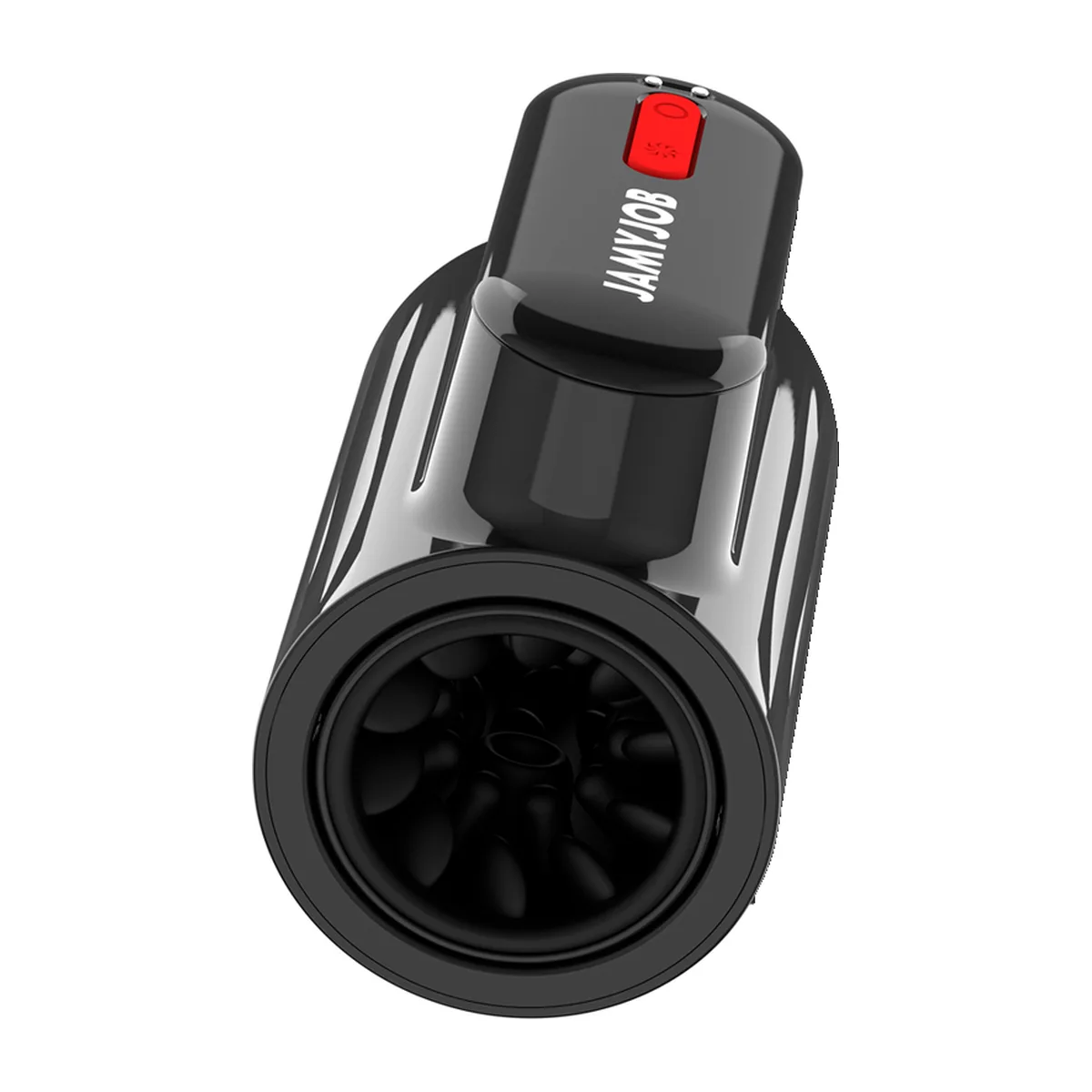
Jamyjob Vortex Thrusting & 360 Rotate Tech Masturbator is a motor-driven masturbator that does two things at the same time: it moves the sleeve up and down, and it rotates it 360 degrees. It’s that combination that gives the product its name, and it’s also the only thing that really sets it apart from the significantly larger number of masturbators that only vibrate or only suck. The manufacturer states ten thrust modes, ten rotation modes, and a built-in turbo mode.
The specification that is actually published looks like this: total dimensions 13 centimeters, height 11.8 centimeters, an insertion width stated to vary between 5 and 8.5 centimeters, weight 628 grams, magnetic USB charging, and a construction described as waterproof. The material is listed as medical silicone. The model was launched on June 5, 2025, with a recommended price of 79.95 euros including VAT. In Sweden, it is sold by five stores at prices between 716 and 895 SEK.
Just as important is what is not published, and that list is long. The manufacturer states no battery capacity, no operating time, no charging time, no IP rating, no sound level, no stroke length, no strokes per minute, and no manufacturer warranty. This review is therefore just as much about what can be verified as about what the product does — and, as you’ll see, there are several pieces of information that contradict each other outright.
The article being reviewed is the one with EAN 8435566047572. The same item has the item number D-236664 with the manufacturer’s wholesaler, and that number appears again at both Taboo and Lekosmek. The product is sold in only one color and one variant — black with deep red details — so there is no variant table you can get lost in, which is an unusually straightforward starting point in this category.
The category is called automatic masturbator, and it’s defined by the product moving itself. A typical stroker is passive: all movement comes from the hand. A vibrating masturbator adds an eccentric motor that shakes the whole housing. Instead, an automatic masturbator like Vortex has a mechanism that drives the sleeve in one direction — in this case both along and around.
The manufacturer describes the two movements as “empuje” and “rotación,” meaning thrust and rotation, and adds a turbo mode that is supposed to provide short bursts of higher intensity. Mechanically speaking, that means there are at least two movement axes in the housing, and that is also the reason the product weighs so much more than a passive stroker: the motors, gears, and battery are in the broad top section that you hold in your hand.
What makes this product type interesting is that it frees up your hand. What makes it hard to assess is that a mechanical movement inside a closed sleeve cannot be described in a specification in the same way as a vibration frequency. Two products can both indicate “ten settings” and still feel completely different, because the settings differ in both stroke length and speed. For example, Kiiroo publishes both stroke length—up to 75 millimeters—and tempo—up to 230 strokes per minute—for its Keon. Jamyjob does not publish either stroke length or strokes per minute for Vortex, and that means the settings can’t be compared numerically with any other model.
The question is more relevant than it sounds, because it determines where the specific information is located. Jamyjob has its own domain, jamyjob.com, but at the time of writing it is a password-protected shop with no public content. So there is no classic manufacturer page with a datasheet.
The brand is owned and distributed by International Dreamlove S.A., a Spanish company with an address in Carmona outside Seville, and it is on dreamlove.eu that the product’s official specifications are published—in nine languages, with article number 31636 in their catalog. That page is the first-hand source used in this review, and it’s also the only place where the manufacturer’s own product images with dimensions and button explanations are available in full resolution.
A practical implication: the EAN number 8435566047572 starts with 843, which is the Spanish country-prefix series. That matches the origin, and it’s a simple check to do yourself if you want to make sure a shop lists the correct item. Both Sexonic, Taboo, and the European database source Eroticanum link the same number to exactly this model, making identification unambiguous.
The material issue is the single most important characteristic of a product that is meant to sit against mucous membrane, because it determines whether the surface can be cleaned and whether it holds up over time. It’s also the issue where this product has its clearest problem, and it’s not about the material being bad—it’s about the fact that three sources say three different things.
The manufacturer’s product text is unambiguous: Vortex is described as being made of extra soft, high-quality silicone, and in the section on materials and care it explicitly states that the toy is made of silky-smooth medical silicone that is very easy to glide and quickly absorbs body heat. An adult repeats the same wording in Swedish, and Blush Me writes “high-quality silicone” in its specification table.
But the manufacturer’s own packaging image says something else. The icon row along the edge of the package contains a material icon that says “TPE”, together with an icon marked “BPA FREE”. TPE is not silicone. It is a thermoplastic elastomer, a completely different material system, and the difference is not just cosmetic. Next to that, the retailer lists the material as “Abs Silikon” in its specification table.
Can it be reconciled? Partly. The most reasonable interpretation is that the product consists of multiple materials: a hard housing in ABS plastic that holds the motors and the battery, and a soft sleeve inside. The question is what the sleeve is made of—silicone according to the product text, TPE according to the packaging. There is no published material breakdown by component anywhere, and that is exactly the breakdown a buyer needs.
For comparison, Kiiroo does exactly that: for Keon, the housing is listed as ABS and PC, while the FeelStroker sleeve is listed as TPE, body-friendly, and phthalate-free. Arcwave similarly lists medical silicone and body-friendly ABS plastic for the Ion 2, and it also explicitly states in its material text that its silicone sleeve is denser and more hygienic than the TPE stroker toys that are common in the industry. So both of these manufacturers are talking about the material per part. Jamyjob does not, and therefore the answer here is: which part of Vortex is silicone and which is TPE cannot be determined from the manufacturer’s published material information.
The difference between silicone and TPE is not academic. Silicone is non-porous, which means the surface can be cleaned—there are no microscopic voids where residues and bacteria can remain. TPE is generally porous to varying degrees. A porous surface can be rinsed off, but not cleaned in the same way, and it ages by becoming sticky and ultimately becoming impossible to sanitize. On a product with a deep, closed channel—just like a masturbator—that difference becomes more practically significant than on almost any other type of product, because the inside is difficult to reach.
The second part of the question is about softeners. Phthalates are a group of substances that are used to make plastic, above all soft, flexible PVC. The Chemical Inspection Agency describes them as substances that can affect the endocrine system and reproduction, and several of them are restricted or banned within the EU. Silicone does not need phthalate plasticizers to become soft—the softness is in the polymer’s own structure. TPE can be manufactured phthalate-free, but the label "TPE" in itself says nothing about which additives are included.
The manufacturer does not provide a phthalate declaration for Vortex in running text. The only thing there is is the BPA-free icon on the packaging, and BPA is another substance than phthalates. The fact that Kiiroo writes “phthalate-free” for its TPE sleeve while Jamyjob does not do so for Vortex is a real difference in how much information the buyer gets—not necessarily a difference in how the products are manufactured, but a difference in what can be verified.
The manufacturer states three measurements, and all three are also shown directly on one of the product images, which is unusually clear: total length 13 centimeters, height 11.8 centimeters, and an insertion width that varies from 5 to 8.5 centimeters. The last figure is the interesting one. It does not describe a fixed inner measurement, but how much the sleeve stretches, which is also why Taboo writes “stretchable” instead of a diameter value in its table.
The 11.8-centimeter height is, in practice, the grip measurement—it is that dimension that determines whether the product sits comfortably in the hand, and the manufacturer explicitly calls it an ergonomic height. With a 13-centimeter total length, Vortex is therefore shorter and chunkier than a classic stroker: it is built like a block, not like a tube.
Then comes the weight information, and there the text has to be careful. The manufacturer states 628 grams, but publishes that figure directly under the line “Dimensioner: 150 × 86 × 159 millimeter”, which are the packaging’s measurements and not the product’s. The database source Eroticanum lists the same three measurements explicitly as “packaging dimensions” and, at the same time, leaves its line for packaging weight blank, while Loviux includes 628 grams in a field that is only called “Weight (g)”. In other words: 628 grams is the only weight that is published, but no source says whether it is the product by itself or the entire packaged shipment.
Taboo makes the situation worse by stating 600 gram, and the same shop also states the length as 15 centimeters. Fifteen centimeter is not the product’s length—it is 150 millimeters, meaning exactly the first measurement of the packaging. Lekosmek also writes ”a length of 15 cm” in its product text. The conclusion is simple and worth taking with you: two of the five Swedish shops have added the packaging measurement as the product’s length. The manufacturer’s 13 centimeter is the correct number, and it is also confirmed by a dimensioned product image.
Regardless of how the 628 grams should be interpreted, the product is heavy for its size. That’s to be expected: it contains two motion mechanisms and a battery in a housing that only measures 13 centimeters. For comparison, Arcwave lists 153.5 × 51.98 × 83.19 millimeters for the Ion 2, a product that is longer but significantly narrower, and Kiiroo lists 220 × 130 × 146 millimeters and 1.1 kilo for the Keon. Vortex therefore sits between a handheld stroker and a real machine, both in format and in weight.
The interface is as simple as it can be. The manufacturer’s own button graphics show a red button bar on the top side of the motor unit with two buttons, and above them two small LEDs. There is no display, no app, no remote control, and no Bluetooth connection mentioned anywhere in the manufacturer’s material.
Having a stripped-down interface is an advantage for exactly this product type. You hold the product in one hand, and the buttons are where your thumb naturally lands—that’s the difference versus an app-controlled machine that requires the phone to be within reach and for a connection to work. The downside is just as obvious: with two buttons, you can’t jump directly to a specific mode; instead, you step through them.
The manufacturer’s button graphics are actually unusually specific, and it’s worth reading before buying. The upper button has the text ”press about 2 seconds to turn on/off, short press to swich 10 thrusting & rotation”. So a long press of about two seconds turns the product on and off, and a short press steps between the modes.
The lower button has the text ”short press turn on/off the one-click climax mode”. This is the turbo mode: a short press turns it on, and another short press turns it off. Having the turbo mode on its own button instead of being last in the mode list is a real design choice — you can go to max intensity and back again without losing track of which mode you were on.
The two LEDs above the buttons have no explanation in the manufacturer’s materials. Reasonably, they indicate the operating mode and charging status, but what the two LEDs mean the manufacturer does not publish, and there is no manual available online that explains them. This is the type of detail that normally appears in a quick guide in the package, and that you only get to find out after opening the box.
Here there is a contradiction worth pointing out, because it affects how you should read the marketing. The manufacturer’s product text says “with ten impact modes and ten rotation modes,” which is most naturally read as two independent scales—meaning up to one hundred combinations if they can be set separately.
But the manufacturer’s own button graphics say something else. It states that a short press switches between “10 thrusting & rotation,” meaning ten modes that include both thrusting and rotation. And there are only two buttons in total—one for on/off and mode switching, one for turbo. With two buttons, there is no physical way to control two scales independently of each other.
What can be established, therefore, is this: everything points to ten preprogrammed modes where thrusting and rotation are combined, plus a turbo mode—not ten plus ten as freely adjustable controls. The wording “10 modos de empuje y 10 modos de rotación” in the product text is most likely a description that both movements are varied over the ten steps, not a promise of one hundred combinations. Count on ten modes when comparing with other models, and treat every store text that writes “20 modes” as an interpretation rather than a statement.
Functionally, the turbo mode is the product’s clearest selling point and is written in large letters on the packaging. The manufacturer describes it as a built-in mode for an even more intense experience, and the button graphics call it “one-click climax mode,” meaning a mode you reach with a single press.
Functionally, the principle is the same as “turbo” or “boost” on other products in this category: a mode that sits outside the usual scale and that you turn on as you approach the end, instead of having to step up through nine modes. The point is accessibility—a button, one press.
What that means in practice, however, cannot be given in numbers. The manufacturer publishes neither how quickly the turbo mode works, how long it can be kept going, nor whether it turns off automatically. There is also no information about whether the turbo mode affects battery life, which it reasonably does on a battery that is already unspecified. It’s a mode you have to evaluate on the spot, not on paper.
Two of the Swedish shops market the product as quiet. Taboo writes “quiet-running motor for discreet use” both in its bullet list and in its body text, and Lekosmek writes that the product is quiet-running. That sounds reassuring, but it’s a shop phrasing and not a claim from the manufacturer.
The manufacturer publishes no decibel value for Jamyjob Vortex, and it also doesn’t describe the product as quiet anywhere in its product text. What it says there is instead the opposite in tone: “powerful motor”, “high performance”, and “intensive stimulation”. There is therefore no manufacturer source behind the claim of silence at all.
What can be said generally is that, in principle, a mechanical impact mechanism is harder to make quiet than a vibration motor, because the movement is larger and the change of direction creates a sound pulse at each turning position. A product that both impacts and rotates has two movement systems, both of which contribute. So, if a shop calls such a design quiet-running without stating any measurement value, it should therefore be read as a description of the experience, not as a specification. Websites that provide an exact decibel value for this model either show their own measurement or a value without a source.
A practical tip that applies regardless of model: never place or set a motor-driven product directly on a hard tabletop while it’s running. The tabletop works like a resonance box and noticeably amplifies the sound. A folded towel underneath the product makes more difference than most design details.
The manufacturer states that Vortex is designed to be waterproof, that it is easy to clean, and that it can be used in the bathtub or in the shower. Vuxen writes “100% waterproof” in its bullet list; Blush Me and Taboo write “waterproof”. It’s a consistent claim throughout the entire chain.
The problem is that none of the sources specify a casing rating. No IPX number is published for Jamyjob Vortex—neither by the manufacturer nor by any of the five shops. The word “waterproof” is marketing language with no defined meaning. An IPX rating is not: the number tells you exactly which test the product has been tested against, and it’s comparable between manufacturers.
The difference is practical. Arcwave lists IPX7 for Ion 2, which according to the standard means the product has been tested for submersion at a depth of one meter for thirty minutes. Kiiroo goes the other way and writes plainly that the Keon isn’t waterproof, that only the sleeve is to be washed separately, and that the unit itself should only be wiped with a lightly damp cloth. Both messages are useful, because both are unambiguous.
Vortex is in the middle: it is described as waterproof, but without an IP rating you don’t know whether that means it can be rinsed under the tap, that it can be used in the shower, or that it can be left lying in bathwater. My advice is therefore conservative—treat it as splash-proof and feel free to rinse it off, but avoid submerging it and avoid leaving it lying in water. The manufacturer’s own cleaning instructions also only mention soap and lukewarm water, not submersion.
The manufacturer’s care instructions are brief but clear: the toy is easily cleaned with a little soap and warm water, and for more thorough hygiene a disinfecting cleaning product intended for toys is recommended. An adult repeats the same thing in Swedish and adds disinfecting toy-cleaning. Blush Me writes “easy to clean.”
On the question of lubricant, the manufacturer is equally firm: always use a water-based lubricant. This isn’t by accident but is a material issue. Silicone-based lubricants break down silicone surfaces over time and make them porous, and a porous surface can no longer be cleaned properly—only replaced. With a product where the sleeve is not stated to be replaceable, this is an expensive misstep. Oil-based products such as coconut oil also leave behind a film that’s difficult to remove from a deep channel.
Taboo notes in its table that lubricant is not included in the delivery, which is worth knowing because a product of this kind doesn’t work without it. Include a bottle of water-based lubricant in the cost. The manufacturer does not disclose what is actually included in the packaging in addition to the product and the charging cable, and this is where Vortex differs from the competitors: Arcwave lists for Ion 2 exactly what the box contains—the product, storage pouch, magnetic charging cable, manual, and safety instructions.
Store the product dry and separately from other soft materials. Two soft plastics that are pressed against each other for a long time can react chemically and leave marks, and with a product where the soft part is not safely specified as to material, it’s especially worth avoiding this. Let the sleeve air-dry thoroughly before putting it away—a damp, closed channel is by far the worst way to store it.
The manufacturer states that charging is done with a magnetic USB charger and describes it as convenient because that way the toy is always ready. Blush Me lists USB as the charging type in its feature table, Vuxen writes USB rechargeable, and both Taboo and Lekosmek state rechargeable via USB. So far, all sources agree.
With a magnetic charging cable connected to USB. Magnetic charging means the cable attaches to two contact points on the casing instead of being plugged into a port, and it is, in essence, a good solution for a product that is supposed to withstand water: with no opening in the casing, there is no rubber plug that could be forgotten and left unsealed.
The trade-off is the usual one. A magnetic charging cable is product-specific — if you lose it, no standard USB-C cable works, and unlike larger brands, Jamyjob has no public spare parts page where you can order a replacement charging cable. It is a real risk to rely on this for a product in this price range, and it should be weighed against, for example, Kiiroo using a standard USB connection on the Keon.
A practical detail worth mentioning: magnetic contact points must be kept dry and clean to charge properly. Wipe them off after use in the shower or bath. Salt, soap residue, and limescale on the contact surfaces are the most common cause of a magnet-charged product suddenly stopping to charge, and it is almost always a cleaning problem rather than a fault with the product.
Here is the biggest gap in the entire specification, and it deserves to be stated clearly: the manufacturer does not publish the battery’s capacity in mAh, its voltage, its operating time, or its charging time for Jamyjob Vortex. None of the five Swedish stores fill in any of those lines either, and neither do the European database sources — Loviux even has a field called “Battery” where the entire contents is “magnetic USB charger,” meaning the charging method instead of the battery.
It is a striking difference compared with the competition. Arcwave states for the Ion 2 that the battery is of a USB-chargeable lithium-ion type, that the operating time is 90 minutes, and that the charging time is 120 minutes. Kiiroo states for the Keon a battery life of between 30 minutes and 2 hours depending on intensity, and a charging time of approximately 4 hours. Both figures are rough, but they still let you know what you’re buying.
Why does it matter? Because for a motor-driven product, the operating time is the figure that most often ends up being decisive in practice. A striking mechanism draws significantly more power than a vibration motor, and the difference between 30 and 90 minutes of operation is the difference between needing to plan the charging and not having to think about it. Without a capacity figure, you also can’t convert anything — you can’t estimate the operating time from the capacity or assess how heavily the cell is being loaded.
What generally applies to lithium-ion batteries also applies here: capacity drops with the number of charge cycles; the cell does best when it’s charged regularly rather than stored completely discharged; and in this price range the battery is, in practice, not replaceable. With use a couple of times a week, it’s the battery, not the sleeve, that sets the limit for how long the product lasts — and since no service life is published, that’s an assumption rather than a piece of information.
We do not have price data from shops in your market yet.
The manufacturer’s text says medical silicone. The manufacturer’s own packaging features an icon marked TPE. Both cannot apply to the same part.
Two comparisons are relevant: versus the most well-regarded masturbator in the closest price bracket, and versus the machine that actually does the same thing, only bigger. All the information below comes from each manufacturer’s own specifications, and all prices come from the shops’ product feeds on 29 July 2026.
Arcwave Ion 2 costs from 1 186 SEK, i.e. 440 SEK more than Jamyjob Vortex at its cheapest in stock. The two do different things: Ion 2 uses air pressure against the underside of the clit’s glans, while Vortex uses a mechanical jolt and rotation around the entire shaft. So whoever knows what kind of stimulation he wants has already made his choice.
What still makes the comparison meaningful is how much more Arcwave tells you. For Ion 2, the enclosure rating IPX7 is published, along with battery type lithium-ion, operating time 90 minutes, charging time 120 minutes, material per part — medical-grade silicone and body-friendly ABS plastic — product dimensions 153.5 × 51.98 × 83.19 millimeters, packaging dimensions 196 × 136.5 × 70 millimeters, complete package contents, and a two-year warranty. Every line that is blank in Vortex’s specifications is filled in by Ion 2’s.
Is it worth 440 SEK? If you only compare features: no, you don’t get a jolt-and-rotation mechanism in Ion 2. If you compare risk: yes, because you know exactly what you’re getting and you have a manufacturer’s warranty to rely on. The honest summary is that Vortex is cheaper and does more mechanically, while Ion 2 is more expensive and does less but is fully documented. It’s two different kinds of reassurance, and only you know which one weighs more.
Kiiroo Keon costs from 1 441 SEK, i.e. almost twice as much as Vortex. Keon is the closest functionally related cousin in the comparison: it’s also an automatic masturbator that moves a sleeve up and down. The differences are, however, big in every single line.
Kiiroo publishes up to 230 strokes per minute and a stroke length of up to 75 millimeters, three modes—manual, interactive, and app-controlled—Bluetooth and WiFi, battery life 30 minutes to 2 hours, charging time about 4 hours, dimensions 220 × 130 × 146 millimeters, weight 1.1 kilograms, and the materials ABS, PC, and silicone, with a TPE sleeve that is explicitly stated to be phthalate-free. The warranty period is one year. And most importantly: Keon, according to the manufacturer, is not waterproof, and it must not be used in wet environments—only the sleeve is washed separately, while the device itself is wiped with a lightly damp cloth.
So what do you get for the extra SEK 695? A significantly more powerful and larger machine with published performance values, app control, and compatibility with interactive content—but a product that weighs 1.1 kilograms, does not rotate, and does not tolerate water. In return, Vortex is easy to grip in one hand, rotates in addition to thrusting, is stated to withstand water, and costs under a thousand kronor. For those who want the simplest path to an automatic masturbator without an app, wiring, or a machine on the nightstand, Vortex is the more practical purchase. For those who want performance and data, Keon is the one.
Five Swedish stores sell the item with EAN 8435566047572. The cheapest in the list is Sexonic at 716 kronor, and the most expensive are Vuxen and Taboo at 895 kronor each. It is 179 kronor, or a 25 percent difference, for exactly the same item number and the same packaging.
The stock situation changes that picture. Sexonic had the product as the last example in stock at the time of the check and is shown as sold out in the price feed, which makes Lekosmek at 746 kronor the cheapest option that actually can be ordered. The difference between the cheapest and the most expensive available store then becomes 149 kronor, or 20 percent—still enough that it pays to compare, but less dramatic than the price spread suggests.
Prices are also reduced at several stores. Lekosmek lists 746 kronor from the regular price of 899, Blush Me 795 kronor from 895, and Taboo 895 kronor against a recommended price of 995. The manufacturer’s own recommended price is EUR 79.95 including VAT, which explains where the nine-hundred-kronor level comes from. It also means that the reduced prices are real discounts compared to a published reference price, and not constructed comparison prices.
The same product appears under four different labels in the Swedish stores, which is worth recognizing if you’re searching on your own. Vuxen and Blush Me call it “Vortex Thrusting & 360 Rotate Tech Masturbator”, Sexonic uses the manufacturer’s full English name, Lekosmek shortens it to “Vortex Thrusting Masturbator”, and Taboo has translated it to “Jamyjob Vortex Up & Down”.
Under the surface, it’s the same product. Taboo and Lekosmek both use the manufacturer’s wholesale number D-236664, Blush Me uses the EAN number directly as the item number, and Sexonic lists EAN13 8435566047572 in its product details. The European database source Eroticanum links the two numbers: GTIN 8435566047572 and MPN D-236664 belong to the same item. If you see any of these numbers, you know you’re looking at the right product.
One more thing about the prices in the table above: they’re updated when the stores’ product feeds are updated, but always check the final price at checkout. Free shipping starts at 699 SEK at several of the stores, and this product passes that threshold everywhere except possibly after a discount code — and that specific free-shipping limit is what most often smooths out the last few hundred kronor between two stores.
It’s for you if you want an automatic masturbator that both thrusts and rotates, that you can hold in one hand without a cord to the wall, and that doesn’t need an app or interactive content. Two buttons and a turbo mode on its own button is a simple interface that works even if you can’t see it, and the price tag under a thousand kronor makes it one of the cheapest ways into the category of motorized masturbators.
It’s also for you if you want to be able to use the product in the shower, with the reservation above that its water resistance is not classified. And it’s for you if you want an adjustable sleeve — the insertion width is stated to vary between 5 and 8.5 centimeters, which is a wider range than most fixed sleeves offer.
It’s not for you if you want to know how long the battery lasts before you buy, because that figure isn’t provided. It’s not for you if you require an IPX rating to feel comfortable taking an electric product into the bathtub. It’s not for you if you want an unambiguous material declaration, because the manufacturer’s text says medical silicone while the manufacturer’s own packaging bears a TPE icon. And it’s not for you if you want performance values to compare — whether stroke length, rhythm, or sound level is published.
One last thing that belongs in the decision. This product is sold by five stores in Sweden and has been on the market since June 2025. That’s a small spread and a short history compared with the established brands in the category, and it affects everything from how easy it is to get hold of a replacement charging cable to how likely it is that the model will still be available in two years. It doesn’t have to be a reason to skip it, but it is a reason to buy it for what it is today rather than as a long-term investment.
The manufacturer does not publish a warranty period for Jamyjob Vortex. There is no warranty period page, no warranty terms, and no information about a warranty period anywhere in the material Dreamlove publishes for the product. This is a clear difference from Arcwave, which provides a two-year warranty for the Ion 2, and from Kiiroo, which provides a one-year warranty for the Keon.
The closest thing to a warranty you’ll find is a store commitment: Lekosmek states a two-year product warranty on what it sells. That commitment comes from the store and not from the manufacturer, which means that it applies against Lekosmek and not against Jamyjob. Always read the store’s own terms and conditions before you count on them, and save the receipt.
What does, however, always apply are your statutory rights, and in practice they are stronger than most manufacturer warranties. Under the Swedish Consumer Sales Act (konsumentköplagen), you have a right to complain for three years in the event of defects in the goods, regardless of what the manufacturer promises or does not promise. A battery that no longer charges, a motor that stops working, or a sleeve that cracks within that time is a defect in the goods that you can complain about to the store you bought it from.
For distance purchases, you also have a right of withdrawal for fourteen days under the Act on Distance Contracts and Contracts Outside Business Premises. Be aware that in practice the right of withdrawal is limited for hygiene products that have been taken out of a sealed package — the right to complain in case of defects, however, always applies. If you have questions about what applies in your case, Konsumentverket, via Hallå konsument, can guide you.
In summary: for a product without a published manufacturer warranty, the store is your counterpart in everything. It’s another reason to buy from an established Swedish retailer rather than chasing the last fifty kronor at a shop outside the EU, because the Swedish Consumer Sales Act’s three years are only worth anything if there is someone in Sweden you can direct the claim toward.
Jamyjob Vortex Thrusting & 360 Rotate Tech Masturbator isn’t included in any ranking yet. In best i test guides, the entire categories are compared against each other using five shared criteria, with what was left out shown.
Every numerical piece of information in the text can be traced to one of the sources below. The links were checked manually on the specified date.
This page is machine-translated from Swedish. Read the Swedish original