

Review
Review: Satisfyer Pro 2 Next Generation
Cheapest among the broadly sold — 219 SEK and a 15-year warranty.
29 July 2026
Review · Penis extender · Mechanical traction device
The Danish traction device reviewed against the manufacturer’s product page and QuickGuide, as well as price data from six Swedish stores. Three published pull-force levels of 1,200, 2,000, and 2,800 grams and eight extension rods are set against a completely missing material declaration, a warranty period that is stated differently in two of the manufacturer’s own documents, and an 86 percent price difference between the stores.
The most fully equipped variant in the Jes-Extender range: eight extension rods in three lengths, two attachment methods, and three defined traction force levels of 1,200, 2,000, and 2,800 grams. This is unusually concrete documentation for the category. What you pay for is a completely missing materials declaration, three stores that state three different materials, a warranty period that differs between the manufacturer’s two own documents, and a requirement of five to six hours of daily use.
Jes-Extender Titanium is a purely mechanical penis extender of the type usually referred to as a traction unit. While the rest of this category on the site consists of products with a motor, a battery, and modes, this one consists of a base unit, a front piece, threaded rods, and two spring-loaded cylinders. There is no electronics at all in it, and that changes which questions are worth asking: instead of runtime and sound level, everything comes down to pulling force, fit, time needed, and what the manufacturer is actually willing to state.
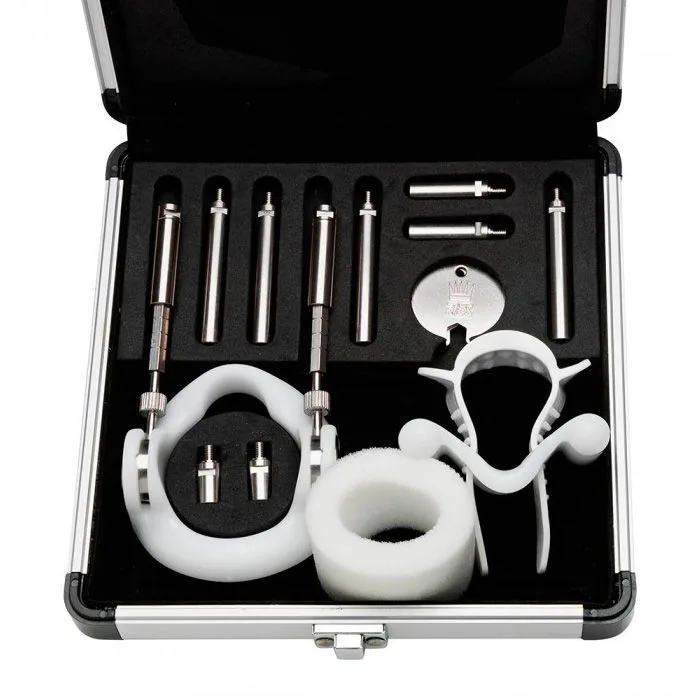
The manufacturer is DanaMedic ApS in Lyngby, outside Copenhagen, and the address is printed in plain text on the last page of the product's QuickGuide. The manufacturer states that all Jes-Extender products are manufactured and assembled in Denmark. The Titanium version is shipped in an aluminum case and, according to the manufacturer's own delivery list, includes a base unit, a front piece with dual function, a silicone tube, a comfort strap, a protective cushion, eight extension rods in three lengths, and a QuickGuide. The product page also states a set of keys and access to an online instruction video.
This review is about the item with EAN 5710458106005, which has the manufacturer’s item number 106. The number can be checked in three ways: Taboo lists the barcode as 5710458106005, Lekosmek lists the same number as the gtin13 in its structured product data, and Mshop lists it as an EAN. Vuxen lists the item under its own number JES106, which is the manufacturer’s item number with a brand prefix. Six Swedish stores sell it, at prices between 1 611 and 2 999 SEK, and four of them had it in stock at the price check on July 29, 2026.
The question deserves a straightforward answer, because the model name leads you to think about a material claim. What can be established is that the manufacturer publishes no material declaration at all for Jes-Extender Titanium. The product page says “high quality materials” and mentions the aluminum case, but nowhere on the product page or in the QuickGuide does it state that any part of the unit is made from titanium or a titanium alloy. The name appears on the case cover as “Titanium Edition” and “Titanium Series,” meaning as a series designation within the range.
It’s worth knowing before you pay the extra 20 US dollars that the manufacturer charges for Titanium compared with Original. What you can verify is the difference in the contents and the case—we’ll get back to that in the comparisons. What you can’t verify with the manufacturer is that there’s titanium in the product. If you see a claim about titanium alloy in a store text or a blog walkthrough, you should treat it as an unsubstantiated claim until the manufacturer states it themselves.
A couple of stores make it even more confusing. Both Taboo and Lekosmek list the item with the brand set to "Titanium" in their structured product data, meaning as if Titanium were the brand and the Jes-Extender model. It’s the other way around. The brand is Jes-Extender, Titanium is the model. This matters when you search for the product, because the search results differ depending on which of the names you base your search on.
Jes-Extender is sold in four versions that are easy to mix up, especially because Swedish stores rarely state which one they sell. The manufacturer’s own product pages make the differences clear.
The difference between Original and Titanium is therefore two things: the aluminum case instead of mahogany, and the extra pair of rods measuring 1.25 centimeters. That’s the entire upgrade according to the manufacturer’s own delivery lists. The size limit is the same, the warranty is the same, and the load-bearing parts are described in the same way. If you want finer steps in the length adjustment, that’s what you pay for with the two short rods.
The materials question is the hardest part of this review, and the reason is uncomfortable: the manufacturer doesn’t answer it. Neither the product page nor the QuickGuide includes a materials declaration for the base unit, the front piece, the rods, or the cylinders. The only material stated explicitly is aluminum—and that applies to the case, not the unit.
When the manufacturer is silent, it leaves it up to the stores to fill the gap—and here they split it up in a way that’s worth detailing. Taboo and Lekosmek both list the material as "brass, Nitin, and POM"—POM stands for polyoxymethylene, a hard and wear-resistant technical plastic that’s common in mechanical components. Joyland instead lists "Silicone, Metal" under its specifications. Vuxenkul only lists "ABS".
Three stores, three mutually incompatible answers for the same article number. That says something important about how product data spreads in this industry: the information doesn’t come from the manufacturer but from different wholesaler flows, and it gets copied onward without being checked. The identical wording from Taboo and Lekosmek, and the identical article number 536954, suggest that both pull their text from the same wholesaler flow. Joyland’s and Vuxenkul’s information evidently comes from somewhere else.
So what can be confirmed? That, according to the manufacturer’s own images and according to all store images, the product consists of shiny metal rods, white plastic parts, a translucent silicone tube, and a black rubber strap. So the presence of metal and plastic is uncontroversial. Which metal and which plastic, however, has not been confirmed by the manufacturer, and anyone with a known allergy to, for example, nickel should contact the manufacturer directly instead of trusting a store listing. An intimate product worn against the skin for several hours a day is precisely the kind of use where the material question weighs heaviest—and it’s exactly that question the manufacturer’s documentation leaves open.
For its part, Vuxen labels the item with "Body-safe & Phthalate-free". Phthalates are a group of plasticizers used to make plastic, above all plasticized PVC, flexible. The Swedish Chemicals Agency (Kemikalieinspektionen) describes them as substances that can affect the hormonal system and make reproduction more difficult, and several of them are restricted or banned within the EU. The labeling in itself is positive, but it comes from the store and not from the manufacturer, and it says nothing about which polymers are actually included.
The manufacturer does not publish either weight or external dimensions for Jes-Extender Titanium. But the stores do, and they come up with different figures—but this time, the contradiction can be explained.
Retailers Taboo and Lekosmek both list 800 grams, and Lekosmek also provides it as a structured weight field in grams. Retailer Mshop instead lists 1.43 kilograms, but it does so explicitly under the heading "Dimensions (Packaging)" along with the measurements 20.00 × 20.00 × 5.80 centimeters. If you read that as shipping weight including the outer cardboard and as the outer cardboard’s dimensions, the picture becomes logical: about 800 grams for the case with contents, a little over 1.4 kilograms for the fully packed package.
What you can use the information for in practice: according to Mshop, the package is roughly 20 × 20 centimeters in the outer dimensions and just under six centimeters thick, which sets an upper limit for how large the case inside can be. It fits in a suitcase but not in a toiletry bag, and it weighs enough to be noticeable in a shoulder bag. That it is an aluminum case with a clasp is an advantage for storage at home; that it is a sturdy case with a foam insert is also the reason the package weighs what it weighs.
One detail that only one of the six stores publishes deserves special attention, because it can determine whether the product is suitable for you at all. The retailer Joyland states that the ring at the base of the penis is about 4.1 centimeters in diameter and explicitly urges the buyer to check that the penis in its flaccid state is not wider than that.
It is the only fit information that is published anywhere in the material alongside the length interval, and the manufacturer doesn’t publish it at all. That one store does, while the manufacturer is content with listing a maximum length, is a remark about the documentation rather than about the product. A traction unit that can’t be closed around the base is unusable no matter how good the rest of the construction is, and you should be able to make that check before buying, not after.
Note the wording: approximately. It’s an estimated value from a store text, not a manufacturer measurement. If you have leeway of only a few millimeters, that’s a reason to contact the store or the manufacturer instead of taking a chance—especially since the right of withdrawal, which we’ll get back to, is limited as soon as the seal is broken.
The basic principle is simple and described step by step in the manufacturer’s QuickGuide. A base unit is placed against the base of the penis. From the base unit, two threaded rods extend forward, and on the rods sits a front piece that the penis head is fixed against. The rods are telescopic and spring-loaded, and by screwing on two hand screws you extend them—which creates constant tension between the base unit and the front piece.
What separates this product category from almost everything else on the site is that there’s no performance curve to compare. There’s only geometry and force. That’s why the two figures that matter are: how long the unit can be made, and how much traction it provides.
The manufacturer’s QuickGuide provides unusually concrete information. On the hexagonal plunger, there are three markings, and the guide states what they correspond to: marking 1 = 1,200 grams, marking 2 = 2,000 grams, and marking 3 = 2,800 grams. The farther into the cylinder the plunger sinks, the higher the pull. The guide also indicates where the limit is: when the threads start to become visible, you should stop screwing.
Three clearly defined force levels are more information than most manufacturers in this category publish, and it is, by far, the strongest entry in the entire specification. In practice, this means you can follow an escalation toward a known value instead of guessing based on how it feels.
But here the second major contradiction in the material appears. The retailers Taboo and Lekosmek both state the pulling force as “900–1,500 grams.” This does not match the manufacturer’s three markings, which go up to 2,800 grams, and it also does not match the guide’s instruction to begin the treatment specifically at 1,200 grams. When a store listing is up against the manufacturer’s own manual, the manufacturer’s, 900–1,500 grams should be regarded as an incorrect—or at least heavily cut—assignment in two Swedish store texts.
According to the manufacturer, the delivery includes eight rods: four at 5 centimeters, two at 2.5 centimeters, and two at 1.25 centimeters. They’re screwed in pairs between the base unit and the telescopic part, and the number determines the unit’s total base length. The QuickGuide gives the rule for how you choose: the total length should be marginally longer than your flaccid penis but fully extended.
Having the pairs in three lengths provides fine-tuning in increments of 1.25 centimeters at a time, compared with 2.5 centimeters as the minimum step on the Original model. That is the entire functional difference between the two models, and it is also the entire reason to pay the price difference if you don’t care about the case. If you add up the four 5-centimeter rods, the two at 2.5, and the two at 1.25, the total extension capacity comes to 27.5 centimeters distributed across two sides—so 13.75 centimeters per side if everything is mounted.
A detail from the guide that rarely appears in the store texts: before the front piece is attached, there should be about 1 millimeter of clearance on both sides of the adjusting screw’s handle, against both the hexagonal plunger and the plastic ring in the base. This is the prerequisite for the screw to be able to expand in both directions. If you miss it, you won’t get the full adjustment range.
The front piece is called “dual function front piece” just because it requires two different fastening methods, and the manufacturer makes it clear that you should use one or the other—not both. The transparent silicone tube is threaded through the holes in the front piece and locked into the grooves underneath. Instead, the comfort strap is threaded into the slits and tightened to a comfortable position.
The guide gives no indication of which one is best, but instead states plainly that you should try both and see which one suits you. That’s more honest than most product descriptions, and it’s also the practical reality: the fixation behind the glans is where comfort is decided, and it’s individual. A protective pad is included and should be placed under the tube or strap if the skin becomes irritated. The manufacturer also sells additional protection options, such as a cohesive bandage, a so-called No-Slip Protech, and a 3M patch, as well as a Velcro strap as an accessory—these are not included in the delivery and should be considered consumables.
This is where the most important information for anyone considering a purchase is found, and it’s not about the product—it’s about what it requires from you.
The manufacturer’s QuickGuide indicates a slow start: one hour per day during the first week, at 1,200 grams of pulling force, and then gradually more time and more pulling according to the manufacturer’s guidelines. Both the guide and the manufacturer’s questions and answers page state that most users then wear the device 5–6 hours daily.
Five to six hours a day is not an incidental matter—it’s the central “cost” of the product, and it should be weighed more heavily than the price tag. The manufacturer writes that the device can be worn under loose pants during sedentary work, and that it can be difficult to keep it on during sleep if you move around a lot. There is no fixed treatment pattern after the start-up phase—according to the manufacturer, the results depend solely on the total number of hours worn and the pulling force used.
The manufacturer publishes specific figures for the expected outcome, and they should be reproduced correctly and with clear attribution. The QuickGuide states that the average increase is 10 percent in erected length and 8 percent in circumference after 400 hours of treatment at 2,000 grams of pulling force, and that most people manage 400 hours within two months. The same guide further states that clinical studies document an average increase of 28 percent in length and 19 percent in circumference after four to six months of use, and it refers to an article in the British Journal of Urology from 2011.
This is the manufacturer’s information, not an independent evaluation, and it assumes the daily wearing time above. We do not take a position on the medical claims — that is outside what a specification comparison can determine. What can, however, be established is that the figures at the retailer level sometimes grow on the way: the retailer Mshop writes “up to 40 % penis enlargement” in its own headline text, a figure that does not appear anywhere in the manufacturer’s materials. Such discrepancies are reason enough to always consult the manufacturer’s documentation before forming an opinion.
Another point where the manufacturer’s two own documents do not say the same thing. The product page states that Jes-Extender Titanium fits sizes up to 24 centimeters (9.1 inches), and that wording is reproduced by Vuxen and Joyland. The QuickGuiden instead states that the device fits sizes from 4 to 22 centimeters in an extended flaccid state, and in another question in the same guide it says that it has been developed for sizes over 4 centimeters.
The stores also do not follow each other: Lekosmek lists 4–24 centimeters, Taboo lists 5–24 centimeters, and Vuxenkul only lists “Längd 24 cm” as a product attribute, which is more like a product dimension than a fit limit.
Practical reading: the lower limit of 4 centimeters in an extended flaccid state comes from the manufacturer’s manual and is the only lower limit that has been published. The upper limit is stated by the manufacturer itself in two different ways, 22 and 24 centimeters, in two different documents. If you are close to the upper limit, it is a reason to either choose the XXL variant or ask the manufacturer before buying, rather than relying on the higher of two conflicting figures.
The manufacturer does not publish any cleaning instructions in the QuickGuiden and does not assign an IP rating for the product. It is a real gap in the documentation for a product that is worn against the skin for several hours every day, and it’s worth pointing out. Vuxenkul states in its specification table “Water-resistant: Yes,” but that is a generic store attribute with no support in the manufacturer’s materials and should not be read as an enclosure class.
What can nevertheless be established from the construction is that the device is fully mechanical and detachable. The rods are unscrewed, the front section comes off the springs, and the silicone tube and strap are removed. The parts can therefore be cleaned individually, unlike a sealed electronic product. The protective pad and the cohesive bandage that the manufacturer sells as an accessory are consumables — the guide states that one roll of bandage is enough for four to six uses.
Because the manufacturer does not state anything about either temperature tolerance, cleaning agents, or lubrication, there is no basis to recommend a specific method. The reasonable conclusion is that the contact parts need to be cleaned regularly due to the usage time, and that the absence of instructions is not a sign that the product would withstand anything.
For completeness, since the comparison table on the site includes those rows: Jes-Extender Titanium has no motor, no battery, and no charging connector. Therefore, there is neither battery capacity in mAh, a runtime, a charging time, nor a measured sound value to report—not as omitted information, but as characteristics that the product simply does not have.
It has two consequences that actually matter in a comparison. The first is lifespan: on an electronic intimate product, it is almost always the fixed-in lithium-ion battery that determines how long the product lasts, and a product without a battery has no such limitation. The second is that there is no electronics that can be damaged by moisture, which is why the lack of an IP rating has less practical significance here than it would have had on a vibrator.
Instead, what determines lifespan is mechanical wear: threads, springs, and the parts that are bent. The manufacturer’s warranty commitment in the QuickGuiden is worded exactly in those terms—if something breaks during normal use, spare parts are sent, alternatively the product is repaired or replaced. It is a more reasonable warranty design for a mechanical product than a purely replacement commitment, provided that the commitment lasts as long as the product page claims. And that’s the next contradiction, which we address in the warranty section.
We do not have price data from shops in your market yet.
The manufacturer specifies three levels of pulling force in grams exactly — but does not publish a single word about what material the device is made of.
Four comparisons are relevant: three within its own range, where the manufacturer’s own product pages make the differences measurable, and one against the other Danish traction product that is sold widely in Sweden. All information below comes from the respective manufacturer’s or shop’s own pages, and all Swedish prices come from the shops’ product feeds on 29 July 2026.
Jes-Extender Original has a list price of 229,95 US dollars versus 249,95 for Titanium, i.e. 20 dollars less with the manufacturer. For that difference, according to the manufacturer’s own delivery lists you get exactly the same base unit, the same front piece with dual function, the same silicone tube, the same comfort strap, the same protective cushion, the same two-year warranty, and the same size limit of 24 centimeters.
The Titanium adds two 1.25-centimeter rods that the Original lacks, as well as an aluminum case instead of mahogany. The Original has six rods, while Titanium has eight. The smallest adjustment step therefore becomes 1.25 centimeters instead of 2.5.
The conclusion is unusually concrete: if you want to fine-tune the base length in half-inch steps, Titanium is the right choice, and it’s the only functional reason. If you don’t care about that, and you also prefer a wooden housing to a metal housing, Original does the same job. You have to weigh that against the fact that the price difference in Swedish stores is often greater than the 20 dollars the manufacturer charges.
Jes-Extender Light costs 199.95 US dollars from the manufacturer, i.e. 50 dollars less than Titanium. The differences, however, are significantly greater than the price tag suggests, and two of them are fundamental.
First, the warranty: Light has one year of warranty, while Titanium has two years. Second, the size limit: Light is explicitly stated to be usable only for sizes up to 17 centimeters, versus 24 for Titanium. Third, the contents: Light comes with four extension rods, compared to Titanium’s eight, and the manufacturer’s delivery list for Light mentions neither an aluminum case nor a set with keys.
So Light is a genuinely different product and not just a cheaper package. If you’re under 17 centimeters and want to test whether the method works for you, it’s the cheapest way into the brand. If you need more adjustment range, a longer warranty, or an aluminum case, it’s not an option.
Titanium XXL costs 349.95 US dollars, i.e. 100 dollars more than Titanium. According to the manufacturer’s delivery list, the rods are the same — 2 x 1.25 cm, 2 x 2.5 cm, and 4 x 5 cm — and the case and the warranty are the same. What’s different is that the base unit and the front piece are in XXL format.
That makes XXL relevant only as a fit question, not as a performance question. If you have trouble getting it to fit into the standard ring that Joyland states is about 4.1 centimeters in diameter, XXL is the way forward. If you don’t, you’re paying a hundred dollars for space you’re not using. Unfortunately, the manufacturer doesn’t publish a corresponding diameter specification for the XXL base, which means the choice between them can’t be figured out — it’s just a matter of asking.
Male Edge is the traction product that most often sits next to Jes-Extender on Swedish store shelves and is therefore the most relevant comparison outside the brand. The information below is store information from Vuxen, not manufacturer information, and should be read accordingly.
The retailer Vuxen states a weight of 0.527 kilograms for Male Edge Basic and the package dimensions 23 × 19 × 7 centimeters, as well as a shipping contents consisting of the extender, a measuring tape, two rubber bands, a treatment program, a product box, and a bag. So this is a lighter and simpler set: two rubber bands as the fastening method for Jes-Extenders silicone tube plus a comfort strap plus a protective cushion, and no set of threaded rods in three lengths.
The differences that actually matter: Jes-Extender Titanium has published force levels with three defined steps of 1,200, 2,000, and 2,800 grams, eight extension rods in three lengths, and two alternative fastening methods. Male Edge Basic is, according to store information, lighter and has a simpler set of accessories. If you choose based on documented traction force and adjustability, Jes-Extender is stronger. If you choose based on weight and simplicity, Male Edge is closer at hand. It should be said that neither of them publishes a complete materials declaration.
Six Swedish stores sell the item under EAN 5710458106005. Cheapest is Joyland at 1,611 SEK, and most expensive is Vuxenkul at 2,999 SEK. That is a 1,388 SEK or 86 percent difference for the same item number and the same packaging—one of the largest price spreads across the entire site.
The stock situation narrows the spread slightly but not by much. Four of the six stores had the product in stock at the time of the price check: Joyland at 1,611 SEK, Taboo at 1,895, Mshop at 2,189, and Lekosmek at 2,195. Vuxen at 2,195 SEK and Vuxenkul at 2,999 SEK were sold out. The difference between the cheapest and most expensive available store is therefore 584 SEK, which is still 36 percent.
A comparison with the manufacturer’s own list price puts the numbers into perspective. The manufacturer states 249.95 US dollars for Titanium on its US website. What that corresponds to in kronor depends on the exchange rate, tax, and shipping and should not be converted into an exact figure here—but in any case, the spread between 1,611 and 2,999 SEK in Swedish retail is significantly larger than what any exchange-rate movement can explain. It’s a question of the stores’ own margin pricing on a product that is sold in low volumes and is rarely subject to price pressure.
The prices in the table above are updated when the stores’ product flows are updated, but always check the final price at checkout. In this price range, all the stores are over the threshold for free shipping at most of the main retailers, which means the price difference goes straight through.
It fits you if you’ve decided on the traction method and want the most fully equipped version within the brand: eight bars in three lengths, two alternative attachment methods, and an aluminum case with a clasp. It fits you if you want to be able to follow an escalation toward a known value rather than toward a feeling — the three defined power levels of 1 200, 2 000, and 2 800 grams are the best documentation in the entire specification. And it fits you if you can actually set aside five to six hours a day, because that’s the time the manufacturer itself states.
It doesn’t fit you if you want a declaration of materials before you place a product against your skin for hours — it doesn’t exist, and the stores’ three mutually contradictory answers make the situation worse, not better. It doesn’t fit you if you’re close to the upper size limit, because the manufacturer states 22 centimeters in the manual and 24 on the product page. It doesn’t fit you if you’re wider than about 4.1 centimeters at the base, if Joylands’ information is to be believed. And it doesn’t fit you if you’re looking for something that delivers results without daily effort, because the whole method is built on accumulated carry time.
One last thing belongs in the decision. The price difference compared to the Original-modellen is what you pay for two short bars and a metal case, not for any difference in traction mechanics or size limit. If the budget is decisive, that’s where you save without losing functionality. If it isn’t, Titanium is the variant that offers the most adjustability for the money within the brand.
The warranty issue includes the last and maybe most important contradiction in the manufacturer’s own material. The product page states a two-year warranty. QuickGuiden, which is included in the package, formulates the commitment differently: if something breaks during normal use within twelve months, replacement parts are sent, alternatively the product is repaired or replaced free of charge.
Two documents from the same manufacturer, two different timeframes. It can’t be determined which one applies based on the published material, and that’s in itself a note. Practical advice: save both the order confirmation and the QuickGuiden, and base yourself on the shorter timeframe when you plan.
QuickGuiden also states two conditions that are easy to miss. If anything is missing from the package, or if you want to return the product, you must contact them within two weeks of receiving it. And because of the product’s nature, no refund is offered if the sealed plastic bag the product is delivered in has been opened. The manufacturer, on the other hand, offers a double money-back guarantee for the person who, after documented and regular use for six months, hasn’t seen any results — an undertaking with conditions you should read in full before counting on it.
What always applies, however, are your statutory rights, and they’re stronger than the manufacturer’s twelve months. According to the Swedish Sale of Goods Act (konsumentköplagen), you have three years of complaint rights for defects in the item, regardless of what the manufacturer promises, and that right is directed at the store you bought from — not at DanaMedic. With distance purchases, you also have a right of withdrawal for fourteen days under the Act on distance contracts and contracts outside business premises. Be aware that, in practice, the right of withdrawal is limited for hygiene products that have been removed from a sealed package, which is in line with the manufacturer’s own condition regarding the plastic bag. The right to complain for defects applies, on the other hand, always. If you have questions about what applies in your case, Konsumentverket guides you via Hallå konsument.
Jes-Extender Titanium Penisförlängare is ranked på plats 2 av 10 in penis sleeve best i test, where the entire category is compared against each other using five shared criteria. Guiden vinns av Toy Joy Hydrated Skin Penis Sleeve Silicone 16 cm.
Every numerical piece of information in the text can be traced to one of the sources below. The links were checked manually on the specified date.
This page is machine-translated from Swedish. Read the Swedish original