

 Premium pick
Review · Prostate vibrator · App-controlled
Lelo Hugo 2: review
Lelo’s app-controlled prostate vibrator is reviewed against the manufacturer’s own specifications and price data from five Swedish stores. Two motors at 130 and 108 hertz, ten modes, six of which are unlocked in the app, 72 millimeters insertion part, 121 grams, a lithium-ion battery of 420 mAh, and IPX7 — but only one hour of specified operating time, and a price that differs by more than double between the cheapest and the most expensive store.
My rating
The lightest and most easily accessible prostate vibrator in the comparison: 121 grams, 72 millimeters insertion part, two motors with different frequencies and ten modes, six of which are in the app. Lelo also publishes more technical data than any of the competitors. What you pay for is runtime—up to one hour is the shortest in the class—plus a 20-minute pause, a charging connector that only fits Lelo’s own cable, and that the intensity can’t be adjusted without a phone.
- Two motors: 130 Hz and 108 Hz
- Ten modes — four on the toy, six via the app
- 121 g and 72 mm insertion part — lightest in the comparison
- Li-Ion 420 mAh 3,7 V, up to 60 min runtime
- IPX7 according to the manual’s labeling
- 931–1 895 SEK at five stores for the same EAN
Lelo Hugo 2 at a glance — this is what you get
Lelo Hugo 2 is the app-controlled prostate vibrator in Lelo’s lineup. It has two separate motors—one in the base and one in the top—and ten modes, of which four are inside the toy itself and six are unlocked only when it’s paired with the Lelo app via Bluetooth. The manufacturer lists the dimensions as 104 × 107 × 41 millimeters, an insertion part of 72 millimeters, a weight of 121 grams, and a lithium-ion battery of 420 mAh and 3.7 volts. The manual labels the product with an IPX7 ingress protection rating.
It’s an unusually well-documented product for its category. Lelo publishes motor frequencies in hertz, battery capacity in milliamp-hours, rated power in and out, and a maximum sound level—information that several competitors completely omit. At the same time, the specification is also unusually clear about what is the product’s biggest weakness: runtime is stated as up to 1 hour. That makes it the shortest of all models in this comparison.
This review is exclusively about the black, app-controlled version with EAN 7350075029363. That number has been checked against five Swedish store feeds, all of which link it to Lelo Hugo 2 in black. Check the EAN before you pay, because Lelo sells a closely related model called Hugo 2 Remote, which neither has an app nor the same weight—and because several Swedish stores list both under similar-looking headings. In Sweden, the item is sold by five stores at prices between 931 and 1 895 SEK. Lelo’s own web store lists 1 790 SEK.
What a prostate vibrator does, and why the shape looks the way it does
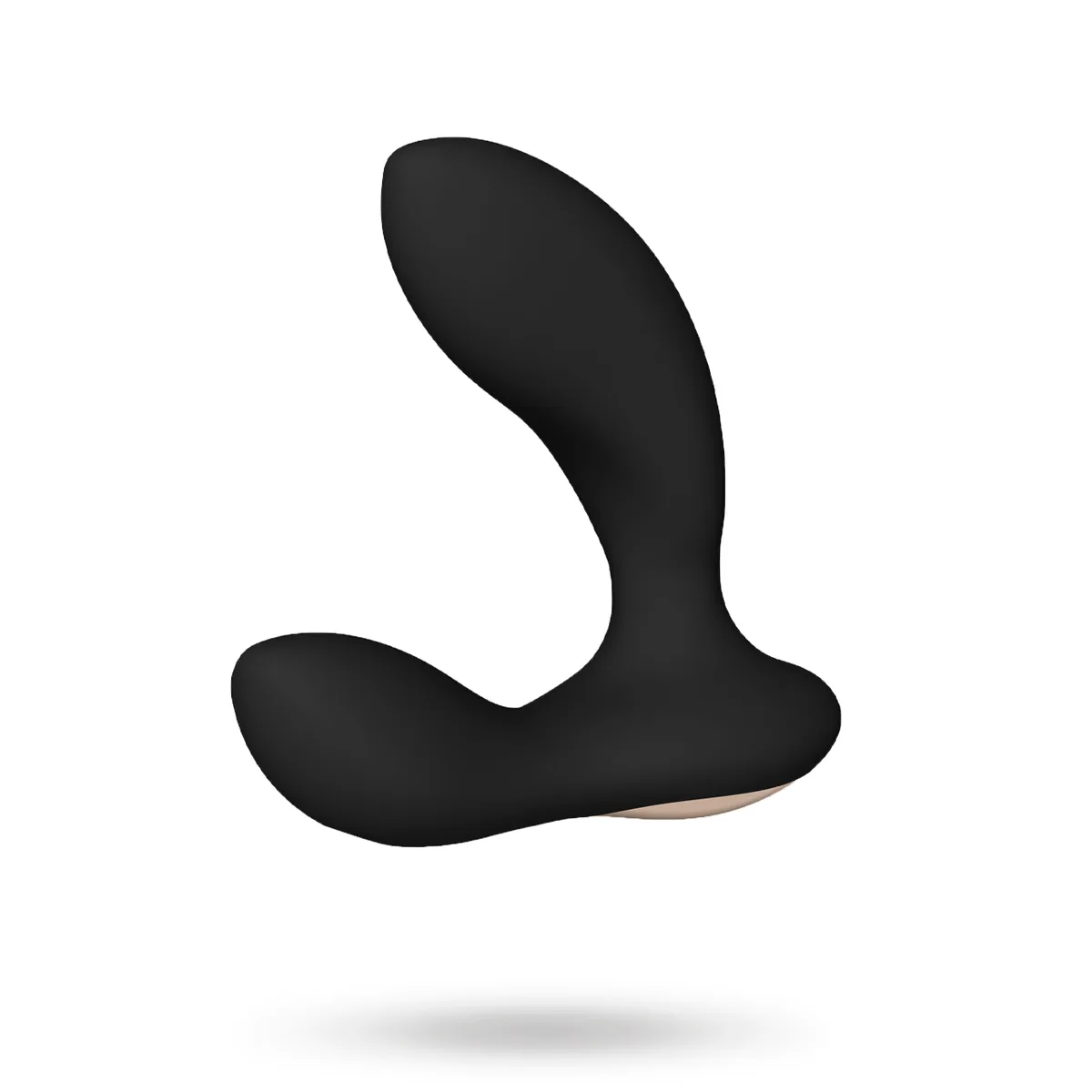
A prostate massager is designed to sit in place without needing to be held. That explains the entire design language: a curved insertion part that rests against the prostate’s location on the front side of the rectum, a waist that lets the anal sphincter keep the product in place, and an outer arm that lies against the perineum—the area between the scrotum and the anus. In the Hugo 2, a motor is placed at each end of this construction, which is the whole point of the model: it stimulates two points at the same time instead of just one.
The size specification of 104 × 107 × 41 millimeters is therefore easy to misunderstand. It is not the length of anything that is inserted, but the product’s overall outer dimensions in three directions—it's almost as tall as it is wide, because the outer arm sticks out to the side. The measurement that actually matters during use is the insertion part at 72 millimeters, i.e. just over seven centimeters. It’s shorter than Lovense Edge 2, where the manufacturer lists 91 millimeters, and significantly shorter than Lelo’s own Loki Wave 2 at 100 millimeters.
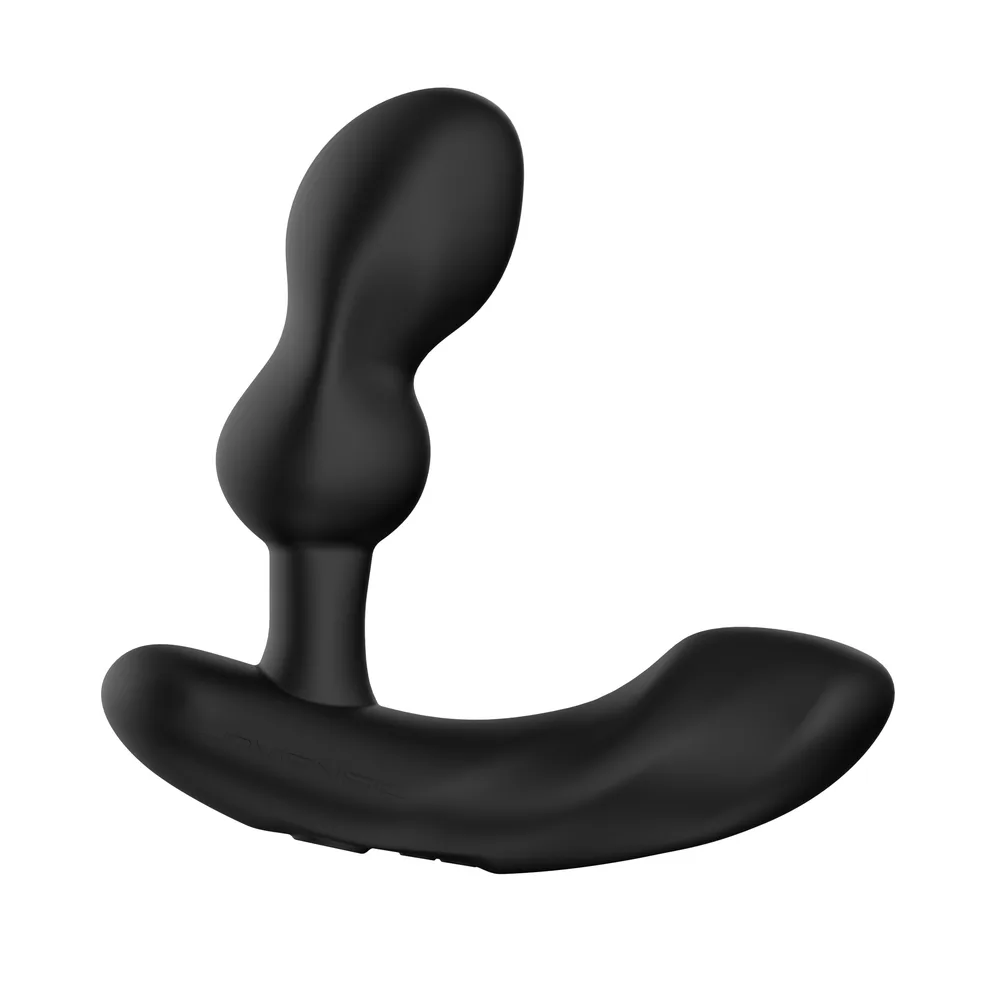
However, one detail is missing from Lelo’s specification, and it’s not unimportant: the manufacturer does not publish a diameter for the insertion part. For an anal product, the circumference is at least as important as the length, and here you therefore can’t compare using numbers. For example, Lovense lists the maximum diameter as 35 millimeters for Edge 2. For Hugo 2, you have to make do with the shape shown in the picture.
Hugo 2, Hugo 2 Remote, or Loki Wave 2 — which Lelo is which?
Lelo has three prostate models that are close together in their lineup, and Swedish stores regularly mix them up. The differences are real and can be checked in the manufacturer’s own specifications.
- Hugo 2 — the model this text is about. App-controlled via Bluetooth, ten modes (four on the toy, six via the app), 121 grams, one button. Lelo’s own price is 1,790 SEK.
- Hugo 2 Remote — the same 72-millimeter insertion part and the same 420 mAh battery, but six modes instead of ten, no app, and a physical remote control controlled with SenseMotion, i.e. by tilting the remote. It weighs 157 grams and costs 2,190 SEK from the manufacturer.
- Loki Wave 2 — a completely different product despite the same category. It is 196 millimeters long with a 100-millimeter insertion part, weighs 196 grams, has twelve modes, five buttons, a battery of 850 mAh, and Lelo’s WaveMotion mechanics that move the top back and forth instead of just vibrating. No app.
The weight specification is the detail that causes the most confusion in secondary sources. Several major retailers list 157 grams for “Hugo 2”. That figure applies to Hugo 2 Remote, not the app-controlled Hugo 2, which Lelo lists as 121 grams. The difference of 36 grams is less than a quarter of the Remote version’s weight, and it’s not insignificant for something that’s supposed to stay in place without being held.
Material and build quality: silicone on the outside, ABS on the inside
The material question is the only property of an intimate product that neither experience nor care can compensate for, and it determines whether the product is still hygienic after five years. Lelo lists two materials for the Hugo 2: body-friendly silicone and ABS plastic, with a smooth finish. The manufacturer’s product description specifies that the product is fully covered in an extra-soft premium silicone. Where the ABS plastic sits isn’t stated in the specification, but since the entire surface is described as silicone-covered, it’s not the part that contacts the body.
What body-friendly silicone means in practice
Silicone is a non-porous material. A non-porous surface can be cleaned, because there are no microscopic cavities where residue can get stuck. It is the single most important property of a material that is meant to lie against mucous membrane, and that’s why the material declaration weighs more heavily than almost every other line in a specification.
For an anal product, an additional requirement applies that doesn’t apply to other product categories: the design must have a clear stop to prevent the product from sliding in fully. In the Hugo 2, that’s handled by the outer perineum arm, which is wider than the insertion part and therefore works both as stimulation and as a physical barrier. It’s a design solution that Lelo shares with the Lovense Edge 2 and We-Vibe Vector+—all three are based on the same principle with two arms and a waist.
The fact that the manufacturer describes the entire product as silicone-covered is a real difference from cheaper models, where the silicone is only a thin layer over a hard plastic core with visible seams on the shaft. The fewer junctions between different materials, the fewer places where residue can get stuck—and for an anal product, that’s the decisive hygiene issue.
Phthalates, BPA, and what Lelo doesn’t print
Phthalates are a group of plasticizers used to make plastics—above all flexible PVC—pliable. Kemikalieinspektionen describes them as substances that can affect the hormone system and make reproduction more difficult, and several of them are therefore restricted or prohibited within the EU in a large number of products. This product category is a recurring subject of supervision precisely because it contains flexible plastic against skin and mucous membrane.
Here, Lelo deserves a note. The manufacturer does not publish an explicit phthalate-free or BPA-free declaration for the Hugo 2 on the product page. It says "body-safe silicone, ABS plastic" and nothing more. This should be weighed against Lovense, which explicitly states that the silicone in the Edge 2 is free from phthalates. Stating the material as silicone is in itself a strong message—silicone doesn’t require phthalate plasticizers to become soft, because the softness comes from the polymer’s own structure—but an explicit declaration would have been better than an implied one.
What Lelo highlights instead is that the company claims to comply with ISO 3533, the international safety standard for sex toys. It’s a broader commitment than a single material declaration, and for someone who relies on paper documentation, it’s the most substantial piece of information in all of Lelo’s marketing.
What ISO 3533 is, and what it isn’t
ISO 3533 is an international standard for construction and safety of products that come into direct contact with sex organs, the anus, or both. Lelo describes the purpose itself like this: to create global rules for how sex toys are constructed, what materials they are made from, and what information users are given, with the aim of minimizing the risk of injury and ensuring body-safe materials.
Two things are worth keeping separate. The first is that the standard is relevant specifically for anal products—the requirement that a product can’t slip in completely is one of the concrete design requirements that a standard of this kind addresses. The second is that a manufacturer’s own statement that it complies with a standard is not the same as a third-party certificate with a published certificate number. Lelo publishes a page describing the commitment, but no certificate number and no certifying body. It’s still more than what most competitors disclose, but it’s a commitment rather than proof.
Dimensions and weight: 121 grams and a 72-millimeter insertion part
Lelo lists the overall dimensions as 104 × 107 × 41 millimeters, the insertion part as 72 millimeters, and the weight as 121 grams. In the comparison group, it’s the lightest product: Lovense Edge 2 is listed at 151.3 grams, Hugo 2 Remote at 157 grams, and Loki Wave 2 at 196 grams. So Hugo 2 is about 20 percent lighter than Edge 2 and just under two-thirds of the weight of Loki Wave 2.
Weight matters more for a product that’s meant to stay in place than for one that’s held in the hand. The heavier the product is, the more work the anal sphincter muscle and the perineal arm have to do to keep it in position, and the more noticeable it becomes when you move. What can be concluded from the specifications is that the Hugo 2 is built to be the lightweight in its class—it has the shortest insertion part and the lowest weight of all the compared models, and that’s a consistent design choice rather than a coincidence.
The downside of that same choice is capacity. A smaller housing fits a smaller battery, and Hugo 2’s 420 mAh is intended to power two motors. Loki Wave 2, which is twice as heavy, has 850 mAh and a stated run time that’s twice as long. This relationship isn’t a coincidence, but a direct result of how much volume is left once the shape has been set.
Ten modes, two motors, and a single button
The interface on the Lelo Hugo 2 consists of exactly one button. The manufacturer states it plainly in the specification: "Interface: 1 button". The manual describes how it is used. A short press turns the product on, after which the LEDs first blink to indicate the battery level and then light up steadily to show the vibration level. Additional short presses step through the modes. Press and hold for three seconds to turn off.
A detail from the manual that’s easy to miss the first time you use it: the product is delivered transport-locked and is unlocked by connecting the charger. If the interface is locked during use, you unlock it the same way you start the product—by holding the button down for three seconds. It’s information that isn’t found in any store text, and it’s precisely the kind of thing that would otherwise be perceived as a flaw on a brand-new product.
One mode is worth noting in context: the manual states that the modes that run directly on the toy, without an app, are at 100 percent intensity. So without a phone, you can change the pattern but not turn down the strength. That’s the most important practical consequence of the one-button interface, and it’s also the strongest argument for actually using the app rather than treating it as a bonus.
The Lelo app: four modes on the toy, six more in the phone
Lelo states there are ten modes in total: four that are built into the product and another six that become available when Hugo 2 is paired with the Lelo app over Bluetooth. The app is available for iOS and Android.
Pairing is described step by step in the manual. Hold the button down for three seconds to start the product with Bluetooth enabled—all the LEDs blink at the same time, which is the pairing signal. In the app, you select the product under the toy icon, tap Connect, and confirm again with a press of the button on the product. After that, you go to "My Lelo Toys" and "Play", choose among four control modes, and configure the six extra modes under "Settings". There is a save function that stores the settings in the product for use without a phone.
The save function is the most underrated line in the entire manual. It means the app doesn’t have to be running every time you use it—it works as a configuration tool that you can use once and then put away. It’s a meaningful difference from app-controlled products where the phone must be connected in order to access the extended modes.
What is not published, however, is the technical information about the connection. Lelo does not state either the Bluetooth version or the range for Hugo 2, either on the product page or in the manual. What can be established is that the product has a radio module approved under FCC ID ZT5-HUGO and IC 9798A-HUGO, and that it is covered by the EU’s Radio Equipment Directive 2014/53/EU — but this says nothing about how far the connection reaches through a wall.
130 Hz and 108 Hz — what two motor frequencies mean
Lelo lists two separate frequencies: vibration motor 1 operates at 130 hertz and vibration motor 2 at 108 hertz. It’s an unusually concrete piece of information in this category, and it explains the core idea behind the design better than the marketing text does.
The frequency determines how a vibration is experienced. High frequencies are perceived as sharp and superficial, low ones as deep and more penetrating. That Lelo puts 130 hertz in one motor and 108 hertz in the other means that the two stimulated points do not have the same character of vibration — they are intentionally different. The manufacturer places the motors in the base and the top respectively, that is, at the perineum and at the prostate, but it does not specify which frequency belongs to which position.
The practical takeaway from this is that the difference between the modes is not just about rhythm but about which of the two motors is active and how intensely. Compare it with Lovense Edge 2, which also has two motors, but where the manufacturer instead emphasizes an unlimited number of user-defined patterns via the app. Two different philosophies: Lelo gives you a limited set of carefully balanced modes; Lovense gives you a pattern editor.
Twenty-minute cutoff: the detail that few store texts mention
Lelo states in the specification "Switch off: Automatic after 20 minutes", and the manual explains why: the product switches off automatically every twentieth minute so the motor does not overheat if the product is used in a way it is not intended for.
This is a feature, not a fault, but it should be a conscious choice when you buy. Twenty minutes is shorter than many expect, and anyone who wants a product that can run uninterrupted for longer sessions needs to restart it. The manual states that the switch-off time can be set in the app via a drop-down menu, between 10 and 20 minutes — so it can be shortened, but not extended. Lelo’s own Loki Wave 2 has the same twenty-minute limit.
Taken together with the operating time of up to one hour, that means in practice that a full charge lasts for roughly three such sessions. That’s the most useful way to add up Lelo’s two separate specification lines, and it’s worth doing before you pay.
Sound level: under 60 dB according to the manufacturer
Lelo states a maximum noise level of less than 60 decibels. Publishing any figure at all is more than the norm in this category, where most manufacturers stick to terms like "discreet" or "whisper-quiet".
But the value should be read for what it is. "Less than 60 dB" is a ceiling, not a measurement, and Lelo publishes neither the measurement distance, the measurement method, nor the mode in which the value was measured. Without a distance, a decibel figure is not comparable between manufacturers, because sound pressure decreases quickly with distance. The same ceiling below 60 dB that Lelo states for the Loki Wave 2 and for the Hugo 2 Remote suggests that it is a generic limit for the range rather than a model-specific measured result.
For comparison, Lovense lists 43 dB for the Edge 2 in its own noise comparison. It’s a lower and more precise figure, but it is taken from the manufacturer’s own graphics and is also not accompanied by measurement conditions. The conclusion is that both numbers work as an order-of-magnitude reference and nothing more. What can be established is that an anal product like this sits inside the body during use, which dampens the sound in a way that no external measurement captures.
A practical tip that applies regardless of model: place the product on a soft surface between uses. A hard tabletop works like a resonance box and noticeably amplifies the sound if the product is started by mistake.
Water resistance: IPX7 in the manual, 100 percent on the product page
Here, the manufacturer’s two documents differ in wording but not in substance. The product page says "100% waterproof" without any rating. The manual labels the product with IPX 7 in the symbol section and states that the Hugo 2 is completely waterproof, which makes cleaning easy.
IPX7 comes from the international standard IEC 60529, which defines enclosure classes for electrical equipment. The number 7 in the second position means that the product is tested for submersion in water to a depth of one meter for 30 minutes. So that is the classification that applies, and "100% waterproof" on the product page is the marketing wording for the same thing.
IPX7 vs. "splash-proof" — the difference that matters
The difference versus a splash-proof product is greater than the wording suggests. Splash protection covers water droplets and, at best, water jets, but not submersion. Such a product handles a damp cloth and possibly a shower, but not a bathtub, and it should not be kept under running water without thinking about the button and the charging contact.
For an anal product, the difference isn’t cosmetic but hygienic. A product that’s used anally must be able to be cleaned properly every time, and that requires that the entire product can be kept under running water without any exceptions. With IPX7, that’s straightforward. If a product lacks an IPX rating entirely, it must be treated as not waterproof—the absence of a rating is never a sign that the product would be approved.
Both Lovense Edge 2 and Lelo Hugo 2 are listed as IPX7 by their respective manufacturers, so on that point they’re equal. The difference is that Lovense prints the rating on the product page, while Lelo only has it in the manual’s labeling section—so anyone reading the shop text gets no rating at all, just a claim of one hundred percent.
Cleaning, lubricant, and storage
The manual’s instructions are specific. Rinse the product off, spray it with a cleaning product for intimate products, and rinse again, then let it dry. The silicone can be washed with warm water and antibacterial soap, rinsed with clean hot water, and dried with a lint-free cloth. Always clean both before and after each use—for an anal product, that order is more important than for any other product category.
Two prohibitions are explicitly stated in the manual. Never use cleaning products that contain alcohol, gasoline, or acetone. And don’t use hand creams or silicone-based lubricants—they can make the silicone surface permanently sticky. The latter is the manufacturer’s own wording, and it describes a damage progression that can’t be repaired: silicone-based lubricant breaks down the silicone surface, and a degraded surface can no longer be cleaned properly—only replaced. A water-based lubricant is what applies, and for anal use you need it in larger amounts than for other use because the area doesn’t have its own lubrication.
The manual also covers storage. Avoid direct sunlight and never expose the product to extreme heat. Store it dust-free and separate from products made of other materials—this last one is a classic silicone rule, because some soft plastics can react with silicone during long-term contact. A satin storage pouch is included in the delivery.
Battery and charging: 420 mAh and one hour of operation
Lelo publishes the entire battery chain, which is unusual. The battery is listed as lithium-ion, 420 mAh, and 3.7 volts. Charging takes up to two hours at 5.0 volts and 500 milliampere. The rated power is listed as 5 volts and 2.1 watts input and 3.7 volts and 2.5 watts output. The standby time is listed as 90 days. The operating time is listed as up to 1 hour.
How is Lelo Hugo 2 charged?
With the included USB charging cable. The manual states that a DC connector is inserted into the DC port on the base of the product, and that the other end of the cable is connected to a USB port. While charging, the LED pulses; when the battery is full, it shines with steady light. When the battery starts to run low, it blinks white.
So it’s not a magnetic charging cable, which sets Hugo 2 apart from both Lovense Edge 2 and We-Vibe Vector+, which both charge magnetically. The cable is still product-specific: it has a regular USB-A on one end but a Lelo-specific DC plug on the other, and the manual expressly says that only original chargers from Lelo should be used. So if you lose the cable, no regular phone charger will work—that’s the same practical problem as with magnetic cables, just with a different connector type.
One thing from the manual that’s hard to find anywhere else: the product is delivered locked for shipping and is unlocked by connecting the charger. So if a brand-new Hugo 2 doesn’t respond to the button, that’s the first thing to try—before any other troubleshooting.
One hour: the weakest line in the specification
Battery life is the product’s clearest weakness, and you can see it right away in a comparison. The manufacturers’ own figures: Lelo Hugo 2 up to 1 hour, Lovense Edge 2 between 65 and 130 minutes depending on level, We-Vibe Vector+ up to 2 hours, and Lelo Loki Wave 2 up to 2 hours. Hugo 2 comes last, in some cases with only half the time the competitors state.
The explanation is in the volume. The 420 mAh capacity is supposed to run two motors in a housing that weighs 121 grams. Loki Wave 2, which weighs 196 grams, has 850 mAh—so a battery that’s twice as large—and is also stated to provide twice the battery life. The relationship is straightforward: there just isn’t more space in the Hugo 2. We-Vibe, for its part, doesn’t give the capacity for Vector+ in milliampere-hours, but only 3.7 volts and 0.32 ampere, which means the two batteries can’t really be compared using numbers.
Compared to charging time, the picture becomes clearer: two hours of charging gives up to one hour of runtime. It’s a 2:1 ratio between charging and use, versus Vector+ where We-Vibe states 90 minutes of charging for up to two hours of runtime, i.e. 0.75:1. What can be concluded is that Hugo 2 requires more planning than the competitors. The 90-day standby time softens it a bit—a charged product sitting in the box retains its charge for a long time—but anyone who uses the product often will notice that it spends a large portion of the time in the charger.
What generally applies to lithium-ion batteries also applies here: capacity drops with the number of charge cycles, the battery is built in and not intended to be replaced, and the cell is best off being charged regularly rather than being stored completely discharged. With use a couple of times per week, it is the battery, not the silicone, that sets the limit for service life.
Where can you buy it — and what does it cost?
We do not have price data from shops in your market yet.
Two hours of charging for up to one hour of runtime. It’s the only line in the specification where Hugo 2 comes last compared with all the models in the comparison.
Pros
- Two motors with different frequencies—130 Hz and 108 Hz
- Ten modes: four in the toy, six via the Lelo app over Bluetooth
- Lightest in the comparison: 121 g vs Edge 2’s 151,3 g
- Short insertion part at 72 mm—the most accessible of those compared
- IPX7 according to the manual’s labeling— the entire product can withstand being submerged
- The manufacturer publishes battery capacity, voltage, and motor frequencies
- Two-year manufacturer warranty with a free replacement product
Cons
- Run time up to 1 hour—the shortest of all the compared models
- Two hours of charging for one hour of operation
- Automatic shut-off every 20 minutes—can only be shortened in the app
- Without the app, the settings run at 100 percent intensity—no strength adjustment
- Product-specific DC charging connector; the manual advises against other chargers
- No published diameter for the insertion part and no phthalate-free declaration
- The manual states a one-year warranty, while the warranty page states two
Rating in detail: five criteria, the same for the entire category
7.9Good
- Materials and hygiene
- 8,5
- Silicone over the entire surface, an ABS frame, and stated ISO 3533, but no phthalate-free declaration in plain text.
- Water resistance and cleaning
- 9,3
- Rated IPX7 in the manual and charging via contact pins without an exposed outlet—the entire body can be rinsed.
- Power supply and runtime
- 6,0
- The published 420 mAh and 3.7 V are listed, but 60 min of runtime on 120 min of charging is the shortest among the rechargeable ones.
- Fit and controls
- 7,5
- Two motors and ten modes, but only four without an app. Easiest in the field: 121 g and a 72 mm insertion part.
- Price versus performance
- 8,0
- 931 SEK versus the manufacturer’s 1 790 SEK, with a two-year warranty and the field’s most complete datasheet.
Lelo Hugo 2 compared with the alternatives
Four comparisons are relevant: against Lelo’s own remote-control variant, against the two app-controlled competitors from Lovense and We-Vibe, and against Lelo’s larger and more expensive model. All information below comes from each manufacturer’s own specifications, and all Swedish prices come from the shops’ product feeds on July 29, 2026.
Lelo Hugo 2 Remote — what’s the difference between Hugo 2 and Hugo 2 Remote?
This is the comparison that most people get wrong, because the models are named almost the same and are sold on the same store shelves. The insert part is identical — 72 millimeters in both — as is the battery at 420 mAh and 3.7 volts, the charging time of up to two hours, the operating time of up to one hour, the standby time of 90 days, the motor frequencies of 130 and 108 hertz, the sound level under 60 dB, and the interface with a single button on the product itself.
There are three differences. Hugo 2 has ten modes versus six for the Remote version. Hugo 2 is controlled over Bluetooth with the Lelo app, while the Remote is controlled with a included physical remote control that works with SenseMotion—meaning the remote control is tilted in different directions. And Hugo 2 weighs 121 grams versus 157 grams for the Remote version.
The price differs too: Lelo lists 1,790 SEK for Hugo 2 and 2,190 SEK for Hugo 2 Remote. So the choice is between, on one side, more modes, lower weight, and a lower price, and on the other, a physical remote control that doesn’t require anyone to pick up a phone—on the one hand, and the other. If you want a partner to control it without a screen, the Remote version is the only way to do that within Lelo’s Hugo family.
Lovense Edge 2 — 164 SEK apart
Lovense Edge 2 costs from 1,095 SEK and Hugo 2 from 931 SEK. That’s a difference of 164 SEK between two products that solve the same task with two motors, an app, and IPX7.
Edge 2 wins on three points. Operating time is listed as 65–130 minutes versus up to one hour for Hugo 2. The neck is bendable and retains its position, which lets you adjust the angle toward the prostate—Hugo 2 has a fixed shape. And Lovense states both the largest diameter, 35 millimeters, and a decibel value of 43 dB, which gives more to compare. Edge 2 also has an unlimited number of user-defined vibration patterns in the app, versus Hugo 2’s ten fixed modes.
Hugo 2 wins on four. The weight is 121 grams versus 151.3 grams. The insertion part is shorter, 72 versus 91 millimeters, which makes it more accessible for someone who is new. The warranty is two years versus Lovense’s one. And Lelo publishes more technical data about the drive itself — 420 mAh, 3.7 volts, 130 and 108 hertz, and rated power in and out — where Lovense does not publish battery capacity or voltage for Edge 2.
In short: Edge 2 weighs the most for runtime and an adjustable angle, while Hugo 2 weighs less, has a shorter insertion part, double the warranty length, and a lower price — weighs more.
Against We-Vibe Vector+ — double the runtime
We-Vibe Vector+ costs from 1,079 SEK, which is 148 SEK more than Hugo 2 at its cheapest. The construction is essentially the same: a tapered insertion part with a narrow neck and a rounded tip for the prostate, plus an external arm for the perineum.
The big difference is the power supply. We-Vibe states up to two hours of runtime and a 90-minute charging time for Vector+, versus Lelo’s up to one hour and up to two hours. Vector+ therefore provides double the usage time with a shorter charging time. The battery is stated as 3.7 volts and 0.32 ampere, and the charging as 5 volts and 0.5 ampere, via a magnetic charging cable.
Vector+ also has a wireless remote control in the package in addition to app control, which Hugo 2 does not have. A practical objection to that: according to We-Vibe’s manual, the remote control is powered by a non-rechargeable 4LR44 battery, meaning a battery that runs out and has to be bought. The warranty is two years with both manufacturers.
If you choose based on runtime and getting a remote control included, Vector+ wins. If you choose based on weight, on published motor data, and on the lowest price in the comparison, Hugo 2 wins.
Against Lelo Loki Wave 2 — 968 SEK for a different mechanism
Loki Wave 2 costs from 1,899 SEK in Swedish retail, which is 968 SEK more than Hugo 2. With that difference, you get a completely different product, not an upgraded Hugo.
Loki Wave 2 measures 91 × 42 × 196 millimeters with a 100-millimeter insertion part and weighs 196 grams. The battery is 850 mAh and 3.7 volts; runtime is stated as up to two hours and charging time as up to two hours at 5.0 volts and 750 milliampere. It has twelve modes, five buttons, a frequency of 122 hertz, and Lelo’s WaveMotion mechanism, where the sculpted tip moves back and forth instead of just vibrating. The sound pickup is stated to be under 60 dB and the automatic shut-off to 20 minutes, just like on Hugo 2.
Two things stand out in how they’re used. Loki Wave 2 has no app—everything is controlled by the five buttons on the product. And it’s significantly bigger: 196 grams and a 100-millimeter insertion piece make it a product for anyone who already knows that this format works. Hugo 2 is the smaller, lighter, app-controlled model; Loki Wave 2 is the more powerful one, with motion instead of vibration only, and with twice the runtime.
Price range: 931 to 1,895 SEK, and four stores with stock
Five Swedish stores sell the item with EAN 7350075029363. The cheapest is Joyland at 931 SEK, and the most expensive is Vuxen at 1,895 SEK. That’s a difference of 964 SEK, which means the most expensive store charges just over twice as much as the cheapest store for the exact same item number, the same color, and the same packaging.
Four of the five stores had the product in stock at the price check. The only one missing stock was Sexonic at 1,603 SEK. That means the price range is genuinely available: both the cheapest and the most expensive store had the item at home, and the difference between the cheapest and the second-cheapest available is 364 SEK—Blush Me and SexleksakerOutlet are both at 1,295 SEK.
It’s worth having a reference price. Lelo’s own web shop lists 1,790 SEK for Hugo 2. That means the cheapest Swedish store is 859 SEK below the manufacturer’s own price, while the most expensive is 105 SEK above it. That one of five stores charges more than the manufacturer itself isn’t unusual, but it’s exactly the kind of situation where a price comparison is most useful.
The prices in the table above are updated when the stores’ product feeds are updated, but always check the final price at checkout. Shipping costs are added at most stores under a certain order value, and in this price range several stores are close to the threshold for free shipping—which can affect which store is actually the cheapest overall.
Who is Lelo Hugo 2 for—and who isn’t it for?
It’s for you if you want a prostate vibrator that stays put without being held, that’s light and short rather than big, and that’s controlled from a phone. The 72-millimeter insertion piece and the 121-gram weight make it the most accessible of the compared models for someone who’s relatively inexperienced. It’s also for you if you want two motors with different characteristics rather than one, if you want to be able to save app settings and then use the product without a phone, and if you value that the manufacturer actually publishes battery capacity, motor frequencies, and a sound limit.
It doesn’t fit you if you need long battery life. One hour is the shortest time in the comparison, and the 20-minute stop means that long sessions require the product to be restarted. It doesn’t fit you if you want to be able to adjust the intensity without a phone — because the app runs the modes at full power. It doesn’t fit you if you want to be able to charge with the same cable as your phone, since the DC connector is Lelo’s own and the manual advises against other chargers. And it doesn’t fit you if you require a published diameter for the insertion part or an explicit phthalate-free declaration before purchase, because Lelo does not publish either.
One more thing belongs in the decision. Hugo 2 is an app-controlled product where six out of ten modes are only available in the app. That means the product’s value is tied to Lelo continuing to maintain its app for the operating systems you use. The four modes in the toy work independently of everything, and the save function means configured modes remain in the product — but the person who, in principle, doesn’t want an account and an app linked to an intimate product should instead choose Hugo 2 Remote or Loki Wave 2.
Warranty, complaints, and right of withdrawal
Lelo offers a two-year worldwide manufacturer’s warranty on its products, and extends it in countries where the law requires a longer time. The warranty covers defects in materials or workmanship that affect the product’s function, and in that case Lelo replaces the product free of charge. You activate the warranty by registering the serial number from the packaging on your account with Lelo, and you must save the receipt as proof of the purchase date.
Two things in the warranty terms are worth reading carefully. Shipping costs are not refunded if Lelo requests that the product be sent in, and the ten-year quality guarantee is not an extended warranty but a discount: it gives 50 percent off a new purchase on lelo.com, once, for up to five items in the same order, and it does not apply to packages or Luxe Line. Lelo also explicitly writes that the company does not refund money except for unopened items purchased on lelo.com within 14 days.
An inconsistency in the manufacturer’s own materials should be noted. The product page and the warranty page state two years, while the PDF manual that comes with Hugo 2 describes a one-year limited warranty. The warranty page is the later and more specific source, and it explicitly states that the terms apply to all pleasure objects. However, anyone who is going to make a claim would be wise to rely on the two years stated on the warranty page and refer to it.
What always applies, however, are your statutory rights, regardless of what the manufacturer promises. Under konsumentköplagen, you have three years of reklamationsrätt for defects in the item—i.e., longer than Lelo’s two years. For distance purchases, you also have ångerrätt for fourteen days under lagen om distansavtal och avtal utanför affärslokaler. Be aware that, in practice, the ångerrätt is limited for hygien products that have been taken out of a sealed package, which is particularly relevant for an anal product. The reklamationsrätt for defects, on the other hand, always applies. If you have questions about what applies in your case, Konsumentverket provides guidance via Hallå konsument.
Specifications: dimensions, material, technology, battery, and warranty
Dimensions and material
- Overall dimensions
- 104 × 107 × 41 mm
- Insertion part
- 72 mm
- Diameter
- Not published by the manufacturer
- Lovense states 35 mm as the largest diameter for Edge 2
- Weight
- 121 g
- Material
- Body-friendly silicone and ABS plastic
- Silicone over the entire surface according to the manufacturer. No explicit phthalate or BPA declaration is published
- Finish
- Smooth
- Safety standard
- ISO 3533
- According to the manufacturer’s own information, without a published certificate number
Technology
- Motors
- 2
- One in the base and one at the top
- Motor frequency 1
- 130 Hz
- Motor frequency 2
- 108 Hz
- Modes
- 10
- 4 in the toy, 6 via the Lelo app
- App control
- Yes
- Bluetooth, Lelo app for iOS and Android
- Bluetooth version and range
- Not published by the manufacturer
- Interface
- 1 button
- Automatic shut-off
- 20 min
- Can be set to 10–20 min in the app
- Water resistance
- IPX7
- The manual’s marking. Submersion to 1 m for 30 min according to IEC 60529
- Sound level
- Under 60 dB
- The manufacturer’s stated maximum value, without a published measurement distance or measurement method
Battery and charging
- Battery type
- Lithium-ion
- Capacity
- 420 mAh
- Voltage
- 3.7 V
- Operating time
- Up to 60 min
- Charging time
- Up to 120 min
- At 5.0 V and 500 mA
- Standby
- 90 days
- Rated power
- In 5 V 2.1 W · out 3.7 V 2.5 W
- Charging connector
- DC port in the base, USB cable
- Product-specific — the manual states that only Lelos original chargers should be used
Purchase, packaging, and warranty
- EAN
- 7350075029363
- Black variant, app-controlled Hugo 2
- Color
- Black
- Included
- Product, USB charging cable, satin pouch, warranty registration card, and manual
- Price
- 931–1 895 SEK
- Five shops, checked July 29, 2026
- Manufacturer’s price
- 1 790 SEK
- Warranty
- 2 years
- According to Lelo’s warranty page. The manual states 1 year — see the warranty section
- Quality guarantee
- 10 years
- Provides a 50 percent discount on a new purchase from the manufacturer, not a replacement product
- Right of complaint (reklamation)
- 3 years
- According to the Swedish Consumer Sales Act (konsumentköplagen), regardless of the manufacturer’s warranty
Common questions about the Lelo Hugo 2
What’s the difference between Lelo Hugo 2 and Lelo Hugo 2 Remote?
The insert part is identical—72 millimeters—and both have the same battery of 420 mAh and 3.7 volts, the same charging time of up to two hours, the same run time of up to one hour, the same motor frequencies of 130 and 108 hertz, and the same sound level under 60 dB. The differences are three: Hugo 2 has ten modes compared to the Remote version’s six, Hugo 2 is controlled via Bluetooth with the Lelo app while the Remote is controlled with an included physical remote control that uses SenseMotion, and Hugo 2 weighs 121 grams versus the Remote version’s 157 grams. The manufacturer’s price is SEK 1,790 for Hugo 2 and SEK 2,190 for Hugo 2 Remote. Many retailers incorrectly list 157 grams for the app-controlled Hugo 2—the figure applies to the Remote version.
How long does the battery last in the Lelo Hugo 2?
The manufacturer states up to 1 hour of run time per charge, from a lithium-ion battery of 420 mAh and 3.7 volts. Charging takes up to 2 hours at 5.0 volts and 500 milliampere, and the standby time is listed as 90 days. That’s the shortest run time among the compared models: Lovense lists 65–130 minutes for Edge 2, We-Vibe lists up to 2 hours for Vector+, and Lelo themselves list up to 2 hours for Loki Wave 2. Since the product also turns itself off automatically every twentieth minute, a full charge lasts for about three such sessions.
Do you need the app to use the Lelo Hugo 2?
No, but it affects more than just the number of modes. Four of the ten modes are in the toy itself and are accessed with the single button. The other six are unlocked only when the product is paired with the Lelo app over Bluetooth. The manual also states that the modes that run directly on the toy operate at 100 percent intensity—so without the app, you can change patterns but not lower the power. The app has a save feature that stores configured settings in the product for use without a phone, so the phone doesn’t need to be connected for every use.
Why does the Lelo Hugo 2 turn off after 20 minutes?
It’s an intentional feature. The manufacturer lists automatic shut-off after 20 minutes in the specifications, and the manual explains that it happens so the motor doesn’t overheat if the product is used in a way it isn’t intended for. The time can be set via a drop-down menu in the Lelo app, but only within the interval of 10 to 20 minutes—so it can be shortened, not extended. The same 20-minute limit applies to Lelo’s Loki Wave 2.
Is the Lelo Hugo 2 waterproof?
Yes. The product page says 100 percent waterproof, and the manual labels the product with IPX7. According to the IEC 60529 standard, IPX7 means the product is tested for immersion in water to a depth of one meter for 30 minutes, so the entire product can be rinsed under running water and works in the shower and bathtub. For an anal product, that’s a hygiene necessity rather than a convenience. Note that the manual also warns about extreme heat and direct sunlight — boiling and the dishwasher are therefore out of the question despite the waterproofing.
Which lubricant works with Lelo Hugo 2?
Water-based, and plenty of it. The manual explicitly states that hand creams and silicone-based lubricants can make the silicone surface permanently sticky. Silicone-based lubricant breaks down the silicone surface over time, and a damaged surface can’t be cleaned properly anymore and must be replaced. Oil-based products leave a film that’s difficult to remove. For cleaning, the manufacturer recommends warm water and antibacterial soap, or a cleaning product intended for intimate products — but never products that contain alcohol, gasoline, or acetone.
How do you charge Lelo Hugo 2, and can you use a regular phone charger?
Charging is done with the included USB charging cable, which has a DC connector on the end that plugs into the outlet in the product’s base. During charging, the LED pulses, and when the battery is fully charged it lights up with a steady glow. The connector is Lelo’s own, and the manual explicitly states that only original chargers from Lelo should be used — so an ordinary USB-C cable from a phone won’t work. Note also that the product is delivered transport-locked and unlocked by connecting the charger; a brand-new product that doesn’t respond to the button is usually just locked.
What does Lelo’s warranty cover — two years or ten?
Two years is the actual warranty. Lelo’s warranty page states a two-year worldwide manufacturer warranty against defects in material or workmanship that affect functionality, with a free replacement product, and that it’s extended in countries where the law requires more. The ten-year quality warranty is not an extended warranty but a discount: it gives 50 percent off a new purchase on lelo.com, once, for up to five articles per order, excluding bundles and Luxe Line. Note that the PDF manual included with the product describes a one-year warranty, which differs from what’s on the warranty page. Regardless, you have three years of right to complain under the Swedish Consumer Sales Act (konsumentköplagen) and a 14-day right of withdrawal for distance purchases, with the practical exception that the right of withdrawal is limited for sealed hygiene items that have been opened.
The best-in-test product
Lelo Hugo 2 is ranked på plats 4 av 15 in prostate vibrator best i test, where the entire category is compared against each other using five shared criteria. Guiden vinns av Svakom Iker Neo.
Related guides and searches
Read more
Sources
Every numerical piece of information in the text can be traced to one of the sources below. The links were checked manually on the specified date.
- Dimensions 104 × 107 × 41 mm, insertion part 72 mm, weight 121 g, body material skin-friendly silicone and ABS plastic, smooth finish, battery Li-Ion 420 mAh 3.7 V, charging up to 2 hours at 5.0 V 500 mA, rated power in 5 V 2.1 W and out 3.7 V 2.5 W, operating time up to 1 hour, standby 90 days, automatic shut-off after 20 minutes, motor frequencies 130 Hz and 108 Hz, maximum sound level under 60 dB, interface with one button, ten modes—four on the toy and six via the Lelo app, two motors in the base and top, Bluetooth connection to iOS and Android, fully waterproof, contents of the packaging (product, USB charging cable, satin pouch, warranty registration card, and manual), the manufacturer’s wording about a two-year warranty plus a ten-year quality warranty, article number 3028 in the page’s structured data as well as the manufacturer’s own price 1 790 SEK: Lelo — Official Product Page, Hugo 2 — kontrollerad 29 July 2026
- The enclosure rating IPX7 in the labeling section, the transport lock that is opened with the charger, charging for 2 hours before first use, the button sequences (short press for mode change, three seconds to turn off and on for Bluetooth pairing, three seconds to unlock the interface), that the modes on the toy run at 100 percent intensity, the app flow with four control modes and another six in the settings, the save function for offline use, the adjustable automatic shut-off in 10–20 minutes, the 20-minute stop as protection against an overheated motor, the behavior of the charging indicator, the cleaning instructions, the warning about hand creams and silicone-based lubricant, the prohibition on cleaning agents with alcohol, gasoline, or acetone, FCC ID ZT5-HUGO, IC 9798A-HUGO, HVIN HUGO 2, the directives 2014/53/EU and 2011/65/EU, and the manual’s deviating wording about a one-year warranty: Lelo — Official PDF Manual for Hugo 2 (HUGO2_PUB1_Q423_EN) — kontrollerad 29 July 2026
- A two-year worldwide manufacturer warranty with a free replacement product, registration with the serial number in the package, the RMA procedure, that shipping costs are not refunded, that the ten-year quality warranty provides a 50 percent discount on lelo.com instead of a replacement product (one-time use, at most five items per order, except for bundles and Luxe Line), and that Lelo does not return money other than for unopened items purchased on lelo.com within 14 days: Lelo — Official EU Warranty Page — kontrollerad 29 July 2026
- Lelo states that it complies with the international safety standard ISO 3533 for sex toys, and the manufacturer’s description of what the standard regulates (construction, material selection, and user information): Lelo — ISO 3533 Certificate — kontrollerad 29 July 2026
- Comparison data for Lelo Hugo 2 Remote: dimensions 107 × 41 × 104 mm, insert part 72 mm, weight 157 g, same battery Li-Ion 420 mAh 3.7 V, same charging up to 2 hours, operating time up to 1 hour, standby 90 days, motor frequencies 130 Hz and 108 Hz, maximum sound level under 60 dB, interface with one button, six modes, as well as SenseMotion remote control. Manufacturer’s own price 2 190 SEK: Lelo — official product page, Hugo 2 Remote — kontrollerad 29 July 2026
- Comparison data for Lelo Loki Wave 2: dimensions 91 × 42 × 196 mm, insert part 100 mm, weight 196 g, battery lithium 850 mAh 3.7 V, charging up to 2 hours at 5.0 V 750 mA, operating time up to 2 hours, standby up to 90 days, frequency 122 Hz, automatic shut-off after 20 minutes, maximum sound level under 60 dB, interface with five buttons, twelve modes, two motors, WaveMotion technology, and that the model is not app-controlled. Manufacturer’s own price 2 190 SEK: Lelo — official product page, Loki Wave 2 — kontrollerad 29 July 2026
- Comparison data for Lovense Edge 2: weight 151.3 g, insert part 91 mm, largest diameter 35 mm, body-friendly silicone without phthalates, operating time 65–130 minutes depending on level, standby up to 120 hours, charging time about 100 minutes via a magnetic charging cable to any USB port, IPX7, one-year warranty, unlimited number of vibration patterns via the app, two separate motors for the prostate and perineum, bendable neck, as well as the manufacturer’s sound comparison in which Edge 2 is stated to be 43 dB. The page contains no information about the battery’s capacity in mAh or its voltage. Lovense replies with HTTP 429 to automated calls behind its Cloudflare block — therefore the link goes to an Internet Archive copy of the manufacturer’s own product page: Lovense — official product page, Edge 2 (via Internet Archive) — kontrollerad 29 July 2026
- Comparison data for We-Vibe Vector+: gtin 4251460616850 in the product page’s variant table, two-year warranty, magnetic USB charging cable, included wireless remote control, as well as the tapered insert part with a narrow neck and rounded tip for the prostate and perineum: We-Vibe — official product page, Vector+ — kontrollerad 29 July 2026
- We-Vibe — official online manual for Vector+: built-in lithium-ion battery 3.7 V 0.32 A, charging at 5 V 0.5 A, operating time up to 2 hours, charging time 90 minutes, model designation 10000-02, and that the included remote control is powered by a non-rechargeable 4LR44 battery: We-Vibe — official online manual for Vector — kontrollerad 29 July 2026
- The definition of the IPX7 enclosure class (immersion 1 meter for 30 minutes): IEC 60529 — Degrees of protection provided by enclosures — kontrollerad 29 July 2026
- Phthalates as softeners, health effects, and limitations within the EU: Kemikalieinspektionen — kontrollerad 29 July 2026
- Three years of right to complain about defects in the goods: Konsumentköplag (2022:260) — Sveriges riksdag — kontrollerad 29 July 2026
- Fourteen days’ right of withdrawal for distance purchases: Lag (2005:59) om distansavtal och avtal utanför affärslokaler — Sveriges riksdag — kontrollerad 29 July 2026
- Guidance on the right of withdrawal and the exception for sealed hygiene products: Konsumentverket — kontrollerad 29 July 2026
- Prices, stock status, and item number at five stores for EAN 7350075029363, as well as the comparison prices for Lovense Edge 2 (from 1 095 SEK), We-Vibe Vector+ (from 1 079 SEK), and Lelo Loki Wave 2 (from 1 899 SEK, EAN 7350075028960). Collected from the stores’ own product feeds on July 29, 2026: Adtraction (kanal Testkollen) and Addrevenue (kanal Testra) — kontrollerad 29 July 2026
This page is machine-translated from Swedish. Read the Swedish original