

Review
Review: Womanizer Next
Fourteen intensity steps times three depth levels — 42 combinations.
29 July 2026
Review · Prostate massage · App-controlled with two motors
Lovense’s app-controlled prostate massage is reviewed against the manufacturer’s own specifications, the user manual, and the warranty terms, as well as price data from eight Swedish stores. Two separate motors for the prostate and perineum, flexible neck, insert part measuring 91 millimeters, IPX7 according to IEC 60529, 65 to 130 minutes of runtime, and a published sound value of 43 dB — but only a one-year warranty and a price that differs by 55 percent between the cheapest and the most expensive store.
The most adjustable prostate massager in the comparison: two motors that can be controlled separately via the app, a flexible neck that keeps its position, and IPX7 across the entire product. The manufacturer also publishes a sound value, which is unusual in this category. What you pay with is an interface that requires a phone to access half the benefits, a specification without battery capacity or external dimensions, and a warranty of only one year that also can’t be transferred.
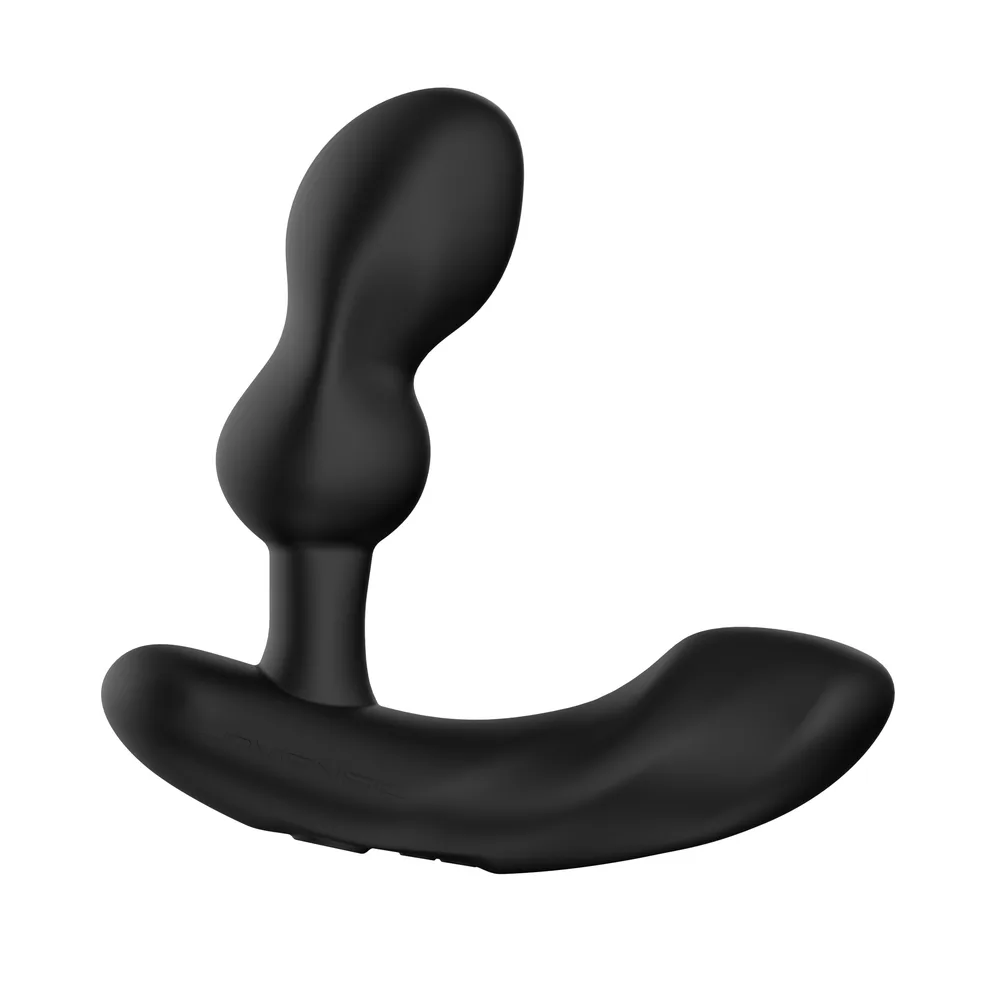
Lovense Edge 2 is the brand’s app-controlled prostate massager, and the second generation of the Edge model. The manufacturer describes it as an adjustable prostate massage with two motors: one in the insertable arm that sits against the prostate, and one in the outer arm that rests against the perineum. It is this construction that sets the product category apart from a standard anal plug — Edge 2 is built to stimulate in two places at the same time and to stay in place without being held.
The specification looks like this: the insert part is 91 millimeters long and up to 35 millimeters in diameter, the product weighs 151.3 grams, the material is stated as body-friendly silicone, the protection rating is IPX7, the operating time is up to 130 minutes, the standby time is up to 120 hours, the charging time is about 100 minutes, and the warranty is one year. In Sweden, the item is sold by eight shops at prices between 1,095 and 1,695 SEK, and all eight had it in stock at the price check.
This review is about the black variant with EAN 728360599780. The number can be verified against the manufacturer’s own structured product data, where the sku field on the Edge 2 product page contains that exact number. Lovense sells the model in a single version, which makes this product unusually easy to compare on price — unlike, for example, Lovense Hush 2, which comes in four diameters with four different EANs.
The manufacturer states that Edge 2 has two motors and that they can be controlled independently of each other via the Lovense Remote app. This is the single most important technical specification in the entire spec, and it deserves to be clarified, because “dual motors” is used carelessly in the product category.
A product with two motors and one control always runs both motors at the same level. You can raise and lower them, but you can never change the balance between them. A product with two motors and two controls lets you run one at full power and the other at zero. The difference is fundamental: in the first case, you have an intensity scale; in the second, you have two. Lovense places Edge 2 in the second category, but only when the app is connected. Using only the button on the product gives you one control, not two.
What can be established from it is that Edge 2, in practice, is two different products depending on how you use it. Without a phone, it is a two-motor prostate massager with a single button. With a phone, it is a product where you can place the focus on the prostate or on the perineum, as you wish. If you don’t plan to install the app, you should count on the first version—and then a large part of what you pay for is for unused capability.
The mechanical innovation in the second generation is the neck between the two arms. The manufacturer states that the neck is bendable, that it retains its position after it has been adjusted, and that the combination of a longer, slimmer neck with a larger end knob makes the product stay in place better. Lovense also describes that the angle can be adjusted to your body position—lying down, sitting, or standing.
Why it matters is simple anatomy. The distance from the anal opening to the prostate and the angle to it vary between bodies, and a prostate massage with a fixed angle hits either right or wrong without there being anything you can do about it. An adjustable neck shifts that variable from the manufacturer to the user. It’s the same idea behind the We-Vibe Vector+, which the manufacturer also describes as adjustable—so the two models solve the same problem in a similar way, and instead they differ in battery, warranty, and controls.
The counterargument also exists. A bendable neck is a moving part, and moving parts in a silicone-coated product are the place where the material is subjected to the most stress over time. The manufacturer publishes no information about how many bending cycles the neck is designed for, and it’s worth knowing that this detail can’t be verified in advance.
The material question is the only property of an intimate product that can’t be compensated for with habit or care. It determines whether the product is still hygienic after five years, and for a product intended to be used anally it weighs even more heavily than usual, because the lining of the rectum is thinner and more permeable than skin.
Silicone is a nonporous material. A nonporous surface can be cleaned, because there aren’t microscopic cavities where residue can get trapped. It’s the single most important property of a material that is meant to lie against mucous membrane, and that’s why the material declaration carries more weight than almost every other line in a specification.
There is, however, a discrepancy between the manufacturer’s own documents that is worth printing. The product page states that the Edge 2 is made of 100 percent pure body-friendly silicone, while the user manual states that all Lovense products are made of silicone and ABS plastic. The two pieces of information don’t need to contradict each other—the manual’s wording applies to the entire range and not just this model, and ABS may be present in internal components without ever coming into contact with the body. But it also means that anyone who wants to know exactly which materials come into contact with the skin doesn’t get a clear answer from the manufacturer, but two formulations pointing in different directions. The manual’s safety section is also clear on that point: it advises against use in the event of an allergy to silicone or ABS.
What can still be established is that both materials are hard or non-porous polymers, not soft-gelled PVC. Neither requires phthalate plasticizers to work, and that is the crucial difference from materials that are "TPE" or "jelly rubber", which say nothing at all about which plasticizers are included.
Phthalates are a group of plasticizers used to make plastic—primarily soft-gelled PVC—flexible. The Swedish Chemicals Agency describes them as substances that can affect the hormone system and make reproduction more difficult, and several of them are therefore restricted or prohibited within the EU in a large number of products. This particular product category is repeatedly subject to supervision because it contains polymers for the mucous membrane.
Lovense states on the product page that none of their products contain phthalates or other harmful chemicals. This is a marketing claim. The manual goes one step further and makes a regulatory commitment instead: the materials are stated to be free from substances of very high concern (SVHC) above the applicable limit values, and the silicone and ABS plastic are stated to meet the restrictions in Annex XVII to the REACH Regulation (EC) No 1907/2006. This is a significantly more verifiable formulation than "no harmful chemicals", because it refers to a named regulation with defined limit values rather than an opinion.
The manual also addresses disposal, which is unusually specific for the category: the product is covered by the WEEE Directive 2012/19/EU and may not be thrown away in household waste, and the built-in battery is covered by the Battery Directive 2006/66/EC and must be handed in at an approved collection point. Since the battery is built in, that means the entire product must be disposed of as electrical waste when it is used up.
The manufacturer publishes three measurements for Edge 2: the length of the insert part 91 millimeters (3.59 in), the largest diameter 35 millimeters (1.38 in), and the weight 151.3 grams (5.3 oz). Lovense itself adds a disclaimer saying that the measurements are approximate and that smaller deviations may occur.
The measurements are what matter most in this category, and they place Edge 2 in the midrange. For comparison, Lelo states that Hugo 2 has an insert part of 72 millimeters and an overall size of 104 × 107 × 41 millimeters. So Edge 2 has an insert part that is 19 millimeters longer. That’s a significant difference in a product class where the insertable portion is rarely over ten centimeters, and it should be taken into account by someone who isn’t used to this: more length means the product reaches deeper, not necessarily that it hits better.
The weight of 151.3 grams is 30.3 grams higher than Lelo Hugo 2’s 121 grams. For a product that’s meant to stay in place without being held, the weight is not insignificant—it affects how much the product wants to glide out of position when you move. At the same time, it’s exactly that feature the manufacturer says it worked on in the second generation, with the longer, slimmer neck and the larger end knob.
What Lovense, on the other hand, does not publish is the product’s total length and width. Only the insert part and the largest diameter are stated. The outer arm that rests against the perineum has no published measurement at all, which is unfortunate, since it’s precisely that part that determines whether the product sticks out under clothes and how it feels when sitting on it. So it’s not possible to figure out how much space the product takes up in a travel pouch based on the manufacturer’s information.
The interface on Lovense Edge 2 is intentionally minimal. The manual describes exactly one button on the product, a status indicator light, and a charging connector. Everything else happens in the app. It’s a completely different design philosophy than, for example, with Womanizer or Satisfyer, where each function has its own control on the housing.
According to the manufacturer’s manual, you turn Edge 2 on and off by holding the button pressed for three seconds, and a short press steps between the vibrations. That’s the entire button interface. While charging, a solid red light turns on, and it goes out when the battery is fully charged.
The reason the button is the only one is practical and ties in with how the product is used. Edge 2 is designed to stay in place and be controlled by someone else—either you via the phone or a partner via the app. A button row on a product that sits in position is hard to hit accurately, and it would also require openings in the housing, which is difficult to reconcile with IPX7.
The downside is just as obvious. Without a phone, you’re limited to stepping forward through a list of modes, with no way to go back or jump directly to a specific mode, and with no way to control the two motors independently. Anyone who wants a product that works fully without an app should choose something else.
The manufacturer states that the number of vibration patterns is unlimited, which is marketing language meaning that the app lets you draw your own patterns instead of choosing from pre-set programs. According to the manufacturer, the app can also control the two motors separately, generate vibrations from sound and music, and give a partner remote control of the product.
Here’s another deviation in the manufacturer’s own material that’s worth knowing about. The product page states an “unlimited” number of vibration patterns, while Lovense’s own functional graphic for the Edge 2— the one resellers use in their product galleries—shows four vibration modes and three intensity levels. The two pieces of information can be reconciled if you read them as different things: four modes and three levels on the product itself, and an unlimited number of patterns via the app. But the manufacturer never spells out that breakdown, and that means the number of modes you actually reach using only the button isn’t published unambiguously.
The manufacturer also states that the Edge 2 works together with other Lovense products—among other things, that it can follow the movements of a Max 2 so that the rhythm controls the strength—and that the model is intended to work with tap functions in live broadcasts. These are features that require the app and an account, and they are part of the explanation for why Lovense products cost more than their purely mechanical counterparts.
What the manufacturer, on the other hand, does not publish is which Bluetooth version the product uses or what the connection range is. The radio part is only described in the manual’s regulatory sections, with the frequency band and the transmitter power. Range in meters isn’t specified on either the product page or in the manual, and therefore information about range that circulates elsewhere lacks coverage from the manufacturer.
The manufacturer answers yes to that question in its own FAQ and states that the product is designed to stay in place once it’s in position and the angle has been adjusted. The recommendation that comes with it is to use plenty of water-based lubricant and to take the time to find the right angle.
What can be confirmed purely from a construction standpoint is that the outer arm against the perineum works as a counter-support, and that it is this geometry — not the weight or the material — that determines whether the product stays in place. The same principle is used by the We-Vibe Vector+ and the Lelo Hugo 2. The difference is that Lovense explicitly states that the neck angle can be adjusted and that it keeps its position, which is the variable that determines how well the counter-support sits against your body.
Unlike many competitors, Lovense publishes a number. On the product page, there is a comparison scale where Edge 2 is listed as 43 dB, placed between libraries at 40 dB and normal conversation at 60 dB, with a restaurant at 80 dB as the upper reference. The manufacturer describes the product as whisper-quiet.
The information should be read for what it is. Lovense does not state under what conditions the figure was measured — not the distance, not whether the product was run on the highest setting, not whether the measurement took place in free field or inside some enclosure. A decibel figure without measurement conditions is an order of magnitude, not a comparable measurement value. But 43 dB is still more information than, for example, Womanizer provides for its models, and it is in the same ballpark as Lelo’s information about the Hugo 2, which is stated to be below 60 dB as the maximum sound level.
One thing specific to this product category: the sound is greatly dampened when the product is in place, because the body is a much better sound-insulating material than air. The practical problem instead is the sound on the way there and the motor sound from the outer arm, which sits freely against the skin. A piece of advice that applies regardless of the model: place the product on a soft surface when it is out and ready. A hard tabletop surface works as a resonance box.
Lovense Edge 2 is rated IPX7 both on the product page and in the manual. The rating comes from the international standard IEC 60529, which defines enclosure classes for electrical equipment. The number 7 in the second position means that the product is tested for submersion in water to a depth of one meter for 30 minutes. The manufacturer states the consequence plainly: the product can be used while swimming, in a bathtub, and in the shower.
A caveat comes from the manufacturer itself, and it is relevant specifically for an app-controlled product: Bluetooth connectivity can, according to Lovense, become unstable in and under water. Radio waves are greatly dampened by water, so this is physics rather than a fault in the product — but it means that the most valuable feature, the app control, is the one that works worst in the bathtub. So water resistance is primarily a cleaning advantage, not a promise of full function under the surface.
The difference compared to a splash-proof product is greater than the wording suggests. Splash protection covers water droplets and, at best, water jets, but not submersion. Such a product can handle a damp cloth and possibly a shower, but not a bathtub, and it should not be held under running water without giving thought to the button and charging contact.
With IPX7, the entire product can be rinsed off without any precautions. For an anal product, this is not a convenience detail but a hygienic requirement — a product that can only be wiped off is, in practice, not cleanable for this kind of use. If a product lacks an IPX rating, it should be treated as not waterproof. The absence of a rating is never a sign that the product would be approved.
The manufacturer’s instructions are brief: clean with warm water and soap, and dry the product thoroughly before putting it away. The manual specifies that the soap should be mild and fragrance-free, and that the product should be cleaned already before first use. The manual also states that the product is intended for personal use and should not be shared, which for an anal product is a hygiene and infection-control issue rather than a matter of politeness.
Lubricant is not optional for this product category; it is a requirement. The manufacturer explicitly recommends a high-quality water-based lubricant and justifies it by saying that with a good lubricant there’s no need to reapply it during use. Silicone-based lubricant should not be used on silicone products — it breaks down the silicone surface over time and makes it porous, and a porous surface can no longer be cleaned properly, only replaced. Oil-based products such as coconut oil leave a film that is difficult to remove.
The manual also covers two things that rarely appear in store texts. The product should not be exposed to extreme heat or cold — boiling and the dishwasher are therefore out of the question despite IPX7 — and use should be stopped if irritation or discomfort occurs. The product should also not be used on damaged or irritated skin. The age limit is stated as 18 years.
The manufacturer states a runtime of up to 130 minutes and clarifies in its FAQ that it varies between 65 and 130 minutes depending on which vibration level you use. Standby time is stated as up to 120 hours. The battery is described as a rechargeable lithium-ion battery, and the manual states that it is built in.
The range of 65 to 130 minutes is unusually honestly stated, and it’s worth taking a closer look. It means that the upper figure is halved at high levels, which makes sense when two motors run at the same time. Based on the lower end, the Edge 2 still comes in above the Lelo Hugo 2, which the manufacturer states is up to one hour, but below the We-Vibe Vector+, where the manufacturer’s manual states up to two hours.
Charging is done via a magnetic charging cable that can be connected to any USB port or USB adapter. The manufacturer states an approximately 100-minute charging time to a full battery, and that the product should be turned off before charging. The manual specifies the power supply as DC 5 volts and 0.5 ampere, and describes that a steady red light is on while charging and turns off when the battery is full.
Magnetic charging is a trade-off, not a pure advantage. The advantage is that there’s no need for an opening in the housing, which makes it easier to achieve IPX7 without a rubber plug—and for a product that’s meant to be rinsed off after every use, that’s a noticeable win. The downside is that the cable is product-specific: if you lose the charging cable, no regular USB-C cable works. Here, however, Lovense has an advantage worth noting: the same charging cable is used for roughly thirty models in the manufacturer’s own list of models in its range, from Max 2 and Nora to Lush 4 and Hush 2. If you already own a Lovense product, you probably have a spare cable at home. The same reasoning applies to the We-Vibe Vector+, which is also charged with a magnetic cable.
Lovense does not publish the battery’s capacity in mAh or its voltage for Edge 2, either on the product page or in the manual. The only information provided is that it’s a built-in lithium-ion battery and that charging happens at 5 volts and 0.5 ampere.
It’s worth noting because competitors do it. Lelo lists 420 mAh and 3.7 volts for the Hugo 2, and We-Vibe’s manual for the Vector lists 3.7 volts and 0.32 ampere. Without the capacity, you can’t convert runtime into power consumption, and you can’t compare how heavily the cell is loaded between models. Combined with the fact that runtime is given as a range rather than a specific value, Edge 2 is harder to assess precisely in terms of the battery than its competitors.
What generally applies to lithium-ion batteries also applies here: the capacity drops with the number of charge cycles, and the battery is not replaceable. The manual’s battery safety guidance is clear—the cell must not be punctured or crushed, or exposed to fire or water. The product should be unplugged once charging is complete and it must not be overcharged, and performance is degraded at extreme temperatures. With use a couple of times a week, it’s the battery—not the silicone—that sets the limit for lifespan—and since it’s fixed in place, the product is essentially used up when the cell is.
The manual contains the regulatory information for the radio part, and it is more precise than what most manufacturers in the category publish. The frequency band is stated as 2402–2480 MHz, i.e. the usual 2.4 GHz band that Bluetooth operates in. The transmitter power is stated as E.I.R.P. 5.13 dBm, i.e. the radiated power calculated against an isotropic reference antenna. It is a low power in absolute terms, and it is published—which is more than most competitors in the category disclose.
The product is certified with FCC ID 2AXNT-EDGE2 and IC 28653-EDGE2, and the manual reports compliance with the applicable directives under CE marking, including the Low Voltage Directive, the EMC Directive, and the Radio Equipment Directive, as well as the UKCA requirements in the United Kingdom. The manufacturer is stated to be HYTTO PTE. LTD. in Singapore, with manufacturing at Shenzhen Love Sense Technology Co. Ltd. in China.
Why it is relevant for a purchase decision: a product that is to be worn against the body and transmit radio is radio equipment in the sense of the law, and the reported certification numbers are the only way to check that it has actually undergone testing. The information is dry, but it can be looked up in the authorities’ registers—which is more than you can say about most of the other things that are stated on packaging in this category.
We do not have price data from shops in your market yet.
Two motors and one button. The second motor is only really available when the phone is with you—without the app, half of the product is inaccessible.
Three comparisons are relevant: against the most comparable premium product from another brand, against the nearest technical equivalent, and against Lovense’s own cheaper alternative. All the information below comes from the respective manufacturers’ own specifications, and all the prices come from the shops’ product feeds on July 29, 2026.
Lelo Hugo 2 costs from 931 SEK, i.e. 164 SEK less than Edge 2 at its cheapest. Both are prostate massagers with two motors, app control, a silicone surface, and water resistance, so the comparison is fair.
Lelo publishes more data than Lovense. Hugo 2 is stated to measure 104 × 107 × 41 millimeters, with a plug-in part of 72 millimeters, to weigh 121 grams, to have a lithium-ion battery of 420 mAh and 3.7 volts, ten settings—four on the product and six via the app—motor frequencies of 130 Hz and 108 Hz, a maximum sound level under 60 dB, an interface with one button, and certification according to ISO 3533. The material is stated as body-friendly silicone and ABS plastic.
The differences that actually matter: Edge 2 has a longer insertion part (91 versus 72 millimeters), a flexible neck that Hugo 2 lacks, and a runtime of 65 to 130 minutes versus Hugo’s up to one hour. Hugo 2 is lighter in return, lists battery capacity and motor frequencies, and has double the warranty—two years plus a ten-year quality warranty versus Lovense’s one year. If you go by the provided data and warranty, Lelo wins. If you go by runtime, adjustability, and the app ecosystem, Lovense wins.
We-Vibe Vector+ is the closest technical equivalent: an adjustable prostate massager with two arms, app control, and a magnetic charging cable. It costs from 1 079 SEK, but that shop didn’t have it in stock at the price check—the lowest in-stock price is 1 182 SEK, so 87 SEK more than Edge 2.
We-Vibe states up to two hours of runtime and 90 minutes of charging time, versus Lovense’s 65 to 130 minutes and about 100 minutes. So, on paper, Vector+ has both longer runtime and shorter charging time. It also has a two-year warranty versus Lovense’s one, and—perhaps the most important difference—a physical remote control is included in the delivery. That means you can control Vector+ at a distance without a phone, while Edge 2 requires the app for everything except stepping through modes with the button.
What Edge 2 has in return is the flexible neck that keeps its position, a published sound value, and an app ecosystem where the product can be connected with other Lovense devices. One practical drawback for Vector+ is that, according to the manufacturer’s manual, the remote control is powered by a non-rechargeable 4LR44 battery—that is, a coin-cell battery that has to be replaced and isn’t available in every convenience store.
Lovense Hush 2, at 57 millimeters in size, costs from 1 094 SEK, so one SEK less than Edge 2. On the price tag, they’re essentially the same product, but they’re two different designs: Hush 2 is an anal plug with a motor, while Edge 2 is a prostate massager with two motors and an outer arm for the perineum.
Choosing between them isn’t about money—it’s about what you want. If you want perineum stimulation at the same time as the prostate, and the ability to control the two independently of each other, Edge 2 is the only one of the two that does that. If you want something that stays discreetly in place and comes in four diameters to grow into, Hush 2 is the right choice. Both are controlled by the same app and charged with the same magnetic cable, so the ecosystem argument applies equally to both.
Eight Swedish stores sell the item with EAN 728360599780. The lowest price is Vuxen and Joyland at 1,095 SEK each, and the highest price is Mshop at 1,695 SEK. That’s a difference of 600 SEK, or 55 percent, for the exact same item, the same color, and the same packaging.
The stock situation is unusually good and deserves to be highlighted, because it is often the real problem in this category. All eight stores had the product in stock during the price check. This means the price spread is real—you can actually buy at the lowest price instead of being forced to pay more because the cheaper stores are sold out. It’s the direct opposite of how it looks for newer models, where the cheapest stores often list an old price for an item they don’t have.
It’s also worth knowing that two stores share the lowest price at 1,095 SEK: then you can choose based on shipping, delivery time, and return terms instead of price. Always check the final price at checkout. Shipping costs are added by most stores under a certain order value, and in this price range several stores are close to the threshold for free shipping.
One last point of reference: the manufacturer itself states a list price of 199 dollars and regularly sells at the campaign price of 99 dollars in its own store. The Swedish lowest price of 1,095 SEK is therefore closer to the campaign price than to the list price, and that says something about how Swedish stores price the model competitively rather than charging an import markup.
It’s for you who want stimulation of the prostate and perineum at the same time and who want to be able to adjust the two independently of each other. It’s for you who already use app-controlled products, or who want to be able to hand over control to a partner remotely. It’s for you who need to be able to adjust the angle for the right fit, and you who want to be able to rinse off the entire product under running water. And with eight out of eight stores having it in stock, it’s also one of the easier purchases in the category right now.
It’s not for you if you want a product that works fully without an app—the button interface is a single button, and the two motors can only be controlled separately via your phone. It’s not for you if you want a physical remote control in the package; in that case, We-Vibe Vector+ is the obvious choice. It’s not for you if you require published battery capacity, published outer dimensions, or a specified Bluetooth range before you buy, because Lovense doesn’t publish either. And it’s not for you if you weigh warranty time heavily: one year is short in this price range, and both Lelo and We-Vibe offer twice as long.
One more thing belongs in the decision. The insertion part that’s 91 millimeters long is, at the very longest, too long for someone who’s new to anal products, and it can’t be shortened. A beginner is smarter to start with something narrower and shorter—Lovense states themselves that Edge 2 can suit beginners, but only with plenty of water-based lubricant, low levels from the start, and gradual angle adjustment. It’s unusually restrained advice from a manufacturer, and it should be read as it is written.
Lovense provides a one-year warranty against material and manufacturing defects, counted from the original purchase date, and Edge 2 is explicitly listed among the products covered. If the warranty becomes applicable, the manufacturer replaces the product free of charge and covers the shipping cost.
Read the terms before you count on the warranty, because they include three limitations that are easy to miss. For the first, it does not cover use in violation of the manual, normal wear and tear, commercial use, lack of maintenance, accidents, modifications, or attempts at your own repairs. For the second the warranty is tied to the first buyer and cannot be transferred—so a used Edge 2 has no remaining warranty, no matter how new it is. For the third, proof of purchase is required with a receipt or invoice, order number, purchase date, and place of purchase, which means you should save the order email from the Swedish store.
Lovense’s ten-year quality warranty is also worth clarifying, since it’s often cited without reservations. According to the manufacturer, it only applies to the person who bought the product on lovense.com, and it does not provide a new product—it gives a 55 percent discount on a new purchase in the same store, once, and on no more than three items in the same order. So if you buy from any of the eight Swedish stores listed above, you’re not covered by it.
What always applies, on the other hand, is your statutory rights. Under the Swedish Sale of Consumer Goods Act (konsumentköplagen), you have three years of right to complain for defects in the goods, regardless of what the manufacturer promises—which in this case is three times as long as the manufacturer’s own warranty. For distance purchases, you also have a right of withdrawal for fourteen days under the Act on Distance Contracts and Contracts Outside Business Premises (lagen om distansavtal och avtal utanför affärslokaler). Be aware that, in practice, the right of withdrawal is limited for hygiene products that have been removed from a sealed package, which is particularly relevant for an anal product. The right to complain for defects, however, always applies. If you have questions about what applies in your case, Konsumentverket guides you via Hallå konsument.
Lovense Edge 2 Prostate Massager is ranked på plats 3 av 15 in prostate vibrator best i test, where the entire category is compared against each other using five shared criteria. Guiden vinns av Svakom Iker Neo.
Every numerical piece of information in the text can be traced to one of the sources below. The links were checked manually on the specified date.
This page is machine-translated from Swedish. Read the Swedish original