

Review
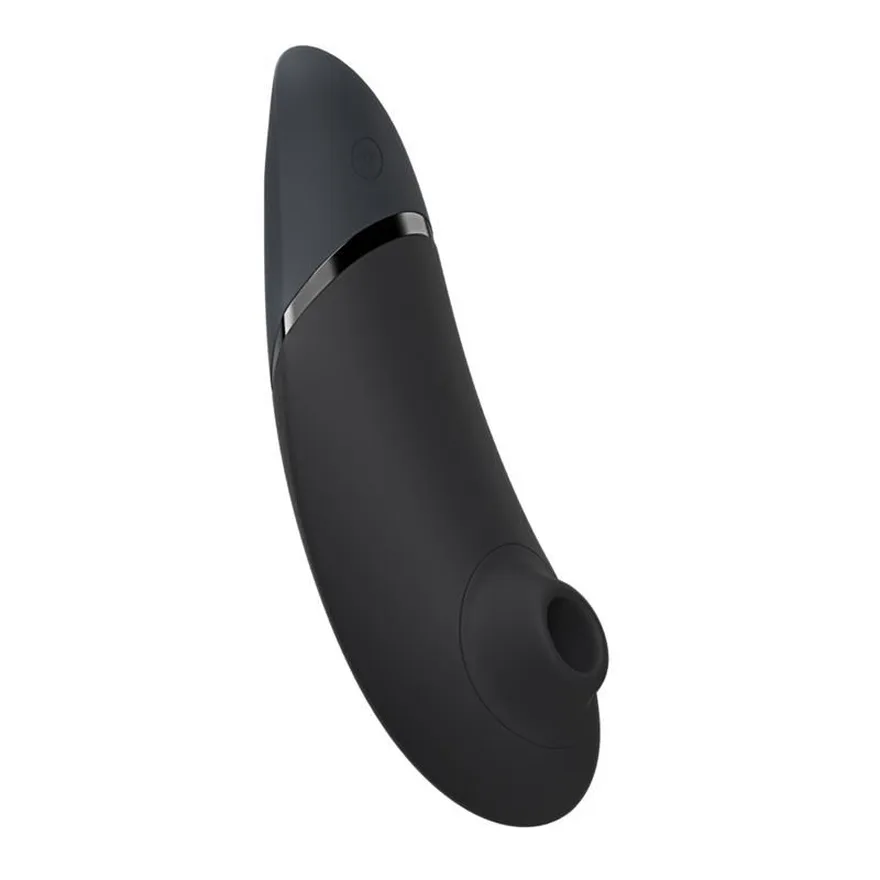
Review: Womanizer Next
Clitoral stimulator with 3D air pressure — 14 steps and three depth levels.
29 July 2026
Review · Rabbit vibrator · G-spot and clitoris
Lelo’s rabbit vibrator in the third generation reviewed against the manufacturer’s own specifications and pricing data from five Swedish stores. Ten vibration modes, body-friendly silicone and ABS plastic, 110-millimeter insertable length, 150 grams, and two hours of runtime — but without a published IPX rating, without a measured sound level, and with two contradictions in the manufacturer’s own materials.
An light and well-shaped rabbit vibrator with ten settings, clearly stated measurements, and an unusually complete operating specification — frequency, charging current, and standby time are included, which is rare in this category. What pulls down the rating isn’t the product but the datasheet: no IPX rating, no sound level, no phthalate-free declaration, a product-specific DC charging cable, and two contradictions in the manufacturer’s own material regarding battery capacity and warranty period.
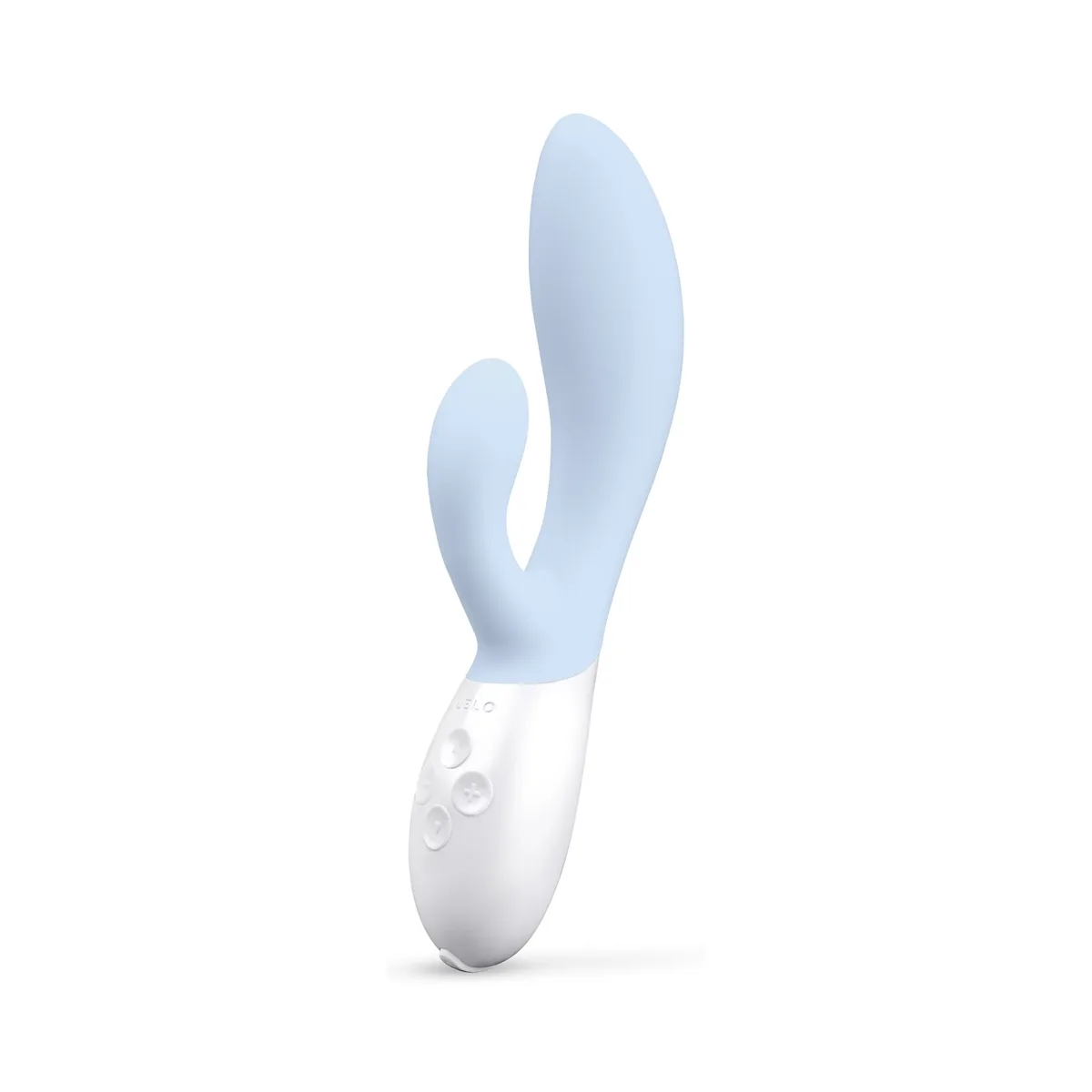
Lelo Ina 3 is the third generation of the brand’s most famous rabbit vibrator. It has two arms: a longer, curved insertion part intended for the G-spot, and a shorter outer arm that sits against the clitoris at the same time. The manufacturer calls the design a dual-action massager, and the whole point of the shape is that both areas are stimulated without you needing to hold two products.
The specification according to Lelo looks like this: body-friendly silicone and ABS plastic, dimensions 200 × 65 × 45 millimeters, insertable length 110 millimeters, diameter 37.09 millimeters, weight 150 grams, ten vibration modes, an interface with four buttons, frequency 60 hertz, automatic shut-off after 20 minutes, charging time two hours at 5.0 volts and 500 milliamps, operating time up to two hours and standby time up to 90 days. The product is described as 100 percent waterproof. The manufacturer states a two-year warranty plus a ten-year quality warranty, and that the model is certified against the safety standard ISO 3533.
This review is exclusively about the color Seafoam with EAN 7350075028311. Lelo’s own manual lists three colors for Ina 3 — Coral, Seafoam and Seaweed — and each color has its own EAN. Functionally, they are identical. There is, however, one practical pitfall: Swedish stores call the light-blue version different things. Vuxen writes Seafoam, Joyme writes blue, respectively light blue, and Sexonic markets the exact same item number as "Luxury Celeste". It’s the same product, but if you compare prices, the barcode is the only thing that is unambiguous.
In Sweden, the item is sold by five stores at prices between 1,259 and 1,745 SEK, and two of them had it in stock at the price check on July 29, 2026.
A rabbit vibrator is a vibrator with two arms that come from the same handle. One is inserted, the other sits on the outside. The name comes from the early models where the outer arm was shaped like a rabbit head with two ears; the shape has disappeared, but the name remains. What distinguishes the designs today is mainly three things: how far apart the arms sit, whether they have their own motor or share one, and whether the inner arm only vibrates or also moves.
Ina 3 belongs to the simplest of the three families. The inner arm vibrates but has no separate movement — no wave movement, no thrust movement. Instead, the manufacturer describes it as an upgrade in strength and range: according to Lelo, Ina 3 has 30 percent more power than its predecessor, and the number of settings has been increased to ten. What you can tell from the specification is that it follows the same basic principle as in Ina 2, but with a broader range.
The geometry of the arms is fixed. The distance between them cannot be adjusted, which means the fit either matches your anatomy or it doesn’t. It’s the single biggest uncertainty in this product category, and it can’t be solved with technology—only with shape. That’s why Lelo publishes two measurements that are more useful than overall length when you want to assess whether it will fit: the insertable length of 110 millimeters and the diameter of 37.09 millimeters. This is the roughest point on the inner arm, i.e. the measurement that determines whether the inside feels comfortable or not.
Lelo’s naming is confusing within this product family, because two models have almost identical outer housings but different insides.
In practice, that means the two models feel just as similar in the hand and take up the same space in a travel pouch, but they solve the task differently. Ina 3 is the simpler and lighter of the two. Ina Wave 2 adds motion to the inner arm and 26 grams, two extra modes, and an extra button to the interface. None of them is an upgrade of the other in a technical sense—they have the same battery voltage, the same charging time of two hours, and the same stated operating time of up to two hours.
The materials issue is the only characteristic of an intimate product that can’t be compensated for with experience or care, and it determines whether the product will still be hygienic after five years. Lelo lists two materials for Ina 3: body-friendly silicone and ABS plastic. That matches how the product looks—the blue arms are silicone, and the white handle with the buttons is hard plastic.
There’s one deviation worth noting. The retailer Vuxen states the material as "100% Premium Silicone", meaning full silicone. The manufacturer’s own specification says silicone and ABS plastic. When a shop and a manufacturer contradict each other on a material line, the manufacturer wins, so the correct description is that only the body-contacting part is silicone.
Silicone is a pore-free material. A pore-free surface can be cleaned, because there are no microscopic cavities where residue can get trapped. It is the single most important property of a material that is meant to be in contact with mucous tissue, and that is why the material disclosure carries more weight than almost all other lines in a specification.
Having the separation line between silicone and plastic at the handle has two consequences. The first is hygienic and positive: the entire part that is inserted or rests against the body is silicone, meaning the part where pore-free actually matters. The second is that there is a seam between silicone and ABS plastic, and a seam is always the point where dirt is first able to gather. Rinse thoroughly right there—don’t just rinse over your arms.
Lelo also points out that the model is certified against ISO 3533, the international safety standard for sex toys. The standard sets requirements for materials to be safe in contact with the genital area and for the product to be safe in reasonable and foreseeable use. This is not a guarantee that the product is good, but it is one of very few third-party references that exist at all in this category—and it’s more valuable than a marketing term like "premium".
Phthalates are a group of plasticizers used to make plastic—especially soft PVC—flexible. Kemikalieinspektionen describes them as substances that can affect the hormone system and make reproduction harder, and several of them are therefore restricted or banned within the EU in a large number of products. This particular product category is a recurring subject of oversight because it contains softened plastic against skin.
It’s important to be careful about who is saying what. Lelo only writes on its product page "body-safe silicone, ABS plastic" and publishes no explicit phthalate-free declaration for Ina 3. So that information should be read as a shop claim, not as a commitment from the manufacturer.
What can still be established, though, is that silicone doesn’t require phthalate plasticizers to become soft—the softness comes from the polymer’s own structure. The material statement silicone is therefore, in itself, a better indication than terms like "TPE" or "jelly rubber", which don’t say anything at all about which plasticizers are included. By comparison, We-Vibe explicitly states for Nova 2 that the silicone is made without phthalates, BPA, and latex. That’s the wording you want to see, and it’s missing from Lelo’s specifications for Ina 3.
Lelo lists the overall measurements as 200 × 65 × 45 millimeters, the insertable length as 110 millimeters, and the diameter as 37,09 millimeters. The weight is given as 150 grams, and the manual specifies that this is the weight of the product alone—not the entire delivery including packaging, cable, and bag. It’s an unusually clear clarification, and it’s worth appreciating: the norm in this category is that the weight information is provided without any explanation.
That’s exactly why a store listing stands out. The retailer Taboo states the weight as 348 grams, which is more than twice as much as the manufacturer. The same store also lists the diameter as about 3,4 centimeters versus Lelo’s 37,09 millimeters, the charging time as about 300 minutes versus Lelo’s two hours, and the usage time as about 90–120 minutes versus Lelo’s up to two hours. Taboo is right about the total length of 20 centimeters and the insertable length of 11 centimeters — those numbers match Lelo — but in four of its lines, the store deviates from the manufacturer. When that happens, the manufacturer’s information applies, and the discrepancy is shown here so you can recognize it if you read the same table at the checkout.
Practically speaking, 150 grams means that Ina 3 is a lightweight product for its size. Two decimeters sounds like a lot, but most of the length is the inner arm and the handle; only 110 millimeters is intended to be inserted. The width of 65 millimeters is the distance to the outer arm, not a thickness. That figure determines whether the product fits comfortably, and it can’t be adjusted—the angle of the arms relative to each other is fixed.
According to the manufacturer, the interface on the Lelo Ina 3 consists of four buttons. The manual names them: a plus button and a minus button for the intensity, and two arrow buttons for browsing between the ten vibration patterns. The charging connection sits at the bottom of the handle. It’s an interface without a display, where the LED is the only feedback you get.
The split into two controls—one for strength, one for pattern—is the logical point of having four buttons instead of two. You can therefore switch patterns without the intensity hopping with it, which is the difference from simpler products where a single button steps through everything in a fixed order. The price you pay is that there are more buttons to find in the dark, on a handle where the buttons sit close together.
The product is delivered locked for transport. The manual states two ways to unlock it: either you connect the charger, or you hold down the plus and minus buttons at the same time for three seconds until the lamp turns on. After that, you start with a press on the plus button, increase the strength with more presses, lower it with the minus button, and turn it off by holding the minus button down.
Here’s another contradiction in the manufacturer’s own documentation worth knowing about. The manual’s section on getting started states three seconds for the unlocking, while the troubleshooting section in the same document states five seconds. It’s the same function described in two places with two different times. In practice, it doesn’t matter—keep the buttons pressed until the light turns on—but it says something about how carefully the documentation was proofread, and it’s worth knowing if you’re looking at the manual and wondering why nothing happens after three seconds.
The manual also states that the product should be charged for two hours before the first use, that the LED pulses during charging and then remains steadily lit when the battery is fully charged, and that it blinks red when the battery starts to run out. The manufacturer also states that only Lelo’s original charger may be used.
Ten vibration settings are more than most people use. Lelo describes the range as everything from a teasing whisper to a satisfying pulse, but it does not publish a breakdown of what each individual pattern does—unlike, for example, Womanizer, which provides exact intervals for its automatic modes. What can be concluded is that ten patterns multiplied by the intensity scale produce a large number of combinations, and the pattern in this product category is that in practice you end up returning to two or three of them.
The frequency is stated as 60 hertz. It’s an unusual value to publish in this category, and it’s worth explaining: 60 hertz means 60 oscillations per second, so it’s a relatively low—and therefore deep—vibration. Low frequency propagates through tissue better than high frequency, which is the technical prerequisite for an insert to be felt more than just on the surface. The fact that Lelo publishes the frequency at all is a plus in a category where most manufacturers are content with marketing wording.
An easy-to-miss detail: Lelo states that the product turns itself off automatically after 20 minutes. It’s a safety feature, but it has a practical consequence—the product turns itself off even while you’re using it if you haven’t pressed any button for 20 minutes. The corresponding line in the manual only says "Automatic" without a time specification, and it’s the product page that states the 20 minutes.
Lelo markets the Ina 3 by saying it has 30 percent more power than its predecessor and provides deeper, more intense vibrations. The wording is repeated verbatim in all Swedish shop texts, because they reproduce the manufacturer’s description.
What can be established is what the claim does not contain. Lelo does not publish either motor power in watts, amplitude in millimeters, or any other measurement that makes the 30 percent figures controllable. The comparison is made against a product that is no longer sold, and the baseline value is not published either. The only thing that can actually be compared between the generations is the number of settings, which Lelo says has been expanded to ten. So treat the percentage figure as a marketing statement and not as a measurement — it’s not the same as saying it’s incorrect, but it can’t be verified.
Sound level is one of the three questions that are asked most often about this product category, and the answer has to be short and honest: Lelo publishes no decibel value for Ina 3, neither on the product page nor in the manual. There is also no descriptive wording about sound level in the manufacturer’s specifications — unlike several of Lelo’s other models, where a maximum value is given.
The only thing the manufacturer publishes that has to do with it is the frequency of 60 hertz. It says something about the character of the vibration but nothing about sound pressure, because sound level depends on how the motor is mounted inside the housing and on how much of the vibration is transferred to the air. Sites that provide an exact decibel figure for Ina 3 either show their own measurement or a value without a source from the manufacturer.
Still, two things can be said in general. Products with hard plastic handles, like Ina 3 with its ABS housing, typically sound louder than products where the entire body is covered in silicone, because soft silicone dampens. And regardless of model, a hard surface works as a resonance box: place the product on a towel between uses instead of directly on a tabletop.
Lelo states that Ina 3 is 100 percent waterproof and suitable for baths and showers, and the manual repeats that the product is completely waterproof and therefore easy to clean. It’s a clear, plain-language commitment.
What’s missing is a rating. The manufacturer does not publish any IPX number for Ina 3, neither on the product page nor in the manual. The wording “100 percent waterproof” is the manufacturer’s own wording and is not defined in any standard, which means it can’t be compared, point by point, with a product that shows a tested value.
Enclosure classes are defined in the international standard IEC 60529. The number in the second position indicates protection against water: IPX5 means the product is tested against water jets but not against submersion, while IPX7 means it is tested for submersion to a depth of one meter for 30 minutes. So the difference is not gradual but fundamental—one can handle the bathtub, the other one can’t.
Not specifying a class for Lelo means you can’t determine which of the two levels Ina 3 corresponds to. The situation is complicated by the fact that the retailer Taboo on its own lists IPx5 for the product, meaning splash protection without submersion. It’s a store claim that directly contradicts the manufacturer’s “100 percent waterproof.” The manufacturer weighs the heaviest, and practically Lelo’s wording means the product can be rinsed and used in the bath. But if you want a tested, comparable value to rely on, you don’t get that here—We-Vibe states IPX7 outright for Nova 2.
The manual’s instructions are specific. Rinse the product and spray it with Lelo’s toy cleaning solution, rinse again, and let it dry. Alternatively, you wash the silicone with warm water and antibacterial soap, rinse with clean warm water, and dry it with a lint-free cloth. Always clean both before and after each use. Cleaning agents that contain alcohol, gasoline, or acetone must not be used.
The lubricant issue is the most important of them all for a silicone product, and the manufacturer is clear: silicone-based lubricants and hand creams can make the silicone permanently sticky. A sticky surface attracts dust and can no longer be properly cleaned, and the damage is not reversible. Use a water-based lubricant. Oil-based products such as coconut oil also leave behind a film that’s difficult to remove.
The manual also covers storage: avoid direct sunlight, never expose the product to extreme heat, store it dust-free, and keep it separate from products made of other materials. The last point isn’t nitpicky—silicone that sits against molded plastic can react and become sticky over time, and that’s the whole reason a storage pouch is included in the package. The manual also includes a safety note that rarely appears in store texts: anyone who is pregnant or has a pacemaker, diabetes, phlebitis, thrombosis, or another illness should talk to healthcare professionals about the risk of blood clots before using a massage product.
Lelo states the operating time to up to two hours and the charging time to two hours at 5.0 volts and 500 milliamperes. The standby time is stated as up to 90 days. Two hours of operation is a normal value in the category and holds up evenly against the We-Vibe Nova 2, which is stated at up to 120 minutes of operation and up to 90 minutes of charging. Nova 2 therefore charges faster, while in practice the operating time is the same.
Charging takes place via a cable that is connected to a DC connector in the bottom of the handle. The manual explicitly describes it as a DC plug in a DC port, and the package contents list a USB charging cable—so USB on one end and a round direct-current connector on the other.
It’s a trade-off that goes the wrong way compared with newer products. The cable is product-specific, which means that a regular USB-C cable doesn’t work, and a physical opening for the contact in the housing is also harder to seal than a magnetic charging surface. If you lose the cable, you have to get a replacement, and the manufacturer explicitly states that only Lelo’s original charger may be used. The manual also states that the product may only be powered with SELV, i.e. low voltage—so, in other words, it should be charged from a standard USB source and not connected to anything else.
For comparison, We-Vibe states for Nova 2 that the charging cable is a USB cable that fits any USB port. It’s not a small difference over a product’s lifetime, because charging cables are the part that disappears first.
This is the clearest inconsistency in Lelo’s documentation for this model. The product page states the battery as Li-ion 500 mAh 3.7 volts. The manufacturer’s own PDF manual for the same product states 520 mAh 3.7 volts. It’s a deviation of 20 milliamp-hours, i.e. four percent, between two of the manufacturer’s own documents.
You can’t determine which value is correct without opening the product, and you shouldn’t do that—Lelo states that any attempt to open or disassemble the product voids the warranty. What speaks for 520 mAh is that Lelo states 520 mAh 3.7 volts specifically for Ina Wave 2, which has the same external dimensions and the same charging specification. What speaks for 500 mAh is that it’s the figure on the current product page, which is the newer of the two sources. The Swedish retailer Joyme reproduces the product page’s 500 mAh.
It’s worth noting that the four percent figure hardly makes any difference for how long the product lasts. But the information is the only one that makes it possible to recalculate runtime into power consumption and compare how heavily the cell is loaded between models, and that it is given differently in two places is worth knowing before using it in a comparison. What applies generally to lithium-ion batteries also applies here: capacity decreases with the number of charge cycles, the battery isn’t replaceable, and in practice the product is used up when the cell is.
We do not have price data from shops in your market yet.
The product page states 500 mAh, the manual 520. A four percent difference between two of the manufacturer’s own documents about the same battery.
Two comparisons are relevant: against Lelo’s own closest model, which has an identical housing but different mechanics, and against the best-selling competitor from another premium brand. All the information below comes from the respective manufacturers’ own specifications.
Lelo Ina Wave 2 has exactly the same outer dimensions as Ina 3: 200 × 65 × 45 millimeters, an insertable length of 110 millimeters, and a diameter of 37,09 millimeters. It has the same charging specification: two hours at 5,0 volt and 500 milliamperes, and the same stated operating time of up to two hours. The delivery contents are the same: the product, USB charging cable, storage pouch in satin, warranty registration card, and instructions for use.
Three figures set them apart. Ina Wave 2 weighs 176 grams compared with Ina 3’s 150 grams, has twelve vibration modes compared with ten, and has an interface with five buttons compared with four. The extra 26 grams and the fifth button are the cost of Lelo’s wave movement—the mechanics that make the inner arm move and not just vibrate. Ina Wave 2 is also listed with the battery 520 mAh 3,7 volt, the same figure as in Ina 3’s manual but not on Ina 3’s product page.
The conclusion is simple. If you want movement in the inner arm, it’s only available in the Wave model, and you pay for it with weight and a more complicated interface. If you don’t want it, you get the same shape, same insertable length, same diameter, same charging time, and the same operating time in a lighter product with two fewer buttons. So Ina 3 is not a worse Ina Wave 2—it’s a simpler product in the same housing.
We-Vibe Nova 2 is the closest competitor among rabbit vibrators from another premium brand. It measures 217 × 85 × 39 millimeters and is therefore both longer and wider than Ina 3, but thinner. Operating time is stated at up to 120 minutes and charging time at up to 90 minutes—faster charging than Lelo’s two hours, with the same operating time.
The differences that actually matter are not in performance, but in what the manufacturers state. We-Vibe lists the IPX7 enclosure rating, meaning a tested value according to IEC 60529, where Lelo only states “100 percent waterproof.” We-Vibe explicitly states that the silicone is made without phthalates, BPA, and latex, where Lelo only states “body-safe silicone.” We-Vibe states that the charging cable is a USB cable that fits any USB port, where Lelo uses a product-specific DC connector. Nova 2 also has app control, which Ina 3 completely lacks.
On the other hand, Nova 2 has a flexible outer arm that is designed to follow the body — and that is precisely the feature Ina 3 lacks, because its arms sit at a fixed angle. On Lelo’s side, it says that Ina 3 is the significantly smaller product in two of three dimensions, and that the manufacturer publishes more technical values about the operation itself: frequency, standby time, charging current, and a specified product weight. On warranty, they are the same: both list two years, but Lelo adds a ten-year quality warranty, whose meaning is worth its own paragraph further down.
Five Swedish stores sell the item with EAN 7350075028311. Cheapest is Lekosmek at SEK 1,259, and most expensive is Vuxen at SEK 1,745. That is SEK 486, or a 39 percent difference for exactly the same article number, same color, and same packaging.
The stock situation here is at least as important as the price spread. Only two of the five stores had the product in stock during the price check: Joyme at SEK 1,599 and Vuxen at SEK 1,745. The three cheapest listings — Lekosmek at SEK 1,259, Taboo at SEK 1,399, and Sexonic at SEK 1,603 — were all sold out. That means that the difference between the cheapest and the most expensive actually available copies was SEK 146, not SEK 486. Stores that list a product as sold out may still have an old price in the feed, and that price is rarely what you end up paying when the item comes in again.
That three out of five stores were sold out at the same time is, in itself, a message. Ina 3 was launched as the successor to a model that has been around for a long time, and a product that’s difficult to get hold of at the majority of its retailers is most often either in a supply gap or at the end of its lifecycle. Expect the price range to move quickly in both directions, and always check the final price at checkout — shipping costs are added by most stores under a certain order value.
A note about item numbers belongs here. The shops use completely different internal numbers for the same product: Vuxen writes L8311, Lekosmek writes K8311H, and Sexonic uses the EAN number itself as a reference. The only common denominator is the barcode 7350075028311. If you compare prices between shops, that’s what you should base it on—not the color name—especially since the same color is called Seafoam, light blue, blue, and Luxury Celeste in the five shops’ own headings.
It’s for you if you want simultaneous inner and outer stimulation in a single product and you don’t need the inner arm to move. It’s for you if you want an interface where strength and patterns are two separate controls instead of a single button that steps through everything. It’s for you if you want a light product—150 grams is low for a two-arm vibrator of this size—and for you if you want to be able to rinse the entire product under running water and use it in the bath.
It’s not for you if you need to adjust the distance between the arms, because the angle is fixed and the fit is therefore decided in advance. It’s not for you if you want app control or a remote control, because Ina 3 has none. It’s not for you if you require a tested and comparable water-resistance rating, a published noise level, or an explicit phthalate-free declaration from the manufacturer, because Lelo does not publish either for this model. And it’s not for you if you want to be able to charge with the same cable as your phone—the round DC connector requires Lelo’s own cable.
One more thing belongs in the decision. With two of five shops in stock and a range of 486 SEK between the lowest and highest price, this is a product where it pays to wait for the right shop instead of buying from the first one that has it in stock. The difference between 1 599 and 1 745 SEK is 146 SEK, and that’s about what a year’s supply of water-based lubricant costs—which you’ll need, since a silicone-based option is out of the question.
One more clarification is required, because Lelo’s own documents do not say the same thing. The product page states a two-year warranty with free replacement, while the printed manual in the package states a one-year limited warranty. Lelo’s separate warranty page for the EU confirms what the product page says: a two-year worldwide manufacturer’s warranty, with extensions in the countries where the law requires longer coverage. The manual’s one-year wording can therefore be read as an outdated text in a document from 2021, but it’s worth recognizing if you find it in the box.
The warranty covers defects in manufacturing or materials that affect the product’s function. It does not cover cosmetic wear, damage caused by accidents, improper use, or neglect, and every attempt to open or take apart the product voids it. Registration takes place with the serial number on Lelo’s website, and you must keep the receipt.
The ten-year quality warranty deserves a clear read, because it is often quoted in store texts. On the product page, it states that it covers the product for ten years after the two-year warranty has run out. If you read Lelo’s own warranty terms, it turns out that the in practice means 50 percent off a replacement product bought on lelo.com, not a free replacement. The benefit applies once per customer, for up to five items per order, and it excludes bundles and the Luxe series. It’s still a benefit—but it’s a discount, not a guarantee in the everyday sense.
Lelo’s 30-day satisfaction guarantee is also worth a clarification. According to the manufacturer, it applies only to purchases on lelo.com; it gives you a voucher to shop in the same store instead of money back; and you pay the return shipping yourself. So if you buy from any of the five Swedish stores listed above, you are not covered by it.
What always applies, on the other hand, are your statutory rights. Under the Consumer Sales Act (konsumentköplagen), you have three years to file a complaint for defects in the goods, regardless of what the manufacturer promises. For distance purchases, you also have a right of withdrawal for fourteen days under the Act on Distance Contracts and Contracts Outside Business Premises (lagen om distansavtal och avtal utanför affärslokaler). Be aware that in practice the right of withdrawal is limited for hygiene products that have been removed from a sealed package—however, the right to complain for defects always applies. If you have questions about what applies in your case, Konsumentverket guides you via Hallå konsument.
Lelo Ina 3 Rabbit Vibrator — Seafoam is ranked på plats 14 av 21 in rabbit vibrator best i test, where the entire category is compared against each other using five shared criteria. Guiden vinns av We-Vibe Nova 2.
Every numerical piece of information in the text can be traced to one of the sources below. The links were checked manually on the specified date.
This page is machine-translated from Swedish. Read the Swedish original