

Review
Review: LELO Sona 3 Cruise Plum
Same Cruise Control, just clitoral stimulation — and a published sound level.
29 July 2026
Review · Dual-stimulation vibrator · Sonic pressure waves
LELO’s dual-stimulation sonic massage wand reviewed against the manufacturer’s own specifications, the user manual in PDF form, and price data from seven Swedish stores. Eight modes, 850 mAh lithium-ion battery, frequencies of 60 and 100 Hz, IPX7 according to the manual’s labeling, and patented Cruise Control — but neither sound level nor charging time is published, and only two stores had it in stock.
The only product in the comparison that combines touch-free sonic clitoral stimulation with a vibrating G-point arm in the same body, and Cruise Control solves a real problem: the effect does not drop when you press harder. The manufacturer also publishes battery capacity and frequencies, which is unusual. What you pay with is a product-specific charging connector, no app, a materials declaration without any information about phthalates, and a specification where neither sound level nor charging time is included. Also, since the original model Enigma has identical hardware for 100 SEK less, the price tag is even harder to justify than it looks.
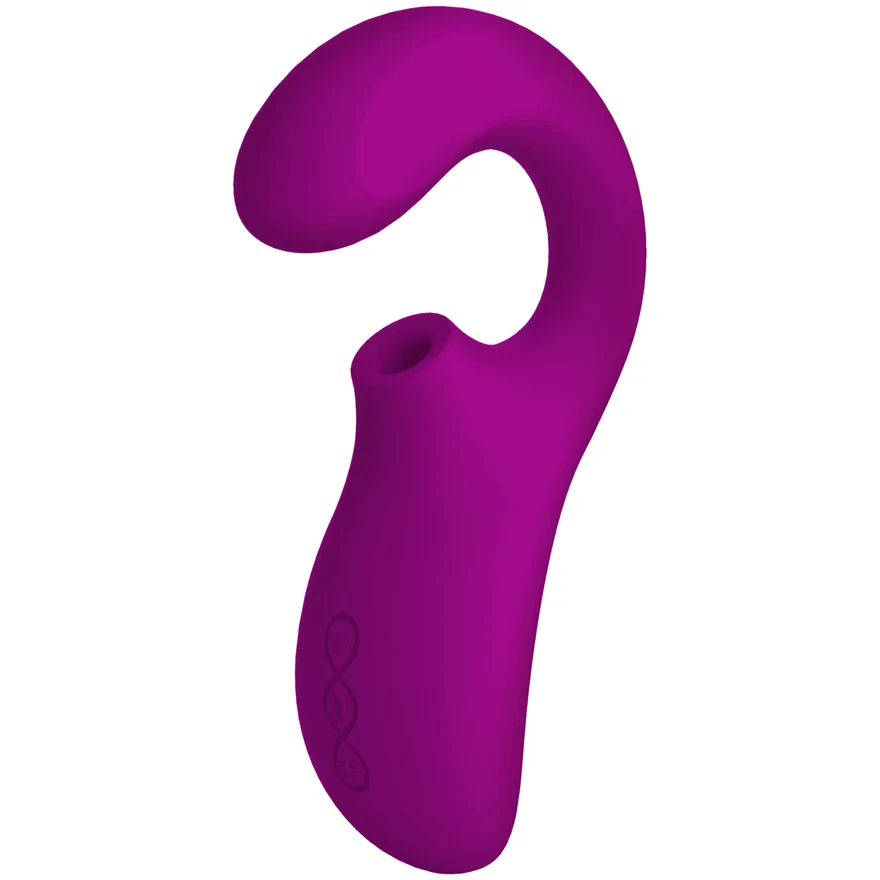
LELO Enigma Cruise is a dual-stimulation product that combines two completely different technologies in the same body. The upper, flexible arm is a standard vibrator designed for the G-spot. The lower part is a sonic clitoral stimulator—that is, a chamber that works with pressure waves in air instead of mechanical contact. The manufacturer calls the sonic part SenSonic and describes it as sound waves that stimulate the clitoris—even the parts that aren’t visible—without making direct contact.
The specifications look like this: body-safe silicone and ABS plastic, eight modes, three buttons and two LEDs, a lithium-ion battery of 850 mAh and 3.7 volts, up to two hours of runtime, up to 90 days of standby, automatic shut-off after 20 minutes, dimensions 100 × 50 × 185 millimeters, insertion depth 140 millimeters, and weight 196 grams. LELO lists the product as completely waterproof, and the enclosure rating IPX 7 is printed in the user manual. In Sweden, the item is sold by seven shops at prices between 1,195 and 2,190 SEK, but only two of them had it in stock at the price check.
This review is about the item with EAN 7350075028625. Here’s a detail worth knowing before you compare prices: the shops call that number four different things. Blush Me writes Deep Purple, Joyland writes lila, Sexonic writes Purple, and Lustly, Mshop, Taboo, and Lekosmek write Deep Rose. The manufacturer itself lists only two colors for the model—Deep Rose and Black—and since the black version has its own number, 7350075028618, 7350075028625 is therefore Deep Rose. It’s the same item in all seven shops, regardless of what the color is called in the product name.
The two names describe two different things, and they’re often mixed up in shop texts. SenSonic is the stimulation technology. Cruise Control is an effect regulation function. You can have one without the other, and that’s exactly what LELO does in its range: the original model Enigma has SenSonic but lacks Cruise Control.
SenSonic is based on the same underlying principle as the rest of the category of touch-free clitoral stimulation. A chamber is placed over the clitoris, and a drive unit creates rapid pressure changes in the air inside the chamber. The chamber never touches the clitoris directly. The difference from a regular vibrator is fundamental: the vibrator transfers mechanical movement from a motor through the material to the skin, whereas a sonic device transfers pressure changes through air. That’s also why this product category is often described as milder despite being experienced as intense—the surface itself is, in practice, stationary.
Cruise Control, on the other hand, is a control function, and the manufacturer’s manual is unusually specific about how it works. It is described as fully automatic—so it’s not a setting you turn on or off. The function senses when the motor starts slowing down—which it does when the product is pressed hard against the body—and compensates through pulse-width modulation, PWM, so that the power is kept constant. It’s the same principle as an RPM regulator: the control electronics measure that the motor is running slower than it should and increase the supplied power until it’s back at the correct level.
What can be established is that this solves a real, well-known problem in the category. Without power regulation, the output from an air-pressure or sound-wave driven unit drops when counterpressure increases—meaning exactly at the moment you press harder to get more. LELO states itself that the technology is patented. What is not published, however, is how large the power reserve is in percent or watts, and therefore it’s not possible to put a figure on how much Cruise Control actually adds.
LELO sells three models with Enigma in the name, and they are so close to each other that Swedish retailers regularly mix them up. The differences are actually simple when you line up the specifications next to each other.
The conclusion is more direct than the marketing suggests. The step from Enigma to Enigma Cruise is a single function, not a new product generation—everything hardware-wise that the manufacturer publishes is identical. The step from Enigma Cruise to Enigma Wave, however, is a real design change, because the third motor gives the inner arm its own movement.
The material question is the only property of an intimate product that can’t be compensated for with experience or care, and it determines whether the product is still hygienic after five years. LELO lists two materials for Enigma Cruise: body-safe silicone and ABS plastic. It’s the same material specification that the brand uses for Enigma, Enigma Wave, and Sona 3 Cruise.
Silicone is a non-porous material. A non-porous surface can be cleaned, because there are no microscopic cavities where residue can be left behind. It’s the single most important property of a material that’s meant to lie against mucous membranes, and that’s why the material declaration carries more weight than almost every other line in a specification.
Having ABS plastic listed in the declaration isn’t a problem in itself, but it’s worth knowing where it sits. On this model, the entire body-contact surface is covered in silicone — the flexible G-spot arm, the chamber, and the grip — while the decorative panel on the back is hard and glossy. It’s that surface that determines where the seam between silicone and plastic is, and it’s in a seam like that that residue collects most easily. The consequence is practical, not dramatic: spend an extra second on the transition between the silicone and the panel when you clean it.
The shape deserves its own section, because it’s what sets Enigma Cruise apart from most competitors. The product is molded in a single bent piece, where the inner arm and the outer head sit at a fixed angle to each other, roughly like a hook. That means you can’t adjust the distance between the G-spot part and the sonic chamber — that distance is set by the mold. The arm is flexible, so some adjustment is possible, but the basic geometry is fixed. That’s the most important fit question to consider before purchase, and you can’t determine it from a specification.
Phthalates are a group of softeners used to make plastic — above all flexible PVC — pliable. Kemikalieinspektionen describes them as substances that can affect the hormonal system and make reproduction harder, and several of them are therefore restricted or banned in the EU in a large number of products. This product category is repeatedly the subject of supervision because it contains pliable plastic against skin and mucous membranes.
LELO is different from several competitors, and not to its advantage. The manufacturer doesn’t spell out "phthalate-free, BPA-free, and latex-free" for Enigma Cruise. The wording is instead "body-safe silicone, ABS plastic". For comparison, We-Vibe plainly states for Nova 2 that the material is body-friendly silicone made without phthalates, BPA, and latex. That’s a clearer commitment, and it’s easier to hold the manufacturer to it.
What can, however, be established in LELO’s favor is that the brand refers to ISO 3533, the international standard for safety requirements for sex toys in direct contact with the genital area or anus. LELO explains the standard on its own page and describes it as a guarantee that the production materials are safe for contact with genitals or the anus. It is a third-party standard, and thus a different kind of claim than its own marketing wording. Silicone also doesn’t require phthalate plasticizers to become soft—its softness comes from the polymer’s own structure—so specifying silicone as the material is, in itself, better information than almost any other detail in a product specification.
LELO lists the dimensions as 100 × 50 × 185 millimeters and the weight as 196 grams. The insertion depth is given separately as 140 millimeters. The three figures hang together in a way that’s worth pausing on: 185 millimeters is the full length of the product, 100 millimeters is how wide it grips across the opening of the hook, and 140 millimeters is how much of the inner arm is intended to be inserted.
Fourteen centimeters of insertion depth is a lot in this category, and it should be read as a maximum value rather than a guideline. The sonic chamber sits on the outside and, in practice, sets a limit for how far the arm can go—the arm can’t be inserted deeper than the chamber’s position against the clitoris allows. What can be established is that the product is designed so that both parts are meant to be in place at the same time, and therefore assumes a certain anatomical fit. A model like Sona 3 Cruise, which only has the outer chamber, makes no such demands at all.
The weight of 196 grams is reasonable for a product of this size. By way of comparison, LELO lists 128 grams for Sona 3 Cruise, which is significantly smaller, and 201 grams for Enigma Wave—where the figure is also explicitly labeled "only the product". There is no corresponding clarification for Enigma Cruise, where it only states "Weight: 196 g". Since Enigma Wave is a larger product with an extra motor and yet only weighs five grams more, everything points to 196 grams also referring to only the product—but the manufacturer doesn’t say so, and therefore the figure should be read with that reservation.
The packaging is a black cardboard box, with the product visible behind a die-cut opening. According to the manufacturer’s contents list, the package includes the product, a USB charging cable, a satin storage pouch, a warranty registration card, and a detailed user manual. The registration card is not an advertising brochure but a requirement for the warranty, which we’ll come back to a bit further down—don’t throw it away.
According to the manufacturer, the interface consists of three buttons and two LEDs. The manual names them: plus and minus for intensity, and a third button marked (( )) for selecting the position. They sit on the front of the product, below the sonic chamber, and they are molded into the silicone rather than inserted as separate parts.
The manual’s order of use is straightforward. Plus starts the product and increases the power for each press. Minus lowers it. (( )) switches between the eight modes. A long press on (( )) turns it off. It’s an interface with no menus, no display, and no app—and the lack of app control is actually a difference compared with LELO’s own Sona 3 Cruise, where the manufacturer states that there are ten modes on board and twelve when the product is connected to the app.
The manufacturer also states that the product turns itself off automatically after 20 minutes. It’s a battery-saving feature, not a safety lock, but it’s shorter than on many competitors and can feel like an interruption. What can be established is that it only triggers due to inactivity, according to the wording in the manual—so it doesn’t turn off in the middle of use as long as you touch the buttons.
This is the most common reason a new LELO product is perceived as defective, and it deserves its own heading. The manual starts with a warning in all caps: your pleasure object has been locked for transportation. So the product is delivered locked and doesn’t respond to any button until it’s unlocked.
According to the manual, unlocking is done in one of two ways: either by connecting the charger, or by holding the plus and minus button pressed at the same time until the light turns on. There’s a detail worth noting here— manual’s instruction section states three seconds, while the troubleshooting section in the same document states five seconds. It’s a contradiction in the manufacturer’s own material. In practice, it plays little role: keep the buttons pressed until the light turns on, no matter how long it takes.
A travel lock is, in principle, an advantage. It prevents the product from starting up on its own in a bag, which both saves battery and is the only function that really matters when something is in a checked suitcase. The downside is that someone who doesn’t read the manual first risks thinking the product is broken.
It’s easy to think that Cruise Control is a ninth mode or a turbo button. It isn’t. The manufacturer’s manual describes it as a fully automatic function that doesn’t require you to turn anything on or off, and that works in the background regardless of which of the eight modes you’ve chosen.
Technically speaking, this means that the control electronics continuously monitor the motor’s operation. As counterpressure increases and the motor starts to slow down, the system increases the supplied power via pulse-width modulation until the RPM is back where it should be. The power is therefore not higher than what you selected when the product is held loosely against the body—only when you press does the difference arise.
What this means in practice is that it isn’t a function you notice as an added benefit, but rather as the absence of a drop-off. That’s also why it’s difficult to evaluate in advance: the difference versus Enigma without Cruise Control arises only in that specific mode where the product is pressed hard. The price for the function, on the other hand, can be calculated—100 SEK, if you compare the cheapest Enigma Cruise in stock at 1,495 SEK to the cheapest Enigma at 1,395 SEK.
LELO publishes two frequencies for Enigma Cruise: 60 Hz and 100 Hz. It’s unusually transparent—most manufacturers in the category publish no frequency at all—and it says something specific about the design. In practice, two frequencies means two drive units that work in different ranges: the lower one for one part of the product and the higher one for the other.
Frequency is the number of vibrations per second. Low frequencies are experienced as deep and muffled, and high frequencies as shallow and buzzing. What can be concluded is that Enigma Cruise therefore offers two different characters at the same time, which is the whole point of a dual-stimulation product. As a comparison, LELO lists a single frequency for Sona 3 Cruise, 63 Hz, because it has only one drive unit—and three frequencies for Enigma Wave, 65 Hz, 130 Hz, and 1.3 Hz, because it has three motors.
What the manufacturer, however, does not publish is how the eight modes are distributed between the two frequencies, or whether the intensity steps affect the frequency or only the amplitude. Expect that in practice you’ll return to two or three of the eight modes, which is the pattern across the entire product class.
Here the answer has to be short and honest. LELO publishes no decibel value for Enigma Cruise, either on the product page or in the user manual. The specification list includes materials, color, interface, shut-off, frequency, battery, runtime, standby, dimensions, insertion depth, and weight—but no sound level.
What’s notable is that the manufacturer does this for other models. For Sona 3 Cruise, LELO explicitly states the sound level as below 60 dB. The fact that the same manufacturer publishes a cap for one model but not for another is information in itself, but it doesn’t say anything about which one is actually the quietest. Websites that state an exact decibel value for Enigma Cruise either show their own measurement or a value without a source.
What can be established on technical grounds is that the product has two drive units running at the same time, whereas a pure clitoral stimulator has one. Two sources typically sound louder than one, all else being equal. A practical tip that applies regardless of the model: place the product on a soft surface between uses. A hard tabletop works like a resonance box and noticeably amplifies the sound.
LELO markets the Enigma Cruise as “100% waterproof” on the product page, and the user manual repeats that the product is completely waterproof and therefore easy to clean. It’s a claim with no measurable meaning. The measurable information is located somewhere entirely different: on the markings page at the very back of the manual, where the symbols are listed; IPX 7 is printed together with the CE mark and the Class B designation.
The IPX7 rating comes from the international standard IEC 60529, which defines enclosure classes for electrical equipment. The number 7 in the second position means that the product has been tested for submersion in water to a depth of one meter for 30 minutes. It is a defined test with a specific outcome, unlike the wording “100% waterproof,” which is not connected to any standard at all.
The difference from a splash-proof product is greater than the wording suggests. Splash protection covers water droplets and, at best, water jets, but not submersion. Such a product can handle a damp cloth and possibly a shower, but not a bathtub. With IPX7, the entire product can be rinsed off without any precautions. If a product has no IPX specification at all, it should be treated as not waterproof—the absence of a rating is never a sign that the product would be approved.
It’s worth pointing out that the information is in the manual but not in the product-side specification, since it’s exactly the other way around for LELO’s sister model Sona 3 Cruise, where no IPX rating is published at all. So in this case, it’s the printed materials that are the better source, not the website.
The manual’s instructions are unusually precise and worth following. Rinse the product and spray it with a cleaning agent intended for intimate products, rinse again and let it dry. Alternatively, the silicone can be washed with warm water and antibacterial soap, rinsed with clean warm water and dried with a lint-free cloth. Clean before and after every use—the manufacturer prints out both.
Three prohibitions are explicitly stated in the manual and are easy to miss. Never use cleaning products that contain alcohol, gasoline, or acetone. Never expose the product to extreme heat, and don’t leave it in direct sunlight. And store it dust-free and separately from products made of other materials — silicone against silicone or silicone against soft plastic can cause chemical reactions on the surface over time, which is the whole reason a satin pouch is included.
The question about lubricant has a direct answer from the manufacturer: silikone-based lubricant and hand creams can make the silicone permanently tacky. The wording “permanent” is LELO’s own, and it’s worth taking seriously — the damage can’t be washed away. Use a water-based lubricant. Oil-based products such as coconut oil also leave behind a film that is difficult to remove and that breaks down materials over time.
The manual also covers a technical detail that rarely appears in store texts: the device may only be powered with SELV, meaning low voltage with protective separation. Practically, that means you should charge it via a standard USB port or an approved USB adapter, and not via any kind of improvised power source.
LELO specifies a lithium-ion battery of 850 mAh and 3.7 volts, an operating time of up to two hours, and a standby time of up to 90 days. The fact that they publish the capacity is a clear plus — several competitors in the same price range don’t — and it means the number can actually be compared.
The comparison within LELO’s own range is interesting. Sona 3 Cruise has 520 mAh and is also stated to have up to two hours of operating time. So Enigma Cruise has 63 percent more battery for the same reported operating time. It’s not a mystery: Enigma Cruise powers two units at the same time, while Sona 3 Cruise powers one, and the larger capacity goes to the other motor. What can be established is that two hours for a dual-stimulation product is reasonable in the class — We-Vibe states up to 120 minutes for Nova 2, which is exactly the same.
With the included charging cable. The manual describes the process step by step: the DC connector is inserted into the socket in the product’s base, and the other end of the cable is connected to a USB port. The LED pulses during charging and lights with a steady glow when the battery is fully charged. When the battery starts to run low, the diode blinks white.
So the construction is a product-specific DC connector on one end and USB on the other. It’s the same solution as in LELO’s other product line, and it’s a trade-off rather than a pure benefit. If you lose the cable, no ordinary USB-C cable will work—you’ll need to get a replacement from the manufacturer. The manual is also explicit on that point: use only original chargers from LELO. That’s a real difference compared with products that charge directly via USB-C, and it’s worth factoring in, because a charging cable is the part that most often goes missing first.
There’s a gap in the manufacturer’s documentation that’s worth pointing out. The specifications list for Enigma Cruise contains absolutely no charging time. The closest you get is the manual’s first point under Use: charge the product for up to two hours before the first use.
That the gap is an oversight rather than a secret is shown by LELO publishing the information for closely related models. For the original model Enigma — which, according to the manufacturer’s own specifications, has exactly the same battery at 850 mAh and 3.7 volts — it says "Charging: 2 h at 5.0 V 750 mA". For Sona 3 Cruise, it’s up to two hours at 5 volts and 520 milliampere. So you can’t definitively say that Enigma Cruise charges in two hours at 750 milliampere, but the information for the otherwise identical predecessor is the best available clue.
What generally applies to lithium-ion batteries also applies here: capacity drops with the number of charging cycles, the battery is permanently installed, and the product does best when it’s charged regularly rather than stored completely drained. With use a couple of times a week, it’s the battery—not the silicone—that sets the limit for lifespan—and since the cell can’t be replaced, the product is, in practice, used up when the battery is. In that context, the 90-day standby figure is a useful number: it says the product can be left unused in a desk drawer for a quarter without being empty when you take it out.
We do not have price data from shops in your market yet.
Enigma and Enigma Cruise have identical dimensions, identical weight, identical battery, and identical frequencies. The only difference is Cruise Control—and one hundred kronor.
Four comparisons are relevant: two against LELO’s own sister models in the Enigma series, one against the brand’s pure clitoral stimulator, and one against the closest alternative from another brand. All of the details below come from each respective manufacturer’s own specifications, and all prices come from the stores’ product feeds on July 29, 2026.
This is the most revealing comparison in the entire review. The original model Enigma costs from 1,395 SEK. Enigma Cruise costs 1,495 SEK as the cheapest option in stock. And when you put the manufacturer’s two specifications lists side by side, they are in practice identical: the same dimensions 100 × 50 × 185 millimeters, the same insertion depth 140 millimeters, the same weight 196 grams, the same lithium-ion battery of 850 mAh and 3.7 volts, the same frequencies 60 Hz and 100 Hz, the same operating time of up to two hours, the same standby time of 90 days, the same automatic shut-off after 20 minutes, the same three-button interface, the same two colors, and the same included contents.
The only thing that differs is Cruise Control. One hundred kronor for a function that keeps the power up when the product is pressed against the body is, in a product that costs nearly 1,500 SEK, a small amount — and it’s hard to argue for saving it. But it’s also worth knowing that you don’t buy a newer or better-built product for the money. You’re buying a control function for the same hardware.
An interesting side effect: the original model publishes a specification that the Cruise version lacks, namely the charging time of 2 hours at 5.0 V and 750 mA. So if you want the full specification, you get it for the older model, not the newer one.
Enigma Wave costs from 2,299 SEK, i.e., 804 SEK more than Enigma Cruise as the cheapest option in stock. Here, however, the difference is real construction, not just drive electronics.
Enigma Wave measures 106 × 50 × 182 millimeters and weighs 201 grams, stated as only the product. The insertion depth is the same 140 millimeters and the battery is the same 850 mAh at 3.7 volts, with the same operating time of up to two hours and the same standby time of 90 days. The decisive factor is the motor configuration: LELO lists three frequencies for Enigma Wave — a wave motor at 65 Hz, a vibration motor at 130 Hz, and a gear motor at 1.3 Hz. The last one is the real added feature. 1.3 Hz is not a vibration, it’s a movement: a little more than one cycle per second, meaning a mechanical oscillation of the inner arm.
The conclusion is easy to put into words. If you want an inner part that moves instead of just vibrating, Enigma Wave is the only one of the three that does it, and 804 SEK is then a reasonable price for an extra motor. If you don’t want that, you’re paying for a function you don’t use — and Enigma Wave is also not available in Deep Rose; it’s available in Black and Cyber Purple.
Sona 3 Cruise costs from 1,513 SEK, i.e., only 18 SEK more than Enigma Cruise as the cheapest option in stock. On the price tag, they’re in practice the same product; in reality, they solve two different problems.
Sona 3 Cruise is a pure clitoral stimulator without an insertion part. It measures 112 × 51 × 55 millimeters and weighs 128 grams, so it is significantly smaller and lighter. The battery is 520 mAh at 3.7 volts with up to two hours of operating time and a published charging time of up to two hours at 5 volts and 520 milliamps. It has ten modes onboard and twelve via the LELO app, a single frequency of 63 Hz, and — most importantly for anyone comparing data — a published noise level of under 60 dB.
The differences that actually matter: Enigma Cruise provides double stimulation and 63 percent more battery capacity, while Sona 3 Cruise provides app control, two extra modes, a substantially smaller format, a published charging time, and a published noise level. If you choose based on the reported data, Sona 3 Cruise wins. If you choose based on function — that both parts should be stimulated at the same time — there is absolutely no competition, because Sona 3 Cruise can’t do that.
We-Vibe Nova 2 costs from 1 149 SEK, which is 346 SEK less than Enigma Cruise at its cheapest in stock. It’s the closest competitor from another brand: also double-stimulating, also silicone, also designed for clitoris and G-spot at the same time.
We-Vibe lists the dimensions as 217 × 85 × 39 millimeters, an operating time of up to 120 minutes, a charging time of up to 90 minutes, an IPX7 enclosure rating, and a two-year warranty. The material is listed as body-friendly silicone manufactured without phthalates, BPA, and latex — a clearer materials declaration than LELO’s. Nova 2 is also controlled via We-Vibe’s app, which Enigma Cruise can’t.
The crucial technical difference is the stimulation principle. Nova 2 is a classic rabbit design where the outer arm vibrates against the clitoris with mechanical contact. Enigma Cruise instead uses pressure waves in a chamber that does not touch the clitoris. Those are two different sensations, and which works best is an individual question that no specification can answer. What can be stated is that Nova 2 is 346 SEK cheaper, states its charging time, provides a clearer materials declaration, and has an app — while Enigma Cruise states its battery capacity and frequencies, is smaller in two out of three dimensions, and offers touch-free clitoral stimulation.
Seven Swedish stores sell the item with EAN 7350075028625. The cheapest is Blush Me at 1 195 SEK, and the most expensive is Mshop at 2 190 SEK. That’s 995 SEK or an 83 percent difference for the exact same item number and the same packaging — one of the larger price spreads in the category.
The inventory situation is at least as important as the price spread here, and it is unusually tough. Only two of the seven stores had the product in stock during the price check: Joyland at 1 495 SEK and Mshop at 2 190 SEK. The difference between the two available stores is thus 695 SEK, or 46 percent. Blush Mes price of 1 195 SEK applies to an item that could not be ordered, and stores that list a product as sold out often keep an old price in the feed — that price is rarely what you actually pay when the item comes back in again.
The price spread does not depend on any store selling a different variant. All seven stores list EAN 7350075028625, regardless of whether they call the color Deep Rose, Deep Purple, lila, or Purple in the product name. So it is about the stores’ own margin setting, and in this case also about the fact that a product that is sold out is rarely repriced. Always check the final price at checkout — shipping costs are added at most stores under a certain order value, even if most are above the free-shipping threshold in this price range.
It’s for you if you want the clitoris and G-spot stimulated at the same time, and you want the clitoris part to work touch-freely with pressure waves rather than with a vibrating arm against the skin. It’s for you if you want a product where the manufacturer actually publishes battery capacity and frequencies, for you who appreciate a travel lock, and for you who want to be able to rinse off the entire product under running water with a protection rating at the bottom rather than only a marketing claim.
It’s not for you if you want to control the product from an app — there, both Sona 3 Cruise and We-Vibe Nova 2 are options. It’s not for you if you want to be able to charge with the same cable as your phone, because the charging cable has a product-specific DC power connector, and the manufacturer expressly requires an original charger. It’s not for you if you require a published sound level or a published charging time before purchase, because LELO does not state either of those for this specific model. And it’s not for you if you’re unsure whether the fixed angle between the two parts matches your anatomy — that is the only factor that determines whether a double-stimulating product with molded geometry works, and you can’t figure it out by reading about it.
One more thing belongs in the decision. If you’re unsure whether touch-free clitoral stimulation is even right for you, it’s an expensive way to find out. Sona 3 Cruise costs almost exactly the same and only does one of the two things — but it does it, and it is smaller, app-controlled, and better documented. If, on the other hand, you already know that the technology works for you and want it combined with G-spot stimulation in the same product, Enigma Cruise is a well-justified choice.
There is a contradiction in the manufacturer’s own material that is important to know. The product page for Enigma Cruise states two years of warranty plus a ten-year quality warranty that runs after the two-year warranty has expired. The user manual included in the box, edition PUB2_Q424 from 2024, instead says “1-YEAR WARRANTY” and describes a one-year warranty that is activated with the number from LELO’s authenticity card. LELO’s central warranty page for the EU is, however, unambiguous: all LELO products are covered by a two-year worldwide manufacturer’s warranty, and in countries that require a longer warranty period, LELO extends it accordingly. Assume two years, but save the receipt and expect that you may need to refer to the warranty page if the manual is cited against you.
Read the terms and conditions before you count on the warranty. It covers defects in workmanship or materials that affect the product’s function. It covers does not cover cosmetic wear due to normal use and does not cover damage caused by accidents, misuse, or neglect. Taking the product or its accessories apart makes the warranty invalid. Shipping costs are not reimbursed, and LELO offers a replacement product—not a refund. The only exception is unopened goods purchased in LELO’s own web shop within 14 days from receipt.
Two practical requirements are easy to miss. First, the product must be registered on an account with LELO using the serial number from the packaging—this is why the warranty registration card is included in the delivery. Second: the extended warranty is voluntary and must be activated within 30 days from the purchase via product registration. If you miss that deadline, the extension cannot be activated afterward. The warrantor is LELOi AB at Karlavägen 41 in Stockholm, which in practice makes it easier for a Swedish buyer than for most competitors in the category.
What always applies, however, are your statutory rights, regardless of what the manufacturer promises. Under the Swedish Consumer Sales Act (konsumentköplagen), you have three years of right to complain about defects in the goods—that is, longer than LELO’s own two-year warranty. For distance purchases, you also have a right of withdrawal in fourteen days under the Act on Distance Contracts and Contracts Outside Business Premises (lagen om distansavtal och avtal utanför affärslokaler). Be aware that in practice the right of withdrawal is limited for hygiene items that have been taken out of a sealed package—however, the right to complain about defects always applies. If you have questions about what applies in your case, Konsumentverket (Konsumentverket) guides you via Hallå konsument.
LELO Enigma Cruise is ranked på plats 10 av 12 in g-spot vibrator best i test, where the entire category is compared against each other using five shared criteria. Guiden vinns av Womanizer OG.
Every numerical piece of information in the text can be traced to one of the sources below. The links were checked manually on the specified date.
This page is machine-translated from Swedish. Read the Swedish original