

Review
Review: Satisfyer Pro 2 Next Generation
Cheapest among the widely sold — 219 SEK and a 15-year warranty.
29 July 2026
 Best budget
Review · G-spot vibrator · App-controlled via Bluetooth
LELO’s app-controlled G-spot vibrator reviewed against the manufacturer’s own specifications and price data from six Swedish shops. 169 × 35 × 42 millimeters, 100 millimeters insertable length, 93 grams, lithium-ion battery of 420 mAh, two hours of run time, maximum sound level under 60 decibel and eight modes plus two via the LELO app — at a price where there is a 68 percent difference between the cheapest and the most expensive shop.
The cheapest app-controlled G-spot vibrator in the comparison, and the only one of the three LELO models with Bluetooth. The manufacturer publishes an unusually large amount: dimensions, insertable length, weight, battery capacity, voltage, motor frequency, and a sound ceiling in decibels. What you pay for is the operating time, which, according to LELO’s own figures, has been halved compared with the predecessor Liv 2, a sound ceiling raised by ten decibels, a product-specific charging cable, and a waterproofing specification without an IP rating.
LELO Liv 3 is the third generation of LELO’s classic G-spot vibrator, and the first in the series that can be controlled from a mobile phone. The specification is unusually complete for the category: the manufacturer lists dimensions 169 × 35 × 42 millimeters, insertable length 100 millimeters, weight 93 grams, a lithium-ion battery of 420 mAh and 3.7 volts, charging time up to two hours, usage time up to two hours, standby time 90 days, motor frequency 100 hertz, automatic shut-off after 20 minutes, maximum sound level under 60 decibels, and an interface with three buttons. The product has eight vibration modes, and two more are unlocked when it’s connected to the LELO app via Bluetooth.
This review is exclusively about the color Deep Rose with EAN 7350075029790. The number is checked in the page source of three of the shops — Mshop, Taboo, and Sexonic — and in all cases it is tied specifically to that pink variant of Liv 3. LELO does not publish an EAN on its own product page, which is worth knowing before you start comparing item numbers between shops.
Six Swedish stores sell the item, at prices ranging from 595 to 999 SEK. Four of them had it in stock at the price check. That makes Liv 3 the cheapest app-controlled G-spot vibrator in this comparison — cheaper than both LELO’s own Gigi 3 and We-Vibe Rave 2, and cheaper than the predecessor Liv 2.
A G-spot vibrator differs from a straight vibrator in a single but decisive way: the tip is curved. The reason is anatomical. The G-spot area lies on the front wall of the vagina, a couple of centimeters inside the opening, toward the stomach. A straight shaft pushes straight inward and applies its pressure to the back part of the vagina; a curved shaft applies the pressure upward and forward, where it should be. That’s the whole idea behind the shape, and that’s why this product category looks the way it does.
The manufacturer describes Liv 3 as lightly curved, with a redesigned shape that is supposed to fit more bodies than its predecessor. What you can confirm from the specification is that the curve sits on a shaft with a width of 35 millimeters and a height of 42 millimeters, and that the insertable part is 100 millimeters. It’s a medium-sized product: long enough to reach, but not so wide that it requires getting used to in the same way as a realistic dildo in the same length.
According to the manufacturer, the motor works at 100 hertz. Frequency is a detail that very few manufacturers in the category publish at all—and it says something concrete: 100 hertz is a relatively low frequency, which, in vibration contexts, is usually experienced as deeper and more muted rather than superficial and buzzing. Since LELO states the figure, it makes it possible to compare models on something other than marketing terms—and that’s exactly what we do further down, because both Gigi 3 and Liv 2 are stated to work at the same 100 hertz.
The most notable thing about Liv 3’s specification becomes clear only when it’s placed next to the predecessor. LELO still publishes the full specification for Liv 2, and it looks like this: battery Li-Ion 500 mAh and 3.7 volts, charging time two hours, usage time up to four hours, and maximum sound level 50 decibels.
Liv 3 is listed as 420 mAh, charging time up to two hours, usage time up to two hours, and maximum sound level under 60 decibels.
So, using the manufacturer’s own figures, the battery capacity has dropped by 80 mAh, the stated operating time has been halved, and the stated sound limit has been raised by ten decibels between generation two and three. This isn’t an interpretation—it’s a direct comparison between two specification tables that are published on the same website. What the manufacturer got back for it is Bluetooth, two extra modes via the app, a new shape, and eight preset programs instead of Liv 2’s program list.
In practice, this means the generational change isn’t a straight-up upgrade, but a shift in priorities: app control and new ergonomics toward battery life and quietness. Whether that change is worth anything depends entirely on whether you actually plan to use the app. If you don’t, you end up with a model which, according to the manufacturer’s own figures, runs for less time on a charge and is allowed to be louder than the one that came before.
The color names for this product are a bit of a minefield, and it’s worth a few lines because they directly affect what you get.
In reality, the color is a deep magenta that leans both toward pink and toward purple depending on the light, which explains the variety. But that means that a comparison based on color names alone is unreliable here: go by the EAN number 7350075029790, not the word in the product headline. This is especially true with Joyme, which lists Liv 3 on several separate product pages for different colors at the same price.
One more thing belongs here. The manufacturer’s own product page showed only the color Powder Blue at the time of the review. Deep Rose therefore no longer has its own page on LELO, even though the variant is still sold by six Swedish shops. This does not affect the warranty—it applies to the product, not the color—but it means that you can’t look up your exact color on the manufacturer’s site, and that the specification below was taken from the blue variant’s page. Functionally, the colors are identical; it’s the same model with the same model designation.
The material question is the only property of an intimate product that can’t be compensated for with experience or care, and it determines whether the product will still be hygienic after five years. LELO lists two materials for Liv 3: body-friendly silicone and ABS plastic, with a matte finish. Vuxen states the same breakdown on its product page, and Joyland specifies it—the retailer explicitly writes that the white handle is ABS plastic, while the colored part is silicone.
The manufacturer also states that the product is manufactured according to ISO 3533, the international safety standard for this specific product category. It’s an unusual piece of information to see printed on a product page, and it is, in itself, a better sign than the vague wording that’s common in the segment.
Silicone is a non-porous material. A non-porous surface can be cleaned, because there are no microscopic cavities where residue can get trapped. It’s the single most important property of a material that should sit against mucous membranes, and that’s why the material declaration weighs more heavily than almost every other line in a specification.
Silicone also does not require phthalate plasticizers to become soft—its softness comes from the polymer’s own structure. Phthalates are a group of plasticizers used to make plastic, above all plasticized PVC, flexible. The Swedish Chemicals Agency (Kemikalieinspektionen) describes them as substances that can affect the endocrine system and make reproduction more difficult, and several of them are therefore restricted or banned within the EU. So, having a material listed as silicone is, in itself, better news than labels such as "TPE" or "jellygummi", which say nothing at all about which plasticizers are included.
There is, however, a gap to be honest about. LELO does not state on the product page that the material is free from phthalates, BPA, and latex, unlike, for example, We-Vibe, which does for Rave 2. Instead, LELO states "body-safe silicone" and refers to ISO 3533. It’s a reasonable commitment, but it is not as explicit as an express phthalate declaration, and that difference shouldn’t be glossed over. If you’re allergic to latex and want a written statement from the manufacturer, you need to ask LELO directly.
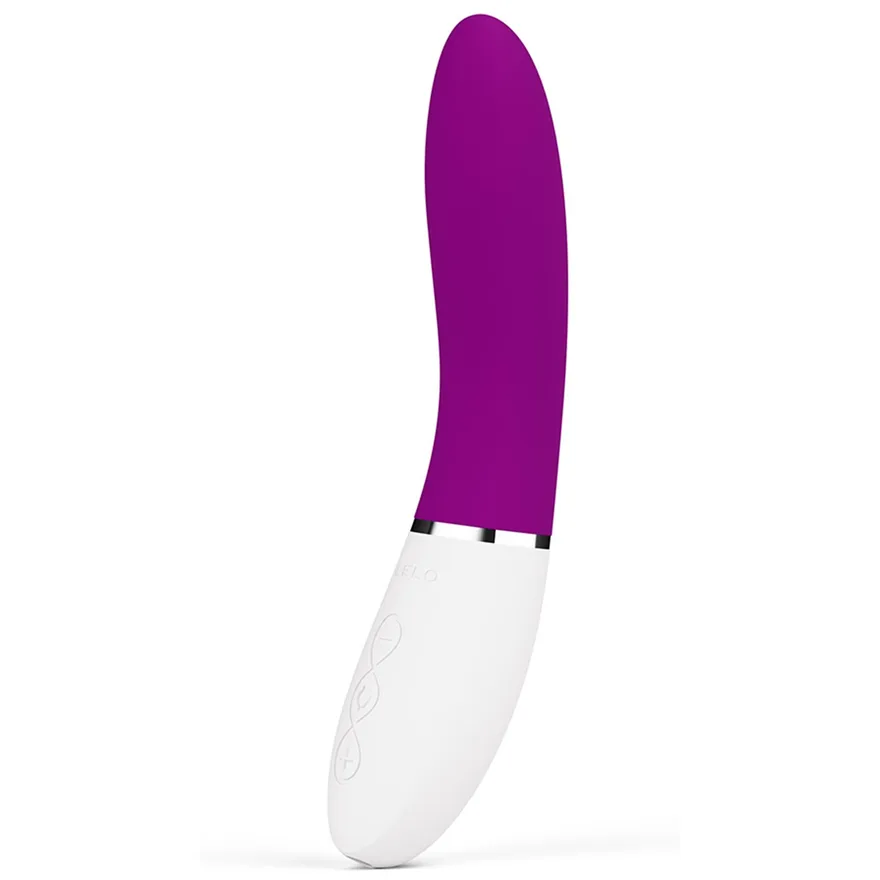
That the product is made of two materials has practical consequences that rarely appear in store text. The insertable part and the curve are silicone; the white handle with the three buttons is ABS plastic. Between them sits a visible seam with a metal-colored ring.
The advantage of ABS in the grip is that hard plastic provides better grip than silicone when hands are wet or have lubricants on them—silicone becomes slippery when it’s wet, and an all-silicone housing is therefore not automatically better. Joyland makes exactly that argument in its product text. The buttons also sit in the hard section, which gives clearer pressure points than membrane buttons in soft material.
The downside is the seam. A transition between two materials is always the point where dirt can collect and where a product first starts to loosen. What you can say is that this construction requires you to rinse the seam carefully, and that, according to the manufacturer, the product may not be taken apart—if you do, the warranty will no longer apply under LELO’s own terms.
For comparison, We-Vibe Rave 2 is, according to the manufacturer, all silicone without phthalates, BPA, or latex. There you pay more and get one fewer material transition. Which is better is a trade-off between grip and being free of a seam, not an obvious choice.
The manufacturer states 169 × 35 × 42 millimeters, insertable length 100 millimeters, and weight 93 grams. Vuxen states on its product page a total length of 16.9 centimeters and a diameter of 3.5 centimeters, which matches the manufacturer’s figures.
The 93 grams are one of the more useful pieces of information in the entire specification, because the weight determines how a handheld product feels in use over time. It’s a light product for its size class—compare LELO Gigi 3 at 87 grams and Liv 2 at 86 grams, which are therefore only marginally lighter despite Liv 2 being five millimeters longer. None of them is anywhere near the weight where the wrist becomes more tired than the user.
Distinguishing between total length and insertion length is important when buying. The total length of 169 millimeters includes the handle; what actually goes in is 100 millimeters. The 69-millimeter difference is the grip you hold, and it’s that part that determines whether the product can be angled comfortably with one hand. A common buying mistake in this category is to compare total lengths between models and assume it says something about the insertion depth.
The manufacturer does not publish the packaging dimensions. The retailer Joyme, on the other hand, lists 190 × 110 × 45 millimeters and a shipping weight of 220 grams. It’s a store detail, not a manufacturer detail, but it’s useful for two reasons: it shows that the entire shipment weighs a little over twice as much as the product itself, and it gives you an idea of the package size for anyone who cares about how discreet a delivery is.
The manufacturer states an interface with three buttons and eight vibration modes, described as patterns with varying intensity from teasing hum to a satisfying pulse. Two additional modes are unlocked via the LELO app. That means there are a total of ten modes—two of which require you to install an app and pair the product via Bluetooth.
Three buttons is a deliberate choice from LELO, and the same solution as on Gigi 3, where the manufacturer also lists three buttons. The point of having three instead of one is that you can switch programs and adjust the strength independently—on a one-button product you have to cycle through the entire list to get back to what you had. The trade-off is that there are three buttons to find in the dark instead of one.
The manufacturer’s own function graphic, which the retailer Vuxen publishes in its image gallery, shows the controls step by step. The product is started with the plus button or with the wave button in the middle. The wave button switches between the preset modes. Plus and minus adjust the intensity within the mode you’re in. The product is turned off by holding down the wave button.
The same graphic states that the product should be charged for two hours before the first use. It’s an easy routine to skip, and it matters: a lithium-ion battery is rarely delivered fully charged, and your first real use will be shorter than the specification promises if the product goes directly from the box to the body.
That the intensity is adjusted within one setting rather than every step switching everything all at once is the functional difference compared with cheaper models. What can be established is that eight patterns times multiple intensity steps provide more combinations than eight pure programs—but the manufacturer does not state how many intensity steps there are per setting, so you can’t calculate an exact number. The number of intensity steps is not published by LELO.
Two functions in this product are purely everyday functions rather than pleasure-tech, and both are worth knowing about before you buy.
The first is the lock feature. The manufacturer’s information graphic shows that the lock is opened by holding the plus and minus buttons pressed at the same time for three seconds. A lock prevents the product from starting on its own in a bag or toiletry case, and it’s a significantly more useful function than it sounds—something like a vibrator turning on in a checked bag will drain itself completely and can also get uncomfortably warm against other luggage. That LELO builds it in is a clear plus.
The second is the automatic shut-off after 20 minutes, which the manufacturer specifies in the specifications. Here, the trade-off is less clear-cut. The advantage is that the product can’t just sit there and drain the battery. The disadvantage is that 20 minutes is a hard limit no matter what you’re doing—a session that goes beyond that time is interrupted by the product itself, and you have to turn it on again. With a stated total operating time of just two hours, the shut-off is at the same time a reasonable battery protection.
Bluetooth connectivity is what sets the Liv 3 apart from the Liv 2 and from the Gigi 3, neither of which has app control. The manufacturer names the two modes that the app unlocks: Finish Me Off, described as a gradual ramp-up until orgasm, and Out Of Control, described as an unpredictable pattern set in the app. Taboo uses the same two names in its Swedish product text.
What can be established purely from a technical standpoint is that the two modes aren’t accessible without the app. Eight out of ten modes are in the product; the last two require a phone, an installed app, and a working Bluetooth pairing. That makes the app a prerequisite for parts of the functionality, not an optional extra—and that’s the most important question to ask before you pay for app control: do you actually plan to use it?
An app also involves a dependency chain that does not exist on a product with only buttons. The app must continue to be available in the phone’s app store, it must continue to support new versions of the operating system, and the product must continue to be pairable. No manufacturer in this category provides any guarantee about how long an app is maintained, and LELO does not publish any support duration for the app. The buttons on the product, on the other hand, work regardless of what happens with the app, and the eight basic positions are not lost.
LELO differs from most others in the industry in a way that deserves praise: they actually publish a number. The maximum sound level is stated as under 60 decibel. It is a ceiling figure, not a measured level at a specific setting, but it is incomparable to the manufacturers who are content with the word "whisper-quiet".
Sixty decibels is roughly the level of a normal conversation up close. That sounds like a lot for a product marketed as discreet, but two things need to be said. On the one hand, it is a maximum value at full power, not the level the product operates at during normal use. On the other hand, it is a ceiling — the actual value can be significantly lower, and the manufacturer does not state which one it is.
The comparison within LELO’s own range, on the other hand, is uncomfortable. Liv 2 is listed as 50 decibel as the maximum sound level, meaning ten decibels lower. The decibel scale is logarithmic, which means that ten decibels corresponds to a tenfold doubling of sound power and is experienced roughly like a doubling of perceived loudness. Gigi 3 is specified, just like Liv 3, at under 60 decibel. So the new generation is, according to the manufacturer’s own figures, not quieter than the old one — according to the figures, it is allowed to be higher.
A practical tip that applies regardless of the model: never place a switched-on vibrator on a hard tabletop. The tabletop works as a resonance box and noticeably amplifies the sound. A soft surface makes a bigger difference in how much is heard through a wall than most specification differences do.
LELO states that Liv 3 is 100 percent waterproof and suitable for baths and showers. Mshop and Vuxen repeat the same wording. It sounds unambiguous, but here there is a real shortcoming in the information base that should be pointed out: the manufacturer does not publish an IP rating for Liv 3.
The difference matters. The IP system is defined in the international standard IEC 60529, which specifies exactly what each digit means — for example, IPX7 means submersion to a depth of one meter for 30 minutes, tested and specified. The wording "100 percent waterproof" is, however, a marketing phrase with no defined content: it does not say which depth, which time, or which test procedure is behind it.
What can be established is that, according to the manufacturer, the product is intended to be used in bath and shower, and that it has no visible charging opening in the housing—this is the usual technical prerequisite for real water resistance. What can’t be established is how deep or how long. For comparison, We-Vibe lists the IPX7 enclosure rating outright for the Rave 2. There you know exactly what you’re getting; here you only get the manufacturer’s word.
Rinse the product in lukewarm water after each use, and use fragrance-free soap or a cleaning product intended for intimate products. Pay special attention to the seam between the silicone parts and the ABS handle, because it’s the only point on the product where residue can be left behind. Let it air-dry before putting it away. A satin storage pouch is included according to the manufacturer’s delivery contents, and it’s actually useful—dust-free storage is the whole point of a pouch for a silicone product, because silicone attracts lint like few other materials do.
Use a water-based lubricant. Do not use a silicone-based lubricant on silicone products: it breaks down the silicone surface over time and makes it porous, and a porous surface can no longer be cleaned properly—only replaced. Oil-based products like coconut oil also leave a film that’s difficult to get rid of and that can produce the same result. Joyland expressly recommends a water-based lubricant for this particular product.
Two things belong here. According to LELO’s warranty terms, the product must not be disassembled—doing so would invalidate the warranty. And because the battery isn’t replaceable, the product’s service life in practice is the battery’s service life. A lithium-ion battery does best when it’s charged regularly rather than stored completely discharged, and the stated standby time of 90 days is a reasonable reminder of how often the product should be plugged in even when it isn’t being used.
LELO publishes the full battery specification, which is unusual: lithium-ion, 420 mAh, 3.7 volts. Charging time is stated as up to two hours at 5 volts and 420 milliampere, and usage time as up to two hours. Standby time is stated as 90 days. The manufacturer also provides the rated power—input at 5 volts and 420 milliampere, corresponding to 2.1 watts, and output at 3.7 volts and 600 milliampere, corresponding to 2.22 watts.
Having the capacity published is in itself valuable. Without the mAh figure, you can’t convert runtime into power consumption and you can’t compare how heavily the cell is loaded between models. Womanizer, to take an example from a neighboring category, does not publish either capacity or voltage for its models. LELO does for all three models in this comparison.
With the USB charging cable included in the package. The manufacturer lists the product, a USB charging cable, a satin storage bag, a warranty registration card, and a detailed user manual as included contents.
Here there’s a practical limitation that’s easy to miss. The charging cable is product-specific and connects with a small round connector in the product, not with USB-C. So if you lose the cable, no regular phone cable will work—you’ll need to get a replacement. LELO sells charging cables separately, but that’s an extra cost and an extra thing to keep track of—especially when traveling, where it’s entirely possible to have four USB-C cables with you and still be missing the right one.
The advantage of this solution is the same as the reason for it: a hidden, sealed connector is easier to make waterproof than an open USB-C port with a rubber plug. It ties in with the waterproofing section above—what you gain in durability, you pay for in cable reliance.
Two hours of runtime is short in this context, and it shows most clearly compared with the manufacturer’s own predecessor. Liv 2 is rated for up to four hours on a 500 mAh battery. Liv 3 is rated for up to two hours on a 420 mAh battery.
The 80 mAh capacity reduction alone doesn’t fully explain a halved runtime—420 mAh is 84 percent of 500 mAh, not 50 percent. What’s behind the rest the manufacturer doesn’t publish, but Bluetooth radio is a reasonable part of the explanation: a radio that keeps a connection alive draws power even when the motor is running at low power. LELO does not disclose how much the runtime is affected by the product being Bluetooth-connected, which is information that would be directly useful and is missing.
In practical use, two hours is rarely a problem for an individual session. It becomes a problem if the product is used often and charged rarely, and that makes the relationship between charging time and runtime interesting: two hours of charging gives two hours of operation, i.e. a 1:1 ratio. We-Vibe Rave 2 states 90 minutes of charging for 120 minutes of operation, i.e. 1:1.33. Liv 2 states two hours of charging for four hours of operation, i.e. 1:2. Of the compared models, Liv 3 is the one that provides the least runtime per charged hour.
We do not have price data from shops in your market yet.
The battery shrank from 500 to 420 mAh, the runtime was halved from four to two hours, and the noise level was raised from 50 to under 60 decibels. Everything according to the manufacturer’s own specifications.
Three comparisons are relevant: versus LELO’s other G-spot vibrator in the same price range, versus the other major brand in the app-controlled category, and versus the model Liv 3 replaced. All the specifications below come from each manufacturer’s respective product pages, and all prices come from the shops’ product feeds on July 29, 2026.
Gigi 3 costs from 1,099 SEK, which is 504 SEK more than Liv 3 at its lowest price. If you line up the specifications next to each other, the similarity is almost total: Gigi 3 is listed at 163 × 35 × 42 millimeters versus Liv 3’s 169 × 35 × 42, weight 87 grams versus 93, same battery of 420 mAh and 3.7 volts, same charging time of up to two hours, same usage time of up to two hours, same standby time of 90 days, same frequency of 100 hertz, same automatic shut-off after 20 minutes, same maximum sound level under 60 decibels, and the same interface with three buttons.
The real differences are two. The insertable length is 90 millimeters on Gigi 3 versus 100 millimeters on Liv 3—10 millimeters more to work with on the cheaper model. And Liv 3 has Bluetooth and app control, which LELO does not state for Gigi 3.
The conclusion is unusually simple: on paper, Liv 3 is the cheaper product, and it also has a longer insertable part and app control. Gigi 3 has a different tip—it’s shaped for a more concentrated pressure—but that is a shape difference, not a specification difference, and the manufacturer doesn’t quantify it. If you pay 504 SEK extra for Gigi 3, you’re paying for the shape and the model name, not for the technology.
We-Vibe Rave 2 costs from 1,079 SEK, which is 484 SEK more than Liv 3. Both are app-controlled G-spot vibrators in body-friendly silicone, and both come from established manufacturers with published specifications.
Rave 2 is listed as having 120 minutes of operating time and 90 minutes of charging time, i.e., the same operating time as Liv 3 but a faster charge. The material is listed as body-friendly silicone without phthalates, BPA, or latex—a more explicit material declaration than LELO’s. The ingress protection rating is listed as IPX7, which is a defined class according to IEC 60529 instead of the wording “100 percent waterproof.” The warranty is listed as two years, the same as LELO’s base warranty.
We-Vibe, however, neither publishes battery capacity in mAh, voltage, weight, nor motor frequency for Rave 2, and the dimensions stated on the product page, 250 × 110 × 750 millimeters, are evidently related to packaging rather than product measurements. That’s where LELO shows considerably more.
If you choose based on stated material safety and a defined waterproofness class, Rave 2 wins. If you choose based on the stated product data—dimensions, weight, battery, and price—Liv 3 wins—and it does so with a 484 SEK margin.
Liv 2 costs from 761 SEK, which is 166 SEK more than Liv 3. This is the most uncomfortable comparison in this text, because the older model wins on several of the points that usually determine a purchase.
Liv 2 is listed as 174 × 35 × 29 millimeters, with a diameter of 30 millimeters, an insertable length of 100 millimeters — in other words, exactly the same insertable length as Liv 3 — and a weight of 86 grams. The battery is listed as 500 mAh and 3.7 volts, the charging time as two hours at 5.0 volts and 500 milliamps, the operating time as up to four hours, and the maximum sound level as 50 decibels.
Summary: Liv 2 is listed as having twice the operating time, ten decibels lower sound ceiling, a larger battery, lower weight, and a slimmer profile — 29 millimeters in height versus Liv 3’s 42. In return, Liv 3 has Bluetooth with two extra modes, a new shape that the manufacturer describes as adapted for more bodies, and a lower price.
In practice, that means the choice between the generations comes down to one question: do you want the app? If you say no, there’s no specification-based reason to choose Liv 3 over Liv 2 other than the price — and a 166 SEK difference is easy to weigh against the halved operating time. If you say yes, then Liv 3 is the only one of the two that can deliver, since LELO does not state any app control for Liv 2.
Six Swedish stores sell the item with EAN 7350075029790. The cheapest is Joyland at 595 SEK, and the most expensive is Vuxen at 999 SEK. That’s a 404 SEK or 68 percent difference for exactly the same item number and the same color — one of the wider price spreads in this category.
The stock situation is unusually good compared with many other premium products. Four of the six stores had the product in stock at the price check: Joyland at 595 SEK, Joyme at 749 SEK, Mshop at 990 SEK, and Vuxen at 999 SEK. The two that lacked stock were Sexonic at 886 SEK and Taboo at 995 SEK. That means that the cheapest store is also one of the ones that can actually ship the item — which is far from always the case.
The difference between the cheapest and the second-cheapest available store is 154 SEK, i.e. 26 percent. That’s a large enough difference that it pays to compare before you pay, and the price spread isn’t because one store sells another variant — all six list the same EAN or their own item number linked to the same item. For example, Vuxen’s item number L9790 contains the last four digits of the EAN number.
A warning before you buy: since the stores use three different color names for the same item — Deep Rose, Pink, and Lila — it’s extra important to check the item number and not the color headline when you compare. Joyme also lists Liv 3 on separate product pages for each color, all at the same price, which makes it easy to accidentally add the wrong variant to the basket.
The prices in the table above are updated when the stores’ product feeds are updated, but always check the final price at checkout. Shipping costs are added by most stores under a certain order value, and in this price range several of the stores are below the threshold for free shipping — which can eat up some of the 154 SEK.
It’s for you if you want a G-spot vibrator from an established manufacturer that publishes the full specification, at a price that’s clearly below the category’s premium level. It’s for you if you want to be able to control the product from your phone and if you actually plan to use the two app modes. It’s for you if you want a 100-millimeter insertable length with a curved tip and a firm handle that can be held with wet hands. The latch also makes it a reasonable choice for anyone who brings their things along on trips.
It’s not for you if you prioritize run time. Two hours is the shortest specified run time among the compared models, and LELO’s own Liv 2 specifies twice as much for 166 SEK more. It’s not for you if you want the lowest possible noise level — where the manufacturer itself lists a ceiling that’s 10 decibels lower than for the predecessor. It’s not for you if you require a defined IP rating before the product is allowed to come along in the bath, since LELO states “100 percent waterproof” without an IP number. And it’s not for you if you want to be able to charge it with the same cable as your phone — the charging cable is product-specific.
One last thing belongs in the decision. Liv 3 is priced as an entry-level product in the premium segment, and that’s where it provides the most value: as a first proper G-spot vibrator from a well-known brand, with a complete specification and a two-year warranty, for 595 SEK. If you want the best figures in the class, this model is not the one you should buy — but if you want a well-known brand with published data for under six hundred kronor, it’s hard to beat.
LELO provides a two-year worldwide manufacturer warranty counted from the date of purchase. The warranty covers faults caused by inadequate workmanship or inadequate materials that affect the product’s function. In the event of an approved claim, the manufacturer replaces the product free of charge. To activate the warranty, the product must be registered with the serial number from the packaging on an account with LELO, and the original receipt must be kept as proof that the claim is within the warranty period.
Read the exceptions before you count on the warranty. It does not cover cosmetic wear from normal use, damage caused by an accident, misuse, or neglect, and taking apart the product or its accessories will make the warranty invalid. LELO also expressly states that they do not offer refunds or account credit within the warranty—refunds are only given for unopened items purchased on lelo.com within fourteen days.
The ten-year quality guarantee, which is often quoted in store texts as if it were an extended warranty, deserves clarification. It gives, according to LELO’s own terms and conditions, 50 percent off a new purchase on lelo.com—not repairs and not a replacement product. The discount can be used once, on up to five items in the same order, and does not apply to bundles or the Luxe series. So it is a loyalty discount, not a warranty in a legal sense, and it should not be factored into a purchase decision as if it were.
The manufacturer also offers a voluntary extended warranty for an additional twelve months after the basic warranty expires. It must be activated within 30 days of purchase by product registration with the serial number, and the contracting party is LELOi AB at Karlavägen 41 in Stockholm. If you miss the 30-day window, there is no way back.
What always applies, however, are your statutory rights. Under the Swedish Sale of Goods Act (konsumentköplagen), you have a right to complain for three years if the item is defective, regardless of what the manufacturer promises—and in this case, Swedish law is therefore one year more generous than LELO’s own warranty. For distance purchases, there is also a right of withdrawal in fourteen days under the Act on Distance Contracts and Off-Premises Contracts (lagen om distansavtal och avtal utanför affärslokaler). Be aware that in practice the right of withdrawal is limited for hygiene products that have been taken out of a sealed package—however, the right to complain for defects always applies. If you have questions about what applies in your case, Konsumentverket guides you via Hallå konsument.
LELO Liv 3 Deep Rose is ranked på plats 9 av 12 in g-spot vibrator best i test, where the entire category is compared against each other using five shared criteria. Guiden vinns av Womanizer OG.
Every numerical piece of information in the text can be traced to one of the sources below. The links were checked manually on the specified date.
This page is machine-translated from Swedish. Read the Swedish original