

 Premium pick
Review · Anal balls · Bow-Motion vibration
Lelo Soraya Beads: review
Lelo’s vibrating anal balls are reviewed against the manufacturer’s own specifications, the user manual, and price data from five Swedish stores. Four balls in ascending size, eight modes, 520 mAh, and up to two hours of operation, IPX7, and silicone over the entire insertable part — but neither the insertable length, the ball diameters, nor the material declaration is published, and the price differs by 93 percent between stores.
My rating
The most well-thought-out shape in the comparison for anyone who wants to start with anal play: four beads in increasing size make the progression part of the product instead of a purchase decision, and the broad handle works both as a retainer and as a grip. IPX7, a fully silicone-coated insertion portion, and a published battery capacity weigh heavily. What you pay for is documentation with holes — neither insertable length, bead diameters, nor a phthalate declaration is published — a product-specific charging cable, and the absence of an app and remote control that cheaper competitors have.
- Four beads in increasing size, broad handle as a retainer
- Eight settings and three buttons — no app
- 520 mAh, up to 2 h runtime and 2 h charging
- IPX7 according to the manufacturer’s manual — immersion 1 m for 30 min
- Two-year warranty; the ten-year warranty is a discount coupon
- 1,186–2,289 SEK at five stores for the same EAN
Lelo Soraya Beads at a glance — this is what you get
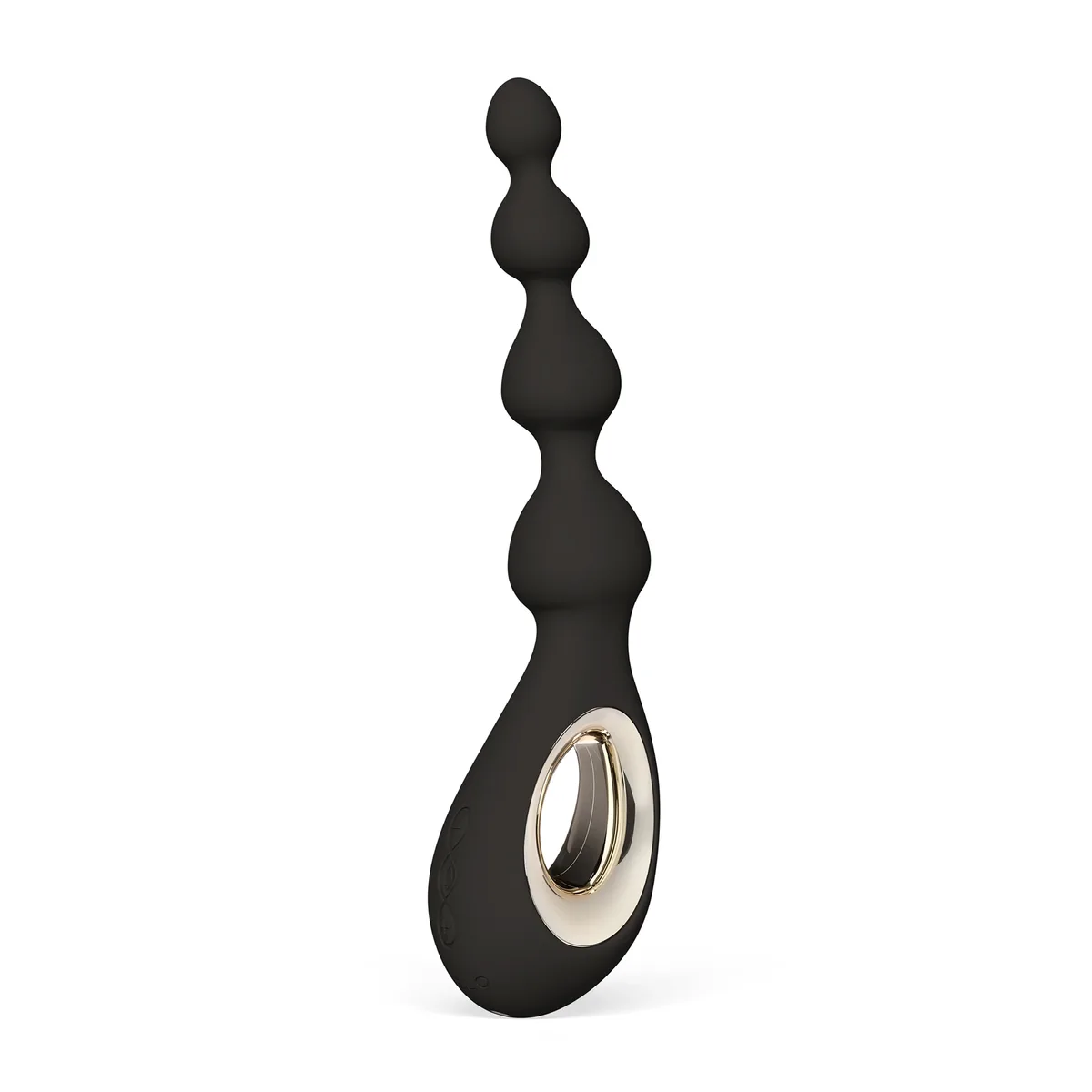
Lelo Soraya Beads are vibrating anal beads: four beads in increasing sizes on a flexible tail, with a wide drop-shaped handle at the other end. The manufacturer describes the model as gender-neutral and aimed at the person who is new to anal, and places it in the brand’s range alongside its prostate massagers rather than among its vibrators. Behind the product stands LELOi AB at Karlavägen 41 in Stockholm; the manual states that the product has been developed by Lelo in Sweden and manufactured in China.
The specification looks like this. The material is body-friendly silicone and ABS plastic. The dimensions are 234 × 59 × 46 millimeters and the weight is 145 grams. The battery is a 520 mAh lithium-ion battery at 3.7 volts; the operating time is stated as up to two hours and the charging time as up to two hours at 5.0 volts and 500 milliamps. The standby time is stated as 90 days. The interface consists of three buttons and eight settings. The maximum sound level is stated as under 60 dB, and the product automatically switches off after 20 minutes. The manufacturer’s manual labels the product as IPX7. In Sweden, the item is sold by five stores at prices between 1,186 and 2,289 SEK, and four of them have it in stock.
This overview is exclusively about the black variant with EAN 7350075029387. Lelo sells Soraya Beads in two colors—black and Violet Dusk—and each color has its own EAN. Functionally, they are identical, but check the number if you compare prices, because several Swedish shops list both colors on the same product page and then vary the price by variant. Lelo doesn’t publish a GTIN in the source code of its own product page, so the link between the item and the EAN can only be confirmed via the retailers’ product feeds—where the number throughout applies to the black one.
What the Bow-Motion technique is—and what it isn’t
Lelo calls the drive technology Bow-Motion and describes it as inspired by violinists’ bowing movements: the vibrations should be spread evenly over the entire insertable tail and transferred to the body through each individual bead, so the intensity doesn’t taper off toward the tip. The marketing talks about a jolt-like sensation without a jolting movement.
It’s worth reading that wording carefully, because it includes its own clarification. Soraya Beads has no mechanical jolt function. Nothing in the product moves back and forth. What you can actually establish from the specification is that the manufacturer lists three frequencies—130, 103, and 130 Hz—which reasonably correspond to three separate vibration sources distributed along the tail. Lelo, however, doesn’t spell out how many motors the product contains or where they’re located, unlike how the same manufacturer does on its own Hugo 2, where the two motors are named individually with 130 and 108 Hz. Bow-Motion is therefore a description of how the vibration is distributed, not of a movement.
In practice, that means your expectations should be calibrated. If you want the feeling of something being inserted and pulled out, don’t buy this product—there are specific jolting products for that. If you want an even vibration along a flexible chain of beads that you can move in depth by hand while it vibrates, you’ll get exactly what the manufacturer describes.
Four beads in increasing size: what the design means for a beginner
The underlying design idea is that the beads gradually grow. The manufacturer states four beads, with the smallest at the very end and three progressively larger ones after it, and it explicitly justifies this with comfort for the person exploring anal for the first time. The construction lets the user control how many beads are inserted, and each additional step is a small step rather than a big one.
The drop-shaped handle serves two functions at the same time. It is the interface — the buttons and the charging port are located there — and it is also a latch that is wider than each bead. With anal products, the wider base is not a design detail but the whole safety principle: the anus lacks the natural stop that the slider has, and a product with an insufficiently wide base can slip all the way in. Here, the base is also shaped so it can be held while the product is in use, which allows the depth to be adjusted continuously.
One thing Lelo actually does not publish is the individual diameters of the beads. The measurement of 59 millimeters in the specification refers to the product’s widest point, which is the handle — not the thickest bead. The manufacturer does not state the diameter of the smallest or the largest bead, and that is the piece of information that a first-time buyer has the most use for. A well-informed purchase decision in this category is normally based on just the bead diameters, and you therefore have to make do without that information.
Material and build quality: silicone on the outside, ABS on the inside
Material is the only property of an intimate product that can’t be compensated for with experience or care, and it determines whether the product is still hygienic after five years. Lelo lists two materials for Soraya Beads: body-friendly silicone and ABS plastic, with the surface finish specified as smooth.
What body-friendly silicone means in practice
Silicone is a non-porous material. A non-porous surface can be cleaned, because there are no microscopic pores where residue can get trapped. It is the single most important property of a material that is meant to lie against mucous membrane, and the reason the material declaration weighs more heavily than almost every other line in a specification. For an anal product, it weighs even more than usual, because the bacterial flora in the rectum is different from that on skin.
The fact that ABS plastic is included in the material list is normal and not a warning flag. Lelo uses the same combination on Hugo 2, and ABS is the plastic that typically sits in buttons, electronics chassis, and the decorative metallized ring on the handle. What matters is where the boundary between the materials lies. The manufacturer does not specify which parts are silicone and which are ABS, but the product images show that the entire insertable part and the entire outside of the handle are covered in silicone, while the inset ring on the side of the handle is the hard, shiny part. The seam between the silicone and the ring is the only place where cleaning needs extra attention.
Phthalates, BPA, and latex — the declaration that Lelo does not print
Phthalates are a group of plasticizers used to make plastic—above all, soft PVC—flexible. The Swedish Chemicals Agency describes them as substances that can affect the endocrine system and make reproduction more difficult, and several of them are therefore restricted or banned within the EU in a large number of products. Sex toys are a product category that is repeatedly subject to supervision precisely because it contains soft plastic against the mucous membrane.
Here, something needs to be noted that is easy to miss in store texts. Lelo publishes no explicit declaration about phthalates, BPA, or latex for Soraya Beads—either on the product page or in the user manual. The wording used is "body-safe silicone" and a reference to the international safety standard ISO 3533, which, according to Lelo’s own site, covers construction, materials, and user information. It is an indirect undertaking. Several Swedish stores, on the other hand, state "latex- and phthalate-free" in their product texts, and that information therefore does not have coverage in the manufacturer’s own material.
The comparison with the competitor is instructive. We-Vibe states plainly on its product page for Ditto+ that the silicone is free from phthalates and BPA and made without latex. That is exactly the wording that makes a difference for someone with a latex allergy, because a latex allergy causes reactions on the mucous membrane faster than on normal skin. The fact that Lelo doesn’t state it is not a message that the substances are there—silicone does not require phthalate plasticizers to become soft, because the softness comes from the polymer’s own structure—but it is a piece of information that the manufacturer chooses not to publish, and it shouldn’t be turned into a promise.
Measurements and weight: 234 × 59 × 46 millimeters and 145 grams
Lelo lists the length as 234 millimeters, the width as 59 millimeters, and the height as 46 millimeters, and the weight as 145 grams. That makes Soraya Beads a long product in a category of short ones: it is more than twice as long as the brand’s own Hugo 2, which measures 104 × 107 × 41 millimeters, and a little over three times as long as the We-Vibe Ditto+ at 68.45 × 88.10 millimeters.
However, the length is not the insertion depth. Most of the 234 millimeters are the butt with the balls, but a substantial part is the handle, which should never be inserted. The weight of 145 grams is close to Hugo 2’s 121 grams, which is reasonable since both include a battery of roughly the same size and a similar amount of silicone. It’s a weight that doesn’t require anything from the wrist and at the same time is sufficient to ensure the product doesn’t feel cheap.
A practical consequence of the shape: a 23-centimeter-long, flexible product doesn’t fit in a pouch in the same way as a compact plug. The satin pouch that comes with it solves storage but not the volume. Anyone looking for something to bring on a trip would be better off looking at a shorter model.
The missing measurement: insertable length
There is one single piece of information that is more important than anything else for anyone buying an anal product, and that is how far it’s intended to go in. Lelo does not publish an insertable length for Soraya Beads.
This is particularly noteworthy because the same manufacturer publishes the exact measurement for the Hugo 2, where "Insertable length: 72 mm" appears as its own line in the specification. So the field exists in Lelo’s own specification template, but it isn’t filled in for this model. It’s therefore not possible to work out where the boundary is between the rear end and the handle without having the product in front of you, and it’s an uncomfortable omission for a product that is expressly marketed to beginners.
What can be established is that the total length of 234 millimeters is the product’s maximum extent, that the handle is the widest part at 59 millimeters, and that the four balls, according to the manufacturer’s own description, are intended to be inserted one at a time rather than all at once. In practice, the depth is determined by the user, not the product—but anyone who wants to know in advance how much product will fit gets no answer from the manufacturer.
Eight settings and three buttons: that’s how Soraya Beads is controlled
The interface is simple and is described precisely in the manufacturer’s manual. There are three buttons: a plus button and a minus button for intensity, and a third button that both turns the product on and off and steps between the modes. The charging port sits at the bottom of the handle. According to the manual, you start the product with a short press of the plus button or the mode button, increase the strength with plus, reduce it with minus, switch between the eight vibration patterns with the mode button, and turn it off either by holding the mode button pressed or by pressing plus and minus at the same time.
Three buttons is one more button than a minimalist interface and two fewer than a premium vibrator with separate program and intensity controls. The trade-off is reasonable: you can change intensity without having to change patterns, which is the function you miss the most on products with a single button. Lelo’s own Hugo 2, by comparison, has only one button and solves the rest via the app. Soraya Beads has no app control at all, which is worth knowing before you buy—everything is controlled on the product itself.
Eight settings—and what the frequency numbers actually say
The manufacturer lists eight modes and describes them as a range from a teasing murmur to a satisfying pulse. What each individual mode does—which ones are constant and which are pulsing, and in what order they come—Lelo does not publish. This is a common omission in this category, but it’s worth noting because the number of modes is the figure stores highlight most clearly.
What can be established, however, is the frequency information: 130, 103, and 130 Hz. Frequency is the number of vibrations per second, and it determines whether the vibration is experienced as deep and rolling or as shallow and buzzing. A lower number gives a heavier, more penetrating character; a higher number gives a more shallow, faster vibration. That Lelo lists three values, one of which deviates downward, suggests that one of the vibration sources is intentionally low-frequency—which would be logical if it sits closest to the handle and thus closest to the deeper nerve pathways. But the manufacturer does not state which frequency corresponds to which position, so this is a reasonable interpretation rather than a conclusion.
A comparison puts the figures into context. Hugo 2 is stated to have 130 Hz in motor 1 and 108 Hz in motor 2, meaning that in practice it’s the same frequency range as Soraya Beads. This suggests that Lelo uses the same motor types across the lineup, and that it’s the distribution along the product—not the motors’ character—that accounts for the difference between the models.
The transport lock — the most common start problem
The manual begins with a warning that’s worth reading before concluding that the product is broken: it is delivered locked for transport. The lock is released either by connecting the charger or by holding plus and minus pressed in for three seconds at the same time. The same operation locks and unlocks the interface during normal use.
In practice, this is the most common reason why a Lelo product doesn’t start right out of the box, and it isn’t mentioned in the store texts. The manual also recommends charging for two hours before first use, regardless of how charged the product appears to be upon delivery.
Why does it turn itself off after 20 minutes?
Both the product page and the manual state that Soraya Beads turns itself off automatically after 20 minutes. The manual also gives the reason: it’s protection against the motor overheating if the product is used incorrectly.
It’s a function with two sides. The positive side is that a product left switched on in a bag can’t get hot or fully discharge. The negative side is that the lockout can’t be turned off: after 20 minutes, you have to restart the product manually, and it then returns to the starting state rather than to the setting you had. The same 20-minute limit exists on Lelo’s Hugo 2, so it’s a consistent design principle from the manufacturer rather than a quirk of this model. Count on it—it's not a fault.
Sound level: under 60 dB — but that’s a ceiling, not a measurement
Lelo states a maximum sound level of under 60 dB. It’s more information than many manufacturers publish at all, and it’s something worth noting positively. But the value should be read for what it is.
Under 60 dB is an upper limit, not a measured value, and Lelo does not state either the measurement distance, the measurement method, or at what intensity the number applies. The same number — under 60 dB — is also listed on Lelo’s product page for Hugo 2, which is a completely different product with a different design. That suggests that 60 dB is a shared ceiling that Lelo sets for the range rather than a measurement per model. Without a measurement distance, the figure also can’t be compared with any other manufacturer’s information, because sound pressure level decreases with distance.
As an order of magnitude, under 60 dB is roughly a normal conversation close up. It’s audible in a quiet room but not through a closed door, and a filter or a blanket reduces it further. A practical tip that applies regardless of model: place the product on a soft surface between uses, because a hard tabletop acts like a resonance box and noticeably amplifies the sound.
Water resistance: IPX7 is stated in the manual, not on the product page
Lelo’s product page writes "100 % waterproof" without any rating, which in itself doesn’t say very much. The rating, however, is in the manufacturer’s user manual, on the labeling area along with the serial number, manufacturing date, and the WEEE symbol: IPX 7. The manual also repeats in plain language that the product is completely waterproof and therefore easy to clean.
IPX7 versus "splash-proof" — the difference that matters
The rating comes from the international standard IEC 60529, which defines enclosure classes for electrical equipment. The number 7 in the second position means the product has been tested for submersion in water to a depth of one meter for 30 minutes. The letter X in the first position means that protection against solid objects and dust has not been tested or is not specified — that’s standard for this product class and nothing to dwell on.
The difference versus a splash-proof product is bigger than the wording suggests. Splash protection covers water droplets and, at best, water jets, but not submersion. Such a product can handle a damp cloth and possibly a shower, but not a bathtub. With IPX7, the entire product can be rinsed off without being careful, and that’s a genuine advantage specifically for an anal product, where proper cleaning is non-negotiable. If a product is missing the IPX rating altogether, it should be treated as not waterproof — the absence of a rating is never a sign that the product would be approved.
Cleaning, lubricant, and storage
The manual’s instructions are unusually specific. Rinse the product and spray it with Lelo’s own cleaning solution, rinse again, and let it dry. Alternatively, the silicone can be washed with warm water and antibacterial soap, rinsed with clean hot water, and dried with a lint-free cloth. The manufacturer emphasizes that the product should be cleaned thoroughly both before and after every use—which, for an anal product, is an instruction and not a suggestion.
Three explicit prohibitions are listed in the manual and should be read before the first use. Never use cleaning agents that contain alcohol, gasoline, or acetone. Never leave the product in direct sunlight and never expose it to intense heat. And don’t bend the buttocks too aggressively—the soft, flexible tip can be permanently damaged.
The lubricant question is the most important of all for an anal product, because the rectum does not produce its own moisture, and lubricant is therefore mandatory rather than optional. The manufacturer puts it plainly: hand creams and silicone-based lubricants can make the silicone permanently tacky. This applies generally to silicone products—silicone-based lubricant attacks the silicone surface over time and makes it porous, and a porous surface can no longer be cleaned properly, only replaced. Use a water-based lubricant, and expect to need to top up during use. Oil-based products like coconut oil also leave a film that’s difficult to remove. Lelo itself includes a sample of its water-based lubricant of 5 milliliters in the packaging, which is enough for one use and not more.
Store the product dust-free and separately from products made of other materials. The latter instruction is not an exaggeration: silicone that lies directly against soft plastic can react with it and become sticky at the contact surface. The included satin bag solves that.
Battery and charging: 520 mAh and two hours of runtime
Lelo publishes the full battery specification, which not many manufacturers do. The battery is a lithium-ion battery of 520 mAh and 3.7 volts. Runtime is stated as up to two hours, and charging time as up to two hours at 5.0 volts and 500 milliampere. Standby time is stated as 90 days.
Two hours of runtime is a reasonable value in context, and it’s double compared to Lelo’s own Hugo 2, which is stated as up to one hour on a smaller 420 mAh battery. We-Vibe states 120 minutes of runtime and 90 minutes of charging time for the Ditto+, so it has the same runtime but charges faster. That runtime and charging time are the same length on Soraya Beads means, in practice, that a full charge takes as long as it lasts—which is completely normal with a 500 mA charging current, but worth knowing if you’re thinking you’ll be able to top up quickly.
An annotation about the manufacturer’s own documentation belongs here. The product page states the rated power up to 3.7 volts and 1 watt, while the specifications page in the user manual states 3.7 volts and 1.2 watts for the same model. The two numbers don’t match, and Lelo doesn’t state which one is the correct one. The difference is small and has no practical significance for the user, but it’s an example of why you should always read a specification against more than one source from the same manufacturer.
How is the Lelo Soraya Beads charged?
Charging happens via a cable with a DC plug that is inserted into the charging port at the bottom of the handle, and a USB connector at the other end that can be connected to any USB port. The manual clearly states that only Lelo’s original charger may be used.
That means the cable is product-specific. If you lose the charging cable, no standard USB-C cable works; instead, you need a replacement from the manufacturer. That’s the direct cost of the design: a DC connector at the bottom is easier to seal than a USB-C port, which is part of the reason the product can be IPX7-rated. The comparison with We-Vibe Ditto+, which according to the manufacturer is charged via USB from any USB port or adapter, is still not to Lelo’s advantage at that point.
The manual also describes how to read the charge level. The LED on the handle’s interface pulses while charging and stays lit with a steady glow when the battery is full. When the battery begins to run low, the diode blinks white. If the diode doesn’t pulse at all when the charger is connected, then according to the manual the battery is either completely drained and needs a few minutes before it responds, or the connection isn’t seated properly.
90-day standby — and what it says about lifespan
The 90-day standby time means that a fully charged product keeps its charge for about three months without being used. It’s a useful figure because it says something about the product’s self-discharge rate, and thus how often it needs charging even when it’s left unused.
What generally applies to lithium-ion batteries also applies here. Capacity drops with the number of charge cycles, and Lelo doesn’t state that the battery can be replaced—the manual, on the contrary, explains that any attempt to open the product makes the warranty void. With use a couple of times per week, it’s therefore the battery, not the silicone, that sets the limit for lifespan, and once the cell is used up, the product is, in practice, also done. Charge regularly instead of storing the product completely drained, and avoid letting it sit in heat.
Where can you buy it — and what does it cost?
We do not have price data from shops in your market yet.
The field is included in Lelo’s own specification template — the insertable length is stated for Hugo 2. On Soraya Beads, it is blank.
Pros
- Four balls in increasing size — progression is built into the shape
- Wide teardrop-shaped handle that works as a stopper and grip
- Silicone over the entire insertable part, pore-free and easy to clean
- IPX7 according to the manufacturer’s manual — the entire product can be submerged
- Published battery capacity: 520 mAh and up to 2 h of operating time
- Eight settings and three buttons — intensity can be changed without changing patterns
Cons
- The manufacturer does not publish an insertable length — even though the field is filled in on Hugo 2
- The manufacturer does not publish the individual diameters of the balls, which is the most important measurement for beginners
- No explicit phthalate-, BPA-, or latex declaration from the manufacturer
- Product-specific DC charging cable — regular USB-C does not work
- No app and no remote control, unlike the cheaper Hugo 2 and Ditto+
- Under 60 dB is a range limit, not a measurement for this model
- The price varies by 93 percent between stores for the same item
Rating in detail: five criteria, the same for the entire category
7.3Good
- Materials and hygiene
- 7,7
- Silicone over the entire insertable part, ABS in the chassis and ring. No phthalate or BPA declaration.
- Safety and extension
- 8,8
- Wide base as a stop and three buttons. The body, 234 × 59 × 46 mm, is provided, unlike the field’s.
- Shape and progression
- 7,0
- Four balls in increasing size and eight settings, but neither ball diameters nor insertable length are provided.
- Cleaning and water resistance
- 8,6
- IPX7 in the manual — immersion 1 m for 30 min according to IEC 60529. The charging connector is product-specific.
- Price for performance
- 4,6
- 1 186 SEK is six times the winner’s price. Lelo Hugo 2 costs 931 SEK and also has app control.
Lelo Soraya Beads compared with the alternatives
Two comparisons are relevant: against another anal product from the same manufacturer, and against the best-selling competing anal product from another premium brand. All information below comes from each respective manufacturer’s own specifications, and all prices come from the shops’ product feeds on July 29, 2026.
Against Lelo Hugo 2 — the same brand, completely different product
Lelo Hugo 2 in black costs from 931 SEK, i.e. 255 SEK less than Soraya Beads at its cheapest. Both are anal products from the same manufacturer, both are silicone and ABS plastic, both turn themselves off after 20 minutes, both are stated to be under 60 dB, both have 90 days of standby, and both are in the same frequency band — 130 and 108 Hz on Hugo 2 versus 130, 103 and 130 Hz on Soraya Beads.
That’s where the similarities end. Hugo 2 is a prostate massager: 104 × 107 × 41 millimeters, 121 grams, with a published insertable length of 72 millimeters and a fixed shape that is intended to sit still and press against a specific spot. Soraya Beads is 234 millimeters long and is intended to be moved in depth. Hugo 2 has a smaller battery of 420 mAh and a runtime of up to one hour versus Soraya Beads’ two hours, but in return it has app control via Bluetooth and a version with a remote control, while Soraya Beads has no app at all.
The conclusion is that they don’t compete. If you want targeted prostate stimulation without having to hold the product, Hugo 2 is the right choice—and it’s also cheaper. If you want something that can be inserted step by step, that works regardless of anatomy, and that doesn’t require you to find a specific spot, it’s Soraya Beads’ product—and the published insertable length on Hugo 2 is also a reminder of what’s missing on this model.
Against We-Vibe Ditto+ — what’s the difference between anal balls and an anal plug?
We-Vibe Ditto+ in Satin Black costs from 995 SEK, i.e. 191 SEK less than Soraya Beads at its cheapest. It’s the closest competitor in price and positioning, and a comparison between them clearly shows what the two product types are for.
Ditto+ is an anal plug: 68.45 × 88.10 millimeters, i.e. a small and compact product with a tapered top and a wide base, designed to stay in place. We-Vibe states 120 minutes of runtime and 90 minutes of charging time, IPX7, a lithium-ion polymer battery that charges via standard USB, a two-year warranty, and body-friendly silicone that is explicitly stated to be free from ftalates and BPA and manufactured without latex. The package also includes a remote control with intensity controls, and the product can be controlled via We-Vibe’s app.
The differences that matter: Ditto+ offers app control, remote control, charging via a standard USB connection, and a published materials declaration—four points where Soraya Beads has no equivalent. Soraya Beads, on the other hand, offers a completely different kind of use: four beads in increasing sizes that can be inserted step by step and moved during use, a larger battery, and a published battery capacity. If you choose based on the provided data and the flexibility of the control, We-Vibe wins. If you choose based on gradual progression and a product you control with your hand, Lelo wins.
Price range: 1,186 to 2,289 SEK at five stores
Five Swedish stores sell the item with EAN 7350075029387. The lowest price is Joyland at 1,186 SEK, and the highest is Mshop at 2,289 SEK. That is a difference of 1,103 SEK or 93 percent for exactly the same item number, the same color, and the same packaging—one of the largest price spreads we see on a single item in this category.
The stock situation is more favorable here than for many other models. Four of the five stores had the product in stock at the time of the price check: Joyland at 1,186 SEK, Vuxen at 1,695 SEK, Lustly at 1,919 SEK, and Mshop at 2,289 SEK. Sexonic at 2,050 SEK was sold out. This means you can actually buy from the cheapest store, and that the difference between the cheapest and the second-cheapest available options is 509 SEK. Paying an extra 1,103 SEK for the same item is, in this case, purely an information error.
The price spread isn’t because any store sells a different variant. All five stores list the item under EAN 7350075029387, and all of them specify the color black. Joyland’s own product feed also lists 2,289 SEK as the regular price, which is exactly Mshop’s price—so it’s reasonable to read 2,289 SEK as Lelo’s recommended level in Sweden and anything below that as the stores’ own pricing.
The prices in the table above are updated when the stores’ product feeds are updated, but always check the final price at checkout. Shipping costs are added by most stores under a certain order value, and at this price level several stores are above the threshold for free shipping.
Who is Lelo Soraya Beads for—and who is it not for?
It’s for you if you’re curious about anal play and want a product where progression is built into the shape rather than something you have to figure out yourself by buying three sizes. Four beads in increasing sizes let you stop at the first one and still have use for the product. It’s for you if you want silicone all over the insertable part, if you want to rinse off the entire product under running water, and if you prefer to control the depth with your hand during use rather than having something that stays in place.
It also suits you if you value the fact that the manufacturer actually publishes battery capacity and operating time. Two hours of operation on a 520 mAh battery is double compared with Lelo’s own Hugo 2, and the reported data is rarer in this category than you might think.
It doesn’t suit you if you want app control or remote control — that functionality isn’t available at all, and both Hugo 2 and Ditto+ offer it for less money. It doesn’t suit you if you want to charge with the same cable as your phone, because the DC connector requires Lelo’s own cable. It doesn’t suit you if you want a product that stays in place by itself while you do something else — a plug-in unit is the right design. And it doesn’t suit you if you require a published insertable length, published head diameters, or an express phthalate and latex declaration before purchase, because Lelo doesn’t publish either for this model.
One last thing belongs in the decision. This is a product whose strongest argument is its shape and whose weakest point is the documentation. If you already know what you want and the size doesn’t worry you, the price of 1 186 SEK is reasonable for a full-silicone-covered product with IPX7 and two hours of operation. If you’re unsure about how big you can handle, however, it’s a bad purchase to commit to a model where the manufacturer doesn’t state a single insertable measurement.
Warranty, complaints, and right of withdrawal
Lelo provides a two-year worldwide manufacturer warranty on all of its products, and in countries that require a longer warranty period, Lelo extends it accordingly. The warranty covers defects in workmanship or materials that affect the product’s function. It does not cover cosmetic wear, or damage caused by accidents, incorrect use, or neglect. Opening or disassembling the product makes the warranty void. In the event of an approved claim, Lelo replaces the product at no cost, but shipping costs are not refunded.
However, there is one deviation in the manufacturer’s own material that’s worth knowing about. The user manual for Soraya Beads states a one-year warranty, not two. The manual is dated to the third quarter of 2023 and is therefore older than the current warranty terms on lelo.com, which apply for two years for all products. It’s reasonable to assume the current terms on the website, but if you get a warranty claim rejected with reference to the manual, it’s worth pointing to the warranty page.
Lelos "ten-year quality guarantee" deserves a clarification, because it is frequently cited in store texts and sounds like a ten-year guarantee. It isn’t. According to Lelo’s own terms, it provides, if the product breaks after the two-year period or if you have lost the receipt, the right to 50 percent off a new purchase at lelo.com — limited to a single occasion, up to five items in the same order, and with exceptions for bundles and the Luxe series. It’s a discount coupon, not a commitment to repair or replace. The same applies to the satisfaction guarantee: it provides a value check to shop with, not money back. Lelo only refunds for unopened items purchased on lelo.com within 14 days.
What does always apply, on the other hand, are your statutory rights, and they are stronger than the manufacturer’s promises. Under the Consumer Sales Act (konsumentköplagen), you have three years of right to complain about defects in the goods, regardless of what Lelo writes in its warranty. For distance purchases, you also have a right of withdrawal within fourteen days under the Act on Distance Contracts and Contracts Outside Business Premises. Be aware that in practice the right of withdrawal is limited for hygiene products that have been removed from a sealed package—however, the right to complain about a defect always applies. If you have questions about what applies in your case, Konsumentverket (the Swedish Consumer Agency) guides you via Hallå konsument.
Specifications: dimensions, material, technology, battery, and warranty
Dimensions and material
- Overall dimensions
- 234 × 59 × 46 mm
- Insertable length
- Not published by the manufacturer
- Lelo publishes the measurement for Hugo 2 (72 mm) but not for this model
- Ball diameters
- Not published by the manufacturer
- Weight
- 145 g
- Material
- Skin-friendly silicone and ABS plastic
- No explicit phthalate-, BPA-, or latex declaration is published
- Surface finish
- Smooth
- Colors
- Black and Violet Dusk
- Each color has its own EAN
Technology
- Drive technology
- Bow-Motion
- Vibration distributed along the entire tail — no mechanical jolt movement
- Modes
- 8
- Number of balls
- 4
- Increasing size, smallest on the outside
- Frequencies
- 130, 103 and 130 Hz
- The manufacturer states three values but does not print the number of motors
- Interface
- 3 buttons
- Plus, minus, and on/off with mode selection
- App control
- No
- Automatic shut-off
- After 20 min
- Protects the motor against overheating according to the manual
- Water resistance
- IPX7
- According to the labeling in the manufacturer’s manual. Submersion at 1 m for 30 min according to IEC 60529
- Sound level
- Under 60 dB
- The manufacturer’s stated limit—no measured value, measurement distance, or method is specified
Battery and charging
- Battery
- Li-Ion 520 mAh, 3.7 V
- Operating time
- Up to 2 h
- Charging time
- Up to 2 h
- At 5.0 V and 500 mA
- Standby
- 90 days
- Rated power
- Input 5 V 2.5 W / output 3.7 V 1 W
- The manual instead lists 3.7 V and 1.2 W — the details contradict each other
- Charging connector
- DC plug with USB cable
- Product-specific — a normal USB-C cable does not work
Purchase, packaging, and warranty
- EAN
- 7350075029387
- Black variant
- Included
- Product, USB charging cable, satin pouch, warranty card, and detailed manual
- The manufacturer’s packaging image also shows a 5 ml sample of Lelo Personal Moisturizer
- Price
- 1,186–2,289 SEK
- Five stores, checked July 29, 2026
- Warranty
- 2 years
- The manual from 2023 incorrectly states 1 year
- Ten-year quality warranty
- 50% discount on a new purchase
- Only on lelo.com, one occasion, up to five items — not a guarantee
- Right to make a complaint
- 3 years
- According to the Swedish Consumer Sales Act, regardless of the manufacturer’s warranty
Lelo Soraya Beads FAQs
How long is the insertable part on the Lelo Soraya Beads?
Lelo does not publish any insertable length for the Soraya Beads. What is provided is the total length of 234 millimeters, the width of 59 millimeters, and the height of 46 millimeters, but the width refers to the handle and not the widest ball. The fact that this information is missing is especially striking because the same manufacturer lists the measurement for its Hugo 2, where the insertable length is given as 72 millimeters. In practice, you control how many of the four balls are inserted yourself, and the wide, drop-shaped handle works as a latch — but if you want to know the measurement in advance, you won’t get an answer from the manufacturer.
What is Bow-Motion, and does the product move?
Bow-Motion is Lelo’s name for how the vibration is distributed, not for a movement. The manufacturer describes the technology as inspired by violinists’ bowing motions: the vibrations are spread evenly over the entire insertable tail and transferred to the body via each individual ball, so the intensity doesn’t taper off toward the tip. The marketing talks about a jolt-like sensation without any jolting motion, and that clarification is important — nothing in the product moves mechanically back and forth. Lelo lists three frequencies, 130, 103, and 130 Hz, but it doesn’t state how many motors the product contains or where they are located.
How is the Lelo Soraya Beads charged?
With a cable that has a DC plug on one end, which is inserted into the charging port at the bottom of the handle, and a USB connector on the other. The manufacturer states an up to two-hour charging time at 5.0 volts and 500 milliamps, and recommends charging for two hours before the first use. The cable is product-specific: a regular USB-C cable doesn’t work, and the manual states that only Lelo’s original charger may be used. The LED pulses while charging, stays steadily lit when the battery is full, and blinks white when it starts to run out.
Why does it shut off after 20 minutes?
That’s an intentional protective feature. Both the product page and the manual state automatic shutoff after 20 minutes, and the manual gives the reason: to protect the motor from overheating if the product is used incorrectly. The function can’t be turned off, and the product returns to its starting position when you restart it. The same 20-minute limit is found on Lelo’s Hugo 2 as well, so it’s a design principle from the manufacturer and not a flaw specific to this model.
Is the Lelo Soraya Beads waterproof?
Yes. The manufacturer’s product page only states that it is 100 percent waterproof, but the labeling page in the user manual lists the rating IPX7. According to the standard IEC 60529, that means the product has been tested for submersion in water to a depth of one meter for 30 minutes, so the entire product can be rinsed under running water and used in the shower and bathtub. The manual also states at the same time that the product must never be exposed to strong heat or left in direct sunlight, and that cleaning agents containing alcohol, gasoline, or acetone may not be used.
Which lubricant works with Lelo Soraya Beads?
Water-based, and a lubricant is mandatory on an anal product because the anus does not produce its own moisture. The manufacturer explicitly warns that hand creams and silicone-based lubricants can make the silicone permanently sticky. Silicone-based lubricant breaks down the silicone surface over time and makes it porous, and a porous surface can no longer be cleaned properly. Oil-based products such as coconut oil leave a film that is difficult to get rid of. A sample of 5 milliliters of Lelo’s own water-based lubricant is included in the package according to the manufacturer’s packaging image—that’s enough for one use.
What’s the difference between Lelo Soraya Beads and We-Vibe Ditto+?
They solve two different things. Soraya Beads are anal beads measuring 234 × 59 × 46 millimeters with four beads in increasing size, intended to be inserted step by step and moved in depth during use, with a 520 mAh battery, up to two hours of operating time, and eight modes that are controlled on the product. We-Vibe Ditto+ is an anal plug measuring 68.45 × 88.10 millimeters that is designed to stay in place, with 120 minutes of operating time, 90 minutes of charging time, charging via standard USB, including a remote control and app control. Ditto+ costs from 995 SEK versus Soraya Beads at 1,186 SEK, and We-Vibe also explicitly states that the silicone is free from phthalates and BPA and made without latex—a declaration Lelo does not publish for its model.
What does Lelo’s warranty cover—and does the ten-year warranty really apply for ten years?
Lelo provides a worldwide manufacturer warranty of two years against defects in workmanship or materials that affect function. It does not cover cosmetic wear or damage from accidents, improper use, or neglect, and opening the product makes the warranty invalid; shipping costs are not refunded. The so-called ten-year quality warranty, on the other hand, is not a warranty in the real sense — according to Lelo’s own terms, it provides a 50 percent discount on a new purchase on lelo.com, limited to one occasion and at most five items, with the exception of bundles and the Luxe series. Also note that the 2023 user manual states a one-year warranty, which is contradicted by the current terms on the website. Regardless of the warranty, you have a three-year right to complain under konsumentköplagen (the Swedish Consumer Sales Act) and a fourteen-day right of withdrawal for distance purchases, with the practical exception that the right of withdrawal is limited for sealed hygiene items that have been opened.
The best-in-test product
Lelo Soraya Beads is ranked på plats 5 av 10 in anal beads best i test, where the entire category is compared against each other using five shared criteria. Guiden vinns av Satisfyer Love Beads Soft Silicone Black.
Related guides and searches
Read more
Sources
Every numerical piece of information in the text can be traced to one of the sources below. The links were checked manually on the specified date.
- Material (body-friendly silicone and ABS plastic), dimensions 234 × 59 × 46 mm, weight 145 g, lithium-ion battery 520 mAh / 3.7 V, charging up to 2 hours at 5.0 V and 500 mA, rated power in 5 V 2.5 W and out 3.7 V 1 W, operating time up to 2 hours, 90 days standby, frequencies 130, 103 and 130 Hz, automatic shut-off after 20 minutes, maximum sound level under 60 dB, interface with three buttons, eight modes, four balls in increasing size, Bow-Motion, 100 percent waterproof, package contents, as well as two years’ warranty and ten-year quality warranty: Lelo — official product page, SORAYA Beads — kontrollerad 29 July 2026
- The IPX7 rating on the labeling side, the button functions (plus and minus for intensity, one button for on/off and mode selection, and the charging port), eight vibration patterns, the transport lock and unlocking by holding plus and minus for three seconds, automatic shut-off every 20 minutes to protect the motor, the LED behavior during charging, two hours of charging before first use, the warning about hand creams and silicone-based lubricants, the prohibition on cleaning agents with alcohol, gasoline or acetone, the deviating rated power of 3.7 V and 1.2 W, the deviating warranty period of one year, and the information that the product is developed by Lelo in Sweden (LELOi AB, Karlavägen 41, Stockholm) and manufactured in China: Lelo — official user manual for SORAYA Beads (PDF, Q3 2023 edition) — kontrollerad 29 July 2026
- Two years of worldwide manufacturer’s warranty on all Lelo products, the terms for warranty claims, that the ten-year quality warranty in practice is a 50 percent discount on a new purchase at lelo.com limited to one time and at most five items, that the satisfaction guarantee provides a value check and not a refund of money, that refunds are only given for unopened items purchased on lelo.com within 14 days, and the EU legal right of withdrawal period of 14 days: Lelo — EU warranty terms — kontrollerad 29 July 2026
- That Lelo states that it complies with the international safety standard ISO 3533 for sex toys, and what the standard covers in terms of design, materials, and user information: Lelo — ISO 3533 page — kontrollerad 29 July 2026
- Comparison data for Lelo Hugo 2: dimensions 104 × 107 × 41 mm, insert length 72 mm, weight 121 g, lithium-ion battery 420 mAh / 3.7 V, charging up to 2 hours, operating time up to 1 hour, 90 days standby, automatic shut-off after 20 minutes, vibration motor 1 at 130 Hz and motor 2 at 108 Hz, maximum sound level under 60 dB, interface with one button and app control: Lelo — official product page, HUGO 2 — kontrollerad 29 July 2026
- Comparison data for We-Vibe Ditto+: dimensions 68.45 × 88.10 mm, operating time 120 minutes, charging time 90 minutes, IPX7, lithium-ion polymer battery charged via USB, body-friendly silicone expressly free from phthalates and BPA and manufactured without latex, included remote control, app control and two years’ warranty: We-Vibe — official product page, Ditto+ — kontrollerad 29 July 2026
- The definition of the IPX7 enclosure rating (submersion 1 meter for 30 minutes): IEC 60529 — Degrees of protection provided by enclosures — kontrollerad 29 July 2026
- Phthalates as plasticizers, health effects, and limitations within the EU: Swedish Chemical Agency (Kemikalieinspektionen) — kontrollerad 29 July 2026
- Three years of complaint rights for defects in the goods: Consumer Sales Act (2022:260) — Sweden’s Riksdag — kontrollerad 29 July 2026
- Fourteen days’ right of withdrawal for distance purchases: Act (2005:59) on distance agreements and agreements outside business premises — Sweden’s Riksdag — kontrollerad 29 July 2026
- Guidance on the right of withdrawal and the exception for sealed hygienic products: Swedish Consumer Agency (Konsumentverket) — kontrollerad 29 July 2026
- The manufacturer’s own packaging image, which, in addition to the product, shows the manual, a 5 ml sample of Lelo Personal Moisturizer, a USB charging cable, a satin pouch, and a warranty card: Lelo — packaging image for SORAYA Beads, published by the retailer Joyland — kontrollerad 29 July 2026
- Prices, stock status, and article number at five stores for EAN 7350075029387, as well as the comparison prices for the Lelo Hugo 2 in black (from 931 SEK, EAN 7350075029363) and the We-Vibe Ditto+ in Satin Black (from 995 SEK, EAN 4251460616843). Retrieved from the stores’ own product feeds on 29 July 2026: Adtraction (channel Testkollen) and Addrevenue (channel Testra) — kontrollerad 29 July 2026
This page is machine-translated from Swedish. Read the Swedish original