

Review
Review: Satisfyer Pro 2 Next Generation
Cheapest among the widely sold — 219 SEK and 15-year warranty.
29 July 2026
 Author's pick
Review · Wand vibrator · Two motors · App-controlled
LELO’s double-sided wand checked against the manufacturer’s own specifications, the PDF manual, and price data from four Swedish stores. Two motors at 100 and 93 hertz, ten modes plus two in the app, sixteen intensity levels, a 1 000 mAh lithium battery, IPX7 according to IEC 60529, and a maximum sound level under 63 decibels — at a price where the difference between the cheapest and the most expensive store is 67 percent.
The most versatile wand in the comparison: two motors with different frequencies provide a ribbed end for the clitoris and a curved end with an 83-millimeter insertable length, and ten modes plus sixteen intensity levels go a long way. The manufacturer also publishes more data than the competitors — capacity, rated power, motor frequencies, and a sound level figure. What you pay for is a product-specific charging cable, an automatic shutoff every twentieth minute that can only be shortened, and a warranty situation where the manufacturer’s own documents contradict each other.
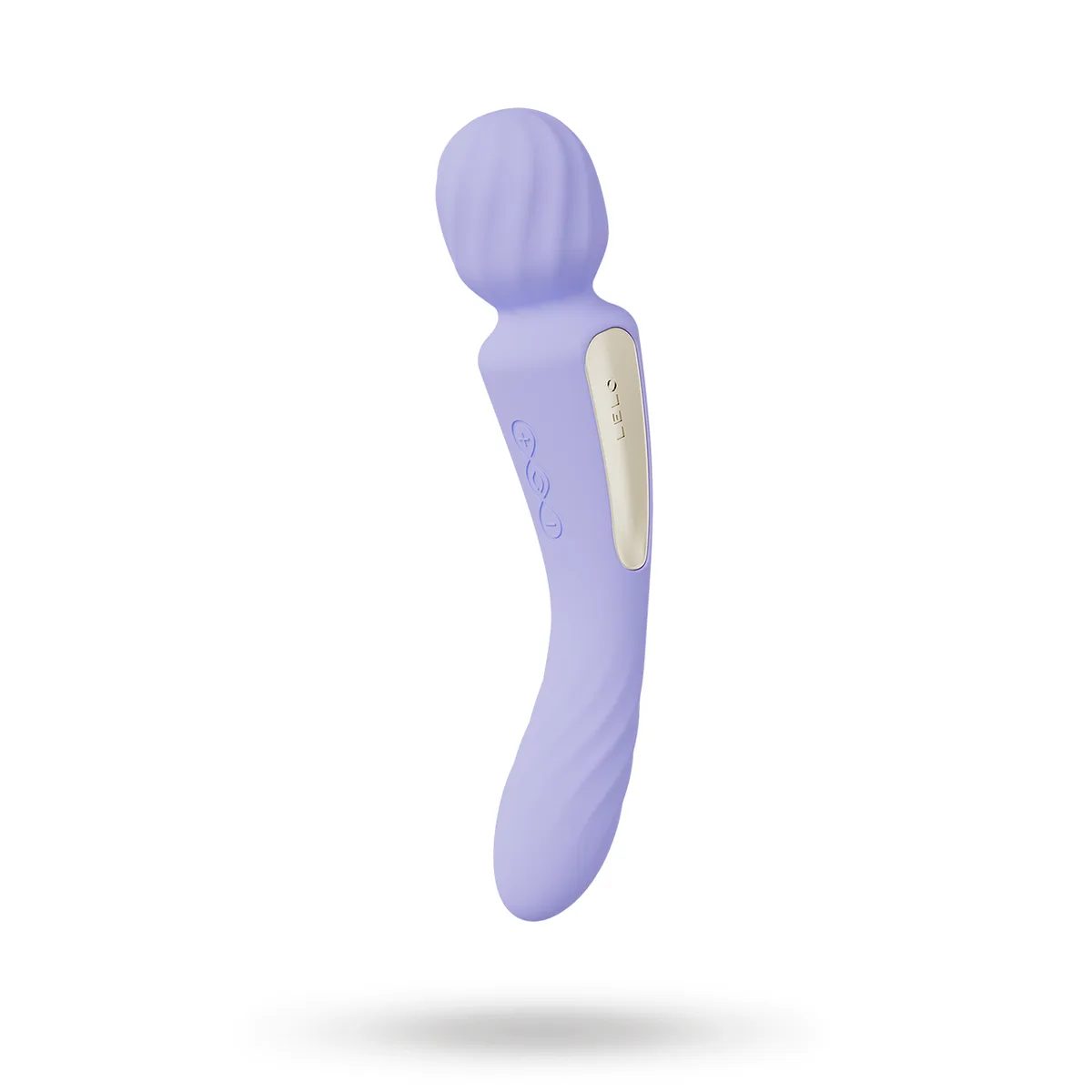
LELO Switch is the brand’s attempt to turn the classic wand massager into something other than a massager wand. Instead of a vibrating head at one end and a passive handle at the other, Switch has two motors, one at each end of the wand. The ridged wand end is intended for the clitoris, the bent and tapered end is intended to be inserted. That’s the whole idea, and it’s also the only feature that really sets the model apart from the rest of the wand range.
The specification looks like this according to the manufacturer: 217 × 64 × 43 millimeters, 83 millimeters insertable length, 167 grams, body-friendly silicone and ABS plastic, a lithium battery of 3.7 volts and 1,000 milliampere-hours, charging time under two hours, runtime up to two hours, 90 days standby, ten vibration modes on the device plus two more in the app, sixteen intensity levels, three buttons, and two LEDs. The maximum sound level is stated as under 63 decibels. The top motor operates at 100 hertz, the handle motor at 93 hertz.
This review is exclusively about the lilac variant with EAN 7350167260278, which the stores sell under the name Lilac. The number is confirmed in the structured product data of two of the retailers: Mshop lists it as gtin13 and Sexonic as EAN13. At the same time, the retailer Vuxen lists two other colors, Soft Pink and Aqua, as their own items with their own prices. Functionally they are identical — but check the number if you compare prices, because the colors are listed on different pages in multiple stores. In Sweden, the lilac variant is sold by four stores at prices between 1,195 and 1,995 SEK, and three of them had it in stock at the price check on September 12, 2026.
A typical wand has one motor. It sits in the head, and the whole point of the shape is that the handle should keep the vibration away from the hand. LELO Switch breaks with that by putting a second motor in the handle — which therefore is no longer a handle but a second working end.
The manufacturer publishes two frequencies, and they are the most concrete indication of what the difference between the tips consists of: the top motor in the wand head runs at 100 hertz, and the handle motor runs at 93 hertz. Seven hertz sounds like nothing, but in this part of the scale it is an audible and tangible difference in character. Lower frequency is normally perceived as a deeper, rumbling vibration, while a higher frequency is perceived as a sharper, more superficial buzzing. So the fact that the insertable tip is lower in frequency is logical: deep vibration is transmitted better through tissue, while superficial vibration does more for an external, nerve-dense point.
What can be established is that Switch is therefore two products in one body, not a single product with two modes. Compared with LELO’s own INA Wave 2, which also stimulates both the clitoris and the G-spot, the difference is fundamental: INA Wave 2 does it at the same time with an arm on each side, while Switch does it alternately by turning the wand. If you want simultaneous dual stimulation, Switch is the wrong product. If you want two clearly different sensations in one purchase, that’s the right one.
The manufacturer does not publish any power specifications per motor, and it does not publish any amplitude measurement either. The frequency figures are therefore the only quantitative information available when comparing the two tips.
LELO’s range includes three models that often end up in the same search, and they solve three different problems. All of the information below comes from the respective official product page.
In summary: if you want maximum power and the longest runtime for external massage, Smart Wand 2 Large is the way to go. If you want simultaneous internal and external stimulation, INA Wave 2 is right. Switch is the compromise that does both things separately, in a body that is smaller and lighter than the large wand, and that can also be controlled from an app.
Material is the only property of an intimate product that neither habit nor care can compensate for, and it determines whether the product is still hygienic after five years. LELO lists two materials for the Switch: body-friendly silicone and ABS plastic. The manual specifies the silicone as food-grade quality. Retailer Vuxen states the material as "ABS + Silicone", and retailer Joyland explicitly writes that the product is phthalate-free.
Silicone is a non-porous material. A non-porous surface can be cleaned, because there are no microscopic cavities where residue can get trapped. This is the single most important property of a material that is meant to sit against the mucous membrane, and that is why the material declaration weighs more than almost every other line in a specification.
Phthalates are a group of plasticizers used to make plastic—especially soft PVC—flexible. The Swedish Chemicals Inspectorate (Kemikalieinspektionen) describes them as substances that can affect the hormone system and make reproduction more difficult, and several of them are therefore restricted or prohibited within the EU in a large number of products. Silicone doesn’t require phthalate plasticizers to become soft; the softness comes from the polymer’s own structure. That’s why "silicone" as a material designation by itself is a better signal than terms like TPE or jelly rubber, which don’t say anything at all about which plasticizers are included.
It’s not clear where the ABS plastic is located from the manufacturer’s specification, but you can see it in the manufacturer’s own product images: the elongated metallized panel on one side of the shaft is a different surface than the matte silicone around it. That’s where the interface sits. So the seam between the panel and the silicone is the point you should wipe extra carefully around, in the same way as on every other product where two materials meet.
A detail from the manual that rarely appears in shop texts: LELO explicitly warns that hand creams and silicone-based lubricants can make the silicone permanently sticky. It’s a stronger wording than the usual warning that the surface "can be broken down", and it’s worth taking seriously because, according to the manufacturer, the damage cannot be reversed.
The ridges are one of LELO’s three marketing arguments for the model. The manufacturer describes them as ultra-soft, patterned ribs that are supposed to stimulate more nerve endings and increase blood flow. The images show them as spiral-shaped ridging over the wand head and a wave-shaped profile along the insertable end.
However, there is one discrepancy in the manufacturer’s own documentation that is worth noting. The product page’s specification lists the surface as "Smooth", while the PDF manual’s specification lists the same line as "Ribbed". It is the same field in the same table, with two different values. The manual and the product images point in the same direction, and the retailer Vuxen also lists the texture as "Ribbed", so the most reasonable reading of the product page’s "Smooth" is that it’s a leftover label. But it’s an example of why a single line on a product page is not enough as a basis.
LELO states the length as 217 millimeters, the width as 64 millimeters, and the height as 43 millimeters, as well as an insertable length of 83 millimeters. The weight is listed as 167 grams on the product page; the manual specifies the same figure as 167 grams with a manufacturing tolerance of ±10 percent, i.e. roughly 150 to 184 grams. It’s unusual that the manufacturer prints the tolerance instead of letting the number stand on its own, and it’s consistently to the reader’s benefit.
Retailers confirm the dimensions. Joyland lists 21.7 × 6.4 × 4.3 centimeters, a penetrating length of 8.3 centimeters, and a weight of 167 grams. Vuxen lists total length 21.7 centimeters and insertable length 8.3 centimeters. Mshop also publishes the packaging dimensions, which the manufacturer does not: 24.50 × 11.00 × 5.20 centimeters according to the retailer Mshop, with a listed weight of 0.17 kilograms. That weight figure is so close to the product’s weight that it is likely the product’s and not the entire package’s—so don’t treat it as shipping weight.
What does 167 grams mean in practice? It’s light for a wand. LELO’s own SMART WAND 2 Large weighs 383 grams, so more than twice as much, and it’s 304 millimeters long versus 217 for the Switch. INA Wave 2 weighs 176 grams—nine grams more than the Switch even though it is seventeen millimeters shorter. In other words, the Switch is in the weight-and-size class of a plug-in vibrator rather than a real massage wand, which is the trade-off you make when choosing it: it’s easier to hold for a long time, but it doesn’t have the large wand’s mass behind the head.
According to the manufacturer, the interface consists of three buttons and two LEDs. The manual names them: one plus and one minus button for intensity, and a central on/off button that also changes modes. The charging port sits in the base of the wand.
The controls are simple enough that you can learn them without a manual, but the manual specifies them exactly. You start the product with the plus button or the center button. A short press on the center button steps through the ten settings. Plus and minus increase and decrease the intensity. A long press on the center button turns it off. If you press plus and minus at the same time, the product turns off and locks—this is the same transport lock as the product is delivered with from the factory.
This is the point where store text often becomes misleading, so it deserves to be clarified. The manufacturer states that the unit has ten settings on the device plus two more via the app, and sixteen intensity levels. Setting and intensity are two independent controls: the setting determines the pattern—steady vibration, pulse, wave—while the intensity determines the strength within that pattern.
In practice, that means the person who counts “ten settings” underestimates the adjustability quite a lot, and the person who multiplies ten by sixteen and ends up at 160 overestimates it just as much. A pulsing pattern at level 3 and the same pattern at level 12 are not two programs; it’s the same program with different strength. The meaningful number is ten basic characteristics, each of which can be fine-tuned in sixteen steps—and that is, compared with LELO’s own ten settings on Smart Wand 2 Large and twelve on INA Wave 2, in the upper part of the brand’s own range.
The pattern in this product category is that the lowest intensity steps are clearly separated, while the highest ones are closer together, because the noticeable difference per step decreases as the motor approaches its maximum power. Expect that, in practice, you return to three or four combinations of setting and intensity, no matter how many there are.
Switch connects to LELO’s app via Bluetooth. The manual describes the connection step by step: you hold the center button for three seconds to start the product with Bluetooth enabled; all LEDs blink at the same time during pairing; and you confirm by pressing the button again when the app has found the device.
According to the manual, what the app adds is four standard control modes—Manual, Screw, Shake, and Swiping—plus two advanced modes. Finish Me Off gradually builds up the intensity, and Out Of Control provides an unpredictable pattern. The manufacturer also describes the Love Bridge function, which lets two people hand over control of each other’s app-connected LELO devices regardless of distance. Settings can be saved for use without the app, and the automatic shut-off can be set between 10 and 20 minutes in the app. The battery level is shown in the app’s upper-left corner.
What can be established is that the app is not a requirement to use the product. The ten modes and the sixteen intensity levels are on the device. The app adds two modes, remote control, and a readout of the battery level. The manufacturer does not publish any information about Bluetooth range, and it also provides no information about how long saved settings remain in the product.
Two behaviors surprise new owners more often than anything else on this model, and both are in the manual.
The first is the transport lock. The product is delivered locked and does not respond to button presses until it is unlocked, which is done either by connecting the charger or by holding the plus and minus buttons pressed for three seconds. A product that seems dead out of the box is therefore likely just locked.
The second is the automatic shut-off. Switch turns itself off every twentieth minute, according to the manufacturer, to save battery. This applies regardless of whether it is being used or left idle, and it is not a standby function that is triggered by movement—it turns off. Can it be changed? Partly: via the app the interval can be set between 10 and 20 minutes, meaning only shorter, not longer. The same design is used on LELO’s Smart Wand 2 Large and INA Wave 2, so it’s a recurring feature across the brand’s range rather than something unique to Switch—but it’s a behavior you should know about before you buy.
Here, LELO differs from several competitors by actually publishing a number. The specification states a maximum sound level of under 63 decibels. The retailer Joyland repeats the same value in its product text.
Read the number correctly. It’s a maximum value, meaning what the product sounds like at the highest intensity, not what it sounds like in normal use. The manufacturer provides neither a measurement distance nor a measurement method, and without those details the number cannot be compared directly to a decibel value from another manufacturer. What can still be established is that LELO publishes a number at all: We-Vibe settles for the wording “whisper quiet” for its Wand 2 and gives no measured value, and LELO publishes no sound value for either Smart Wand 2 Large or INA Wave 2.
A practical tip that applies regardless of model: place the product on a soft surface between uses. A hard tabletop works like a resonance box and noticeably amplifies the sound. This applies in particular to a product with two motors, where one is in the handle and is therefore close to the surface the wand rests on.
The manufacturer’s product page settles for the wording "100 % waterproof", which in itself says nothing measurable. The classification, however, is stated in the manual: on the page with the product label’s symbol information, IPX 7 is given. The retailer Joyland also lists IPX7 in its product text.
The rating comes from the international standard IEC 60529, which defines enclosure ratings for electrical equipment. The number 7 in the second position means that the product has been tested for submersion in water to a depth of one meter for 30 minutes. The letter X in the first position means that protection against solid objects and dust has not been classified—which is normal and irrelevant for a product like this.
The difference compared with a splash-proof product is bigger than the wording suggests. Splash protection covers water droplets and, at best, water jets, but not submersion. Such a product can handle a damp cloth and possibly a shower, but not a bathtub. With IPX7, the entire product can be rinsed off without any caution. If a product lacks an IPX rating entirely, it should be treated as not waterproof—an absence of a rating is never a sign that the product would be approved.
LELO’s own instructions are unusually detailed. Wash the silicone with warm water and antibacterial soap, rinse with clean hot water, and dry with a lint-free cloth or towel. The manufacturer states that the product should be cleaned thoroughly both before and after each use. Cleaning agents that contain alcohol, gasoline, or acetone must not be used.
Lubricant: water-based, and nothing else. The manual explicitly warns that hand creams and silicone-based lubricants can make the silicone permanently tacky. A sticky silicone surface attracts dust and cannot be cleaned back to its original condition—only replaced. The retailer Joyland also recommends water-based lubricants. Oil-based products such as coconut oil also leave a film that is difficult to remove.
Storage: LELO states that the product should be kept dust-free and stored separately from products made of other materials, that it should not be left in direct sunlight, and that it should never be exposed to extreme heat. A satin pouch is included with the delivery. The instruction to keep it separate from other materials is not a courtesy phrase—silicone can react with certain soft plastics and become tacky from nothing more than contact over a long period of time.
The battery is a lithium battery of 3.7 volts with 1,000 milliampere-hours. The manufacturer states the operating time to be up to two hours and the charging time to be under two hours at 5 volts and 1,000 milliampere. The standby time is stated to be 90 days. The manual also provides the rated power: at 5 volts and 1,000 milliampere, i.e. 5 watts, and at 3.7 volts and 800 milliampere, i.e. 2.96 watts.
That both capacity and voltage are published is not a given in this category—for example, it’s more than We-Vibe states for the Wand 2, where only operating time and charging time are listed. With the capacity, it’s possible to calculate: 1,000 mAh at 3.7 volts corresponds to about 3.7 watt-hours, and two hours of operation then means an average power draw of around 1.85 watts. That’s below the stated maximum power of 2.96 watts, which is reasonable because few use the product at the highest intensity all the time.
With the included cable. The manual describes it as a DC plug that connects to a port in the shaft base, while the other end goes into a USB port. The manufacturer’s own image of what’s included in the package shows a white cable with USB-A on one end and a small round connector on the other.
That means that an ordinary USB-C cable doesn’t work. The cable is product-specific, and LELO explicitly states that only original chargers from LELO should be used. The benefit of the solution is that, together with the seal, it’s part of the IPX7 rating. The downside is just as obvious: if you lose the cable, you have to get a replacement, and that’s something a warranty rarely covers.
The LED shows the charging status. It pulses while charging, shows a steady glow when the battery is full, and flashes white when the battery starts to run out. The manual also points out that a fully discharged battery may need several minutes before it responds at all to the charger being connected—which is worth knowing before you start troubleshooting a product that seems dead.
The manufacturer does not publish any information about whether the battery is replaceable, and it also provides no information about the number of charge cycles. What generally applies to lithium-ion batteries also applies here: capacity decreases with the number of cycles, and the product does best when it’s charged regularly rather than being stored completely discharged. The 90-day standby time should be read as how long a fully charged product retains its charge in standby, not as a recommendation to leave it like that for that long.
Hertz are oscillations per second. A motor running at 100 hertz does 100 full vibration cycles per second. It doesn’t say anything about how strong the vibration is—for that you need the amplitude, which LELO does not publish—but it does say something about the character of it.
Put the numbers into context within the brand’s own product range: the Switch top motor is at 100 hertz and the handle motor at 93, while the Smart Wand 2 Large is at 80 hertz and the INA Wave 2 at 60 hertz. So Switch is the fastest-vibrating of the three, and INA Wave 2 is the slowest-vibrating. Lower frequency is normally described as deeper and more rumbling, higher as sharper and more superficial. If you want the deepest, most rumbling option within LELO, the frequency table points to Smart Wand 2 Large rather than Switch—and this is one of the few times a manufacturer publishes enough data for such a comparison to be possible at all.
We do not have price data from shops in your market yet.
The top motor runs at 100 hertz, the handle motor at 93. That’s the whole difference between the two ends expressed in numbers — and it’s more data than most competitors publish.
Three comparisons are relevant: versus LELO’s dedicated massage wand, versus LELO’s dual stimulator, and versus the closest competitor from another premium brand. All the information below comes from each manufacturer’s own specifications.
SMART WAND 2 Large measures 304 × 80 × 60 millimeters and weighs 383 grams. Switch measures 217 × 64 × 43 millimeters and weighs 167 grams. So the large wand is 87 millimeters longer and weighs 216 grams more—more than double the weight.
What Smart Wand 2 Large adds is runtime and mass. The battery is 1,050 mAh, so marginally larger than Switch 1,000 mAh, but the runtime is stated as up to four hours versus Switch’s two. That means double the runtime from a battery that’s only five percent larger, which in practice means the large wand’s motor is gentler on the cell. Charging time is, in return, longer: 2.5 hours at 5.0 volts and 750 milliamps, versus under two hours for Switch.
What Switch adds is everything else: a second motor, a plug-in end with an insertable length of 83 millimeters, app control with two extra modes and a remote function, and a body that’s half as heavy. Smart Wand 2 Large has ten modes and three buttons just like Switch, but no app and no insertable part.
The conclusion is straightforward: if you’re looking for a classic massage wand for external use, and want the longest possible runtime, Smart Wand 2 Large is the more reasonable product. If you’re looking for a product that does two things and can be controlled from your phone, it’s Switch. They compete less than the catalog implies.
INA Wave 2 measures 200 × 65 × 45 millimeters, weighs 176 grams, and has an insertable length of 110 millimeters with a diameter of 37.09 millimeters. It has twelve modes, five buttons, a battery of 520 mAh, and a runtime of up to two hours.
If you compare them row by row, the differences are small but clear. Switch has twice the battery size—1,000 mAh versus 520—but the same stated operating time of two hours, which is to be expected because Switch drives two motors instead of one. INA Wave 2 has a 27-millimeter-longer insertable part. Switch is seventeen millimeters longer overall but weighs nine grams less.
The decisive difference, however, is not numerical. INA Wave 2 is designed to stimulate the clitoris and G-spot at the same time, with an arm that sits on the outside while the main part is inserted. Switch does the same two things alternately, by turning the wand. If you want simultaneous dual stimulation, you shouldn’t buy Switch. If you want two different sensations with clearly different character—100 hertz versus 93—and the option to use one end as a pure wand, then Switch is the answer.
We-Vibe Wand 2 is the closest competitor from another premium brand: a cordless, app-controlled wand with an IPX7 rating, ten or more intensity levels, body-friendly silicone free from phthalates and BPA, and made without latex, plus a two-year warranty. Operating time is stated as up to 120 minutes, and charging time as up to 150 minutes.
So the operating time is the same as Switch’s two hours, but the charging time is noticeably longer: 150 minutes versus Switch’s under 120. We-Vibe, for its part, has the Smart Silence feature, which makes the product vibrate only when it makes contact with the skin—LELO does not publish any equivalent for Switch.
The most telling difference, however, is what isn’t stated. We-Vibe’s product page for Wand 2 publishes neither dimensions, weight, battery capacity, motor frequency, nor sound level. LELO publishes all five for Switch. For the person who chooses based on presented data, that’s an argument in itself: it’s possible to compare Switch with other products in a way you can’t do with Wand 2, and a manufacturer that prints the tolerance on its own weight spec has a different attitude toward specifications than one that omits weight entirely.
Four Swedish stores sell the item with EAN 7350167260278. The cheapest is Joyland at 1,195 SEK, and the most expensive is Vuxen at 1,995 SEK. That’s 800 SEK, or a 67 percent difference, for exactly the same item number, same color, and same packaging.
Three of the four stores had the product in stock at the price check on September 12, 2026: Joyland at 1,195 SEK, Mshop at 1,990 SEK, and Vuxen at 1,995 SEK. Sexonic was at 1,772 SEK but was sold out in the feed. That means the difference between the cheapest available and the second-cheapest available is 795 SEK—one of the largest price spreads for a single item across the entire category, and it’s hard to explain that other than with the stores’ own margin setting on a model that is still new.
Two notes belong here. The first is that Vuxen states a previous lowest price during the last 30 days of 1 990 SEK, i.e. five kronor below the price that was shown at the price check — the price at the most expensive store has therefore been stable and is not a temporary peak. The second is that Joyland lists a comparison price of 2 199 SEK next to its own price of 1 195 SEK. Always check the final price at checkout: shipping costs are added by several stores under a certain order value, and at this price level all four are above their respective thresholds for free shipping.
The price spread is not because any store sells a different variant. All four list the item either under EAN 7350167260278 or under their own article number that is linked specifically to that lilac Switch. This is exactly the kind of situation where it pays off most to compare before you pay.
It’s for you who want both outer and inner stimulation but don’t want to buy two products, and who are willing to turn the wand instead of getting both at the same time. It’s for you who want a wand that’s light enough to hold for a long time — 167 grams versus 383 for LELO’s large wand. It’s for you who want to be able to rinse off the entire product under running water, and for you who appreciate that the manufacturer publishes battery capacity, motor frequencies, rated power, and a noise level instead of just marketing terms. It also suits you who want app control and a remote function with a partner.
It’s not for you who want maximum power and the longest runtime — that’s where Smart Wand 2 Large, with its four hours and larger body, is the more reasonable choice. It’s not for you who want simultaneous dual stimulation, where INA Wave 2 is the right product. It’s not for you if you’re bothered by a product that turns itself off every twentieth minute. And it’s not for you who want to charge with the same cable as your phone: the charging cable is product-specific, and the manufacturer states that only original chargers may be used.
One more thing belongs in your decision. The price tag starts at 1 195 SEK at the cheapest store, but sits at almost 2 000 SEK at three out of four. So if you shop at the wrong store, you pay 67 percent more for exactly the same item — a bigger difference than the one between the Switch and several of the alternatives in this comparison. Check the EAN number and the price before you add to your cart; it’s the single most worthwhile minute you’ll spend on this purchase.
The warranty question requires more space than usual for this product, because the manufacturer’s own documents do not say the same thing.
LELO’s product page for Switch states a two-year warranty counted from the purchase date, and the brand’s general warranty page confirms that all LELO products are covered by a two-year worldwide manufacturer’s warranty, with the addition that the warranty period is extended in countries that require a longer period. The Switch PDF manual, on the other hand, states a one-year warranty, with the heading “1-YEAR WARRANTY” and the text that LELO guarantees the product for one year from the purchase date. It’s a discrepancy in the manufacturer’s own material, not two different products.
Which one applies? The two published web pages are consistent and newer in how they’re worded, and the warranty page is general for the entire range, so the two-year warranty is the one that reasonably weighs the most. But save the manual and the receipt, and be prepared to refer to the warranty page if a case is handled according to the manual’s one-year text. Either way, it’s worth noting that the warranty covers defects in material and workmanship that affect function — not cosmetic wear, and not damage from accidents, misuse, or neglect. Opening the product voids the warranty.
LELO markets a ten-year quality guarantee in addition to the two-year warranty, and the wording on the product page — that it covers the product for ten years after the two-year warranty has expired — is easy to read as a twelve-year product warranty. It’s not.
The terms page is explicit: the quality guarantee gives 50 percent off a new purchase on lelo.com, not a free replacement product. The discount can be used once, on up to five items in the same order, and bundles and the brand’s Luxe series are excluded. It’s a loyalty discount for the person whose product broke, not a guarantee in the usual sense — and the difference is worth knowing before you let the ten-year promise factor into a purchase decision.
Two other commitments should be clarified in the same way. The extended warranty adds another twelve months after the manufacturer’s warranty ends, but it must be activated within 30 days of the purchase via product registration on lelo.com. The satisfaction guarantee applies according to LELO only to purchases in the brand’s own web shop, provides a value voucher instead of a refund in money, requires a request within 30 days, and puts the return shipping cost on the customer. So if you buy from any of the four Swedish stores listed above, you’re therefore not covered by any of them.
Another note belongs in this section. The manual states that LELOi AB declares the product to comply with the Radio Equipment Directive 2014/53/EU and the RoHS Directive 2011/65/EU, and refers to lelo.com/regulatory for the complete EU declaration. On that page, about twenty LELO models are listed, but LELO SWITCH is not among them as of the inspection date. In other words, the declaration is made in the manual but not published at the address the manual points to.
What always applies, however, are your statutory rights. Under the Swedish Sale of Goods Act (konsumentköplagen), you have a right to complain for a period of three years in the event of defects in the goods, regardless of what the manufacturer warrants. For distance purchases, you also have a right of withdrawal within fourteen days under the Act on Distance Contracts and Contracts Outside Business Premises. Please note that, in practice, the right of withdrawal is limited for hygiene products that have been taken out of a sealed package—however, the right to complain in the event of defects always applies. If you have questions about what applies in your case, the Swedish Consumer Agency, Konsumentverket, will guide you via Hallå konsument.
LELO Switch Lilac is ranked på plats 3 av 11 in wand vibrator best i test, where the entire category is compared against each other using five shared criteria. Guiden vinns av We-Vibe Wand 2 Purple.
Every numerical piece of information in the text can be traced to one of the sources below. The links were checked manually on the specified date.
This page is machine-translated from Swedish. Read the Swedish original