

Review
Review: Satisfyer Double Joy clitoral vibrator with an app
App-controlled couple vibrator as an alternative to the remote control.
13 September 2026
Review · Pair vibrator · Remote control with SenseMotion
Lelo’s remote-controlled pair vibrators reviewed against the manufacturer’s own specifications, user manual, and reseller datasheet, plus price data from four Swedish stores. Eight modes, two of which are motion-controlled, 12 meters range, IPX7, max 50 decibel, and two-year warranty — but three different battery figures in three of the manufacturer’s own documents.
The remote-controlled couple vibrator for those who don’t want an app. SenseMotion lets one partner control the intensity with hand movements from up to 12 meters away; the product is IPX7, and the remote control is designed to withstand water when the lid is sealed—which one of the closest competitors expressly can’t manage. What you pay for is a product-specific DC charging cable, a remote control that’s necessary to access more than two of the eight modes, and a battery specification where the manufacturer itself publishes three different versions.
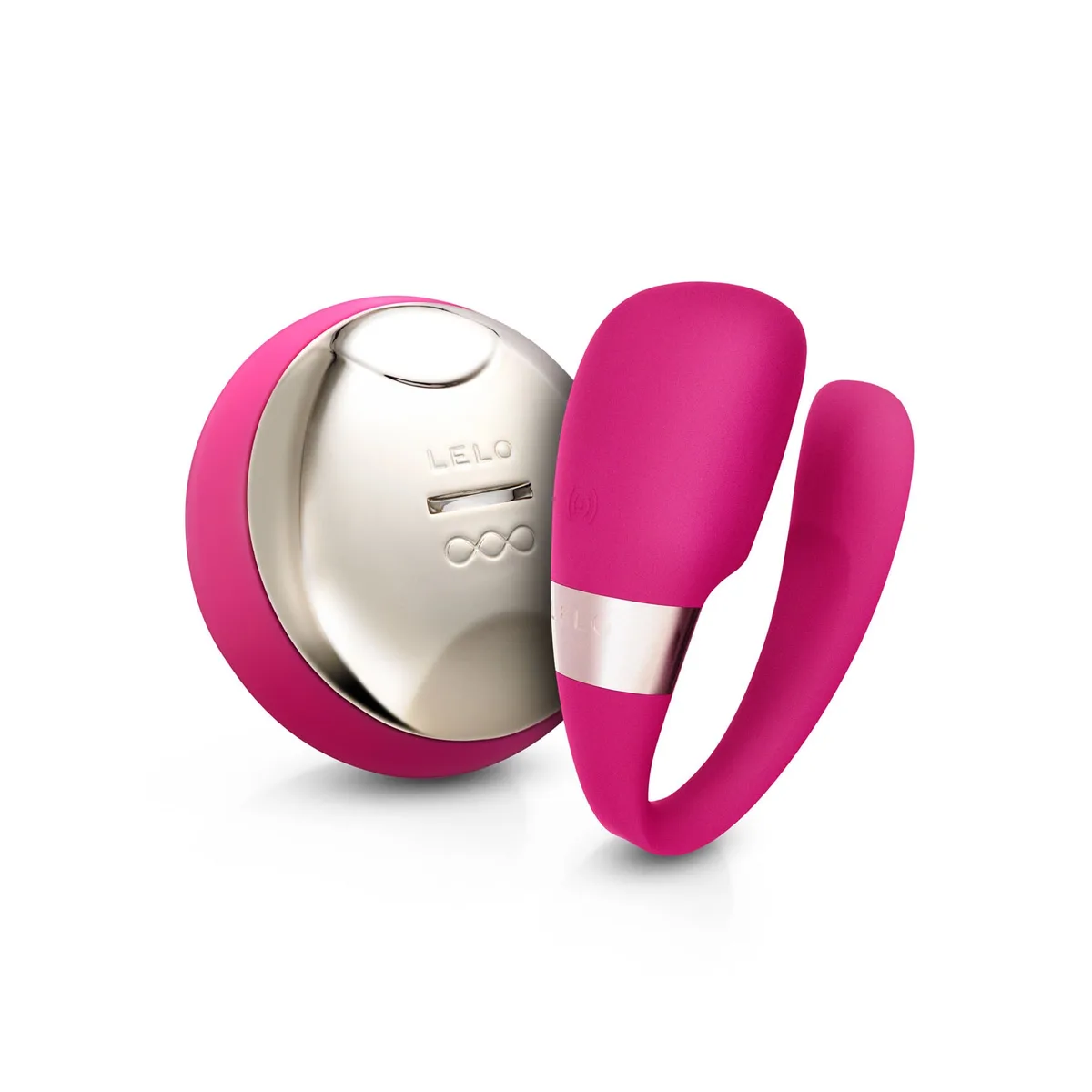
Lelo Tiani 3 is a type of couple vibrator of the kind that is worn by one partner during intercourse. The shape is a soft U: the shorter, narrower arm is inserted and sits against the G-spot; the wider arm lies on the outside against the clitoris; and the vibrations reach both partners because the entire body sits between them. What sets Tiani 3 apart from the vast majority of couple vibrators is that control is not done via an app but via a physical, wireless remote control with a motion sensor. The manufacturer calls the technology SenseMotion.
The specification is as follows according to Lelo’s own product page: dimensions 78 × 44.5 × 32 millimeters, an insertable length of 78.2 millimeters, weight 42 grams, body-friendly silicone and ABS plastic, eight modes, a wireless range of up to 12 meters, a maximum sound level of 50 decibels, a frequency of 125 hertz, automatic shut-off after 20 minutes, and full water resistance. The interface consists of a single button on the product itself plus the remote control. In Sweden, the item is sold by four stores at prices between 1,095 and 1,595 SEK, and two of them had it in stock at the price check 12 September 2026.
This review is exclusively about the cerise-colored variant with EAN 7350022279346. Lelo sells Tiani 3 in three colors, and the manufacturer’s own dealer data sheet lists them with separate item numbers: Cerise 7350022279346, Deep Rose 7350022278226, and Black 7350022279353. Functionally, they are identical, but the color affects the price: Joyland lists the black variant for 949 SEK on the same page where the cerise is sold for 1,095 SEK. Therefore, always check the number when comparing, especially since the Swedish stores call exactly the same color three different things—Joyland and Vuxen write “cerise”, Joyme writes “pink”, and Sexonic writes “fuchsia”, but all four list the same EAN.
SenseMotion is Lelo’s name for the fact that the remote control contains a motion sensor and that the sensor’s movements are translated into vibration control in the product. The manual describes two separate motion modes and is unusually specific about what they do.
In SenseMotion mode 1, you control it by tilting. The manufacturer states that a horizontal remote control corresponds to 10 percent intensity, and that a vertical remote control corresponds to 100 percent, with a sliding scale in between. So you hold the remote in your hand and angle it upward to increase the intensity. In SenseMotion mode 2, you instead control it with movement speed: faster movements in any direction give higher intensity, up to 100 percent. So the difference between the modes is not what type of vibration is produced, but which hand movement triggers it.
What this means in practice is that one partner can control it without looking at a screen, and without a program having to be opened, paired, and kept connected. What can be established purely technically is that, according to the manufacturer, the range is up to 12 meters, which is significantly more than what a physical remote control needs in a bedroom—the number is relevant only if the product will be used in different rooms. The downside of this solution is just as simple: a remote control is an item that can be misplaced, and it runs on replaceable AAA batteries rather than on the product’s own battery.
The Tiani family consists of several models that look the same in miniature and get mixed up in store listings. The differences, however, are clearly stated in the manufacturer’s own specifications.
So the choice between them is not about the number of modes— all three are listed as having eight— but about the number of motors and how you want to control it. If you want a physical remote control, Tiani 3 and Tiani Duo are the only options within the family. If you want to control it via your phone, you should buy Tiani Harmony, and you’ll also get two motors instead of one.
Material is the only characteristic of an intimate product that can’t be compensated for through habit or care, and it determines whether the product is still hygienic after five years. Here, the manufacturer’s information is also phrased a little differently depending on where you read it, which is worth knowing.
Lelos product page states the material as FDA-approved body-safe silicone and ABS plastic. The user manual is more specific and breaks it down: the massager is listed as PC+ABS and body-safe silicone, the remote control as body-safe silicone and ABS plastic. The retailer data sheet states phthalate-free silicone and ABS plastic, with the finish being matte and glossy. Overall, that means the silicone is where the product comes into contact with the body, while polycarbonate and ABS provide the structure—among other things in the metallized band around the waist and in the base where the charging port sits.
Silicone is a non-porous material. A non-porous surface can be cleaned because there are no microscopic cavities where residue can get trapped. This is the single most important property of a material that should sit against mucous membranes, and that is why the material declaration weighs more heavily than almost all other lines in a specification. ABS and polycarbonate are also non-porous, so the boundary between the materials is not, by itself, a hygienic weak spot—but the seam between the silicone and the metal band is the point that benefits the most from being rinsed extra carefully.
Vuxen also states that the product is flexible and that the stiffness is firm, with a smooth texture. This matches the manufacturer’s own description of a flexible construction that should be able to adapt to different body shapes, and it is one of the properties that actually matters for a product that is meant to stay in place without being held there.
Phthalates are a group of plasticizers used to make plastic—especially flexible PVC—pliable. Kemikalieinspektionen describes them as substances that can affect the hormone system and make reproduction more difficult, and several of them are therefore restricted or prohibited within the EU in a large number of products. This particular product category is a recurring subject of supervision because it contains flexible plastic against the skin.
Lelos retailer data sheet explicitly states that the product is 100 percent free from phthalates, and Vuxen repeats the information in Swedish. It is an unambiguous declaration, unlike labels such as "TPE" or "jellygummi", which say nothing at all about which plasticizers are included. Silicone does not require phthalate plasticizers to become soft—the softness comes from the polymer’s own structure—and therefore silicone as a material specification is, in itself, better information than almost any other entry in a product specification.
The wording "FDA-approved" deserves, however, a clarification, since it comes up in store texts as if it were a product certification. The U.S. Food and Drug Administration does not approve sex toys as products. What exists are material grades that meet the authority’s requirements for food or medical contact, and that is the meaning the manufacturer uses. So the information says something about the raw material, not about the finished product. The certification Lelo refers to at the product level is ISO 3533, the international standard for the safety of sex toys, which is stated on the product page.
Lelo lists the dimensions 78 × 44.5 × 32 millimeters and an insertable length of 78.2 millimeters. “Adult” lists the same thing in Swedish: total length 7.8 centimeters and a maximum diameter of 3.2 centimeters. That makes the Tiani 3 a small product — it fits in a clenched hand, and it’s significantly smaller than most vibrators sold in the same price range. According to the manual, the remote control is 64 × 64 × 25 millimeters, i.e., roughly the size of a puck in the palm of your hand.
The weight information requires a note. The manufacturer’s product page and the reseller datasheets both state 42 grams, while the manufacturer’s own user manual lists 80 grams for the massager and 30 grams for the remote control. It’s a duplication of the weight in the same manufacturer’s documentation, and Lelo doesn’t explain the difference. Two interpretations are possible: either the manual’s 80 grams refers to something other than the product page’s 42 grams — for example, an earlier construction or a different weighing method — or one of the figures is incorrect. Worth noting is that the Tiani Duo, which is larger (90 × 45 × 30 millimeters), is listed as weighing exactly 80 grams on its product page, and that the Tiani Harmony is listed as weighing 48 grams. Based on the dimensions, 42 grams appears to be the more reasonable value for the Tiani 3, but until the manufacturer corrects it, you should treat the weight as approximate.
Another number circulates in the trade and should not be confused with the product’s weight. Joyme, in its field for additional information, states a weight of 480 grams and dimensions of 47 × 245 × 110 millimeters. That’s the store’s shipping data, not the product’s — Lelo’s own datasheet lists the package dimensions as 268 × 110 × 57 millimeters, which is in the same order of magnitude as Joyme’s package measurements. So the shipping weight includes the cardboard box, remote control, charging cable, satin pouch, manual, and warranty card.
The interface is intentionally minimal. Lelo states that the product has a single control — a button — and that everything else is handled from the remote control, which, according to the manual, has three buttons. The manual describes the entire operation step by step, and some details are difficult to find anywhere else.
The product is delivered locked for transport. The lock is released by connecting the charger, which is worth knowing before you assume the item is broken. The remote control is unlocked by holding down the plus and minus buttons at the same time for three seconds until the light turns on. After that, the massager is started with its own button, and the remote control is turned on with the plus button. When the wireless connection is established, the lights on both the massager and the remote control turn on.
The breakdown of the eight modes is clearly listed. Adult form factor states the most straightforward version: eight stimulation modes—six standard and two created by moving the remote control. Joyland says the same thing, and Lelo’s own dealer database lists eight stimulation modes—six standard and two SenseMotion. The manual confirms the structure from the other side as well: with the remote control, you switch between six vibration patterns, and in addition to those there are SenseMotion mode 1 and SenseMotion mode 2.
So what can be established is that “eight modes” does not mean eight vibration programs. It means six programs plus two motion-controlled modes where the intensity is not preset but is determined by the hand. It’s a meaningful difference when comparing specifications between brands: a competitor that lists ten programs offers ten fixed patterns, while Tiani 3 offers six fixed plus two continuously adjustable.
One limitation that rarely appears in the store texts is shown in the manual. Without the remote control, the product’s own button switches only between two modes. So if you lose the remote control, or if its AAA batteries are out, then you don’t have eight modes left—you only have two. That is the single most important practical consequence of having the control in a separate device.
The manufacturer states a wireless range of up to 12 meters, and Joyland emphasizes that it is three times longer than with other wireless products. That comparison is the store’s own and has no named counterparty, so it should be read as marketing. What can be confirmed, though, is that 12 meters is enough for considerably more than just one bedroom, and it’s that kind of range that makes it possible for one party to keep control from another room.
A comparison is appropriate here. App-controlled couple vibrators use Bluetooth, whose range in practice is limited by walls and bodies. Tiani 3 instead uses a radio connection that Lelo, in its declaration of conformity, describes as a non-specific short-range device according to Directive 2014/53/EU. The manufacturer does not publish which frequency or transmitter power the connection uses, so no direct technical comparison with Bluetooth can be made based on the published information.
Lelo’s product page states automatic shut-off after 20 minutes. The same function is available on the Tiani Duo and Tiani Harmony, meaning it’s on the entire family. The function saves battery life and serves as a safety margin—it prevents a product that’s been put away from continuing to run—but it’s worth knowing for another reason as well: with a stated operating time of between one and two hours, the limit means that a use is, in practice, ended by the product itself if no button is touched. You can restart it, but it’s not a product that can be left running.
Here, Lelo is unusually clear compared with the rest of the category. The product page states a maximum sound level of 50 decibels, and both the user manual and the retailer data sheet state under 50 decibels. Joyme presents the information in Swedish as “max 50 dB”. It’s a published ceiling, not a marketing comparison—the majority of manufacturers in this category are content with wording like “whisper-quiet”.
What such a value doesn’t say is at least as important. Lelo does not publish which distance the measurement was made at, which weighting was used, or at which of the eight settings the ceiling is reached. Without those details, the figure can’t be meaningfully compared with another manufacturer’s figure, because decibels drop with distance and because A-weighted and unweighted measurements give different results. Read 50 decibels as an order of magnitude from the manufacturer, not as a measurement you can calculate from.
The second numeric detail related to sound is the frequency, and unfortunately it’s contradictory. The product page and the retailer data sheet state 125 hertz, while the user manual states 130 hertz. The difference is small and it’s likely not noticeable, but it’s another example that Lelo’s three documents for the same product are not synchronized. By comparison, the manufacturer states 130 and 105 hertz for Tiani Duo’s two motors and 208 and 161 hertz for Tiani Harmony’s—so Tiani 3 is in the lower, more muted part of the family’s frequency range.
A practical tip that applies regardless of model: place the product on a soft surface between uses. A hard tabletop works like a resonance box and noticeably amplifies the sound.
Lelo's product page markets the Tiani 3 as 100 percent waterproof and suitable for bath and shower. The dealer data sheet is more precise and states that the product is submersible to a depth of one meter, thanks to a vacuum-sealed charging port. However, the exact enclosure class is not shown on the product page at all, but in the symbol box on the second-to-last page of the user manual, where the IPX 7 marking is embossed together with the serial number and manufacturing date fields. It’s a good example of why it pays to open the manual before buying.
The rating comes from the international standard IEC 60529, which defines enclosure classes for electrical equipment. The number 7 in the second position means that the product is tested for submersion in water to a depth of one meter for 30 minutes. This matches the data sheet’s wording about a one-meter depth exactly, and it means that the entire product can be rinsed under running water without any caution regarding the button or the charging port.
There’s a detail that’s easy to miss and that sets the Tiani 3 apart from one of its closest competitors. Lelo's manual instructs that the remote control’s cover must always be properly closed before it’s used in water, and it describes how the cover is opened with the included plastic key via a ten-turn twist. The wording means that the remote control is intended to withstand water when it’s correctly sealed — but also that the seal is the user’s responsibility every time the batteries are changed.
We-Vibe states clearly for its Chorus that the product is IPX7 while the remote control is only splash-resistant and not fully waterproof. So anyone who wants a remote-controlled couples vibrator that works in the bathtub has a reason to choose Lelo — provided that the cover is really locked.
The manual’s instructions are specific. Rinse the product and spray it with Lelo’s own cleaning product, rinse again and let it dry. Alternatively, the silicone is washed with warm water and antibacterial soap, rinsed with clean hot water, and dried with a lint-free cloth. Cleaning should be done both before and after every use.
Two prohibitions are explicit. Never use cleaning agents that contain alcohol, gasoline, or acetone. And don’t use silicone-based lubricant—the manufacturer states that hand creams and silicone-based lubricants can make the silicone permanently sticky. It’s the same mechanism that applies to all silicone products: silicone dissolves silicone, the surface breaks down and becomes porous, and a porous surface can’t be cleaned properly anymore—only replaced. Joyland recommends water-based lubricant, which is the only correct answer.
Regarding storage, the manual says the product should be stored dust-free and kept separate from objects made of other materials, that it must not be exposed to direct sunlight, and that it must never be exposed to strong heat. The latter is important despite IPX7: boiling water and a dishwasher are out of the question. A satin storage pouch is included in the delivery.
This is the weakest part of Tiani 3’s documentation, and it deserves to be presented plainly rather than being smoothed over. Lelo publishes three different sets of battery data for the same product, in three separate documents.
So all three are the manufacturer’s own. All three agree on the voltage of 3.7 volts, the charging time of two hours, and the standby time of 90 days, but they disagree on both the capacity and the operating time.
It is possible to argue which piece of information is most likely, but the matter can’t be determined without the manufacturer correcting it. Still, two observations are relevant. First, the charging current matches the capacity in both cases—70 milliamps for a cell of 70 mAh, 200 milliamps for a cell of 200 mAh—which suggests that the two sets come from two different design generations rather than that a figure is simply a misprint. Second, Lelo lists 200 mAh for both the Tiani Duo and the Tiani Harmony, meaning for the two closest sibling models.
So the practical advice is: count on the lower of the stated operating times, i.e. about one hour, and treat two hours as a best-case scenario. One hour is short for the category—We-Vibe lists 90 minutes for Chorus, and Lelo itself lists up to two hours for both the Tiani Duo and the Tiani Harmony. With automatic shutoff after 20 minutes, an hour of operating time is still enough for multiple uses between charges, but it isn’t a product you take with you for a weekend without a charger.
Charging takes place via a DC outlet in the product’s base. The manual states that the base mount is twisted counterclockwise to expose the outlet, that the DC connector is plugged in, and that the other end of the cable is connected to a USB port. The LED pulses during charging, lights up with a steady glow when the battery is fully charged, and blinks white when it starts to run low. The manufacturer states that only original chargers from Lelo may be used, and the manual states that the product should be charged for two hours before first use.
According to the retailer datasheet, the charging port is vacuum-sealed, which explains why it can be used in a product that is submersible to one meter. The downside, however, is clearly noticeable and should be factored in before purchase: the cable is product-specific with a DC connector, not USB-C, so no standard phone cable works. If you lose it, you must get a replacement from the manufacturer, which sells chargers and cables as separate accessories.
One detail sets the documents apart. The product page’s shipping contents list a USB charging cable, while the retailer datasheet lists a wall charger. This suggests that the package contents have changed over time, which is common when manufacturers switch to USB power. What you can count on today is the USB-connected cable that the product page and manual describe.
The remote control does not have a rechargeable battery. According to the manual, it is powered by two AAA batteries, and two such batteries are included in the delivery. It’s a trade-off rather than a drawback: the advantage is that the remote control never needs to be charged and it works right away even after months in a drawer; the disadvantage is that the batteries are consumables and the cover must be opened to replace them.
Opening the cover is a detail worth reading up on. The manual states that the cover is opened with the included plastic key by twisting it ten degrees counterclockwise, and it explicitly warns against using other tools, such as coins, because they can damage the remote control’s surface. The same manual also points out that the cover must be securely attached before the remote control is used in water. In other words: the key is not an accessory to throw away.
We do not have price data from shops in your market yet.
Three of the manufacturer’s own documents state three different combinations of battery capacity and operating time for the exact same product.
Three comparisons are relevant: against the two sibling models within the Tiani family and against the best-selling competitor in the category of remote-controlled pair vibrators. All information below comes from the respective manufacturers’ own specifications. We do not provide prices for the comparison models, because they are not included in the price data that forms the basis for this review.
Tiani Duo is the same basic concept, with one more motor. Lelo states two motors with frequencies of 130 hertz and 105 hertz respectively, compared to Tiani 3’s single motor at 125 hertz according to the product page. In practice, the difference is that the inner and outer arm can work with different characteristics at the same time, instead of having to split up the same vibration.
Duo is also larger and heavier: 90 × 45 × 30 millimeters and 80 grams, versus Tiani 3’s 78 × 44.5 × 32 millimeters and 42 grams. The battery is specified as 200 mAh and 3.7 volts, with up to two hours of operating time and two hours of charging at 5.0 volts and 200 milliampere. Both have eight modes, a wireless remote control, a maximum sound level of 50 decibels, and automatic shut-off after 20 minutes. Color options are limited to black and ocean blue.
The conclusion is simple: Duo is the upgrade for anyone who wants dual motors and a published battery capacity without contradictions. Tiani 3 is the smaller, lighter product and the only one in the family available in cerise.
Harmony is the model Lelo built for people who would rather control it via phone. Two motors at 208 and 161 hertz—so noticeably higher frequencies than in both Tiani 3 and Tiani Duo—45 × 30 × 90 millimeters, 48 grams, a lithium-ion battery at 3.7 volts and 200 mAh, charging two hours at 5.0 volts and 200 milliampere, and an operating time of up to two hours. Automatic shut-off after 20 minutes and 90 days of standby, just like on Tiani 3.
The decisive difference is visible in the contents of the delivery. Harmony is delivered without a remote control—the package contains the product, a USB charging cable, a satin pouch, a warranty card, and a manual. So any control beyond the single button takes place via the app. That makes Harmony the better choice if you want to be able to control it remotely over the internet and avoid an extra item, and the worse choice if you don’t want a phone involved, or if you want to be able to give the remote control to someone who shouldn’t have to install anything.
We-Vibe Chorus is the most direct competitor and almost exactly the same size. We-Vibe states the length as 78 millimeters, the height as 44 millimeters, and the width as 33 millimeters, versus Lelo’s 78 × 44.5 × 32 millimeters. It’s within one millimeter for each measurement, which says something about how closely the category has converged in terms of form.
The differences are in other places. Chorus states a runtime of 90 minutes and a charging time of 120 minutes—so longer runtime than Tiani 3’s lowest stated value and shorter than its highest. The material is listed as ABS and body-friendly silicone made without phthalates, BPA, or latex, which is a more detailed disclosure than Lelo’s: Lelo lists phthalate-free, but mentions neither BPA nor latex. Chorus remote measures 37 × 96 millimeters, meaning an oblong shape instead of Lelo’s round puck at 64 × 64 × 25 millimeters.
The most important difference for someone who uses them together is the one mentioned already: We-Vibe explicitly states that the Chorus remote control is only splash-proof, not waterproof, while Lelo’s manual assumes that Tiani 3’s remote control is used in water as long as the lid is sealed. Both manufacturers offer a two-year warranty. If you choose based on published runtime and the material disclosure, We-Vibe wins. If you choose based on the remote control in water and the fact that you don’t need an app, Lelo wins.
Four Swedish stores sell the item with EAN 7350022279346. The cheapest is Joyland at 1,095 SEK, and the most expensive is Vuxen at 1,595 SEK. That’s a difference of 500 SEK or close to 46 percent for the exact same item number, the same color, and the same packaging. Joyme is at 1,179 SEK and Sexonic at 1,505 SEK.
The stock situation is at least as important as the price spread. Only two of the four stores had the product in stock at the price check 12 September 2026: Joyland at 1,095 SEK and Joyme at 1,179 SEK. So the difference between the cheapest and the second-cheapest available is 84 SEK, not 500. Stores that list a product as sold out may keep an old price in the feed, and that price is rarely what you actually end up paying when the item comes back into stock.
One reservation belongs here. Joyland also states on its own product page that the item is estimated to be in stock on September 30, 2026, and that orders are shipped the same day the item comes into stock. Therefore, check the delivery time at checkout before you pay, even when the price feed shows stock status. Joyme, for its part, writes that there are only four copies left.
The price spread isn’t because any store sells a different variant—we’ve checked the EAN number against the manufacturer’s own EAN list, and Sexonic also publishes the EAN13 openly on its product page. It comes down to the stores’ own markup on a model that has existed long enough to be priced differently depending on how it’s stocked. Worth knowing: Joyland lists 1,899 SEK as the regular price, which means that 1,095 SEK is a campaign price that can return.
Is the color negotiable? There’s more money to save. Joyland lists the black Tiani 3 — EAN 7350022279353 according to the manufacturer’s datasheet — for 949 SEK on the same page. It’s 146 SEK cheaper than cerise for a product that’s identical in everything except the color.
The prices in the table above are updated when the shops update their product feeds, but always check the final price at checkout. Shipping costs are added at most stores under a certain order value.
It’s for you if you want a dual motor vibrator with a physical remote control instead of an app. That’s the model’s clearest distinguishing feature, and it’s a real argument: no pairing, no installation, no account, and a control that can be reached across to someone else without any further explanation. SenseMotion also means that the person holding the remote control uses hand movements instead of button presses, which is difficult to do on a touchscreen.
It’s for you if you want to be able to take the product into the bath or shower. IPX7 according to the manual, submersibility to one meter according to the datasheet, and a remote control that is intended to withstand water when the lid is closed are a combination that one of the nearest competitors explicitly doesn’t offer. It also fits you if you want something small: 78 × 44.5 × 32 millimeters and 42 grams is a product that barely shows up in a toiletry bag.
It’s not for you if you require unambiguous battery data. Three of the manufacturer’s own documents state three different combinations of capacity and operating time, and that’s a reasonable reason to rule out the model if you want to know exactly what you’re buying. It’s also not for you if you want to charge with the same cable as your phone — the charging port is a DC socket and the cable is product-specific. It’s not for you if you want two motors; then Tiani Duo or Tiani Harmony is the right model within the same family. And it’s not for you if you want to be able to control it over the internet, because the remote control’s range stops at the 12 meters the manufacturer states.
One final objection belongs in the decision. Since the product’s own button only switches between two modes, the remote control isn’t an accessory but a requirement in order to use all eight modes of the specification. Anyone who knows that small items disappear around the house should factor that in.
The warranty question requires clarification, because the stores give different answers and because the manufacturer’s own documents do the same. Lelo’s user manual and dealer data sheet state a one-year warranty, while Lelo’s product page and warranty terms state two years. Vuxen repeats the one-year information, Joyme the two-year information. What applies today is the warranty terms on lelo.com, where the manufacturer writes that all Lelo products are covered by a two-year worldwide manufacturer’s warranty, and that the warranty period is extended in countries where legislation requires a longer time. The one-year text in the manual is a leftover from an older edition.
Read the terms before you count on the warranty. It covers defects in workmanship or materials that affect the product’s function. It does not cover cosmetic wear, accidents, incorrect use, or neglect, and taking apart the product or its accessories voids the warranty. Lelo replaces the product free of charge in an approved claim, but shipping costs are not reimbursed, and the warranty for a replacement product is counted from the original purchase date — not from the replacement.
The so-called ten-year warranty is the claim that is most often misunderstood, and it should be read carefully. It is not a warranty in the usual sense of the word. According to Lelo’s own terms, it provides a 50 percent discount on lelo.com when you buy a new product, once per customer, on up to five items in the same order, and it does not apply to bundles or the Luxe series. It can be used if the product breaks after the end of the two-year warranty period or if you’ve lost your proof of purchase. It’s an offer of a discount on a new purchase, not a promise about repair or replacement.
Lelo also explicitly states that it does not offer refunds, store credit, or a satisfaction guarantee, in addition to refunds for unopened items purchased on lelo.com within 14 days. If you shop at any of the four Swedish stores listed above, then you are therefore not covered by any of the manufacturer’s return promises.
What always applies, however, are your statutory rights. Under the Consumer Sales Act, you have the right to make a complaint about defects for three years, regardless of what the manufacturer promises. For distance selling, you also have a right of withdrawal for fourteen days under the Act on Distance Contracts and Contracts Outside Business Premises. Be aware that in practice the right of withdrawal is limited for hygiene products that have been removed from a sealed package—however, the right to complain about defects always applies. If you have questions about what applies in your case, Konsumentverket (Swedish Consumer Agency) provides guidance via Hallå konsument (Hello Consumer).
Lelo Tiani 3 Cerise is ranked på plats 7 av 15 in couples vibrator best i test, where the entire category is compared against each other using five shared criteria. Guiden vinns av We-Vibe Sync O Petrol Green.
Every numerical piece of information in the text can be traced to one of the sources below. The links were checked manually on the specified date.
This page is machine-translated from Swedish. Read the Swedish original