

Review
Review: Womanizer Next
Air pressure technology with three depth levels — 42 combinations and a five-year warranty.
29 July 2026
 Author's pick
Review · Mini-wand · App-controlled massage wand
Lovense app-controlled mini-wands reviewed against the manufacturer’s own specifications and price data from eight Swedish stores. Up to 370 minutes of runtime, seven preset modes plus ten programmable, 233.88 millimeters and 299.9 grams, IPX6 according to IEC 60529, and a one-year warranty — at a price that differs by 107 percent between the cheapest and the most expensive store.
The most long-lasting wand in the comparison: up to 370 minutes of runtime is a little more than three times what We-Vibe Wand 2 states, and it’s also shorter and lighter than both Lelos and Satisfyers’ wands. Seven preset modes are built into the product; the three basic levels can be switched via the app, and ten of your own patterns can be saved so it works without a phone. What you give up is the protection rating — IPX6 is enough for rinsing but not for the bathtub — a one-year warranty, a product-specific charging connector, and a specification where neither battery capacity, sound level, nor the Bluetooth version is published.
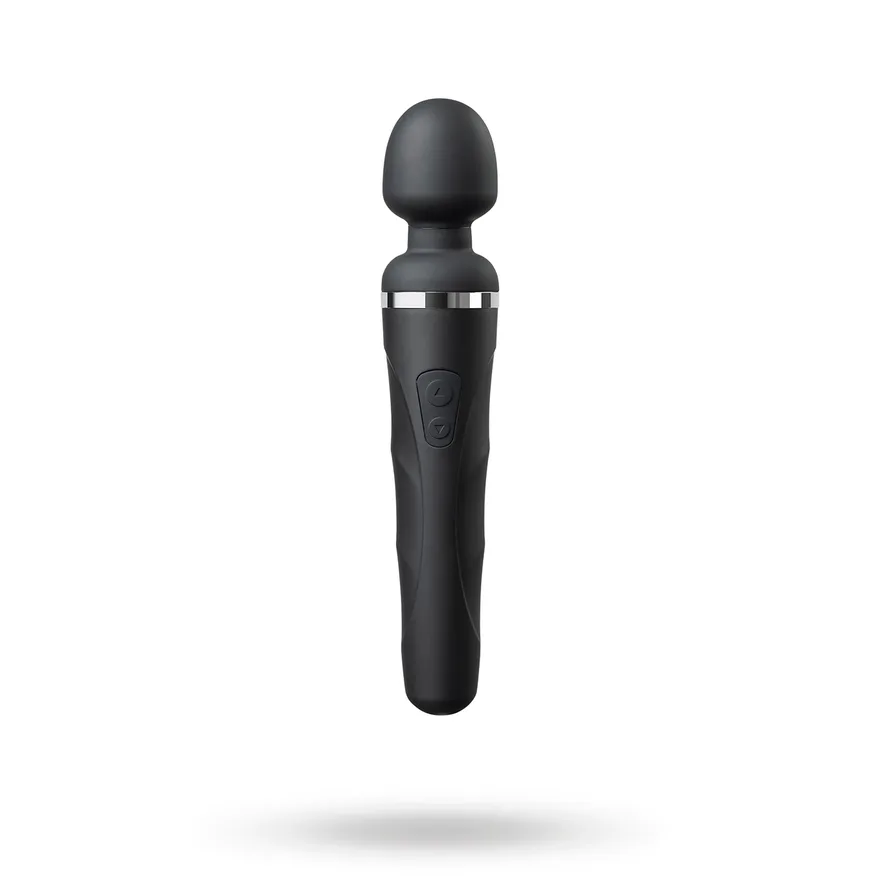
Lovense Domi 2 is a cordless mini wand with Bluetooth. In its own product data, the manufacturer calls it App-Controlled Mini Personal Wand Vibrator and places it in the category wand vibrators, but in practice it’s two products in one: a standalone massage wand with seven preset modes on two buttons, and a remote-controlled device that can be programmed, synced to music, and passed on to someone else over the internet via the Lovense Remote app.
The specification looks like this. The dimension drawing on the manufacturer’s product page states 233.88 millimeters in length and 44.1 millimeters over the head. The manual states the weight is 299.9 grams, the material is ABS plastic and body-friendly silicone, a rechargeable lithium-ion battery, 160 minutes of charging time, up to 370 minutes of operating time, up to 100 hours of standby, and an IPX6 enclosure rating. The warranty period is one year. In Sweden, the item is sold by eight stores at prices between 968 and 1 999 SEK, and seven of them have it in stock.
This review is about the item with EAN 728360599674. The number has been verified against the manufacturer’s own structured product data, where the entry with the brand name Lovense and the alternative name Domi 2 carries exactly that number as the article number — and all eight Swedish stores list the product under the same EAN. Lovense does not list any color variants of Domi 2, and all Swedish stores sell it in black.
A wand is originally a body massage wand: a long handle with a large, rounded head on a flexible neck. The shape comes from conventional muscle massage wands, and that’s why the category is different from almost everything else in this product class. A wand is not made to be inserted; it’s made to be placed against an area — the clitoris, labia, groin, the end of the back, or whatever you point it at — and to stimulate a surface instead of a point.
The key technical feature is the motor. Classic wands are wired and have a large, unbalanced eccentric weight that produces so-called rumbly vibrations: low frequency, high amplitude, and force that propagates through the tissue instead of stopping in the skin. This is the feeling that cordless wands are trying to recreate, and it’s also why they’re almost always heavier and more power-hungry than a regular vibrator.
“Mini” in Domi 2’s case refers to the fact that it’s shorter than the classic wand shape. The manufacturer writes that the model is significantly smaller than other wands on the market, and the numbers back it up: 233.88 millimeters versus 304 millimeters for the Lelo Smart Wand 2 Large and 340 millimeters for the Satisfyer Wand-er Woman. The weight follows suit—299.9 grams versus 383 and 647.13 grams, respectively. What can be established is that Domi 2 weighs under half as much as Satisfyer’s wand and still sits in the same product category. We-Vibe does not publish any measurements or weight for the Wand 2, so that model can’t be compared against the figures.
Lovense has sold two generations of the Domi model, and both are still found in Swedish shops’ feeds. The first Domi is listed by Blush Me for 1 249 SEK under EAN 728360599452, but it was sold out at the price check. Domi 2 is the generation that’s sold widely today.
The manufacturer describes the difference in terms of three things: an updated design with safer grip, a reinforced neck section, and better wireless connection through a new antenna and Bluetooth chip. Here, one point deserves to be said plainly: Lovense does not state which Bluetooth version Domi 2 uses, either on the product page or in either of the two manuals. Several Swedish store texts claim Bluetooth 5.0. That could very well be true, but it’s not information that the manufacturer publishes, and it should therefore not be treated as a specification. What Lovense does, however, state is that the Lovense Remote app requires Bluetooth 4.0 on the connecting device.
The accessories are the same for both generations. Lovense sells two plug-in attachments—Domi/Domi 2 Female Attachment and Domi/Domi 2 Male Attachment—for 25 US dollars each, and both are named on the manufacturer’s one-year warranty list together with Domi 2 itself. They are not included in the package, but you can buy them in Sweden: Joyland lists the Domi Male Attachment for 251 SEK and the Domi Female Attachment for 254 SEK, both in stock at the price check. So include them as an extra expense, not as something you can’t get.
The material issue is the only characteristic of an intimate product that can’t be compensated for with practice or care. It determines whether the product is still hygienic after five years, and it’s also the only one in the specification that can’t be upgraded afterward. Lovense states the material in plain text in the manual: ABS plastic and body-friendly silicone.
Silicone is a non-porous material. A non-porous surface can be cleaned, because there are no microscopic cavities where residue can get trapped. It’s the single most important property of a material that’s meant to lie against mucous membranes, and that’s why the material declaration weighs more heavily than almost all other lines in a specification. ABS is a rigid construction plastic — the same family that’s used in electronic housings — that’s stable, dimensionally stiff, and easy to mold with tight seams.
On Domi 2, the silicone is where the product meets the body: the head and the flexible half section. The handle and the shiny ring between the neck and the grip are made of harder plastic. It’s a common and reasonable design in this price range, but it isn’t the same thing as a product where the entire surface is covered in silicone, and that difference is what shop copy most often overlooks when they write “silicone” straight out. Lelo likewise lists body-friendly silicone and ABS plastic for the Smart Wand 2, and Satisfyer lists ABS plastic and silicone for the Wand-er Woman — this entire category is built the same way.
The consequence is practical rather than principled. The seam between silicone and plastic is the point where dirt can collect, and it’s also the point you should look at when you clean. The silicone head on Domi 2 isn’t detachable, which means it’s not possible to rinse the inside of it—but it also means there’s no gap for water to get into.
Phthalates are a group of plasticizers used to make plastic — especially soft PVC — pliable. The Swedish Chemicals Agency (Kemikalieinspektionen) describes them as substances that can affect the endocrine system and make reproduction more difficult, and several of them are therefore restricted or prohibited within the EU. This particular product category is repeatedly subject to supervision, because it contains soft plastic that comes into contact with skin and mucous membranes.
Lovense goes further than most here, but in a place that few people read. In the compliance section of the newer manual, it states that the materials are free from substances of very high concern (SVHC) above applicable limit values, and that the silicone and ABS plastic in the product comply with the restrictions in Annex XVII to the REACH Regulation (EC) No 1907/2006. That’s exactly the annex that contains the phthalate restrictions, and it’s a significantly more specific commitment than the marketing phrase “body-safe” shown on the product page.
What there is, however, not is an explicit latex declaration. Lovense does not state anywhere that Domi 2 is latex-free, unlike We-Vibe, which states it for the Wand 2. If you’re allergic to latex, it’s something to ask the store or the manufacturer’s support before buying. The manual contents itself with advising anyone who is allergic to silicone or ABS against using the product, and referring to the material information on the packaging.
The same compliance section also covers the disposal stage, which is unusual in this category. The product is covered by the WEEE Directive 2012/19/EU and must be taken to electronics recycling, and the battery is covered by the Battery Directive 2006/66/EC. A crossed-out trash bin on the packaging thus means exactly what it usually means: it should not go in household waste.
The manufacturer’s dimension drawing lists two figures: 9.21 inches, i.e. 233.88 millimeters, for the entire product length, and 1.74 inches, i.e. 44.1 millimeters, for the head height. The weight, 299.9 grams, appears in the manual’s specifications table. That makes the Domi 2 a product that fits in a toiletry bag but not in a pocket, and that weighs about the same as a large smartphone with a case.
There is one deviation worth noting. Several Swedish stores list the measure as “23.3 cm long, 4.6 cm in diameter.” The length matches the millimeter with the manufacturer’s 233.88 millimeters, but the width information does not: Lovense lists 44.1 millimeters, the stores list 46 millimeters, and the manufacturer does not publish a separate diameter for the head. The difference of just under two millimeters doesn’t matter in your hand, but it shows that the store texts in this category build on each other rather than on the manufacturer’s datasheet. Use the manufacturer’s figure.
The shape is the classic one: a round head on a tapering neck, a decorative ring in a glossy finish, and then a handle that swells in the middle and narrows toward the end. The manufacturer describes the neck as reinforced, and links it to the idea that you should be able to steer the pressure against your body. The two buttons sit in the middle of the top side of the handle, and the charging contact is at the end of the handle.
Size is also the strongest argument in the entire specification. A typical wand is an object you store in a drawer and take out; the Domi 2 is short enough to lie in a toiletry bag without dominating it. It’s not a small difference when the options in the same category measure 304 and 340 millimeters.
The interface on the Domi 2 itself is intentionally minimal. The manufacturer’s manual names two buttons: button A at the top, which is turned on and off by being held in, and which, with short presses, steps upward through the pre-set positions, and button B underneath it, which steps downward. The online guide specifies that you press the upper button firmly and hold it for three to five seconds to turn on the product, and that it vibrates for one second as confirmation when it starts.
That’s the entire physical interface. There is no display, no separate mode button, and no level indicator other than the light. The advantage is that the product can be used without a phone and without having to learn anything; the downside is that you can’t see which level you’re on, only feel it. On a product whose entire point is adjustability, that is a deliberate trade-off that assumes you use the app for fine-tuning.
Lovense publishes its own mode graphic in the user guide, and it’s unambiguous. From the factory, seven modes are in the product, in this order: Low, Medium, High, Pulse, Wave, Fireworks, and Earthquake. The first three are constant vibration with increasing strength. The last four are patterns — pulsing, wave-shaped, irregular, and the strongest.
What makes the setup more interesting than it looks is that the first three levels aren’t locked. The online guide describes how, via the app’s programming mode, you tap “Adjust Levels” to change exactly what Low, Medium, and High are supposed to correspond to. In other words: you can move the whole scale down if High is too much, or up if Low is pointless weak. This is the most underappreciated line in the entire specification, and it plays a particularly big role on a wand, where the distance between “barely noticeable” and “too much” is often short.
In addition, the manual states that you can store up to ten of your own patterns in the product via the app’s programming mode. They then remain in Domi 2 and can be stepped through with the buttons without a phone nearby. That’s the feature that makes the difference between an app-controlled product that’s unusable without a phone and one that works both ways.
A caveat belongs here. Lovense does not state any number of intensity steps for Domi 2 and no frequency in hertz. The product page talks about “unlimited vibration patterns” via the app and about a scale from feather-light to earthquake, but there’s no published figure to compare it to. Lelo, for example, lists 80 Hz for Smart Wand 2, and Satisfyer lists 50 vibration combinations of ten rhythms and five intensities for Wand-er Woman. On that point, Lovense is less forthcoming than its competitors.
The app is what sets Domi 2 apart from a standard cordless wand, and the manufacturer lists six functions on the product page: direct control, long-distance control, an unlimited number of vibration patterns, synchronization to music, sound-controlled vibrations, and the ability to set your own levels. Programming patterns and levels takes place in the app’s Program view, which is described step by step in the online guide.
Compatibility requirements are also published, and they are worth reading before buying. Lovense specifies iPhone, iPad Air, iPad Mini, and iPod Touch with iOS 14.2 or later, Android 5.0 or later with Bluetooth 4.0, Mac with Bluetooth 4.0— and for Windows computers, a separate Lovense USB Bluetooth Adapter is required, which is not included. The last point is a real caveat: anyone who plans to control the product from a PC must factor in an additional hardware cost.
Sound control deserves an explanation, because it’s often confused with music sync. Music sync lets the app analyze a track and translate the beat into vibration patterns. Sound control, instead, uses the microphone in real time, so that ambient sounds—voices, music in the room, breathing—drive the motor. These are two completely different functions, and the latter is the one that lets the product be controlled by something happening in the room rather than by a file or a finger on a screen.
The principle is simple: your phone keeps the Bluetooth connection to the product and the internet connection to the other party. The product itself has no own internet connection—it only sees a phone nearby. That means that in practice the range is unlimited as long as your own phone is within Bluetooth range of the product and has a network connection.
This also means two things that are easy to overlook. The first is that the chain has two weak links—Bluetooth connectivity between the phone and the product, and internet connectivity between the phones—and that remote control stops if either of them is broken. Then you’re back to the two buttons on the product. The second is that the function is based on the Lovense cloud service, which means the product’s most marketed feature depends on the manufacturer continuing to run it. Lovense also writes in its warranty terms that if there is a warranty replacement, it reserves the right to end support for the replaced device, including shutting down the app services for it. That says something about how tightly the hardware and the service are connected.
Lovense does not market Domi 2 as quiet. That in itself is unusual and fairly honest: the product page’s main argument is power, not discretion, and the manufacturer describes the vibrations as deep and "rumbly". In pure physics, the two are connected—when a motor moves a lot of mass at a low frequency, it can be heard more than a small motor at a high frequency.
Lovense does not publish a measured decibel value for Domi 2, either on the product page or in any of the manuals. The closest thing there is is the manufacturer’s own compilation of customer reviews on the product page, where the model gets 4.8 out of 5 in total rating from 204 reviews—but where the sub-rating for power is 5.0 and the sub-rating for quietness is 3.6. This is Lovense’s own statistics from its own store, and they should be read accordingly, but it’s a clear message about which quality the product prioritizes.
Websites that list an exact decibel value for Domi 2 either report their own measurement or a value without a source. What can be established without measuring is that a cordless wand of this class belongs to the louder products in the category, and that Domi 2, according to the manufacturer, also has a dual-rotating head—meaning more mechanics in motion, not less. Without a published measurement value, it’s not possible to say how much you can hear it through a closed door. A piece of advice that applies regardless of model: place the product on a soft surface when using it on a surface, because a hard tabletop works as a resonance box and noticeably amplifies the sound.
Lovense Domi 2 is rated IPX6. The rating comes from the international standard IEC 60529, which defines enclosure classes for electrical equipment. The manufacturer is consistent on this point: IPX6 is stated in the printed manual, in the new manual, and on the product page, where it is worded as the product being able to withstand powerful water jets and being easy to clean.
The number 6 in the second position means protection against powerful water jets. The number 7 means protection against immersion in water to a depth of one meter for 30 minutes. These are two different tests, and one does not include the other. A product rated IPX6 can be rinsed under the tap but should not be submerged in the bathtub, and the manufacturer is consistent with that: the manual says you can rinse Domi 2 and, at the same time, explicitly warns against letting water drip into the charging port.
This is the single most important limitation in the entire specification, and it is also the point where Domi 2 comes last among all three competing competitors. We-Vibe Wand 2, Lelo Smart Wand 2, and Satisfyer Wand-er Woman are all IPX7-rated and can therefore be used while submerged. For someone who wants a wand for the bathtub, this is the difference between the right and the wrong product. For someone who showers or just rinses off afterward, it doesn’t matter at all.
The explanation for the difference is likely the charging connector. Domi 2 charges via an open pin connector at the end of the handle—not via a magnetic connection, but via an opening in the housing. Satisfyer, for example, specifies a magnetic charging cable for its wand. An open connector is difficult to reconcile with a submersion test, and it’s the same trade-off that determines the enclosure rating for many other products in this category.
The manual is concise and clear: clean Domi 2 before and after every use with warm water and mild soap, or a cleaning product intended for intimate products, and dry it thoroughly before putting the product away. The new manual also adds that cleaning before the first use should be done with fragrance-free soap, and that the product should not be used on damaged or irritated skin. Domi 2 is intended for personal use and, according to the manufacturer, should not be shared with anyone else.
The lubricant question has a single correct answer. The manufacturer writes that only water-based lubricant may be used, because silicone- or oil-based lubricants can affect the silicone housing. Silicone-based lubricant breaks down the silicone surface over time and makes it porous, and once the surface is porous, it can no longer be cleaned properly—only replaced. Oil-based products such as coconut oil leave a film that is difficult to remove and also attacks condoms if they are made of latex.
Two warnings belong here as well, both from the manufacturer’s own material. The product should not be exposed to extreme heat or cold, which rules out boiling and dishwashers regardless of enclosure rating, and it must not be used while it’s charging. Lovense also writes that the product should be charged at least once per half-year even if it isn’t used, which is a common but often overlooked piece of advice for lithium-ion batteries. A storage pouch is included in the package.
Run time is Domi 2’s strongest single figure. The manual states up to 370 minutes—meaning just over six hours—and up to 100 hours of standby. The product page phrases the same as “5–6 hours of continuous use” and “up to six hours of battery life,” with the caveat that run time depends on the intensity level you use.
The comparison makes the figure understandable. Lelo states up to four hours for Smart Wand 2 Large, and We-Vibe states up to 120 minutes for Wand 2. Domi 2 therefore lasts, according to the manufacturers’ own information, a little over three times as long as We-Vibe Wand 2 and over fifty percent longer than Lelo’s wand. In a product class that draws a lot of power, that’s a real practical advantage—not just a line in a datasheet.
With a USB charging cable included that connects to a pin connector at the end of the handle. The cable can be connected to any USB port or USB power adapter, and the newer manual specifies the power supply as DC 5 volts and 1 ampere. Charging time is listed as 160 minutes in the printed manual, 150 minutes in the newer manual, and about 2.5 hours on the product page—three pieces of information from the same manufacturer that are within ten minutes of each other. Plan on two and a half to three hours.
A red light stays on while charging and goes out when the battery is fully charged. The online guide also adds that the battery level can be read in the app, which is useful precisely because the fixed light doesn’t say anything about how far the charging has come. The manual also points out that the pin should be pressed in firmly but slowly, and that you should stop pressing when the light turns on—an instruction that exists because the contact is of a more sensitive type.
And that’s where the practical downside lies. The charging cable is product-specific—no regular USB-C cable works. If you lose it, you have to buy a new one, and one actually is available in Swedish retailers’ range: the replacement charger for Domi 2 is sold under EAN 728360599582 for 129 SEK. That it costs a little over thirteen percent of the product’s lowest price is worth factoring into the total cost—but the fact that it can be ordered at all in Sweden is an advantage.
Lovense does not publish Domi 2’s battery capacity in mAh or its voltage, either on the product page, in the printed manual, or in the manual from December 2025. The only thing stated is that the battery is of the lithium-ion type and built-in. It’s worth noting because the competitors do it: Lelo lists 1,050 mAh and 3.7 volts for Smart Wand 2 Large and also specifies the charging current as 750 mA at 5.0 volts.
Without the capacity, it’s not possible to convert operating time into power consumption, and you can’t compare how heavily the cell is loaded between models. So the operating time of 370 minutes says nothing about whether the motor is power-efficient or the battery is large. It only says that the combination lasts longer than the competitors’.
What generally applies to lithium-ion batteries also applies here: capacity decreases with the number of charge cycles, performance worsens in cold and heat, and the battery is built in. The manufacturer states that it must not be punctured, crushed, or exposed to fire or water, that the product must be disconnected when charging is complete, and that only manufacturer-approved replacement batteries may be used. In practice, this means that the product is used up when the cell is, and that it is the battery—not the silicone—that sets the limit for lifespan with regular use.
A final piece of information from the new manual, which is otherwise hard to find: the radio part transmits at 2402–2480 MHz with a radiated power of 2.73 dBm, the product is approved under FCC ID 2ARUK-DOMI2 and IC 28653-DOMI2, and it bears CE marking in accordance with the Low Voltage, EMC, and Radio Equipment Directives as well as UKCA. The manufacturer is Hytto Pte. Ltd. in Singapore, and the product is manufactured in Shenzhen. It is not marketing copy, and that is why it is the most reliable part of the documentation.
We do not have price data from shops in your market yet.
Up to 370 minutes of runtime is a little over three times as much as We-Vibe states for Wand 2. What you pay for includes IPX6 and a one-year warranty.
Three comparisons are relevant: versus the other app-controlled wand in the same price range, versus a larger wand without an app from a premium brand, and versus a significantly cheaper alternative. All the information below comes from each respective manufacturer’s own specifications, and all the prices come from the retailers’ product feeds on 29 July 2026.
We-Vibe Wand 2 costs from 1,101 SEK and Domi 2 from 968 SEK. The difference is 133 SEK, so in practice it’s nothing, and that makes this comparison the most interesting of the three. Both are app-controlled cordless wands from established brands in the same price range.
We-Vibe lists more than ten intensity levels, app control at any distance, an IPX7 ingress protection rating, a lithium-ion polymer battery, runtime up to 120 minutes, charging time up to 150 minutes, body-friendly silicone that is free from phthalates and BPA and manufactured without latex, the Smart Silence feature that makes the product vibrate only upon contact with skin, and a two-year warranty.
The differences that actually matter are three. According to the manufacturers’ own information, Domi 2 has a runtime that is a little more than three times as long—370 versus 120 minutes—and it can store ten of its own patterns in the product itself. We-Vibe, on the other hand, has IPX7 instead of IPX6, meaning it is approved for a bathtub rather than only being splash-proof, twice the warranty period, and an explicit latex declaration. If you choose based on runtime and programmability, Lovense wins. If you choose based on water resistance, warranty, and material declaration, We-Vibe wins. The price tag changes nothing here.
Lelo Smart Wand 2 Large costs from 1,395 SEK, which is 427 SEK more than Domi 2 at its lowest price. It is also a completely different kind of product: 304 × 80 × 60 millimeters and 383 grams versus Domi 2’s 233.88 millimeters and 299.9 grams. It is a full-size wand, not a mini.
Lelo also publishes more data than any other in the comparison: a lithium-ion battery of 1,050 mAh and 3.7 volts, charging for 2.5 hours at 5.0 volts and 750 mA, operating time up to four hours, standby up to 90 days, motor frequency 80 Hz, automatic shut-off after 20 minutes, an interface with three buttons, and body-friendly materials of silicone and ABS plastic. The warranty is two years, with a ten-year quality warranty on top, and Lelo states that the product meets the international standard ISO 3533 for sex toys.
What Domi 2 adds over Lelo is the app and the operating time: 370 versus 240 minutes, plus long-distance control, music syncing, sound control, and programmable levels—features that Lelo does not state at all for the Smart Wand 2, whose interface is described as three buttons. What Lelo adds is size, published battery data, a doubled warranty period, and IPX7. In short: Lelo is a wand for the person who wants a large, simple, and well-documented product; Lovense is a wand for the person who wants a small, connected, and long-lasting one.
Satisfyer Wand-er Woman costs from 349 SEK in black. Domi 2 costs 968 SEK at its lowest price, which is 619 SEK more—almost three times as much. Both are cordless wands with a silicone head; both are charged via USB; and both are intended for the same type of stimulation.
Satisfyer’s, however, is a completely different product in the hand: 340 millimeters long, 78 millimeters high, 56.8 millimeters wide, and 647.13 grams. That is more than double the weight versus Domi 2. It has 50 vibration combinations of ten patterns and five intensities, an enclosure rating IPX7, ABS plastic and silicone, a magnetic USB charging cable—and a fifteen-year warranty, i.e. fifteen times longer than Lovense’s one-year warranty. What Satisfyer does not state for the Wand-er Woman is app control; the brand’s app-controlled wands are instead called Double Wand-er Connect App and are sold as separate products.
The conclusion is uncomfortable but reasonable. If you just want a powerful wand, Satisfyer’s model is hard to beat in terms of price, warranty, and water resistance—and the 619 SEK price difference in practice only corresponds to the app, the format, and the operating time. If you want long-distance control or programmable levels, however, there is no way to get there via Satisfyer Wand-er Woman—and then the comparison is no longer meaningful, because the products solve different problems.
Eight Swedish shops sell the item with EAN 728360599674. The lowest price is Mshop at 968 SEK, and the highest is Lustly at 1,999 SEK. That’s a difference of 1,031 SEK or 107 percent for the exact same item number, same color, and same packaging — the largest price spread in the entire comparison.
The stock situation is unusually good. Seven of eight stores had the product in stock during the price check — all except Lustly, which is also the most expensive. That means the price spread is real and not an artifact of old prices in sold-out flows: the person doing the comparison can actually buy it for 968 SEK. The next cheapest are Vuxen and Joyland at 995 SEK each, i.e. 27 SEK more.
The manufacturer’s own list price is 199 US dollars, and during the price check Lovense sold the model in its own store for 99 dollars under the heading "Exclusive Deal — 50 % OFF". That says something about where in its life cycle the product is: Domi 2 has been on the market long enough to become a price-pressured volume item, and that’s also why the spread between the Swedish shops is so large. Shops that bought in early or haven’t updated their prices stay high, while others have pushed them down.
The prices in the table above are updated when the shops’ product feeds are updated, but always check the final price at checkout. Shipping cost is added at most shops under a certain order value, and in this price range several shops are right around the free-shipping threshold — which can change the order among the three cheapest. Also factor in that a spare charger for 129 SEK is a likely future expense.
It’s for you if you want a wand but don’t have space for a classic one. At 233.88 millimeters and 299.9 grams, it’s smaller and lighter than both the Lelo Smart Wand 2 Large and the Satisfyer Wand-er Woman, and that’s the argument that holds up no matter how you weigh the rest. It’s for you who want to be able to set exactly what low, medium, and high should mean instead of accepting the manufacturer’s scale, and for you who want to store your own patterns in the product so it works even without a phone.
It’s also clearly for you if you want long-distance control. The app supports both in-person control and control over the internet, and neither Lelo nor Satisfyer lists any corresponding function for their wands. And it’s for you who don’t want to charge often: a little over six hours of runtime is the longest among the compared options, with a comfortable margin.
It does not suit you if you want to use the product in the bathtub. IPX6 is enough for showering and rinsing off, but not for submersion, and in that area all three compared competitors are better — We-Vibe Wand 2, Lelo Smart Wand 2, and Satisfyer Wand-er Woman all state IPX7. It does not suit you if you prioritize quiet operation — the manufacturer markets it for power rather than discretion, and the sub-rating for quietness in Lovense’s own customer statistics is the lowest of the three sub-ratings. It does not suit you if you want to charge it with the same cable as your phone, and it does not suit you if you want long warranty coverage: one year is the shortest in the entire comparison, and a fifteenth of Satisfyer’s.
One last thing belongs in the decision. Domi 2 is built as a connected product, and its most marketed features assume that you install an app, create an account, and trust a cloud service. If you want a wand that’s only a wand, you’re paying for features you’ll never use — and then there are both cheaper and better-documented alternatives in the same stores.
Lovense provides a one-year manufacturer’s warranty from the date of purchase, and Domi 2 is listed by the manufacturer for that one-year period together with the two accessories. The warranty covers material and manufacturing defects when used according to the manual, and in that case Lovense replaces the product free of charge and covers the shipping of the replacement item.
Read the terms before you count on the warranty. Lovense requires the product’s serial number, which is on the packaging — so don’t throw it away — as well as proof of purchase with a receipt, order number, date of purchase, and where the purchase was made, a description of the fault, and proof in the form of a picture or video. The warranty is tied to the first purchaser and cannot be transferred, and it does not cover normal wear and tear, commercial use, lack of maintenance, accidents, your own modifications, or unauthorized repairs.
Two things that are often quoted incorrectly deserve a clarification. Lovense’s 10-year warranty is not a warranty but a discount: it gives a person who bought on lovense.com and had an error outside the warranty period 55 percent off a new product in the same shop. And unlike We-Vibe, which markets a 100-day satisfaction guarantee on its product page, Lovense explicitly writes that, considering the personal nature of the products, it does inte leave any kind of satisfaction guarantee.
What always applies, on the other hand, is your statutory rights, and they are stronger than the manufacturer’s one-year warranty. Under konsumentköplagen, you have a three-year right to complain about defects in the product, regardless of what the manufacturer promises, and it applies to the store you bought from—not to Lovense. With distance purchases, you also have a right of withdrawal for fourteen days under lagen om distansavtal och avtal utanför affärslokaler. Be aware that in practice the right of withdrawal is limited for hygiene products that have been removed from a sealed package; the right to complain about defects, however, always applies. If you have questions about what applies in your case, Konsumentverket will guide you via Hallå konsument.
Lovense Domi 2 is ranked på plats 2 av 11 in wand vibrator best i test, where the entire category is compared against each other using five shared criteria. Guiden vinns av We-Vibe Wand 2 Purple.
Every numerical piece of information in the text can be traced to one of the sources below. The links were checked manually on the specified date.
This page is machine-translated from Swedish. Read the Swedish original