

Review
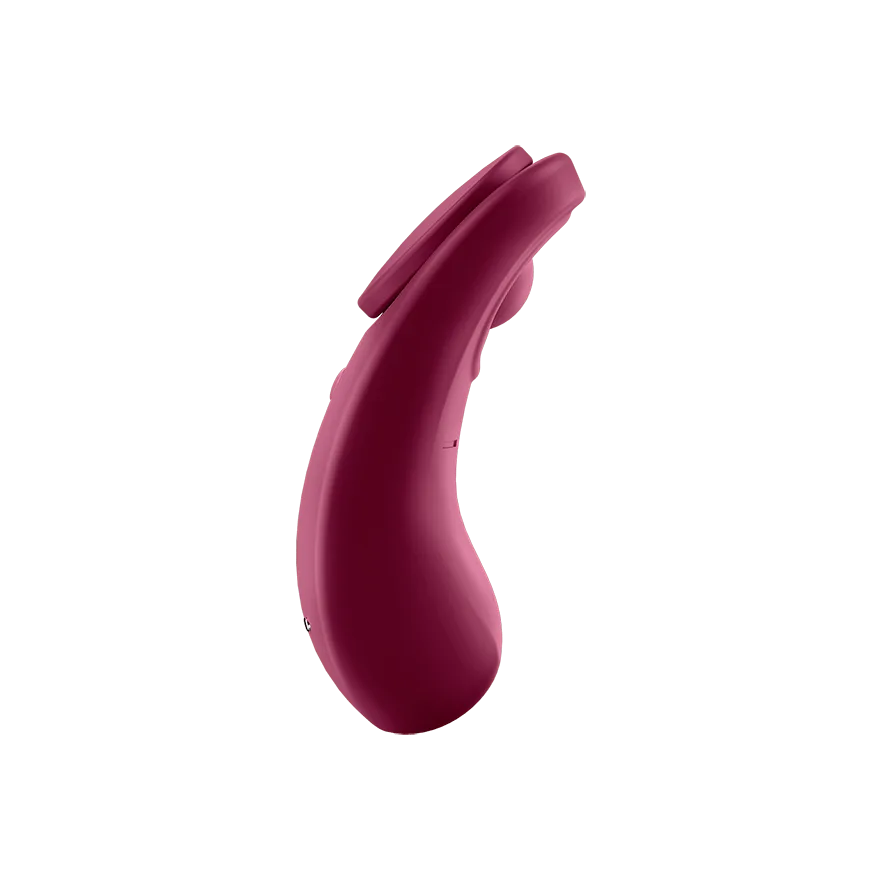
Review: Satisfyer Sexy Secret Panty Vibrator with App
Cheapest app-controlled panty vibrator — 359 SEK and 15 years of warranty.
29 July 2026
 Author's pick
Review · Thong vibrator · App-controlled with magnetic attachment
Lovense’s magnetic thong vibrator reviewed against the manufacturer’s own specifications and price data from eight Swedish stores. 74.5 × 27 × 21 millimeters and 35 grams make it the smallest of the compared options, with 195 minutes of runtime on an hour of charging, making it the most long-lasting — but only three intensity levels without the phone, and a one-year warranty pulls the other way.
The smallest and lightest app-controlled thong vibrator in the comparison, and the one with by far the best battery figures: 195 minutes of operating time on one hour of charging and 100 hours in standby. The magnetic fastening lets you place the contact point freely, and the charging cable is shared with around thirty other Lovense models. In return, you get three intensity levels without the phone, a package without a remote control and a storage pouch, and a one-year warranty in which Satisfyer provides fifteen.
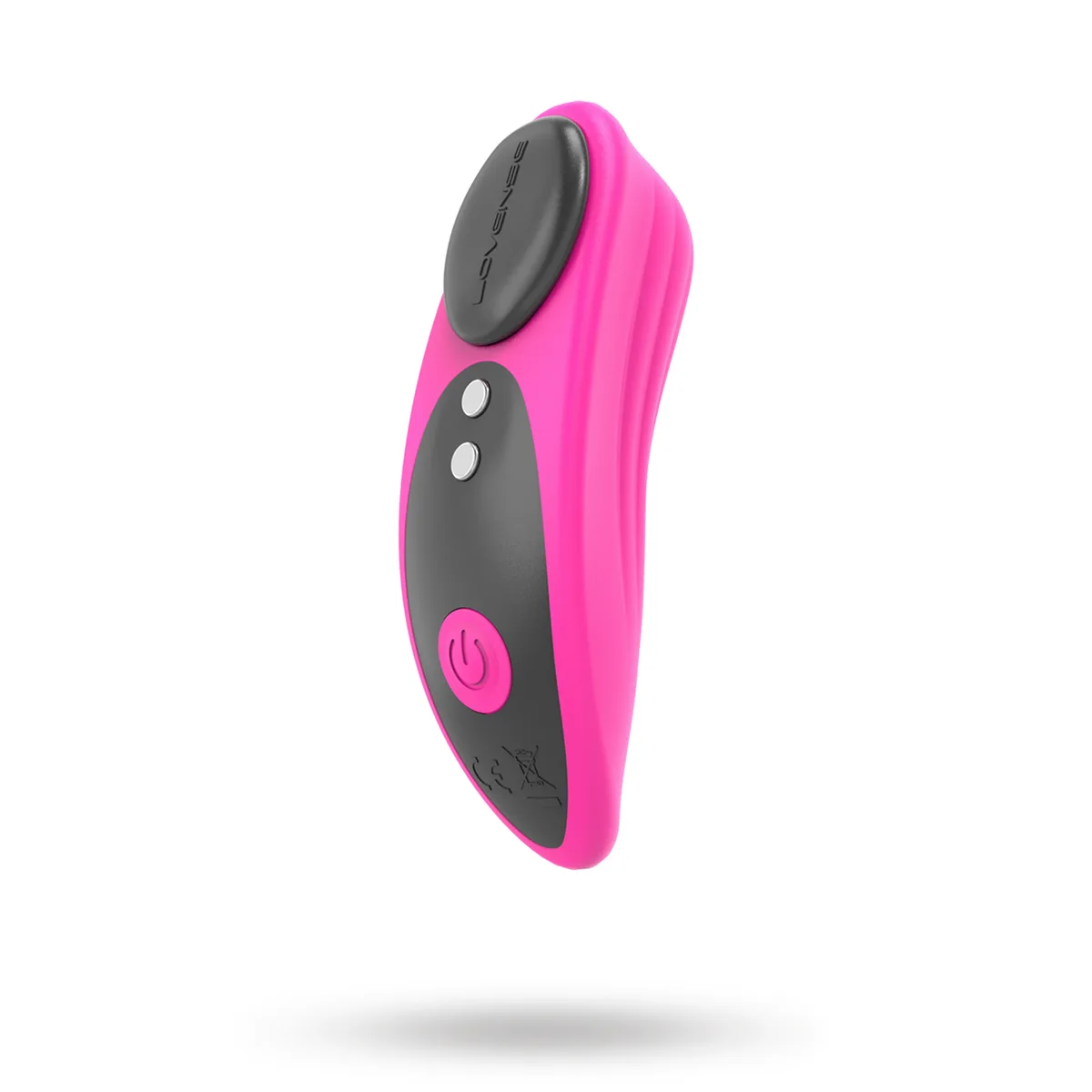
Lovense Ferri is an app-controlled panty vibrator that stays in place with a magnet instead of a clamp, a strap, or just the fabric. The product is placed inside underwear with the ribbed silicone side against the body, and a separate magnetic tab in black plastic is attached to the outside of the garment. The two parts pull together through the fabric, and that’s the whole design idea: it’s the garment itself that becomes the fastening.
The specifications look like this according to the manufacturer: 74.5 × 27 × 21 millimeters, 35 grams, silicone and ABS plastic, protection rating IPX7, a lithium-ion battery with 195 minutes of operating time, 60 minutes of charging time, and 100 hours of standby time, seven vibration patterns on the product itself, three intensity levels via the button, and an unlimited number of patterns via the Lovense Remote app. The warranty period is one year. In Sweden, the item is sold by eight stores at prices between 1,088 and 1,495 SEK, and three of them have it in stock.
This review is about the item with EAN 728360599681, which Lovense themselves list under the name Remote-Controlled Magnetic Vibrating Panties, with the product name Ferri. The same EAN is found in all eight Swedish store listings, where the model throughout is called Ferri Remote Controlled Panty Vibrator. The color is pink with black details—Lovense sells Ferri in a single variant, which makes this model unusually simple to compare on price versus most competitors, which have their own EAN per color.
A panty vibrator is a small, portable vibrator designed to stay in place against the clitoris while you move, rather than being held in your hand. The entire product category rises or falls on one question: how does it stay attached? Three solutions dominate the market. The first is a clip that grips the edge of the fabric, the second is a molded bowl that is meant to be kept in place by snug underwear, and the third—Ferri—is a pair of magnets that clamp the fabric together between them.
The difference is fundamental. A clip sits on the edge of the fabric and can therefore only be placed where there is an edge, which in practice locks the position. A bowl without an attachment moves with the garment and requires that the garment, in turn, fits tightly. A pair of magnets, on the other hand, can be placed anywhere on the fabric, because it doesn’t need an edge to grip—so you decide exactly where the contact point ends up, and you can adjust it without having to take anything off other than what’s necessary.
What can be established purely technically is that the force between the magnets is independent of how the garment fits, while the friction in a bowl solution is not. At the same time, the manufacturer is clear about the limitation: on the product page’s FAQ, Lovense themselves write that snug underwear keeps Ferri in place better than loose. So the magnet solves the attachment to the fabric, but not how much the fabric in turn moves against the body.
Lovense has a wide range of portable products, and three of them are repeatedly mixed up in Swedish stores because they are all marketed as app-controlled and discreet.
The choice between Ferri and Lush 4 therefore isn’t about price or which one is “best,” but about what type of stimulation you want and whether something should be inserted or not. The two can’t be compared on specifications because they solve different tasks. What can, however, be compared is that both are charged with exactly the same magnetic cable, which is a real advantage if you already own a Lovense product.
The material issue is the only characteristic of an intimate product that can’t be compensated for with experience or care, and it determines whether the product is still hygienic after five years. Lovense lists two materials for Ferri: silicone and ABS plastic. It’s an honest declaration, but it’s also partly a different matter than an all-silicone product, and the difference is worth understanding before you pay.
Silicone is a non-porous material. A non-porous surface can be cleaned, because there aren’t microscopic pores where residue can get stuck. It’s the single most important property of a material that’s meant to lie against mucous membrane, and that’s why the material declaration carries more weight than almost any other line in a specification.
On Ferri, the ribbed, pink side — the one that lies against the body — is silicone, while the black panel with the button and the charging contacts, as well as the magnetic tab on the outside, is ABS plastic. ABS is itself a hard, non-porous and chemically resistant material that doesn’t require softeners, and it’s fully suitable on a surface that lies against clothing. The practical problem with two-material constructions isn’t the materials themselves, but the seam between them: the boundary between silicone and plastic is where residue collects and where a product starts to become difficult to get truly clean.
On Ferri, this seam runs all the way around the entire black panel and around the two charging contacts, which sit like small metal dots in the plastic. What can be established is that there are more seam millimeters than on an all-silicone product with magnetic charging without openings, and that cleaning therefore requires a bit more attention exactly there. By way of comparison, We-Vibe lists body-safe silicone without phthalates and BPA for the Moxie+, while Satisfyer states the same combination as Lovense—silicone and ABS plastic—for the Sexy Secret Connect App. The construction is therefore normal for the class rather than a deviation.
Phthalates are a group of plasticizers used to make plastic—above all soft PVC—flexible. The Swedish Chemicals Agency (Kemikalieinspektionen) describes them as substances that can affect the endocrine system and make reproduction more difficult, and several of them are therefore restricted or prohibited within the EU in a large number of products. This specific product category is a recurring subject of supervision because it contains soft plastic against the skin.
Lovense writes in the product page’s FAQ that all of their products are body-safe and that none of them contain phthalates or other harmful chemicals. The wording is unambiguous, but it is a general commitment for the entire range rather than a product-specific statement in the specification table—and on this point it is less formal than, for example, We-Vibe, which spells out phthalate-free, BPA-free, and latex-free manufacturing directly in Moxie+’s own specification.
What still holds true is that neither silicone nor ABS needs phthalate plasticizers to function. Silicone’s softness comes from the polymer’s own structure, and ABS is intended to be hard. The material designation “silicone and ABS plastic” is therefore, in itself, a significantly better indication than terms like “TPE” or “jelly rubber,” which say nothing at all about which plasticizers are included. Lovense, however, does not publish any information about latex for Ferri, either confirming or refuting it, which is worth noting for anyone with a latex allergy.
The manufacturer’s dimension drawing in the specification section gives the length as 74.5 millimeters, the width as 27 millimeters, and the thickness as 21 millimeters. The largest dimension across the product, including the magnet tab, is stated as 24.5 millimeters. The weight is listed as 35 grams.
The numbers are the strongest single argument for Ferri, and they become clear only in comparison. Satisfyer Sexy Secret Connect App measures 85.7 × 39 × 29 millimeters and weighs 40.3 grams. We-Vibe Moxie+ measures 85 × 23 × 27 millimeters. So Ferri is shorter than both, narrower than the Satisfyer, and thinner than both — and it is the lightest of the three. On a product whose entire justification is that it can be carried without being noticed, eleven millimeters in length and five grams are not a detail — they are the whole point.
The shape is asymmetrical and ribbed on the body side, with a wide, rounded end where the magnetic tab sits and a tapered tip. The construction means the product is not symmetrical up–down, and that the orientation therefore matters for where the contact point ends up. Since the magnetic tab is a separate part that sits on the outside of the garment, it can be moved afterward without having to take the product out, which is the practical advantage of this solution.
A note about the packaging belongs here. Lovense does not publish any packaging dimensions and no shipping weight for Ferri, which several competitors do. What is stated is what’s included: the app-controlled vibrator, a USB charging cable, and a user manual. So no storage pouch is included, unlike We-Vibe Moxie+, where the manufacturer states that both a wireless remote control and a storage pouch are included.
The interface on the Lovense Ferri is intentionally minimal. There is a single button on the product, placed in the black panel, and all more advanced control takes place in the Lovense Remote app. The manufacturer specifies three intensity levels and seven vibration patterns on the product itself, and an unlimited number of patterns when the app is used.
This split is the most important thing to understand before buying, and it’s also the one that’s most often misunderstood. Ferri is a product that works without a phone, but it’s designed to be used with one. What can be stated is that without the app you get access to three steps and seven preset patterns — which is fewer steps than most handheld vibrators in the same price range — while the app removes the ceiling completely.
A button meant to handle on/off, three intensity levels, and seven patterns means, in practice, that you cycle through the modes through repeated presses. It’s a trade-off that makes sense for this specific product type: the button sits inside the garment during use, and a more advanced button set would be both harder to hit and more visible from the outside.
The consequence is, however, worth taking seriously. If the phone runs out of battery, if you don’t want to install the app, or if you happen to be somewhere where you don’t want to pick up your phone, then three levels are all you have. Compare that with We-Vibe Moxie+, where the manufacturer specifies ten modes and where a separate wireless remote control is also included in the package. It’s a genuine difference in functionality, and it goes in Moxie’s favor for anyone who wants to control it without using a phone.
Lovense describes in its FAQ that the intensity levels can also be reassigned via the app: you can adjust what the first three levels correspond to and add your own pattern that the product can then play back on its own. That significantly softens the limitation, because the three steps then become three steps you chose yourself rather than three factory values—but it assumes that you’ve used the app at least once.
The app is the half of the product that the price tag actually pays for. Lovense states that Lovense Remote handles close-up control via Bluetooth, live long-distance control over the internet, control during voice and video calls, and toy-to-toy pairing, where two products can mirror each other’s movements. On Ferris product page, the manufacturer also describes pattern editing, synchronization with music, and control via sound from the microphone on your phone.
The long-distance feature is the one that sets this category apart the most from standard vibrators. The manufacturer is clear about how it works: when both users are connected, a partner can control Ferri over any distance. What can be stated purely from a technical perspective is that it’s two different connections in series—Bluetooth between the product and the phone in the room, and an internet connection between the two phones. So in practice, the range isn’t limited by Bluetooth but by mobile coverage on both sides.
Compatibility is broader than on most competitors. Lovense states iOS 14.2 and later, Android 5.0 and later with Bluetooth 4.0, and Mac with Bluetooth 4.0. Windows computers are also supported, but according to the manufacturer only with a separate Lovense USB Bluetooth adapter—so it is an accessory that costs extra and is not included in the package. Lovense does not publish any Bluetooth range in meters for Ferri and no Bluetooth version for the product itself; the requirement for Bluetooth 4.0 applies to the connecting device. According to Bluetooth SIG, range in this technology depends on transmitter power, the antenna, and obstacles in the environment, so a number without specified test conditions therefore says little.
The magnet tab is a separate, black plastic part that is placed on the outside of the garment opposite the product. The manufacturer describes it as what keeps Ferri stable in place during use and as what allows it to stimulate the clitoris while you walk, sit, dance, or lie down.
Two practical consequences follow from the design. The first is that the thickness of the fabric matters: the thicker the fabric between the magnets, the weaker the force becomes, since magnetic pull decreases quickly with distance. Thin, snug underwear is thus the favorable situation—something that is also exactly what the manufacturer itself writes in its FAQ. The second is that the magnet tab is a loose part that can be misplaced: it is not fixed to the product and it is not included in the actual casing.
Having magnets in the product also has a safety aspect that is rarely addressed in store texts. Strong permanent magnets should not be placed directly over a pacemaker or other implanted electronics, and cards with a magnetic stripe should be kept away from them. This applies generally to magnetic products, and it is worth knowing, regardless of model.
Sound level is the decisive feature on a product that is marketed for use outside the home, and here Lovense actually deserves praise for its honesty. The manufacturer does not publish any measured decibel value for Ferri, either in the specification table or in the FAQ. But instead of simply claiming that the product is quiet, they state outright that it is designed to be discreet and quiet to use in public environments, and that it is not completely silent—and that snug clothing, quiet rooms, and higher vibration levels make it more noticeable.
It’s an unusually straightforward wording in a category where most manufacturers are content with the word "whisper-quiet". It also says something useful: the sound is not a fixed value—it depends on the level and on what surrounds the product. Wearing it under thick jeans in a busy environment is a completely different situation from wearing it under thin underwear in a quiet waiting room.
Websites that provide an exact decibel value for Ferri either show their own measurement or a value with no source from the manufacturer. What can be said is that small motors in small housings tend to sound brighter rather than stronger, and that a sound that is high in frequency is perceived as more intrusive in a quiet environment even at the same measured level—but that is a property of the product category, not a published value for this specific model.
Lovense Ferri is rated IPX7. The rating comes from the international standard IEC 60529, which defines enclosure ratings for electrical equipment. The number 7 in the second position means that the product is tested for submersion in water to a depth of one meter for 30 minutes. The manufacturer reproduces the definition word for word in its own FAQ and draws its own conclusion: Ferri is completely waterproof and can be used in the shower or bath.
The difference versus a splash-proof product is greater than the wording suggests. Splash protection covers water droplets and, at best, water jets, but not submersion. Such a product can handle a damp cloth and possibly a shower, but not a bathtub, and it should not be held under running water—think twice about the buttons and the charging contact.
With IPX7, the entire Ferri can be rinsed off without any precautions, including the black panel with the charging contacts. If a product has no IPX rating at all, it should be treated as not waterproof—an absence of a rating is never a sign that the product would be approved. Incidentally, all three models in this comparison are rated IPX7: Ferri, Satisfyer Sexy Secret Connect App, and We-Vibe Moxie+.
However, the manufacturer makes an important reservation that has nothing to do with sealing and everything to do with the radio: Lovense says the Bluetooth connection is not stable in or under water. It’s more physics than a product fault—radio waves in the 2.4 GHz band are heavily attenuated by water—but in practice that means app control, i.e. half the product’s value, can’t be relied on in the bathtub. There, you’re back to the button’s three levels.
Rinse the product in lukewarm water after each use and use fragrance-free soap or a cleaning product intended for intimate products. Pay extra attention to the seam between the silicone and the black ABS panel and around the two charging contacts—that’s where residue collects in a two-material construction. Wipe it with a clean towel and let it air-dry before putting the product away. Clean the magnetic tab as well; it has been touching the outside of the garment and is easy to overlook.
Use a water-based lubricant. Silicone-based lubricant should not be used on silicone products—it breaks down the silicone surface over time and makes it porous, and a porous surface can no longer be cleaned properly; it only can be replaced. Oil-based products such as coconut oil leave a film that’s hard to remove, and fragranced or alcohol-based lubricants have no place against mucous membranes at all.
Since no storage pouch is included in the package, the product should be stored in something of its own—either a fabric pouch or a clean box—rather than loose in a toiletry bag. This is partly about hygiene and partly because the magnetic latch is a loose part that could otherwise be lost. Do not also store it directly against a credit card with a magnetic stripe or against other electronics that are sensitive to magnetic fields.
Lovense states the operating time as 195 minutes, the charging time as 1 hour, and the standby time as 100 hours. The battery is listed as lithium-ion. Three hours and a quarter on a 1-hour charging time are strong figures for a product that weighs 35 grams, and they become clear only in comparison: Satisfyer states about 60 minutes of usage time and about three hours of charging for the Sexy Secret Connect App, and We-Vibe states up to two hours of operating time and 90 minutes of charging time for the Moxie+.
Ferri therefore delivers more than three times the operating time of the Satisfyer in one-third of the charging time, and about 60 percent longer operating time than the Moxie+ in two-thirds of the charging time. That is the single biggest measurable advantage in the specification, and it is particularly relevant for this product type, because a portable product is often kept switched on in periods throughout an entire evening rather than in one continuous session.
The standby time of 100 hours deserves a note on its own, because it is rarely published by any manufacturer. It describes how long the product holds its charge in an on standby mode, meaning connected but not vibrating. This is the figure that determines whether the product is still working when you take it out after a few days in your bag, and in practice it is a more useful piece of information than the operating time for the person carrying the product without using it constantly.
Charging is done with a magnetic cable that connects to USB. The cable’s two connectors attach to the two metal contact points on the black panel, which means there is no need for an opening in the casing—and that is part of the reason the product can be IPX7-rated without a rubber plug.
Here there is a real advantage that’s easy to overlook. Magnetic charging cables are normally product-specific, and if a cable is dropped, it usually means you have to order a new one from the manufacturer. Lovense has solved it differently: according to the manufacturer, the same charging cable is used for around thirty Lovense models, including Ferri, Lush 3, Lush 4, Lush Mini, Edge 2, Gush, Hush 2, Max 2, Nora, Diamo, the Domi series, Gemini, Flexer, Ridge, Vulse, and Fizz. If you already have a Lovense product, chances are you already have a spare cable lying around, and a replacement cable is an in-stock item from the manufacturer rather than a model-specific order.
The drawback remains, though, for anyone buying their first Lovense product: a standard USB-C cable won’t work. That’s a difference compared with products that charge via a port, and it’s one of the few real weaknesses in an otherwise strong charging solution. Treat the cable as part of the product and put it where you’ll find it again.
Lovense does not publish either the battery capacity in mAh or its voltage for Ferri, either in the specifications table or in the FAQ. What’s provided is the battery type (lithium-ion), operating time, charging time, and standby time. It’s worth noting because competitors do it: Satisfyer specifies 120 mAh and 3.7 volts for the Sexy Secret Connect App in its quick guide. Without the capacity, it’s not possible to convert operating time into power consumption, and you can’t judge how heavily the cell is stressed between models.
What applies generally to lithium-ion batteries also applies here: capacity drops with the number of charge cycles, and the product does best when it’s charged regularly rather than stored fully discharged. Lovense also does not provide any information on whether the battery is replaceable for Ferri. On a 35-gram product with an IPX7 rating and a glued housing, the starting point is that it isn’t—and with use a couple of times a week, it’s then the battery, not the silicone, that sets the limit for how long the product lasts.
We do not have price data from shops in your market yet.
195 minutes of operating time on an hour of charging, at 35 grams. That’s the figure that makes Ferri hard to dismiss — and the three levels on the button are what make it hard to love without your phone.
Three comparisons are relevant: versus the cheapest app-controlled masturbator from a large brand, versus the closest competitor in the same price range, and versus Lovense’s own portable model in another product category. All information below comes from each manufacturer’s own specifications, and all prices come from the shops’ product feeds on July 29, 2026.
Satisfyer Sexy Secret Connect App costs from SEK 359. Ferri costs from SEK 1,088, so that’s SEK 729 more—more than three times the price. Both are app-controlled masturbators, both are silicone and ABS plastic, both are IPX7, and both are charged with a magnetic USB cable. On paper, they’re almost the same product.
The differences are in three numbers. Ferri is smaller and lighter: 74.5 × 27 × 21 millimeters and 35 grams versus Satisfyer’s 85.7 × 39 × 29 millimeters and 40.3 grams. Ferri has a longer operating time: 195 minutes versus about 60. And Ferri charges faster: one hour versus about three hours. That’s an operating time that’s just over three times as long on one-third of the charging time, and on a portable product it’s a meaningful difference rather than a catalog figure.
Satisfyer, however, wins on two points that carry a lot of weight. One is the price. The other is the warranty: Satisfyer offers 15 years of manufacturer warranty, compared with Lovense’s one year. Fifteen times the warranty for a third of the price is a hard-to-beat offer, and anyone who primarily wants to find out whether an app-controlled clitoral vibrator is suitable for them would do well to start there. If you already know that the format works for you, and that size and run time are what matter, then Ferri is the better product — but the price difference should be a deliberate choice.
We-Vibe Moxie+ costs from 1,016 SEK, i.e., 72 SEK less than Ferri at its lowest. On the price tag, they are, in practice, the same product, and that’s what makes the comparison the most decisive in this text.
Moxie+ measures 85 × 23 × 27 millimeters — longer and thicker than Ferri, but two millimeters narrower. We-Vibe lists ten modes versus Ferri’s three levels and seven patterns on the product; run time up to two hours versus Ferri’s 195 minutes; charging time 90 minutes versus Ferri’s 60; and two years of warranty versus Lovense’s one year. The material is listed as body-friendly silicone without phthalates and BPA, and made without latex, which is a more formal material declaration than Lovense’s.
The most important difference, however, is what’s in the box. We-Vibe includes a wireless remote control and a storage pouch in addition to app control. Ferri is delivered with the product, a charging cable, and a manual — no remote control and no pouch. That means Moxie+ can be controlled discreetly by a partner in the same room without anyone picking up a phone, while Ferri always requires an app. For use outside the home, it’s a real functional difference.
Overall: if you choose based on size, weight, run time, and charging time, Ferri wins. If you choose based on the number of modes without a phone, the included remote control, warranty length, and the written material declaration, Moxie+ wins. Since the difference in price is only 72 SEK, the choice should be determined by which of these lists describes you—not by your wallet.
Lovense Lush 4 costs from 1,015 SEK and is therefore 73 SEK cheaper than Ferri. This surprises many, because Lush is the larger and more talked-about product. But the two solve different tasks and don’t really compete with each other.
Lush 4 is a plug-in egg with an antenna that stays outside. Ferri is completely external and isn’t inserted anywhere — Lovense explicitly states that it’s intended for external clitoral stimulation and not for internal G-spot stimulation. So if you’re choosing between them, you’re choosing between internal and external stimulation, not between two versions of the same thing.
What they have in common is the platform: both are controlled with Lovense Remote, both support long-distance control, both are IPX7, and both are charged with exactly the same magnetic cable. If you already own one, the threshold for the other is therefore low—the app is the same and the cable is the same. For someone who wants both external and internal stimulation in a single product, Lovense’s Gemini is the model that combines the two, but it’s a third product with its own specifications and its own price.
Eight Swedish stores sell the item with EAN 728360599681. Cheapest is Mshop at 1,088 SEK, and most expensive is Vuxen at 1,495 SEK. That’s 407 SEK, or a 37 percent difference for the exact same article number, the same color, and the same packaging.
The stock situation changes the picture in a way that’s unusually favorable here. Three of the eight stores had the product in stock at the price check: Mshop at 1,088 SEK, Joyland at 1,095 SEK, and Vuxen at 1,495 SEK. That means that the two cheapest stores in the entire list are also the two that can actually deliver, and that the difference between them is seven kronor. So the person who buys the cheapest available one basically pays the list’s floor price—which is rarely the case in this category.
The five stores priced between 1,185 and 1,410 SEK were all sold out. Stores that list a product as their last one may keep an old price in the feed, and that price is rarely what you actually end up paying when the item comes back in again. Take the prices in between with a pinch of salt and compare first and foremost the three that have the item at home.
As a reference point, Lovense themselves state a list price of 119 US dollars in the structured data on their product page. The manufacturer also ran a time-limited promotion at the time of the check, which is worth knowing if you’re comparing it to ordering directly—but then shipping cost, any customs duty, and the longer delivery time from the manufacturer should be factored in. The prices in the table above are updated when the stores’ product feeds are updated, but always check the final price in the checkout.
It’s for you if you want the smallest and lightest app-controlled panty vibrator among the ones compared—74.5 × 27 × 21 millimeters and 35 grams are consistently smaller than both Satisfyer Sexy Secret Connect App and We-Vibe Moxie+. It’s for you if you want to be able to carry the product through an entire evening without having to think about the battery, since 195 minutes of run time and 100 hours of standby time are strong figures for the class. It’s for you if you like the idea of a magnetic attachment rather than a clamp, because it lets you place the contact point freely. And it’s for you if you already own a Lovense product, because then the app and the charging cable are the same.
It doesn’t suit you if you want to be able to control the product properly without a phone. Three intensity levels on the button are few, and unlike the We-Vibe Moxie+, no remote control is included. It doesn’t suit you if you count on being able to use the app control in the bathtub, since the manufacturer itself states that Bluetooth is not stable in water. It doesn’t suit you if you prioritize a long warranty—one year is short in this category, and Satisfyer provides fifteen. And it doesn’t suit you if you want everything in the package: neither a storage pouch nor a remote control is included.
One final thing belongs in the decision. Ferri is a product whose value largely lies in the software. Three levels and seven patterns on the button make it a mediocre product if the app is never used, and one of the most flexible in the class if it is used. If you’re uncomfortable connecting an intimate product to an app and an account, you should skip the entire category rather than just this model—but then you should also know that you’re skipping what the price tag pays for.
Lovense states a one-year warranty for Ferri in the specification table on the product page. That’s short compared with the competitors in this comparison: We-Vibe offers two years on the Moxie+ and Satisfyer offers fifteen years on the Sexy Secret Connect App. One year is also shorter than the Swedish right to complain, which means that the manufacturer’s warranty has limited practical significance for a Swedish purchase.
What always applies, though, is your statutory rights—and they are stronger than the warranty here. According to konsumentköplagen, you have three years’ right to complain for defects in the goods, regardless of what the manufacturer promises—and you direct it to the shop you bought from, not to Lovense. For a product with a one-year manufacturer warranty, that means it’s the shop, not the manufacturer, that is your counterparty during most of the product’s expected service life. Save the receipt.
For purchases made at a distance, you also have a right of withdrawal for fourteen days under the lag om distansavtal och avtal utanför affärslokaler. Be aware that in practice the right of withdrawal is limited for hygiene items that have been taken out of a sealed package—however, the right to complain for faults always applies. If you have questions about what applies in your case, Konsumentverket provides guidance via Hallå konsument.
One final practical point about the warranty: the magnetic clasp and the charging cable are the two parts that are most likely to get lost or break first, and both are loose parts rather than faults in the product. Lovense does not publish any explicit warranty exclusions for wear parts on Ferri’s product page, but a lost magnetic clasp is, in practice, always your own cost. The manufacturer sells it as a spare part, and as mentioned, the charging cable is shared with about thirty other models—making that part unusually easy to replace.
Lovense Ferri is ranked etta av 11 in panty vibrator best i test, where the entire category is compared against each other using five shared criteria.
Every numerical piece of information in the text can be traced to one of the sources below. The links were checked manually on the specified date.
This page is machine-translated from Swedish. Read the Swedish original