

Review
Review: Womanizer Next
Fourteen intensity steps times three depth levels—and a complete specification.
29 July 2026
 Author's pick
Review · Vibrating egg · App-controlled
Lovense most-sold vibrating egg reviewed against everything that can actually be substantiated: twenty intensity steps according to the manufacturer’s own developer documentation, remote app control, LED tail, and fast charging — and nine stores that list seven different battery lives for exactly the same item number. Price from 1 015 SEK.
The most finely tuned app control in the comparison: the manufacturer’s own developer documentation describes twenty intensity steps, where the category otherwise stops at ten, and the control works just as well in the same room as from the other side of the world. Fast charging is the most useful new feature in the fourth generation. What you pay for is a sourcing situation that’s worse than the competitors’: every measurement, minute, and decibel comes from the stores, and they don’t agree with each other.
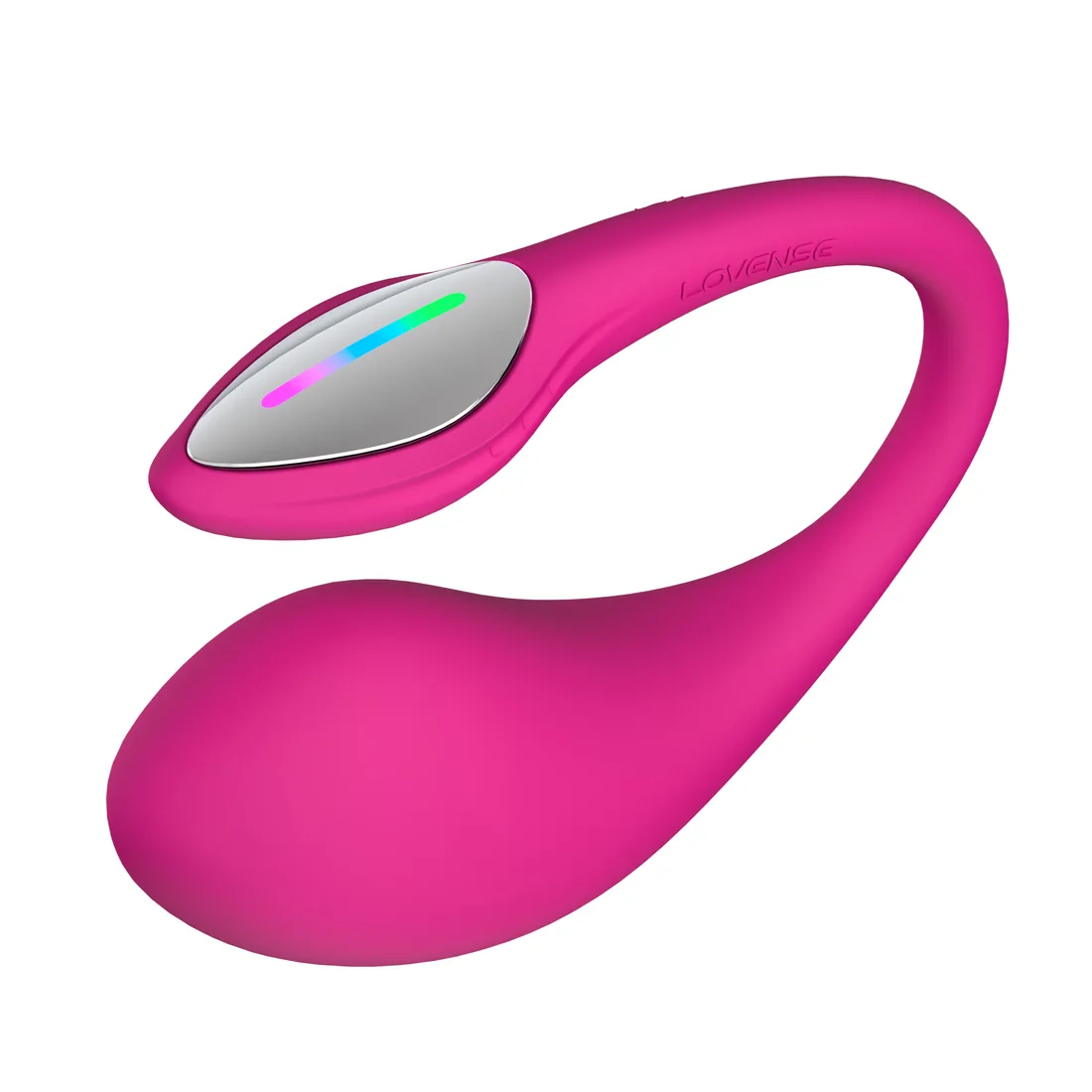
Lovense Lush 4 is the fourth generation of the app-controlled vibrating egg that has defined the category more than anything else. The shape is the same as before: a rounded, insertable body that rests against the G-spot and a curved tail that sticks out and keeps the egg in place. What’s new in the fourth generation, according to the stores that sell it, is an LED strip in the tail that glows in multiple colors and reacts to the vibration intensity, a stronger motor, and a fast-charging function.
This review is about the pink variant with EAN 6972677430456. The number is found in the product feeds from nine Swedish stores, and all of them link it to Lovense Lush 4 in pink: Vuxen lists the item as Lovense Lush 4 Pink, Blush Me states the color pink in its spec table, and Taboo uses the article number 120452-Pink with the same barcode. Vuxenkul also lists its own article number SC4312-1 against the same EAN. There is therefore no mismatch between the barcode and the model.
The price picture is unusually spread out. Nine stores sell the item for between 1 015 and 1 549 SEK, seven of them have it in stock, and the difference between the cheapest and the most expensive is 53 percent for exactly the same barcode. The cheapest is Mshop at 1 015 SEK, the most expensive is Vuxenkul at 1 549 SEK. This is one of the biggest price spreads in this product category right now, and the only reason is the stores’ own margin-setting.
A vibrating egg is an insertable product without a handle. The entire product is carried inside the body except for the tail, which serves two functions: it keeps the egg in place and makes it possible to remove it again. It’s this design that makes the product category hands-free — unlike a wand vibrator or an air-pressure product, there’s nothing that needs to be held during use.
The app-controlled add-on is what makes the Lush series something other than an ordinary egg. The control isn’t done with a button on the product, but via Bluetooth from a phone, and since the phone in turn has internet, the control can be handed over to someone else anywhere. The manufacturer’s own description of the app Lovense Remote lists on-demand control, live remote control, control during voice and video calls, and the option to connect two toys to each other. The app is stated there to have over five million downloads and a rating of 3.9 out of five from 19.7 thousand reviews.
The difference versus a remote-controlled product of an older type is that there’s no physical remote control to lose — but also that the product depends on the app working and the phone having battery. It’s a trade-off, not a pure upgrade, and it’s worth thinking through before you pay for exactly the app function.
This text has to be straightforward with its own supporting evidence. Lovense’s own product page and the manufacturer’s manual PDF consistently responded with the error code 429 and a robot check on the control date, and therefore could not be verified as a source. The only Lovense-published sources that could be verified are the developer documentation on developer.lovense.com and Lovense’s own page for the app Lovense Remote on Google Play. That means all the hardware figures below come from the shops’ own product pages and are presented as shop information, not as the manufacturer’s specifications.
It may sound like a formality, but it’s exactly the opposite — and it’s the single most important thing you need to know before you read a number about this product. The shop details are not only different. They’re incompatible. Seven shops state seven different battery times: four hours at Lustly, 4.5–5 hours in Intima’s fact box, up to five hours at Mshop, up to six hours in Intima’s body text, 350 minutes at Vuxenkul, 297 minutes at level 1 and 131 minutes at level 3 at Blush Me, and about 90–120 minutes in Taboos specification table.
The same applies to charging time. Blush Me, Intima and Taboos body text state 50 minutes, Vuxenkul states 45 minutes, and Taboos own specification table lower down on the same page states about 180 minutes. Taboo therefore contradicts itself by a factor of four within the space of a single product page. What can be established is that none of these figures has any independent backing, and that anyone who wants an exact number needs to look for it in the manual that comes with the package.
Three Lush models are sold in parallel in Swedish shops, and they’re regularly mixed up because both the shape and the product images look similar.
The interesting observation is the price gap. The difference between Lush 3 and Lush 4 is 44 SEK at the cheapest stores. It’s so small that the argument for saving money on the predecessor has effectively disappeared — provided you can find Lush 3 at that price, since several of the stores that list it already have it sold out.
The material question is the characteristic of an intimate product that neither experience nor care can compensate for, and it determines whether the product can still be kept hygienic in a few years. For a product that’s worn inside the body for a long time, it weighs more than for almost all other categories.
Silicone is a non-porous material. A non-porous surface can be cleaned, because there are no microscopic cavities where residue can get trapped. It’s the single most important property of a material that should sit against the mucous membrane for an extended period, and the reason why the material specification carries more weight than almost any other line in a given specification.
Stores largely agree that the material is silicone. Blush Me states high-quality silicone, Taboo states body-safe silicone, and Vuxenkul lists silicone in its property table. But at the same time, Vuxenkul also states silicone and ABS in its own quick facts box further down the same page. There’s a real difference: ABS is hard plastic, and if parts of the body are ABS, that means there’s a seam between two materials — exactly the point where an insertable product is hardest to get clean.
Based on the product images, it’s reasonable to assume that the oval plate on the tail, where the LED strip and charging contacts sit, is not silicone. That’s also where, if so, a seam would be. No material statement from the manufacturer stating which parts are which materials could be verified, and that means it’s not possible to determine how big that seam is.
Phthalates are a group of plasticizers used to make plastic — above all, soft PVC — flexible. The Swedish Chemicals Agency (Kemikalieinspektionen) describes them as substances that can affect the endocrine system and make reproduction more difficult, and several of them are therefore restricted or banned within the EU in a large number of products. This product category is repeatedly the subject of supervision, because it contains soft plastic against skin and mucous membranes.
Silicone does not require phthalate plasticizers to become soft — the softness comes from the polymer’s own structure. For that reason, listing the material as silicone is, in itself, a better sign than labels such as TPE or jelly rubber, which say nothing at all about which plasticizers are included. But none of the nine stores states an explicit commitment that the material is free from phthalates, BPA, or latex, and the manufacturer’s own declaration could not be verified. That’s a difference compared with a direct competitor, We-Vibe Jive 2, where the manufacturer itself states body-friendly silicone free from phthalates and BPA and made without latex — clearly stated on its own product page.
The latex information matters for anyone with a latex allergy, because reactions occur faster on mucous membranes than on regular skin. If the information is missing entirely, it’s not possible to rule out latex in advance, and anyone who knows they react should ask the store before buying.
The measurements are the second place where the store data falls apart. Mshop states a total length of 10,00 cm, insertion length of 8,90 cm, and insertion diameter of 3,80 cm. Blush Me states an insertion length of 10,00 cm and a max diameter of 3,70 cm. Intima states the egg’s diameter as max 3,7 cm. Taboo states in its body text an insertion length of about 9,5 cm, total length of about 20 cm, and diameter of about 4,3 cm.
The differences are most likely about what’s included. A total length of 20 centimeters reasonably can only refer to the egg plus the entire extended tail, while 10 centimeters refers to the egg itself. However, that one store calls 10 centimeters “total length” and the other calls the same number “insertion length” is not a matter of interpretation but a direct contradiction. Plan on an insert part of around nine to ten centimeters and a max diameter of roughly 3,7 to 4,3 centimeters, and treat it as a range rather than a measurement.
The weight is the same story. Mshop lists 0.29 kilograms, while Taboos specification table lists 350 grams. Both figures are high for a product of this size—for comparison, Lelo lists 36 grams for its egg Lyla 2, which measures 80 × 33 × 32 millimeters. The likely explanation is that the stores’ weight figures refer to the entire packaged shipment, not the product in hand. Mshop lists the package dimensions as 18.10 × 12.40 × 5.40 centimeters, which supports that interpretation: a cardboard box of that size with a cable and manual weighs significantly more than the egg itself.
Here there are actually hard facts from the manufacturer, even if they’re in an unexpected place. Lovense publishes open developer documentation for its LAN API, and it describes exactly which commands can be sent to a Lovense toy and within what intervals. It’s the manufacturer’s own material, aimed at developers rather than the market, and that’s why it’s unusually concrete.
According to Lovense’s own documentation, the vibration command takes a value between 0 and 20 and applies to all toys in the range. That means twenty steps above zero, which is a noticeably finer resolution than what competitors report: Lelo lists eight settings for its egg Lyla 2, and We-Vibe doesn’t specify any number of intensity levels at all on its product page for Jive 2.
The same documentation also describes a separate command for preset patterns, with four modes numbered 0 to 3, and Lush is explicitly singled out there as one of the models that the command applies to. In addition, the battery level can be read out as a value between 0 and 100, which explains why the app can show exact battery percentages instead of just a warning light.
What this means in practice is that control isn’t limited to the patterns the manufacturer built in. Since the intensity can be set to any whole number between 0 and 20, the app—and third-party programs that talk to the same API—can build arbitrary sequences. That’s the technical prerequisite for the features that stores describe as music control, sound control, and custom patterns.
Stores also list the motor’s maximum speed as 7,000 vibrations per minute, a figure that appears identically on Blush Me, Mshop, Intima, Vuxen, Taboo, and Vuxenkul. That all six list the same number suggests that it comes from the manufacturer’s own marketing material. What it says about perceived strength, however, is limited: revolutions per minute describes frequency, not amplitude, and two motors with the same RPM can feel completely different depending on how much mass is moving.
The chain consists of two links. The first is Bluetooth between the toy and the phone, the second is the internet between the phone and the person who controls it. Bluetooth operates according to Bluetooth SIG in the unlicensed 2.4 GHz band, with 79 channels for Bluetooth Classic and 40 for Bluetooth LE. It’s the same band that wifi and microwave ovens use, which is the reason that range in this category is always an environment-dependent quantity rather than a fixed number.
Vuxenkul states the range as 105 meters. That figure should be read as a theoretical maximum in clear line of sight, not something you can count on through a concrete wall — Lelo, for comparison, states up to 12 meters for its own wireless link on the same frequency band, with a transmitter power of 1 milliwatt. Lustly says that the antenna in the tail is adjustable specifically to improve the connection, which in turn says something about how sensitive the link is. Taboo states that the connection is established in three seconds.
What’s worth understanding is that only the first link is short. As long as the phone is near the toy, it doesn’t matter where the other person is — it’s the phone’s internet connection, not Bluetooth, that determines the range at a distance. The manufacturer’s own app description lists remote live control and control during voice and video calls as core functions.
The most visible new feature in the fourth generation is the LED strip in the tail. Intima states seven color modes and that the light reacts to the intensity of the vibrations; Taboo states LED in seven colors that are adjusted with the vibrations. Both also describe that the color theme can be set in the app.
The feature is hard to justify for pure private use — the light isn’t visible when the product is in place under clothes. It becomes understandable in the context that Taboo and Vuxenkul both point out in their product texts: live streams, where the tail gives the audience a visual response to what’s happening. So it’s a function aimed at a specific group of users, and for everyone else it’s, in practice, a detail that drains the battery.
Sound level is crucial in this specific product category, because the whole point of a portable egg is that you can use it wherever other people are. Here, the stores list two different values. Vuxenkul states 36 dB outright. Blush Me and Intima both state a range of 36–42 dB.
The interval is the more credible wording, for the simple reason that a vibrator sounds different at different intensities. A single number without any specified intensity basically only tells you what the product sounds like on its quietest setting. None of the stores states under what conditions the value was measured, at what distance, or with which weighting — and the manufacturer’s own measurement value for Lush 4 could not be verified.
For comparison, Lelo states a maximum of 50 dB for Lyla 2 on its own product page, measured at the highest setting. We-Vibe states no decibel value at all for Jive 2, instead describing the product as whisper-quiet. This says something about how little comparable information there is in this category even when a number is published: without information about measurement distance and intensity, two decibel values from different manufacturers are not comparable with each other.
A practical consideration that applies regardless of model: a vibrating egg sounds significantly less when it’s in place than when it’s lying freely, because the body dampens it. The opposite applies on hard surfaces, where a tabletop surface works as a resonance box and noticeably amplifies the sound.
Fast charging is the feature the stores highlight the most after the LED tail, and it’s also the one where they are least in disagreement. Mshop, Intima, Vuxenkul and Lustly all state that five minutes of charging provides about an hour of use. Blush Me, Vuxen and Taboo express the same thing as saying that one minute of charging gives ten minutes of use, which is the same ratio per minute. Blush Me and Vuxen also state that charging is 40 percent faster than on the predecessor.
With a magnetic charging cable that connects to USB. Lustly explicitly states a magnetic USB cable, Vuxenkul states USB-magnet, and Mshop lists a USB magnetic charging cable in the package contents together with the product and the user manual. Taboo also states that a storage pouch is included.
Magnetic charging is a trade-off, not a pure advantage. The advantage is that the casing doesn’t need any opening, which is a prerequisite for achieving full water resistance without a rubber plug — and for an egg that’s meant to be carried inside the body, it’s a clear design requirement. The downside is that the cable is product-specific: if you lose the charging cable, no regular USB-C cable will work, and you need a replacement intended for the model.
As for charging time, the stores disagree. Blush Me, Intima and Taboo’s main text states 50 minutes for a full charge, Vuxenkul states 45 minutes, and Taboo’s own specification table states approximately 180 minutes. There’s no way to determine which one is correct based on published data. The fact that three independent stores state 50 minutes makes it the most likely piece of information, but it’s an argument, not evidence.
Only one of the nine shops publishes a battery specification. Blush Me states 3.7 volts and 500 mAh, along with runtime times of 297 minutes at level 1 and 131 minutes at level 3. Because the information is formulated per intensity level, it’s more useful than a simple maximum figure, since that specific link is missing in the rest of the category.
Based on Blush Me’s own figures, the product therefore uses about twice as much current at level 3 as at level 1—131 minutes versus 297, a ratio of 2.3. That’s a reasonable order of magnitude for a vibration motor, and it makes the numbers internally consistent, which is more than can be said about most other information for this product. However, it does not make them verified.
For comparison, Lelo lists 200 mAh and 3.7 volts for Lyla 2 with about two hours of runtime, and We-Vibe lists a lithium-ion polymer battery with up to four hours of runtime for Jive 2 without publishing the capacity. None of the manufacturers in the category publish enough to recalculate runtime into power consumption in a way that can be compared between models.
What generally applies to lithium-ion batteries also applies here: capacity drops with the number of charge cycles, the cell is not replaceable in products of this type, and it performs best when charged regularly rather than being stored fully discharged. With use a couple of times a week, it’s the battery—not the silicone—that sets the limit for how long the product lasts.
Three of the shops list the enclosure rating IPX7: Blush Me, Intima, and Vuxenkul. The rating comes from the international standard IEC 60529, which defines enclosure classes for electrical equipment. The number 7 in the second position means that the product is tested for immersion in water to a depth of one meter for 30 minutes.
Instead, Taboos specification table lists IPX5. This is not a minor deviation. According to the same standard, IPX5 covers water jets from a nozzle—so showering and rinsing—but not immersion. An IPX5 product must not be placed in the bathtub. An IPX7 product can be.
For a plug-in product, the difference is also more practical than theoretical, since cleaning normally takes place under running water. Since three shops state IPX7 and one states IPX5, IPX7 is the likely specification, but anyone who wants to be sure should read the enclosure rating in the included manual before the product is lowered into water. If the rating is missing entirely, a product should always be treated as not waterproof—lack of a specification is never an approval.
Lustly states the manufacturer’s recommendation directly: use a water-based lubricant, and always clean after use with a toy cleaner or mild soap and water. This is the guidance that generally applies to silicone products, and the reason is chemical. Silicone-based lubricants break down the silicone surface over time and make it porous. Once the surface is porous, it can no longer be cleaned properly—only replaced. Oil-based products like coconut oil leave a film that is difficult to remove.
Rinse the egg in lukewarm water after each use; be especially careful where the egg transitions to the tail, and around the oval plate where the LED strip and the charging contacts sit—that’s where, if applicable, there would be a seam between silicone and harder plastic. Wipe with a clean towel and let it air-dry before putting the product away. Taboo states that a storage pouch is included in the package, which lets the product be stored dust-free without having it touch other silicone.
Two things that are rarely mentioned in store texts but apply to the product class: a lithium-ion battery should not be exposed to high temperatures, which rules out boiling and dishwashers even for a product with an IPX7 rating, and a product with a magnetic charging contact should be kept away from cards with a magnetic stripe.
We do not have price data from shops in your market yet.
Seven stores state seven different battery lives for the same barcode. That says more about the industry’s product texts than about the product.
Three comparisons are relevant: against the direct competitor in app-controlled handheld eggs, against the manufacturer that actually publishes its measurements, and against Lovense’s own predecessors. The competitor data comes from each manufacturer’s own product pages, and all prices come from the shops’ product feeds on July 29, 2026.
We-Vibe Jive 2 costs from 1 155 SEK, i.e. 140 SEK more than Lush 4 at its cheapest. It’s the same product category and the same way of using it: a handheld egg with a tail, controlled via an app.
We-Vibe publishes its specification itself, and it looks like this: lithium-ion polymer battery charged via USB, operating time up to four hours, charging time up to 90 minutes, IPX7 enclosure rating, body-friendly silicone free from phthalates and BPA and manufactured without latex, plus a two-year warranty. In the box, you get a splash-safe remote control, a USB charging cable, a quick guide, and a cotton pouch.
The differences that actually matter are three. Jive 2 comes with a physical remote control in addition to the app, which is a real feature for someone who doesn’t want the phone involved. We-Vibe publishes its material declaration and its warranty period, which Lovense does not do in a way that could be verified here. Lush 4, on the other hand, has a documented intensity resolution of twenty steps, while We-Vibe does not publish any number of levels at all for Jive 2, plus fast charging that has no counterpart with the competitor. If you choose based on the reported hardware data, We-Vibe wins. If you choose based on control and charging flexibility, Lovense wins.
Lelo Lyla 2 costs from 1,119 SEK, i.e. 104 SEK more than Lush 4 at its cheapest. It’s a different kind of product despite the similar shape: Lyla 2 is controlled with a physical remote control, not with an app, and therefore completely lacks the long-distance function.
Lelo’s specifications are the most complete in the comparison, and with a wide margin: dimensions 80 × 33 × 32 millimeters, diameter 32 millimeters, insertable length 80 millimeters, weight 36 grams, material ABS plastic and body-friendly silicone, a lithium-ion battery of 200 mAh and 3.7 volts, operating time about two hours for the egg and about ten hours for the remote control, 90 days standby, charging time two hours at 5.0 volts and 200 milliamperes, vibration frequency 120 Hz, maximum sound level 50 dB, wireless range up to 12 meters at 2.4 GHz, automatic shut-off after 20 minutes, eight settings, fully waterproof, and a two-year warranty plus a ten-year quality warranty.
The comparison is therefore asymmetrical in a way that is worth stating plainly. Lyla 2 is smaller, lighter, and significantly worse on paper when it comes to operating time — two hours versus the four to five hours that the stores state for Lush 4 — and eight settings versus Lovense’s documented twenty steps. But it is the only one of the three where every figure comes from the manufacturer itself and can be checked. For someone who chooses based on documentation rather than on features, that’s a strong argument. For someone who wants app control and long-distance use, Lyla 2 simply isn’t an option, because the range ends at the remote control’s twelve meters.
Lovense Lush 3 costs from 971 SEK, and Lush Mini from 899 SEK. Lush 4 costs 1,015 SEK, so the difference is therefore 44 and 116 SEK, respectively.
It’s unusually low for a generational change, and that makes it hard to justify the predecessor for pricing reasons. What the stores list as new in the fourth generation is the LED tail, the stronger motor, and fast charging — and of those, fast charging is the only one that matters practically for most people. Lush Mini, on the other hand, isn’t a cheaper Lush 4, but a physically smaller product, and that choice should be based on size, not on price.
A warning that applies specifically to this comparison: several of the stores that list Lush 3 at the lowest prices have it sold out. A price in a product feed from a store without inventory on hand is rarely what you actually end up paying when the item comes in again.
Nine Swedish stores sell the item with EAN 6972677430456. The cheapest is Mshop at SEK 1,015, closely followed by Joyland at SEK 1,016. The most expensive is Vuxenkul at SEK 1,549. It’s a difference of SEK 534, or 53 percent, for exactly the same barcode and the same color.
The inventory situation is unusually good in this case. Seven of the nine stores had the product in stock at the price check, and the two that didn’t — Taboo at SEK 1,495 and Vuxenkul at SEK 1,549 — are at the same time also the two most expensive. That means the price spread among the stores that actually can deliver is smaller than it looks: SEK 1,015 to SEK 1,495, i.e. 47 percent.
The middle tier is tight. Three stores — Blush Me, SexleksakerOutlet, and Lustly — are all at exactly SEK 1,195, which is SEK 180 more than Mshop. Intima is at SEK 1,395 and Vuxen is at SEK 1,495. The difference between the cheapest and the most expensive store with the item in stock is almost half a thousand SEK for a product in this price range, making the price comparison the single most worthwhile step before buying.
The prices in the table above are updated when the stores’ product feeds are updated, but always check the final price at checkout. Shipping cost is added at most stores under a certain order value, and in this price range several stores are right around the threshold for free shipping.
It’s for you if you want a hands-free product controlled from your phone and that can be handed over to someone else remotely. It’s for you if you want more intensity levels than the category’s usual ten — the manufacturer’s own documentation describes twenty. It’s for you if you rarely charge and want to be able to get usable run time from just a few minutes of charging. And it’s for you if you stream live and have practical use for the tail, providing visual feedback.
It doesn’t fit you if you want a physical remote control in the package—there, We-Vibe Jive 2 or Lelo Lyla 2 are the right products. It doesn’t fit you if you want the smallest possible egg; Lyla 2 measures 80 × 33 × 32 millimeters versus a plug-in part of around nine to ten centimeters on Lush 4, and Lush Mini is available for those who want the same app in a smaller format. It also doesn’t fit you if you require a complete and verifiable specification before purchase—every measurement, every minute, and every decibel for this product comes from the stores, and they don’t agree.
One last thing belongs in your decision. The magnetic charging cable is product-specific, and since none of the stores state any warranty period for Lush 4, a lost or broken cable is most likely your own cost. Put it in the storage pouch together with the product, not in the box with all the other cables.
Here’s the news, short and not particularly flattering. None of the nine stores states any manufacturer’s warranty for Lovense Lush 4, and Lovense’s own warranty terms could not be verified on the inspection date. It stands in sharp contrast to the competition: We-Vibe states a two-year warranty directly on its product page for Jive 2, and Lelo states a two-year warranty plus a ten-year quality warranty for Lyla 2.
The absence of a published warranty period doesn’t mean you’re left without protection. Under konsumentköplagen, you have three years’ right to complain for defects in the item, regardless of what the manufacturer promises or fails to promise. The complaint is made against the store you bought from, not against Lovense, which in this case makes the choice of store part of the issue of peace of mind.
For distance purchases, you also have a right of withdrawal for fourteen days under lagen om distansavtal och avtal utanför affärslokaler. Be aware that in practice the right of withdrawal is limited for hygiene products that have been taken out of a sealed package—however, the right to complain for defects always applies. Konsumentverket guides via Hallå konsument if you’re unsure what applies in your case.
A practical tip that follows from everything above: save both the receipt and the manual that comes with the package. The manual is the only source of the manufacturer’s own specifications that you can be sure you have access to, and that’s where you’ll find information about charging time, operating time, and the protection class that the stores don’t agree on.
Lovense Lush 4 Pink is ranked på plats 4 av 12 in g-spot vibrator best i test, where the entire category is compared against each other using five shared criteria. Guiden vinns av Womanizer OG.
Every numerical piece of information in the text can be traced to one of the sources below. The links were checked manually on the specified date.
This page is machine-translated from Swedish. Read the Swedish original