

Review
Review: Womanizer Next
Most adjustable air pressure — 14 steps times three depth levels.
29 July 2026
Review · App-controlled egg vibrator · G-spot
The smallest model in the Lovense Lush series reviewed against the manufacturer’s own specifications, the user manual, and price data from eight Swedish stores. 31 millimeters insert diameter, 58 grams, up to 7,000 vibrations per minute, IPX7 according to IEC 60529, and an operating time that the manufacturer itself states to be between 63 and 236 minutes — at a price where there is a 67 percent difference between the cheapest and the most expensive store.
The smallest and lightest product in the Lush series: 31-millimeter insertion diameter and 58 grams versus 75 grams for both Lush 3 and Lush 4. Fast charging is category-leading — 40 minutes for a full charge and seven minutes for an hour of use. What you pay with is the runtime, which drops from 236 to 63 minutes when the intensity goes up, a warranty of only one year, and an interface where everything except a single button is in the app.
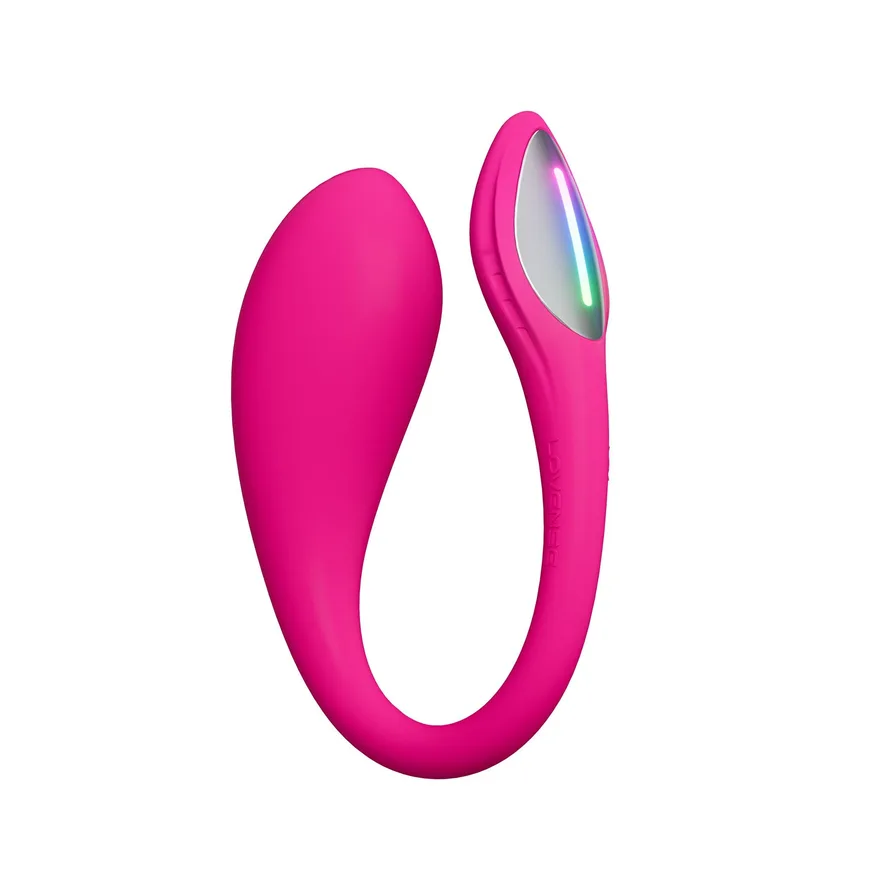
Lovense Lush Mini is the smallest model in the Lush series, the product family that made Lovense a household name in app-controlled sex toys. The manufacturer describes it as a remote-controlled G-spot egg-type vibrator with an LED-equipped tail, and it’s that tail and the size that set it apart from the rest of the series. The basic idea is the same as in all Lush models: an insertion part that stays against the G-spot, a flexible tail that holds it in place outside the body, and all actual control in an app on your phone.
The specifications look like this according to Lovense: 31-millimeter insertion diameter, 58 grams weight, silicone on the outside and electroplated plastic in the tail, a li-polymer battery with 40 minutes charging time and up to 236 minutes operating time, up to 120 hours standby, up to 7,000 vibrations per minute, an unlimited number of vibration patterns via the app, a Bluetooth range of up to 93 meters outdoors, an IPX7 ingress protection rating, and a one-year manufacturer’s warranty. The lowest sound level is stated as 36 decibels. In Sweden, the item is sold by eight stores at prices between 899 and 1,499 SEK, and seven of them have it in stock.
This review covers the variant with EAN 6972677430500. The number can be read directly from the barcode on the manufacturer’s own packaging image, where the digits 6 972677 430500 are printed under the code—which is the most reliable link you can make, since Lovense does not publish GTIN numbers on its product pages. The model is called simply Lush Mini in the manual, and the manufacturer is HYTTO PTE. LTD. in Singapore, with manufacturing at Shenzhen Love Sense Technology in China.
An egg vibrator is an insertable vibrator without a handle. It is inserted and stays there instead of being held against the body, and that’s what makes the category portable: you can have it on while you do something else. The practical difference compared with a clitoral simulator like Womanizer or Satisfyer is therefore not only where the stimulation happens, but also whether you need your hands on the product or not.
Lovense builds its version around three things. The first is the tail: a flexible silicone arm that runs from the insertion part and out of the body, both as a pull-out strap and as something that rests against the labia. The second is the LED lighting at the end of the tail, which, according to the manufacturer, changes color in sync with the vibrations and can be turned off in the app under Settings. The third, and most important, is that almost all control is handled in the Lovense Remote app: there is exactly one button on the toy itself.
What that means in practice is that Lush Mini is a product that assumes a phone. The manufacturer states an unlimited number of vibration patterns, but that value applies to the app — that’s where patterns are created, saved, synced to music, and handed over to someone else. Without the app, the fixed modes remain that the button steps through. How many fixed modes the button has is not published by Lovense, either on the product page or in the manual, and that’s one of the more annoying gaps in the specifications for anyone who wants to use the product offline.
The Lush series consists of multiple generations that are sold in parallel in Swedish stores, and they’re often mixed up because the names differ by only one number.
The most important thing to understand from that table is that Lush Mini is not cheaper than Lush 4 with the manufacturer. Both are at 129 dollars. So Mini isn’t the entry-level model in the series — it’s the side model for someone who wants a smaller body, and it pays for the smaller size with a third shorter runtime than Lush 4. That it’s still often the cheapest of the three in Swedish stores is due to the stores’ pricing, not because Lovense positions it as a budget option.
The material issue is the only property of an intimate product that can’t be compensated for with experience or care, and it determines whether the product is still hygienic after a few years. Lovense lists two materials for the Lush Mini: silicone and electroplated plastic. In the product page’s own FAQ, the breakdown is specified—according to the manufacturer, the outside is one hundred percent body-friendly silicone, while the LED tail’s end is electroplated plastic. The manual states the type of plastic: ABS.
Silicone is a non-porous material. A non-porous surface can be cleaned, because there are no microscopic cavities where residue can remain. This is the single most important property of a material that is supposed to rest against mucous membrane, and that is why the material declaration carries more weight than almost all other lines in a specification.
So, the crucial factor is that the silicone covers the entire part that is inserted. The electroplated plastic sits at the very outer end of the tail—that is, the part that lies outside the body and contains the LED window. What can be established is that the construction is molded as a single piece without a seam where the insertion part meets the tail, which is an advantage compared with products where a silicone part is mounted on a plastic handle and the seam becomes a dirt-trapping pocket.
The downside of the same construction is that nothing can be disassembled. There is no detachable head to rinse separately, no battery compartment, and no part that can be replaced. The product is a sealed unit, and that makes it easy to clean but impossible to service.
Phthalates are a group of plasticizers used to make plastic—above all, softened PVC—flexible. The Swedish Chemicals Agency (Kemikalieinspektionen) describes them as substances that can affect the endocrine system and make reproduction more difficult, and several of them are therefore restricted or banned within the EU in a large number of products. This specific product category is repeatedly the subject of supervision, because it contains softened plastic against skin and mucous membrane.
In the product page’s FAQ, Lovense writes that none of their products contain phthalates or other harmful chemicals. The manual goes one step further and frames it in regulatory terms: the materials are stated to be free from substances of very high concern (SVHC) above applicable limit values, and the silicone and ABS plastic are stated to comply with the restrictions in Annex XVII to the REACH Regulation (EC) No 1907/2006. The manual also states that the product is covered by the WEEE Directive 2012/19/EU and the Batteries Directive 2006/66/EC, and that HYTTO PTE. LTD. has issued an EU declaration of conformity with the directives 2014/53/EU and 2011/65/EU.
It’s unusually detailed for the category. Silicone doesn’t require phthalate plasticizers to be soft—the softness comes from the polymer’s own structure—and that’s why silicone as a material specification in itself is a better sign than labels like “TPE” or “jelly rubber,” which don’t say anything at all about which plasticizers are included. Still, one thing in the manual is worth noting: Lovense explicitly urges anyone who is allergic to silicone or ABS not to use the product. The fact that ABS is mentioned in that warning is a reminder that the plastic part can actually come into contact with skin.
Lovense publishes exactly two measurements for Lush Mini: the insertable diameter of 31 millimeters and the weight of 58 grams. The diameter is shown both on the product page and printed on the front of the packaging, where the manufacturer writes “Insertable diameter: 31 mm (1.2 in)”. It’s an unusually clear numerical specification for the category, and it’s also the only one that really matters to anyone wondering whether the product will fit.
However, the manufacturer does not publish either the product’s total length or how far in it goes, either on the product page, on the packaging, or in the manual. And there are no shortage of guesses in retail: Vuxen states the total length as 7.2 centimeters and the insertable length as 6.7 centimeters, while Blush Me lists 9.6 and 7.0 centimeters, respectively, for the same item number. Two stores, the same EAN, a difference of two and a half centimeters in total length. Both agree that the largest diameter is 3.1 centimeters, which matches the manufacturer’s 31 millimeters—but for the length question, there’s no source to rely on until Lovense itself publishes a value. Treat the stores’ length measurements as approximate.
The weight, on the other hand, is easy to put into context. 58 grams versus 75 grams for both Lush 3 and Lush 4 means that Mini weighs a little over twenty percent less than its siblings. For a product that’s designed to be worn for longer stretches of time, it’s one of the most relevant figures in the entire specification—weight is noticeable over time in a way that a top effect doesn’t.
The shape is the classic Lush shape: a drop-shaped insertable part that transitions into a narrow, flexible tail that curves back. The manufacturer’s own product images show that the tail carries both the CE marking and the symbol for separate collection, and that the LED window sits on the outside of the tail, with the two magnetic charging contact points on the back just below. That’s also where the only button is located.
The interface on the Lovense Lush Mini is as simple as it can get. The manual describes a single button with two functions: press and hold for three seconds to turn it on or off, press once to step through the vibrations. There’s no display, no plus and minus buttons, and no separate mode for strength and patterns.
It’s a deliberate trade-off, and it cuts both ways. The advantage is that the product is impossible to fumble with once it’s already in place and the button is out of sight—one press is one press. The downside is that you can’t go back one step, only around, and that you can’t know which mode you’re in without looking at the LED tail or on your phone.
You can use the Lush Mini completely without an app: turn it on with a three-second press, and step through with short presses. But that’s also all the manufacturer describes. Lovense doesn’t state how many fixed vibration modes are in the button, and it also doesn’t state in what order they come. The product page’s value “unlimited vibration patterns” explicitly refers to the Lovense Remote app, not the button. So anyone who buys the product intending to use it standalone will need to be prepared to try things out and figure it out.
What can be established, though, is that the charging indicator is the same LED that lights up during use: the manual states that the lamp glows red while charging and turns off when the battery is fully charged. The same lamp can be turned off entirely via the app under Settings, which is relevant for anyone who wants to use the product discreetly under clothing—a color-shifting LED in sync with the vibrations is exactly the detail that turns an invisible product into a visible one.
The app is the product’s real interface. The manufacturer states an unlimited number of vibration patterns, the ability to let a partner take over control in real time from any location, and that the product is so-called tip-activated—it can respond to donations in live streams, which is the feature that has made the Lush series standard equipment among streamers.
It’s worth being clear about what this architecture costs. A product whose main functions are in an app depends on the app remaining available, being updated, and continuing to support the model. It’s a completely different risk to lifespan than what applies to a mechanical vibrator with buttons, and it doesn’t show up in any specifications. What can be established on a technical level is that the connection is via Bluetooth in the 2402–2480 MHz band according to the manual’s radio data, with a radiated power (E.I.R.P.) of 1.27 dBm. Lovense doesn’t specify which Bluetooth version is used, either on the product page or in the manual.
Lovense states the range as up to 93 meters outdoors for Lush Mini, up to 105 meters for Lush 4. It’s a line-of-sight figure: outdoors, without walls and without a body in between. Indoors, through clothes and furniture, it becomes shorter—and this applies to all Bluetooth equipment. The difference of twelve meters between the models is, in practice, marginal compared with what a concrete wall does.
One detail that Lovense actually spells out—and that most manufacturers gloss over—is that the Bluetooth connection can become unstable in or under water. It’s physics, not a product flaw—2.4 GHz is heavily attenuated by water. The consequence is concrete: the product can handle bathing thanks to IPX7, but remote control doesn’t necessarily have to. Expect that the button is what you use in the bathtub.
For long-distance use, the range doesn’t matter at all. The signal goes via the internet to your partner’s phone and then to yours, and it’s the phone’s connection that determines the lag. The Bluetooth range is only the distance between your own phone and the toy.
Lovense publishes a decibel figure, which is more than most in the category do. The value is 36 dB, and the manufacturer is careful with the wording: it is a lowest sound level. The product page also shows a comparison scale where a whisper is listed as 30 dB, Lush Mini as 36 dB, a library as 40 dB, and a restaurant as 80 dB.
What can be established, then, is that 36 dB applies to the weakest setting, not the strongest. Lovense does not publish what the product sounds like at full power, and they also do not state according to which method or at what distance the measurement was made. Without a measurement distance, a decibel value isn’t comparable between manufacturers, and it’s worth knowing before you pit 36 dB against a figure from another brand. The fact that Lovense lists exactly the same 36 dB for Lush Mini as for the significantly larger Lush 4 also suggests that the value describes the motor’s lowest RPM rather than the product’s overall sound profile.
A practical point that applies regardless of model: a plug-in vibrator is noticeably quieter when it’s in place than when it lies freely, because the body dampens. Anyone who tests the product first on the kitchen table will be surprised—the tabletop works like a resonance box and noticeably amplifies the sound.
Lovense Lush Mini is rated IPX7, both according to the product page and according to the icon on the back of the packaging. The rating comes from the international standard IEC 60529, which defines enclosure classes for electrical equipment. The number 7 in the second position means that the product is tested for submersion in water to a depth of one meter for 30 minutes. The manufacturer states the consequence directly: the product can be used in the shower, bath, and pool down to a depth of one meter.
The difference from a splash-proof product is greater than the wording suggests. Splash protection covers water droplets and, at best, water jets, but not submersion. Such a product handles a damp cloth and possibly a shower, but not a bathtub, and it should not be held under running water, with consideration for the charging contacts.
With IPX7, the entire product can be rinsed off without being careful. This is especially relevant here, because Lush Mini is cast in one piece with no openings—the magnetic charging contacts sit on the outside of the housing, which means there is no door or rubber plug that can become unsealed over time. If a product has no IPX rating at all, it should be treated as not waterproof. The absence of a rating is never a sign that the product would be approved.
Lovense instructions are concise and unambiguous: clean with warm water and soap, and dry thoroughly before putting the product away. The manual specifies the soap as mild and unperfumed and adds that the product should be fully charged before first use. Since there are no parts to take apart, it’s enough to rinse off the entire product under the tap.
On the question of lubricant, the manufacturer recommends water-based lubricant. This is not just a product recommendation but a material issue: silicone-based lubricant should not be used on silicone products, because it breaks down the silicone surface over time and makes it porous—and a porous surface can no longer be cleaned properly; it can only be replaced. Oil-based products, such as coconut oil, leave a film that is difficult to remove.
The manual also covers a couple of things that rarely appear in store text. The product should not be exposed to extreme heat or cold, it should not be used on damaged or irritated skin, and it is intended for personal use and should not be shared with anyone else to avoid spreading infection. Lovense also states explicitly that the product is not a medical device and has no medical properties.
One thing to note about storage: no storage pouch is included. The manufacturer’s own list of contents on the back of the package lists exactly three items — Lush Mini ×1, USB charging cable ×1, and user manual ×1. So the fact that Mshops’ Swedish product page says that a storage pouch would be included doesn’t match what Lovense itself prints on the box. It’s a small thing, but it’s worth knowing if you compare what’s in the package between shops — and especially if you compare it with We-Vibe Jive 2, where a cotton pouch is actually included according to the manufacturer.
Lovense states a li-polymer battery with a charging time of 40 minutes and a runtime of up to 236 minutes, i.e. almost four hours. Standby time is listed as up to 120 hours. The most “salesy” figure, however, is another one: a seven-minute charge should give an hour of operation, which the manufacturer calls fast charging and highlights as one of the model’s main arguments.
Two things in the manufacturer’s own material are worth highlighting, because they significantly nuance the picture. The first is in the product page’s FAQ: the runtime varies with the vibration level, and the range is given as 63 to 236 minutes. So four hours applies to the weakest setting. At full power it’s just over an hour, and that’s the figure that’s relevant for someone buying the product for its power.
The second is a direct contradiction. The specification table lists the charging time as 40 minutes. The same page’s FAQ answers the question “how do I charge Lush Mini” by saying it takes about 50 minutes to charge it fully. So the manufacturer publishes two different charging times for the same product on the same page. The difference isn’t dramatic, but it’s worth knowing: plan on somewhere between 40 and 50 minutes rather than relying on the lower value.
With a magnetic charging cable. Lovense says the cable can be connected to any USB port or USB adapter, and that the product should be turned off before charging begins. The manual lists the input as 5 volts and 0.8 ampere, and describes the indicator: the light glows red while charging and turns off when the battery is full.
Magnetic charging is a trade-off, not a pure advantage. The advantage is that you don’t need an opening in the casing, which makes it much easier to achieve IPX7 without a rubber plug that wears out. The downside is that the cable is product-specific: if you lose the charging cable, no standard USB-C cable will work, so you have to get a replacement from the manufacturer. Since the only cable in the box is also the only one that fits, it’s worth keeping it in a specific place.
Lovense does not publish the battery’s capacity in milliampere-hours or its voltage for the Lush Mini, either on the product page, on the packaging, or in the manual. The only electrical value stated is the charging input 5 V 0.8 A, and it does not say anything about the cell’s size. Without the capacity, you can’t calculate runtime into power consumption, and you can’t compare how heavily the cell is loaded between models. mAh figures circulating on other sites lack support in the manufacturer’s materials.
What generally applies to lithium batteries also applies here: capacity drops with the number of charge cycles. The manual is also very clear on one point that determines the product’s total service life — the built-in battery is not replaceable and cannot be replaced by the user. With use a couple of times per week, it’s the battery, not the silicone, that sets the limit, and because the cell is permanently fixed, the product is essentially used up when the battery is. Lovense also writes that battery performance can deteriorate at extreme temperatures, and that the charger should be unplugged once charging is complete.
We do not have price data from shops in your market yet.
Four hours of runtime applies to the lowest setting. At full power, the manufacturer states 63 minutes.
Three comparisons are relevant: against the full-size model in the same series, against the previous generation, and against the nearest competitor from another brand. All the information below comes from the respective manufacturers’ own specifications, and all prices come from the shops’ product feeds on 29 July 2026.
Lush 4 is the most important comparison, because Lovense sells both for 129 dollars on its own site. That’s where the similarity doesn’t end either: both list 36 dB as the lowest sound level, both up to 7,000 vibrations per minute, both IPX7, both lithium-polymer batteries, both the same materials — silicone and electroplated plastic — both an unlimited number of patterns in the app, both 120 hours of standby, and both a one-year warranty.
The differences are four, and they’re all measurable. Lush 4 weighs 75 grams versus Lush Minis’ 58. Lush 4 charges in 45 minutes versus 40. Lush 4 goes up to 350 minutes versus 236 — that is, almost two hours longer. And Lush 4 has up to a 105-meter Bluetooth range versus 93.
The summary is awkward for the Mini on paper: you get 17 grams less weight and five minutes faster charging, and you pay for it with 114 minutes less runtime. In Swedish stores, Lush 4 is also priced from 1,015 SEK versus Lush Minis at 899 — so just 116 SEK more. What still speaks in favor of the Mini is the very reason it exists: a 31-millimeter insert diameter and a lighter body are decisive for the person who thinks full-size eggs are too big, and that question isn’t answered by a table. If you want the longest runtime, you buy Lush 4. If you want the smallest product, there’s only one option in the series.
Lush 3 costs 119 dollars from the manufacturer, so 10 dollars less than the two newer models. It weighs the same as Lush 4 — 75 grams — and has the same materials, the same IPX7, the same Li-polymer battery, the same 120-hour standby time, and the same one-year warranty.
Where it falls behind is charging and runtime. Lush 3 is listed as having an 80-minute charging time and up to 220 minutes of operating time. So it has twice the charging time as the Lush Minis 40 minutes, and slightly shorter operating time than the Minis 236 minutes. That difference is the clearest generational improvement across the entire series, and it’s worth knowing if you find a Lush 3 at a sale price.
In Swedish stores, Lush 3 costs from 1,249 SEK, which is 350 SEK more than the Lush Mini at its cheapest. At those prices, there’s no reason to choose the older model: you pay more for double the charging time, shorter runtime, and a heavier body. Lush 3 is interesting only when the price difference goes the other way.
We-Vibe Jive 2 is the closest competitor from another brand: the same product type, the same use case, the same price bracket. We-Vibe lists a rechargeable lithium-ion polymer battery, a runtime of up to four hours, a charging time of up to 90 minutes, body-friendly silicone free from phthalates and BPA, and made without latex, an IPX7 ingress protection rating, and a two-year warranty. In Sweden, it costs from 1,199 SEK.
Two differences weigh heavily. The first is what’s included in the package: with We-Vibe, a physical remote control and a cotton pouch are included in addition to the USB cable, while Lovense delivers the toy, cable, and manual. A physical remote control means the product can be controlled by someone else in the same room without anyone needing to take out their phone — and it works even if the app doesn’t. The second is the warranty: two years for We-Vibe versus one for Lovense.
Where Lovense wins is charging time and the reported transparency about the product’s limits. 40 to 50 minutes versus We-Vibe’s up to 90 is a halving, the seven-minute fast charge for an hour of operation has no match at We-Vibe, and Lovense actually publishes both a decibel figure, a range, and a span for the operating time — information that We-Vibe doesn’t state at all. When you compare accessories, warranty, and independence from the phone, Jive 2 wins. When you compare charging time, ecosystem, and long-distance functions, Lush Mini wins.
Eight Swedish stores sell the item with EAN 6972677430500. Cheapest is Mshop at 899 SEK, most expensive is Vuxen at 1,499 SEK. That’s a 600 SEK or 67 percent difference for the exact same item number, the same color, and the same packaging — and the price spread isn’t because any store sells a different variant, but because each store sets its own margin.
Seven of the eight stores had the product in stock at the price check, which is unusually good availability in this category. Only Vuxenkul at 1 479 SEK was sold out. That means the price comparison can actually be used: the difference between the cheapest and the next-cheapest store with the item delivered to your home is 250 SEK, between Mshop at 899 and Blush Me and SexleksakerOutlet at 1 149 SEK each.
Put the numbers in perspective with the manufacturer’s own list price. Lovense sells Lush Mini for 129 dollars, with a stated regular price of 259 dollars. That means the Swedish pricing landscape is in the same ballpark as the manufacturer’s promotional price at the low end and a good bit above it at the high end. There’s therefore no reason to pay more than around a thousand kronor for this product as long as the stock looks like it does.
The prices in the table above are updated when the stores’ product feeds are updated, but always check the final price at checkout. Shipping costs are added by most stores under a certain order value, and in this price range several stores are right around the threshold for free shipping—which can eat into part of the difference between the cheapest options.
It’s for you if you want the smallest product in the Lush series. A 31-millimeter insertion diameter and 58 grams are the two figures that justify the entire model, and they’re crucial for anyone who thinks full-size eggs are too big or too heavy to carry for extended periods. It’s for you who want a product you can carry discreetly under clothes, for you who want to be able to hand over control to a partner remotely, and for you who value being able to get an hour of runtime from seven minutes of charging when time is tight.
It’s for you if you want to be able to use the product in the shower and bath—IPX7 applies down to a one-meter depth—and for you who want a manufacturer that actually publishes both the decibel value, the range, the charging time, the standby time, and a range for the operating time instead of a single marketing figure.
It’s not for you if you want maximum runtime: with Lush 4, you get almost two hours more for an extra 116 SEK. It’s not for you if you want to be able to use the product fully without a phone, because all patterns except the button’s fixed modes are in the app, and the manufacturer doesn’t even state how many the fixed modes are. It’s not for you if you want a physical remote control in the box—that’s where We-Vibe Jive 2 is the right product. And it’s not for you if you require published battery capacity and published total length before purchase, because Lovense doesn’t publish either.
One last thing belongs in the decision. A one-year warranty is short. Both We-Vibe and several other brands in the same price range offer two years or more, and since the battery cannot be replaced, the warranty period practically defines how long the manufacturer’s own risk lasts. That makes Swedish consumer complaint rights more relevant here than for most products in the category.
Lovense provides a one-year warranty on the Lush Mini. The terms state that the warranty applies for one (1) year from the original purchase date and covers material and manufacturing defects when used according to the product’s manual. If a defect is discovered within the warranty period, Lovense replaces the product free of charge and covers the shipping cost for the replacement product. The claim must be supported by reasonable evidence, and the company requires proof of purchase—a receipt or invoice with the order number, purchase date, and where the purchase was made.
Read the exceptions before you count on the warranty. It does not cover damage that occurs from other use than the intended use, normal wear and tear, commercial use, lack of maintenance, carelessness, accidents, your own modifications, or unauthorized repairs. The fact that commercial use is the exception is worth a special note for this particular model, because Lovense simultaneously markets it as tip-activated and suitable for live streams. Anyone using the product professionally should read the term carefully.
Lovense also offers a 55 percent discount on a new product to customers whose item has broken after the warranty period has ended. According to the terms, this offer applies only to purchases made on lovense.com and can be used once. So if you shop at any of the eight Swedish stores listed above, you are not covered by it.
What always applies, however, is your statutory rights, and they last longer than the manufacturer’s warranty. Under konsumentköplagen, you have three years of right of complaint for defects in the goods, regardless of what the manufacturer states—so three times as long as Lovense’s one-year warranty. For distance purchases, you also have a right of withdrawal for fourteen days under the lagen om distansavtal och avtal utanför affärslokaler. Be aware that in practice the right of withdrawal is limited for hygiene products that have been removed from a sealed package—however, the right of complaint for defects always applies. If you have questions about what applies in your case, Konsumentverket guides you via Hallå konsument.
Lovense Lush Mini is ranked på plats 2 av 12 in g-spot vibrator best i test, where the entire category is compared against each other using five shared criteria. Guiden vinns av Womanizer OG.
Every numerical piece of information in the text can be traced to one of the sources below. The links were checked manually on the specified date.
This page is machine-translated from Swedish. Read the Swedish original