

Review
Review: Fleshlight Flight Pilot
The manual counterpole—no motor, no battery, and from 429 SEK.
29 July 2026
Review · Masturbator · App-controlled with an air pump
Lovense app-controlled masturbator reviewed against the manufacturer’s own specifications, manual, EU declaration of conformity, and price data from eight Swedish stores. Air pump with 360-degree contractions, vibration on its own button, ABS and TPE, IPX6 per IEC 60529, 95 to 215 minutes of operating time, and a one-year warranty — but only ninety days on the sleeve, and neither measurements nor sound level are published.
The most connected product in the comparison: air pump with 360-degree contractions and vibration on each button, plus an app ecosystem for long-distance use that no competitor in the price range matches. What you pay for is hygiene and water resistance — the TPE sleeve must not be washed with soap, it has only a ninety-day warranty, and IPX6 means the product can handle water jets but not submersion. The manufacturer also does not publish measurements, battery capacity, or sound level.
Lovense Max 2 is the brand’s app-controlled masturbator, and the product in the lineup that combines a vibrator with an air pump that contracts the sleeve around it. The manufacturer describes the function as 360-degree contractions: an air cushion around the sleeve is inflated and then released again, so that the pressure changes all around the circumference instead of just from one side. That function is what sets Max 2 apart from almost everything else in the category, and it’s also why the product has two buttons instead of one.
According to the manufacturer, the specification looks like this: housing in ABS plastic, sleeve in TPE, weight 750 grams, rechargeable lithium-ion battery, 100 minutes charging time, 95 to 215 minutes operating time, up to 120 hours standby, and ingress protection rating IPX6. The model designation in the EU declaration of conformity is simply Max 2; the manufacturer is Hytto Pte. Ltd. in Singapore, and the EU representative is Apex CE Specialists GmbH in Düsseldorf. In Sweden, the item is sold by eight retailers at prices between 1 036 and 1 399 SEK, and seven of them had it in stock at the price check.
This review is about the item with EAN 728360599612. The number is checked against Lovense’s own structured product data, where the entry “Lovense Max 2 App-Controlled Male Masturbator” carries that exact number in both the SKU and gtin12 fields. All eight Swedish retailers list the item under the same number, and the manufacturer lists only a single version with a single item number — so there’s no variant confusion to keep track of here, unlike many other products in the category.
A typical masturbator is a passive object: a sleeve in a casing that you move yourself. All the work comes from your hand, and the sleeve’s texture is the whole product. Lovense Max 2 belongs to a different category. Here, a motor and an air pump sit inside the casing, and both can be controlled independently of each other — the vibration with one button, the contractions with the other.
“Rent technically” means contraction in this context that an air chamber between the sleeve and the outer shell is filled and emptied. When the chamber is filled, the sleeve is pressed inward around the entire circumference; when it is emptied, it relaxes again. The manufacturer calls the effect 360-degree contractions precisely because the pressure does not come from a single point, but from the entire outer surface. It’s a different mechanism than the one a thrusting product uses, where a motor moves the sleeve back and forth along the product.
The vibration is the other half. Lovense describes it as an extended vibrator that is supposed to provide noticeable vibrations along the entire sleeve rather than just at one spot. What that means in practice is that the two functions can be used separately or together, and that the app can control both at the same time—that’s where the product’s real argument lies, and we’ll get back to that.
What you can also determine about the air pump is that it requires care. The manufacturer’s manual states that the air pump’s valve must be open when the product is used and closed when it’s cleaned. This isn’t a detail to read past: a closed valve during use means the pump is operating against a closed system, and an open valve during cleaning means water can get into the pump channel. None of the Swedish store texts mention this.
Lovense has three penis products in its lineup that are often mixed up in Swedish stores, and they solve three completely different problems.
The difference that determines the choice isn’t price but principle. If you want the product to do the work for you, Solace is the only one of the three that does. If you want the most water-resistant of them, Calor is the only option with IPX7. If you want contractions around the entire circumference, there’s only Max 2.
The material question weighs more heavily in this product category than in almost any other, because the sleeve is the only part that comes into contact with mucous membranes and because it can’t be boiled, dish-washed, or sterilized. Lovense lists two materials for Max 2: ABS plastic in the casing and TPE in the sleeve. It’s not the same as silicone, and the difference is worth understanding before you pay over a thousand kronor.
TPE stands for thermoplastic elastomer. It’s a soft, rubber-like material that’s cheaper to mold than silicone and that can be made significantly softer—which is exactly why it’s used in this type of sleeve. The downside is that TPE isn’t nonporous in the same way as platinum-hardened silicone. A porous surface has microscopic cavities where moisture and residue can remain, and that’s why a TPE sleeve is always a consumable item rather than a lifetime part.
The manufacturer’s own instructions confirm that picture in an unusually clear way. The manual states that Max 2 should be cleaned before and after each use, that the cleaning should be done with warm water, and that soap may not be used on the inner sleeve because the material can break down. It’s an instruction you won’t find on a silicone product, and it practically means that the only permitted cleaning for the surface that has been in contact with the body is water and mechanical rinsing. This places higher demands on making sure the sleeve is dried properly and replaced when it starts to look worn.
The good news is that Lovense has built the product for exactly that. The sleeve is replaceable and is sold separately by the manufacturer in two variants—Vagina Sleeve and Neutral Hole Sleeve—for 10 US dollars each versus 15 as of the control date. The sleeve included in the box is the neutral sleeve. The fact that a wear part can be bought separately for a tenth of the product’s price is a real advantage, and there are more manufacturers who should do the same.
Phthalates are a group of plasticizers used to make plastic flexible. Kemikalieinspektionen (the Swedish Chemicals Agency) describes them as substances that can affect the hormone system and make reproduction more difficult, and several of them are therefore restricted or banned within the EU in a large number of products. The issue is especially relevant for soft plastic that lies against mucous membranes—meaning exactly the use a TPE sleeve has.
Here it’s important to be exact about what actually is stated and what isn’t. Lovense doesn’t state any explicit phthalate, BPA, or latex declaration for Max 2 on the product page or in the manual. What it does have, however, is the manufacturer’s EU declaration of conformity, which lists the REACH regulation (EC) no 1907/2006 among the legal acts the product is stated to meet, along with RoHS, RED, GPSR, the Low Voltage Directive, WEEE, and the EMC Directive.
It is not the same thing as a material declaration, but it’s also not nothing. REACH is the regulation that governs restricted substances in the EU, and a published conformity document that names it is more than most manufacturers in this price category make public. That Lovense also publishes the document openly on its regulatory page, for Max 2 and for the rest of the range, is a reasonable confirmation that the product is a regulated EU item and not a gray-market import. If you want an explicit “phthalate-free” in plain text, though, you’ll have to look in another range—Fleshlight, for example, expressly states that their SuperSkin material is phthalate-free.
The weight is 750 grams according to both the manufacturer’s product page and the printed manual, and the two pieces of information match. It’s an unusually heavy product for something handheld. For comparison, Lovense lists 980 grams for Solace—but Solace is designed to stand still and work on its own, and it’s also delivered with a table stand. Max 2 therefore weighs three-quarters as much as a machine that isn’t intended to be held in the hand at all.
What 750 grams means in practice is that the product isn’t made for long sessions with a straight arm. It’s made to rest against the body or against a surface, and that part of the ergonomics depends entirely on the way it’s used rather than on the grip, since the shell is a smooth cylinder with no handle or finger indentation.
This is where a clear note belongs. Lovense does not publish the product’s length, its diameter, or the insertion depth for Max 2, either on the product page, in the manual, or in the EU declaration of conformity. It’s a strange gap in a specification that is otherwise unusually comprehensive, and it’s particularly bothersome in this category, where fit is the single most important feature. The manufacturer is satisfied with the wording that the product accommodates most sizes. Figures for length and insertion depth that circulate on other sites can’t be traced back to any information from Lovense, and that’s why they aren’t included here.
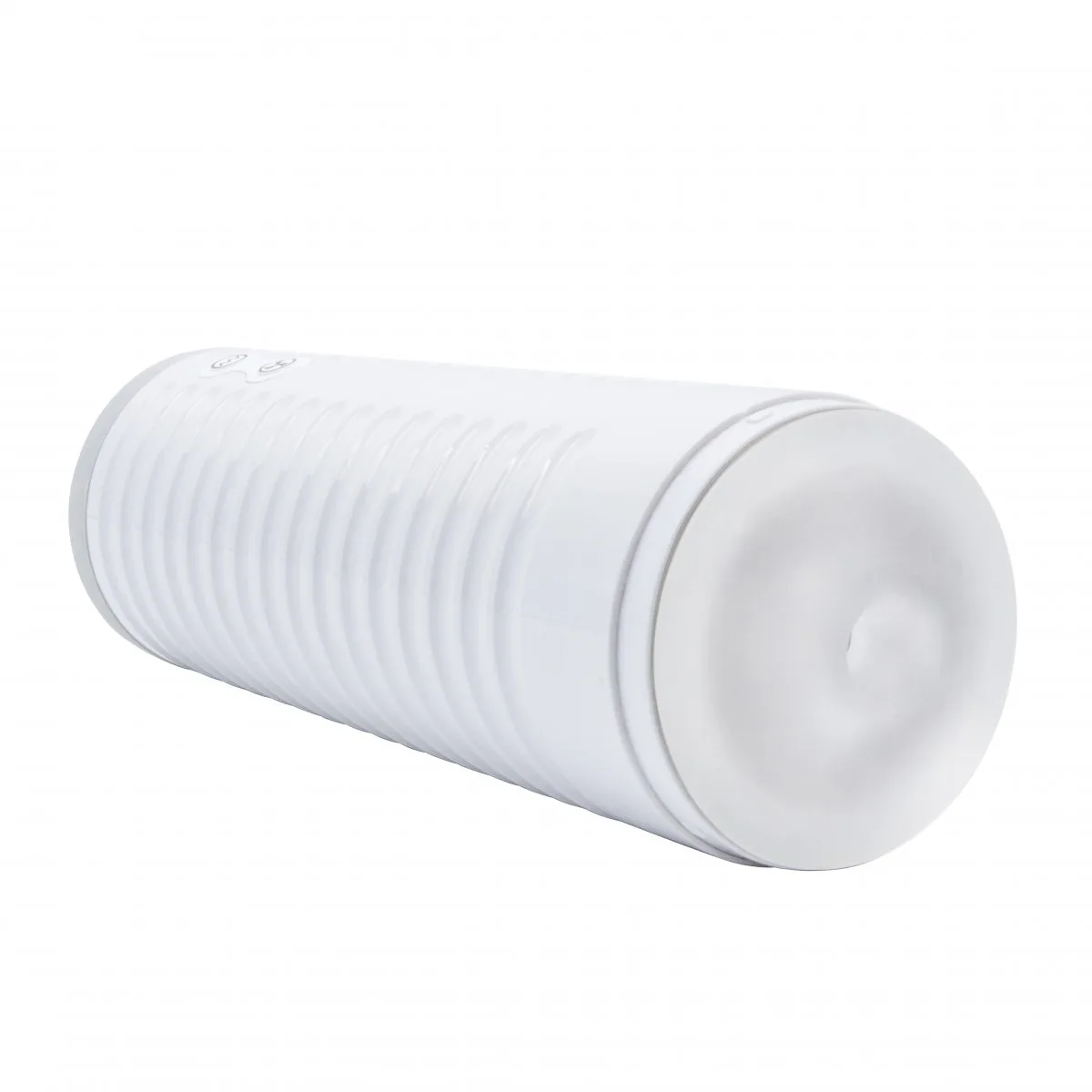
The shape is easy to describe: a straight cylinder with a closed cap at one end and the sleeve opening at the other. Two buttons sit a little way down on the shell’s outer surface: the adjustable air vent and the charging port. The surface is ribbed over most of the cylinder, which provides grip when your hands are wet or have lubricant on them—and it’s a practical detail rather than an aesthetic one, since the manual expressly advises plenty of lubrication of both the sleeve, the opening, and the body before use.
The interface on the Lovense Max 2 is stripped down compared with the app. The manufacturer’s manual names each element: button A turns the product on and off when it’s held in for three seconds and steps between vibrations with a short press; button B steps between contractions with a short press; and in between sits an indicator light. On the casing there are also three things that are not buttons: a Quick Air Release, an adjustable air vent, and the air pump’s own valve.
It’s an interface designed so it can be used without you seeing it, which is reasonable given how the product is held. The downside is that the only feedback is an LED—there’s no display and no numeric indication of which step is active. If you want to know exactly where you are, you have to use the app.
The contractions are the product’s signature feature, and the manufacturer’s own description is more straightforward than the texts in stores: an air pump mimics adjustable contractions all the way around the circumference. Button B steps between the modes. How many modes it involves is not stated—Lovense publishes no number either for the vibration steps or for the contraction steps, either on the product page or in the manual, which consistently talks about “stepping between” them without listing them. This is by far the biggest gap in an otherwise well-written documentation.
What can, however, be established is that contraction and vibration are two independent controls with their own buttons. You can therefore run high vibration with a light contraction—or vice versa—and it’s two completely different settings. It’s the same principle that makes a comparison based on “number of programs” misleading: Max 2 doesn’t have one mode scale but two that are multiplied with each other.
A feature of the air chamber is worth highlighting because the manufacturer itself does. The manual states that the air cushion, over time, conforms to how it’s been used, and that a certain amount of stretching is normal and doesn’t affect function. Translated: the construction is intended to change somewhat over time. It’s honest of the manufacturer to print that out, but it’s also a reminder that an air-pump product has more movable and moldable parts than a passive sleeve—and therefore more things that can change character after half a year.
Two of the three air-related details on the casing are pure comfort functions. The adjustable air vent controls suction strength: if you open it, air is let in and suction decreases; if you close it, suction increases. Quick Air Release is a quick-release solution which, according to the manual, should be pressed in when the product feels too tight.
It sounds trivial until you think about why it’s needed. A sealed air chamber around an inserted body is a system where the pressure can become uncomfortably high, and without a way out there’s no quick fix. The fact that the manufacturer has built in a dedicated release button and written in the manual exactly when it should be used—at excessively high pressure or discomfort—is a genuine safety feature. It’s also one of the few places where the manual adds something that no shop text mentions.
The third detail is the air pump’s own valve, and it works the opposite of what you’d guess. It should be open during use and closed during cleaning. The manual repeats the instruction in three places in the English section—within the itemized list, in the cleaning section, and in the warning box—which says something about how often it’s missed. If you forget to close it during cleaning, you risk getting water where it doesn’t belong, even though the product is rated IPX6.
The shortest possible honest answer: the manufacturer doesn’t state it. The manual describes button A as a button that steps up through the vibrations, and button B as a button that steps through the contractions, but neither of them includes a number. The product page doesn’t either.
What Lovense instead emphasizes is that the number of modes on the product isn’t the interesting figure, because the app replaces them anyway. In Lovense Remote, the vibration patterns are stated to be unlimited, and the intensity is set in a continuous way rather than in steps. That’s a reasonable argument for someone who plans to use the app. For someone who wants to be able to use the product without a phone, though, it’s a real documentation shortcoming: you don’t know how many steps you have to step through until you’re standing there with the product in your hand.
You can use Max 2 as a standalone product, but that’s not how it’s designed. Lovense’s whole business concept is based on the app, and Max 2 is one of the models where the difference between with and without the app is greatest—because two motors have to be controlled at the same time and the product only has two buttons.
The manufacturer lists the functions: in-app control, long-distance control, long-distance synchronization, unlimited vibration patterns, synchronization to music, and sound-activated vibrations. On top of that, there’s the ability to create, share, and use patterns that other users have made, and to let the product react to content in video and games that support the Lovense ecosystem.
The function that most often is the whole reason for buying is called Toy Sync. Lovense states that Max 2 can be synchronized with a Nora, a Calor, or an additional Max 2, and that the products then react to each other’s movements regardless of distance. In practice, that means that movements in one product are translated into stimulation in the other, in real time and over the internet.
It’s a technology that’s hard to compare on paper, because no manufacturer publishes latency figures. What can be established is that Lovense has built the broadest ecosystem of any manufacturer in the category: the same app controls the entire range, the same account is used for long-distance control, and the manufacturer sells bundles where Max 2 is combined with Nora or Edge 2 specifically for that purpose. Competitors in this price range have nothing comparable.
Content synchronization is the other half. Lovense states that vibrations and contractions can follow the action in compatible video, VR content, and games. Here you should be sober about what that means: the function requires that the content is made for the Lovense ecosystem, and it doesn’t work with arbitrary video. It’s a feature with a narrower use case than the marketing suggests, but it exists and it’s documented by the manufacturer.
The manufacturer is unusually specific here, and the requirements are worth checking before you buy. Lovense states that Lovense Remote works with iPhone, iPad Air, iPad Mini, and iPod Touch with iOS 14.2 or later, with Android 5.0 or later with Bluetooth 4.0 turned on, with Mac with Bluetooth 4.0 — and that a Windows computer requires a Lovense USB Bluetooth Adapter in order to be able to connect.
The last point is the one that costs money. So a Windows computer can’t control the product with its built-in Bluetooth without the manufacturer’s own adapter, which is sold separately. For anyone who plans to use Max 2 with games or content on a PC, it’s a hidden cost that doesn’t show up in any Swedish shop text.
On the radio side, you can be precise, for once. The manufacturer’s EU declaration of conformity states the frequency band 2402–2480 MHz and a maximum RF output power of 5.99 dBm. So it’s standard Bluetooth in the 2.4-gigahertz band with low transmit power, and the range should be understood as range within a room — long-distance control works over the internet via the phone, not via Bluetooth.
Sound level is one of the most common questions about this product type, because an air pump sounds different than a vibration motor. The answer has to be honest: Lovense does not publish any measured decibel value for Max 2, either on the product page, in the manual, or in the EU declaration of conformity. The product page also does not contain any statement that the model is quiet or discreet—which in itself is information: a manufacturer that uses a quietness argument usually relies on it.
What can be established purely from a technical standpoint is that the product has two sound sources instead of one. The vibration motor provides a continuous sound, and the air pump provides a pulsing sound—pumps are inherently audible because they move air. That a product with an air pump would be quieter than a product without one is not likely, but since no measurement is published, it stays at a technical expectation rather than a value.
Websites that list an exact decibel level for Max 2 either show their own measurement or a value without a source. A practical piece of advice that applies regardless of model: do not place the product on a hard tabletop during use, because the tabletop acts as a resonance box and noticeably amplifies both the motor and pump sound.
Lovense Max 2 is rated IPX6, and the rating is not only shown on the product page but also in the manufacturer’s EU declaration of conformity, with reference to the IEC 60529 standard. Having an enclosure rating included in a conformity document rather than only in marketing copy is unusual, and it means the information is formally declared.
The number 6 in the second position means protection against powerful jets of water from all directions. The manufacturer’s own wording on the product page is that Max 2 can handle powerful water sprays, and that is exactly the right way to describe it. IPX6, however, does not mean that the product can be submerged in water. That step requires IPX7, which according to the same standard corresponds to submersion for one meter for 30 minutes. The difference is real and it affects everyday life: Max 2 can be rinsed under the tap, but it does not belong in the bathtub.
This is also where the most interesting internal comparison within the Lovense lineup can be found. Calor, the smaller model in the same family, is rated IPX7 by the same manufacturer. So anyone who prioritizes water resistance over contractions is essentially buying the wrong product if they buy Max 2—and that trade-off is not shown in any store text.
The manufacturer’s routine is brief and needs to be followed exactly. Clean the product before and after every use. Use warm water. Do not use soap on the inner sleeve, because the material can break down. Make sure the air pump’s valve is closed before you start rinsing. Then dry the product thoroughly before putting it away or turning it on again—the manual is explicit that it must be dry before it’s started.
Lubricant is mandatory rather than optional for this product. The manual states that a generous amount of lubricant should be applied inside the sleeve, at the opening, and on the body before use. Use water-based lubricant. Silicone-based lubricant doesn’t belong on a soft elastomer, and oil-based products such as coconut oil leave a film that’s difficult to remove from a porous surface—and a surface that can’t be cleaned is a surface that must be replaced.
The manual also covers three things that rarely appear in store texts. The product must be kept away from extreme heat and cold. It must not be used while it’s charging. And it should be charged at least once every six months even if it isn’t used, which is the standard advice for lithium-ion cells that otherwise would deep-discharge during storage. The storage bag that, according to the manual, is included in the box is the right place between uses—not a box where the sleeve is pressed together.
Lovense lists the operating time as 95 to 215 minutes, the charging time as 100 minutes, and the standby time as up to 120 hours. The battery is lithium-ion type and rechargeable.
The 95 to 215-minute range is more informative than it looks. Most manufacturers only give the upper number, and it always applies to the lowest power output. The fact that Lovense publishes both ends means you can count on around an hour and a half when both the vibration and the air pump are running at full power, and a little over three and a half hours in the gentlest setting. The manual lists only the upper number, up to 215 minutes, while the product page lists the entire range—so the product page is the better source here.
Standby time of 120 hours, meaning five days, deserves a note that isn’t negative but is easy to miss. Five days is short. A product that has sat unused for a week is likely to be empty the next time you take it out, and together with the advice to charge at least every six months, that means Max 2 is best charged when you plan to use it rather than left fully charged in a box.
The manual is simple: turn off the product, connect the cable to any USB port or USB power adapter, and charging starts. The fixed red light turns off when the battery is full. The product must not be used while charging.
Here there is a documentation conflict worth knowing about. The specification table states the charge time as 100 minutes, but the body text in the same manual states about two hours. The product page lists 100 minutes. The difference is just under twenty minutes and has no practical significance, but it is an example of why you should read a specification against several of the manufacturer’s own documents before putting a number down as a fact.
The cable is what deserves the most attention. Lovense sells the charging cable as a separate accessory, and the manufacturer’s own product description states that the same cable fits Max 2 and roughly thirty additional Lovense models — including Nora, Edge 2, Lush 4, Domi 2, and Calor. That means two things in practice. One is that a regular USB-C cable doesn’t replace it: the end that meets the product is Lovense’s own. The other is that someone who already owns a Lovense product probably has a spare cable at home, which is a real advantage for someone buying multiple products within the same ecosystem.
Lovense does not publish the battery’s capacity in mAh or its voltage for Max 2, either on the product page, in the manual, or in the EU declaration of conformity. What is provided is battery type, operating time, charging time, and standby time. Without the capacity, you can’t convert operating time into power consumption, and you can’t compare how heavily the cell is loaded between models.
The general rule still applies, though. The capacity of a lithium-ion cell decreases with the number of charge cycles, and the manufacturer does not state anywhere that the battery is replaceable. With use a couple of times a week, it’s the battery — not the casing, which can be bought new — that eventually sets the limit for the product’s lifespan. The advice in the manual to charge at least once every half year is the single cheapest way to push that limit forward.
We do not have price data from shops in your market yet.
The manufacturer states that soap may not be used on the inner sleeve. It’s an instruction that no silicone product needs—and it says more about the material than any marketing text.
Three comparisons are relevant: against the smaller model in the same family, against Lovense’s own hands-free device, and against the manual classic that costs a quarter of the price. All of the information below comes from the respective manufacturers’ own specifications, and all prices come from the shops’ product feeds on July 29, 2026.
Lovense Calor costs from 1,095 SEK, so exactly the same amount as Max 2 costs at the cheapest shop that had it in stock. The fact that two products from the same manufacturer end up with the same price tag makes the comparison above unusually straightforward: this isn’t about money, but about what you want.
Calor is rated IPX7, which according to IEC 60529 means immersion to a depth of one meter for 30 minutes. Max 2 is rated IPX6, so it’s protected against powerful water jets but not immersion. Calor is stated to support 60 to 130 minutes of continuous use, while Max 2 supports 95 to 215 minutes, and both have a one-year warranty. The items in the package are, in practice, the same: the product, a USB charging cable, and a manual.
What Max 2 adds is the air pump with 360-degree contraction movements and the Toy Sync connection to Nora and Calor. What Calor adds is water resistance and a significantly smaller body. The conclusion is simple: if you want to be able to clean the product without having to think about water, Calor is the right choice at the same price. If you want the contractions, there’s only Max 2.
Lovense Solace costs from 1,295 SEK, i.e., 200 SEK more than Max 2 at the cheapest store with stock. For that money, you switch product category rather than model.
Solace is a hands-free impact massager. The manufacturer lists ABS material, 980 grams, a lithium polymer battery, a 100-minute charging time, up to 13 hours of run time, an enclosure rating IPX4, a maximum striking rate of 280 strikes per minute, and three levels of strike length that change in steps of 0.65 millimeters. A tabletop stand is included in the box. The warranty is one year, and the sleeve, just like with Max 2, has 90 days.
The differences that actually matter: Solace moves on its own, and Max 2 does not. Solace has more than three times the run time—13 hours versus 215 minutes—but worse water resistance, IPX4 versus IPX6. Solace weighs 230 grams more but doesn’t need to be held. Max 2, on the other hand, has contractions around the entire circumference, which Solace doesn’t, and Toy Sync with the partner’s product.
If you’re choosing based on hands-free use and run time, Solace clearly wins. If you’re choosing based on type of stimulation and interaction with a partner, Max 2 wins. In this case, the price difference of 200 SEK isn’t what should decide.
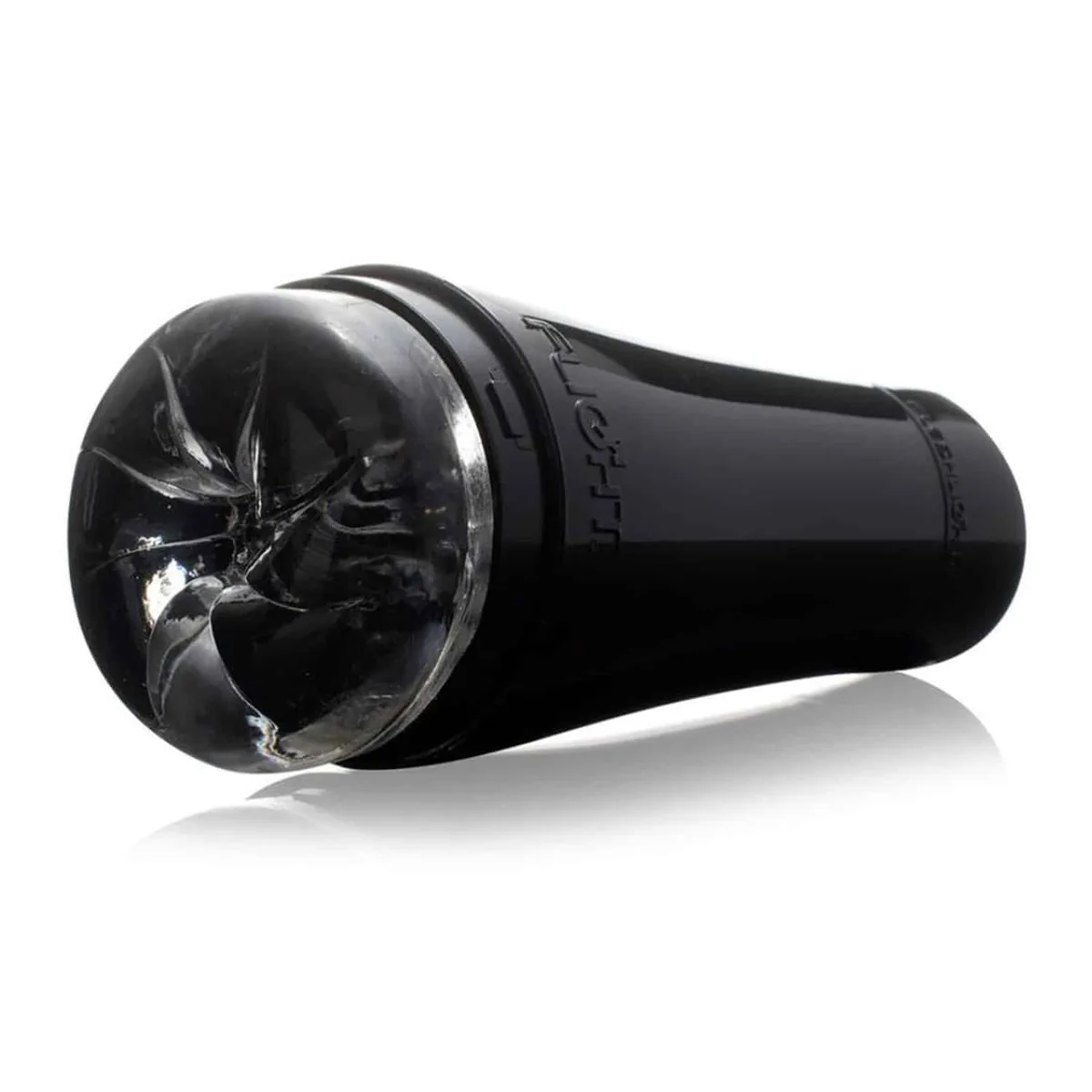
Fleshlight Flight Pilot costs from 429 SEK. Max 2 costs 1,095 SEK at the cheapest in-stock store, i.e., 666 SEK more—two and a half times the price. That’s the comparison that determines whether you should buy a motorized product at all.
Flight Pilot has no motor, no battery, no app, and no air pump. Fleshlight states up to seven inches in length and five and a half inches in circumference, as well as its patented SuperSkin material, which the manufacturer explicitly states is phthalate-free—a declaration that Lovense does not make for the TPE sleeve in Max 2. You can rinse it however you want because there’s no electronics in it, and it can’t break in the way a pump or a battery can.
Are you unsure whether the product type will work for you? Flight Pilot is a hard-to-beat way to find out for under five hundred kronor. If you already know that it works, and you want vibration, contractions, app control, and the option to connect the product with a partner in another location, the price difference is justified—but it should be a conscious choice, not an assumption that more expensive is better. It also needs to be said plainly that Max 2 requires more maintenance: charging, a vent that has to be positioned correctly, and cleaning where soap is forbidden on the most important surface.
Eight Swedish stores sell the item with EAN 728360599612. The cheapest in the feed is Vuxen at 1,036 SEK, and the most expensive is Lustly at 1,399 SEK. That’s 363 SEK, or a 35 percent difference, for the exact same item number and the same packaging.
However, the inventory situation changes the picture. Vuxen, which had the lowest price, had the product sold out at the price check. The cheapest among the seven stores that actually had it in stock was Joyland at 1,095 SEK, followed by Vuxenkul at 1,269 SEK, and then Lekosmek and Taboo at 1,289 SEK each. Counted only on what was actually possible to buy, the spread is 304 SEK, or 28 percent—not 363 SEK.
A store listing a lower price for an item that’s sold out is common and rarely malicious—the feed simply doesn’t update completely until the item comes back in, and the price that remains displayed is rarely what you pay when it does. So always check both the stock status and the final price at checkout before you base anything on the lowest figure in a price comparison.
One last measure of the price picture: Lovense’s own web store listed Max 2 at 99 US dollars, versus the regular 199 US dollars on the check date. That the manufacturer itself sells the product at half its own list price is information in itself, and it’s reasonably part of the explanation for why the spread between Swedish stores is so large: stores that bought in under older terms stay higher than those that bought in later.
It’s for you if you want two independent stimulation types in the same product and if you actually plan to use the app. It’s for you if you’re in a long-distance relationship, because Toy Sync with a Nora, a Calor, or another Max 2 is the function that no competitor in the same price range matches. It’s for you if you already own other Lovense products, both because the app is the same and because the charging cable fits across the range. And it’s for you if you see the casing as a consumable and think it’s reasonable to be able to buy a new one for a tenth of the product’s price.
It doesn’t fit you if you want to be able to submerge the product in water—then Calor from the same manufacturer is the right choice for the same price. It doesn’t fit you if you want a hands-free product that moves by itself; that’s what Solace does. It doesn’t fit you if you require published dimensions, insertion depth, battery capacity, or sound level before buying, because Lovense doesn’t publish any of that for this model. And it doesn’t fit you if you want the absolute minimum maintenance: 750 grams, a valve that has to be positioned correctly in two directions, and a ban on soap on the sleeve—three things that a manual sleeve doesn’t have.
One last thing belongs in the decision. Max 2 is designed as a main product in an ecosystem, not as a standalone purchase. The price, the size, the brand-specific cable, and the fact that the app replaces the product’s own interface all point in the same direction. Anyone who just wants a good sleeve would be better off putting four hundred SEK into a manual model and spending the rest on something else.
Lovense provides a one-year warranty from the original purchase date for the Max 2—but expressly not for the TPE sleeve, which has ninety days. This split is stated in both the manual and the warranty terms, and it’s consistent across Lovense’s entire range: Max, Max 2, Solace, and Solace Pro all have the same design, one year on the product, and ninety days on the sleeve.
Read the terms before you count on the warranty. It covers material and manufacturing defects when used according to the manual, and in that case Lovense replaces the product free of charge and covers the shipping of the replacement item. It does not cover normal wear and tear, commercial use, lack of maintenance, incorrect installation, accidents, or attempts to repair it yourself. To make a claim, you need the product’s serial number, which, according to the manufacturer, is on the packaging—so save the box—as well as proof of purchase, a description of the fault, and a photo or video showing the defect.
Two points in the terms are worth highlighting especially. The warranty is personal and cannot be transferred: it only applies to the original buyer, which means that a product bought second-hand has no warranty at all. And Lovense explicitly states that you don’t get any kind of satisfaction guarantee, referring to the products’ intimate nature. The manufacturer’s ten-year warranty is also not a warranty in the usual sense: it gives 55 percent off a new unit when purchasing on lovense.com, can be used once, and applies to a maximum of three items in the same order. If you buy from any of the eight Swedish stores above, you’re not covered by it.
What always applies, however, are your statutory rights, and Lovense itself writes that a longer period applies where mandatory law requires it. Under konsumentköplagen, you have a three-year right to make a complaint about defects in the item, regardless of what the manufacturer promises—i.e., three times longer than Lovense’s one-year warranty. For distance purchases, you also have a right of withdrawal within fourteen days under lagen om distansavtal och avtal utanför affärslokaler. Be aware that in practice the right of withdrawal is limited for hygiene products that have been taken out of a sealed package, which applies particularly strongly to this product category. The right to make a complaint about defects, however, always applies. If you have questions about what applies in your case, Konsumentverket guides you via Hallå konsument.
Lovense Max 2 isn’t included in any ranking yet. In best i test guides, the entire categories are compared against each other using five shared criteria, with what was left out shown.
Every numerical piece of information in the text can be traced to one of the sources below. The links were checked manually on the specified date.
This page is machine-translated from Swedish. Read the Swedish original