

Review
Review: Lovense Max 2
Vibrating and contracting masturbator with IPX6 — significantly cheaper.
29 July 2026
 Premium pick
Review · Masturbator · Automatic thrusting machine
Lovense’s most advanced thrusting machine reviewed against the manufacturer’s own specifications and pricing data from eight Swedish stores. 300 strokes per minute, stroke length up to 79 millimeters in steps of 0.65 millimeters, up to 14 hours of operating time, USB-C, and a 180-degree table mount — but only enclosure class IPX4, and a 90-day warranty on the sleeve.
The mechanically strongest product in the comparison: 300 thrusts per minute, adjustable 79-millimeter stroke length in steps of 0.65 millimeters, up to 14 hours of runtime, and USB-C. The tabletop mount makes it a true hands-free product. What you pay with is cleaning—the enclosure rating is only IPX4 and the main body must not get wet—and an app dependency for the specific functions that justify the Pro model.
Lovense Solace Pro is the brand’s most advanced automatic thrusting machine for men. It’s called Solace Pro in the manufacturer’s catalog, but on the product page it carries the longer marketing name AI-Powered Remote Control Thrusting Blowjob Machine. The name basically tells you what it does: a motor drives a sleeve back and forth in a cylinder, and the movement is controlled either via the buttons on the side or via Lovense’s app.
The specifications look like this. The maximum thrust rate is 300 thrusts per minute. The thrust length can be adjusted up to 79 millimeters, corresponding to 3.11 inches, with adjustments made in steps of 0.65 millimeters. On the product itself, there are eight speed levels, four depth levels, and four preset patterns. The battery is a lithium polymer type and, according to the manufacturer, lasts up to 14 hours, with a 135-minute charging time via USB-C and up to 120 hours of standby. The material is listed as ABS and PC with silicone, and the sleeve as TPE. The enclosure rating is IPX4. The product weighs 1.2 kilograms and measures 231.5 × 136 millimeters.
This review is about the item with EAN 6972677430364, the number that appears in the sku field in the manufacturer’s own structured product data for Solace Pro. In Sweden, the item is sold by eight stores at prices between 1,438 and 2,109 SEK, and seven of them had it in stock at the price check.
One thing to keep in mind right away: two Swedish stores, Lustly and Taboo, use "solace-pro-2" in their product addresses. No model called Solace Pro 2 exists in the manufacturer’s catalog — Lovense lists Solace and Solace Pro under the Auto Strokers heading, and the comparison table on the manufacturer’s own product page compares Solace Pro against Solace, nothing else. So the store addresses are their own search slugs, not another variant of the product.
The difference is principled, and it determines whether the product at all is the right category for you. A typical masturbator — a Fleshlight, or for that matter Lovense’s own Max 2 — is passive or semi-passive. You hold it and do the movement yourself, and the electronics add vibration or contraction on top of that movement. A thrusting machine does the opposite: the motor performs the actual forward-and-back thrusting motion, and the product is designed to stay in place while it works.
That explains three things in the specification that otherwise look exaggerated. The weight of 1.2 kilograms is there because a machine that thrusts 300 times per minute must have enough mass not to wander across the table. The table mount with an 180-degree adjustable angle is there so the product can be clamped in place and used completely without hands. And the battery of up to 14 hours is there because a machine that works for you is used differently than a product you hold in your hand — session length is no longer controlled by your wrist.
What you can state purely from a technical standpoint is that Solace Pro sits in the small group of products where the mechanical performance is actually measurable and comparable: thrusts per minute, stroke length in millimeters, and the resolution of the adjustment. That’s unusual in this industry, where most specifications stop at a certain number of “modes.”
The manufacturer publishes a direct comparison between the two models on the product page, and it’s unusually concrete. The differences are five, and all except one are measurable.
The weight goes the other way: Solace Pro weighs 1,200 grams versus Solace at 980 grams. That’s 220 grams more to lift, pack, and mount. Whether that’s a disadvantage or an advantage depends on whether you plan to use the product in the table mount — where the weight helps — or carry it around with you.
The summary that actually matters: the difference in thrust frequency is 7 percent, and the difference in operating time is just under an hour. What really differentiates the models is the resolution in stroke length and the USB-C connector. If you’re indifferent to both, there’s nothing in the table that justifies choosing the Pro model.
The material declaration for Solace Pro consists of four words that mean completely different things. The manufacturer specifies ABS and PC for the casing, silicone as the outer material, and TPE for the sleeve. It’s a more honest declaration than many in the category, but it requires you to read it the right way, because it’s only the sleeve that actually touches mucous membrane.
TPE stands for thermoplastic elastomer. It’s a soft, flexible material used in almost all stroker sleeves, for the simple reason that silicone can’t be made as flexible and at the same time as cheap. The advantage is the feel. The downside is that TPE isn’t non-porous in the same way as silicone: the surface has microscopic cavities where residue can remain, and it ages by becoming sticky.
What can be established is that the practical consequence is stated in the manufacturer’s own instructions. Lovense writes that the sleeve should be cleaned before and after every use, not just after, and that it should be dried completely before the product is stored. That wording in itself is a message about the nature of the material: a non-porous surface doesn’t need to be cleaned before use, a porous one does.
The second message is in the warranty. Lovense provides a one-year warranty for Solace Pro but explicitly excludes the TPE sleeve, which instead has a 90-day warranty. The manufacturer treats the sleeve as a consumable part, and you should do the same. The manufacturer sells replacement sleeves separately—Neutral Sleeve and Vagina Sleeve—both for 10 US dollars instead of the regular 15 when purchased together with the product, which is a clearer signal about expected lifespan than any marketing text.
The silicone in the declaration, according to the manufacturer’s material specification, is in the product together with ABS and PC, meaning it’s part of the construction rather than a replacement for the TPE sleeve. Lovense does not specify exactly which parts are silicone and which are plastic, and that’s a gap worth noting in an otherwise well-specified product.
Phthalates are a group of plasticizers used to make plastic flexible, especially soft PVC. The Swedish Chemicals Agency (Kemikalieinspektionen) describes them as substances that can affect the hormone system and make reproduction more difficult, and several of them are restricted or banned in the EU. The question is relevant for this particular product category because it contains soft plastic against skin and mucous membrane.
Lovense addresses the issue in the manual’s compliance section rather than in marketing. It states that the materials are free from particularly hazardous substances—SVHC—above the regulatory limit values, and that the silicone and ABS plastic meet the restrictions in REACH Annex XVII. The manual also states that the manufacturer HYTTO PTE. LTD. assures compliance with the RED directive 2014/53/EU and the RoHS directive 2011/65/EU, and Lovense publishes an EU declaration of conformity for the Solace Pro on its compliance page.
What can be established is that this is a compliance assurance, not a materials declaration of the same kind as “silicone free from phthalates, BPA, and latex”. The wording “free from SVHC above the limit values” means that the product complies with the law, which is a lower statement than saying that a substance is not used at all. It’s nothing remarkable—that’s standard for electronics—but it should be read for what it is.
One more detail: the manual states that the product should not be used on damaged or irritated skin, or by anyone who is allergic to silicone or ABS plastic, and that it is intended for personal use and should not be shared. The last point is connected to the TPE material—because a porous surface can’t be disinfected completely.
The manufacturer’s dimension drawing in the comparison table gives the length as 9.1 inches, i.e. 231.5 millimeters, and the width as 5.35 inches, i.e. 136 millimeters. The specification table gives the weight as 1.2 kilograms. It’s a product in the range of a large thermos, and it weighs more than most portable speakers.
In its category, the dimensions are normal rather than large. Kiiroo Keon, the most direct competitor, is listed as 220 × 130 × 146 millimeters and 1.1 kilograms—so in practice the same class. Lovense’s own Max 2, which is not a thrusting massager, weighs 750 grams. The difference from Max 2 is not sloppy construction, but a direct result of there being a linear drive in the housing that needs to move a sleeve 79 millimeters three hundred times per minute.
What the manufacturer does not publish is the height as the third measurement, the packaging dimensions, and the sleeve’s insertion depth. Lovense does not state a length for the channel of the sleeve and nothing about the maximum circumference it takes, which is the single most important piece of information for anyone wondering whether the product will fit. The closest you get is an instruction in the manufacturer’s online guide that the product can hack if the circumference is large—a wording that confirms there is a limit, but not where it is. Here, you should assume that it needs to be tested.
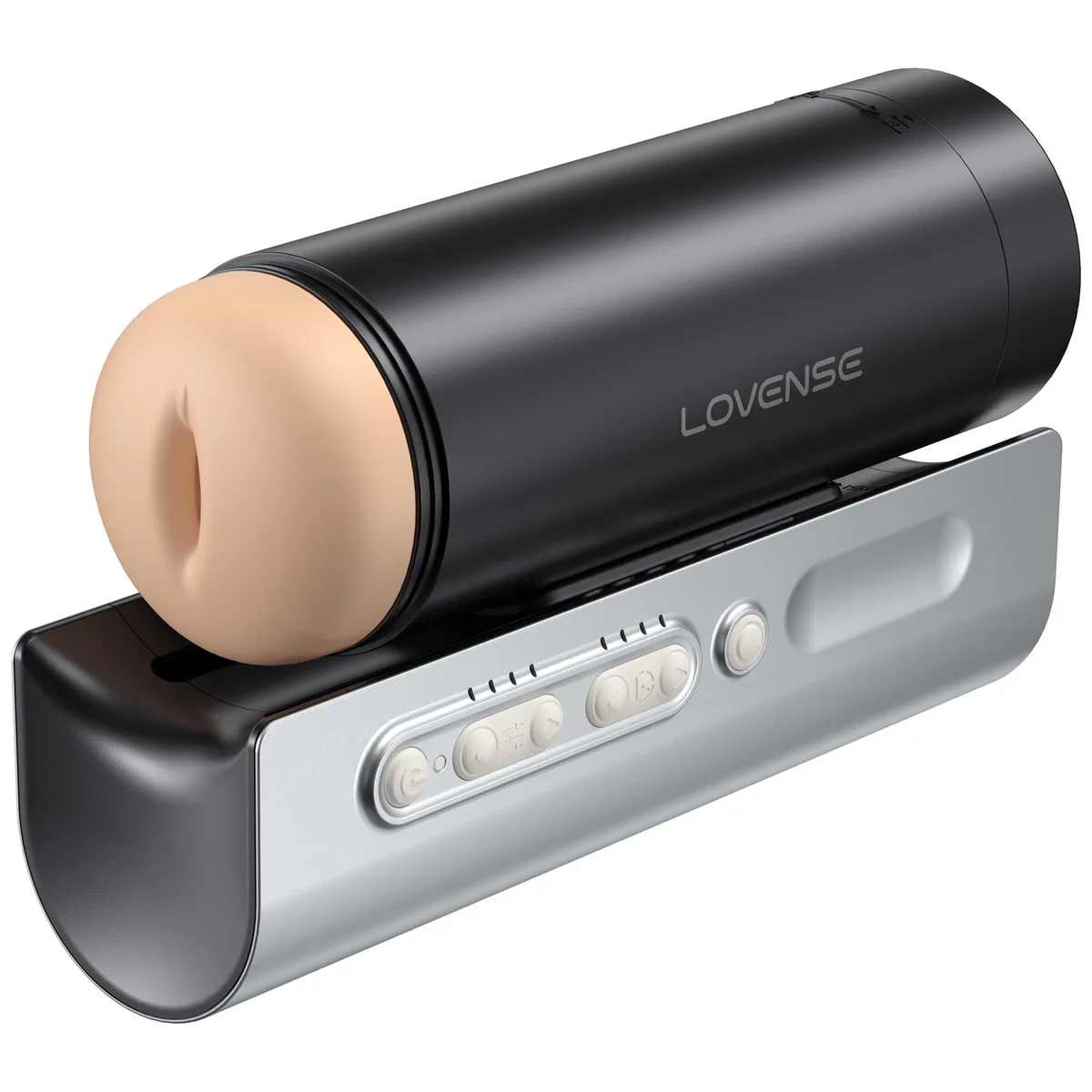
The control panel sits on the silver-colored side of the housing and consists of six buttons. The manufacturer’s manual names them all. The On/Off button turns the product on and off if held down for three seconds, and starts or stops the thrusting motion with a short press. Buttons A and B increase and decrease the speed in eight steps. Buttons C and D increase and decrease the stroke depth in four steps. A separate pattern button starts pattern mode and steps through the four preset patterns; pressing any other button leaves pattern mode.
Both A–B and C–D can be held down so they step gradually instead of one step at a time—a small detail that matters when the product is mounted in the table mount and the buttons aren’t fully visible. LEDs above the respective buttons show which level you’re at for speed and for depth, making the two scales independent of each other. The manual specifies eight LED steps for speed and four for depth. The manufacturer’s online guide states that the product is turned on by holding the button for 3–5 seconds, after which the red light starts blinking.
Straight out of the box, that gives eight speed steps multiplied by four depth levels—32 combinations on the product itself, in addition to the four patterns. That’s more than most people will use, and as always in this category, it’s reasonable to expect that you’ll go back to three or four settings.
The figure that sets Solace Pro apart from the rest of the category is the resolution in stroke length. The manufacturer states that the stroke length can be set up to 3.11 inches, i.e. 79 millimeters, and that the adjustment can be made as precisely as 0.65 millimeter.
What that means in practice is worth doing the math on. 79 divided by 0.65 gives a little over 120 possible stroke lengths, which should be compared with the three fixed levels on the predecessor Solace. The fine resolution isn’t available via the buttons on the product—there are four depth steps—but via the Lovense app, which is the only interface where you can set such a scale. It’s an important practical limitation: if you buy the product for the stroke-length resolution, you’re also committing to the app.
For comparison, Kiiroo lists a maximum stroke length of 75 millimeters for the Keon, i.e. four millimeters shorter. The difference in maximum length is, in practice, negligible. The difference in how finely the length can be adjusted isn’t.
App control isn’t a bonus on this product—it’s part of the core functionality. The manufacturer’s online guide lists the system requirements: iPhone, iPad, or iPod Touch with iOS 14.2 or later, Android 5.0 or later with Bluetooth 4.0 turned on, Mac with Bluetooth 4.0, and a Windows computer—but that requires a Lovense USB Bluetooth Adapter, which isn’t included in the delivery.
In the manufacturer’s programming mode, it’s possible to store up to ten of your own patterns. That’s where the fine-tuning of stroke length and speed over time is done, and it’s also where the four patterns on the product are added.
AI Sync is the manufacturer’s name for the function where the product’s movements follow the content in a video or live broadcast in real time instead of running a fixed pattern. It’s the function Lovense themselves point out as the main difference versus Solace in their own comparison. The movement can also be synced with other Lovense products and controlled remotely by a partner.
The counterargument should be stated plainly: anything that requires an account and an app is a dependency chain that the product inherits. If the side buttons work, the product does its job without a phone—eight speeds, four depths, four patterns. But the fine stroke-length control, the custom patterns, AI Sync, and long-distance control all sit behind the app.
The table mount is included in the delivery, and it’s that detail that makes the product a true hands-free product rather than something you hold in your hand. The manufacturer states that the mount is adjustable in 180 degrees.
The manual gives the task that actually determines whether it works in your home: the table mount can accommodate a tabletop of at most 55 millimeters. That’s enough for most desks and kitchen tables, but not for a thick solid-wood tabletop or a countertop with an underlying frame. Check the tabletop before counting on the hands-free mode.
The assembly is done with three screws, which the manual calls X, Y, and Z: X clamps the bracket to the table, Y locks the height when the carriage is slid into the correct track, and Z locks the angle. It’s a fully mechanical design with no quick-release fittings, which in practice means the mount either has to stay in place between uses or be reinstalled every time.
A usage tip from the manufacturer’s guide that’s hard to find anywhere else: the product can get stuck if the cup is turned upward, and Lovense recommends plenty of lubricant on both the product and the body before use. So it’s not only a comfort issue—friction against a TPE sleeve puts load on the drive.
Here, Lovense differs from most in the industry by actually publishing a number. The manufacturer states a maximum sound level of 63 dB for Solace Pro and sets it on its own scale with two references: conversation at 55 dB and TV at 70 dB.
It’s a useful detail, but it should be read with two caveats. Lovense does not state at what distance 63 dB was measured, what weighting was used, or at which speed setting. A decibel value without a measurement distance is not comparable between manufacturers, and a device whose sound plausibly varies with speed doesn’t have a sound value—it has a curve.
What can still be determined is the order of magnitude. 63 dB, according to the manufacturer’s own scale, is between a conversation and a TV at normal volume—so it’s audible in the room, but not through a closed door with other noise on. It’s a reasonable expectation for a machine with a linear drive that moves mass back and forth five times per second at maximum speed. If you’re looking for a quiet product, you’re not looking in this category.
A practical tip that applies regardless of model: the tabletop mount transfers vibrations to the tabletop, and a thin plate acts as a resonance box. A thicker table or a spacer between the clamp and the plate does more for the sound level than any setting in the app.
Lovense Solace Pro is rated IPX4. The rating comes from the international standard IEC 60529, which defines enclosure classes for electrical equipment. The number 4 in the second position means protection against water splashes from all directions—nothing more.
This is the most important limitation in the entire specification, and it deserves to be stated plainly. IPX4 means the product can handle splashes. It doesn’t mean it can handle water jets, and it absolutely doesn’t mean submersion. For comparison, Lovense’s own Max 2 is rated IPX6—that is protection against powerful water jets—and a modern clitoral stimulator is typically rated IPX7, which means submersion to one meter for 30 minutes.
The manufacturer is unambiguous in both the manual and the online guide: remove the stroker, remove the sleeve, and don’t let the main body get wet. Only the inner sleeve can be washed. That means Solace Pro can’t be rinsed off as a whole, doesn’t work in the shower, and doesn’t belong in the bathtub. It’s a real drawback in a product category where you handle lube in large quantities, and it’s the single point where Solace Pro falls the most compared to simpler products.
The routine according to the manufacturer is as follows. Remove the stroker from the main body and pull out the sleeve. Clean the sleeve with lukewarm water and mild soap or a cleaning product intended for intimate products. Do this both before and after each use. Dry the sleeve completely before putting it back and before storing the product. The main body is dried on the outside, never under running water.
The lubricant question is just as clear-cut. Lovense states that only water-based lubricant should be used, and that silicone- and oil-based lubricants must not be used. Silicone-based lubricant breaks down elastomers over time and makes the surface sticky and porous. Oil-based products leave a film that can’t be washed off from a TPE sleeve. The manufacturer also points out that water-based lubricant dries out and needs to be topped up during use—an issue in this particular category, since a machine that works for twenty minutes can dry out considerably more than a hand can.
The manual also covers two things that rarely appear in store descriptions. The product must not be exposed to extreme heat or cold, which rules out boiling and the dishwasher even for the sleeve. And the built-in lithium battery must not be punctured, crushed, or exposed to fire or water—it is not user-replaceable, and the product is covered by the WEEE Directive 2012/19/EU and the Battery Directive 2006/66/EC, which means it should be taken to electronics recycling and not thrown away in household trash.
The battery is the strongest line in the entire specification. Lovense lists a lithium polymer battery, a runtime of up to 14 hours, a charging time of 135 minutes, and up to 120 hours of standby. Fourteen hours of operation is a figure that’s far above the category: Kiiroo states 30 minutes to 2 hours for the Keon, depending on use, and Lovense’s own Max 2 is listed as 95–215 minutes.
With USB-C. It’s one of the more significant upgrades over the predecessor, which—according to the manufacturer’s own comparison table—is charged via a USB-DC cable. USB-C means that any charging cable will do; a dropped cable costs twenty kronor instead of you having to place an order with the manufacturer; and the phone charger is enough. The manual lists the input voltage and current as 5 V 2 A, so it’s a completely standard USB charger.
The charging procedure according to the manufacturer’s online guide: turn off the product before charging, connect the cable to any USB port or power adapter, and expect about 135 minutes for a full charge. The indicator light is on while charging and turns off when the battery is full. The manufacturer explicitly states that the product must not be used while it is charging, and that it should be charged at least once every half year even when it isn’t being used.
Lovense does not publish the battery’s capacity in mAh or its voltage for the Solace Pro—neither on the product page nor in the manual. What’s stated is that the battery is of the lithium polymer type and that it is built in and not user-replaceable.
It’s worth noting because the competitor does: Kiiroo lists 14.8 volts and 700 mAh for the Keon. Without the capacity, you can’t convert those 14 hours into a power-consumption figure, and you can’t assess how heavily the cell is loaded at 300 strokes per minute compared with at the lowest speed. The "up to 14 hours" figure is also exactly that—what setting it applies to isn’t stated.
What generally applies to lithium polymer batteries also applies here. Capacity drops with the number of charge cycles, the cell isn’t replaceable, and the product does best when it’s charged regularly rather than stored completely discharged. With a product in this price range, it’s worth being aware that it’s normally the battery—not the mechanism—that sets the limit—and that in practice the product is used up when the cell is.
We do not have price data from shops in your market yet.
79 millimeters of stroke length adjusted in steps of 0.65 millimeter provides just over 120 settings. The question isn’t whether it’s enough, but whether you’re willing to handle a product that only tolerates splashes.
Three comparisons are relevant: against the brand’s own previous generation, against the direct competitor in the thrusting-device class, and against a substantially cheaper alternative in another product class. All the information below comes from the respective manufacturers’ own specifications, and all Swedish prices come from the shops’ product feeds on July 29, 2026.
The manufacturer’s own comparison table makes this comparison straightforward. Solace Pro delivers 300 strokes per minute versus Solace at 280. Solace Pro adjusts stroke length in 0.65-millimeter steps versus Solace’s three fixed levels. Solace Pro lasts up to 14 hours versus 13. Solace Pro charges via USB-C, while Solace charges via USB-DC. And Solace Pro supports AI Sync, which Solace doesn’t.
What Solace adds is lower weight—980 grams versus 1,200—and a lower price from the manufacturer. On Lovense’s own site, Solace cost 184 US-dollars versus Solace Pro at 199 on the control date, both discounted from 369 and 399, respectively.
Conclusion: the difference in raw power is small, while the difference in controllability is big. If you’re looking for a thrusting machine that just needs to run fast, the extra price for Pro is hard to justify. If you’re looking for something that can be set exactly—and where a dropped charging cable isn’t a problem—USB-C and the millimeter resolution are two concrete reasons to choose Pro.
Kiiroo Keon is the most direct competitor and the only product in the comparison that does the same thing. Kiiroo lists up to 230 strokes per minute versus Lovense’s 300, a maximum stroke length of 75 millimeters versus 79, dimensions of 220 × 130 × 146 millimeters versus 231.5 × 136, and a weight of 1.1 kilos versus 1.2. The materials are listed as ABS, PC, and silicone—so it’s the same material family.
The two lines where the difference is big are about electric current. Kiiroo states a battery of 14.8 volts and 700 mAh, a charging time of four hours, and a running time of 30 minutes to 2 hours depending on use. Lovense states a charging time of 135 minutes and up to 14 hours of running time. Even though Lovense’s figures are an “up to” value without a specified setting, the order of magnitude is so different that it hardly depends on the measurement method: Keon charges almost twice as long and is used for a fraction of the time.
On the other hand, Kiiroo publishes the battery’s capacity and voltage, which Lovense does not, and both manufacturers provide a one-year warranty. If you choose based on the reported data, the comparison is more even than the numbers first suggest. If you choose based on shock frequency, charging contact, and running time, Solace Pro wins clearly.
Max 2 is not a shock machine. It vibrates and retracts while you hold it, and it does not do the forward-and-back movement for you. Still, it’s included here because it’s the most common alternative product in the same shops and costs a fraction.
Specifications: ABS plastic and Neutral Color TPE, 750 grams, lithium-ion battery, 100 minutes charging time, 95–215 minutes running time, up to 120 hours standby, and enclosure rating IPX6. The last line is interesting — Max 2 can therefore handle powerful water jets where Solace Pro only tolerates splashes, making it easier to clean even though both have a TPE sleeve.
If you’re unsure whether a motorized product is right for you at all, Max 2 is a cheaper way to find out. If you already know you want the automatic shock movement feature — that function simply isn’t in Max 2 — then the comparison is really not relevant, because then it’s Solace, Solace Pro, or Keon that applies.
Eight Swedish shops sell the item with EAN 6972677430364. Cheapest is Mshop at 1,438 SEK, most expensive is Vuxenkul at 2,109 SEK. That’s 671 SEK, or a 47 percent difference, for exactly the same item number and the same packaging.
The stock situation, for once, is good news. Seven of the eight stores had the product in stock at the price check; only Lustly at 1,549 SEK was sold out. That means the price spread is real and not an artifact of old prices in feeds from shops that still can’t deliver. The three cheapest — Mshop at 1,438, Joyland at 1,441, and Vuxen at 1,495 SEK — are also so close to each other that free shipping or a discount code can easily change the rankings.
Comparing it is worth more here than in most categories, for two reasons. The product is expensive enough that 671 SEK is real money, and it’s new enough that shops haven’t yet converged on a shared market price. That’s exactly the kind of situation where the difference between clicking the first result and comparing eight stores is greatest.
A point of comparison: at the manufacturer itself, Solace Pro cost 199 US dollars at the control date, discounted from the list price of 399. Lovense also states a store rating of 4.8 out of 5 from 159 reviews in its own web store—which is the manufacturer’s own collection and should be interpreted accordingly. The prices in the table above are updated when the shops’ product feeds are updated, but always check the final price at checkout.
It’s for you if you want the automatic thrusting motion and nothing less. It’s for you if you want to be able to clamp the product onto a table and use it completely hands-free, for you who want long runtime without having to think about charging, and for you who want to be able to set the stroke length exactly instead of choosing between three levels. If long-distance control or syncing to content is a plus for you, Lovense’s ecosystem is also the most developed in the industry.
It’s not for you if you want to be able to rinse off the entire product. IPX4 and the manufacturer’s express instructions that the main body must be kept dry make cleaning a multi-step process every time. It’s not for you if you want to avoid app dependency, because the features that justify the Pro model are behind the app. It’s not for you if you want something discreet: 1.2 kilos, 231.5 millimeters, and 63 dB are no kind of product you pack in your makeup bag. And it’s not for you if you expect the sleeve to last as long as the machine—the manufacturer itself sets a 90-day warranty on it.
One last thing belongs in the decision. The table mount can handle tabletops up to 55 millimeters thick. If you have a thicker table, the feature that most of all justifies the product’s weight and design is not available to you—and then a lighter product is the more honest choice.
Lovense offers a one-year warranty on Solace Pro counted from the original purchase date, with an express exception for the TPE sleeve, which instead is covered by a 90-day warranty. In the event of an approved warranty case, the manufacturer replaces the product free of charge and covers the shipping of the replacement item.
Read the requirements before you rely on the warranty. Lovense asks for the serial number from the packaging, proof of purchase with a receipt or invoice number, order date and place of purchase, an error description, and a photo or film that shows the problem. So keep the outer box—the serial number is there, not on the product. The warranty is tied to the original buyer and cannot be transferred, and it does not cover normal wear and tear, commercial use, lack of maintenance, or your own repair attempts.
The manufacturer’s so-called ten-year warranty is not a warranty in the usual sense. It means that the person who bought the product on lovense.com and gets a defect outside the warranty period can buy a new unit with 55 percent discount on lovense.com, once, for up to three items per order. Lovense also explicitly states that it does not offer any kind of satisfaction guarantee, citing the intimate nature of the products.
What does apply, however, is your statutory rights. Under the Swedish Consumer Sales Act (konsumentköplagen), you have three years of right of complaint for defects in the goods, regardless of what the manufacturer promises—and three years is therefore three times as long as Lovense’s own warranty. For distance purchases, you also have a right of withdrawal within fourteen days according to the Act on distance contracts and contracts outside business premises. Be aware that in practice the right of withdrawal is limited for hygiene products that have been removed from a sealed package—however, the right of complaint for defects applies always. If you have questions about what applies in your case, Konsumentverket (the Swedish Consumer Agency) guides you via Hallå konsument.
Lovense Solace Pro is ranked på plats 11 av 20 in masturbator best i test, where the entire category is compared against each other using five shared criteria. Guiden vinns av Satisfyer Men Vibration+.
Every numerical piece of information in the text can be traced to one of the sources below. The links were checked manually on the specified date.
This page is machine-translated from Swedish. Read the Swedish original