

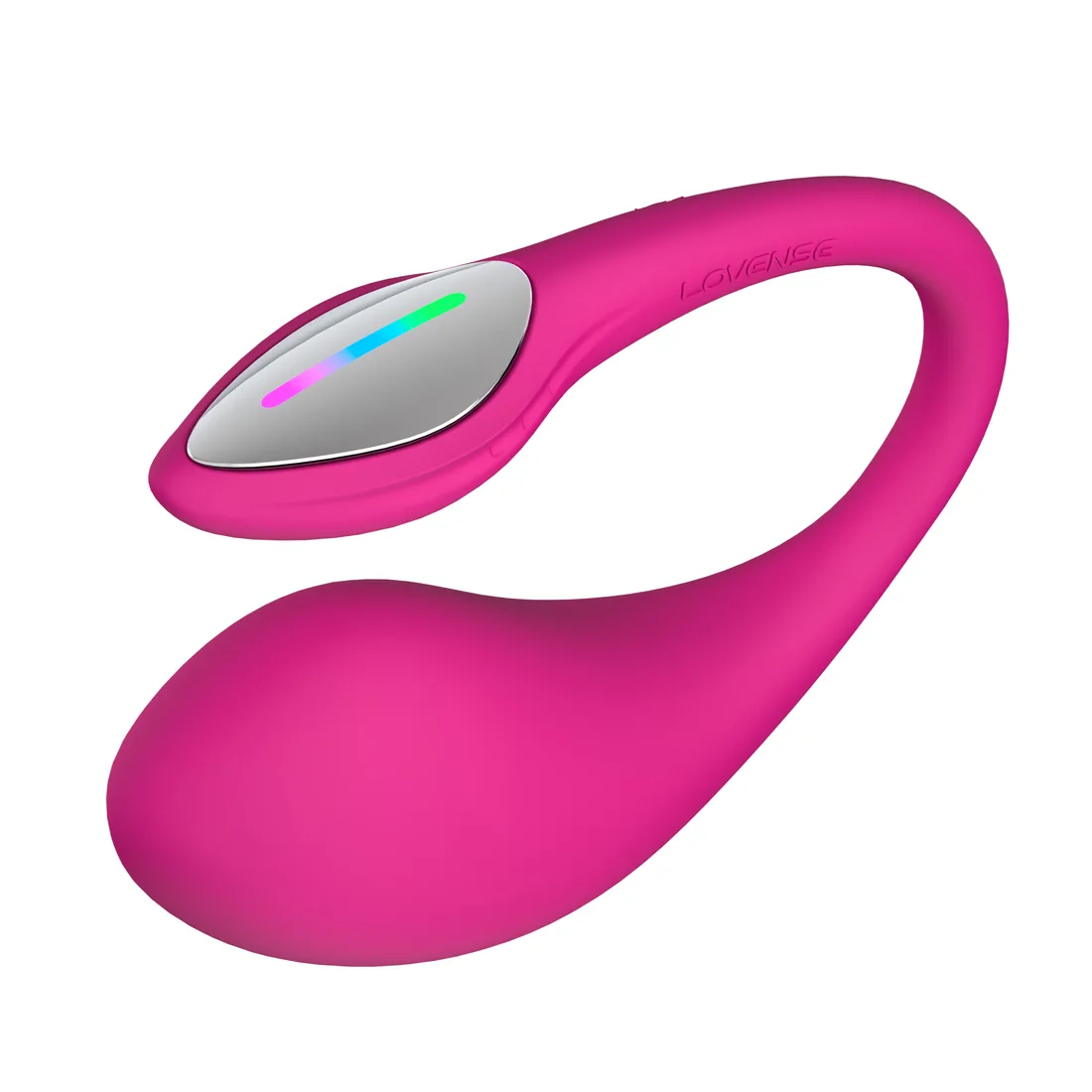
Review
Review: Lovense Lush 4
The successor with LED tail, 350 minutes of runtime, and a 105-meter range.
12 September 2026
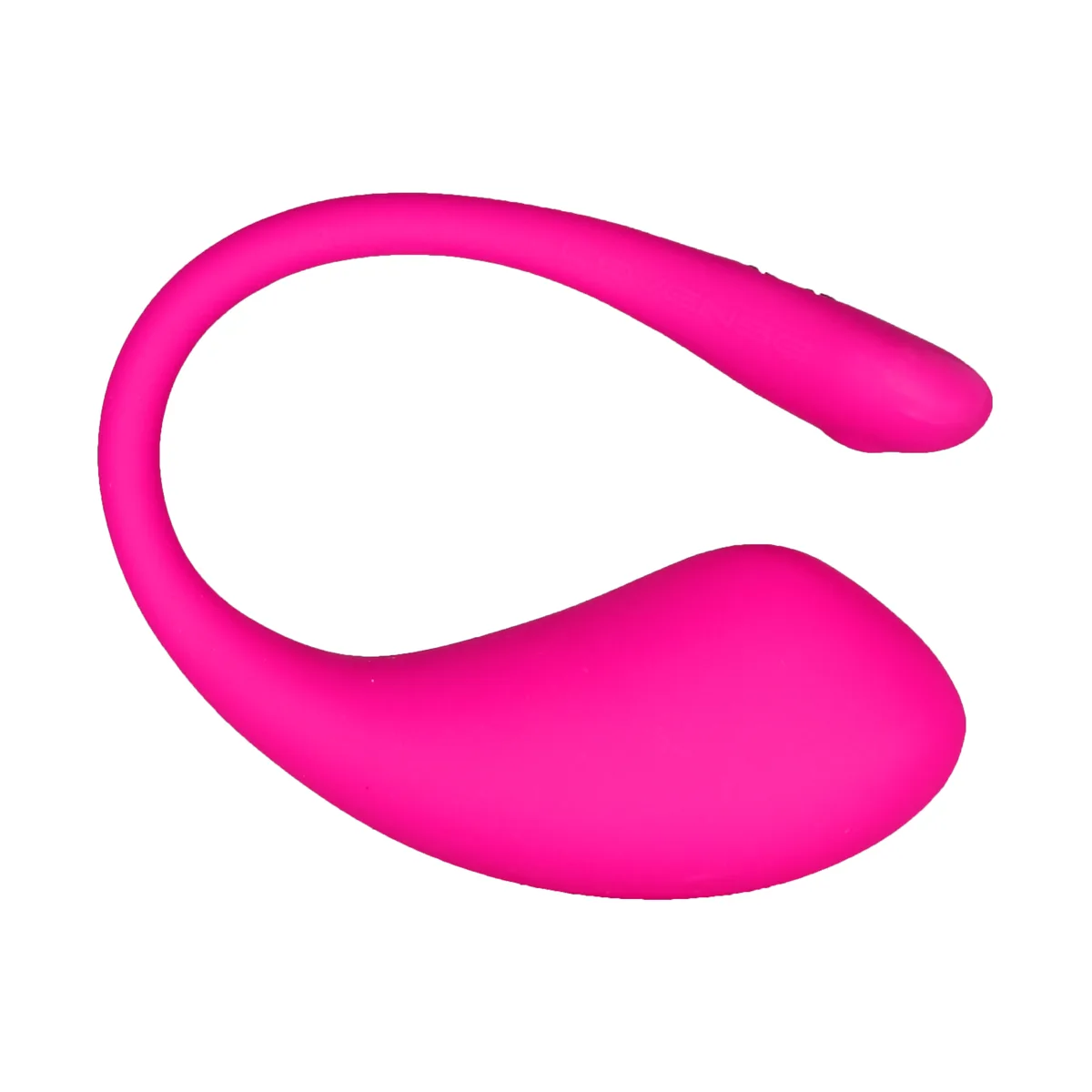 Author's pick
Review · Egg vibrator · App-controlled via Bluetooth
Lovense’s bestselling egg vibrator reviewed against the manufacturer’s own specifications and price data from six Swedish shops. Fully silicone-covered body, 75 grams, IPX7 according to IEC 60529, 220 minutes of runtime on 80 minutes of charging, 38–43 dB, and an app that lets someone on the other side of the world control it in real time — but one specification where neither dimensions nor battery capacity are published.
The app-controlled egg vibrator that built the category, and still the one with the most developed ecosystem. Fully silicone-covered body, 75 grams, IPX7, 220 minutes of runtime on 80 minutes of charging, and a published sound level of 38–43 dB. What you pay for is a specification without dimensions and without battery capacity, a one-year warranty, where competitors offer two years, and that the product without a phone is limited to one button and four preset patterns.
Lovense Lush 3 is the model that made the app-controlled egg vibrator into its own product category. It consists of two parts that fit together: an oblong egg that is inserted, and a curved tail that stays outside the body. The tail is not decoration. It is both what holds the product in place and what houses the Bluetooth antenna, and it explains why Lush 3 looks the way it does instead of being a round egg with a cable.
The manufacturer’s specifications look like this: fully silicone-sheathed body, weight 75 grams, lithium polymer battery, charging time 80 minutes, operating time up to 220 minutes, standby time up to 120 hours, IPX7 enclosure rating, up to 7,000 vibrations per minute, Bluetooth range outdoors up to 75 meters, and a one-year manufacturer’s warranty. Lovense states that the number of vibration patterns is unlimited, because the patterns are created in the app and are not fixed in the product.
This review is about the item with EAN 728360599728, the number Lovense themselves list as the SKU in the structured data on their product page for Lush 3. Six Swedish shops sell the same item number at prices between 1,036 and 1,399 SEK, and four of them had it in stock at the price check on 12 September 2026.
An egg vibrator is an insertable product without a handle. It stimulates from the inside and is intended to stay in place without being held, unlike a wand or an air-pressure product that you hold against the body. What makes Lush 3 an app-controlled egg vibrator is that it has absolutely no physical remote control at all. Any control beyond the single button on the product itself happens in the Lovense Remote mobile app over Bluetooth.
The difference compared to a regular vibrating egg with a remote control is fundamental and worth understanding before you buy. A remote control is a radio transmitter that reaches a few meters and is always included in the package. An app is a computer that just happens to sit in your pocket: it can save patterns, read music, listen to audio, connect two toys on different continents, and hand over control to someone else via a link. The trade-off is that the product depends on a phone, an account, and a cloud service for everything except its very simplest setting.
What can be stated purely technically is that Lush 3 works even without a phone. The manufacturer describes the button on the tail as an on-and-off button that at the same time steps between vibration modes, and Lovense’s own developer documentation shows that the product internally works with an intensity scale between 0 and 20, as well as four pre-set patterns that are expressly stated to apply to Lush. But the two million shared patterns, music syncing, and remote control exist only in the app.
Lovense sells three Lush models at the same time, and they get mixed up in almost every Swedish store. The manufacturer’s own comparison table makes the differences unusually clear, so it’s worth reading them one by one.
So the difference between Lush 3 and Lush 4 is therefore not the strength—both are specified as up to 7,000 vibrations per minute—but rather runtime, range, sound level, and the LED. It’s 130 minutes longer operation, 30 meters longer range, and a 2 dB lower bottom level for ten dollars more in the manufacturer’s own price list. The only specified feature where Lush 3 actually differs in its favor is the antenna’s stiffness: the manufacturer describes Lush 3’s tail as firmer, which they say gives a more targeted pressure on the G-spot, while Lush 4’s softer antenna is described as more comfortable for more body types. It’s a question of fit, not performance, and you can’t determine it from a specification.
The material is the only feature of an insertable product that neither habits nor care can compensate for, and it determines whether the product is still hygienic after five years. Lovense lists two materials for Lush 3: silicone and electroplated plastic. On the same page, they describe the body as fully covered in silicone, and that wording is also used in the comparison table, where the “Body Type” row for Lush 3 reads “Fully covered in silicone.”
Silicone is a non-porous material. A non-porous surface can be cleaned, because there are no microscopic pores where residue can be left behind. It’s the single most important property of a material that’s meant to sit against mucous membranes, and that’s why the material declaration carries more weight than almost every other line in a given specification.
Electroplated plastic is not a contradiction. Electroplating is a surface treatment in which a thin metal layer is deposited onto a substrate, and on Lush 3 it’s the two charging contacts on the top side of the tail that are metal. The manufacturer’s own product image shows them as two round, metal-shiny dots on the otherwise unbroken silicone surface. So the material statement should be read as meaning that it’s the silicone that touches the body and that the metal sits in the charging points—not as if half the product is hard plastic.
Having the body fully covered in silicone has two consequences. The first is tactile: the surface is soft instead of slick, which matters for a product that needs to stay in place under clothes for hours. The second is hygienic: there’s no seam between a silicone head and a plastic shaft where residue can collect. It’s a real difference compared with, for example, Lelo Lyla 2, which the manufacturer itself states is made of both ABS plastic and body-friendly silicone.
Phthalates are a group of plasticizers used to make plastic—especially soft PVC—flexible. Kemikalieinspektionen describes them as substances that can affect the hormone system and make reproduction more difficult, and several of them are therefore restricted or banned within the EU in a large number of products. This product category is regularly subject to supervision precisely because it involves soft plastic against mucous membranes.
There’s a gap in the manufacturer’s material information that’s worth noting. Lovense doesn’t state on the product page or in the serial guide that Lush 3 is free from phthalates, BPA, or latex. They list the material, but not the absence of additives. It’s the retailers who do: Vuxen says "body-safe and free from phthalates" and Lustly says "phthalate-free: yes" in its own specification table. These are store statements, not the manufacturer’s words, and they should be read as such.
What can, however, be established independently of who says it is that silicone does not require phthalate plasticizers to become soft. The softness comes from the polymer’s own structure. Silicone as a material specification is therefore, in itself, a better signal than almost any other item in a product specification, and unequivocally better than terms like "TPE" or "jelly rubber", which say nothing at all about which plasticizers are included. For comparison, We-Vibe states plainly on its product page for the Jive 2 that the material is free from phthalates and BPA and made without latex—this is the level of material disclosure a manufacturer can provide when it wants to.
The weight is simple. Lovense states 75 grams in its own specification table, and Vuxenkul gives the same figure in its shop data. It’s easy for the category—Lelo lists 36 grams for the significantly smaller Lyla 2 egg, but then no tail is included. Seventy-five grams is a weight a muscle can hold in place without effort, which is the whole point of a product that’s meant to stay put under clothes.
The measurements are harder, and here the answer has to be honest: Lovense publishes no measurements at all for Lush 3—neither total length, insertable length, nor diameter. The specification table on the manufacturer’s product page skips the dimensions entirely. It’s a notable gap for an insertable product, where the insertable length and diameter are the two pieces of information a buyer needs most.
The shops fill the gap, but they fill it with different numbers. Vuxen lists an insertable length of 9.5 centimeters and a maximum diameter of 3.7 centimeters. Mshop lists a length of 22 centimeters, a width of 3.7, and a diameter of 3.7 centimeters. Vuxenkul lists only a diameter of 3.7 centimeters. So the three shops agree on the diameter, and 3.7 centimeters is a credible measure of the egg’s widest part. The length, however, is what they measure differently: 9.5 centimeters is reasonably the egg, and 22 centimeters is reasonably the entire product stretched out with the tail held straight. None of them comes from the manufacturer, and which figure refers to what is something none of the shops spells out. Base it on 3.7 centimeters in diameter and assume it’s that figure that determines whether the product will fit you.
A word about the packaging weight, since it shows up as "weight" in one of the shops’ tables. Mshop lists 0.20 kilograms and the packaging dimensions as 14.00 × 5.00 × 6.00 centimeters. That number can’t be the product’s own weight, since the manufacturer states 75 grams. It’s very likely referring to the entire shipment, including the cardboard, charging cable, and manual, and it’s useful for anyone calculating shipping costs—but not for someone wondering how heavy the egg feels.
The interface on the Lush 3 is as simple as it can be. There is a single button, and it sits on the top side of the tail—meaning on the part that is outside the body. The placement is a deliberate choice: it lets you turn the product on and off while it is already in place, without you needing to take it out.
That button handles three things: start, stop, and stepping between vibration modes. The manufacturer’s functional graphics in the retailers’ galleries mark it as “Power Button and Vibration Modes.” Everything else is in the app. That means the person who only wants a toy to turn on and shut off gets exactly that, and the person who wants all the other features needs a phone within reach.
The app is called Lovense Remote and it’s free. The manufacturer’s own app page on Google Play lists the features in three groups, and the list is longer than on almost all competing products. For couples: voice and video calls with simultaneous control, toy-to-toy pairing so that one product’s movements control another, live control in real time, and synchronized control of multiple devices. For social use: a control link that lets someone else control it without installing anything, Control Roulette with strangers, and group games. For personal use: remote control, over two million user-shared patterns, a game mode for adult games, and media synchronization to music, sound, or video.
The app page lists a rating of 4.0 out of five from 20.1 thousand reviews, over five million downloads, and the age rating PEGI 16. These are the manufacturer’s own figures on its own distribution channel, and they say something about how established the platform is—but they are ratings for the app, not for the toy.
Two practical limitations belong in the decision. Lekosmek points out in its store text that the app isn’t available for Huawei devices without Google services, and that a USB adapter is needed to connect the toy to a computer. Lustly states that compatibility includes iOS 9.0 and later, Android 4.3 and later with Bluetooth 4.0, Mac with Bluetooth 4.0, and Windows PCs—but that the PC requires Lovense’s own USB Bluetooth adapter, meaning an accessory that isn’t included. Both are store claims, and both are worth checking against your own phone before you pay.
Here it gets technical in a way that actually matters. Bluetooth transmits according to Bluetooth SIG in the unlicensed 2.4 GHz band—the same band that Wi‑Fi and microwave ovens share. Radio waves in that band are heavily attenuated by water, and a human body is made mostly of water. So a transmitter located inside the body has a physics problem that no software can solve.
That’s exactly the problem Lovense Lush 3’s tail is designed to solve. By having the antenna sit in the part that stays outside the body, the signal doesn’t have to pass through tissue. Lovense describes the construction itself as a new-generation antenna with a new circuit board for stable connection, and they state the outdoor range as up to 75 meters. “Outdoor” is an important clarification: the figure applies to line of sight, not through walls.
Seventy-five meters should be measured against what the category offers otherwise. Lovense’s own Lush 4 is stated as 105 meters, and the Lush Mini as 93 meters—both therefore longer than Lush 3. Lelo states up to 12 meters for Lyla 2—but Lyla 2 uses a physical remote control on 2.4 GHz with a transmitter power of 1 mW, not a phone, and the two solutions aren’t directly comparable. What can, however, be established is that direct connection is never what determines how far away your partner can be: the distance control in the app goes over the internet, and then the range is unlimited as long as the phone paired with the toy is within Bluetooth range.
The manufacturer’s product page answers “unlimited” to the question about the number of vibration patterns, which is true but not particularly informative. The patterns are created in the app, and according to Lovense the library holds over two million user-shared variations. A specification that says “unlimited” can’t be compared to one that says “ten settings.”
You can still get a number, and it comes from the manufacturer themselves. Lovense development documentation describes the Vibrate command, which takes a value between 0 and 20 and explicitly applies to all the toys in the range. That means the underlying strength scale in the hardware has twenty steps over zero—everything the app does is built on that scale. The same documentation describes the Preset command, which provides four preset patterns numbered 0 to 3 and is identified as applicable specifically for Lush. Reasonably, these are the same patterns you step through with the button when the phone isn’t nearby.
A value that the manufacturer publishes and that rarely appears in the store texts: up to 7,000 vibrations per minute. That corresponds to just under 117 sways per second—so a frequency in the same ballpark as Lelo’s stated 120 Hz for Lyla 2. Frequency says something about the character of the vibration—lower frequency is experienced as deeper and rumbling, higher as more surface-level and buzzing—but it says nothing about amplitude, and it’s amplitude that determines how strong the vibration feels. Lovense does not publish an amplitude, and neither does any other manufacturer.
This is unusual: Lovense actually publishes numbers for sound level, which most manufacturers in the category do not. The product page markets Lush 3 as "extremely quiet" with a maximum volume of 43 dB, and the same page’s comparison table lists a lowest sound level of 38 dB. The two figures don’t contradict each other — they’re the floor and the ceiling on the same scale, and together they give a range of 38 to 43 decibels depending on how hard you run it.
The shops confirm the ceiling value. Blush Me writes "very powerful vibrator but still quiet (43 dB)" and Vuxenkul lists "max approx. 43 dB" in its specification table. It’s the same number as the manufacturer’s, reproduced by retailers, not an independent measurement.
What 43 dB means in practice is harder than it sounds, and there’s a reason to be careful with the interpretation. A decibel value without a specified measurement distance and without a specified measurement method can’t be converted into something you can recognize. Sound pressure decreases with distance, and a number measured ten centimeters from the product isn’t the same as a number measured on a meter-away distance. The manufacturer states neither distance, weighting filter, nor surface. Treat 38–43 dB as an order of magnitude that places Lush 3 in the quieter half of the category, and read it in light of the fact that Lovense themselves state 36 dB for both Lush 4 and Lush Mini — meaning that, according to the manufacturer, the successors are measurably quieter.
For comparison, Lelo lists a maximum of 50 dB for Lyla 2, and We-Vibe publishes no decibel value at all for Jive 2. A practical tip that applies regardless of model: place the product on a soft surface between uses. A hard tabletop acts like a resonance box and noticeably amplifies the sound.
Lovense lists the enclosure rating IPX7 for Lush 3 in two places on its own product page: in the row "Water Repellency" in the specification table and in the row "Waterproof" in the comparison table. The classification comes from the international standard IEC 60529. The number 7 in the second position means that the product has been tested for submersion in water to a depth of one meter for 30 minutes. The manufacturer states the consequence plainly: IPX7 lets you use the product in the bath or shower and makes it easy to clean.
Here are some of the clearest discrepancies between the shops in this entire review, and it’s worth taking seriously. Mshop states the water resistance as “splashproof” in its specification table and labels its own functional graphic “Splashproof”. This is not the same as IPX7—splash protection covers water droplets and, at best, water jets, but not immersion. Lustly goes the other way and states “waterproof up to 1.5 m for 30 minutes,” which is more than what IPX7 entails.
The rule in such cases is simple: the manufacturer wins. Lovense lists IPX7, and IPX7 means one meter for 30 minutes according to IEC 60529. Mshop’s “splashproof” is an understatement, and Lustly’s “1.5 meters” is an overstatement, and both are shop claims with no coverage in the manufacturer’s specifications. That three of six shops describe the same product’s water resistance in three different ways is, in itself, a result: it’s exactly the kind of information that should be checked with the manufacturer and not in product text.
The difference is bigger than the wording suggests. A splashproof product can handle a damp cloth and possibly a shower, but it should not be kept under running water without thinking carefully about the buttons and charging contacts, and it absolutely should not be submerged in a bathtub. An IPX7-rated product can be rinsed off without any particular care, and that’s a genuine everyday advantage for a product that’s inserted into the body and therefore must be cleaned every time.
One more thing that’s easy to miss: the absence of an IP rating is never a sign that a product would be approved for water. If a product has no IPX rating at all, it should be treated as not waterproof. So the fact that Lovense publishes the rating in two places is, in itself, a quality signal compared with manufacturers who are content with the word “waterproof” in their marketing copy.
Rinse the product in lukewarm water after every use, and use fragrance-free soap or a cleaning product intended for intimate products. Be extra careful at the transition between the egg and the tail, where the shape narrows—this is the only point on an otherwise smooth product where residue can end up staying. Pat dry with a clean towel and let it air-dry before putting the product away.
Use a water-based lubricant. A silicone-based lubricant should not be used on silicone products: it breaks down the silicone surface over time and makes it porous, and a porous surface can no longer be cleaned properly—only replaced. Oil-based products such as coconut oil leave a film that’s difficult to remove and that also breaks down latex if you use a condom over the product. The fact that Lush 3 is an insertable product makes the lubricant question more important than with a clitoral stimulator, since the contact area is larger and the contact lasts longer.
No storage bag is included. The manufacturer’s included items consist of three items: the vibrator, a USB charging cable, and an instruction manual. This is noteworthy because We-Vibe includes a cotton pouch in the packaging for the Jive 2, and Lelo includes a satin pouch for the Lyla 2. A pouch isn’t expensive, but it serves a purpose: silicone attracts dust and lint, and two silicone products stored against each other can, over time, react with each other’s surfaces.
Lovense states the runtime as up to 220 minutes and the charging time as 80 minutes, with a lithium polymer battery and a standby time of up to 120 hours. In practice, that means just under four hours of use on a charge that takes under an hour and a half—a ratio between charging time and runtime of roughly 1 to 2.75, which is good for the category.
Here, however, there’s a discrepancy within the manufacturer’s own material that is worth pointing out. The product page’s specification table states 220 minutes, while Lovense’s own Lush series guide lists "up to 3 hours" for the same model. Three hours are 180 minutes, so 40 minutes less. Of the two, the specification table is the more precise and the one that Vuxenkul reproduces verbatim in their store data, so 220 minutes is the figure that’s used consistently throughout here—but the difference shows how much leeway is hidden in the phrase "up to".
The stores add to the spread. Blush Me lists "about 4.5–5 hours" and Mshop "up to 5 hours of enjoyment on a charge". Both are far above the manufacturer’s own highest figure of 220 minutes, i.e. 3 hours and 40 minutes. These are store claims without coverage in the manufacturer’s specifications, and they shouldn’t be used as a basis for a purchase decision. Start from 220 minutes at low intensity and expect significantly less at high intensity—runtimes are always stated at the lowest power setting, and that applies across the entire category.
With a magnetic charging cable that connects to USB. The two electroplated contact points on the top side of the tail are the charging port, and the cable snaps onto them with magnets. The manufacturer states the charging time as 80 minutes and describes the solution as seamless charging.
Magnetic charging is a trade-off, not a pure advantage. The advantage is that there’s no need for an opening in the housing, making it easier to achieve IPX7 without a rubber plug—and on a plug-in product, a rubber plug is also a point where dirt collects. The downside is that the cable is product-specific: if you lose the charging cable, no standard USB-C cable will work.
However, there is a mitigating circumstance worth knowing, and it comes from the manufacturer’s own material. Lovense lists the same charging cable as compatible with around thirty of its products, including Lush 3, Lush 4, Lush Mini, Edge 2, Ferri, Domi 2, Hush 2, Gush, and Max 2. So if you already have a Lovense product at home, the cable you already have is likely the one that fits, and a replacement is a standard item in the range rather than a model-specific spare part. It’s a less uniquely constrained solution than an entirely unique cable, but it’s still not a cable you can find in just any box.
Lovense does not publish the battery’s capacity in mAh or its voltage for Lush 3, neither on the product page, in the serial guide, nor in the warranty terms. What is provided is the battery type — lithium polymer — as well as operating time, charging time, and standby time. Without the capacity, you can’t convert operating time into power consumption, and you can’t compare how heavily the cell is loaded between models.
It’s worth noting because competitors do it: Lelo lists 200 mAh and 3.7 volts for Lyla 2 and also the charging current and charging voltage. We-Vibe only lists the battery type for Jive 2, just like Lovense. Information about an exact mAh figure for Lush 3 that circulates on other sites lacks support in the manufacturer’s own material.
What applies generally to lithium polymer batteries also applies here: capacity drops with the number of charge cycles, the cell is not replaceable on a fully molded silicone product, and the battery is best charged regularly rather than stored completely discharged. The standby time of 120 hours — five days — means the product needs to be charged even if it isn’t used, and it’s a practical detail worth remembering before a trip. If you use it a couple of times a week, it’s the battery, not the silicone, that sets the limit for lifespan.
We do not have price data from shops in your market yet.
The manufacturer publishes sound level, standby time, and Bluetooth range — but not a single measurement for a product that is meant to be inserted into the body.
Three comparisons are relevant: against the successor in the same series, against the other major brand in app-controlled eggs, and against the classic solution with a physical remote control. All the information below comes from each manufacturer’s own specifications.
This is the comparison most people actually face, because both are sold in parallel in the same Swedish stores. The manufacturer’s own comparison table makes the difference unusually easy to read: Lush 4 has 350 minutes of operating time versus Lush 3’s 220, Bluetooth range of 105 meters versus 75, a baseline sound level of 36 dB versus 38, and an LED tail that Lush 3 completely lacks. Both are listed for up to 7,000 vibrations per minute, both are IPX7, both have a one-year warranty, and both charge with the same magnetic cable.
In Lovense’s own price list, it’s ten dollars: 119 versus 129. Based on the specification alone, it’s hard to argue for Lush 3—an extra 130 minutes of battery life for ten dollars is one of the better upgrades in the category. What Lush 3 adds is the firmer antenna, which, according to the manufacturer, delivers a more targeted pressure to the G-spot, where Lush 4’s softer antenna is described as more comfortable for more body types. Which of the two fits your anatomy can’t be read into it, and that’s the only good reason to choose the older model.
The other good reason is the price in Swedish stores, which doesn’t follow the manufacturer’s dollar list. Always check both prices at the same store on the same day before you decide—ten dollars in list price can end up being anything in a Swedish checkout.
We-Vibe Jive 2 is the closest direct competitor: also an app-controlled portable egg, also IPX7, also intended to stay in place. The manufacturer states a rechargeable lithium-ion polymer battery, battery life up to 4 hours, and charging time up to 90 minutes. So battery life is longer than Lush 3’s 220 minutes, while the charging time is ten minutes longer than Lush 3’s 80.
Two differences weigh more than battery life. The first is the material disclosure: We-Vibe explicitly states that the silicone is free from phthalates and BPA and made without latex, which Lovense doesn’t do for Lush 3. The second is what’s included in the box. Jive 2 comes with a remote control, USB cable, quick guide, and a cotton pouch. Lush 3 comes with a cable and a manual. The remote control is the decisive practical difference: it means Jive 2 works fully without a phone, while Lush 3 without a phone is limited to the four pre-set patterns on the button.
The warranty also speaks in We-Vibe’s favor: two years versus Lovense’s one. What Lovense has in return is the app ecosystem, which is significantly more developed—two million shared patterns, group play, control links, and a game mode has no competitor in the category. If you go by hardware and the reported data, Jive 2 wins. If you go by what you can do with the product over the internet, Lush 3 wins.
Lelo Lyla 2 represents the older solution: an egg with a physical remote control instead of an app. It’s interesting here primarily as a contrast in how much a manufacturer can publish. Lelo specifies dimensions of 80 × 33 × 32 millimeters, a diameter of 32 millimeters, an insertable length of 80 millimeters, a weight of 36 grams, a battery of 200 mAh and 3.7 volts, a charging time of 2 hours at 5.0 volts and 200 milliamps, operating time of 2 hours for the egg and 10 hours for the remote control, standby time of 90 days, a frequency of 120 Hz, a maximum sound level of 50 dB, a wireless range of up to 12 meters at 2.4 GHz, transmitter power of 1 mW, and automatic shutoff after 20 minutes. They also state that the product complies with ISO 3533, the international safety standard for sex toys.
Set this list against Lush 3’s, where neither dimensions nor battery capacity are provided. It says something about how unevenly the category presents itself. Functionally, Lyla 2 is a different type of product: smaller and lighter, at 36 grams versus 75, with a shorter operating time of 2 hours versus 220 minutes, with ABS plastic in the construction instead of full silicone, and with a range of 12 meters, making it a product for the same room rather than for distance. The warranty is two years plus a ten-year quality guarantee.
Conclusion: if you want a product to hand over control in the room next door, Lyla 2 is a completely reasonable and better documented solution. If you want that, Lush 3 is built for—someone on the other side of the planet who controls in real time—there is no competition at all in this comparison.
Six Swedish shops sell the item with EAN 728360599728. Cheapest is Vuxen at 1,036 SEK; most expensive is Vuxenkul at 1,399 SEK. That’s 363 SEK, or a 35 percent difference, for exactly the same item number, same color, and same packaging.
The stock situation is at least as important as the price spread. Four of the six shops had the product in stock at the price check on 12 September 2026: Vuxen at 1,036 SEK, Blush Me at 1,095 SEK, Lustly at 1,249 SEK, and Mshop at 1,289 SEK. The two that lacked stock—Lekosmek at 1,085 SEK and Vuxenkul at 1,399 SEK—represent both ends of the price range except for the very cheapest one. That means that the person buying today in practice chooses between 1,036 and 1,289 SEK, i.e., a spread of 253 SEK instead of 363. Shops that list a product as sold out may have an old price in the feed, and that price is rarely what you actually end up paying when the item comes back in again.
The price spread is not due to any store selling a different variant. All six list the item under EAN 728360599728 or under their own item number linked specifically to Lush 3 — Vuxen uses WOO-8007, Mshop 582150, Vuxenkul ER0001-1, and Lekosmek E31211. So it’s about the stores’ own margin-setting for a model that has been around long enough to have become a volume product.
Two footnotes about the price. Vuxen itself states a recommended price of 1,495 SEK and a lowest price during the last 30 days of 971.25 SEK, which means that 1,036 SEK is not the lowest price that has been available on the Swedish market in the past month. Lekosmek lists an ordinary price of 1,619 SEK versus its current 1,085. So count on the model moving in price, and that a couple of weeks of patience can be worth more than switching stores. Always check the final price at checkout—shipping costs are added at most stores under a certain order value, and several of them are right around the threshold for free shipping in this price range.
It’s for you if you want an insertable product that someone else can control over the internet. That’s the whole product concept, and it’s the only feature where neither We-Vibe nor Lelo comes close: two million shared patterns, control links, toy-to-toy pairing, and control during video calls. It’s for you if you prefer silicone all over rather than plastic in parts of it, if you want to be able to rinse off the entire product under running water, and if you want 75 grams that stays in place without being held.
It’s for you if you prefer a firmer antenna and targeted pressure on the G-spot instead of the softer solution in Lush 4—but it’s an anatomy matter, not a performance matter, and it can’t be determined in advance.
It’s not for you if you want a product that works fully without a phone. Without the app, Lush 3 is a toy with one button and four preset patterns, and that’s where We-Vibe Jive 2 with its included remote control is the better solution. It’s not for you if you need to know exactly how long and how thick an insertable product is before you order, because the manufacturer publishes no measurements at all and the stores contradict each other. It’s not for you if you require a published battery capacity or a printed ftalate declaration from the manufacturer itself. And it’s not for you if you’ve already decided on maximum runtime—there, Lush 4 with its 350 minutes is the obvious choice within the same series.
One last thing belongs in the decision. Lush 3 is built around an account, an app, and a cloud service, and is therefore dependent on the manufacturer continuing to maintain the platform. The app was last updated on September 12, 2026, and has over five million downloads, so that risk is currently low — but it is a different kind of dependency than a product with a physical remote control, and it should be a conscious choice.
Lovense provides a one-year manufacturer’s warranty, and Lush 3 is expressly named in the list of products covered by the manufacturer’s warranty terms. The warranty runs from the date of purchase and covers material and manufacturing defects when used according to the manual. In that case, Lovense replaces the product free of charge and covers the shipping of the replacement item.
Read the exclusions before you count on the warranty. It does not cover normal wear and tear, commercial use, lack of maintenance, your own modifications, or unauthorized repairs. It is tied to the first buyer and cannot be transferred—if you buy it used, there is no warranty left. And the manufacturer states plainly that, given the intimate nature of the products, they do not offer any kind of satisfaction guarantee. That’s a more honest wording than most competitors’, but it also means you can’t return the product because it didn’t suit you.
The ten-year quality guarantee that Lovense markets should be clarified, since it is cited in store texts as if it were an extended warranty. It offers a 55 percent discount on a new product if yours breaks after the warranty year ends. It applies only to purchases made on www.lovense.com. It can be used once, and it covers up to three items per order. If you buy from any of the six Swedish stores listed above, then, you are not covered by it.
A one-year warranty is short in comparison. We-Vibe offers two years on the Jive 2, and Lelo offers two years plus a ten-year quality guarantee on the Lyla 2. One of the Swedish stores, Lekosmek, in turn promises two years of product warranty on what it sells—but that is the store’s own promise to you as a customer, not Lovense’s warranty, and it doesn’t come with the product if you buy it somewhere else.
What always applies, however, are your statutory rights, and they are stronger than the manufacturer’s commitment. Under the Swedish Consumer Sales Act (konsumentköplagen), you have three years to make a complaint about defects in the goods, regardless of what Lovense writes in its terms. For distance purchases, you also have a right of withdrawal for fourteen days under the Act on distance contracts and contracts negotiated away from business premises. Be aware that in practice the right of withdrawal is limited for hygiene products that have been taken out of a sealed package—however, the right to make a complaint about defects applies in any case. If you have questions about what applies in your case, Konsumentverket, via Hallå konsument, can guide you.
Lovense Lush 3 isn’t included in any ranking yet. In best i test guides, the entire categories are compared against each other using five shared criteria, with what was left out shown.
Every numerical piece of information in the text can be traced to one of the sources below. The links were checked manually on the specified date.
This page is machine-translated from Swedish. Read the Swedish original