

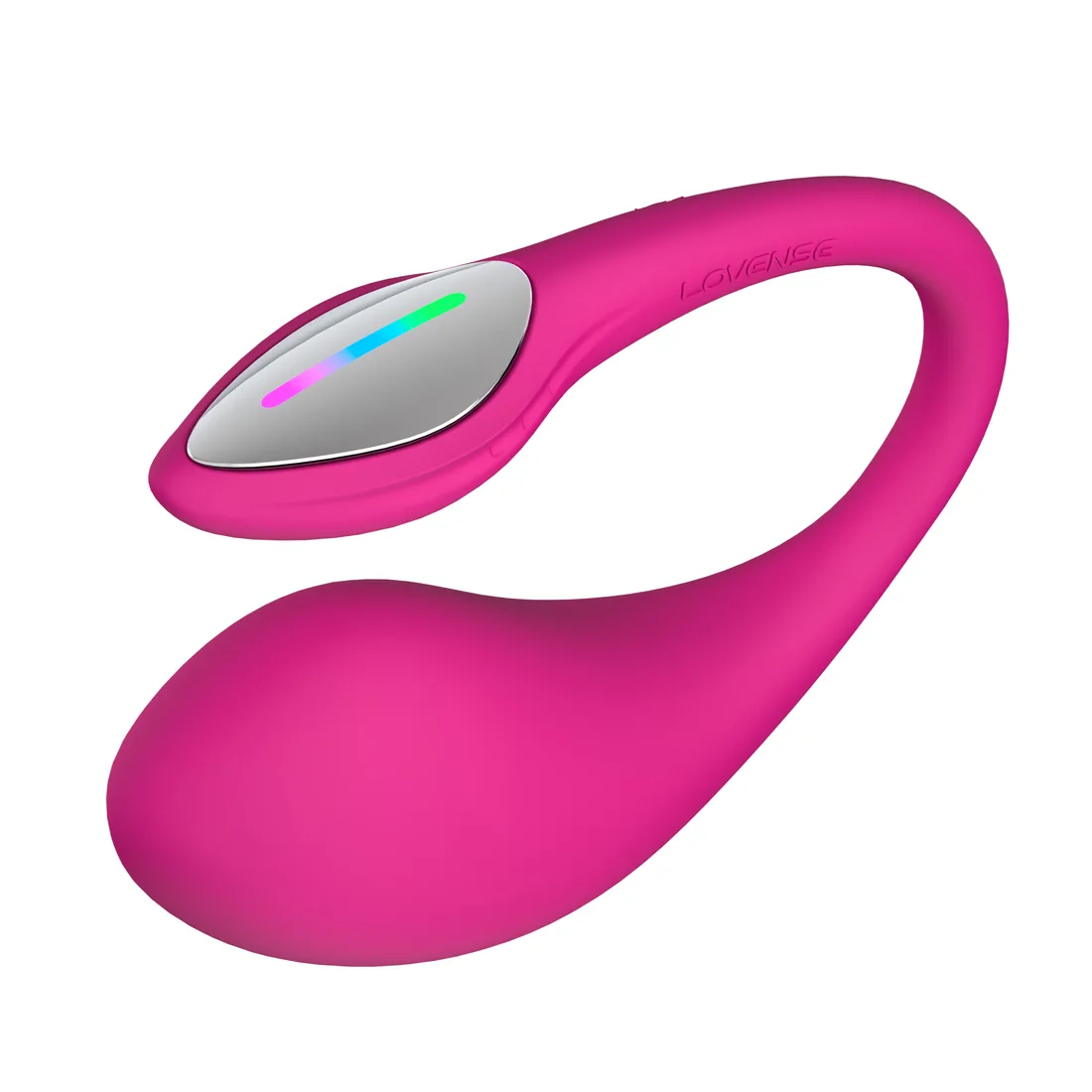
Review
Review: Lovense Lush 4 Pink
Same app, no shock — but 350 minutes of runtime and published sound level.
29 July 2026
Review · Egg vibrator · Thrust function and app control
Lovense thrusting egg vibrator reviewed against the manufacturer’s own specifications and price data from four Swedish stores. Ten millimeters of stroke length at up to 120 thrusts per minute, 100 percent silicone, IPX7 according to IEC 60529, 82 grams, and unlimited patterns in the app — but only one hour of runtime, a one-year warranty, and a price that differs by 115 percent between the cheapest and most expensive store.
The only product in the comparison that really thrusts instead of just vibrating: 10 millimeters of stroke length at up to 120 strokes per minute, in an 82-gram egg made of full silicone with IPX7. What you pay for is endurance. The manufacturer states up to 1.08 hours of runtime, which is one fifth of what Lovense’s own Lush 4 can handle, and the warranty stays at one year. Add that neither the sound level, battery capacity, nor dimensions are published, and it becomes a purchase for anyone who specifically wants the thrust function — and for no one else.
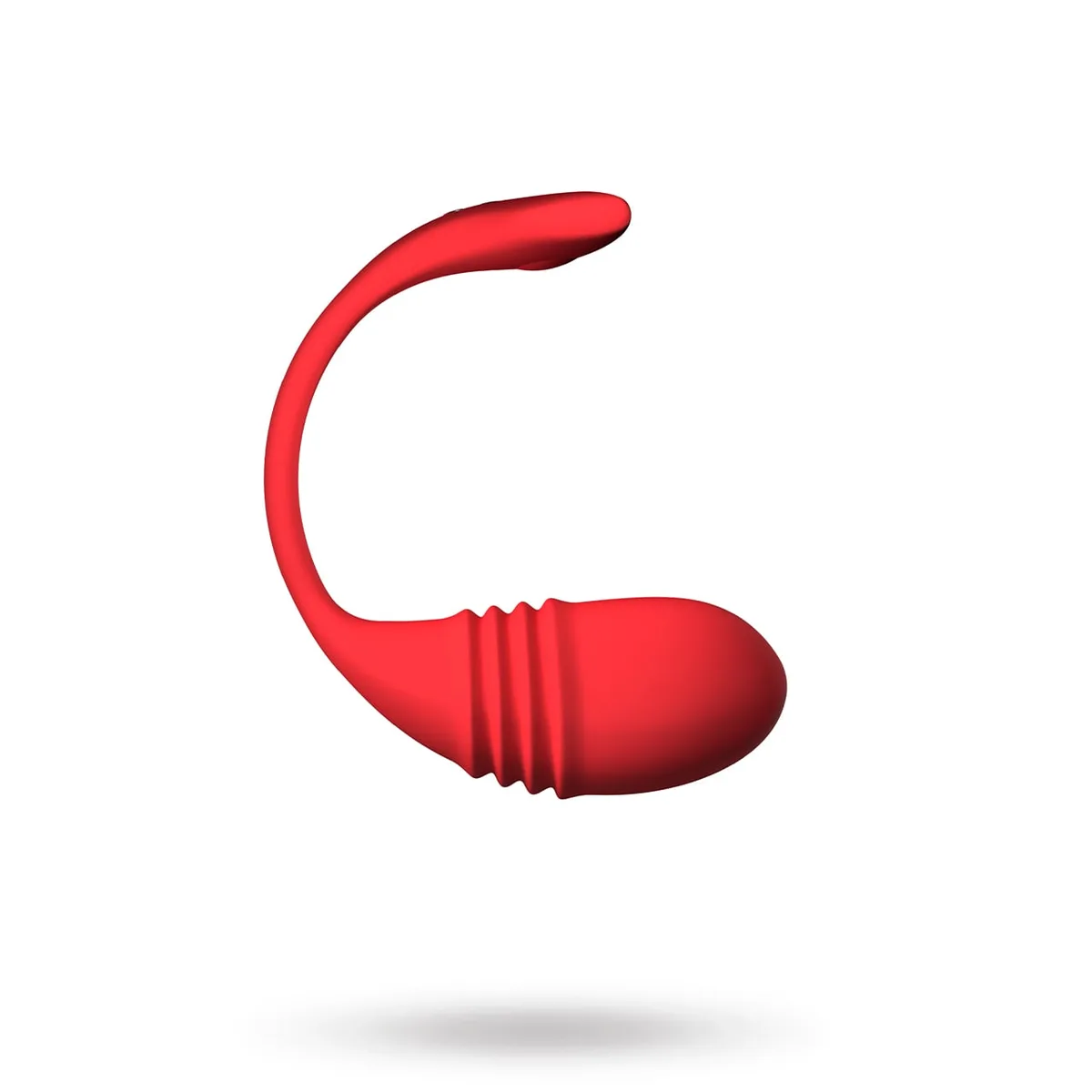
Lovense Vulse is an egg vibrator that does two things at the same time: it vibrates, and it thrusts. The other thing is the unusual part. A standard egg vibrator has a motor that shakes the whole body, while Vulse also has a section just behind the tip that moves forward and back. The manufacturer states the stroke length as 10 millimeters and the speed as up to 120 strokes per minute—so two strokes per second at maximum power. That’s the entire product idea, and it’s also the only feature you can’t get from the competing eggs in the same price range.
The rest of the specifications look like this according to Lovense: 100 percent silicone, weight 82 grams, protection class IPX7, operating time up to 1.08 hours, charging time 60 minutes, standby up to 120 hours, and a one-year manufacturer’s warranty. The patterns are described by the manufacturer as unlimited, because they’re created in the Lovense Remote app rather than stored in the toy. In Sweden, the item is sold by four stores at prices between 695 and 1,495 SEK, and all four had it in stock at the price check on September 12, 2026.
This review applies to the red variant with EAN 6972677430159. The number has been checked in two independent ways: it appears as the SKU in the product data on Lovense’s own product page, and it can be read as a barcode on a photo of the back of the packaging at Joyland. So it matches both the manufacturer’s database and the physical cardboard, which is unusually clear in this product category.
A vibration and a thrust are two different mechanical events. A vibration motor spins an unbalanced weight, or drives a linear actuator, and the result is a rapid shaking that spreads throughout the entire silicone body. The frequency is on the order of thousands of movements per minute, the amplitude is fractions of a millimeter, and the sensation is described as buzzing or rumbling depending on how the motor is built.
A pulse is the opposite: fewer movements, longer distance. The manufacturer states 120 strokes per minute and a stroke length of 10 millimeters for Vulse. That means that the folded section in the middle of the egg lengthens and shortens the product by a centimeter, twice per second, instead of shaking it. From a purely physical standpoint, it’s a completely different type of stimulation: vibration acts on nerve endings on the surface, while a pulse moves tissue. What you can say is that someone who already knows that vibrations work for her doesn’t automatically get anything out of a pulse, and vice versa.
The size of the movement is worth putting into perspective before you pay for it. Ten millimeters is about the width of a pen. It’s not the same as the pulsing dildos and sex machines that use stroke lengths of seven or eight centimeters, and it would be misleading to compare them. Vulse delivers a short, fast pulse to a small area — according to the manufacturer, aimed at the G-spot — not a penetrating movement in the usual sense. That’s also why the product can be worn handsfree: a longer movement wouldn’t have stayed in place.
Lovense sells several portable eggs that look roughly the same and that often end up next to each other in the same shop’s listings. The differences are, however, significant, and they’re about entirely different things than the names suggest.
The practically important thing in this lineup is that Vulse has the shortest run time of the three, with a clear margin. The difference between Vulse 1,08 hours and Lush 4 350 minutes isn’t marginal—it’s more than five times. The pulse motor costs power, and that’s where you pay for the function—not just in kronor. If you want an egg that should last the whole evening, Vulse is the wrong product in Lovense’s own range.
The material question determines whether an intimate product can still be used a few years from now, and it can’t be compensated for with care. Lovense states a single material for Vulse: silicone. In the manufacturer’s own FAQ, this is specified further: Vulse is made of 100 percent pure silicone, and no Lovense product contains phthalates or other harmful chemicals. The back of the packaging is labeled Body-Safe. Retailers repeat the same claim in their own words: Blush Me writes “skin-friendly silicone,” Vuxen writes “body-safe silicone,” and Joyland explicitly states phthalate-free.
Silicone is a non-porous material. A non-porous surface can be cleaned because there are no microscopic cavities where residue can get trapped. It’s the single most important property of a material that’s meant to lie against a mucous membrane, and the reason the material section carries more weight than almost every other line in a specification.
With Vulse, this applies to the entire body, including the long silicone tail that is used to draw out the egg. This sets the product apart from Lovense’s own Lush 4, where the manufacturer lists silicone and electroplated plastic, because the light tail on that model is plastic-coated. From a hygiene standpoint, full silicone is preferable: there is no seam between two materials where dirt can collect, and no plastic section that can be scratched.
However, there is one design detail on Vulse that deserves an honest note, and that is the pleated section. For the impact/blow function to be able to extend the product by ten millimeters, the surface must be able to be pulled out and pressed together, and that’s solved with a bellows-like pleating in the silicone. The folds are clearly visible in the manufacturer’s and retailers’ product images. A bellows has more surfaces than a smooth body, and they partially fall into each other’s shadow when the product is folded together. In practice, this means that cleaning requires more care than with a smooth egg: the folds must be rinsed through, not just wiped off. The manufacturer doesn’t comment on this particularly in its instructions, and it’s a point where the specification doesn’t tell the whole story.
Phthalates are a group of plasticizers used to make plastic—above all, soft PVC—flexible. The Swedish Chemicals Agency (Kemikalieinspektionen) describes them as substances that can affect the endocrine system and make reproduction more difficult, and several of them are therefore restricted or prohibited within the EU in a large number of products. This particular product category is a recurring subject of supervision, because it contains soft plastic against skin and mucous membrane.
Lovense answers the question straight in its FAQ: no products contain phthalates or other harmful chemicals, and Vulse is made of pure silicone. It’s a clear statement—unlike labels such as TPE or jelly rubber, which say nothing at all about which plasticizers are included. Silicone doesn’t require phthalate plasticizers to become soft—the softness comes from the polymer’s own structure—and that’s why specifying silicone as the material is, by itself, better information than almost any other item in a product specification.
What Lovense, on the other hand, does not do is list latex and BPA separately, as for example We-Vibe does for Jive 2, where the declaration reads “body-friendly silicone free from phthalates and BPA and made without latex.” For someone who’s allergic to latex, the difference isn’t academic. Latex allergy causes reactions on the mucous membranes faster than on normal skin, and an explicit statement is worth more than an implied one. Lovense does not publish a separate latex or BPA declaration for Vulse—only the general promise of pure silicone without harmful chemicals.
Weight is the only measurement Lovense itself publishes: 82 grams. Vuxen states the same figure. It’s easy to put into context—Lovense lists 75 grams for Lush 4, which doesn’t have any thrust motor at all—and for a product meant to be worn hands-free, weight is a direct comfort issue, not a technical curiosity.
Lovense, however, does not publish length, width, or insertion depth. That leaves the shops, and that’s where it starts to get interesting, because they don’t agree. Here’s what the four Swedish retailers list:
Two of the contradictions dissolve when you read them together. That Joyland lists 3.7 centimeters and Blush Me lists 3.6 is explained by Mshop’s breakdown into width 3.6 and height 3.7: the egg isn’t round but slightly oval, and the two shops have simply chosen a different axis. In addition, the insertion depth is the same figure at two of the three shops—8.5 centimeters—and that’s the piece of information that matters most for the fit.
The length difference is larger and requires an interpretation. 20.3 centimeters vs 11.8 centimeters is almost double, for the same article number. The reasonable reading is that one shop measures the product stretched out, from the tip of the silicone tail to the bottom of the egg, while the other measures it as it sits in its naturally curved form — an interpretation supported by the fact that the product in all product images is bent into a hook. But that’s just an interpretation. The manufacturer publishes no length at all, and therefore the dispute can’t be determined against a primary source. Count on an egg depth of a bit over eight and a half centimeters when inserted and a tail in the same size range, and check the measurement in the store if it’s decisive for you.
The packaging is the only dimension where there is an unambiguous piece of information, and it also comes from one shop: Mshop lists the carton’s dimensions as 15.50 × 12.00 × 4.50 centimeters and the shipping weight as 0.28 kilograms. The difference between the 280 grams and the product’s 82 grams is the carton, charging cable, bag, and instruction manual — a useful example of why shipping weight should never be read as a product weight.
The interface is intentionally minimal. On the wide end of the silicone tail there’s a button, and next to it the two metal contacts for charging. That’s all that’s on the product. The manufacturer describes the patterns as unlimited, and it should be read literally: they aren’t stored in the toy; they’re created in the Lovense Remote app, which is also the only place where you can set both impact strength and vibration strength separately.
This construction is a trade-off worth understanding before buying. The advantage is simple: with one button, it can’t go wrong in the dark, and the product is never outdated on the functionality side — the app gets updated, the toy doesn’t need to be replaced. The downside is just as simple: without a phone, Vulse is a significantly simpler product than the packaging suggests.
The manufacturer states that Vulse synchronizes with Lovense Remote, which is available for the App Store and Google Play, and that the app lets you tailor both vibration patterns and impact levels. The functions marketed on the product page are near-range control via Bluetooth, remote control over the internet, unlimited vibration patterns, synchronization with music and sound, and sound-activated vibrations. Vuxen also describes Lovense’s pattern library as a library with over 100,000 patterns that can be searched.
Joyland lists the technical requirements, and it is a store statement that is unusually specific: iOS 11.0 and later, Android 5.0 and later with Bluetooth 4.0 enabled, a Mac with Bluetooth 4.0, and a Windows computer — but for Windows, the store requires the accessory Lovense USB Bluetooth Adapter, which is not included. The last point is worth noting for anyone who has planned to control the toy from a desktop computer.
Lovense does not publish the Bluetooth range for Vulse, which is notable since they do for their purely vibrating eggs: the Lush 4 is stated to reach up to 105 meters outdoors and the Lush 3 up to 75 meters. The missing number for Vulse does not mean that the range is worse, but it does mean that it can’t be compared. The manufacturer’s own FAQ adds a practical limitation, however, which is printed: the Bluetooth connection is not stable in or under water.
This is the question that determines whether the product is right for you, and the manufacturer’s product page doesn’t really answer it. Joyland does: according to the store, you can program up to ten favorite patterns in the app, and these individual patterns and speeds can then be saved and used with the button on the toy. It’s therefore a model where the app downloads settings to the toy, which can then be used without being tethered to the app.
The information comes from a retailer and not from Lovense, which should be taken into account. But it is consistent with how the manufacturer describes the product on the back of the packaging, where it states that the app is used to customize vibration patterns and shock levels. What can be established is that the button is a shortcut to the saved modes, not a full-fledged control — and that anyone who never plans to install the app is buying the wrong product.
The entire portable egg product category stands or falls with whether the product stays in place. The construction here is the classic one: an egg that is inserted and a long, flexible silicone tail that stays outside and is used to take it out again. Joyland states it plainly: with the silicone strap, you can easily remove the egg whenever you want.
Two things in the specification suggest that it works as intended. One is the weight of 82 grams, which is low in absolute terms. The other is that the tail is made of the same silicone as the rest, meaning it is flexible without a hinged seam. What can be established at the same time is that the shock function, by its nature, works against the tissue in the longitudinal direction, and that is a force that doesn’t exist in an otherwise purely vibrating egg. How that force affects the fit depends on anatomy, and there’s nothing you can read out of a specification.
The manufacturer describes Vulse as designed for easy insertion with a slim tip, and as intended for solo play, near-field control, and long-distance control. It’s worth keeping this marketing claim about using the product outside the home together with the next section, because there is an objection that one of the shops mentions and that the manufacturer does not address at all.
Lovense does not publish a measured decibel value for Vulse, either on the product page or in the FAQ. This is a striking gap, because the manufacturer publishes the figure for its other eggs: Lush 4 is listed with a minimum sound level of 36 dB and Lush 3 with 38 dB in Lovense’s own comparison table. When a company reports a measurement for three products and omits it for a fourth, the absence itself is information.
The only qualitative information on the matter comes from a shop, and it’s more straightforward than the marketing texts: Joyland writes that the Vulse pulse function sounds a little louder than usual vibrations, and concludes that the product is primarily suited for home use or for public environments where the noise level is already high. It’s a shop’s claim and not a measurement, but it’s technically logical: a pulse means that a mass is accelerated and braked twice per second inside a sealed casing, and that kind of motion can’t be made as quiet as a rotating weight.
So the conclusion for anyone considering taking the product to the movies or into a quiet restaurant is therefore to be cautious. You can’t say how high the sound level is, because nobody publishes the figure, but the only retailer that addresses the issue advises against exactly that use. A practical tip that applies regardless of model: place the product on a soft surface between uses, because a hard tabletop works like a resonance box.
Lovense Vulse is rated IPX7, which is stated both on the product page and on the back of the packaging. The rating comes from the international standard IEC 60529, which defines enclosure classes for electrical equipment. The number 7 in the second position means that the product is tested for immersion in water to a depth of one meter for 30 minutes. The manufacturer’s own FAQ phrases the same thing and draws the implication: the product is completely waterproof and can be used in the shower and bath.
The difference versus a splash-proof product is greater than the wording suggests. Splash protection covers water droplets and, at best, water jets, but not immersion. Such a product can handle a damp cloth and possibly a shower, but not a bathtub, and it shouldn’t be held under running water—without thinking about the button and the charging contact.
With IPX7, the entire product can be rinsed off without being careful, and for this particular model it’s more worth it than usual — the ridged shock section needs to be rinsed through, not just wiped. If a product is missing an IPX rating entirely, it should be treated as not waterproof. The absence of a rating is never a sign that the product is approved.
The manufacturer’s instructions are short and clear: clean with lukewarm water and mild soap or a cleaning product for sex toys, and dry thoroughly before putting the product away. Lovense also states a prohibition that rarely appears in store texts: never boil the product in water — the battery can explode or water can seep into the toy. So IPX7 doesn’t mean the product can handle heat; it only means it can handle water.
On the question of lubricant, Lovense recommends a high-quality, water-based lubricant, and Joyland states the same thing in its specifications. Silicone-based lubricant should not be used on silicone products: it breaks down the silicone surface over time and makes it porous, and once the surface is porous it can no longer be cleaned properly — it can only be replaced. Oil-based products such as coconut oil leave a film that’s difficult to remove — and on a ridged surface, that film is harder to remove than on a smooth one.
Storage is loose in the packaging. According to the photo of the back of the cardboard, a storage bag is included, and you can see it in the picture of the shipping contents as a black bag with a drawstring. Use it — silicone attracts dust and lint, and leaving it loose in a drawer is the most common reason a silicone surface has to be rinsed off before every use instead of after.
This is where the product’s clearest weakness lies, and it shouldn’t be dismissed. Lovense states a runtime of up to 1.08 hours, meaning just under 65 minutes, and a charging time of 60 minutes. The stores confirm and specify: Joyland lists up to 1 hour, and Vuxen breaks it down to up to 65 minutes at the lowest level and up to 58 minutes at the highest level. These three figures are connected and point in the same direction.
Put it in relation to the competitors, and the difference is large. Lovense lists 350 minutes of runtime for the Lush 4 and 220 minutes for the Lush 3, and We-Vibe lists up to four hours for the Jive 2. So Vulse is between a fifth and a third of what they can manage for purely vibrating eggs. The explanation isn’t mysterious — a shock motor that moves mass ten millimeters, 120 times per minute, simply draws significantly more current than a vibration motor.
The standby time, on the other hand, is good: up to 120 hours according to both Lovense and Joyland, i.e. five days. That means the product doesn’t self-discharge over a whole weekend, and that charging the day before is enough. Practically, it’s the charging time that saves the situation — 60 minutes to a full charge means the product can be ready by dinner.
With a magnetic charging cable to USB. The manufacturer’s delivery list indicates a USB charging cable, and that it is magnetic is evident from both Joyland’s and Mshop’s specifications — Mshop lists the contents as a vibrator and a magnetic USB charging cable — and from the manufacturer’s own photo of the delivery contents, where the cable is shown with two springy contact pins that meet the two metal points on the end of the tail.
Magnetic charging is a trade-off, not a pure advantage. The advantage is that you don’t need any opening in the casing, which is a prerequisite for reaching IPX7 without a rubber plug. The downside is that the cable is product-specific: tappar du laddkabeln fungerar ingen vanlig USB-C-kabel, so you have to get a replacement. Lovense sells charging cables separately and lists a shared cable for a large number of models, Vulse included, which at least means that someone who already owns another Lovense product can have a spare charging cable at home.
Lovense doesn’t publish either the battery capacity in mAh or its voltage for Vulse. The manufacturer doesn’t even specify the battery type on the product page, unlike Lush 4, where it states a lithium-polymer battery, and unlike We-Vibe, which specifies a rechargeable lithium-ion polymer battery for Jive 2. The shops also don’t fill in the gap: Joyland only states rechargeable via USB, and Blush Me only states charging type USB.
The consequence is concrete. Without the capacity, you can’t convert the runtime into power consumption, and you can’t determine whether the short runtime is due to a small cell or to a power-hungry motor. It matters, because the two cases age differently: a small cell that’s fully discharged every time wears out faster than a larger cell that’s used for only half of its charge.
What generally applies to lithium batteries also applies here. The capacity drops with the number of charge cycles; the cell isn’t replaceable in a product that’s sealed for IPX7, and the product does best when it’s charged regularly instead of being stored fully discharged. With a runtime of just under an hour, there are more charge cycles per usage hour than with an egg with four or six hours of runtime — and it’s the battery, not the silicone, that practically sets the limit for how long the product lasts.
We do not have price data from shops in your market yet.
Ten millimeters, 120 times per minute—and one hour of run time. The impact motor is the whole idea of the product, and it’s also the entire price you pay in endurance.
Three comparisons are relevant: against Lovense's own top cap without a stimulation function, against the nearest competing brand in the category of portable, app-controlled eggs, and against the previous generation in the same family. All information below comes from each manufacturer’s own specifications.
Lush 4 is the direct counterpart to Vulse within the same brand, and they differ on nearly every line except the form factor. Lovense lists 75 grams for Lush 4 versus 82 for Vulse, 45 minutes of charging time versus 60, and up to 350 minutes of runtime versus up to 1.08 hours. The last one is the difference that matters in everyday life: 285 minutes, i.e. almost five extra hours on a single charge.
Lush 4 also has two specifications published that are completely missing for Vulse: a lowest sound level of 36 dB and a Bluetooth range of up to 105 meters outdoors. For anyone who wants to take the product outside the home, both are directly relevant, and the fact that they exist for one model but not the other makes the choice easier than it should be.
Vulse wins on two points. One is the stimulation function, which Lush 4 completely lacks—that’s the whole point of the product. The other is the material: Vulse is listed as pure silicone, while Lush 4 is listed as silicone and electroplated plastic. Both have IPX7, both have a one-year warranty, and both have 120 hours of standby. The conclusion becomes unusually straightforward: if you want stimulation, you buy Vulse and accept one hour of runtime. If you want everything else, Lush 4 is the better product.
We-Vibe Jive 2 is the closest competing portable egg from another premium brand. We-Vibe lists IPX7, a rechargeable lithium-ion polymer battery, runtime up to four hours, charging time up to 90 minutes, and a material declaration that’s more detailed than Lovense’s: body-friendly silicone free from phthalates and BPA, and made without latex. In the package, there’s a cotton pouch and an illustrated instruction manual in several languages.
The biggest difference on paper is the warranty. We-Vibe provides two years of warranty on the Jive 2, Lovense one year on the Vulse. On a product where the battery is the component most likely to break first, a doubled warranty period isn’t a detail. Runtime goes in the same direction: four hours versus one.
Vulse adds the stimulation function, which Jive 2 doesn’t have, and a charging time that’s half an hour shorter. Jive 2 also adds a physical remote control in addition to the app—so a way to control the product without a phone, the exact feature that’s missing on Vulse for anyone who doesn’t want to install anything. If you choose based on the presented data and endurance, Jive 2 wins. If you choose specifically because you want a stimulating motion, Jive 2 isn’t part of the match.
Lush 3 is the older generation, and it’s still available at many stores precisely because it’s cheaper. Lovense’s own comparison chart states a charging time of 85 minutes, operating time of up to 220 minutes, a lowest noise level of 38 dB, and a Bluetooth range of 75 meters outdoors. So it’s slower to charge and shorter in range than Lush 4, but still more than three times as long-lasting as Vulse.
The point of including it in the comparison is another one: the same app, the same ecosystem, the same charging-cable family. If you’re unsure whether app control is something you’ll actually use, a used or discounted Lush 3 is a cheaper way to find out than paying full price for the stimulation function—and if you discover that the app is what you like, Vulse can be bought later without anything being lost.
Four Swedish stores sell the item with EAN 6972677430159. The cheapest is Joyland at 695 SEK, followed by Mshop at 916 SEK, Blush Me at 1,295 SEK, and the most expensive is Vuxen at 1,495 SEK. That’s a difference of 800 SEK, or 115 percent, for the exact same item number and the same packaging. All four had the product in stock during the price check on September 12, 2026, which is unusual—in most comparisons, the cheapest store is also the one that sells out first.
The spread has a likely explanation, which the store itself states. Joyland marks the item as discontinued and heavily price-reduced, and lists a regular price of 1,699 SEK compared with today’s 695. So this isn’t about a normal margin difference, but about a clearance sale in one store while the other three remain at the regular level. In practice, that means that anyone who wants the product for 695 SEK shouldn’t count on the price being available for very long, and that anyone comparing in about half a year will likely see a completely different picture.
As a reference point, Lovense itself lists Vulse at 119 dollars in its own web store, against a regular price of 239 dollars, and Lush 4 at 129 dollars against a regular 259. So the manufacturer’s own campaign price is in the same general order of magnitude as the Swedish stores’ regular prices. It says something about how pricing in the category works: the list price is rarely the price that someone actually pays, and that applies both to the manufacturer’s store and to retailers.
A note about store data belongs here, because it’s a good example of why specifications should be taken from the manufacturer. Mshop lists the item correctly under EAN 6972677430159 with a proper specification table, but the ongoing product description on the same page is about a completely different product—a We-Vibe model. This happens in all store data feeds, and that’s why each entry in the table at the bottom of this page is labeled with where it comes from.
The prices in the table above are updated when the shops’ product feeds are updated, but always check the final price at checkout. Shipping costs are added by most stores under a certain order value — Mshop, for example, states free shipping over 999 SEK and 39 SEK below that, which means that the difference between the two cheapest stores in practice shrinks a bit.
It’s for you if you specifically want a thrusting motion and not just vibrations. It’s the only product in this comparison that has the feature, and 10 millimeters at 120 strokes per minute is clearly a different kind of stimulation than what a purely vibrating egg provides. It’s for you who want full silicone against the body rather than silicone plus plastic, for you who want to be able to rinse off the entire product under running water, and for you who already use the Lovense Remote and want to add a toy in the same app.
It’s not for you if you want a long runtime. One hour is short, and that’s by far the single biggest objection to the product — Lush 4 gives nearly five more hours on a charge, and We-Vibe Jive 2 gives four more hours. It’s not for you if you want to carry the product in a quiet place, because the only retailer that addresses the sound issue explicitly advises against it and no one publishes a metric. It’s also not for you if you want to control the toy without your phone, because the button only reaches saved modes, or for you who require published battery capacity, sound level, and Bluetooth range before buying — none of that Lovense publishes for this model.
One more thing belongs in the decision. Joyland marks the article as being discontinued. That doesn’t mean the product stops working, but it does mean that availability of spare parts and campaign prices is time-limited, and that anyone who wants it at the low price should decide rather than waiting for the next sale. At the regular price, meaning around 1,295 to 1,495 SEK, the calculation is different and significantly more debatable — then one hour of runtime costs as much as five hours does at the competitor.
Lovense offers a one-year manufacturer’s warranty, counted from the original purchase date, and Vulse is expressly listed among the products covered by the one-year period. The warranty applies to material and manufacturing defects when used according to the instructions for use, and in that case the manufacturer replaces the product at no cost and covers the shipping on the replacement item. The same labeling is also printed on the back of the packaging: 1-Year Warranty.
Read the exceptions before you rely on the warranty. It does not cover use in any way other than as intended, normal wear and tear, commercial use, lack of maintenance, negligence, accidents, modifications, or your own repair attempts. Claims must also be supported by reasonable evidence. One detail that’s easy to miss: the warranty is tied to the first buyer and is not transferable, which means a used Vulse has no warranty regardless of how much time is left in the year.
Lovense’s ten-year quality warranty is often quoted in store texts and deserves clarification. According to the manufacturer, it applies only to products purchased on lovense.com, it does not provide repair or replacement but instead gives 55 percent off a new product, and it can be used once for up to three items in the same order. So if you shop at any of the four Swedish stores listed above, you are not covered by it.
What always applies instead are your statutory rights, and Lovense itself writes in its terms that longer mandatory statutory periods take precedence over its own warranty. Under konsumentköplagen, you have a three-year right to complain about defects, meaning three times as long as the manufacturer’s warranty. For distance purchases, you also have a right of withdrawal for fourteen days under the lagen om distansavtal och avtal utanför affärslokaler (distansavtalslagen). Be aware that in practice the right of withdrawal is limited for hygiene products that have been taken out of a sealed package — however, the right to complain about defects always applies. If you have questions about what applies in your case, Konsumentverket guides you via Hallå konsument.
Lovense Vulse Thrusting Egg is ranked på plats 4 av 12 in thrusting vibrator best i test, where the entire category is compared against each other using five shared criteria. Guiden vinns av Fun Factory Bi Stronic Arc Thrusting Rabbit Pulsator.
Every numerical piece of information in the text can be traced to one of the sources below. The links were checked manually on the specified date.
This page is machine-translated from Swedish. Read the Swedish original