

Review
Review: Satisfyer Pro 2 Next Generation
Cheapest of the widely sold — 219 SEK and a 15-year warranty.
29 July 2026
Review · Impact vibrator · Dual motor
ToyJoy’s cheapest impact vibrator reviewed against the manufacturer’s own specifications and price data from eight Swedish stores. An eight-centimeter impact stroke length, total length 31–39 centimeters, insertable 16–24 centimeters, two motors and ten settings—but no published weight, no IP rating, no battery, and no sound level, and a price difference of 87 percent between the cheapest and most expensive store.
The cheapest way to a real impact movement: 8-centimeter stroke length, two motors and ten settings from 846 SEK. The dimensions are provided by the manufacturer and shown as ranges, 31–39 centimeters total and 16–24 centimeters insertable. What you pay for is a specification full of gaps—none of the following are published: weight, battery, runtime, stroke frequency, IP rating, or sound level—and a design that is only splash-proof and therefore doesn’t belong in the bath.
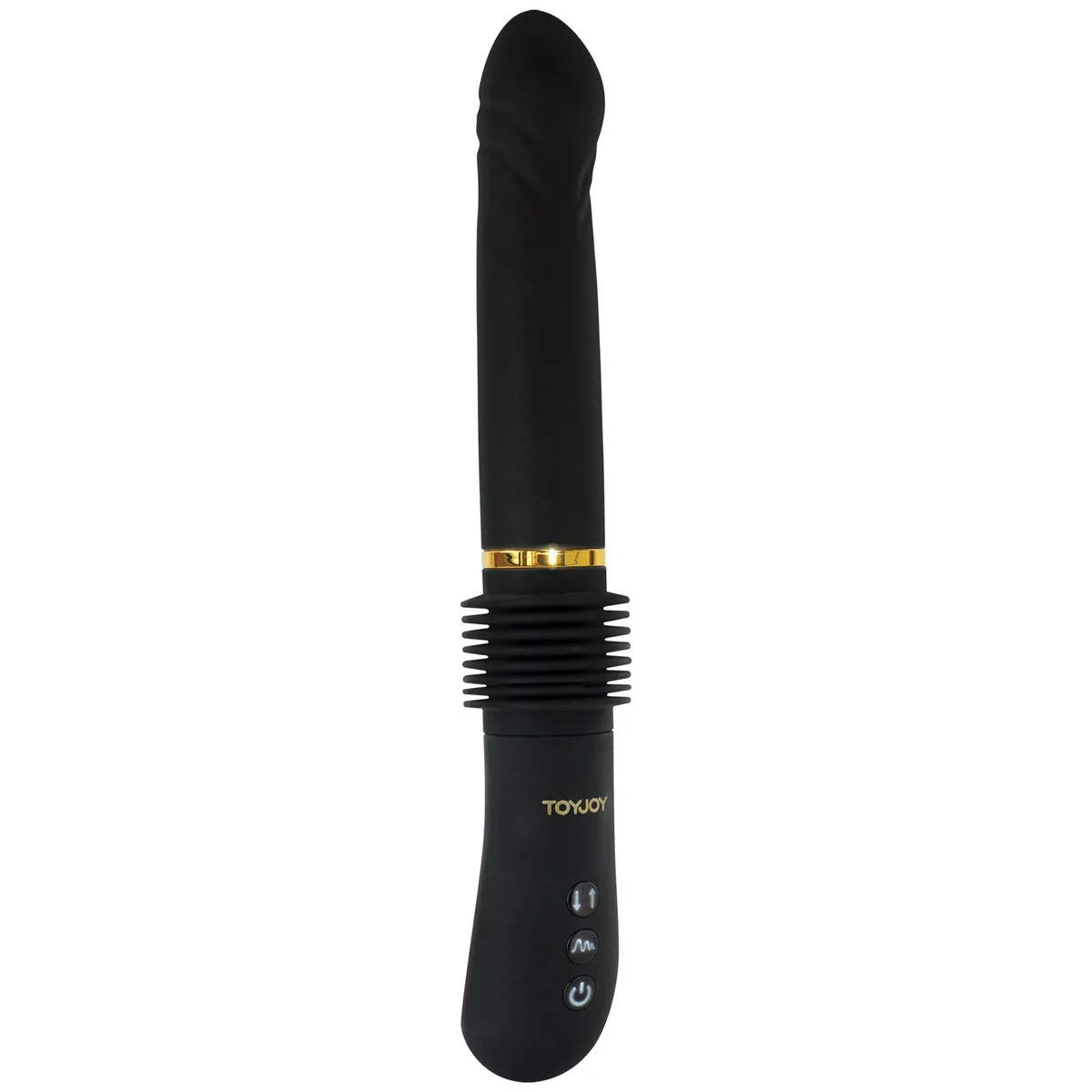
Magnum Opus Thruster is the cheapest model in ToyJoy’s Designer Edition series that works with real thrust motion. The product doesn’t just vibrate: a harmonica-shaped section between the shaft and the handle folds in and is extended by a motor, which means the entire shaft moves back and forth. The manufacturer specifies the thrust length as 8 centimeters, and that number is what the entire design is built around.
The specification looks like this according to the manufacturer: two motors, three thrust speeds, three vibration speeds, four pulsing modes, body-safe material, splash-proof design, and charging via USB. The dimension sketch in the manufacturer’s own product gallery states the total length as 31–39 centimeters depending on whether the shaft is retracted or fully extended, the insertable length as 16–24 centimeters, and the diameter as 3.5 centimeters. In Sweden, the item is sold by eight stores at prices between 846 and 1 579 SEK.
This review is about the black variant with EAN 8713221495235, the manufacturer’s item number 10392-BLACK. According to the manufacturer’s product page, black is the only color the model is available in, which in practice makes the EAN number a sufficient way to know that you’re comparing the right product between stores. This is necessary because the stores sell the model under at least five different names.
A regular vibrator transfers shaking from a motor through the casing to the skin. The movement is fast and short, it happens in place, and it’s the skin’s sensory receptors that respond. A thrust vibrator — the English thruster, which in Swedish stores is often called a pulseator or a thrusting dildo — does something completely different: it moves the entire shaft lengthwise. The movement is slower, longer, and targeted, and it works against the pressure sensation inside the body instead of against the surface.
There is a fundamental difference that matters for who the product is suitable for. Vibration is effective against the clitoris, where nerve density is high. Thrusting motion is aimed at what responds to pressure and rhythm—that is, the area that is usually called the G-spot and the walls closest to it. Magnum Opus Thruster can do both at the same time, because the manufacturer states that there are two separate motors—one for the thrusting motion and one for the vibrations. What can be established purely technically is that it makes the product mechanically more complex than a vibrator, with more moving parts and, consequently, more things that can stop working.
The construction with a retractable bellows is also the reason the product’s length is given as an interval instead of a single number. There is no one total length to write on the package: it is 31 centimeters retracted and 39 centimeters extended. That specific detail is the cause of almost all the contradictory information that circulates about the model in Swedish stores, and it is worth understanding before you start comparing figures.
ToyJoy sells three models with Magnum Opus in the name, and they are so close to each other that they get mixed up even in the stores’ own categories. All the information below comes from the manufacturer’s respective product pages.
So the difference between the base model and the Pro is not the thrust length—that is 8 centimeters in both—but the remote control, the suction cup, and the published stroke frequency. It’s worth knowing before you pay the price difference, because store texts often like to describe the Pro as “stronger” without there being a single published figure that supports it.
The model is called Magnum Opus Thruster by the manufacturer. Despite that, exactly the same article number is sold in Sweden under the names Magnus Opus Thruster at Vuxen, Magnum Opus, Thruster at Joyland, Toyjoy Thruster Vibrator at Lekosmek, and Toyjoy Thruster Sexmaskin at Taboo. None of them sells a different variant—everyone lists either EAN 8713221495235 or the manufacturer’s article number 10392.
The practical advice is simple: compare by the EAN number, not the name. Six of the eight stores publish the EAN or the manufacturer’s item number openly on the product page — Mshop, Vuxenkul, and Sexonic state the EAN number, while Vuxen, Lekosmek, and Taboo state 10392. That’s enough to determine whether a low price applies to this model or a sister model. The difference between the base model and the Pro version is several hundred SEK, and they’re often listed in the same category with almost identical images.
The manufacturer’s dimension sketch, which is included as one of six images in the product gallery, lists three values: total length 31–39 centimeters, insertable length 16–24 centimeters, and diameter 3.5 centimeters. The difference between the low and the high value is exactly 8 centimeters in both cases, which matches the stated stroke length. So it’s not two different measurements, but the same product in two positions.
The stores present this in five different ways, and that in itself is a find worth printing:
None of the stores has made up the numbers; they’ve chosen different parts of the same measurement interval. But the consequence for the person who’s shopping is real: the same product appears to be either 30.5 or 39 centimeters long depending on which tab you read. Count on 31 centimeters in the retracted position and 39 centimeters when the shaft is fully extended, and count on 16 centimeters as the insertable starting position. These are the manufacturer’s own values, and they’re the only ones that present both end positions.
Eight centimeters is a long stroke length in this product category. For comparison, Fun Factory-type pulsators use a weight that moves inside a fixed housing, which gives a bump feel without the product actually changing length. Magnum Opus Thruster does the opposite: the shaft leaves the handle and returns, and the movement is visible on the outside.
That means two things in practice. The first is that the insertable length changes during use, from 16 to 24 centimeters — it’s not a product where you set a depth and leave it at that. The second is that the handle must be kept still for the thrust movement to become a thrust movement and not just a movement in your hand. The manufacturer’s own manual is clear on that point and expressly warns against bending, stretching, or otherwise obstructing the product’s mechanical movement, because it can damage the mechanics inside. It’s an instruction that has no equivalent on a normal vibrator, and it’s worth reading for what it is: a design limitation.
ToyJoy does not publish any weight for Magnum Opus Thruster, either on the product page, in the gallery, or in the manual. Two shops fill the gap, and they say different things. Retailer Taboo states 240 grams. Retailer Mshop states 0,50 kilo, but does it in the table header "Dimensioner (Förpackning)" together with the package dimensions 37 × 12 × 7,5 centimeters, which means that figure is most likely the shipping package’s weight and not the product’s.
What can be established is that both pieces of information are shop details, that they don’t measure the same thing, and that the manufacturer does not state either of them. A product that is 31 centimeters long, has two motors, a battery, and a mechanical drive system reasonably ends up well over the 240 grams that Taboo lists — Fun Factory, for example, lists 295 grams for its significantly shorter Stronic G at 209 millimeters. Treat 240 grams as a shop figure without support from the manufacturer, and 0,50 kilo as a shipping weight.
The material issue is the only characteristic of an intimate product that can’t be compensated for with habits or care. The manufacturer’s packaging and functional image indicate the material with a single symbol: BODY-SAFE. ToyJoy does not publish any breakdown of the materials by part for this model. Four of the Swedish shops do, however, and they agree: Mshop, Vuxenkul, and Joyland all list silicone and ABS plastic, and Blush Me lists high-quality silicone in the feature table and silicone plus ABS plastic in the description.
Silicone is a non-porous material. A non-porous surface can be cleaned because there are no microscopic cavities where residue can get trapped. That’s the single most important property of a material that will lie against mucous membranes. ABS is a hard thermoplastic that is also non-porous, but it’s stiff — it’s used for housings, buttons, and mechanics, not for surfaces that are inserted.
The manufacturer’s own product images show how the split looks on this model: the shaft and the ribbed bellows are matte, soft silicone, while the lower part of the handle with the three buttons and the shiny gold ring between the shaft and the bellows are made with a different design. In practice, that means that the part that is inserted is silicone—which is what matters hygienically—while the handle is built to withstand the load from the impact mechanism.
Phthalates are a group of softeners used to make plastic—especially soft, flexible PVC—pliable. Kemikalieinspektionen describes them as substances that can affect the hormone system and make reproduction more difficult, and several of them are restricted or banned within the EU in a large number of products. Silicone doesn’t require phthalate plasticizers to become soft, because the softness comes from the polymer’s own structure, and therefore silicone as a material specification is, in itself, a better indication than most other entries in a specification.
Here, however, it’s worth being careful about who says what. The manufacturer writes “body-safe” on the packaging but does not publish an explicit phthalate declaration for this model. The retailer Vuxen states “Kroppsäker & Fri från Ftalater” in its quick facts. It’s a store claim, not a manufacturer commitment, and the difference is relevant: “body-safe” is a marketing term without a legal definition, while “free from phthalates” is a verifiable claim. ToyJoys manual instead refers to the packaging: anyone who is allergic to any material is advised to read the material specification there.
The ribbed bellows between the shaft and the handle are the model’s signature feature and also its most difficult surface to clean. It consists of about a dozen folds that are compressed together and extended out with every impact, and folds are by definition places where liquid and lubricants collect. No manufacturer can design that away; it’s the price of a visible telescoping movement.
In practice, that means cleaning requires more care than with a smooth product. The manufacturer’s manual specifies warm water and mild soap or toy cleaner, and that the product should be completely dry before it’s put away—which is harder when the surface has folds that trap moisture. Since the bellows also moves, it should be rinsed in the extended position if you want access to the entire surface. Anyone who wants the least possible maintenance should choose a product with a fixed casing; a pulsator of Fun Factory’s type has no folds at all, precisely because the movement happens inside.
The interface consists of three buttons on the top side of the handle. The manufacturer’s own product images show them clearly: at the top, a button marked with an up and down arrow, in the middle, a button marked with a wave symbol, and at the bottom, an on/off button. The layout follows the functions—the arrows control the thrusting motion, the wave controls vibration and pulsing.
There are only three buttons for a product with ten settings, and that is both an advantage and a limitation. The advantage is that there is nothing to memorize by heart. The limitation is that the settings can only be stepped through in one direction: if you want to go back one step, you have to go around. The manufacturer does not publish a description of the button sequences, and ToyJoy has no model-specific manual for item 10392 — the collection page for manuals contains only a general manual and a manual for a pump.
The manufacturer lists three groups: three up-and-down speeds, three vibration speeds, and four pulsing functions. That gives ten settings in total, distributed across two independent motors. The fact that there are two motors — the manufacturer’s functional diagram explicitly states twin motor — is what makes the combinations possible: the thrusting motion and the vibration can be run at the same time and controlled independently.
Compare that with how the shops describe the same thing, and a common mistake shows up in the category. Blush Me writes "total 7 intense vibration patterns" by adding the four pulsing patterns to the three vibration speeds, while the thrust settings are counted separately. Joyland writes "double motor for strong vibrations in three speeds" and lists the four pulsing patterns and the three thrust settings separately. None of them is wrong, but the one that compares "number of settings" between two products is, in practice, comparing two different ways of counting. What can be established is that this model has three thrust speeds — not more.
According to the manufacturer’s description, all control happens with the intuitive buttons on the handle. There is no remote control and no app for this model—it’s the Pro variant that has a wireless remote control. For a product with a handle that needs to be held still, that is a real difference: the buttons are on the same part you hold in your hand, making them easy to reach, but also easy to press by mistake when your grip changes.
The manufacturer does not publish a button-lock function for the model. Fun Factory, for example, explicitly states a key lock on its Stronic G, which is an argument for storage and travel that ToyJoy does not match with published information.
ToyJoy does not publish any stroke frequency for Magnum Opus Thruster — neither strokes per minute nor any other measure of speed. The only thing that is stated is that there are three speed levels. It’s worth noting because the manufacturer publishes the figure for the system model: Magnum Opus Thruster Pro is stated to work with 70 strokes per minute.
Without a number, it’s not possible to convert the speed into anything comparable, and it can’t be determined whether the base model is above or below the Pro model at the highest setting. Websites that list an exact stroke frequency for this article either report their own measurement or a value without a source from the manufacturer.
This is the model’s clearest limitation, and it is well documented. The manufacturer’s operating image and the package print state splash proof, meaning splash-proof. ToyJoy’s general manual puts it plainly: splash-proof products must not be used in water, but may be cleaned with water. The manual adds that a product that is not water- or splash-proof may not even be used near water, and that charging must never take place in or near water.
Enclosure classes are defined in the international standard IEC 60529. The number in the second position indicates protection against water: 4 means splashing water from all directions, 5 means a water jet, and 7 means immersion to a depth of one meter for 30 minutes. The difference between 4 and 7 is not incremental but fundamental — the first four levels deal with water that hits the outside, while level 7 is about the product being able to be under the surface.
ToyJoy publishes no IP rating at all for Magnum Opus Thruster, only the word splash-proof. Still, two pieces of information circulate: the retailer Taboo states "Vattentålig IPx5: Ja" on its product page, and Vuxen lists IPX4 for the Pro system model. Neither of them has coverage in the manufacturer’s materials for this article, and when the store and the manufacturer contradict each other, the manufacturer’s information applies. Treat the product as splash-proof, not as rated.
Practically, this means the model doesn’t belong in the bathtub or in the shower, no matter how many store texts suggest otherwise — for example, Vuxenkul writes that the splash-proof design means you can enjoy the product even in the shower, which directly contradicts the manufacturer’s own manual. It also means that it differs from Fun Factory Stronic G, which the manufacturer states is IPX7 and is therefore submersible.
The manufacturer’s manual states warm water and mild soap or a cleaning agent for intimate products, both before and after use, and that the product should be 100% dry before it’s put away. Since the model is splash-proof and not waterproof, cleaning should be done with a damp cloth or with a short rinse—not by placing the product in water. The bellows’ folds require extra attention, and it should be rinsed in the extended position.
The lubricant question is unambiguous in the manufacturer’s instructions: use a water-based lubricant, because oil- and silicone-based lubricants can damage the materials. Silicone-based lubricant breaks down the silicone surface over time and makes it porous, and a porous surface can no longer be cleaned properly—only replaced. Retailer Joyland states the same thing in its specification, with water-based as the recommended lubricant.
The manual also covers three things that rarely appear in store texts. The product should be stored dry, dust-free, and at room temperature, without direct sunlight. Products should be stored separately from each other to avoid chemical reactions between materials—a satin pouch or a small box is enough. And the product should not be shared with others, which is a hygienic recommendation and not a legal one.
The manufacturer states that the product is USB rechargeable. That’s all of the published battery information. The manual adds three instructions: never charge in or near water, use only the included USB cable because another cable can damage the product, and don’t force the connector in—aim it at the port first.
Via USB, with the cable that comes with it. The most important line in this context is that the manufacturer explicitly writes that only the included cable may be used: kabeln ska betraktas som produktspecifik, and a lost cable is therefore a problem that isn’t solved with the USB-C cable that’s in the desk drawer. That’s a clear difference compared to Fun Factory Stronic G, which the manufacturer states is charged with USB-C.
The manufacturer also doesn’t publish a charging time. Retailer Lekosmek indicates 120-minute charging time and about 90 minutes of usage time in its product text. That’s the only runtime information that can be found for the model—it comes from a store and not from ToyJoy, and it should be read accordingly. At the same time, ninety minutes is a reasonable order of magnitude for a product with two motors, one of which drives a mechanical movement that requires significantly more energy than a vibration motor.
ToyJoy does not publish the battery’s capacity in mAh, its voltage, its type, or whether it is replaceable for Magnum Opus Thruster. Retailer Vuxen states a lithium-ion battery for the sister model Pro, which makes it likely that the same technology is used here, but it’s a shop claim about a different item.
Without the capacity, you can’t convert runtime into power consumption, and you can’t compare how heavily the cell is loaded between models. What generally applies to lithium-ion batteries still applies: capacity drops with the number of charge cycles, and the product does best when it’s charged regularly instead of being stored fully discharged. Since the impact mechanics draw more current than a vibration motor, it’s reasonable to expect shorter runtime in the highest impact modes than in pure vibration.
ToyJoy does not publish any decibel value for Magnum Opus Thruster, either on the product page, in the gallery, or in the manual, and none of the eight Swedish shops either. So there’s nothing to compare, and every decibel figure that shows up for this model lacks a source from the manufacturer.
What can be established is the consequence of the design. An impact mechanism moves a mass back and forth along the longitudinal axis and works against a harmonica-shaped housing made of silicone. It’s mechanical work of a different kind than a vibration motor’s, and it’s not reasonable to expect a product with visible movement to sound as quiet as one without. The manufacturer also doesn’t market the model as silent—unlike what’s common in the category; the word doesn’t appear in the product text. Anyone who lives in thin walls and needs to know an actual number before buying gets no answer from either the manufacturer or the shops.
We do not have price data from shops in your market yet.
An eight-centimeter striking length is the product’s entire idea. That the manufacturer doesn’t publish weight, battery, striking frequency, or an IP rating is the whole problem.
Three comparisons are relevant: against the two sister models in the same series, and against the established European competitor that solves the same task with another technology. All the information below comes from each manufacturer’s own product pages, and the Swedish prices from the shops’ product feeds July 29, 2026.
The Pro model has the same 8-centimeter extension and the same three impact speeds, but adds three things: a wireless remote control, a suction-cup base for hands-free use, and seven vibration modes instead of the base model’s three speeds plus four pulsing patterns. The manufacturer also states 70 impacts per minute for Pro—a figure that is completely missing for the base model.
The measurements are different too. According to retailer Vuxen, Pro is 30 centimeters long overall, with 17.5 centimeters that can be inserted and a maximum diameter of 4.1 centimeters, compared with the base model’s 3.5 centimeters. Pro is therefore shorter but noticeably thicker. With the manufacturer, Pro costs 129.99 euros versus the base model’s 119.99 euros; in Sweden, Joyland lists the Pro model at 931 SEK and Vuxen at 1,395 SEK.
The conclusion is more straightforward than the price difference suggests: the suction cup is what actually changes how the product can be used, because it makes hands-free possible. If you only want support-and-thrust movement in your hand, you get the same support-and-thrust length for less money in the base model. If you want the product to stand on its own, there’s no way to get there through this article.
Supreme Thruster 2 is stated by the manufacturer to have a total length of 31 centimeters, meaning the same collapsed length as the base model, and it’s described with several positions for vibration, pulsing, and thrusting movement without the number of modes being specified. The stated added value is aesthetic: purple instead of black, and a gift package that is intended to function as a storage box between uses.
The price, meanwhile, is the highest in the series—143.99 euros from the manufacturer versus 119.99 euros for the base model. What can be established is that whoever pays the difference pays for color and for packaging, because the manufacturer does not publish a single technical specification that distinguishes Supreme 2 from the base model to Supreme’s advantage. A storage box is, of course, not insignificant when the manual explicitly requires products to be stored dry and kept separate from each other—but a satin pouch costs under a hundred.
Fun Factory Stronic G is the most fully specified competitor in the category, and it solves the same task in the opposite way. Instead of a telescopic shaft, it uses a weight that is moved inside a fixed housing, which provides a thrusting feel without the product changing shape. The manufacturer states the weight as 295 grams, the dimensions as 209 × 49 × 37 millimeters, the materials as silicone and ABS plastic, the enclosure rating as IPX7, charging via USB-C, ten thrusting programs, a button lock, and the price as 69.95 euros.
The differences that actually matter are four. Stronic G is rated IPX7 and can therefore be submerged, while Magnum Opus Thruster is only splash-proof and, according to the manufacturer’s manual, must not be used in water. Stronic G is charged with USB-C, while ToyJoy’s manual requires the included cable. Fun Factory publishes weight, dimensions in millimeters, and the IP rating, while ToyJoy publishes dimensions but neither weight, the IP rating, the battery, nor the striking frequency. And Stronic G is 20.9 centimeters long versus Magnum Opus Thruster’s 31–39, so it’s a completely different product to store.
On the other hand: Stronic G has no actual stroke length of 8 centimeters, no separate vibration motor, and no visible telescopic shaft. If you want a product that really moves in and out, ToyJoys’ design is the only one of the two that does that. If you want published figures, a bathroom-resistant design, and a charging cable that can be replaced at any electronics store, Fun Factory wins on every point.
Eight Swedish stores sell the item with EAN 8713221495235. The cheapest is Joyland at 846 SEK, the most expensive is Taboo at 1,579 SEK. That’s 733 SEK or an 87 percent difference for exactly the same item number, the same color, and the same packaging—one of the biggest spreads in the entire category.
The inventory situation is unusually good compared with premium products in the same price range. Six of the eight stores had the item in stock at the price check: Joyland at 846 SEK, Vuxen and Blush Me at 995 SEK, Mshop at 1,389 SEK, Lekosmek at 1,419 SEK, and Taboo at 1,579 SEK. The two that were out of stock were Vuxenkul at 1,035 SEK and Sexonic at 1,074 SEK.
In practice, that means you can choose freely, and the difference between the cheapest and the second-cheapest available store is 149 SEK. The price spread isn’t because any store sells a different variant—the black one is the only color the manufacturer lists, and all eight stores list either the EAN number or the manufacturer’s item number 10392. So it’s simply the stores’ own margin setting for the same item.
One more thing about the price tags: several of the stores list the product as discounted from a higher regular price. The manufacturer’s own price is 119.99 euro, which puts the Swedish price range roughly around the manufacturer’s level rather than below it. The prices in the table above are updated when the stores’ product feeds are updated, but always check the final price at checkout—shipping costs are added by most stores under a certain order value.
It’s for you if you want a real thrusting motion and not just vibration, and if you want it at the lowest possible price: a stroke length of 8 centimeters with two motors from 846 SEK is hard to beat in kronor terms. It’s for you if you want a handle to control it with instead of a remote control, if you want a generous insertion length of 16 to 24 centimeters, and if you want to be able to vary thrust speed and vibration independently of each other.
It doesn’t fit you if you want to use the product in the shower or a bathtub — the manufacturer states that it’s splash-proof and the manual explicitly forbids use in water. It doesn’t fit you if you require published battery capacity, operating time, weight, IP rating, or sound level before purchasing, because ToyJoy doesn’t publish any of that for this model. It also doesn’t fit you if you want the smallest possible product to store: at 31 centimeters folded and 39 centimeters extended, it’s large even for the category, and the packaging measures, according to Mshop, 37 × 12 × 7.5 centimeters.
One last thing belongs in the decision. The mechanical motion is both the product’s entire idea and its most vulnerable part. The manufacturer’s manual warns against preventing the mechanical motion, and a bellows with ten folds is a surface that requires more care than a smooth one. The person who wants something that lasts for ten years with minimal care buys a simpler product; the one who wants thrust motion for under a thousand kronor has few other ways to get there.
ToyJoy’s manual states that the statutory warranty applies, that it covers material and manufacturing defects during normal use, that normal wear and tear is excluded, and that the warranty period runs from the purchase date with the receipt as the valid proof of purchase. The manufacturer does not state any number of years, and ToyJoy does not publish any voluntary manufacturer’s warranty beyond the law. That differs from the premium manufacturers in the category, who often provide five, ten, or fifteen years of their own warranty.
A store detail exists: the retailer Lekosmek states a two-year product warranty on its product page. That’s the store’s commitment and not the manufacturer’s, and in that case it applies only to purchases made from that store.
What always applies, however, are your statutory rights. According to konsumentköplagen, you have three years to file a complaint for defects in the goods, regardless of what the manufacturer or the store promises. For distance purchases, you also have a right of withdrawal for fourteen days under the lagen om distansavtal och avtal utanför affärslokaler. Be aware that in practice the right of withdrawal is limited for hygiene items that have been taken out of a sealed package — the right to complain about defects, however, always applies. If you have questions about what applies in your case, Konsumentverket guides you via Hallå konsument.
For a product with moving mechanical parts, the right to complain is more relevant than usual. What breaks first on a thrust vibrator is not the silicone but the drive unit, and three years’ right to complain for an original defect is, in practice, better protection than most voluntary warranties — provided that you save the receipt, which the manufacturer’s manual also points out.
ToyJoy Magnum Opus Thruster is ranked på plats 12 av 12 in thrusting vibrator best i test, where the entire category is compared against each other using five shared criteria. Guiden vinns av Fun Factory Bi Stronic Arc Thrusting Rabbit Pulsator.
Every numerical piece of information in the text can be traced to one of the sources below. The links were checked manually on the specified date.
This page is machine-translated from Swedish. Read the Swedish original