

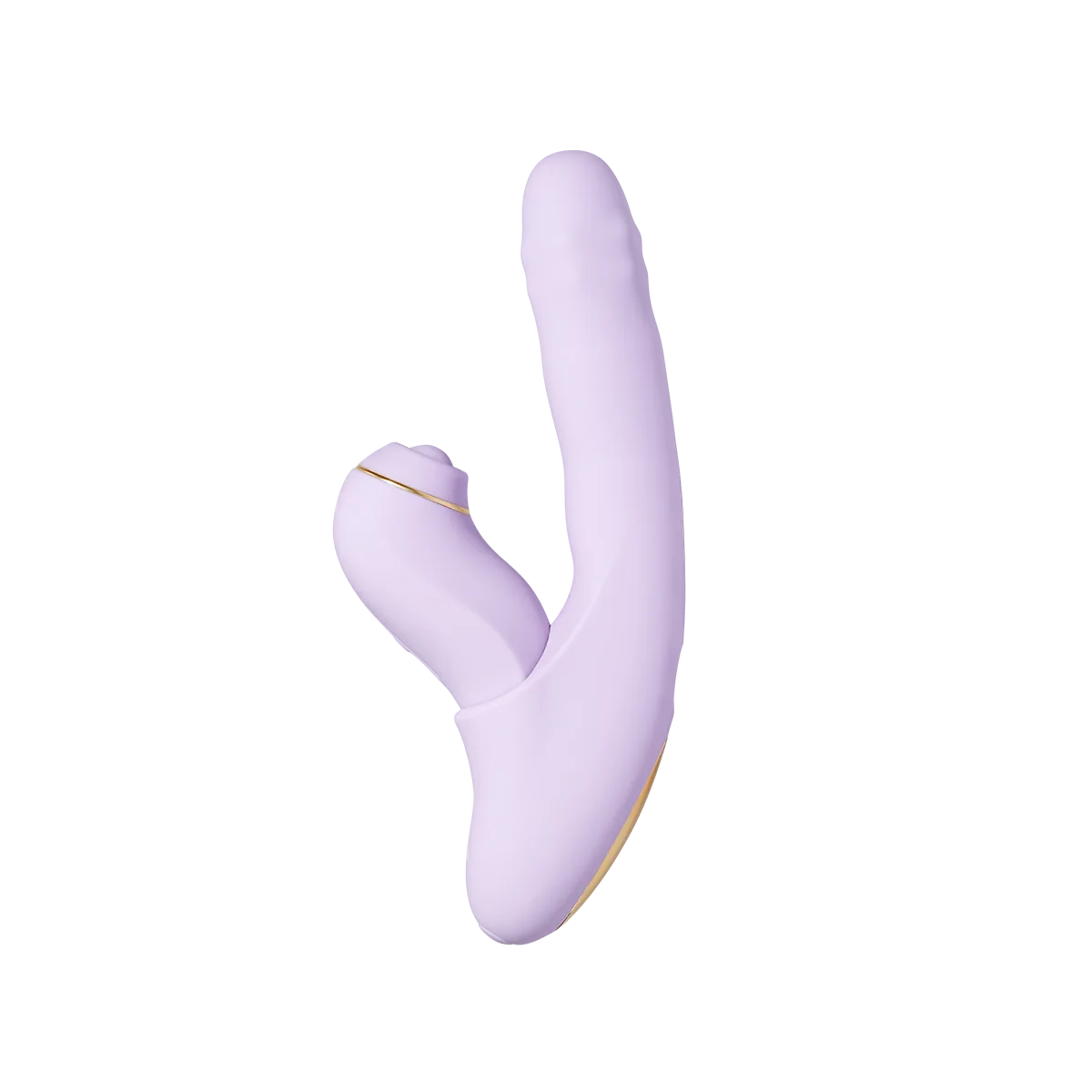
Review
Review: Svakom Rabbit DuoGlow
Rabbit with thrusting motion and heat — but only one hour of runtime.
29 July 2026
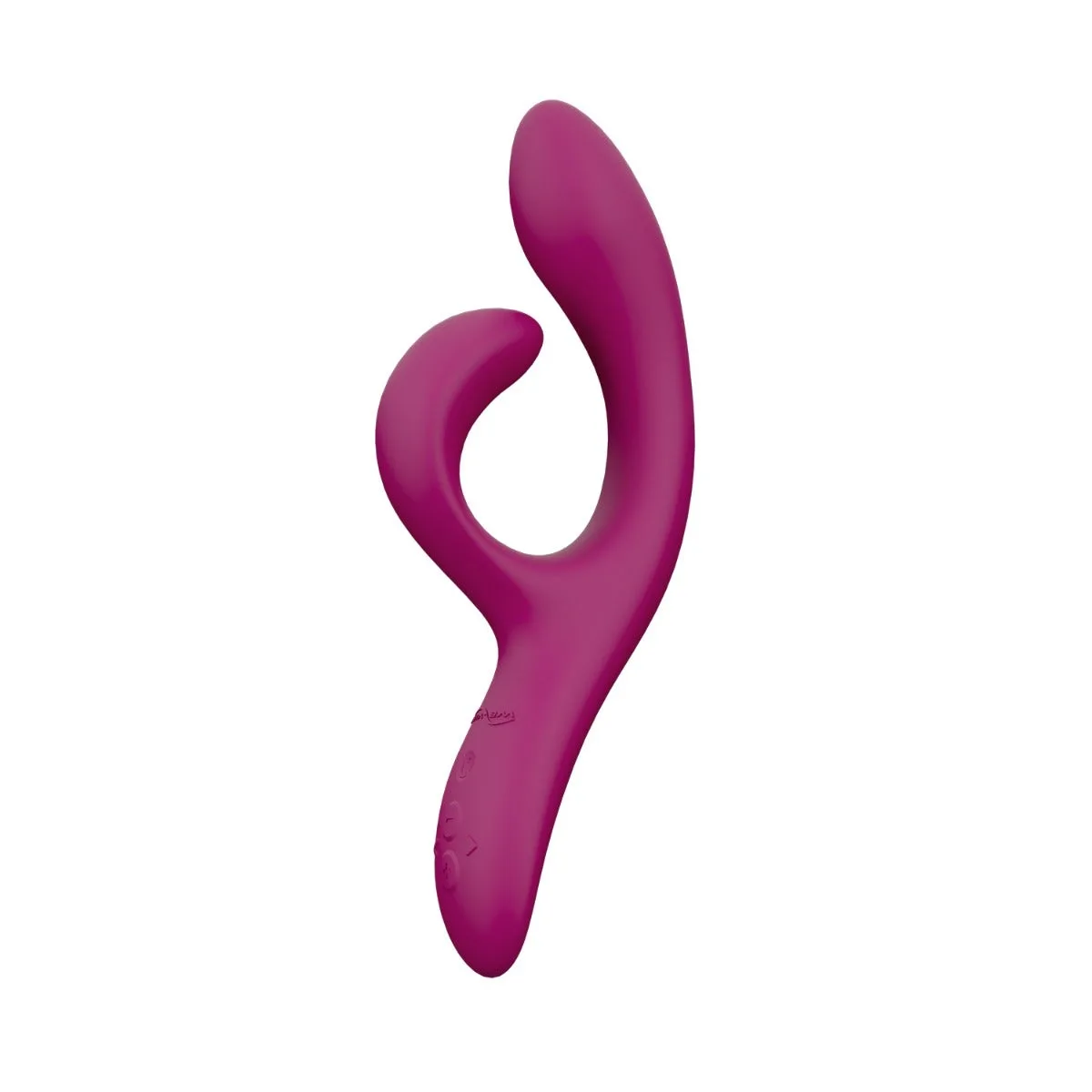 Author's pick
Review · Rabbit vibrator · Two motors · App-controlled
We-Vibe’s flexible rabbit vibrator reviewed against the manufacturer’s own specifications, manual, and price data from seven Swedish stores. Two separately adjustable motors, body-friendly silicone without phthalates, BPA, or latex, IPX7 according to IEC 60529, 217 × 85 × 39 millimeters, and up to 120 minutes of runtime — but only a two-year warranty and no published weight, battery capacity, or sound level.
The rabbit in the comparison that’s built around a single problem: the clitoral arm losing contact when you move. The flexible outer arm and the two separate independently adjustable motors are real engineering advantages, and full silicone plus IPX7 make it easy to keep clean. What you pay for is two years of warranty, where competitors offer ten or fifteen, a magnetic charging cable that can’t be replaced with a regular USB cable, and a specification where neither weight, battery capacity, nor sound level is published.
We-Vibe Nova 2 is the brand’s rabbit vibrator, and the function that the manufacturer builds the entire product around is the outer arm. On a classic rabbit, the clitoris arm is set at a fixed angle and loses contact as soon as the product moves. On Nova 2, the outer arm is flexible and springs back toward the body, and the manufacturer summarizes the point in two of its five points on the product page: constant clitoris contact and flexible arm. It’s that difference that justifies the price tag, and it’s the only function in the specification that you can’t buy cheaper somewhere else.
The rest of the specifications look like this. Two separate motors—one in the inner G-spot arm and one in the outer clitoris arm—plus a separate button to switch control between them. The dimensions are 217 × 85 × 39 millimeters. The material is body-friendly silicone made without phthalates, BPA, and latex. The enclosure rating is IPX7. The runtime is stated as up to 120 minutes and the charging time as up to 90 minutes, via magnetic charging contacts and a USB charging cable. The warranty is two years. The product is also app-controlled via Bluetooth through We-Vibe’s own app.
This review is exclusively about the variant with EAN 4251460603959, which in the manufacturer’s own variant table has the item number SNNASGX and the color designation Fuchsia. Nova 2 is sold in two colors, and the other one — Midnight Blue, item number SNNA2SG5 — has its own EAN: 4251460616867. Functionally, they’re identical, but they’re two different items, and several Swedish shops describe them on the same page. One shop in the price comparison below even lists the color as “Purple” despite listing the Fuchsia number. Check the number, not the color.
In Sweden, the item is listed by seven shops at prices between 1,334 and 1,899 SEK. Four of them had it in stock when the price data was collected. The lowest price with the item at home is 1,449 SEK.
A rabbit vibrator is a product with two stimulation points at the same time: an insertable part that works against the front vaginal wall where the G-spot sits, and an outer arm that rests against the clitoris. The name comes from the clitoris arm shaped like a goosebill on early models and has become a term for the genre rather than a brand descriptor. What differentiates models within the genre is almost always three things: how the arms are angled relative to each other, whether they have their own motor or share one, and how much the arms’ geometry can be adjusted to fit the user.
That’s exactly where Nova 2 lays out its design. According to the manufacturer’s manual, the inner arm is adjustable — it can be bent in small steps at a marked adjustment point to change the angle toward the G-spot — while the outer arm is flexible and gives way to movement without leaving the clitoris. These are two different features that are often mixed up. You set the inner arm once and it keeps its position. The outer arm is designed to move all the time.
What that means in practice is that the most common objection against the rabbit genre — that the clitoral arm slips away as soon as you move and therefore you have to keep the product still — is the objection the design is trying to solve. What can be established from the specification is that the solution is mechanical and not electronic: there is no sensor that keeps contact; there is only an arm in softer silicone with a springy shape. The manufacturer’s own dimension sketch shows how the outer arm curves into an almost closed loop against the insertion part, which is what gives it that springiness.
We-Vibe sells Nova 2 in two colors, and they have separate item numbers and separate EANs. Fuchsia is SNNASGX with EAN 4251460603959, which is the item the store table on this page refers to. Midnight Blue is SNNA2SG5 with EAN 4251460616867. The difference is only the color — the dimensions, material, battery, IPX rating, and warranty are the same in the manufacturer’s specification.
The reason this is worth its own section is that the store data is messy. Two of the listings in the price comparison come from the same store and point to two different product pages with the same EAN — one is called “We-Vibe Nova 2 Fuchsia”, the other “WE-VIBE — VIBRATOR APP NOVA”. A third store lists the color “Lilac” on an EAN that the manufacturer associates with Fuchsia. It’s not necessarily the wrong product in the box, but it means the color word in the store text isn’t something you can trust. Go by the EAN, not the color name.
The material question is the only characteristic of an intimate product that neither habit nor care can compensate for, and it determines whether the product can still be cleaned in five years. We-Vibe states a single material for Nova 2: body-friendly silicone, made without phthalates, BPA, and latex. That’s the wording on the product page, and it’s the only material detail the manufacturer publishes.
Silicone is a non-porous material. A non-porous surface can be cleaned, because there are no microscopic pores where residue can get trapped. It is the single most important characteristic of a material that is meant to sit against mucous membrane, and that is why the material declaration weighs more heavily than almost every other line in a specification. Silicone also tolerates heat and common cleaning agents better than the softened plastics that are still found in cheaper products.
When the silicone covers the entire product, there are two consequences. The first is tactile: the surface feels soft in the hand instead of like slippery plastic, which provides a better grip when your hands are wet or have lubricant on them. The second is hygienic: there is no seam between a silicone section and a plastic handle where dirt can collect—and on this particular product, where the arms bend and move, such a seam would have been right where the movement is greatest.
Here, however, there is one deviation that needs to be reported. Two of the Swedish stores list the material as “Silicone, PU”, meaning silicone and polyurethane, while the manufacturer only writes silicone. PU typically appears as a surface layer or coating on this type of product. When the store and the manufacturer contradict each other, the manufacturer’s information wins—and what appears in the specification table further down is therefore the manufacturer’s statement. But the deviation is worth knowing if you are sensitive to polyurethane, and it is an example of how the store texts in this category often come from the wholesaler’s field documents rather than from the manufacturer.
Phthalates are a group of plasticizers used to make plastic—especially softened PVC—flexible. The Kemikalieinspektionen describes them as substances that can affect the hormone system and make reproduction more difficult, and several of them are therefore restricted or prohibited within the EU in a large number of products. This particular product category is a recurring subject of supervision, because it contains soft plastic that sits against skin and mucous membrane for a long time.
We-Vibe states plainly in plain language that the silicone in Nova 2 is manufactured without phthalates, BPA, and latex. It is an unequivocal declaration, unlike terms such as “TPE” or “jelly rubber,” which do not say anything at all about which plasticizers are included. Silicone does not need phthalate plasticizers to become soft—the softness comes from the polymer’s own structure—and that is why silicone as a material specification in itself is a better piece of information than almost every other entry in a product specification.
The latex information is relevant for anyone who is allergic to latex. Reactions on mucous membrane will occur faster and be more intense than on normal skin, and for that reason an intimate product is exactly the kind of use where this information matters. That the manufacturer states it instead of staying silent about it is a plus.
The manufacturer states 217 × 85 × 39 millimeters, and the same three numbers are given in plain text in the dimension diagram We-Vibe publishes in its own product gallery: 217 mm in length measured from the end of the handle to the tip of the insertion part, 85 mm as the height across the two arms, and 39 mm as the width. The diagram also shows that the button group sits on the top side of the handle, a bit away from the insertion part.
One of the Swedish stores reproduces exactly the same three numbers. The others do not. Two stores state the overall length as 21.5 cm, one as 21 cm, and one as 20.5 cm — versus the manufacturer’s 21.7 cm. The diameter is given as 3.5 cm by three stores and as 4 cm by one. The variation is, in practice, small, and the most likely explanation is that the stores round the numbers or measure from different points on a product that is curved in two planes. But it’s a good example of why a specification should be taken from the manufacturer and not from the store that just happens to be listed at the top of the search results.
We-Vibe does not publish the insertion depth. Two of the stores state 11 centimeters, and one of them also gives the largest diameter as 3.5 centimeters and the smallest diameter as 2 centimeters for the insertion part. These are store details, not the manufacturer’s, and they should be read as such — but they are the only figures available for that particular question, and an 11-centimeter insertion part on a product with a total length of 21.7 centimeters is a reasonable proportion for a rabbit where the rest is the handle and outer arm.
We-Vibe does not publish any weight for Nova 2, either on the product page or in the manual. Two stores fill the gap, but with two completely different numbers: Lekosmek states 515 grams and Mshop states 0.60 kilograms. Neither of them is likely to be the product’s own weight.
The reason to doubt is easy to calculate. Lelo Soraya 2, a rabbit in the same size class with dimensions 220 × 76 × 45 millimeters, is listed by its manufacturer as weighing 175 grams. Svakom Rabbit DuoGlow, according to its manufacturer, weighs 180 grams for the vibrating part and 248 grams for the entire set. A handheld silicone product with Nova 2’s dimensions weighing 515 or 600 grams would therefore be about three times heavier than its direct equivalents, which doesn’t add up. Mshop also lists the package dimensions as 25.10 × 11.20 × 7.30 centimeters in the same table, which strongly suggests that the figures are shipping weights for the whole box with the cable, storage pouch, and lubricant sample.
What can be concluded, then, is this: the product’s own weight is unknown; the two published figures come from stores and not from the manufacturer; and they should be treated as shipping weights until We-Vibe publishes a number. Assume that the product in your hand weighs significantly less than half a kilogram.
The interface on Nova 2 consists of five buttons gathered on the top side of the handle, and the manufacturer’s manual names them all. A plus button that starts the product and increases vibration, a minus button that decreases and turns it off, a left arrow and a right arrow that step between the vibration patterns, and underneath a toggle button that switches control between the two motors and is also used for pairing. The manufacturer’s close-up of the button group shows that they are embossed in the silicone: plus, minus, the two arrows, and the toggle symbol.
Five buttons are more than on a simple vibrator, and that is the direct cost of the product having two independent motors and app support. In return, all basic functions can be reached without a phone. The product is started with the plus button, turned off with the minus button, and the patterns are stepped through with the arrows — none of it requires the app to be installed.
Nova 2 has a motor in the inner G-spot arm and one in the outer clitoral arm. The toggle button switches which one the plus and minus buttons control. It’s a simple solution to a recurring problem in the rabbit genre: the intensity that fits the clitoris is rarely the same intensity as the one that fits internally, and products with only a shared control therefore always end up as a compromise.
What can be established purely technically is that the two motors are separately controllable but not simultaneously controllable from the product itself — you switch between them with the toggle button and adjust one at a time. If you want to control both at once, it’s the app that does it, through the Single Vibe and Multi Vibe modes. For someone who just wants one button and one sensation, the toggle logic is a threshold; for someone who knows that they want strong clitoral stimulation and mild internal stimulation, that’s the whole point.
The inner arm is also formable. The manual states that it can be bent in small steps at a marked adjustment point to change the angle toward the G-spot, and it explicitly warns against bending the product hard. So it’s a one-time adjustment you make before use, not a control you change while it’s in use.
This is the question where the sources differ the most, and the answer deserves to be written out. The manufacturer’s product page states that it provides no number of vibration modes at all for Nova 2. The feature list there mentions constant clitoral contact, a flexible arm, the We-Vibe app, IPX7, and dual stimulation — but no number.
The manufacturer’s online manual, however, says otherwise. It states, in all fifteen language versions, that the arrow buttons step between ten different pattern modes. Ten is therefore the only number We-Vibe publishes itself for the product without the app.
Swedish shops list four different numbers for the same item number: ten programs, “10+ apartments,” “13 vibration apartments,” and “more than 13 vibration apartments.” None of them refers to any source. The most likely explanation is that the higher numbers come from the app, where the manufacturer lists twelve preset patterns in addition to the option to build your own—but that’s a guess about the shops’ source of those numbers, not a statement from We-Vibe. What is certain is that the product by itself has ten patterns according to the manual, and that the app adds twelve presets to the same product.
One more thing belongs here. The number of modes is one of the worst metrics for a vibrator, which is why the shops can outdo each other without anyone reacting. The patterns in this type of product are almost always concentrated in the upper half of the scale, and most people in practice end up using just two or three of them. What sets Nova 2 apart from a cheaper rabbit isn’t the number of patterns, but that they can be applied to two motors independently of each other.
The travel lock is activated by holding the plus and minus button pressed at the same time for three seconds. The product pulses as confirmation and locks itself. The same press for three seconds unlocks it again, and it is also unlocked if you put it on the charger. It’s a feature that matters in a travel bag and that’s missing on several cheaper rabbits.
Pairing with the app is done via the toggle button. The manufacturer’s app page also describes a shortcut: the app can read the product’s barcode to recognize directly which model it’s for, instead of you selecting it from a list.
The manual also mentions a detail that rarely appears in store descriptions: the product is powered by a built-in lithium-ion battery that is not intended to be replaced, and the manufacturer recommends charging the product regularly even when it isn’t being used, so the battery lasts longer.
Nova 2 is app-controlled via Bluetooth, and We-Vibe’s app is one of the more feature-rich in the category. The manufacturer describes the Single Vibe and Multi Vibe modes for controlling intensity and patterns: twelve preset vibration patterns, with the option to create your own; a Touch Mode in which finger movements on the screen control intensity; and playlists in which you set the order, intensity, and length of each moment in a sequence.
The feature that most often determines whether app control is worth anything is remote control. We-Vibe states that a partner can control the product both in the same room and over any distance, and that the app has a built-in chat and video calling so the connection doesn’t require a separate second program alongside it. The app is available for both iOS and Android.
What can be established is that the app is an add-on and not a requirement. All core functions — start, stop, intensity, pattern change, motor switching, and travel lock — are built into the product. That’s an important difference compared with some competitors where parts of the functionality only exist in the app, and it means the product keeps working the day the app stops being updated.
The radio section is unusually well documented for this product category. The manual states the operating frequency 2402–2480 MHz and a maximum transmitter power of under 20 dBm, which is Bluetooth in the standard 2.4 GHz band. The model number is 10000-05, the FCC-ID is ZUE10000-05 and ZUE1000i respectively, and the IC number is 9804A-1000005.
In the same document, the manufacturer states that the product complies with the Radio Equipment Directive 2014/53/EU and the RoHS Directive 2011/65/EC, and refers to the fact that the complete EU declaration of conformity is published collectively on the company’s legal site. The manual is dated 07/2022, and the manufacturer information is WOW Tech Europe GmbH in Berlin. It’s more formal documentation than what most competitors publish, and it’s worth noting for anyone who cares whether the product is correctly CE-marked rather than just marked.
We-Vibe Nova 2 is rated IPX7, and the rating is stated both in the manufacturer’s feature list and in the manual. The rating comes from the international standard IEC 60529, which defines enclosure classes for electrical equipment. The number 7 in the second position means that the product has been tested for submersion in water to a depth of one meter for 30 minutes.
The difference compared with a splash-proof product is greater than the wording suggests. Splash protection covers water droplets and, at best, water jets, but not submersion. Such a product can handle a damp cloth and possibly a shower, but not a bathtub, and it should not be held under running water without thinking through how the buttons and charging contact are affected. With IPX7, the entire product can be rinsed off without being careful.
One of the Swedish stores writes that the product is waterproof “down to 1.5 m”. That’s not what IPX7 means, and the manufacturer states nothing about 1.5 meters. IPX7 is defined as one meter for 30 minutes; the rating that refers to greater depths is IPX8 and requires the manufacturer to state the depth themselves. The difference lacks practical significance in a bathtub, but it’s an example of how store copy can upgrade a rating without coverage. It’s the manufacturer’s job that matters.
If a product is completely missing an IPX rating, it should be treated as not water-resistant. The absence of a rating is never a sign that the product would be approved for water.
The manufacturer’s cleaning instructions are brief: rinse with lukewarm water and a cleaning product intended for sex toys, and dry with a lint-free cloth. Let the product air-dry before putting it away. A linen storage pouch is included in the delivery, and it does more than it looks like it does — silicone attracts dust and lint, and a pouch is the difference between the product being ready to use and needing to be rinsed first.
The lubrication question is the most important care rule, and the manufacturer is unambiguous. Use a water-based lubricant. Do not use fragranced, silicone-based, or alcohol-based lubricants, gels, or massage oils. Silicone-based lubricant breaks down the silicone surface over time and makes it porous, and a porous surface can no longer be cleaned properly—only replaced. Oil-based products like coconut oil leave a film that’s hard to remove. So the fact that the lubricant sample that comes in the box is water-based is no coincidence.
The manual also covers three things that rarely appear in store texts. The product and its battery must not be exposed to temperatures above 45 degrees, which rules out boiling water and a dishwasher despite IPX7. The product contains magnets in the charging contact, which means it should not be used directly over a pacemaker and that cards with a magnetic stripe should be kept away from it. And the product should not be used or cleaned while it is charging.
We-Vibe states the operating time as up to 120 minutes and the charging time as up to 90 minutes. The manual repeats the 90 minutes and describes the LED’s three modes: fast blinking while charging, solid light when fully charged, and off if the charger isn’t seated correctly or doesn’t have power.
Charging is done via magnetic charging pins on the side of the product and a USB charging cable included with a magnetic end. The manual states charging at 5 V and 1.0 A and that a USB power adapter with corresponding power should be used — the adapter is not included. It also spells out something that’s easy to miss: use original provided cable only, meaning that only the included cable should be used.
Magnetic charging is a trade-off, not a pure advantage. The advantage is that there’s no need for an opening in the housing, which makes it significantly easier to achieve IPX7 without a rubber plug that, over time, wears out or gets left open. The downside is that the cable is product-specific: tappar du laddkabeln fungerar ingen vanlig USB-C-kabel, so you have to get a replacement. It’s a real difference compared to, for example, the Satisfyer Pro+ G-Spot Generation 2, which charges with a standard USB-C cable—even if Satisfyer on their side doesn’t even include the cable in the box.
Also note that We-Vibe’s warranty terms exclude consumable parts and wear parts. A broken or lost charging cable is, in practice, your own cost, and since it can’t be replaced with a standard cable, it’s an accessory worth putting in the same place every time.
We-Vibe does not publish any battery capacity in mAh for Nova 2. What’s available is the electrical labeling in the manual: 3.7 volts and 0.5 amps for the built-in lithium-ion battery, and 5 volts and 1.0 amp when charging via USB. The 3.7 volts is standard for a lithium-ion cell, and 0.5 amps is a current rating — not a capacity. It says something about how heavily the cell is being loaded, but not how much energy it holds.
It’s worth noting because the competitors do. Lelo lists 500 mAh at 3.7 volts for Soraya 2. Svakom lists 800 mAh for the vibrating part and 280 mAh for the stimulation part in Rabbit DuoGlow. Without the capacity, you can’t convert Nova 2’s 120 minutes into power consumption, and you can’t compare how heavily the cell is loaded between models. That makes the runtime comparison a comparison of the manufacturers’ own test methods rather than of measurable quantities.
What generally applies to lithium-ion batteries applies here as well: capacity decreases with the number of charge cycles, the battery is built in, and the product does best when it’s charged regularly rather than stored fully discharged. The manufacturer itself writes in the manual that the product should be charged regularly even when it isn’t being used. With use, a couple of times a week, it’s the battery, not the silicone, that sets the limit for lifespan.
We-Vibe does not publish a measured decibel value for Nova 2, either on the product page or in the manual, and none of the seven Swedish stores lists a number either. So there’s no figure to report, and every site that states an exact decibel level for this model either reports its own measurement or a value without a source.
What can be established is that the product has two motors and that both can run at the same time, which in itself suggests it’s not quieter than a single-motor product of the same size. For comparison, Svakom lists ≤ 60 dB for the vibrating part in Rabbit DuoGlow, and Lelo lists the vibration frequency at 120 Hz for Soraya 2 — two completely different ways of describing the same thing, which says something about how hard to compare the sound level is in this category even when a manufacturer publishes a number.
A practical tip that applies regardless of model: place the product on a soft surface between uses. A hard tabletop works as a resonance box and noticeably amplifies the sound.
We do not have price data from shops in your market yet.
The manufacturer’s product page states that it does not list any number of vibration modes at all. The manual says ten. The stores say ten, ten plus, thirteen, and more than thirteen — for the same article number.
Three comparisons are relevant: versus the other premium rabbit in the same price range, versus a rabbit that adds rocking motion and warmth, and versus a significantly cheaper product that covers the same two stimulation points in a different way. All information below comes from each respective manufacturer’s own specifications.
Lelo Soraya 2 is the most direct competitor. The dimensions are 220 × 76 × 45 millimeters versus Nova 2’s 217 × 85 × 39—so in practice the same length, slightly narrower across the arms, and slightly thicker. The insertion part is stated as 110 millimeters, which is the same figure that two Swedish shops report for Nova 2. The weight is stated as 175 grams, and that’s where Lelo is the only one of the two manufacturers that publishes a figure at all.
The differences that actually matter are three. The first is the battery: Lelo specifies 500 mAh at 3.7 volts, an operating time of up to four hours, and a charging time of two hours. Nova 2 specifies up to two hours of operation and 90 minutes of charging, without a published capacity. So Soraya 2 lasts twice as long according to the manufacturers’ own information, with a charging time that is half an hour longer. The second is the material: Lelo specifies body-friendly silicone and ABS plastic, while We-Vibe only specifies silicone. That’s where Nova 2 wins. The third is the control: Soraya 2 has twelve vibration settings and four buttons but no app control in this model, while Nova 2 has ten patterns on the product plus twelve presets in the app, two independent motors, and remote control from a distance.
The conclusion is that your choice comes down to what you want to get out of the product. If you want the longest operating time and a published, controllable specification, Soraya 2 wins—Lelo publishes weight, battery capacity, charging current, and frequency where We-Vibe is silent. If you want full silicone, two separately adjustable motors, a flexible clitoral arm, and remote control from a distance, there is nothing like that in Soraya 2. The warranty period is two years for both, but Lelo adds a ten-year quality warranty on top.
The Svakom Rabbit DuoGlow targets the same two stimulation points but with a different mechanism. The vibrating part measures 59 × 196 millimeters and the stimulation part 44 × 95 millimeters, and they are two physically separate parts: the stimulator detaches and works both as a standalone toy and as a wireless remote control. The total weight is stated as 248 grams. The material is listed as liquid silicone in the vibrator, silicone in the stimulator, and ABS.
DuoGlow does more than Nova 2. It has seven shock-and-rotation modes, seven vibration modes, seven pulsing modes, and one heat mode, and it indicates three intensity levels. Nova 2 vibrates, period. It’s a genuine functional difference, and for someone who wants impact movement or heat, Nova 2 is simply the wrong product.
The price for all that functionality is in the battery table. Each one states an hour of runtime and 2.5 hours of charging time—compared with Nova 2’s two hours of runtime and 90 minutes of charging. Nova 2 therefore lasts twice as long and charges almost twice as fast. In addition, DuoGlow’s two parts have to be charged separately. Both products are IPX7, and both have a two-year warranty—Svakom with ten years of quality support on top, We-Vibe without.
Satisfyer Pro+ G-Spot Generation 2 is the cheap way to double stimulation, but it does it in a different way. Instead of a vibrating clitoral arm, it has an air-pressure chamber that works touch-free against the clitoris, with eleven pressure-wave intensity levels, while a G-spot part provides twelve vibration programs. The dimensions are 220.5 × 43.3 × 72.9 millimeters and the weight is 200.43 grams—so it’s about the same length as Nova 2 but narrower.
Three differences decide. The material: Satisfyer lists ABS plastic and silicone; We-Vibe lists only silicone. Charging: Satisfyer uses standard USB-C, but the cable is not included in the package, while We-Vibe includes a magnetic cable that can’t be replaced with a standard cable. The warranty: Satisfyer offers 15 years, i.e. seven and a half times as long as We-Vibe’s two.
If you’re unsure whether double stimulation works for you at all, the Satisfyer is an inexpensive way to find out, and a 15-year warranty is an argument that’s hard to argue away. If you already know that you want a classic vibrating clitoral arm that follows your body rather than an air-pressure chamber that has to be held in place, then it’s Nova 2 that does that—and it’s that difference, not the number of programs, that the price difference goes to.
Seven Swedish stores list the item with EAN 4251460603959, spread across eight listings—one of the stores has posted the product twice, under two different product names and two different item numbers, with an identical price. Cheapest in the feeds is Sexonic at 1,334 SEK, most expensive is Vuxenkul at 1,899 SEK. That’s 565 SEK, or a 42 percent difference, for the same item number.
The inventory situation changes the picture completely. Four of the seven stores had the product in stock when the price data was collected, and the cheapest one did not. The lowest price with the item delivered at home is 1,449 SEK, at two stores at the same time—Vuxen and Mshop—followed by Blush Me and Lustly at 1,490 SEK. The difference between the cheapest and the most expensive available options is therefore 41 SEK, not 565. Stores that list an item as sold out may keep an old price in the feed, and that price is rarely what you end up paying when the item comes in again.
Two stores also state a regular price in their feeds—1,495 and 1,490 SEK, respectively—compared to the price they actually charge. That means that 1,449 SEK is a discounted price at the two cheapest available stores, and that it can go up again without anything about the product changing.
The prices in the table above are updated when the stores’ product feeds are updated, but always check the final price at checkout. Shipping costs are added at several stores under a certain order value, and at this price range most are above the free-shipping threshold—which means that the 41 SEK between the available alternatives in practice can be evened out completely.
It’s for you if you already know that you want double stimulation, and that you’ve had the problem of the clitoris arm slipping away with regular rabbits. The entire design is built around that one question. It’s for you who want to be able to control the two motors independently of each other, you who want silicone across the entire product rather than silicone on an ABS frame, and you who want to be able to rinse off the whole product under running water. Remote control over distance also makes it a reasonable choice for couples who don’t live in the same place.
It’s not for you if you want the longest possible runtime—there, Lelo Soraya 2 is twice as long according to the manufacturers’ own information. It’s not for you if you want supporting motion or heat; that functionality isn’t there, and it is available with Svakom Rabbit DuoGlow. It’s not for you if you want to be able to charge it with the same cable as your phone, because the magnetic charging cable is specific to the product. And it’s not for you if you require published weight, battery capacity, and measured sound level before buying, because We-Vibe does not publish any of those for this model.
One more thing belongs in the decision. Nova 2 is 21.7 centimeters long and 8.5 centimeters across the arms—it’s a main product, not something you throw into your travel bag. The size, the product-specific charging cable, and the price tag of at least 1,449 SEK all point in the same direction. If you want something to take with you on a trip, you’ll be better off letting Nova 2 stay at home—and there, a cheaper model is more useful as a complement than as a competitor.
We-Vibe provides a two-year manufacturer’s warranty for Nova 2. The terms specify the duration as 24 months counted from the first delivery to the customer, however at most two years after manufacturing—which in practice means that a product that has been in the store’s inventory for a long time can have a shorter remaining warranty than you expect. The warranty covers manufacturing defects.
Read the exclusions before you count on it. The warranty does not cover minor faults, wear parts and consumables, normal wear and tear, or intentional damage, incorrect use, damage from aggressive chemicals or cleaning agents, or attempts at repair by a third party. Faults must be reported within two months from the time they were discovered or should have been discovered, and valid proof of purchase is required. The exclusion for aggressive cleaning agents is worth remembering in combination with the instructions for using lubricant: if you use a silicone-based lubricant on a silicone product and the surface breaks down, it’s hardly a warranty case.
A two-year warranty is short in this category. Lelo and Svakom both offer two years plus a ten-year quality guarantee, and Satisfyer offers 15 years. That’s the clearest weakness in Nova 2’s terms, and it should be weighed against the fact that the product is one of the more expensive in the comparison.
What always applies, though, are your statutory rights. Under konsumentköplagen, you have three years to make a complaint about faults in the goods, regardless of what the manufacturer promises—so longer than We-Vibe’s own warranty. With distance selling, there is also a right of withdrawal in fourteen days under lagen om distansavtal och avtal utanför affärslokaler. Note that in practice the right of withdrawal is limited for hygiene items that have been removed from a sealed package—however, the right to make a complaint about faults applies always. If you have questions about what applies in your case, Konsumentverket guides you via Hallå konsument.
We-Vibe Nova 2 is ranked etta av 21 in rabbit vibrator best i test, where the entire category is compared against each other using five shared criteria.
Every numerical piece of information in the text can be traced to one of the sources below. The links were checked manually on the specified date.
This page is machine-translated from Swedish. Read the Swedish original