

Review
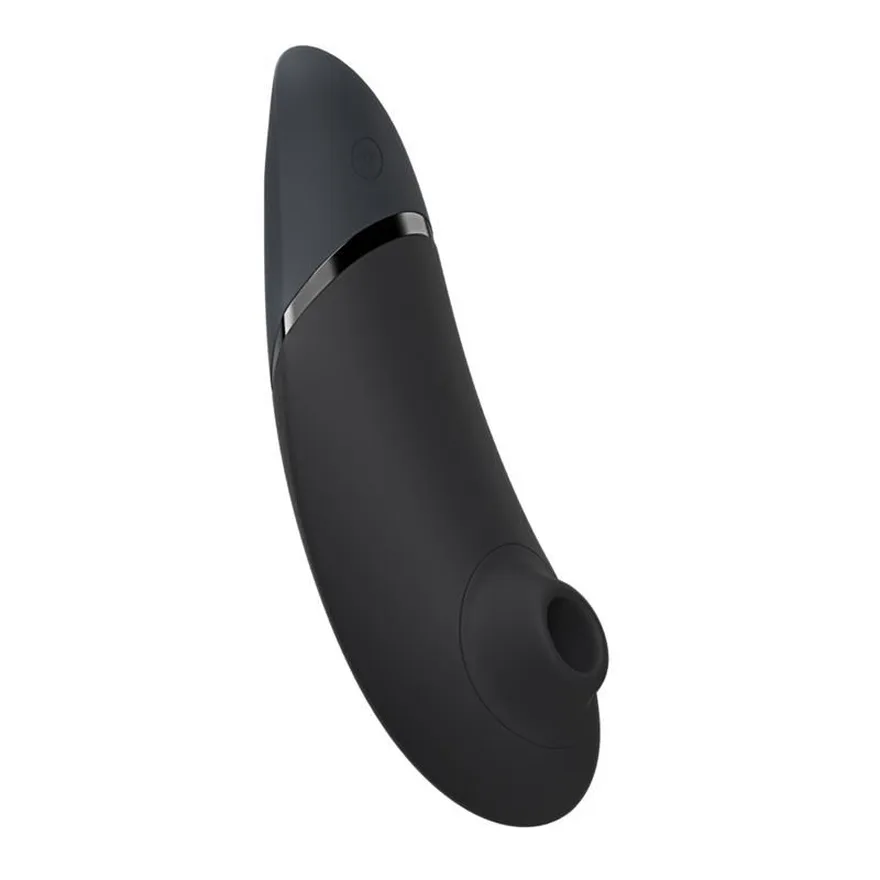
Review: Womanizer Next
Fourteen intensity levels and three depth levels in air pressure technology.
29 July 2026
 Author's pick
Review · Rabbit vibrator · Thrusts, rotation, and heat
Svakom’s two-piece rabbit vibrator reviewed against the manufacturer’s own specifications, the manual SL278U, and pricing data from nine Swedish stores. Five functions in one product that can be split into two, with published battery capacity, published sound level, and IPX7 — but with one hour of runtime versus 2.5 hours of charging, and a 57 percent price difference between the cheapest and the most expensive store.
The most feature-dense product in the comparison and the cheapest: thrusts, rotation, vibration, pulsing, and heat, in two parts that can be used separately, where one is a remote control for the other. Svakom also publishes more data than both We-Vibe and Lelo do for their equivalents. What you pay with is endurance — one hour of runtime versus 2.5 hours of charging is the category’s weakest ratio — as well as a lack of a phthalate and latex declaration, and a product page with leftover text about a completely different model.
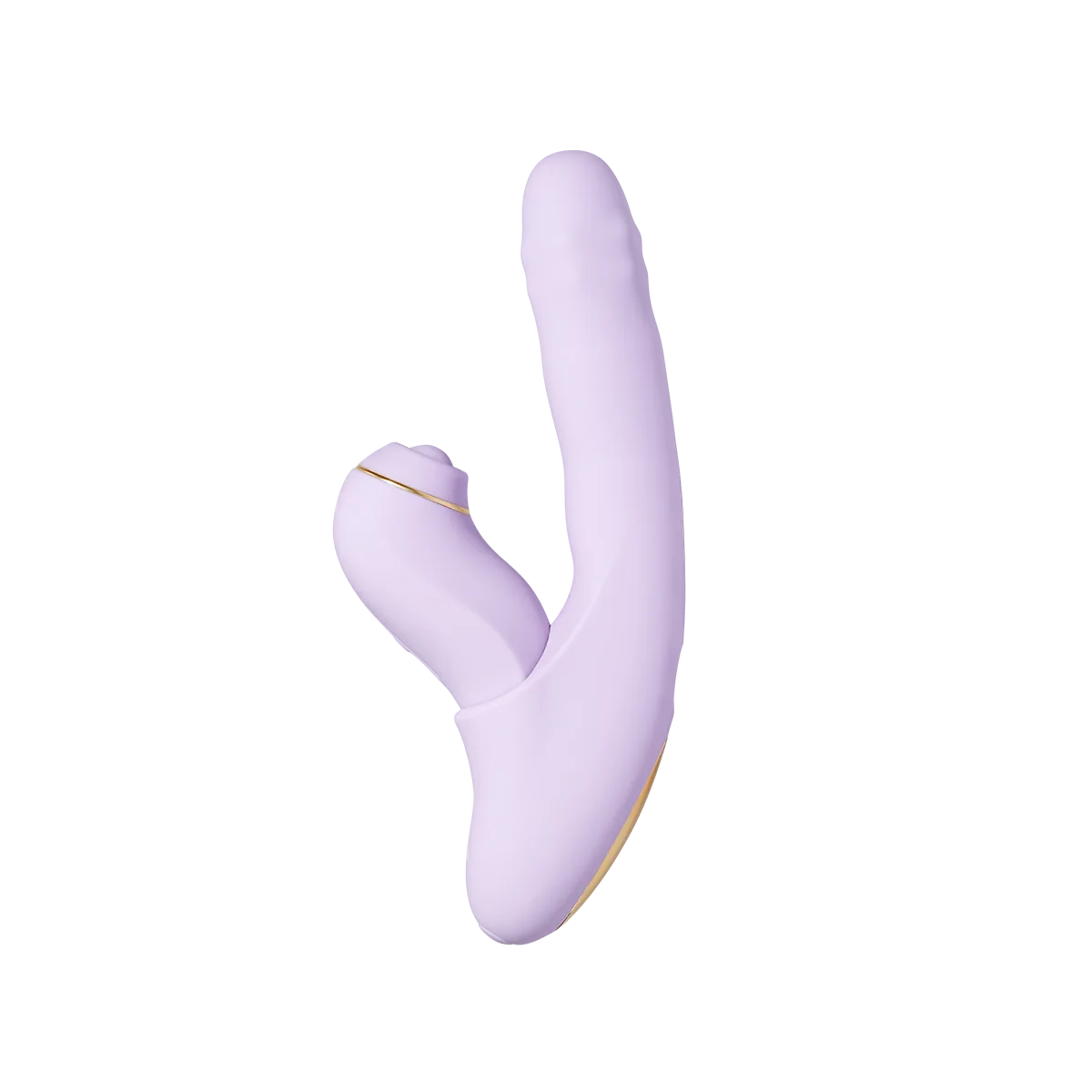
Svakom DuoGlow is not one product but two, and that’s the whole point of the design. The manufacturer describes it as a thrusting vibrator with a pearl ring combined with a detachable pulsing stimulator, and the two parts click together into a unit that looks like a classic rabbit vibrator. If you separate them, you instead have an insertion part and a separate clitoral stimulator that also works as a wireless remote control for the first one.
The specification looks like this. The vibrating part measures 59 × 196 millimeters and weighs 180 grams; the stimulator measures 44 × 95 millimeters and weighs 68 grams, and together they weigh 248 grams. The insertion measurement is given separately as 32 × 115 millimeters. The material is liquid silicone in the vibrator, silicone in the stimulator, and ABS plastic. The enclosure rating is IPX7. The vibrator has seven impact modes and seven vibration modes in three intensity levels; the stimulator has seven pulsing modes, and both parts can be heated. The batteries are lithium polymer with 800 and 280 milliampere-hours, respectively; the charging time is 2.5 hours per part, and the operating time is stated as one hour per part.
This review applies to the item with EAN 6959633105856, which is the manufacturer’s own barcode for the product code SL278U. In Sweden, it is sold by nine stores at prices between 761 and 1,195 SEK, and all nine had it in stock at the price check. Svakom lists only one variant of DuoGlow on its own website, without a color name— the designation Pastel Lilac comes from the Swedish stores, not from the manufacturer, and some other colors are therefore not available to mix it up with.
Svakom markets DuoGlow as a product with five functions. It’s a marketing phrase, but this time it can be broken down into specific, published figures, which is unusual enough to deserve a review. The five movements are impacts, rotation, vibration, pulsing, and heating, and the manufacturer provides a frequency for each of the first four.
What can be established is that the first four movements are independent of one another and therefore multiply. Seven vibration modes times three intensity levels gives 21 vibration settings, and when combined with seven impact modes, that results in 147 combinations for just the vibrator part. If you add the stimulator’s seven pulsing modes, the number grows further. That’s why the manufacturer writes "thousands of combinations". It’s mathematically correct, but it also says very little: the person who actually uses the product will end up returning to a handful of settings, just like with all the other products in the category.
What really sets it apart is that the stimulator comes loose. Compared with We-Vibe Nova 2 and Lelo Ina 3, which are both unified rabbit vibrators where the clitoral arm is fixed in place, there’s a fundamental difference in what you actually own. With DuoGlow, you have two rechargeable products that can be used separately, and one of them is also the remote control for the other. According to the manufacturer’s product image, the distance between the parts is stated as up to 10 meters.
The naming around this article is messy in Swedish shops, and since the price differs by 57 percent between the cheapest and the most expensive, it’s worth knowing exactly what you’re comparing. The manufacturer calls the product DuoGlow only, with the subtitle Thrusting Beaded Vibrator with Pulsating Stimulator. The product code is SL278U, and it’s listed in the manual.
Instead, Swedish shops write variants of Svakom Rabbit DuoGlow Pastel Lilac, Svakom DuoGlow 2-in-1 Vibrator, Svakom Duo Glow Thrusting Beaded Vibrator with App, and Svakom DuoGlow App Controlled Vibrator, sometimes with the color specification “lila” or “purple.” However, all nine stores in the table above list the same article. Three of them — Blush Me, SexleksakerOutlet, and Vuxen — use EAN 6959633105856 directly as the item number, and for Lekosmek and Taboo the same EAN appears in the store’s own product feed. The remaining four use internal item numbers but point to the same product. So it’s not different variants that explain the price difference — it’s the stores’ own pricing.
By the way, the word rabbit is a category label, not a model name. It refers to the basic form where an insert piece and an outer arm sit together at an angle, and that description matches the DuoGlow when the two parts are assembled. So if you use the keyword in a store, you’ll get hits for hundreds of products that don’t have much in common with this one.
Material is the only characteristic of an intimate product that neither experience nor care can make up for, and it determines whether the product is still hygienic a few years from now. Svakom lists three materials for DuoGlow: liquid silicone in the vibrator, silicone in the stimulator, and ABS plastic. Having ABS listed means there’s hard plastic somewhere in the construction — reasonably in the buttons, in the housing of the charging connectors, and in the mechanism that drives the thrusting movement and the bead ring — but the manufacturer doesn’t specify where.
Silicone is a non-porous material. A non-porous surface can be cleaned properly, because there are no microscopic cavities where residue can remain. It’s the single most important property of a material that’s meant to be in contact with mucous membranes, and that’s why the material declaration carries more weight than almost any other line in a specification.
The designation “liquid silicone” — liquid silicone in the manufacturer’s English text — refers to the manufacturing method rather than to another type of silicone. The material is injected into the mold in a liquid state and cures there, which results in fewer seams and a smoother surface than traditional injection molding. What can be established from the specification is that Svakom differentiates between the material in the two parts: the vibrator is described as liquid silicone, while the stimulator is described as silicone without any further description. What that difference consists of, the manufacturer does not publish.
The design with a rotating pearl ring deserves a note here. A surface that rotates against another surface is, by definition, a seam, and seams are the places where residue collects. The manufacturer states IPX7 and provides instructions to wash with lukewarm water and mild soap, which means the entire product can be rinsed — but a rotating ring requires more care when cleaning than a smooth shaft does, and that is a consequence of the function rather than a flaw in the workmanship.
Phthalates are a group of plasticizers used to make plastic — above all soft PVC — flexible. The Swedish Chemicals Agency describes them as substances that can affect the endocrine system and make reproduction more difficult, and several of them are therefore restricted or prohibited within the EU. This product category is therefore a recurring subject of supervision, because it contains soft plastic against the skin and mucous membranes.
Here there is a real gap in Svakom’s documentation. The manufacturer does not publish an explicit phthalate, BPA, or latex declaration for DuoGlow. The product text says “body-safe silicone,” i.e. body-friendly silicone, and the manual warns against lubricants that damage the material — but at some point, that’s where it ends. This is a clear difference from We-Vibe, which for Nova 2 states that the silicone is made without phthalates, BPA, and latex.
How serious is it? Silicone does not require phthalate plasticizers to become soft — the softness comes from the polymer’s own structure — so the material description “silicone” is, by itself, a better sign than labels such as TPE or jelly rubber, which do not say anything about which plasticizers are included. But the absence of an explicit declaration is still an absence, and the person who specifically needs to know that the product is latex-free does not get that answer from the manufacturer.
Svakom publishes the measurements in more detail than most in the category, and that makes them useful. The vibrating part is listed as 59 × 196 millimeters, the stimulator as 44 × 95 millimeters, and the insertion measurement separately as 32 × 115 millimeters. The manufacturer’s own size chart in the product gallery shows the same four numbers printed on the product.
Reporting the insertion depth separately is worth more than it sounds. The total length of 196 millimeters says almost nothing about how the product feels, because the grip, the motor, and the clitoral arm take up a large part of it. The relevant figures are 115 millimeters in depth and 32 millimeters in diameter. For comparison, Lelo states a total length of 200 millimeters for the Ina 3, an insertion part of 110 millimeters, and a diameter of 37,09 millimeters—so a product that is four millimeters longer overall, five millimeters shorter in the insertion part, and just over five millimeters thicker.
Weight is distributed as 180 grams on the vibrator and 68 grams on the stimulator, for a total of 248 grams. DuoGlow is therefore heavier than Lelo Ina 3, which is listed as weighing 150 grams. The difference is reasonable based on the construction: a striking mechanism and a rotating pearl ring require more mechanics and a larger battery than a product that only vibrates. Divided into two, however, each part is lighter than a whole Ina 3, which is a practical advantage for someone who wants to use the stimulator alone. We-Vibe, for its part, does not publish any weight for the Nova 2, and that makes a comparison on that point impossible.
One last dimension that matters is how the parts are assembled. The manual describes the procedure exactly: the marking line on part B should be directed toward the pocket on part A, and part B is pushed into the attachment until the line meets the edge of part A. It is therefore a mechanical attachment with a fixed position, not a magnetic one that you can be careless with.
The interface on the Svakom DuoGlow is split between the two parts, and it is that detail that requires the most from the reader before buying. Each part has its own S button. The vibrator also has a button for the striking function, and the stimulator has a button for heat. The manual lists exactly what each press does, which is unusually detailed for the category and means the interface can be assessed before you have the product in front of you.
The manufacturer calls the vibrator part A and the stimulator part B. According to the manual, you start and shut off each part by holding in its S button. When a part is started, it automatically goes into standby mode and searches for the SVAKOM app—a short press on the S button switches to manual control. It’s worth knowing, because a product that doesn’t respond to button presses when it’s started is often interpreted as broken when, in fact, it is looking for Bluetooth.
The intensity is adjusted in two different ways depending on which button you use. A short press on part A’s S button changes the intensity only on part A. A short press on part B’s S button changes the intensity on båda parts. It’s a well-thought-out division: the removable part is the one you hold or that your partner has, and therefore it’s the one that controls the whole.
A limitation is written out in black and white by the manufacturer, and it should be read before purchase: part A cannot be paused on its own — it can only be turned off. If you want to pause the stimulation function, you press the shock button twice on part B, and a single press starts it again. If the stimulator is discharged, misplaced, or not paired, then there is thus no pause function at all. This is the clearest practical consequence of the remote control being a part of the product rather than an accessory.
Heating is the fifth function, and the manufacturer’s own product image indicates the target temperature as 38 degrees. It sits just above normal body temperature, which is the whole point — the intention is that the product should not feel cold at first contact.
The manual describes two ways to use the function. With part A switched on, you heat only it by pressing the S button three times at the bottom, and the LED flashes while heating is in progress. With part B switched on and paired with part A, it’s enough to press the heat button on part B to heat both parts, and pressing once more turns the heat off.
And then the limitation, which the manufacturer marks as important: the heat on part A cannot be turned off separately as long as part A is switched on. To completely stop the heating, you have to switch off part A. So if you started the heating via the triple-press and then change your mind, there is thus no way back without turning off the product. It’s a real design limitation and not a user-handling mistake, and it’s also a reason to control the heat from part B when both parts are in use.
The manufacturer does not publish how long the heating takes, how much it costs in runtime, or whether the heat is regulated or just switched on and off. Since the runtime is already short — more about that below — it’s a task that would have been valuable to have.
DuoGlow is app-controlled, and Svakom describes the app’s functions in detail on its own page. There you get real-time remote control over any distance, custom patterns built from preset modes, control via music or ambient sound, a draw mode where you drag your finger, a group mode where multiple people can share control, and built-in chat, voice calls, and video calls. The app is available for iOS and Android and can be downloaded for free.
Two practical prerequisites belong to the picture. One is that the control is based on Bluetooth: the manual states the radio frequency as 2400.0–2483.5 megahertz and a transmitter power of at most +6 dBm, which is the frequency band and power class that Bluetooth products normally use. The other is that Svakom themselves state that the connection normally breaks after 30 minutes of inactivity, and that incoming phone calls interrupt the connection.
A line of reasoning worth considering in your purchasing decision: an app-controlled product depends on the manufacturer continuing to maintain the app. This applies to all app-controlled products in the category, and it’s not something specific to Svakom—but it is a real difference compared with a model like Lelo Ina 3, which is controlled only with four buttons on the product and therefore works exactly the same way ten years from now. DuoGlow can be used completely without an app—the button controls are fully comprehensive—but then you’re paying for a feature you’re not using.
Two inconsistencies in Svakom’s own materials should be mentioned, because they’re easy to trip over if you read the product page carefully before buying.
The first one concerns the number of modes. The specification table, the manual, and the English product description consistently state seven vibration modes and three intensity levels. But in the section with the heading FEATURES further down on the product page, it instead says "5 modes and 5 intensities"—and in that same section, the product is also referred to as Cici 2 in six of the text blocks. This is leftover template text from another Svakom model, not a description of DuoGlow. The details about the USB-C port and the dust cover in the same section also do not apply to this product, which is charged magnetically. Stick to the specification table and the manual.
The second concerns water resistance and is shown in its own section below: the product page states IPX7, while the manual’s specification box only says "Waterproof" without any classification.
There’s also a third thing that causes more confusion than it explains. The manual’s general safety text includes the line "For external use only", meaning only for external use—at the same time as the same manual, two pages earlier, states a plug-in size of 32 × 115 millimeters for a product that is marketed for G-spot stimulation. It’s clearly standard text that has been included in the template for the brand’s manuals as a whole. It’s worth recognizing it as just that, but it also illustrates how little care is sometimes put into the safety sections in the category.
Svakom stands out positively compared with several competitors here. While most manufacturers stick to the word "whisper-quiet," Svakom publishes actual figures in the manual: the sound level is specified as at most 60 decibels for the vibrator and at most 55 decibels for the stimulator. These are ceiling values, not measured typical values, and the manufacturer does not state either the measurement distance or the measurement method—yet a published ceiling is still more than nothing at all.
What do the numbers mean? Sixty decibels is roughly equivalent to a normal conversation, and 55 decibels is somewhat below that. So it’s not a silent product in the sense that it would be inaudible in a quiet room, and that’s to be expected: a vibrating mechanism and a rotating pearl ring move more mass than a pure vibration motor does, and mechanical movement can be heard. What can be concluded is that the detachable stimulator is quieter of the two parts, with five decibels lower limit.
Unfortunately, the comparison with the competitors plays into their favor. Neither We-Vibe nor Lelo publishes any decibel value for Nova 2 or Ina 3 respectively, which paradoxically makes Svakom’s openness look worse than the quietness of others. A figure without a comparison tells you little. A practical piece of advice that applies regardless of model: place the product on a soft surface between uses, because a hard tabletop works as a resonating box and noticeably amplifies the sound.
Svakom states IPX7 for the DuoGlow on the product side and repeats the rating in the product gallery image about bath and shower, where the product is described as one hundred percent waterproof. The manual’s specification box, on the other hand, only writes “Waterproof Level: Waterproof” without any rating. It’s the product side and the product image that state IPX7 — the manual does not specify, and anyone who wants to be cautious should note that the most formal of the manufacturer’s own statements is also the one that says the least.
The rating comes from the international standard IEC 60529, which defines enclosure classes for electrical equipment. The number 7 in the second position means that the product is tested for submersion in water to a depth of one meter for 30 minutes. The letter X in the first position means that protection against solid objects and dust has not been classified — not that it is missing.
The difference compared to a splash-resistant product is greater than the wording suggests. Splash protection covers water droplets and, at best, water jets, but not submersion. With IPX7, the entire product can be rinsed off without being careful, and for this particular model that’s a genuine advantage: a rotating pearl ring and a mechanical attachment between two parts are exactly the kind of details that need running water rather than a damp cloth.
An exception is written out by the manufacturer in the manual, and it’s important: the product must not be used, cleaned, or submerged in liquid while it’s charging. The charging contacts are magnetic and exposed, and IPX7 applies to the product — not to the product with a cable connected.
The manual instructs cleaning before and after each use with lukewarm water and mild soap or a cleaning agent intended for intimate products. Cleaning agents that contain alcohol, gasoline, or acetone are expressly forbidden. Pay extra attention to the pearl ring and the attachment between the parts—those are the areas where residue remains. According to the manufacturer, storage must be in a safe, clean, dry, cool, and dark place, away from materials that may damage the silicone.
The question of lubricant is the one where a wrong habit costs the most. The manufacturer’s warning is unusually clear: do not use massage oil or hand cream as a lubricant, as it can lead to irritation or infection, and do not use silicone-based lubricant, oils, or lotions because they damage the product. The reasoning that Svakom themselves state is worth quoting in full—breakdown of the material creates a breeding ground for bacteria, which in turn can cause irritation and infection during use on the body. Water-based lubricant is therefore not a recommendation but a prerequisite, and the manufacturer’s own product image repeats the same message.
The manual also specifies a recommended temperature range of −10 to 50 degrees Celsius for the product. Boiling water and the dishwasher are therefore ruled out despite IPX7, just as with the other products in the category.
Svakom publishes more battery data than most competitors, and the manufacturer deserves credit for that. The battery type is lithium polymer. The capacity is stated as 800 milliampere-hours in the vibrator and 280 milliampere-hours in the stimulator. The rated voltage is 3.7 volts, and the charging voltage is 5 volts, and the manual specifies the input current as 0.9 ampere for the vibrator and 0.4 ampere for the stimulator.
Charging is done with a double-ended magnetic cable included in the package and connected to a USB-A port. The manual is clear about one point that’s easy to miss: both parts must be charged separately. The cable has two ends for that reason, because part A and part B have separate batteries and separate charging contacts, and the manufacturer states that both parts need a full charge in order to be used together. The magnets should snap firmly onto the respective contact surface.
Magnetic charging is a trade-off rather than a pure advantage. The advantage is that no opening in the casing is needed, which significantly simplifies watertightness in a product that already has moving parts. The disadvantage is that the cable is product-specific: if you lose it, no ordinary USB cable works, and Svakom’s warranty terms also expressly exclude accessories such as charging cables. A broken or lost cable is therefore always your own cost. Here, Lelo Ina 3 has a practical advantage with its regular USB cable.
If you only take one number from this review, make it this one. The manufacturer lists the runtime as one hour per part, and the charging time as 2.5 hours per part. So the product charges for two and a half times longer than it runs.
That ratio is striking in the category. Lelo lists 2 hours of runtime and 2 hours of charging for the Ina 3—one to one. We-Vibe lists up to 120 minutes of runtime and up to 90 minutes of charging for the Nova 2, so 0.75 to one. DuoGlow sits at 2.5 to one, which is the worst ratio of the three by a wide margin.
What makes the number especially interesting is that it doesn’t depend on a small battery. If you convert the published values, you get that the vibrator’s cell holds 800 milliampere-hours at 3.7 volts—so about 2.96 watt-hours—and that energy lasts for one hour, i.e. an average draw of around 3 watts. Lelo’s Ina 3 has 500 milliampere-hours at 3.7 volts, i.e. about 1.85 watt-hours, split over two hours—about 0.93 watt. So DuoGlow has a battery that’s 60 percent larger, but it draws about three times as much power.
The explanation lies in what the product actually does. A pure vibration motor spins a small unbalanced weight. DuoGlow is designed to simultaneously drive a thrust motion of 85 strokes per minute, rotate a bead ring at 270 rotations per minute, vibrate, and, where applicable, heat a band to 38 degrees. Each of these functions is its own power draw, and the total adds up to one hour. So it’s not a weakness of the battery—it’s the price of the five functions—but it’s a price you pay every time you use the product, and that’s something you should factor in before buying.
Practically, that means three things. Charge both parts on time, because one doesn’t help the other. Expect the heating function to cost additional runtime, even if the manufacturer doesn’t publish how much. And treat the stated hour as a ceiling rather than a floor, because runtime in this category is consistently given for use that doesn’t take advantage of all functions at the same time. And the fact that the battery isn’t replaceable follows the category norm—once the cell is used up, the product is basically used up too, and the manufacturer states that the product should be charged regularly for the best battery life.
We do not have price data from shops in your market yet.
One hour of runtime versus 2.5 hours of charging time. It’s not a weak battery — it’s the price for five functions that all draw power at the same time.
Two comparisons are the most relevant: versus the other app-controlled rabbit vibrator in this price range, and versus the button-controlled premium reference. All information below comes from each manufacturer’s own specifications, and all prices come from the stores’ product feeds on July 29, 2026.
We-Vibe Nova 2 costs from 1 334 SEK. Svakom DuoGlow costs from 761 SEK, meaning 573 SEK less. Both are app-controlled rabbit vibrators in silicone with an IPX7 enclosure rating and two years of manufacturer’s warranty, so on paper they are direct competitors.
The differences that actually matter go both ways. Nova 2 measures 217 × 85 × 39 millimeters and is therefore longer but roomier than DuoGlow’s 59 × 196 millimeters. We-Vibe states the runtime at up to 120 minutes and the charging time at up to 90 minutes, which is double the runtime and a third shorter charging time than DuoGlow’s—one hour and 2.5 hours, respectively. Nova 2 is also charged via standard USB, compatible with any USB port or power adapter, while DuoGlow requires its own magnetic dual cable. And We-Vibe explicitly states that the silicone is made without phthalates, BPA, and latex—that declaration Svakom lacks.
On the other hand: DuoGlow has thrust movement, a rotating bead ring, and a heating function, none of which Nova 2 has. DuoGlow can be split into two functioning products, which Nova 2 cannot do. DuoGlow publishes battery capacity, voltage, and sound level, which We-Vibe does not—neither weight nor milliampere-hours are included in Nova 2’s specifications. If you choose based on endurance and material declarations, Nova 2 wins. If you choose based on the number of functions per krona and on how much the manufacturer dares to publish, DuoGlow wins—and it does so with a 573 SEK margin.
Lelo Ina 3 costs from 1 259 SEK, meaning 498 SEK more than DuoGlow. It’s the button-controlled counterpart: ten settings, four buttons, and no app at all.
The dimensions are close to each other. Ina 3 is 200 × 65 × 45 millimeters with a plug-in part of 110 millimeters and a diameter of 37.09 millimeters, compared with DuoGlow’s total 196 millimeters and 32 × 115 millimeters for the plug-in dimensions. Ina 3 weighs 150 grams versus DuoGlow’s 248 grams assembled. The material is listed as body-friendly silicone and ABS plastic, meaning the same material family as on DuoGlow. Lelo lists the product as 100 percent waterproof without stating an IPX rating, which is the opposite of Svakom’s situation, where the rating is given on the product page but not in the manual.
The battery is where they differ the most. Ina 3 has 500 milliampere-hours at 3.7 volts and is stated to run for up to two hours with a charging time of two hours at 5.0 volts and 500 milliampere. It also has automatic shut-off after 20 minutes of inactivity, a feature DuoGlow is not stated to have. The warranty is two years plus ten years of quality warranty, which in wording resembles Svakom’s setup.
The conclusion is simple. If you want a product that does one thing well, lasts twice as long, and works exactly the same even after ten years because it isn’t dependent on an app, then Ina 3 is worth the extra 498 SEK. If you want jolts, rotation, heat, app control, and two parts that can be used separately, then there’s nothing in Ina 3’s specifications that matches that, for any price.
Within Svakom’s own lineup, DuoGlow is one of the more complex products, and it’s worth knowing about this when comparing within the brand. Simpler Svakom models are typically single-function products with one button and a single motor. DuoGlow has two separate products, each with its own battery, its own set of buttons, and four movement types plus heat.
It has two consequences that are easy to overlook. The first is that you have two things to charge instead of one, with the double-ended cable as the only tool. The second is that some of the functions are only available when both parts are charged and connected—pause function is the clearest example, because it’s only accessed via the stimulator’s jolt button. A simpler model doesn’t have those dependencies. Anyone who wants the least possible maintenance and the greatest possible predictability gets more of that further down in the lineup, for a lower price.
Nine Swedish stores sell the item with EAN 6959633105856. Cheapest is Joyland at 761 SEK, and most expensive is Intima at 1,195 SEK. It’s a 434 SEK—or 57 percent—difference for the exact same item, same color, and same packaging.
The stock situation is unusually good here, making the price comparison more worthwhile than usual: samtliga nio butiker hade produkten i lager vid priskontrollen. That means the lowest price is actually a price you can buy at, unlike the situation where the cheapest store lists a sold-out item with the old price still left in the feed.
The distribution is also interesting. Five of the nine stores—Vuxen, Blush Me, SexleksakerOutlet, Lekosmek, and Taboo—are at exactly 895 SEK, which appears to be the distributor’s recommended price. Joyland is 134 SEK below that level, and Mshop, Lustly, and Intima are 94, 204, and 300 SEK above it, respectively. In other words: there’s a clear regular price, a clear low price, and three stores that charge significantly more for the same thing.
The prices in the table above are updated when the stores’ product feeds are updated, but always check the final price at checkout. Shipping costs are added at most stores under a certain order value, and in this price range several stores are right around the threshold for free shipping—which can eat up some of the 134 SEK between the cheapest and the next-cheapest store.
It fits you if you want several different types of stimulation from one and the same product, and if you specifically want mechanical movement—thrusts and rotation—and not just vibration. It fits you if you want to be able to split the product into two and use the smaller part on its own, or hand it over to someone else as a remote control. It fits you if you want app control with music sync, your own patterns, and control at a distance. And it fits you if you want to be able to read actual figures in a specification before you pay: capacity, voltage, sound level, insertion dimensions, and movement frequencies are all published—which is more than both We-Vibe and Lelo do for their corresponding models.
It doesn’t fit you if you prioritize endurance. One hour of runtime per part and 2.5 hours of charging time is the category’s weakest ratio among the compared products, and it’s not a minor detail but a characteristic you notice every time. It doesn’t fit you if you want an explicit phthalate-, BPA-, and latex declaration, because Svakom doesn’t publish any for this model. It doesn’t fit you if you want an interface with one button—DuoGlow has four buttons split across two parts, and a pause function that only exists on one of them. And it doesn’t fit you if you want to charge with the same cable as your phone, because the magnetic dual cable is product-specific and excluded from the warranty.
One last thing belongs in your decision. DuoGlow is a product that rewards the person who actually reads the manual. That part A can’t be paused on its own, that the heat on part A can’t be turned off separately, that both parts must be charged separately, and that the product searches for the app before it responds to the buttons are four behaviors that are all included in the manufacturer’s documentation—and all of them would feel like mistakes if you didn’t know about them. If you know about them, it’s a well-described product. If you don’t know about them, it’s a product that seems to be a hassle.
Svakom provides a two-year replacement warranty on its electronic products, counted from the date of purchase, and the warranty covers manufacturing defects. To make a claim, you need to log in to a Svakom account, the product’s serial number—which, according to the manufacturer, is printed on the packaging above the barcode—and proof of purchase in the form of an invoice or receipt.
The ten-year section should be read carefully, because it’s often repeated in store texts as if it were a warranty. Svakom’s ten-year quality support, according to the manufacturer itself, means that you get 50 percent off your next purchase in their own web shop if the product breaks or deteriorates after the two-year period. So it’s a discount coupon, not an extended warranty, and it can only be used with the manufacturer.
The exceptions are extensive and worth knowing before you count on the warranty. It does not cover damage caused by mishandling or negligence, damage caused by lubricants that are not water-based, improper cleaning, attempts to take the product apart, or accessories such as charging cables. It also does not apply when purchasing from unauthorized sellers on marketplaces. For this particular product, this means that the part most likely to fail first—the magnetic twin cable—is outside the warranty.
What always applies, on the other hand, are your statutory rights, and they are stronger than the manufacturer’s promises. Under the Consumer Sales Act (konsumentköplagen), you have a right to make a claim for defects in the goods for three years, regardless of what Svakom promises. For distance purchases, you also have a right of withdrawal for fourteen days under the Act on Distance Contracts and Contracts Outside Business Premises (distansavtalslagen och avtal utanför affärslokaler). Be aware that in practice the right of withdrawal is limited for hygiene products that have been taken out of a sealed package—however, the right to make a claim for defects always applies. If you have questions about what applies in your case, Konsumentverket guides you via Hallå konsument.
Svakom DuoGlow is ranked på plats 10 av 21 in rabbit vibrator best i test, where the entire category is compared against each other using five shared criteria. Guiden vinns av We-Vibe Nova 2.
Every numerical piece of information in the text can be traced to one of the sources below. The links were checked manually on the specified date.
This page is machine-translated from Swedish. Read the Swedish original