

Review
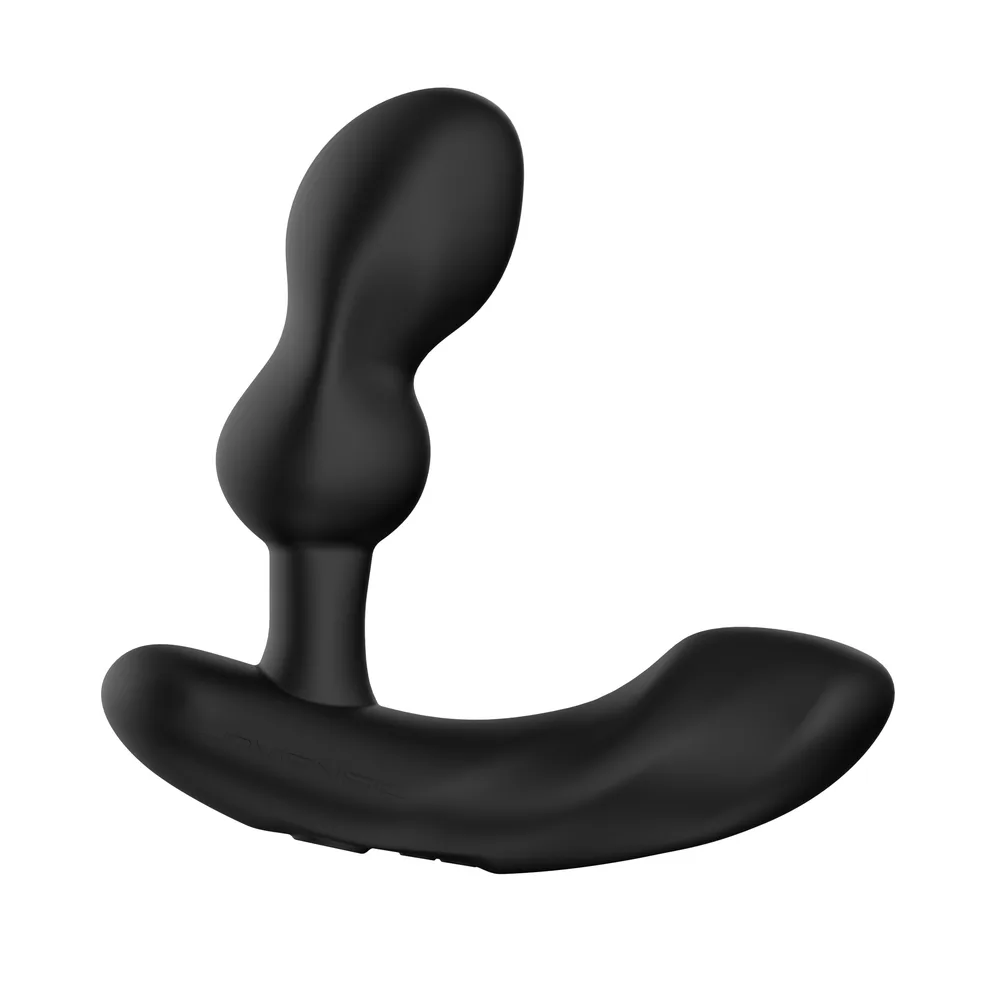
Review: Lovense Edge 2 Prostate Massager
App-controlled prostate massager with IPX7, 130 minutes of run time, and published sound level.
29 July 2026
Review · Prostate massagers · Penis ring · Shock function
NS Novelties’ three-part Renegade product reviewed against the manufacturer’s own specifications and price data from seven Swedish stores. Penis ring, shocking prostate shaft, and perineum vibration in the same silicone body, six speeds, eight functions, and a wireless remote control — at a price where there is a 43 percent difference between the lowest and the highest-priced store, and with a datasheet that lacks both an IP rating and an insertion depth.
Unusually high functionality for the money: penis ring, thrusting prostate rod, and perineum vibration in the same product, with a wireless remote control and no app to install. What you pay for is the documentation. NS Novelties does not publish any IP rating, insertion dimensions, sound level, or battery capacity; the stores list different enclosure classes for the same item, the runtime is 50 minutes versus Lovense Edge 2's 130, and the manufacturer warranty of one year requires that a defective item be sent to the USA at your own expense.
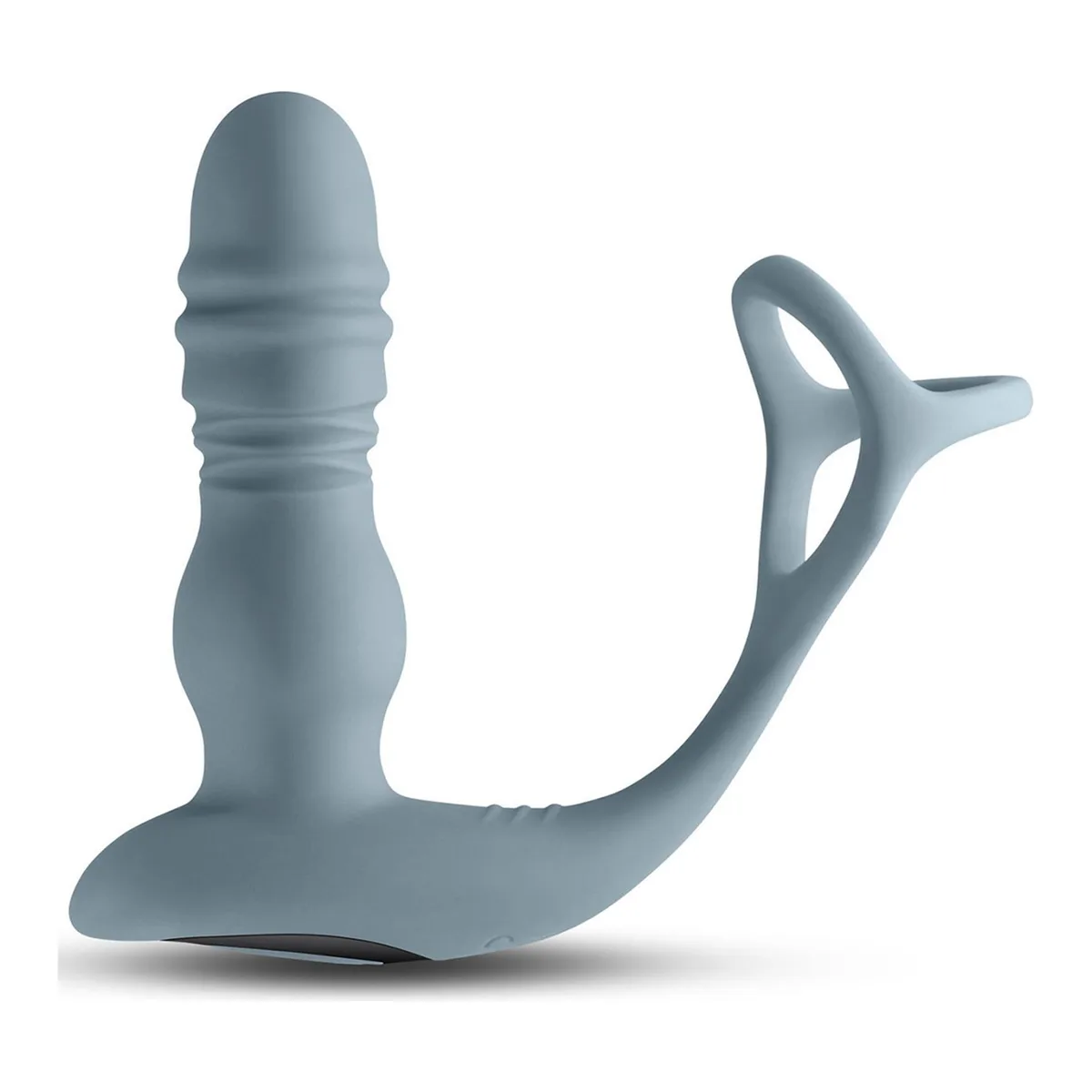
NS Novelties Renegade The Handyman is not a prostate massager product in the usual sense. The manufacturer describes it as a combination of a penis ring and a massager, with point-targeted jolts against the prostate and deep vibrations against the perineum. So it’s three things in the same silicone body: an insertion part that moves, a vibrating pad that sits against the perineum, and a ring that goes around the penis and scrotum. A wireless remote control is included.
The specification that NS Novelties themselves publish is short. The model number is NSN-1101-69, the material is listed as silicone, the product is rechargeable, it has six speeds and eight functions, and it measures 103 × 54 × 145 millimeters. The remote measures 28 × 39 × 80 millimeters. The weight is listed as 336 grams. On the front of the package, the material is listed as Silicone/ABS. In Sweden, the item is sold by seven stores at prices between 695 and 995 SEK, and six of them have it in stock.
This review is exclusively about the gray variant with EAN 657447108365. The number is verified against the manufacturer’s own product page, where the article number NSN-1101-69 is linked to gtin 657447108365. It’s worth checking, because NS Novelties sells several Renegade products that are marketed almost identically at the same price level— for example, the sister model Apex has EAN 657447108372 and a completely different anatomy.
What deserves to be said clearly right away is that the manufacturer’s data sheet is meager. NS Novelties does not publish any IP rating, operating time, charging time, battery capacity, sound level, or insertion dimensions for this product. Those figures exist only in the retail channel, and as you’ll see further down, the stores don’t agree with each other. That affects the rating, and it should affect expectations.
The construction is easiest to understand if you break it down into three parts and look at what each part does.
What can be established is that this three-part design is unusual in this price range. A pure prostate massager like the Lovense Edge 2 does one thing—it stays inside and vibrates. A pure penis ring does another. The Handyman tries to do both at the same time, plus a thrusting motion that most prostate products under a thousand SEK don’t have at all. That’s also the explanation for why the product weighs more and takes up more space than a standard plug.
The downside of the other side of the same coin is that a product intended to fit three body parts at the same time places higher demands on how well your own anatomy matches. The distance between the ring and the insertion part is fixed. The angle between the base plate and the shaft is fixed. There is no adjustment anywhere in the design, unlike for example We-Vibe Vector+, where the manufacturer explicitly states that the insertion part is bendable so it can be adapted to the body. This is the single most important risk with the purchase, and it isn’t visible in any datasheet.
NS Novelties sells two closely related products in the Renegade series that often have the same price in Swedish stores and are described with almost word-for-word the same marketing text. The difference is anatomical, not technical.
Since the price is identical, the choice is purely a matter of which of the two stimulations you want. If you want a ring that sits around the penis and a plate that vibrates against the perineum, you should choose Handyman. If you want a narrower product with testicle stimulation, you should choose Apex. Store descriptions rarely make the difference clear, and both appear in the search for "Renegade prostata" in virtually every Swedish store.
The material is the only attribute of an intimate product that can’t be compensated for with experience or care, and for an anal product it weighs even more heavily than for an external product. The mucous membrane in the rectum is thinner and more permeable than normal skin, and a product intended for that therefore needs both a non-porous material and a shape that prevents it from going any farther in than intended.
NS Novelties states the material as silicone on the product page, and on the front of the packaging it provides the more detailed information Silicone/ABS. It’s the same construction principle as in almost all products in this price range: silicone in everything that touches the body, hard ABS plastic in the inner chassis and in the housing around the electronics. The retail chain is consistent on this point too — Taboo explicitly states "body-safe silicone and ABS" for the same barcode.
Silicone is a non-porous material, and that is the most important feature here. A non-porous surface can be cleaned, because there are no microscopic cavities where residue can be left behind. That is why the material specification carries more weight than almost any other line in a specification, and why terms such as TPE or "jelly rubber" should be read as a warning rather than as a product feature.
Having ABS included in the construction is not a problem in itself — it is a hard, dense plastic that does not absorb liquid. What is worth knowing, however, is that the transition between silicone and plastic is always a seam, and seams are where dirt gathers. On The Handyman, such a transition is clearly visible on the underside of the base plate, where the control panel and the charging port are located. That is the surface that should be wiped most carefully.
Phthalates are a group of plasticizers used to make plastic — especially soft PVC — flexible. The Chemical Inspectorate describes them as substances that can affect the hormone system and make reproduction more difficult, and several of them are therefore restricted or banned within the EU in a large number of products. This product category is a recurring subject of supervision, because it contains soft plastic that lies against the mucous membrane.
Here, an honest note belongs. NS Novelties does not disclose any assurance that The Handyman is free from phthalates, BPA, or latex. The manufacturer states the material — silicone, and Silicone/ABS on the packaging — but makes no declaration about absent substances, unlike, for example, Womanizer and Satisfyer, which both state it on their product pages.
It should be read for what it is, neither more nor less. Silicone does not require phthalate plasticizers to become soft — the softness comes from the polymer’s own structure — so the material specification itself is, in itself, a better indication than an unspecified plastic designation would have been. But the absence of an explicit declaration means that you have to rely on the material information alone, and someone who is latex-allergic gets no information at all from the manufacturer. That is a real difference compared with premium brands, and it costs points in the assessment.
The manufacturer lists the dimensions as 4.06 × 2.13 × 5.71 inches, which equals 103 × 54 × 145 millimeters. The longest of the three figures, 145 millimeters, is the product’s total length from the outer edge of the ring to the tip of the shaft. The remote control measures 28 × 39 × 80 millimeters, roughly like a large car key. The packaging measures 63 × 197 × 234 millimeters — a flat, fairly large cardboard box that can’t simply be tucked away in a drawer.
The weight information deserves a note, because here the sources diverge. The manufacturer’s specification states 336 grams. Taboo lists 240 grams for the same barcode. Which of the numbers refers to the product by itself and which refers to the entire delivery including packaging, remote control, and the charging cable is not made clear by any of the sources. The sister model Apex, as stated by the manufacturer, weighs 288 grams despite being 15 millimeters narrower, which suggests that the manufacturer’s figures are comparable with each other and that 336 grams is therefore most likely the manufacturer’s delivery weight. Treat both numbers as approximate until NS Novelties specifies what they measure.
The number that is actually missing is the most important one for an anal product. The manufacturer does not publish any insertable dimensions at all — the “Insertable Dimensions” field on the product page is blank. That means you can’t know in advance how far into the shaft it goes or how thick it is at its widest point. For the sake of comparison, Lovense publishes those figures for the Edge 2: insertion depth 91 millimeters and maximum diameter 35 millimeters. That an anal product is sold without these two figures being provided is a real shortcoming, and it’s the first thing you should measure yourself when the package is opened.
The shape itself, however, is well thought out in the point that matters most for safety. The wide base plate and the protruding ring mean the product can’t slide in completely, which is the basic requirement of anything inserted anally. In other words, the ring functions as a second safety stop in addition to the plate, and it’s one of the real strengths of the design.
The manufacturer describes the control using two numbers: six speeds and eight functions. They should be read as two separate scales. The speeds are intensity steps — how strongly the motor works. The functions are patterns — how the movement is distributed over time, meaning smooth operation, pulses, waves, and similar. The retailer states the same thing as “eight vibration modes and six speeds.”
Six times eight gives 48 combinations on paper, but that calculation is misleading in practice. Several of the patterns have a built-in rhythm that makes the intensity control less significant, and experience from the entire product category shows that, in practice, you end up returning to two or three settings. What matters is not the number of modes but whether there is a consistent low-intensity setting, because that’s what most people use the most.
The product has its own buttons on the underside of the base plate, visible as an oval panel in a metallic finish in the manufacturer’s images. Exactly how many buttons there are and what each one does are not shown in the manufacturer’s published materials, and there is no manual linked from the product page that provides additional information.
The wireless remote control is the function that most of all justifies the price tag. It has an oval shape, measures 28 × 39 × 80 millimeters, and according to the manufacturer’s own product images it has two buttons on a black panel: one marked with a plus and one marked with a pause-like dash, and one marked with a minus. At the top sits a small red indicator light.
The point of a remote control for this particular product type is concrete. When the product is in place, the buttons are on the underside of the base plate, i.e. between the body and the surface, and they are in practice inaccessible without moving the entire construction. A remote control solves that problem, and it also allows a partner to control it without anyone needing to change position. It’s the same logic that makes We-Vibe sell the Vector+ with both an app and a remote control.
However, there is a gap in the documentation worth knowing before you buy. The manufacturer does not state how the remote control is powered, what range it has, or which radio technology it uses. The specifications box on the product page lists "Battery Type: Rechargeable" and "Battery Quantity: 0", which means that no batteries are included in the package — but not whether the remote control shares a battery with the product or has its own. Information about the remote control’s power supply circulating in the trade is not supported by NS Novelties, and for that reason we don’t reproduce it. Plan to check this in the package.
The word thrust is printed on the packaging along with a bidirectional arrow along the insertion part, and that is the function that sets this product apart from a regular vibrating plug. A vibration is a quick, small movement transmitted through the material. An impact is a slower, longer movement where part of the product actually moves back and forth.
The difference is fundamental and not a difference in degree. A vibration motor sits still and shakes; an impact mechanism needs a motor that drives a shaft back and forth, which requires more space, more power, and a mechanical seal where the moving part exits through the housing. That explains three things at once: why the product is heavier than a regular plug, why the runtime is shorter than on a pure vibrator, and why the question of waterproofness is more sensitive here than on a product without moving external parts.
How far the rod moves — stroke length — the manufacturer does not publish. Nor how many impacts per minute the mechanism can handle at the highest setting. Those are two figures that would say more about the product’s character than "sex speeds" does, and their absence is typical for the price range.
The ring is the only part of the product that has a real medical limitation, and therefore it deserves its own section. RFSU describes the function plainly: a penis ring is intended to keep blood in the penis so that the erection doesn’t go limp. The same source gives the limit just as plainly—stopping the blood flow should be done for no more than 20 to 30 minutes, otherwise it can lead to tissue damage.
That’s the time limit that should govern how you use The Handyman, not the battery life. The fact that the product, according to the store’s information, can run for up to 50 minutes doesn’t mean it should be worn for 50 minutes. Half that time is the relevant limit as long as the ring is in place around the penis.
Two practical follow-up points. First: the ring’s circumference is fixed and cannot be adjusted, which means that a ring that feels tight already when you put it on is the wrong size for you—it doesn’t get better by staying on. Second: silicone rings should be removed by rolling them off, not by pulling. If it hurts, remove the ring immediately. That’s the only rule that applies, with no exceptions, throughout this entire text.
This is where the source image is at its worst, and therefore where it’s most important to be precise. NS Novelties publishes no IP rating at all for Renegade The Handyman. The specification box on the manufacturer’s product page contains no field for water resistance, and no manual is linked from there that would supplement the information.
In the store listings, however, there are two statements, and they contradict each other. Vuxen lists “IPX7 waterproof classification” on its product page and writes in the product text “Waterproof (IPX7 design).” Taboo states “Water-resistant IPx5: Yes” in its specification table for the same barcode. Two stores, the same item, two different enclosure classes. At least one of them is wrong, and neither of them is the manufacturer.
The ratings come from the international standard IEC 60529, which defines enclosure classes for electrical equipment. The number in the second position indicates protection against water, and the difference between the two levels in question is significant:
So in practice, the difference is about the bathtub. With IPX5, the product should be rinsed off but never dipped in. With IPX7, it doesn’t matter. Since the manufacturer doesn’t state either one, and the shops state different things, the only reasonable advice is: treat The Handyman as rinseable but not submersible until NS Novelties publishes a rating. It’s also worth remembering that the product has a movable, protruding part, which is exactly the type of design where it’s hardest to get the seal to be truly watertight.
For comparison, Lovense explicitly lists IPX7 for the Edge 2 on its product page. That a competitor in a similar price range states the rating, while NS Novelties does not, is a difference that deserves to be reflected in the score.
Rinse the product in lukewarm water after every use, and use fragrance-free soap or a cleaning product intended for intimate products. Be especially careful around the underside of the base plate, where the silicone meets the control panel, and around the rotating part’s pivot where the shaft goes into the base—these are the two places where residue remains. Wipe it with a clean towel and let it air-dry completely before putting the product away. No storage pouch is stated to be included in the delivery.
The question of lubricants requires clarification, since the manufacturer and the established recommendation don’t say the same thing. NS Novelties writes that the product works with all lubricants. The general advice for silicone products is the opposite: a silicone-based lubricant breaks down the silicone surface over time and makes it porous, and a porous surface can no longer be cleaned properly—only replaced. Vi rekommenderar vattenbaserat glidmedel oavsett vad tillverkaren skriver, because the downside if the manufacturer is wrong is permanent, while the downside if we are wrong is nonexistent. Oil-based products like coconut oil also leave a film that’s difficult to remove.
For an anal product, lubricants aren’t optional. The rectum produces no moisture of its own, and plenty of water-based lubricant—applied both to the product and around the opening—is the condition for it to work without chafing. Expect to top up during use, since water-based lubricants dry in.
The manufacturer specifies the battery type as "Rechargeable" and nothing more. Run time, charging time, and capacity are missing from NS Novelties’s own material. The figures that do exist come from the retail side, and there Vuxen and Taboo are, for once, in agreement: up to 50 minutes of use after 120 minutes of charging. Taboo also specifies the battery type as lithium-polymer.
Fifty minutes of runtime is short. Lovense states up to 130 minutes for Edge 2, meaning more than two and a half times as long runtime per charge. Also, a two-hour charging session gives you just under an hour of use, which is an unusually poor ratio: 2.4 hours of charging per hour of runtime. No direct comparison of that specific ratio can be made, because Lovense does not publish a charging time for Edge 2.
The explanation is reasonably the mechanics. An impulse motor draws significantly more current than a vibration motor, because it moves mass back and forth instead of just shaking an unbalanced weight. So a short runtime is not necessarily a sign of a bad battery, but of what the product does. But the consequence for you is the same: charge before use, not after.
Charging is via USB. Vuxen states on its product page that the product is USB-rechargeable and that the cable is included in the package, and Taboo says the same thing. Neither the manufacturer nor the stores publish what type of charging connector the product has — a magnetic connector, USB-C, or a product-specific plug.
This is a task that matters more than it sounds. If you lose a product-specific cable, there’s no replacement you can buy at the nearest electronics store, and NS Novelties explicitly says in its FAQ that they do not sell spare parts. A magnetic connector is also almost always model-unique. The practical advice is simple: save the cable in the packaging together with the product, and treat it as part of the product rather than an accessory.
Neither the manufacturer nor the stores provide the battery’s capacity in mAh or its voltage. It’s the same pattern as with several premium brands, but here the numbers they publish are also missing—for example, Lovense does not provide the capacity in mAh for Edge 2, but it does provide both runtime, standby time of up to 120 hours, and battery type. Without the capacity, you can’t convert runtime to power consumption, and you can’t compare how heavily the cell is loaded between models.
What generally applies to lithium-based batteries applies here as well: capacity drops with the number of charging cycles, and the product does best when charged regularly instead of being stored fully discharged. No source states that the battery is replaceable, and the manufacturer’s information that they do not sell spare parts points in the same direction. With use a couple of times a week, it’s the battery—not the silicone—that sets the limit for lifespan.
The question of how much the product makes noise is justified, especially with a striking mechanism. The answer is that neither NS Novelties nor any of the seven Swedish stores publish a decibel value for Renegade The Handyman. There is also no comparison chart or any qualitative description in the manufacturer’s materials.
What can generally be established is that a striking mechanism has more sources of sound than a vibration motor. In addition to the motor sound, there is the sound from the impact itself when the mechanism reverses at its outer positions, and that part of the sound is lower in frequency and therefore harder to dampen. It’s reasonable to expect that a product of this kind is heard more than a pure vibrator in the same price range, but that’s a conclusion about the product category — not a measurement of this particular model.
For comparison, Lovense specifies 43 dB for Edge 2 and places it on a scale where libraries are at 40 dB and a normal conversation is at 60 dB. That a competitor reports a number and NS Novelties does not is an information difference, not automatically a noise difference — but if silence is crucial for you, it’s Lovense that has let you check the matter in advance. A practical tip that applies regardless of model: place the product on a soft surface between uses, since a hard tabletop works like a resonance box.
We do not have price data from shops in your market yet.
The manufacturer does not publish any IP rating, insertion dimensions, operating time, battery capacity, or noise level. Two shops also state different ingress protection classes for the same barcode.
Three comparisons are relevant: against the most well-known app-controlled prostate massager, against a product with the same dual stimulation but from a premium brand, and against NS Novelties’ own sister model. All the specifications below come from the respective manufacturers’ own pages, and all prices come from the stores’ product feeds on 29 July 2026.
Lovense Edge 2 costs from 1 095 SEK, which is 400 SEK more than The Handyman at its cheapest. It’s the product that most people compare with when they’re looking for a prostate massager, and the differences are large in both directions.
Lovense publishes what NS Novelties doesn’t: weight 151.3 grams, insertion depth 91 millimeters, largest diameter 35 millimeters, lithium-ion battery, operating time up to 130 minutes, standby time up to 120 hours, IPX7, and sound level 43 dB. Edge 2 is also controlled via an app with an unlimited number of vibration patterns, and it has an adjustable head that can be angled to match the body. The warranty period is one year — exactly the same as what NS Novelties provides.
The Handyman adds functions that Edge 2 does not have at all: a thrusting insert instead of only vibration, a penis ring, and a vibrating plate against the perineum. Edge 2 is a dedicated prostate massager; The Handyman is three products in one. If you base your choice on the presented data, runtime, and the app, Lovense clearly wins. If you base your choice on the range of functions per SEK, The Handyman wins — but then you buy a product whose basic specification you can’t control in advance.
We-Vibe Vector+ costs from 1,079 SEK, i.e. 384 SEK more. It’s the closest functional equivalent: We-Vibe explicitly describes it as designed to stimulate the prostate and the perineum at the same time, which is exactly the same dual stimulation that The Handyman offers.
The differences are in control, customization, and warranty. Vector+ is controlled via both the app and a remote control, while The Handyman only has a remote control. Vector+ has, according to the manufacturer, an adjustable insert that can be shaped to fit the body, while The Handyman is completely fixed in its geometry. And We-Vibe offers a two-year warranty, versus NS Novelties’s one-year warranty. Vector+ is charged with a magnetic USB cable, which the manufacturer explicitly states.
What The Handyman has that Vector+ does not is the penis ring and the thrusting movement. These are two real functional differences, not marketing. If you calculate kronor per function, The Handyman is cheaper; if you calculate kronor per the stated specification, We-Vibe is the better buy. Which calculation is the right one depends on whether you know you want exactly a ring and a thrusting rod, or whether you’re primarily looking for a well-equipped product for the prostate.
Renegade Apex costs from 695 SEK — exactly the same price as The Handyman at the same stores. It shares the model line, remote control, and control features: six speeds and eight functions, the same wireless control with dimensions of 28 × 39 × 80 millimeters, the same material specification, and the same rechargeable battery without a published capacity.
The difference is the shape. Apex weighs 288 grams versus Handyman 336, and measures 103 × 39 × 142 millimeters versus 103 × 54 × 145. Fifteen millimeters narrower sounds like a little, but it’s a lot for a product that’s meant to sit between the legs. The manufacturer targets Apex at the prostate and testicles, while Handyman targets the prostate and the perineum and adds the penis ring.
The conclusion is unusually simple because the price is identical: the choice is purely anatomical. If you want a penis ring and perineum vibration, choose Handyman. If you want a slimmer product without a ring, choose Apex. Both have the same documentation issues — neither IP rating, runtime, nor insert dimensions are published by the manufacturer for either of them.
Seven Swedish stores sell the item with EAN 657447108365. The cheapest are Blush Me and SexleksakerOutlet at 695 SEK each, and the most expensive are Lekosmek and Taboo at 995 SEK. That’s 300 SEK, or a 43 percent difference, for the exact same item number, the same color, and the same packaging.
The stock situation is unusually good for this category. Six of the seven stores had the product in stock during the price check — only Sexonic at 779 SEK was listed as sold out. That means the price spread is real and directly useful: both the cheapest and the second-cheapest option can actually be ordered. After the two stores at 695 SEK, Vuxen follows at 722 SEK, then the price jumps to 969 SEK at Mshop.
The price spread doesn’t depend on the fact that any store sells a different variant. All seven list the item either directly under EAN 657447108365 or under their own item number that is linked to that specific gray Handyman — Taboo, for example, states the barcode in its own specification table. It’s therefore about the stores’ own margin-setting, and that’s precisely the situation where it pays off the most to compare before you pay.
The prices in the table above are updated when the stores’ product feeds are updated, but always check the final price at checkout. Shipping costs are added at most stores under a certain order value, and in this price range several stores are just below the free-shipping threshold — which can eat up some of the 300 kronor.
It’s for you if you specifically want the combination of a penis ring plus prostate stimulation plus perineum vibration in a single product, and you don’t want to pay a thousand-lot for it. It’s for you if you want a pushing motion rather than vibration only, because that’s unusual in this price range. It’s for you if you want to be able to hand over control to a partner via a remote control without having to install an app or pair anything. And it’s for you if you appreciate that the base plate and the ring together make it so the product can’t slide in.
It isn’t for you if you want to know exactly what you’re buying before you pay. The insert dimensions aren’t published, the IP rating isn’t published, the sound level isn’t published, the battery capacity isn’t published, and the materials declaration lacks a commitment about phthalates, BPA, and latex. It isn’t for you if you need long runtime — 50 minutes according to the store information is short, and charging takes more than twice as long as use. It isn’t for you if you want app control, and it isn’t for you if you need to be able to adjust the fit, because the geometry is completely fixed.
One more thing belongs in the decision. The person who is new to anal stimulation should probably not start here. A product that is at the same time supposed to sit around the penis, lie against the perineum, and move inside the body places demands on you already knowing what you like. A simpler and less advanced alternative first—and preferably one with published insertion dimensions—means that you know what to compare with when you finally get here.
NS Novelties provides a one-year manufacturer’s warranty counted from the date of purchase, against functional defects during normal use. Read the terms before you count on it. According to the manufacturer, the warranty is expressly an exchange warranty—they replace the product; they never pay money back. The defective item must also be sent in before a replacement product ships from them; the customer pays the shipping there themselves, and the address is NS Novelties’ warehouse in Vancouver, in the state of Washington, in the USA.
For a Swedish buyer, this makes the manufacturer’s warranty almost meaningless in practice. Sending a broken product to western USA at your own expense will, as a rule, cost more than a large part of the product’s price. The manufacturer also states that they do not sell spare parts, which means that a broken charging cable cannot be replaced through them.
What therefore applies in practice are your statutory rights against the Swedish store you buy from. Under the konsumentköplagen (Swedish Consumer Sales Act), you have a three-year right to make a claim for defects in the goods, regardless of what the manufacturer promises—so three times as long as NS Novelties’ own warranty, and against a counterparty in the same country. Make the claim with the store, not with the manufacturer.
In addition, when buying at a distance you also have a right of withdrawal for fourteen days under the lagen om distansavtal och avtal utanför affärslokaler (Swedish Act on Distance Contracts and Contracts Outside Business Premises). Be aware that in practice the right of withdrawal is limited for hygiene items that have been removed from a sealed package—NS Novelties’ own return policy states that principle even more strictly and says that products of an intimate nature are not returned at all. However, the right to make a claim for defects always applies. If you have questions about what applies in your case, Konsumentverket guides you via Hallå konsument.
NS Novelties Renegade The Handyman is ranked på plats 13 av 15 in prostate vibrator best i test, where the entire category is compared against each other using five shared criteria. Guiden vinns av Svakom Iker Neo.
Every numerical piece of information in the text can be traced to one of the sources below. The links were checked manually on the specified date.
This page is machine-translated from Swedish. Read the Swedish original